explore development of practice by Teach First beginning
teachers
HRAMIAK, Alison
Available from Sheffield Hallam University Research Archive (SHURA) at:
http://shura.shu.ac.uk/16295/
This document is the author deposited version. You are advised to consult the
publisher's version if you wish to cite from it.
Published version
HRAMIAK, Alison (2017). Using the Dynamic Model of Educational Effectiveness to
explore development of practice by Teach First beginning teachers. Journal for
Educational Research Online, 9 (1), 190-209.
Copyright and re-use policy
See
http://shura.shu.ac.uk/information.html
Abstract
Pressures on pupil achievement, alongside a rigorous inspection regime in English schools has arguably led to an increased interest in demonstrating the impact of beginning teachers on pupil attainment. Routes into teaching have come under intense scrutiny, not least the Teach First route (TF), which is seen as an expensive training model. Several impact studies have attempted to evalu-ate TF and its’ teachers, with mixed results (Darling-Hammond, 2006; Reynolds, Hopkins, Potter, & Chapman, 2001). This research builds on these fi ndings and investigates the impact by TF beginning teachers using the Kyriakides, Creemers, and Antoniou (2009) dynamic model of educational eff ectiveness as a frame-work for analysis. Findings indicate that these teacher level factors are interre-lated and not isointerre-lated characteristics. Participants move between these levels as the year progresses, and may do so in a non-linear, and non-sequential way. This study has added to an existing body of knowledge and indicates that further ex-ploration of teacher impact is necessary, especially in terms of enabling teachers to assess their own impact on pupils, and to understand what it is they are doing that is making a diff erence.
1
Keywords
Impact; Teacher education; Teach fi rst; Educational eff ectiveness
Das Dynamic Model of Educational E
ff
ectiveness als
Grundlage für eine Untersuchung zur Praxisentwicklung
bei beginnenden Teach-First-Lehrkräften
Zusammenfassung
Erfolgsdruck bei Schülerinnen und Schülern entlang eines strengen Inspektions-systems in englischen Schulen führte zu einem erhöhten Forschungs interesse
Dr. Alison Hramiak, She eld Institute of Education, Charles Street Building, She eld Hal-lam University, She eld S1 2HN, United Kingdom
e-mail: [email protected]
Alison Hramiak
Using the Dynamic Model of Educational
E
ff
ectiveness to explore development of practice
by Teach First beginning teachers
am Einfluss beginnender Lehrkräfte auf Schülerleistungen. Damit rücken Ausbildungsgänge für Lehrkräfte, nicht zuletzt das kostspielige Aus bil dungs-modell Teach First (TF), in den Fokus. Verschiedene Studien haben versucht, das TF-Programm und die Wirksamkeit der betreff enden Lehrkräfte für den Unterricht zu evaluieren, was gemischte Ergebnisse hervorbrachte (Darling-Hammond, 2006; Reynolds, Hopkins, Potter, & Chapman, 2001). Der vorliegen-de Artikel greift diese Erkenntnisse auf und untersucht vorliegen-den Einfl uss beginnen-der TF-Lehrkräfte auf das Lernen von Schülerinnen und Schülern auf Grundlage des Dynamic Model of Educational Eff ectiveness nach Kyriakides, Creemers und Antoniou (2009). Die Ergebnisse zeigen, dass die verschiedenen Stufen der Lehrwirksamkeit in wechselseitigen Beziehungen miteinander stehen und nicht isoliert betrachtet werden können. Die teilnehmenden Lehrkräfte bewegen sich im Laufe des ersten Lehrjahres zwischen den Stufen in nicht-linearer und nicht-sequenzieller Weise. Die Studie bringt neue Erkenntnisse in ein bekanntes Forschungsgebiet und verdeutlicht die Notwendigkeit weiterer Erforschung von Lehrwirksamkeit, insbesondere im Hinblick auf Refl exionsmöglichkeiten des eige-nen Lehrerhandelns.
Schlagwörter
Auswirkungen; Lehrerbildung; Teach First; Pädagogische Wirksamkeit
1. Introduction
Pressures on the achievement of pupils, alongside a rigorous inspection regime in schools in the England has arguably been partly responsible for an increased interest in being able to demonstrate the impact of our teachers on the pupils they teach, in terms of attainment and progress. Routes into teaching (Smithers, Robinson, & Coughlan, 2012) have come under intense scrutiny, not least the Teach First (TF) route, which is seen as an expensive model for training teachers. A number of studies have been conducted in England and America which attempt to evaluate this type of programme (the Teach First route in England and the Teach for America route in America are similar but not the same) and the teachers in it, in terms of their e cacy and impact as teachers (Darling-Hammond, 2006; Darling-Hammond, Holtzman, Gatlin, & Heilig, 2005; Muijs, Chapman, Collins, & Armstrong, 2010; Reynolds, Hopkins, Potter, & Chapman, 2001). The results are mixed for both routes, thus, further work is needed in this area to build on pre-vious research and clarify the situation further where possible for TF in England.
of knowledge of the impact of teachers (Muijs, Chapman, & Armstrong, 2012) and demonstrates that this model can be used to measure the development of impact in TF beginning teachers.
2. Theoretical underpinning: Categorising teacher
behaviour
Research into teacher impact typically focusses on the relationship between teacher e cacy and pupil achievement, with a one size fi ts all approach. What is needed is an approach that embraces a diff erentiated teacher behaviour analysis, one that avoids existing models that explain teacher causedlearning (Cox, 2014). It is with this in mind that Kyriakides’s dynamic model of educational eff ectiveness was used in this research, as I would argue that this model most closely fi tted the needs of the study enabling a more detailed examination of the context rich data to be con-ducted using it as a framework for the analysis of teacher eff ectiveness.
Previous research has also indicated that it is possible to identify diff erent teacher profi les. Research in Australia using primary and secondary teachers, iden-tifi ed three distinct types of teachers:
• Highly engaged persisters; • Highly engaged switchers;
• Low engaged desisters (Watt & Richardson, 2008, p. 416).
I would argue that some TF participants might resemble the switchers, who were already contemplating another career path as they completed their teacher educa-tion – something that is supported by the statistics for reteneduca-tion in TF which indi-cates that nearly half of these teachers leave the school in which they were trained at the end of their two-year period there (Muijs et al., 2010). Others might resem-ble the persisters, committed to teaching, and who form over half the TF teachers who stay in schools. Although useful, these profi les were not felt to provide a de-tailed enough analytical tool for the purposes of this study.
In the model, the role of the teacher moves from instructing to coaching and modelling learning, and teaching skills are grouped into fi ve types of teacher be-haviour as follows:
• Type 1: Basic elements of direct teaching: Teachers eff ectively use the daily rou-tines in teaching, such as keeping pupils on task, structuring the lesson content, asking questions and giving pupils tasks to do, including assessments.
• Type 2: Putting aspects of quality in direct teaching and touching on active teaching: Teachers are able to put quality into the basic elements associated with Type 1, but are also able to encourage interactions among pupils, to poten-tially encourage active involvement of pupils in learning.
• Type 3: Acquiring quality in active teaching and reaching out: Teachers at this level are not only able to eff ectively use strategies related to direct and active teaching, but can also use constructivist techniques in their teaching.
• Type 4: Diff erentiation of teaching and putting aspects of quality in new teaching: Teachers at this level are able to diff erentiate their instructions and are able to incorporate some qualitative characteristics of teaching modelling and orientation.
• Type 5: Achieving quality in and diff erentiation in teaching using diff erent ap-proaches: Teachers eff ectively use a variety of teaching approaches, and incor-porate the qualitative characteristics of these approaches into their teaching practice.
Kyriakides et al. (2009) found that teachers at Level 5 were found to be the most eff ective teachers, and that the movement of teachers from one step to another was not always linear, and indeed may not always be sequential from Level 1 to 5. Using the above characteristics as a tool for analysis, this research explored how impact was evidenced (using data from both the participants and their mentors to justify these claims) in terms of the type of teacher, they had developed into during the academic year, and how this had aff ected their practice. This study thus builds on previous research conducted by Muijs et al. (2012) that reported on a theory-based evaluation of the TF programme, and determined that the dynamic mod-el of educational eff ectiveness provided a useful framework for analysing the im-pact of TF.
3. The Teach First initiative and teacher e
ff
ectiveness
Whitty, 2010). Those who successfully complete the course meet the standards for Qualifi ed Teacher Status (QTS) and gain a master’s level certifi cate in education, and do so while being employed as unqualifi ed teachers with a 75-percent time-table of teaching in school.
Following a six week summer training programme at a university, TF trainees are assigned to and employed by a challenging school (a school where behaviour-al management might present di culties, and where aspiration and motivation are often low amongst pupils) (Reynolds et al., 2001), and are given the support of professional and subject mentors in school, along with professional and subject tu-tors in university. TF is intended to address wider issues of poverty by improv-ing outcomes for pupils in these challengimprov-ing schools (Scherrer, 2014). This is a de-manding route into teaching, thus only those judged to be capable of success are taken on to the programme (Muijs et al., 2010).
The TF mission statement states that it should address educational disad-vantage through the use of exceptional graduates, transformed into inspiration-al teachers (Blandford, 2008). Policy research in the England has shown, howev-er, that the ideal of ‘giving something back’ for which many graduates enter TF, merely exemplifi es the socio-economically inequitable system as participants return not to challenge the lack of meritocracy, but, rather to assist others to cope with it (Harding-DeKam, 2014). The ethos of TF combines the expertise of business, schools, government and Higher Education Institutes (HEIs) to educate and devel-op teachers for challenging urban schools such as those involved in this research. TF, therefore, arguably responded to a need to encourage a diff erent kind of grad-uate into teaching. TF also establishes a change in the way we train teachers (Gray & Whitty, 2010), arguably down-grading the importance of a university based spe-cialist professional development in favour of training on the job.
This type of teacher training programme is not uncommon in other parts of the world, particularly in America and Asia – but it has received mixed reviews (McConney, Price, & Woods-MConney, 2012; Sleeter, 2001). Examinations of the eff ectiveness of teachers on the American equivalent of the Teach First programme, Teach for America (a similar programme from which Teach First in England devel-oped) (Darling-Hammond et al., 2005), have indicated that the uncertifi ed recruits in Houston were signifi cantly less eff ective than certifi ed teachers, and performed about as well as other uncertifi ed teachers (Darling-Hammond, 2006). For TF trainees, the problems they encounter of not being able to support student learning may be increased, arguably, by their own personal lack of experience of struggling in school. If we agree that teachers are more eff ective when they can empathise with their pupils, then this is when they can make learning most accessible by join-ing their subject knowledge to their understandjoin-ing of how pupils learn that subject.
en-vironment should encompass teaching strategies – diff erentiation – that cater for all types of students no matter how diverse, with teacher care and pupil trust form-ing very substantial elements of pupil achievement (Skourdoumbis & Gale, 2013). I would argue that this is refl ected in the fi ndings in this study, with diff erentiation being emphasised by participants as something in which they were very keen to de-velop their skills.
Evidence from the participants and their mentors supports the claims made by this research that TF beginning teachers become more eff ective as the academic year progresses, and so have an increasing impact on their pupils as they do. Data from this research will illustrate how the fi ve types of teacher can be evidenced, and how the teachers move between types as they progress through the academ-ic year, at the end of whacadem-ich they arguably demonstrate the capabilities of Type 5 teachers who have made an impact in the school and on their pupils.
4. What is e
ff
ective teaching?
Methods of teacher education arguably have a tendency to focus on the implemen-tation of technical skills, with programmes emphasising behaviour management, lesson planning, classroom management, and so on, with only some countries in-cluding topics such as knowledge in child development and cognitive and behavi-oural sciences (Mussett, 2010). Eff ective teaching, however, involves more than the ability to plan and control lessons, as Sachs (2004) identifi ed in her research with urban teachers in America. She identifi es fi ve attributes of eff ective urban teachers as follows:
• Socio-cultural awareness, • Contextual interpersonal skills, • Self-understanding,
• Risk taking, • Perceived e cacy.
research with secondary teachers in Canada reinforces this view, identifying that for professional development to have a greater impact on beginning teachers, there needs to be a focus on teacher learning and teacher capacity building that enables them to build eff ective relationships with pupils (Hinds & Berger, 2010).
Other research has also shown that limited time is devoted to professional stud-ies (with beginning teachers), with more emphasis on generic management and leadership skills (Gray & Whitty, 2010). TF represents perhaps the most extreme example of this, with training being limited to a few short weeks in summer before participants are given a 75-percent timetable in September in school with sole re-sponsibility for their classes.
Also signifi cant in an eff ective teacher is the ability to address the misconcep-tions of pupils (Hinds & Berger, 2010). Eff ective teachers are able not only to teach specifi c concepts to their pupils, but can also understand the perspective of the pu-pils being taught, and so develop strategies that enable pupu-pils to access learning by anticipating common (and uncommon) misconceptions. An eff ective teacher must be able to understand what it is like not to understand a topic, and then be able to formulate ways to enable a pupil to make progress towards understanding (Entwistle, 2009).
Teacher e cacy can be defi ned as the self-belief of a teacher in terms of their capacity to do what is required to successfully accomplish a specifi c teaching task in a specifi c context. It is contributed to by both the self-perception of teaching competence (an assessment of internal resources and constraints) and also by self-belief regarding the task in had (an assessment of external resources and con-straints) (Tschannen-Moran, Woolfolk Hoy, & Hoy, 1998). Bandura (1997) pro-posed a model of e cacy that encompassed four sources of e cacy expectations: (a) mastery experiences (perceptions about the success of a performance); (b) physiological and emotional states (the level of emotional and physiological arous-al in a person); (c) vicarious experiences (observing the teaching of others to gain information about the teaching task); and (d) social persuasion (verbal feedback on the nature of teaching). None of these are necessarily uniform across the diff er-ent tasks teachers undertake (Bandura, 1997). Bandura’s model suggested that ef-fi cacy might be most malleable early on in learning (Woolfolk Hoy & Burke Spero, 2005) and thus the fi rst years of teaching, as explored in this study, could be crit-ical to the long-term development of teacher e cacy. In this study, I have added to this research and used Kyriakides et al.’s (2009) dynamic model of education-al eff ectiveness as a tool for analysis for this study. This model was chosen for this research, as I would argue that it focuses on the diff erential ability of teachers to undertake tasks such as diff erentiation and behaviour management, and thus the context rich data from the study could be examined appositely in the light of this model.
lon-gitudinal research with Australian trainee teachers has indicated that teacher ef-fi cacy rises during teacher training, but falls with actual experience as a teacher (Woolfolk Hoy & Burke Spero, 2005). The idea of self-e cacy in beginning teach-ers, leading to increased confi dence and greater impact, is felt to be a neglect-ed area in terms of research involving interviews which can provide rich context (Tschannen-Moran et al., 1998), and is explored here in relation to the dynam-ic model of teacher eff ectiveness (Kyriakides et al., 2009) in this study of begin-ning teachers as they progress through the academic year. This research includes a variety of methods that includes interviews and surveys that yield the context rich data that I would argue is necessary to explore this area of research further, and thus add to the body of knowledge therein. This study builds on the work of others which suggests that qualitative investigations are required if we are to better un-derstand how teachers develop e cacy.
In terms of a research question, this research aimed to investigate the impact by TF beginning teachers using Kyriakides et al.’s (2009) dynamic model of educa-tional eff ectiveness as a framework for analysis, to determine the development of e cacy by these teachers.
5. Methods
A multi-method, qualitative approach was used for this research. The design aimed to provide depth, using a combination of methods to add rigour to any claims made from such data (Gorard & Taylor, 2004). The evaluations drew on qualitative and plural approaches, rather than positivist approaches (Coldwell & Simpkins, 2011), providing an appropriate framework and focussing on the detailed respons-es of the participants. The case study approach was particularly suitable because of the specifi city of the contexts (Bassey, 1999). Using a refl ective practitioner model enabled the research to investigate teachers’ practice by asking them to refl ect, and draw on their experiences and beliefs (Sachs, 2004). A small case study provided an authentic evaluation of the issues being explored, and was felt to be the most useful in “uncovering the workings of well-defi ned development programmes with clearly identifi able participant groups” (Coldwell & Simpkins, 2011, p. 154), in this case, TF beginning teachers in specifi c schools.
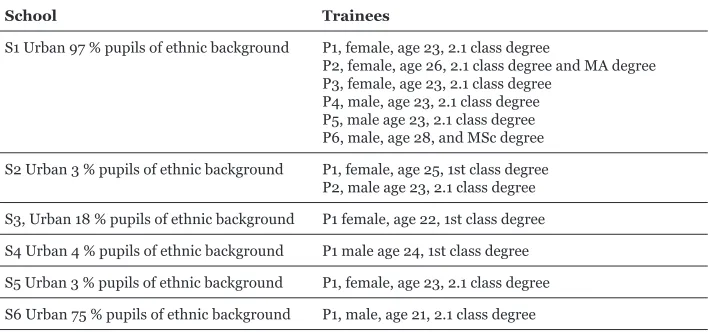
Physics. All were graduates to fi rst level with an age range of 21–28, there were six male and six female teachers, all graduating with at least an upper second class de-gree (two also had masters dede-grees, Level 2) from university (all but one from lead-ing universities). Details of the trainees and their schools are given in Table 1 be-low:
Table 1: Summary of trainees and schools in the study
School Trainees
S1 Urban 97 % pupils of ethnic background P1, female, age 23, 2.1 class degree
P2, female, age 26, 2.1 class degree and MA degree P3, female, age 23, 2.1 class degree
P4, male, age 23, 2.1 class degree P5, male age 23, 2.1 class degree P6, male, age 28, and MSc degree
S2 Urban 3 % pupils of ethnic background P1, female, age 25, 1st class degree P2, male age 23, 2.1 class degree
S3, Urban 18 % pupils of ethnic background P1 female, age 22, 1st class degree
S4 Urban 4 % pupils of ethnic background P1 male age 24, 1st class degree
S5 Urban 3 % pupils of ethnic background P1, female, age 23, 2.1 class degree
S6 Urban 75 % pupils of ethnic background P1, male, age 21, 2.1 class degree
The author was responsible for the trainees in the role of academic tutor. The rel-atively small sample size meant that in-depth context rich data could be obtained throughout the year. At the start of the academic year, all trainees were informed about the nature of the research and invited to participate. All gave informed con-sent for, and participated in the research. Participant names have been changed to protect their identity, as have the names of the schools and any teachers associat-ed with them.
With respect to my own positionality, as their university tutor I was their link between the university, and the school, and my role focussed on supporting their professional learning through their fi rst year in the school, through a series of reg-ular visits to the school. Each participant completed three surveys, and participat-ed in a focus group for the research. I was mindful of possible ethical issues arising from my dual role throughout the research, and for the potential for some blur-ring of boundaries between that of research and tutor as moderator/researcher. As such, I took great care to maintain a professional distance during the research to avoid bias or over familiarisation with participants.
[image:10.482.69.424.153.319.2]sup-ported they felt and what they hoped to achieve. Questions in subsequent surveys focussed more directly on impact aspects as perceived by the participants on their pupils and in their school.
In the second survey, which was distributed and collected during December, 2013, greater emphasis was put on investigating impact, with a series of open and closed questions that explored these issues in terms of the impact they were having on pupils and on the school. The fi nal survey was distributed and collected in June, 2014, near the end of the academic year, with a series of open and closed questions that allowed the trainees to refl ect on and to describe how they felt their teaching had impacted on the pupils in school.
At the end of the academic year, focus groups were conducted with all train-ees in their school or in the university in an informal, private setting to investigate some of the issues brought to light in the surveys conducted throughout the year. This allowed for an in-depth gathering of data – focussing on the impact trainees felt they had throughout their fi rst year of teaching. Focus groups permitted the trainees to share and refl ect on diff erent viewpoints, developing their responses to issues they had previously only refl ected on in private (Elton-Chalcraft, Hansen, & Twiselton, 2008). They allowed participants to explore as a group how practice had changed over time through this fourth point of data collection in the year. Three focus groups were held, each with at least two trainees, but with no more than six as a maximum. Where trainees were unable to attend a focus group (two in to-tal), they were interviewed on a one-to-one basis using the focus group questions. Discussions were recorded by audio device and transcribed by a professional tran-scriber.
most e cient, and therefore arguably the most impactful, type of teacher, by the end of the academic year. Thus analysis was conducted by comparing participant responses against the teacher type characteristics and is described in detail in the following section.
6. Findings and discussion: Applying the teacher type
characteristics as a tool for analysis
6.1 Characterising early type teachers at the start of the academic year
The responses from the fi rst survey indicated that many of the participants had en-tered the teaching profession to have impact on pupils in terms of passing on their subject knowledge to give pupils a good education (Harding-DeKam, 2014). They believed that all children, particularly those in challenging and less a uent schools as served by TF, deserved a good education, and so had gone into teaching through this route in order to infl uence this. They wanted to be that person who provides a good education, in profession where they could make a diff erence, teaching pupils to the best of their abilities, and helping pupils to improve.
They were, however, also mindful of their inability to deliver this right from the start and expressed a desire that their pupils should not be disadvantaged by their own lack of experience and skill in teaching. They were very honest about their lack of teaching skills at this point, and over a third commented on diff erentia-tion in a way that would put them as a Type 1 teacher at this point in the year, cit-ing this as their biggest challenge, and worrycit-ing if they were actually diff erentiating enough for their pupils.
This resonates with the Type 1 teacher characteristic of having got the basics right, and of eff ectively using daily routines in teaching, such as keeping pupils on task, structuring the lesson content, asking questions and giving pupils tasks to do, including assessments. They are not however, able to diff erentiate in class, as char-acterised in Type 4 teachers, and in this case are very aware of this lack of skill on their part. This resonates with the fi ndings of an earlier Australian study which in-dicated that the ability of teachers to meet the needs of all pupils was pivotal to a learning environment (Skourdoumbis & Gale, 2013).
progress in class, and not having enough of a presence around school to manage behaviour eff ectively.
Without establishing control in class, it is di cult for teachers to progress from the early types to the higher ones of Type 4 and 5. One can see how a teacher must fi rst get control of the class routinely and eff ectively, before they feel confi -dent enough to develop their teaching and begin to exhibit the characteristics of higher types, as has been indicated in the work done by Kyriakides et al. (2009).
6.2 Starting to have an impact by the end of the fi rst term in school
The data from the second survey indicated that most participants felt that they had had an impact on the pupils they were teaching. They cited various reasons for this, some of which centred on the progress their pupils had made. Comments also centred on how pupils were talking to them outside normal class times – en abling them to feel more like a member of staff in school: “Yes, because I developed a good relationship with the vast majority of pupils I feel they increasing come to talk to me about their concerns and problems and to ask for advice and share their worries” (P1, S1).
This resonates with the research in Australia which found that teach-er care and pupil trust form highly signifi cant components of pupil performance (Skourdoumbis & Gale, 2013). It was also borne out in the focus group data in which participants commented:
I feel like I have built good relationships with a lot of pupils and you know there are a lot of pupils who always seem to want to come and talk or tell you what their issues are, their problems, and things that they’re proud of. … there are some very loyal kids who are very happy just come and talk to you which is nice. (P1, S2)
A number of participants mentioned that the stability they had brought to the pu-pils by being there – rather than a succession of supply (temporary) teachers – had also had a positive impact on the pupils, and had in some cases positively aff ected their attendance at lessons. As one participant commented:
With my year 10 class I feel they have benefi tted from stability in having me as their teacher, they have mentioned they used to have substitute teachers a lot and they constantly had new teachers. The work tracker also shows that since I have been there the work has much fewer gaps in it. (P1, S6)
improvements had been made in their classes by virtue of the fact that they were there “every day, day-in, day-out.”
A number also commented that while they might have had an impact academ-ically, in terms of results (see example comments above), they did not feel they were having an impact on the attitude and motivation of pupils overall, for exam-ple, commenting that “in terms of motivation and aspirations, I feel I have not made any impact whatsoever. … most pupils have quite negative attitudes which I am struggling to turn around” (P1, S3).
This from the same participant, who at the start of the academic year was wor-ried about behaviour management, and who, from the comments above, was still struggling with the pupils in terms of negativity. It is interesting that, even though they felt that they were positively aff ecting the progress and outcomes of pupils in class, as indicated above, participants were also acutely aware that this did not mean that they had somehow miraculously converted their pupils to being posi-tive about education overall, and that aff ecting attitude and motivation were much longer, harder goals, as one participant said:
… I think the reality that not all children can be saved is slowly taking an understanding in cases where students don’t attend, have no clear aspiration to learn and are consistently in behaviour units. Although with every child I will try to bring them to the right path it is not always possible … (P1, S4)
This level of refl ective realisation in the participants is arguably indicative of their development into a higher type of teacher (Kyriakides et al., 2009) using construc-tivist techniques (Type 3) to encourage pupils to participate in lessons (Type 2). This better understanding of disadvantage was also borne out in other studies on TF participants (Hutchings, Maylor, Mendick, Menter, & Smart, 2006).
In terms of their impact on the school, they are teaching in, fewer participants felt that they were having an impact on the school than they were on the pupils at this point, however, the majority returned positive replies to this question in terms of their own positive attitudes being refl ected in school, and its impact therein. Various reasons were cited, though as with the response to their impact on pupils, pupils seeking them outside lessons for advice, and so on, was felt to be an indi-cator of impact. When pupils seek teachers outside lessons, the teachers feel more like members of staff and less like trainees:“… numerous pupils do come to see me with queries and concerns and so I am beginning to feel like a respected and trust-ed member of staff ”(P1, S2). And:“… I try to have positive conversations with pu-pils outside of lessons whenever I see them and show that I care about their educa-tion which I think has resulted in some positive results in the classroom” (P5, S1).
pu-pils (S1), arguably developing towards the higher level teacher type. Data from the second survey indicated that some participants also thought they had an impact on their school through their extra-curricular, non-teaching roles in school, examples of this ranged from helping at school discos and other after school events (P1, S6), to setting up an achievement leader board for their form group (P5, S1).
6.3 Continuing to have an impact: Achieving teacher Type 4 and 5 as the academic year progresses
Participants responded positively when asked what had the biggest impact on pu-pils they taught in terms of their practice. Responses were varied with some par-ticipants commenting on how they had changed from subject based to skills based lessons, and several thought that their improvements in terms of assessment and feedback of their pupils had made the biggest impact. As one participant said:“My marking is very interactive, requiring pupils to respond to my comments and to re-spond to each other’s work. I want to improve this further to have a bigger impact next year” (P1, S3). This same participant (P1, S3) can be shown to have developed their confi dence tremendously as the year progressed, moving from worries about behaviour management and negative pupil attitudes, to a place where they were much more positive about their impact on pupils.
Another commented similarly:
The classes which I have taught which have made the most progress have been the classes which have had the most quality feedback on their work and were most aware of what they needed to do to improve – this is some-thing that I will seek to improve and develop with next year’s classes. (P5, S1)
And:
Purely in terms of my practice, the way in which I assess my pupils has had a great impact on them … I think I have found a way that particularly caters to their needs … the diff erence in how it asks students to demonstrate this knowledge has greatly improved their performance … (P4, S1)
A number of participants said their eff orts with literacy had had the biggest impact on their pupils by promoting literacy in class outside English lessons, and intro-ducing text books to encourage pupils to write more.
At this point, over a third of the participants had moved from worries about dif-ferentiation in the fi rst part of the year to much more positive comments concern-ing impact through literacy as the year progressed.
were able to improve the self-esteem and self-confi dence of their pupils, which they felt had had the biggest impact:
I have spent a lot of time focussing on building pupils’ confi dence in them-selves … I do believe this has had a positive impact on my pupils as we have had a big increase in the number applying to do GCSE [subject] this year. (P1, S2)
The data supports the notion that the teachers were developing and exhibiting the characteristics of Type 5 teachers, using a variety of teaching approaches, and in-corporating the qualitative characteristics of these approaches into their teaching practice (Kyriakides et al., 2009), whether this be in the form of improvements in assessment, in literacy or through increasing pupil confi dence. This is indeed the model of teaching aspired to in other research where teachers would have a thor-ough subject knowledge, address misconceptions, help pupils relate to each other and participate actively in school life (Hinds & Berger, 2010).
The impact of non-teaching roles in school was explored more formally in the third survey. Despite the pressure the trainee teachers all felt, combined with busy workloads, all except one had other roles in school, and many of these were volun-tary. Some of the participants had several extra roles and were doing a great deal beyond their teaching timetable to integrate successfully into their wider role in school. Research by Muijs et al also supports this notion of participants making a real diff erence to pupils in school (Muijs et al., 2010).
One participant cited their work as literacy co-ordinator as having a more pro-found impact across the whole department rather than just with their classes: “… I am having a positive impact because of the way I contribute to wider school train-ing … and through promottrain-ing good practice with my Literacy Coordinator role” (P1, S1).
The data evidenced that all participants had contributed to the school beyond their classroom. Those that had led clubs of various kinds felt that this had had a very positive infl uence on their relationship with pupils and on the self-confi dence of the pupils who went to these clubs:“I run an extra [subject] class and a [sub-ject] club and this has enabled me to build a positive relationship with certain pu-pils … I have noticed an increase in confi dence in those who attend this extra class and club” (P1, S2). And:“[subject] club and [subject] club have been fantastic for building relations with pupils and infusing students with self-confi dence” (P3, S1).
This, from the same participant, who in the fi rst term, had expressed clear con-cerns about their ability to manage classes. Thus demonstrating how well they had progressed in terms of their abilities with pupils and with their self-confi dence as teachers within and beyond the classroom.
Being a form tutor has been hugely important to me – I feel like I am im-portant part of keeping the school ticking over and that I have had a positive impact on most of my pupils. I look forward to getting another group of year 7’s next year and bedding in routines from day 1. (P5, S1)
And: “My role as form tutor has really allowed me to get to know pupils in my form better … I have been able to show how much I genuinely care about their ex-perience in this school” (P4, S1).
Interview data also indicates that participants had signifi cance impact in school, bringing new experiences to people, as one school mentor said:“… [participant] is very enthusiastic about her subject every single day – this way [participant] can af-fect 200 kids every week” (S2).
Mentors also identifi ed that participants tried to make subjects more practical for pupils, which was not often seen in school, by being “willing to take risks with pupils and the activities they do” (S3). This ties in with similar research with TF trainees, which demonstrated that school managers were very positive about the contributions made by beginning teachers (Muijs, Chapman, & Armstrong, 2013; Muijs et al., 2010). This model of teaching, described as being aspirational in other research, of one where teachers would have a thorough subject knowledge, address misconceptions, help pupils relate to each other and participate actively in school life (Hinds & Berger, 2010) can arguably be likened to the Type 5 teacher charac-teristics identifi ed in this study. Other research has also indicated that TF teachers had a positive impact in schools delivering high quality lessons, and undertaking extra-curricular activities (Hutchings et al., 2006; Muijs et al., 2010).
In several cases, participants believed that taking part in school trips had pos-itively helped their relationship with pupils, whether it was to the theatre to in-spire them (P1, S3); to a robotics competition and winning a trophy (P2, S2); or on a fi eld trip to the sea with pupils dipping their hands in the water for the fi rst time, as this participant said: “… these are the times when you have the biggest impact” (P2, S1).
also underpinned by the comments from their mentors in school who were so very positive about the impact these TF beginning teachers had made.
7. Conclusions
Comparing the characteristics exhibited by the participants in this study with the fi ve stages of teacher development purported by Kyriakides et al. (2009) in their study I would argue that to have maximum impact a teacher would have reached Type 5, “achieving quality and diff erentiation in teaching using diff erent approach-es” (p. 20). This demonstrates that teachers moved towards engaging in the schol-arship of teaching. It should be acknowledged, however, as other research has done (Kyriakides et al., 2009), that these teacher level factors are interrelated and not isolated characteristics. Participants move between these levels as the year pro-gresses, and may do so in a non-linear, and non-sequential way.
Change, however, is contextual and infl uenced by a myriad of factors, and so the changes themselves may impact in diff erent ways, taking into account individ-ual identities, dispositions and roles as well as the settings in which teachers work, as King demonstrated in her study of fi ve urban primary schools (King, 2014). Such diff erences in impact were demonstrated here, with participants reaching the diff erent levels at diff erent times and in diff erent ways.
This study has added to an existing body of knowledge, and has further tested the model developed by Kyriakides et al, as other studies have done (Kyriakides et al., 2013). The study indicates that further exploration of teacher impact is neces-sary, especially in terms of enabling teachers to assess their own impact on pupils, and to understand what it is they are doing that is making a diff erence. I have ar-guably tried to focus on the way in which beginning teachers make sense of their practices to positively impact their pupils, and on the way they try to balance their assessment of negative and positive experiences, as was indicated as a requirement for further research by Kyriacou and Kunc in their study of beginning secondary teachers (Kyriakou & Kunc, 2007). In doing so, I have answered the initial research question and determined the development of e cacy by these teachers using the Kyriakides model.
participants would be useful in order to allow generalisability from the fi ndings, and to further verify this model. This would thus build further on previous work done in this fi eld to to examine the impact of the dynamic approach and the sus-tainability of its eff ects on teacher behaviour and student outcomes.
While it has been demonstrated through this research that these participants can and do have an impact on their pupils, and the schools in which they teach, as reported in other similar research (Muijs et al., 2010; Reynolds et al., 2001), it should be noted that this impact may in fact be fl eeting. Nearly half the TF partic-ipants leave their initial school after the two-year period of their training (Muijs et al., 2010). Such transience must surely aff ect their ability to sustainable build re-lationships (Gray & Whitty, 2010), and thus aff ect their impact overall in school. Research by Sachs (2004) also indicated that teacher education which developed positive attributes for teaching in an urban environment (as the schools used here) may lead to an increased retention of eff ective teachers in these schools. Perhaps then, what should be addressed, having established impact, as described in this study, is further research leading to policy change that will ensure these teachers stay in school and continue to positively aff ect their pupils and colleagues. In ad-dition to this, it is vital that teacher education and subsequent employers of these teachers, take into account the diff erent types of beginning teachers and their dif-ferent aspirations and characteristics when planning a model of teacher education (Watt & Richardson, 2008).
Acknowledgements
I would like to thank Dr. Colin McCaig for his help with this article.
References
Bandura, A. (1997). Self-effi cacy: The exercise of control. New York, NY: W H Freeman. Bassey, M. (1999). Case study research in educational settings. Buckingham, England:
Open University Press.
Blandford, S. (2008). Teach fi rst: From McKinsey to the classroom. Perpspectives in Education, 26(2), 95–104.
Campbell, R. J., Kyriakides, L., Muijs, R. D., & Robinson, W. (2003). Diff erential teacher eff ectiveness: Towards a model for research and teacher appraisal. Oxford Review of Education, 29(3), 347–362.
Coldwell, M., & Simpkins, T. (2011). Level models of continuing professional develop-ment evaluation: A grounded review and critique. Professional Development in education, 37(1), 143–157.
Cox, W. F. (2014). Inconclusive teacher impact research: A biblical interpretation.
Christian Scholar’s Review, 43(3), 213–231.
Darling-Hammond, L. (2006). Powerful teacher education: Lessons from exemplary programs. San Francisco, CA: Jossey-Bass.
America, and teacher eff ectiveness. Education Policy Analysis Archives, 13(42), 1–51.
Elton-Chalcraft, S., Hansen, A., & Twiselton, S. (Eds.). (2008). Doing Classroom Research a step by step guide for student teachers. Maidenhead, England: Open University Press.
Entwistle, N. (2009). Teaching for understanding at university: Deep approaches and disctinctive ways of thinking. New York, NY: Palgrave Macmillan.
Gorard, S., & Taylor, C. (2004). Combining methods in educational and social re-search. Maidenhead, England: Open University Press.
Gray, S. L., & Whitty, G. (2010). Social trajectories or disrupted identities? Changing and competing models of teacher professionalism under New Labour. Cambridge Journal of Education, 40(1), 5–23.
Gupta, A. (2013). Incorporating teacher candidates prior beliefs and funds of knowledge in theories of child development. In G. Wilgus, (Ed.), Knowledge pedagogy and postmulticulturalism shifting the locus of learning in urban teacher education
(pp. 107–128). New York, NY: Palgrave Macmillan.
Harding-DeKam, J. L. (2014). Defi ning culturally responsive teaching: The case of ma-thematics. Cogent Education, 1. Retrieved from http://cogentoa.tandfonline.com/ doi/full/10.1080/2331186X.2014.972676
Hinds, M., & Berger, M.-J. (2010). The impact of professional development on begin-ning teachers’ practices in one secondary school. Brock University, 19(2), 48–64. Hutchings, M., Maylor, U., Mendick, H., Menter, I., & Smart, S. (2006). An
evalua-tion of innovative approaches to teacher training on the Teach First program-me: Final report to the training and development agency for schools. London, England: Institute for Policy Studies in Education.
King, F. (2014). Evaluating the impact of teacher professional development: An evi-dence-based framework. Professional Development in Education, 40(1), 89–111. Kyriakides, L., Christoforou, C., & Charalambous, C. Y. (2013). What matters for
stu-dent learning outcomes: A meta-analysis of studies exploring factors of eff ective teaching. Teaching and Teacher Education, 36, 143–152.
Kyriakides, L., Creemers, B. P. M., & Antoniou, P. (2009). Teacher behaviour and stu-dent outcomes: Suggestions for research on teacher training and professional devel opment. Teaching and Teacher Education, 25(1), 12–23.
Kyriakou, C., & Kunc, R. (2007). Beginning teachers’ expectations of teaching. Teaching and teacher education, 23(8), 1246–1257.
McConney, A., Price, A., & Woods-McConney, A. (2012). Fast track teacher educa-tion a review of the research literature on teach for all schemes. Perth, Australia: Murdoch University, Centre for Learning, Change and Development.
Muijs, D., Chapman, C., & Armstrong, P. (2012). Teach First: Pedagogy and outcomes. The impact of an alternative certifi cation programme. Journal for Educational Research Online, 4(2), 29–64.
Muijs, D., Chapman, C., & Armstrong, P. (2013). Can early career teachers be teacher leaders? A study of second-year trainees in the Teach First alternative certifi cation programme. Educational Management Administration and Leadership, 41(6), 767–781.
Muijs, D., Chapman, C., Collins, A., & Armstrong, P. (2010). Maximum Impact Evaluation: The impact of Teach First teachers in schools. Final report. Manchester, England: University of Manchester.
Reynolds, D., Hopkins, D., Potter, D., & Chapman, C. (2001). School improvement for schools facing challenging circumstances: A review of research and practice. London, England: DfEE.
Robson, C. (1993). Real world research a resource for social scientists and practi-tioner-researchers. Oxford, England: Blackwell.
Sachs, S. K. (2004). Evaluation of teacher attributes as predictors of success in urban schools. Journal of Teacher Education, 55(2), 177–187.
Scherrer, J. (2014). The role of the intellectual in eliminating the eff ects of poverty. A response to Tierney. Educational Researcher, 43(4), 201–207. Retrieved from http://edr.sagepub.com/content/early/2014/03/20/0013189X14528242.full Skourdoumbis, A., & Gale, T. (2013). Classroom teacher eff ectiveness research: A
con-ceptual critique. British Educational Research Journal, 39(5), 892–906.
Sleeter, C. E. (2001). Preparing teachers for culturally diverse schools. Journal of Teacher Education, 52(2), 94–106.
Smithers, A., Robinson, P., & Coughlan, M.-D. (2012). The Good Teacher Training Guide 2012. Buckingham, England: University of Buckingham, Centre for Education and Employment Research.
TeachFirst. (2016). Teach First. What we’re doing. Retrieved from http://graduates. teachfi rst.org.uk/why-teach-fi rst/what-were-doing
Tschannen-Moran, M., Woolfolk Hoy, A., & Hoy, W. K. (1998). Teacher e cacy: Its meaning and measure. Review of Educational Research, 68(2), 202–248.
Watt, H. M. G., & Richardson, P. W. (2008). Motivations, perceptions, and aspirations concerning teaching as a career for diff erent types of beginning teachers. Learning and Instruction, 18(5), 408–428.