and PERRY, Emily <http://orcid.org/0000-0003-3413-1159>
Available from Sheffield Hallam University Research Archive (SHURA) at:
http://shura.shu.ac.uk/3967/
This document is the author deposited version. You are advised to consult the publisher's version if you wish to cite from it.
Published version
BEVINS, Stewart, JORDAN, Julie and PERRY, Emily (2011). Reflecting on professional development. Educational Action Research, 19 (3), 399-411.
Copyright and re-use policy
See http://shura.shu.ac.uk/information.html
Reflecting on professional development
Stuart Bevins, Julie Jordan and Emily Perry
Centre for Science Education, Sheffield Hallam University.
This paper describes how a cluster of ten secondary science teachers from six different schools and colleges in the UK designed and undertook small-scale action research projects as an approach to their own Continuing Professional Development (CPD). The
Introduction
In 2005 a network of Science Learning Centres (SLC) was established in England with a
mission to provide high quality Continuing Professional Development (CPD) that could lead
to sustainable changes in science teachers’ practice. The network and its associated partners
(charitable trusts, industry, universities, learned societies, and subject associations) integrated
to form a national network infrastructure of nine centres, one in each government region and
a national residential centre. In a previously highly fragmented CPD market, often focussed
on whole school issues at the expense of subject related professional development the
‘Believers and Sceptics Report (Wellcome Trust, 2005) stated that teachers had a strong
desire to engage in subject related CPD but the majority of time allocated is used to
implement government driven whole school initiatives rather than providing stimulating, high
quality opportunities for teachers to update their subject knowledge and try out new
pedagogies. The introduction of this initiative offered science teachers in secondary and
primary schools opportunities and funding to participate in subject related professional
development. The network offers one day courses, longer residential programmes, on-line
and school-based CPD delivered by perceived experts and teachers.
Some criticism has been aimed at this type of top-down model as there is an expectation that
teachers will engage in CPD that has been identified and centrally imposed (e.g. the network
offers a core programme of CPD which is based on a set of nationally identified science CPD
priorities) and is determined by political imperatives such as the future supply of scientists
and engineers.
This technical-outcome (Grundy, 1982) view of CPD tends to conform to political contexts
which attempt to increase pupils' attainment and raise standards within schools, rather than
being consistent with CPD as a teacher-led exercise in order to develop teachers'
self-evaluation capabilities and understanding of wider social contexts in teaching and learning.
With this in mind the SLC network could be at risk of losing the confidence of science
teachers by promoting a culture of CPD that is centrally-led and politically motivated. What
is required is an approach that encourages a teacher-led agenda for CPD which focuses on
processes that not only intend to develop solutions and seek change that specifically meet
teachers own needs and contexts but also seek to develop teachers' understanding of the
has reflection as a core element may offer an approach which acknowledges the need for
developing practice but not in isolation from social contexts or political.
Considering this, the SLC network funded a pilot for a teacher-led model of CPD which
emphasised reflection as a crucial agent for change through action research. The Teacher
Action Research Cluster (TARC) involved six secondary science teachers, one primary
teacher, and twoscience lecturers from a Further Education (FE) college who designed and
engaged in classroom-based research. The key aim of their action research was that
reflection would become a vehicle to enhance professional learning which would not only
bring about change in their classroom but also enable them to self-evaluate.
Teacher CPD, action research, and reflection
There has been a surge in classroom teachers researching their own practice, as a model for
their professional development, in England since 2000 when the publication of a consultation
document by the then Department for Education and Employment —Professional
development: support for teaching and learning (DfEE, 2000) stated that teachers should
take ownership of their own professional development and share responsibility and
commitment for development with their schools. A further document—Learning and
Teaching: a strategy for professional development (DfEE, 2001) was released and attempted
to set the agenda for teacher CPD in England into the new century. At the heart of the
Labour Governments strategy was the concept of teacher as reflective practitioner
(Hargreaves, 1996). And, while this concept is largely consistent with empowering and
motivating teachers the underpinning agenda was political and predominantly aimed at
raising standards and placing responsibility for CPD firmly on the shoulders of classroom
teachers. This endorsed a technical outcome view of teacher CPD whereby teachers would
undertake research in an attempt to increase efficiency rather than developing self-evaluation
processes (Leitch and Day, 2000).
However, whether aimed at raising standards or developing self-evaluation skills, by
encouraging the creation of an environment in which information, knowledge and resources
are shared, it should be possible for teachers to develop professionally in all areas. That said
it is often the case that schools do not provide the necessary conditions to encourage and
support regular investigation of, and reflection on practice. The challenge for schools is to
their practice. An environment needs to be created which supports innovative practice by
teachers and allows for risk taking in the classroom. Essential to this is the provision for
regular investigation, reflection, discussion and dissemination about teaching by
teachers─key ingredients of an action research approach to teacher CPD.
Even though action research has become much more widely accepted as an effective and
sustainable model of CPD by classroom teachers and CPD providers over the last decade or
so, it appears that research engaged schools and teachers are still quite rare (Handscomb and
MacBeath, 2009). That said, exponents of action research share similar views about its
potential for supporting classroom teachers’ professional development. Teacher
collaboration and engaging in ongoing dialogue are clearly identified within existing
literature as essential components. Handscomb (2002) suggested that action research has the
capacity for engaging with expertise from within the school rather than importing it, and for
developing communities of practice and enquiry within the school. Ponte, et al (2004) stated
that action research is carried out through constant dialogue with colleagues both within and
outside the school, while Meirink, et al, (2010) suggested that teacher collaboration is
generally viewed as a positive element of professional development and includes working
with other teachers as well as external experts.
Kirkwood (2001) reported findings from a study that explored how the external expert played
a lead role during the early stages of the project, with the participants progressively taking on
a more central role as the research progressed. Harwell et al. (2001) studied teachers'
integration of technology within the classroom and concluded that CPD for classroom
teachers must combine the expertise of researchers and the knowledge of teachers in a
collaborative effort to maximise the potential of the research and subsequent findings.
Cordingley et al (2003)reviewed fifteen studies reporting on collaborative CPD. They
suggested that peer support collaboration in the form of either coaching, joint preparation of
materials and reflective discussions were a feature of thirteen of the fifteen studies. In eleven
of the studies, workshops or seminars provided an opportunity for teachers to meet
collaboratively to explore new strategies and to discuss how best to adapt them to suit their
own contexts.
Action research develops through a self-reflective spiral of cycles which include planning,
is accepted by many as one of the most effective ways for teachers to develop greater insight
into their practice and career (Forde, et al, 2006). Reflection then can be seen as both
intellectual and affective interventions with which teachers are able to evaluate their
experiences in an attempt to develop new understandings. However, Admiraal and Wubbles
(2005) suggested that teachers, particularly beginning teachers, often find it difficult to
progress from simple descriptions of classroom practice to more analytical understandings.
Nevertheless, there seems little doubt that models of reflection which encourage teachers to
evaluate their teaching, and the assumptions and values that underpin their practice are seen
as the most effective (Leitch and Day, 2000). These models offer a wide range of tools and
techniques to support reflective practice and processes from reflective diaries to group
discussions (Forde, et al, 2006). That said, while having a wide range of tools may offer
teachers some flexibility in how they engage in reflection, in order to maximise their
reflective abilities and gain the most benefit teachers must examine the tools on offer and
choose the most appropriate for their purpose.
A Teacher Action Research Cluster (TARC)
Nine teachers participated in total, constituting six secondary teachers, one primary teacher
and two Further Education (FE) lecturers. Fou were invited to join the cluster as they had
previously expressed an interest in carrying out action research to SLC staff but felt they
needed support from university research staff to do so. The two FE lecturers were already
involved in action research and wished to continue investigating their classroom practice with
support from university staff. Three teachers signed up after seeing advertising for the
programme in SLC publicity material.
The Teacher Action Research Cluster was set up with the key aim ofs:
fostering reflective processes among the participants and encouraging a teacher-led
CPD approach through action research
developing knowledge (the project team) of Action Research as a model of CPD
Throughout the programme, reflection was emphasised as a primary driver for professional
development. Participating teachers were introduced to a range of tools designed to
encourage explicit reflection by the teachers in an attempt to support the development of their
different modes—individually, in pairs and through a small group of four. Table 1 identifies
the mode undertaken by the participants, subject specialisms and research topic.
Table 1: Participating Teachers
Mode Specialism Research topic
individual secondary physics teacher active learning in A Level physics
individual primary (KS2) teacher use of STEM activities to enhance boys'
engagement in literacy
individual secondary design and
technology teacher
video-recording STEM lessons to
enable the sharing of good practice
pair sixth form college
psychology teachers
raising student attainment through
enhanced practical skills in psychology
group of
four
secondary STEM teachers development and use of a pupil voice
tool to inform curriculum planning
Programme of support
A two-day professional development course framework over a set period of 12 months was
designed to support the participating teachers and delivered by the project team (university
researchers and SLC professional development leaders). The course framework provided the
teachers with structured support and guidance in carrying out action research through the use
of action planning and reporting templates, reference literature, expert inputs and a range of
tools designed to stimulate reflective processes. The programmes duration was twelve
months.
Prior to attending the initial face-to-face CPD day at the beginning of the support programme,
all participating teachers were asked to write a brief outline of their research project. This
provided a starting point for initial discussions on the day about developing and refining an
action plan for each research project. Discussion on the day also focussed on ensuring that
opportunities were provided to share their ideas with each other, while reflecting on and
developing action research plans for their specific research projects.
The second face-to-face CPD day, which took place 5 months later, enabled teachers to share
their actions and research findings to date. This led to an exploration of what their research
meant in terms of future practice and their own professional development. They also
reflected on their progress through a typical cycle of action research (McNiff and Whitehead,
2002) and discussed what interventions and/or activities took place at each stage. Through
reflecting on the action research cycle the teachers stated that even though they were
conducting different research projects they had progressed through an action research cycle
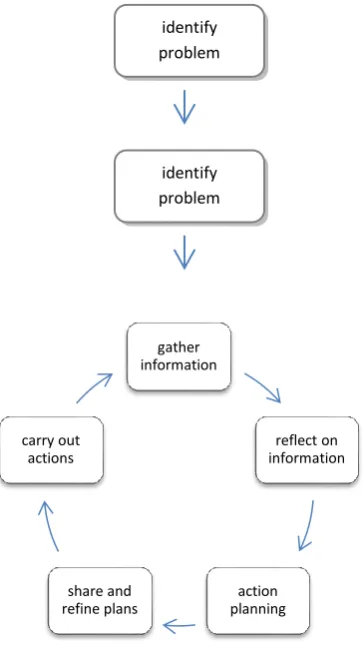
which was slightly different to the example they were given by the project team. The TARC
action research cycle (fig.1) shows the consistent interplay that existed through the ‘share and
refine plans’ step and ‘action planning’ step. The teachers stated that collaborative
discussions with teachers in the TARC cluster, during both CPD days, and with the project
team, during both CPD days and the school visits, had enabled them to reflect closely on
[image:8.595.208.390.446.772.2]these two steps which they viewed as key to the success of the other steps in the cycle.
Figure 1 TARC Action Research Cycle
gather information
reflect on information
action planning share and
refine plans carry out
actions
identify problem
Finally, in order to develop their research skills further they explored a range of data
collection methods and analysis techniques.
School visits were undertaken by members of the project team to supplement face-to-face
sessions. Participating teachers were visited twicewith meetings intended to stimulate
reflective discussions about their action research projects, reflective processes, the impact of
their research, and their own professional development.
Teachers from three of the action research projects presented their findings as part of a
seminar about the programme at the Association for Science Education annual conference.
This provided an opportunity for them to discuss their research with other interested teachers
and academics.
Reflective tools
Three reflective tools were made available to the participating teachers during the programme
with the specific aims of encouraging reflective practice that would provide opportunities for
the teachers to articulate and communicate professional knowledge and to foster
collaboration between teachers and the project team:
online – hub
audio reflections
learning and evaluation tool ‘nutshell’ - a reflective diary
These tools were embedded into the programme framework and were developed with specific
purposes in mind.
On-line hub
An online community area was created for the participants – this provided an electronic
storage space for course materials, a forum to communicate intersession tasks (aimed at
enhancing reflective activity) and a place for all members of the group to share action plans,
audio reflections, resources, and to seek advice and support as appropriate. The hub provided
the flexibility for the project team and, indeed, all participants to respond to each other either
Audio reflections
Each teacher was provided with a digital audio recorder to capture his or her spontaneous
reflections in an attempt to provide a stimulus for further reflection and discussion. All of the
teachers were encouraged to provide two minute audio reflections and to share these by
uploading to an on-line community area – the on-line hub.
Learning and evaluation tool ‘nutshell’ - a reflective diary
The nutshell is part of a three-part impact toolkit developed by the network of SLCs. It is a
paper-based activity used widely on professional development programmes courses to
encourage and enable participants to record key learning points and actions. Its use was
extended in this project as teachers completed nutshell forms both during and between the
two face-to-face CPD days. Participating teachers were asked to reflect not only on the
action research process and their chosen interventions, but also, importantly, on their learning.
In essence, the nutshell constituted a reflective diary and action planning tool that teachers
could use to record brief notes.
Methods
The project team gathered data in order to elicit participating teachers' views of the action
research process they engaged in and the reflective tools they utilised. Interviews and
reflective discussions were undertaken with all nine participating teachers. Systematic
coding (line by line and focused) enabled members of the project team to develop analytic
categories which illustrate the teachers' views. Researchers also recorded notes during both
of the face-to-face sessions. Researcher notes were analysed inductively based on open
coding (Cohen and Manion, 1994). Text units were arranged from the notes and emerging
codes were then organised into themes based on converging responses from teachers which
lead to the identification of common patterns. Other sources of data produced by the teachers
such as action plans, on-line hub messages and audio reflections were treated as secondary
data and were analysed through a coding process similar to above whereby emerging themes
were assigned to analytic categories.
Discussion
The three reflective tools were designed to help stimulate and structure the teachers’
reflections about the action research process, help them articulate and understand their
two of the tools achieved this to some degree the data suggest that the on-line hub was
relatively unsuccessful in achieving its aims. Just two of the teachers interacted with the hub
in a meaningful way. Both utilised the blog facility regularly to communicate with the
project team and to share reflections and ideas with the other teachers. However, as with the
teachers who did not interact at all with the online hub, these two teachers questioned the
effectiveness of what they viewed as a tool primarily for communication that is not really
suitable for enhancing reflection:
I think the hub is useful for communicating and leaving resources but I can’t see its value in supporting the reflective process. I’d rather use a diary or face-to-face interaction
(primary teacher).
This view was echoed by other participating teachers. They indicated that the hub may be
effective in sharing views and perhaps beginning discussions, but felt that meaningful
discussion that leads to greater reflection is largely dependent upon instant responses such as
during face-to-face discussions:
Its ok to upload your reflections after you’ve reflected…if you see what I mean. Then you can share views. But it’s difficult to look at a web site and reflect on your teaching that day or any other day and then type it in as a reflective piece (secondary teacher).
It seems clear that these teachers do not view online forums designed to encourage group
discussion as particularly effective in stimulating reflection, although they agree that sharing
resources and stimulating discussion can be facilitated through such a medium.
The audio reflections were greeted with scepticism by the participating teachers initially and
proved to be used infrequently throughout their action research projects. They appeared
apprehensive about the spontaneity of the reflections and many did not like the unstructured
nature of just speaking into a microphone about how a particular activity developed
(secondary teacher). However, all of the teachers, through their modes of operation
(individuals, pair or group), produced at least one audio reflection. Interestingly, the audio
reflections, which were uploaded to the online hub, were later acknowledged by the teachers
as being much more articulate than they had first thought:
The teachers operating as a group of four had provided an audio reflection that was part of a
reflective discussion the group had engaged in. The group stated that the outcome of the
reflective discussion had provided a way forward and felt that the audio reflection adequately
summarised their discussion and would be useful for other participants to learn from:
We cheated a little bit really because it wasn’t really spontaneous but it might be useful for the others to listen to. It might help focus their reflections and thoughts (secondary teacher)
A secondary teacher working as an individual also found that it was useful to record what the
other participants were saying:
I have found, the voice reflection good, partly because I have been recording what the other teachers have been talking about (secondary teacher).
What does emerge from the data quite clearly is that while the audio reflections were not used
enthusiastically, at least initially, the teachers did begin to recognise their worth in listening
to other teachers comments, bringing their tacit knowledge to the surface and helping them to
structure their reflections both on their action research projects and their own professional
development. However, perhaps this realisation came too late in the project to claim
significant success for the audio reflection tool.
The nutshell was used quite extensively, predominantly to record questions the teachers were
asking themselves as one teacher recorded:
Am I finished with the action stage? Is it time for reflection? (secondary teacher)
When asked, all of the teachers agreed that the tool enabled them to critically evaluate their
actions (within their projects) and to explore their assumptions. However, the tool was not
used by the teachers to reflect on their own professional development, although this was
clearly an omission by the teachers as opposed to a problem with the learning and evaluation
tool:
S came to visit and he got me back on track, reminding me that it isn’t justabout reflecting on the children’s learning (action research project) but alsomy own learning. It was very helpful to bring this to the forefront of mymind as I was focussing purely on the successes in terms of the children’s learning (primary teacher).
Most of the teachers suggested that they had been intensely focussed on their action research
projects and, while they had been engaging in reflective processes they had not reflected on
develop their professional practice as teachers. One of the teachers belonging to the group of
four pointed out that:
The project takes over your thinking, you’re that busy analysing the different stages and developing the next ones that you forget about your own learning and development. After you spoke to us we all said, ‘yes, we have learned personally’. We just missed it and didn’t articulate it to each other or ourselves. Once we realised, the evaluation tool and reflective discussions helped that process a lot (secondary teacher).
The nutshell was a success as it provided a means for reflecting more deeply on what they
were learning about the action research process and enabled them to ask relevant and
provoking questions. However it was less successful in promoting reflection on the teachers
own learning, although that appears to be more concerned with the teachers being immersed
in their action research projects rather than the tool being ineffective:
I am beginning to understand where on the action research cycle our research is and understand which steps to take next (secondary teacher).
The data shows that two of the three reflective tools were of limited use within the context of
their specific aims which were to encourage reflective practice that would provide
opportunities for teachers to articulate and communicate professional knowledge and to foster
collaboration between teachers and the project team. That said, the data does suggest that the
audio reflections tool does have potential if presented to teachers with a clear understanding
of its intended use and limitations. The nutshell was by far the most successful tool of the
three with all the teachers agreeing that they will probably utilise the tool on a frequent basis.
The exploratory nature of this pilot programme meant that the project team had not developed
comprehensive descriptions of the scope and structure of each tool. The online hub was
clearly viewed by teachers as a communication media and not a tool to encourage reflection.
This is interesting as prior to beginning the programme the project team perceived the hub as
having significant potential for stimulating reflective discussions between the TARC cluster
and the project team. However, while the teachers recognised the hub as an effective
repository for storing resources, communicating with the project team and sharing ideas they
did not accept the hub as a stimulus for reflection.
All nine teachers in the TARC cluster clearly indicated that the most effective approach to
stimulating reflection used within the programme was face-to-face discussions conducted
throughout the two CPD days and the school visits. The teachers stated that they were able to
teachers describe their initial plans and views of action research, discussing ideas as a whole
group, asking spontaneous questions of the project team, and listening to action research
descriptions from the project team. They believed that these particular elements of the
face-to-face sessions developed their confidence to undertake their action research projects
successfully:
Seeing examples of other action research projects from teachers of different age groups encouraged me (FE lecturer).
The teachers also valued the face-to-face interaction offered through the school visits made
by the project team. The teachers agreed that consistent contact with the project team
allowed them to tap in to the team’s expertise to inform their own thinking and decision
making which in turn enhanced their confidence to develop new stages and stimulated them
to ask more questions:
I think we all found it useful to be able to talk to you and the others (project team) during the CPD days and when you visited. Being able to get answers to questions and being told that we’re on the right track motivates you to keep going (secondary teacher).
The evidence shows that the impact on the teachers’ professional development is stark. Their
understanding and application of action research, associated methods and reflective processes
has developed significantly. But of more importance is the development of their
self-confidence to engage in such activity. Prior to enrolling on the programme each teacher had
little more than an interest in or basic knowledge of action research and none of them were
engaging explicitly in reflective processes. All of the participating teachers have agreed that
they are now aware of when they are engaging in reflection and feel that they have developed
their skills enough to learn from their reflections and improve their overall practice and
knowledge:
I know I must have done it (reflect) all the time after school or lessons, but I can’t honestly say I was aware of doing it and that I learnt from it. I now consciously reflect and feel that I can learn by reflecting (primary teacher).
The data also indicate that the teachers’ ability to articulate their knowledge and
understanding of pedagogy has been enhanced. Their ability to make explicit their
understanding of not only their practice but also of how to develop their knowledge further is
appropriately demonstrated by one of the secondary teachers:
Responses from the teachers also show that the dissemination of their work through
presentation at the ASE conference was highly valued. The collating and summarising of
their work represented an important reflective step in their action research cycles. They also
viewed presenting their work to peers and others an important element of their professional
development:
Presenting at the ASE in front of academics was a real challenge (secondary teacher).
The importance of working with external experts was also seen by the teachers as an
important element of the programme. The teachers did not view the input of the project team
as top-down, rather as a collaborative effort which allowed them to tap in to external
expertise:
I think it has been collaborative, especially the CPD days. You have different knowledge to us and being able to learn from that has been very useful (primary teacher)
Conclusions
The TARC pilot programme aimed to foster reflective processes among the participants and
encourage a teacher-led approach to CPD through action research that would develop
effective collaboration between participants and the project team. To a large extent the
programme can claim to be a success in that it did foster reflective processes, particularly
through the provision of opportunities to conduct reflective discussions and through the use
of a learning and evaluation tool (nutshell), and to a lesser extent, through the use of audio
reflections. Also, effective collaboration between the TARC and project team was developed
through consistent methods such as the school visits and face-to-face CPD days. These
findings support existing literature which describes these particular elements of action
research as crucial to successfully supporting teacher development (Handscomb, 2002; Ponte,
et al, 2004; Meirink, et al, 2010). Also, Kirkwood (2001), described how external experts
play a lead role early in programmes similar to the current TARC model but then gradually
move in to a more supporting role as the teachers gain independence within the programme.
This can also be claimed of the TARC programme. The programme also encouraged
teachers to engage in reflective processes which would enable them to understand and
articulate their knowledge of pedagogy more efficiently. There is also evidence to show that
the teachers gained some understanding of the wider implications and contexts of teaching
teachers and the project team and through elements of their research such as literature
reviews. It may be premature to claim that a community of practice, where teachers share
common experiences and work towards solutions that specifically meet their own needs and
contexts, has been fully established. However, there is evidence to suggest that this pilot
programme has provided an appropriate framework that, with some development, can foster a
teacher-led CPD programme that has action research and reflective processes as central
features.
References
Admiraal, W., and Wubbles, T. (2005) Multiple voices, multiple realities, what truth? Student teachers’ learning to reflect in different paradigms. Teachers and Teaching: theory and practice. 11 (3), pp. 315–329
Crowther, F. Hann, L. McMaster, J. & Ferguson, M. (2000) Leadership for successful school revitalisation: lessons from recent Australian research. Paper presented at CCEAM Symposium, American Educational Research Association. Annual Meeting, New Orleans. 24-28 April.
Cordingley, P., Bell, M., Rundell, B. & Evans, D. (2003) The impact of collaborative CPD on classroom teaching and learning. In: Research Evidence in Education Library. London: EPPICentre, Social Science Research Unit, Institute of Education.
Department for Education and Employment (2000) Professional development: support for teaching and learning. February.
Department for Education and Employment (2001) Learning and teaching: a strategy for professional development. March.
Forde, C., McMahon, M., McPhee, A. D., and Patrick, F. (2006) Professional Development, Reflection and Enquiry. Paul Chapman, London
Grundy, S. (1982) Three modes of action research. Curriculum Perspectives. 2 (3), pp. 23 – 34.
Handscomb, G., and MacBeath, J. (2009) Professional development through teacher inquiry. In: Lawson, A (Ed.) Action Research: Making a Difference in Education. NFER. Slough.
Handscomb, G. (2002) The rise of collaboration. Professional Development Today. 5 (2), pp. 3 – 6.
Hargreaves, D. (1996) Teaching as a research-based profession: possibilities and prospects. Teacher Training Agency annual lecture. London.
Kemmis, S. (2007) Action Research. In M. Hammersley (Ed). Educational Research and Evidence Based Practice. Sage Publications Ltd. London.
Kirkwood, M. (2001) The contribution of curriculum development to teachers’ professional development: a Scottish case study. Journal of Curriculum and Supervision 17, pp. 5-28. Saxe, G.B., Gearhart, M. & Nasir, N.S. (2001) Enhancing students’ understanding of mathematics.
Leitch, R., and Day, C. (2000) Action research and reflective practice: towards a holistic view. Educational Action Research. 8 (1), pp. 179 - 193
McNiff, J., and Whitehead, J. (2002) Action Research: Principles and Practice. London. RoutledgeFalmer.
McTaggert, R. (1991) Principles for participatory action research. Adult Education Quarterly. 41, pp. 168-187.
Meirink, J.A., Imants, J., Meijer, P.C., and Verloop, N. (2010) Teacher learning and collaboration in innovative teams. Cambridge Journal of Education. 40 (2), pp. 161 – 181