A fuzzy neural network based dynamic data allocation
model on heterogeneous multi-GPUs for large-scale
computations
ZHANG, Chaolong, XU, Yuanping, XU, Zhijie, HE, Jia, WANG, Jing
<http://orcid.org/0000-0002-5418-0217> and ADU, Jianhua
Available from Sheffield Hallam University Research Archive (SHURA) at:
http://shura.shu.ac.uk/18882/
This document is the author deposited version. You are advised to consult the
publisher's version if you wish to cite from it.
Published version
ZHANG, Chaolong, XU, Yuanping, XU, Zhijie, HE, Jia, WANG, Jing and ADU,
Jianhua (2018). A fuzzy neural network based dynamic data allocation model on
heterogeneous multi-GPUs for large-scale computations. International Journal of
Automation and Computing, 1-13.
Copyright and re-use policy
See
http://shura.shu.ac.uk/information.html
DOI: XXX
A Fuzzy Neural Network based Dynamic Data Allocation
Model on Heterogeneous Multi-GPUs for Large-Scale
Computations
Chaolong Zhang
1,3Yuanping Xu
1Zhijie Xu
2,3Jia He
2Jing Wang
4Jianhua Adu
11School ofSoftware Engineering, Chengdu University of Information Technology, Chengdu 610225, PRC 2School ofComputer Science, Chengdu University of Information Technology, Chengdu 610225, PRC 3School ofComputing & Engineering, University of Huddersfield, Queensgate, HD1 3DH, Huddersfield, UK
4Department ofComputing, Sheffield Hallam University, S1 2NT, Sheffield, UK
Abstract: The parallel computation capabilities of modern GPU (Graphics Processing Unit) processors have attracted increasing attention from researchers and engineers who have been conducting high computational throughput studies. However, current single GPU based engineering solutions are often struggle to fulfill their real-time requirements. Thus, the multi-GPU-based approach has become a popular and cost-effective choice for tackling the demands. In those cases, the computational load balancing over multiple GPU “nodes” is often the key and bottleneck that affect the quality and performance of the runtime system. The existing load balancing approaches are mainly based on the assumption that all GPU nodes in the same computer framework are of equal computational performance, which are often not the case due to cluster design and other legacy issues. This paper presents a novel dynamic load balancing (DLB) model for rapid data division and allocation on heterogeneous GPU nodes based on an innovative fuzzy neural network (FNN). In this research, a 5-state parameter feedback mechanism defining the overall cluster and node performances is proposed. The corresponding FNN-based DLB model will be capable of monitoring and predicting individual node performance under different workload scenarios. A real-time adaptive scheduler has been devised to reorganize the data inputs to each node when necessary to maintain their runtime computational performances. The devised model has been implemented on two dimensional (2D) discrete wavelet transform (DWT) tasks for evaluation. Experiment results show that this DLB model has enabled a high computational throughput while ensuring real-time and precision requirements from complex computational tasks.
Keywords: Heterogeneous GPU Cluster, Dynamic Load Balancing, Fuzzy Neural Network, Adaptive Scheduler, Discrete Wavelet Transform.
1
Introduction
In the last decade, the powerful parallel computing ca-pabilities of graphics cards and GPUs, originally driven by the market demands for real-time and high-definition game displays, have been widely accepted by the research com-munities. Large scale and data intensive computational ap-plications such as areal surface characterization filtration, visual recognition, and natural language processing (NLP), have been benefitted by this new-found and cost-effective computational powerhouse. It has also attracted increas-ing attentions from researchers across the globe in devisincreas-ing general hardware-based acceleration models for real world engineering challenges [1–3]. Leading the trend, in 2007, N-VIDIA released the Compute Unified Device Architecture (CUDA) - a software framework that aimed at unifying the efforts in harnessing the GPU powers for general-purpose usages and serious applications. It has greatly simplified the GPU programming practices as well as embracing the inher-ent data parallelism from GPU architectures. The toolkit has significantly enhanced the performances of some of the most common data and signal processing functions such as Fast Fourier Transform (FFT), Gaussian filtering, and discrete wavelet transform (DWT) that are widely used in applications such as face detection, DNA sequencing, and
Regular paper
Manuscript received date; revised date
This work is supported by the National Natural Science Founda-tion of China (No.61203172), the STD of Sichuan (2017JY0011 and 2014GZ0007), and Shenzhen STPP (GJHZ20160301164521358).
more recently, machine learning systems such as convolu-tional neural networks [4–6].
CUDA provides a scalable and integrated programming model for allocating and organizing processing threads and mapping them onto the computer hardware infrastructure equipped with dynamical adaptation ability for all main-stream GPU architectures [7]. In addition CUDA has linked and embedded a series of interfaces and APIs to assist direct programming on GPUs instead of relying on various graph-ics APIs (e.g. OpenGL) like in the so-called “GPGPU” era. CUDA treats GPU as a standalone parallel computational device that can realize data processing algorithms by using C/C++-like programming routines and functions that are familiar to mainstream programmers and researchers.
set with multi-level DWT) [11, 12]. Thus, in comparison, Multi-GPUs based acceleration solutions can be flexible and to achieve higher performance with relatively low hardware costs. Numerous computational-intensive issues that can-not be resolved by using the single GPU model have been making steady progress in the context of multi-GPUs, e.g., multi-GPUs based FFT (Fast Fourier Transform) [13] and Gaussian Filtering [14]. In the meantime, several multi-GPUs based programming libraries (e.g. MGPU) [15] and MapReduce libraries (e.g. GPMR and HadoopCL) [16, 17] have been developed by researchers in the field.
It is a challenging task to fully utilize the parallel compu-tational power of multiple and interconnected GPU nodes [18], which is especially true for the heterogeneous multi-GPU systems. Unbalancing load problem may cause low computational performance. To solve this problem, the load balancing models that can intelligently allocate tasks to individual GPU node becoming the key issue. Chen et al. [19] proposed a task-based DLB solution for multi-GPU systems that can achieve a near-linear speedup with the increasing number of GPU nodes. Acosta et al. [20] had developed a DLB functional library that aims to balancing the load on each node. However, these pilot studies are base according to the corresponding system runtime per-formance on the assumption that all GPU nodes equipped in a multi-GPU platform has equal computational capaci-ty. In addition, task-based load balancing schedulers that these approaches have relied upon often fall short to sup-port applications with huge data throughputs but limited processing function(s) - there are very few “task” to sched-ule, e.g. DWT. These applications need more attention in refining the task partition in each computational iteration taking into account of the data locality [18]. In terms of data parallelism based load balancing schedulers, Acosta et al. presented a DLB model that dynamically balances the workload using information established by the first itera-tion of the computaitera-tion [21], which failed to respond to the information changes during the later computational itera-tions. In contrast, the strategies developed by Boyer et al. and Kaleem et al. collect system information during the system runtime [18, 22, 23], so they can support the dy-namic load balancing scheduling demands according to the real-time feedbacks, which consolidates the foundation for this study.
To optimize the load balancing problem among multi-GPU nodes for large scale applications with highly repet-itive computational procedures or iterations, this paper presents a novel DLB model based on fuzzy neural network (FNN) and data set division techniques for heterogeneous multi-GPU systems, and this study is extended from our previous publication [24]. In this study, five real-time state feedback parameters closely relating to the computational performance of every GPU node are defined. They are ca-pable of predicting the relative computational performance of each GPU node during system runtime. Using the con-structed FNN and the devised advanced data distribution method, a large data set can be adaptively divided to en-hance the overall utilization of all hidden computing powers from a heterogeneous multi-GPU system.
The rest of this paper is organized as follows. Section 2 presents a brief review over the preliminaries and related
works in the field. Based on the literatures, the rationales of this research are justified; then, the proposed FNN DLB model for multi-GPUs is explored and its features discussed in Section 3. Section 4 constructs a case study that demon-strates how to improve the computational performance of the lifting scheme of DWT by using the devised model. Section 5 provides the test results of the design and evalu-ations. Finally, the Section 6 concludes the research with future works.
2
Related Studies
2.1
GPU architectures and process model
Modern GPUs are not only powerful graphics engines, but also highly parallel arithmetic and programmable pro-cessors. More significantly, in 2007, NVIDIA introduced the Tesla architecture, which was the first unified graphics and computing architecture. After that, NVIDIA released series of GPU architectures, i.e. Fermi, Kepler, Maxwell, Pascal, and most recently, the Volta architecture. All GPU cards produced by NVIDIA in the last decade are based on these architectures. In the point of view of the hard-ware architectures, all these models are similar but with incremental improvements on memory sizes and their ac-cessibility, number of data streams or CUDA cores, as well as the overall processing powers. For example, the num-ber of and the so-called special-function units (SFU), and streaming multiprocessors (SM) that each contains multiple stream processors (SP) - the CUDA cores. Modern GPU architectures are based on a scalable processor array formed by SPs that provides a high performance parallel computing platform.
Ex-press) architecture and network connections. Thus, the s-tandalone computers have been chosen for the study in this research.
2.2
Fuzzy neural network
Artificial neural network (ANN) is a branch of artificial intelligence (AI) that was first inspired by the “understand-ing” of how human brain works to process data and summa-rizes patterns. Contrast with traditional methods that have to extract features from input data in a rigid and almost mechanical manner, ANN based models can automatically find features from training data, which are called “learning from data”. One of successful applications relating to ANN is Deep Learning (DL) based on a process model called Deep Neural Network, e.g., Krizhevsky presented the AlexNet to classify images in ILSVRC2012 (the ImageNet Large-scale Visual Recognition Challenge) and achieved a winning per-formance with the test error rate at 15.3% [8]. AlexNet is considered as the first successful DL model. Later, in 2015, He presented a new DL model, ResNet, that won the ILSVRC 2015 with an incredible error rate at 3.6% [25].
Generally speaking, traditional fuzzy systems are built on IF-THEN rules (i.e. fuzzy rules) which are acquired from experimental knowledge of domain experts. Fuzzy system-s can system-solve complex decisystem-sion-making isystem-ssystem-suesystem-s when equipped with abundant fuzzy rules [26]. Li et al. designed a fuzzy keyword search engine based on a fuzzy system for searching encrypted data over cloud sources, and it solved the draw-back of traditional techniques that struggled to match key-words on cloud [27]. Krinidis et al. had improved the fuzzy C-Means (FCM) algorithm and presented fuzzy local in-formation C-Means (FLICM) algorithm based on fuzzy set theory for image clustering. Compared with FCM, FLICM is more effective and efficient, which provides robustness to noisy images clustering [28].
Both fuzzy theory and ANN have been widely used in decision-making applications. However, the main problem of traditional fuzzy systems is that it is very difficult to find experts who can extract and summarize knowledge from their experiences, and extracted IF-THEN rules are usually not objective, which means that traditional fuzzy models are lacking of flexibility and robustness. Furthermore, the ANN models are still inadequate in representing the expert experiences. To solve these shortcomings, fuzzy neural net-work (FNN) was developed to combine the fuzzy rule based fuzzy systems and ANNs. Thus, ANN models have been merged into fuzzy systems to improve their efficiency and accuracy, such that FNN was envisaged to be a promis-ing model [29]. Kuo et al. proposed a FNN based deci-sion support system of intelligent suppliers which is able to consider both the quantitative and qualitative factors [30]. Chen et al. used FNN to approximate unknown function-s in function-stochafunction-stic function-syfunction-stemfunction-s, which not only reduced the online computation load, but also achieved significant performance enhancement for fuzzy control algorithm [31].
Fuzzy theory and ANN based load balancing approaches have been widely used in traditional multi-CPU systems, i.e., distribution systems, data centers, and cloud comput-ing applications, etc. Saffar et al. presented a fuzzy opti-mal reconfiguration approach that combines fuzzy variables and ant colony search method to balance the workloads on
$ODUJHGDWDVHW GLYLGHWKLV ODUJHGDWDVHW LQWRIRXUVPDOO VXEVHWVIRUIRXU *38QRGHV UHVSHFWLYHO\
GDWDSURFHVVLQJ *38
*38n
*38
ILQDOUHVXOW UHFRQVWUXFWLRQ
PHUJH LQWHUPHGLDWH
[image:4.595.321.537.77.203.2]UHVXOWV
Fig. 1 A traditional load balancing model based on the pure data division method
distribution systems [32]. Susila et al. developed a fuzzy based firefly approach for dynamical load balancing pur-pose in cloud computing systems [33]. Toosi et al. pro-posed a fuzzy logic based DLB model for cost and energy efficient purpose [34]. These prior works have inspired the motivation of adopting FNN for multi-GPU load balancing applications investigated in this study.
In summary, based on the achievements of previous relat-ed works, it is anticipatrelat-ed a feasible way to solve the DLB issue by adopting the FNN model. This study explores and implements a novel data-oriented load balancing model by devising a FNN framework for large data sets with simple iterative tasks on heterogeneous multi-GPU systems.
2.3
Conventional Multi-GPU strategies
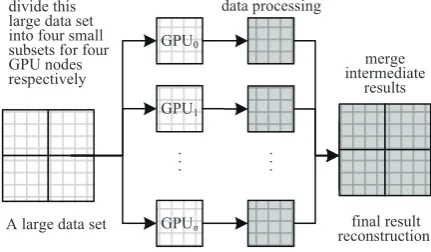
Fig.1 demonstrates a traditional load balancing model based on the pure data set division method [2], and it con-tains: 1) a large raw data set is divided intonsmall chunks (subsets) (n is equal to the number of GPU nodes in a targeted multi-GPU system), and each data chunk is dis-tributed to a GPU node respectively; 2) each GPU node processes the corresponding subset; 3) the final results can be generated after merging the outputs of each GPU n-ode. This approach is very simple and useful, however, it is likely to cause unbalancing load problem when the multi-GPU system contains different type of multi-GPU hardware with unequal computational performances, known as heteroge-neous multi-GPU platforms. As a result, the overall per-formance of a multi-GPU platform is restricted to the GPU node that has the lowest computational capability due to delayed merging process.
too “few task” problem for the scheduler. For example, in surface metrology, metrologists often apply DWT function-s to extract the function-surface texture characterifunction-sticfunction-s from large volume of measured data [35]. Thus, in these cases, a data-oriented load balancing model is more suitable than the task-focused ones.
Boyer et al. explored a data-oriented DLB approach that supports GPU programs having a few kernels to process large volume data set iteratively. The main idea of Boyer’s work is to predict the potential computational performance of each GPU node, and then divide the remaining data set according to the execution time of each GPU node for pro-cessing its previous assigned data set: 1) the host function sends initial small data chunks respectively for each GPU node and launches the corresponding kernels of each GPU. Assuming there are two GPU nodes in a multi-GPU sys-tem, a small data chunk is D, ti indicates the processing
time of theith GPU andCi is the corresponding potential
performance of theithGPU, then Ci=
D ti
(1) 2) the host function divides the remaining data for each G-PU node. LetW be the remaining data set to be scheduled andWi indicates the data set forithGPU, then
W=∑
i
Wi (2)
In the balanced situation, all GPU nodes should finish their computations at the same time satisfying the following e-quation:
C1W1=C2W2 (3)
According to equations (1) and (3), Wi can be given as
following:
W1=
t1W2
t2
(4) One of the drawbacks of this load balancing model is that it is disputable whether the initial execution time can ac-curately predict the real computational ability of a GPU. More specifically, a modern GPU card can have hundreds or even thousands of CUDA cores, e.g., NVIDIA GTX 750 Ti contains 640 cores, and NVIDIA GTX 1080 has 2560 cores. As a result, a small data set may cause a low GPU utilization rate, which causes the inaccurate performance prediction. For instance, in this study, we tested and e-valuated the execution time for processing a small surface measurement data set by using DWT on these two GPUs respectively, experimental result shows that the processing time of these two GPUs are almost the same because both of them cannot fully use their hardware resources as there are not enough data to process. In this case, the data allo-cated on each GPU node will be in the same size by using equation (4), which is no difference with the pure data set division method (see Fig.1). In addition, these previous load balancing models failed to respond to the fluctuation of computational performance that is frequently occurred on multi-GPU systems in the real world.
The proposed DLB model in this paper aimed at pre-dicting the computational performance according to the real hardware conditions rather than testing the processing time with a small data set, such that it improves the accuracy of performance prediction and supports real-time response to the fluctuation of computational performance.
3
Load Balancing on Heterogeneous
Multi-GPU Systems
3.1
DLB idealism
To solve the load unbalancing problem and to respond to the fluctuation of computational performances from a het-erogeneous multi-GPU system, this paper presents a novel DLB model for optimizing the overall parallel computation-al performance of large sccomputation-ale data computations on multi-GPU systems while ensuring the good price-performance ra-tio based on the FNN and dataset division method. In this model, the original data set is divided into several equal-sized data units and these data units are organized inton
groups (nis equal to the number of GPU nodes in a specif-ic multi-GPU platform) by using the scheduler, see Fig.2. The number of data units assigned to each GPU node is different, and it is determined by the real-time feedback-s (e.g. real-time computational performance and feedback-statefeedback-s of each GPU node) of a single GPU node. Thus, the purpose of data-oriented DLB model is to minimize the overall pro-cessing time by dynamically adjusting the number of data units in a group for each GPU node at runtime according to real-time state feedbacks of each GPU node.
3.2
Model and workflow
To describe the relationship between the real-time state feedback parameters and the number of data units assigned in a group to be “pushed” to a node, this model defines the relative computational abilityCPn
i to represent thenth
predication of real-time computational performance of ith
GPU node, and the scheduler andPinis defined as following: CPin=f(
Dunit Tunit
i
), CPin∈[0,1], n= 0,1,2, ... (5)
where Dunitis a data unit, Tunit
i is a feedback parameter
denoting the actual processing time ofDunitby theithGPU
node, andf(x) is a normalization method.
In the ideal load balancing situation, all GPU nodes in a multi-GPU system would finish their respective work at the same time, this idea is the same as Boyer’s model (see equation (3)), and it satisfies the following equation:
T1=T2=...=Tm
⇒Tunit
1 ×W1=T2unit×W2=...=Tmunit×Wm
(6)
whereTi is the total processing time ofith GPU node in a
parallel computational task andWiis the count of current
workload (i.e. the current number of data units) for ith
*38
*38
*38
nIHHGEDFNVHJWKHDFWXDOSURFHVVLQJWLPH
DQGUHDOWLPHVWDWHVRIHDFK*38QRGH
GDWDJURXSV
DODUJHGDWDVHW
*38QRGHV
)11
[image:6.595.115.488.108.286.2]VFKHGXOHU
Fig. 2 The overall framework of the proposed data based DLB model
Tunit
1 ×W1=T2unit×W2
⇒W1=
Tunit
2 ×W2 Tunit
1 ⇒
W1= P2 n×W2
P1n
(7) The same calculation method can be extended to multiple GPU nodes by using equation (7). Based on equations (5, 6, 7), the complete procedure for dynamically calculating the number of data units for every GPU node in any multi-GPU platform during runtime can be defined as: 1) This DLB model conducts the initial prediction to getP0
i for
ev-ery GPU node by using the FNN structure defined in this model after acquiring the original data set (see Fig.2 and Fig.3); 2) The scheduler calculates the number of data u-nits for each data group according toPi0 by using equation
(7); 3) The multi-GPU platform begins the target parallel computational task when every GPU node gets the corre-sponding data group organized by the scheduler, and the FNN collects state feedbacks dynamically to prepare the next predication under certain state; 4) Once a GPU n-ode has finished its data processing while others are not, the model estimates the remaining time (Tir) for each GPU
node by using equation (8).
Tir=T unit
i ×
(
Wi−Wi‘
)
(8) (whereWi′is the finished workload of theithGPU node.); 5)
The data group reorganization is required when remaining time of any GPU node exceeds the threshold preset by this model, such that the next predication is required to getPi1;
6) The scheduler reorganizes the remaining data groups for all GPU nodes respectively according toP1
i; 7) The step2-6
maintain a complete iteration that will be repeated until that all GPU nodes finish their workloads at the same time or the remaining time for every GPU is under the threshold (i.e. satisfying the equation (6)).
According to equation (7), it is convenient to divide data units and organize data groups for each GPU node when
Pin orTiunitare given. Unfortunately,Pin orTiunitcan be
given only when the whole data processing task is finished. Therefore, precise prediction ofPinis the key factor of the
devised model.
3.3
A FNN-driven mechanism
To predictPn
i for each GPU node, this research has
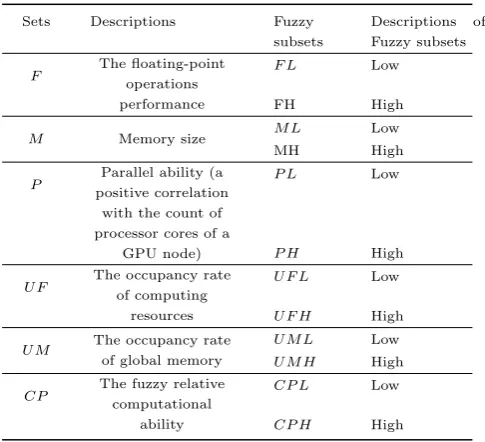
ex-plored in depth the fundamentals of fuzzy theory and de-fined a 5-state feedback (the fuzzy sets) parameters name-ly: the floating-point operations performance (F), global memory size (M), parallel ability (P), the occupancy rate of computing resources of a GPU (U F) and the occupancy rate of global memory of a GPU (U M). Each fuzzy set de-fines the “high” and “low” fuzzy subsets. Likewise, thenth
relative computational ability Pin is also fuzzed as “high”
[image:6.595.311.554.526.747.2]and “low”. All fuzzy sets and subsets are listed in Table 1. Table 1 The defined fuzzy sets and subsets
Sets Descriptions Fuzzy
subsets
Descriptions of Fuzzy subsets
F The floating-point
operations performance
F L Low
FH High
M Memory size M L Low
MH High
P
Parallel ability (a
positive correlation with the count of processor cores of a
GPU node)
P L Low
P H High
U F
The occupancy rate of computing
resources
U F L Low
U F H High
U M The occupancy rate
of global memory
U M L Low
U M H High
CP The fuzzy relative
computational ability
CP L Low
)
)/
)+
0
0/
0+
3
3/
3+
8)
8)/
8)+
80
80/
80+
&3/
&3+
&3
LQSXW IX]]\ KLGHOD\HU RXWSXWOD\HU GHFRGH
wi
wi
x
x
x
x
x
Pi
w
w
I O
O
[image:7.595.128.476.73.392.2]I
Fig. 3 The structure of FNN in the proposed data-oriented DLB model
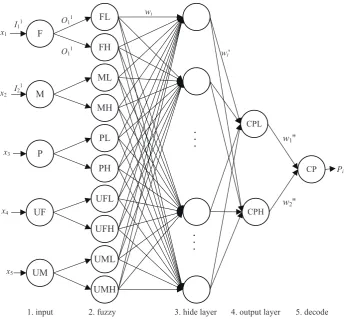
After defining the fuzzy subsets, this research has de-signed a network structure of FNN that combines theories of the fuzzy mathematics and the back propagation mech-anism from ANN to predictPin of each GPU node before
activating the scheduler to organize the data groups, see Fig.3. The first layer of the design is an input layer while the second layer, third layer and fourth layer are considered to be the fuzzy input layer, hide layer and output layer re-spectively in the classic structure of back propagation net-works. This FNN structure has ten fuzzy truth values as inputs and two fuzzy truth result values as outputs. The final layer (i.e. fifth layer) decodes the fuzzy truth values to the correct value which is the actual Pin of i
th
GPU‘s the nth predication. The devised FNN uses Ij
i to denote
the input of the ithartificial neuron in thejth level layer,
Oji to denote the output of theithartificial neuron in the
jthlevel layer,wito denote weights of connections between
the second and third layer,w′ito denote weights of
connec-tions between the third and fourth layer, andw′′i to denote
weights of connections between the fourth and fifth layer (see Fig.3). The workflows of the corresponding inputs and outputs are illustrated in Fig.3.
Input layer: The input layer collects real-time states of a GPU node and generates values of the five state feedback parameters (see Table 1) as inputs when a predication ofPin
is required. The input layer merely import real-time state feedback parameters into the FNN, and the input-output formula shows as the following:
Oi1=I
1
i =xi (9)
where xi is corresponding to the values of F, M, P, U F
andU M in Table 1 respectively.
Fuzzy layer: The fuzzy layer transforms the correct val-ues into fuzzy truth valval-ues by using a membership function. The input and output formulas are illustrated as the follow-ing:
Ii2 =O1i O2i =uA
(
Ii2
)
, Oi2⊂[0,1]
(10) where uA(x) is the membership [31]. There are a lot of
membership functions available, but this research chose the sigmoid function due to its “S” shaped curve can grace-fully reflect the fluctuations of computational performance of GPU nodes [36]. The equation of sigmoid membership function is defined as the following:
f(x) = 1
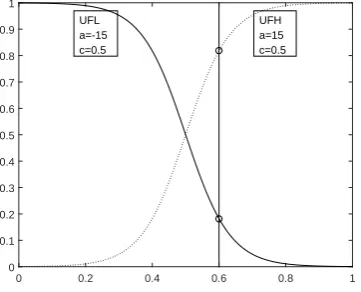
1 +e−a(x−c) (11) where a andc are constants having different values for d-ifferent fuzzy subsets. Taking the occupancy rate of com-puting resources of a GPU node (U F, andU F ∈[0,1]) as an example, this model takes a = −15 and c = 0.5, and
0 0.2 0.4 0.6 0.8 1 0
0.1 0.2 0.3 0.4 0.5 0.6 0.7 0.8 0.9 1
UFL a=-15 c=0.5
[image:8.595.81.262.86.232.2]UFH a=15 c=0.5
Fig. 4 The Membership Functions of UFL and UFH
{
U F L:uU F L(U F) = 1
1+e15×(U F−0.5) U F H:uU F H(U F) = 1
1+e−15×(U F−0.5)
(12) According to equation (12), for instance, when a GPU’s
U F = 0.6, the membership value ofU F Lis 0.18, and the membership value ofU F H is 0.82, see Fig.4.
Hide layer: In principle, the more the hidden layers, the more complex functions can be fitted. However, it also may cause the disadvantages of a mass of computation and overfitting. Generally speaking, a single hidden layer can meet majority requirements for prediction purposes [36]. Thus, this load balancing model has only one hidden layer. The input and output formulas are defined as the following:
I3
i = n
∑
j=1
wiO2j−θi
O3i =φ(I
3
i)
(13)
whereO2j(n=10) denotes outputs of 10 artificial neurons on
the 2nd level layer, andθiis a threshold value whileφ(x) is
the activation function used by the artificial neurons. This research has chosen a sigmoid function as the activation function:
φ(x) = 1
1 + exp(−ax) (14)
Output layer: The output layer generates fuzzy truth values of the “high” and “low” fuzzy subsets of Pn
i. The
input and output formulas are defined as the following:
I4
i = m
∑
j=1
wj′O3j−θ′i
O4i =φ
(
Ii4
) (15)
where m is the number of artificial neurons on the hide layer (i.e. 3rd level layer),θ′iis a threshold value while the
definition ofφ(x) is the same as equation (14).
Decode layer: The decode layer is added in this net-work to transform the fuzzy truth values of the CP Land
CP Hinto the correct value ofPinby using the fuzzy
weight-ed average method. The input and output formulas are defined as the following:
I5= 2 ∑
i wi
′′ O4i
Pi=O5=I5
/∑2
i=1
O4i
(16)
Based on the FNN structure illustrated in Fig.3, the pro-posed load balancing model can be learned by training data using the back propagation algorithm that is collected from historical data of real-time state feedbacks (e.g. data pro-cessing time and a GPU states at some point). After the model is trained, it can be used to predict Pn
i, and then
the scheduler can organize the data groups dynamically ac-cording to equation (7).
4
A Case Study
This data-oriented DLB model supports a wide variety of large scale data computations. This research explores the LWT (Lifting Wavelet Transform - LWT) computation for huge metrological data sets of surface textures as a case study to evaluate the validity and efficiency of the proposed model. Rooted in DWT, which is one of the fundamental algorithms for filtration widely used in surface metrology, signal and image processing, biomedicine visualization, and machine vision, LWT aims to improve the computational efficiency through a lifting scheme, also referred as the sec-ond generation wavelet [37].
The 1D forward LWT contains four operative steps: split, predict, update, and scale [37].
Split: This step splits the original signal into two subsets of coefficients, i.e. even and odd, and the former one is corresponding to the even index values while the latter is corresponding to the odd index values. The split method is expressed as equation (17), and it is also called the lazy wavelet transform.
{
even[i] =X[2i]
odd[i] =X[2i+1] (17)
Predict: Theoddcoefficients can be predicted from the even by using prediction operatorP, and then replace the old odd values by the prediction result as the next new
odd coefficients recursively. This step can be expressed as equation (18).
odd=odd−P(even) (18)
Update: Likewise, even coefficients can be updated from the update operatorU, and then replace the oldeven
values by the updated result as the next new even coeffi-cients recursively. This step shows as equation (19).
even=even+U(odd) (19)
Scale: Normalizeeven and oddcoefficients with factor
K respectively by using equation (20) to get the results of
evenApp and oddDet, which are the final approximation coefficients and detail coefficients of forward LWT respec-tively.
{
evenApp=even×(1/K)
split
P
U
X
...
...
P
mU
m1/K
K
evenApp
oddDet
even
odd
Pi ithSUHGLFWLRQ Ui ithXSGDWH
K QRUPDOL]DWLRQ
ZLWKIDFWRUk
ā
[image:9.595.64.276.75.167.2]ā
ā
Fig. 5 Main computational procedure of single-level 1D forward LWT
7UDQVIHUWKHRULJLQDO'VLJQDOGDWD PDQGUIURPD&38PHPRU\WRWKH
JOREDOPHPRU\RID*38
,WHUDWLRQDUULYHWKH H[SHFWHG/HYHOV"
3HUIRUPVLQJOHOHYHO'IRUZDUG /:7IRUHDFKURZ
3HUIRUPVLQJOHOHYHO'IRUZDUG /:7IRUHDFKFROXPQ
2EWDLQWKHUHVXOWVRI'/:7cA, cH, cVDQGcD)
<
1
2EWDLQcARIWKH ODVWOHYHODQGcH,
cVDQGcDIURP HDFKOHYHO
cH
cD
cV
cH
cD
cV
[image:9.595.314.552.76.301.2] [image:9.595.67.271.211.424.2]Fig. 6 Main computational procedure of multi-level 2D forward LWT
Table 2 The single-level forward LWT based on CDF (9, 7) wavelet
Split:
even[i] =X[2i]
odd[i] =X[2i+ 1]
1thPredict: odd[i]−=−α×(even[i] +even[i+ 1]) 1thUpdate even[i]−=−β×(odd[i] +odd[i−1])
2thPredict odd[i]−=−γ×(even[i] +even[i+ 1]) 2thUpdate: even[i]−=−δ×(odd[i] +odd[i−1])
Scale:
even=even×ε odd=odd×(1/ε)
The inverse LWT with a lifting scheme is achieved by inverting the complete sequence of operation steps of for-ward LWT and switching the corresponding addition and subtraction operators. With the lifting scheme, the com-putational results of both forward and inverse LWT for arbitrary wavelet can be obtained through applying sev-eral steps of prediction and update operations and the final normalization with factor K, where Pi and Ui represent
the ith prediction and update coefficients respectively (see Fig.5). For a multi-level DWT, the computational process is repeatedly applied to the approximation coefficients until a desired number of decomposition levels are reached.
void l w t ( raw [ ] [ ] ) {
// a l l o c a t i n g GPU memory
// t r a n s f e r d a t a t o t h e g l o b a l memory o f a GPU cudaMemcpy ( d raw , raw , s i z e ,
cudaMemcpyHostToDevice ) ;
// S p l i t d a t a on GPU
g p u s p l i t ( d e v e n , d odd , d r a w ) ;
g p u l w t p r e d i c t ( d e v e n , d odd , [−a l p h a , −a l p h a ] ) ; // 1 t h P r e d i c t
g p u l w t u p d a t e ( d e v e n , d odd , [−b e t a , −b a t e ] ) ; // 1 t h Update
g p u l w t p r e d i c t ( d e v e n , d odd , [−gamma , −gamma ] ) ; // 2 t h P r e d i c t
g p u l w t u p d a t e ( d e v e n , d odd , [−d e t a , −d e t a ] ) ; // 2 t h Update
g p u s c a l e ( d e v e n , d odd , p h i ) ; // S c a l e
// t r a n s f e r t h e LWT r e s u l t from t h e g l o b a l memory o f a GPU
// t o CPU memory
cudaMemcpy ( evenApp , d e v e n , s i z e , d e v i c e T o H o s t ) ;
cudaMemcpy ( oddDet , d odd , s i z e , d e v i c e T o H o s t ) ;
}
Algorithm. 1 The scheduling software routine on a GPU node
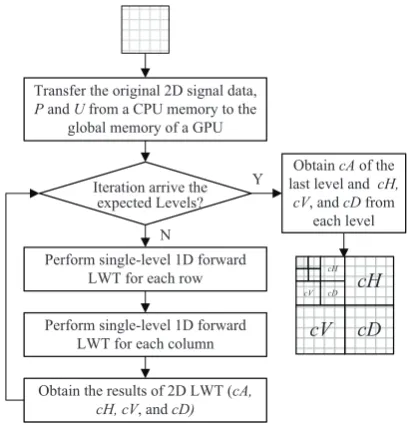
In the case of a 2D DWT, it simply needs to perform the horizontal 1D LWT for each row of a 2D input data set and the vertical 1D LWT for each corresponding column in se-quence separately due to a 2D LWT can be realized through the 1D wavelet transform along its x- and y-axis, such that we can obtain the 2D LWT results: cA, cH, cV and cD;
cA is approximation coefficients while cH, cV and cD in-dicate detail coefficients along horizontal, vertical and di-agonal orientations respectively. Fig.6 illustrates the main computational procedure of a multi-level 2D forward LWT. Lifting scheme supports variety types of wavelets, and in this case, the research has adopted the CDF (9, 7) wavelet as an example. Table 2 illustrates equations for a single level forward LWT based on the CDF (9, 7) wavelet, and its scheduling software routine on a GPU is illustrated in Algorithm.1. The basic idea is that every step of the lifting scheme is performed by different functions, and the CPU program schedules and launches these functions with re-spect to all data dependencies.
In the context of CUDA and multi-GPU architectures, the overall workflow of LWT computation by using the de-vised DLB model conforms to Fig.2, and the scheduler al-locates initial data groups of a raw data set to each GPU node, and then GPU nodes process the corresponding data groups with the LWT functions listed in Algorithm.1.
5
Test and Performance Evaluation
5.1
Hardware and test environment
[image:9.595.49.290.499.597.2]Table 3 The specifications of a computer system for the case study for close-up retrieval
Description
CPU Intel Core i7-4790 3.6GHZ
GPU1 GeForce GTX 750 Ti, 2G
GPU2 GeForce GTX 1080, 8G
OS Windows 10 64 bit
CUDA Version 8.0
5.2
FNN Training
The FNN can be trained end-to-end by the back propa-gation and the stochastic gradient descent (SGD) methods. Since there are limited open benchmarks or datasets for multi-GPUs based load balancing models, this study has devised a customizable dataset containing 5-state feedback parameters (see Table 1), the processing data size D and the corresponding actual processing time T. The relative computational abilityCP can be given by equation (21):
CP=f(D
T) (21)
We randomly initialized the weights for all layers (four lay-ers) from a zero-mean Gaussian distribution algorithm, and trained the FNN in two steps to complete the supervised pre-training and fine-tuning. The first step trained the FNN on 300 data items with the SGD on a learning rate of 0.01. The fine-tuning step then continued the SGD on the learn-ing rate of 0.001 with 200 data items. With this two-step training strategy, the FNN based DLB model has achieved a reliable prediction performance. The comprehensive eval-uation of the devised DLB model is further discussed in the following subsections.
5.3
Computation without the DLB model
This section reports test results and evaluates the com-putational performance of multi-level 2D LWT without ap-plying any DLB models on both a single GPU and a multi-GPU platform.
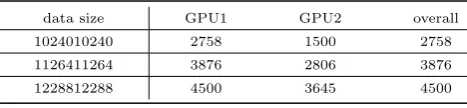
To begin with, this study tested and compared the pro-cessing time of a 2D LWT between a single GPU (using either GPU1 or GPU2 respectively) and two GPUs (using both GPU1 and GPU2) environment without employing any DLB models but the traditional division method to di-vide the data set for each GPU (see Section 2.3). This test performed 4 levels of forward 2D LWT with CDF (9, 7) wavelet on three data sizes 10240×10240, 11264×11264, to 12288×12288. The processing times of each test on three different data sizes had been recorded in Fig.7. It can be seen from Fig.7 that the GPU2 setting needs less processing time than the GPU1 setting, and the main rea-son for this is that the hardware performance of GPU2 is higher than GPU1 - the GPU2 has 2560 CUDA cores while GPU1 contains only 640 CUDA cores, and the memory s-torage of GPU2 is also larger than GPU1. According to Fig.7, the two GPUs (GPU1 & GPU2) setting merely gains limited speedup of about 1.6 times compared with GPU1, and at around 1.3 times compared with GPU2. The detail processing times for processing different data sizes by using the two GPUs setting are shown in Table 4 which also indi-cates the processing time of GPU1 and GPU2 respectively.
[image:10.595.313.547.175.229.2]It can be clearly seen from Table 4 that the overall process-ing time of the two GPUs settprocess-ing in the context of the load unbalancing situation is equal to the GPU1-alone situation because the overall computational performance of a multi-GPU platform is ultimately determined by the multi-GPU node with the lowest performance, in this case, the GPU1.
Table 4 The processing times of Two GPUs Setting with unbalancing implementations (ms) for close-up retrieval
data size GPU1 GPU2 overall
1024010240 2758 1500 2758
1126411264 3876 2806 3876
1228812288 4500 3645 4500
5.4
Computation with the DLB model
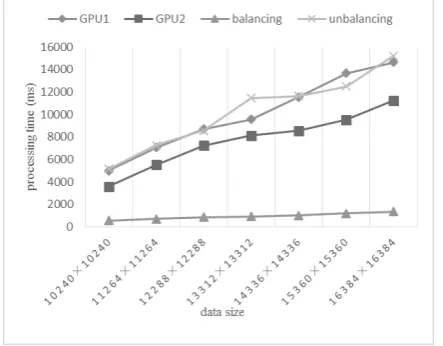
Then, this study has tested and compared the computa-tional performances of the 2D LWT operation between the unbalanced implementation (i.e., each GPU node processes a half of a large data set without consideration of their per-formance variations) and the data-oriented DLB implemen-tation by using the FNN structure in the target multi-GPU system. The processing times of each implementation with different data sizes have been listed in Fig.8. The process-ing times of two sprocess-ingle GPU settprocess-ings (i.e. usprocess-ing GPU1 only and GPU2 respectively) also tested and recorded for com-parison. It can be seen from Fig.8 that the computational performance of the unbalanced implementation has no sig-nificant difference comparing with the two single GPU set-tings. In contrast, the FNN based DLB implementation has gained improvement on computational performances steadi-ly, i.e., it processed a very large data set (e.g. 16384×16384) in less than one second. Compared with the unbalanced implementation, the peak performance gain (speedup) can reach 12 times which is truly significant. The experimental results show that the proposed data-oriented DLB model can satisfy performance requirements from real-time and large-scale data intensive applications.s
5.5
Benchmarking
Fig. 7 The computational performance of three test settings (ms)
Fig. 8 The comparison of processing times between unbalancing and balancing implementations
the fluctuation problem readily and steadily due to its key feature of predicting and adjusting the current computa-tional performance (Pn
i) dynamically according to the real
hardware condition and feedbacks.
6
Conclusions and Future Work
[image:11.595.319.541.76.235.2]To fully utilize the parallel computational power of mod-ern GPUs, this paper presents a novel data-oriented DLB model for multi-GPU systems based on an innovative FNN structure and the corresponding dataset division method-s. The research started with a comprehensive investigation and analysis of the traditional load balancing models, and concluded with the main drawbacks of them, for example, the rigidity when dealing with heterogeneous node specifi-cations and configurations. To alleviate the load balancing issues and to effectively respond to the runtime fluctuation of cluster performance, this research has proposed a novel data-oriented DLB model for balancing and optimizing the overall parallel computational performance across multi-GPU nodes. In this model, five state feedback parameters have been identified, and the FNN structure has been imple-mented to predict the relative computational performance in an adaptive manner. An improved scheduler can then be
Fig. 9 The comparison of processing times between FNN based DLB model and the Beyer’s model
activated to automating the data allocation tasks accord-ing to the relative computational performances across all nodes in a cluster. Experiment results show that the pro-posed model can achieve substantial computational perfor-mance gain when compared with conventional techniques, and the FNN based dynamic model can address the runtime fluctuation issues effectively. The innovative model and its corresponding techniques have addressed the key challenges from large scale computational applications that are often featured by extremely large input volume and highly repet-itive operational procedures. Further work will be focused on bridging the flexible FNN idealism across the GPU and CPU boundary, especially when facing the new computing device paradigm of Cell CPUs, so as to progressing towards a truly hybrid and efficient task-data distribution scheme for engineering applications.
References
[1] D. B. Kirk and W. H. Wen-mei, Programming massively parallel processors: a hands-on approach. Morgan kaufman-n, 2016.
[2] R. Couturier, Designing Scientific Applications on GPUs. CRC Press, 2013.
[3] S. W. Keckler, W. J. Dally, B. Khailany, M. Garland, and D. Glasco, GPUs and the future of parallel computing. IEEE Micro, vol. 31, no. 5, pp. 7–17, 2011.
[4] C. W. Lee, J. Ko, and T.-Y. Choe, Two-way partitioning of a recursive Gaussian filter in CUDA. EURASIP Journal on Image and Video Processing, vol. 2014, no. 1, pp. 33–42, 2014.
[5] J. A. Belloch, A. Gonzalez, F. J. Martnez-Zaldvar, and A. M. Vidal, Real-time massive convolution for audio applica-tions on GPU. The Journal of Supercomputing, vol. 58, no. 3, pp. 449–457, 2011.
[6] F. Nasse, C. Thurau, and G. A. Fink, Face Detection Using GPU-Based Convolutional Neural Networks. International Conference on Computer Analysis of Images and Patterns, pp. 83–90, 2009.
[7] NVIDIA, CUDA C Programming Guide v8.0. [On-line]. Available: http://docs.nvidia.com/cuda/cuda-c-programming-guide/index.htm. 2016.
[image:11.595.61.283.258.431.2][9] C. Szegedy et al., Going Deeper with Convolutions. 2015 IEEE Conference on Computer Vision and Pattern Recog-nition (CVPR), 2015.
[10] K. Simonyan and A. Zisserman, Very Deep Convolutional Networks for Large-Scale Image Recognition. Information and Software Technology, vol. 51, no. 4, pp. 769–784, 2014. [11] X. J. Jiang and D. J. Whitehouse, Technological shifts in
surface metrology. CIRP Annals, vol. 61, no. 2, 2012. [12] W. Jianjun, L. Wenlong, L. Xiaojun, and J. Xiangqian,
High-speed parallel wavelet algorithm based on CUDA and its application in three-dimensional surface texture analy-sis. International Conference on Electric Information and Control Engineering, pp. 2249–2252, 2011.
[13] S. Chen and X. Li, A hybrid GPU/CPU FFT library for large FFT problems. Performance Computing and Com-munications Conference (IPCCC), 2013 IEEE 32nd Inter-national, pp. 1–10, 2013.
[14] C. Zhang, Y. Xu, J. He, J. Lu, L. Lu, and Z. Xu, Multi-GPUs Gaussian filtering for real-time big data processing. 2016 10th International Conference on Software, Knowl-edge, Information Management & Applications (SKIMA), 2016.
[15] S. Schaetz and M. Uecker, A multi-GPU programming li-brary for real-time applications. International Conference on Algorithms and Architectures for Parallel Processing, pp. 231–236, 2012.
[16] J. A. Stuart and J. D. Owens, Multi-GPU MapReduce on GPU clusters. Parallel & Distributed Processing Sympo-sium (IPDPS), pp. 1068–1079, 2011.
[17] M. Grossman, M. Breternitz, and V. Sarkar, HadoopCL: Mapreduce on distributed heterogeneous platforms through seamless integration of hadoop and opencl. Parallel and Dis-tributed Processing Symposium Workshops & PhD Forum (IPDPSW), pp. 1918–1927, 2013.
[18] M. Boyer, K. Skadron, S. Che, and N. Jayasena, Load bal-ancing in a changing world. Proceedings of the ACM In-ternational Conference on Computing Frontiers, pp. 1–10, 2013.
[19] L. Chen, O. Villa, S. Krishnamoorthy, and G. R. Gao, Dy-namic load balancing on single- and multi-GPU system-s. 2010 IEEE International Symposium on Parallel & Dis-tributed Processing (IPDPS), pp. 1–12, 2010.
[20] A. Acosta, R. Corujo, V. Blanco, and F. Almeida, Dynamic load balancing on heterogeneous multicore/multiGPU sys-tems. 2010 International Conference on High Performance Computing & Simulation, pp. 467–476, 2010.
[21] A. Acosta, V. Blanco, and F. Almeida, Towards the Dy-namic Load Balancing on Heterogeneous Multi-GPU Sys-tems. 2012 IEEE 10th International Symposium on Parallel and Distributed Processing with Applications, pp. 646–653, 2012.
[22] B. Prez, E. Stafford, J. L. Bosque, and R. Beivide, Energy efficiency of load balancing for data-parallel applications in heterogeneous systems. The Journal of Supercomputing, vol. 73, no. 1, pp. 330–342, 2017.
[23] R. Kaleem, R. Barik, T. Shpeisman, B. T. Lewis, C. Hu, and K. Pingali, Adaptive heterogeneous scheduling for inte-grated GPUs. Proceedings of the 23rd international confer-ence on Parallel architectures and compilation, pp. 151–162, 2014.
[24] C. Zhang, Y. Xu, J. Zhou, Z. Xu, L. Lu, and J. Lu, Dy-namic load balancing on multi-GPUs system for big data processing. 2017 23rd International Conference on Automa-tion and Computing (ICAC), pp. 1–6, 2017.
[25] K. He, X. Zhang, S. Ren, and J. Sun, Deep residual learning for image recognition. arXiv Prepr, 2015.
[26] H. Zermane and H. Mouss, Development of an internet and fuzzy based control system of manufacturing process. In-ternational Journal of Automation and Computing, vol. 14, no. 6, pp. 706–718, 2017.
[27] J. Li, Q. Wang, C. Wang, N. Cao, K. Ren, and W. Lou, Fuzzy Keyword Search over Encrypted Data in Cloud Com-puting. 2010 Proceedings IEEE INFOCOM, pp. 1–5, 2010. [28] S. Krinidis and V. Chatzis, A Robust Fuzzy Local Informa-tion C-Means Clustering Algorithm. IEEE TransacInforma-tions on Image Processing, vol. 19, no. 5, pp. 1328–1337, 2010. [29] M. Algabri, H. Mathkour, and H. Ramdane, Mobile Robot
Navigation and Obstacle-avoidance using ANFIS in Un-known Environment. International Journal of Computer Applications, vol. 91, no. 14, pp. 36–41, 2014.
[30] R. J. Kuo, S. Y. Hong, and Y. C. Huang, Integration of particle swarm optimization-based fuzzy neural network and artificial neural network for supplier selection. Applied Mathematical Modelling, vol. 34, no. 12, pp. 3976–3990, 2010.
[31] C. L. P. Chen, Yan-Jun Liu, and Guo-Xing Wen, Fuzzy Neural Network-Based Adaptive Control for a Class of Un-certain Nonlinear Stochastic Systems. IEEE Transactions on Cybernetics, vol. 44, no. 5, pp. 583–593, 2014.
[32] A. Saffar, R. Hooshmand, and A. Khodabakhshian, A new fuzzy optimal reconfiguration of distribution systems for loss reduction and load balancing using ant colony search-based algorithm. Applied Soft Computing, vol. 11, no. 5, pp. 4021–4028, 2011.
[33] N. Susila, S. Chandramathi, and R. Kishore, A Fuzzy-based Firefly Algorithm for Dynamic Load Balancing in Cloud Computing Environment. Journal of Emerging Technolo-gies in Web Intelligence, vol. 6, no. 4, pp. 435–440, 2014. [34] A. N. Toosi and R. Buyya, A Fuzzy Logic-Based
Con-troller for Cost and Energy Efficient Load Balancing in Geo-distributed Data Centers. 2015 IEEE/ACM 8th Inter-national Conference on Utility and Cloud Computing (UC-C), pp. 186–194, 2015.
[35] H. Muhamedsalih, X. Jiang, and F. Gao, Accelerated sur-face measurement using wavelength scanning interferometer with compensation of environmental noise. Procedia Engi-neering: 12th CIRP Conference on Computer Aided Toler-ancing, vol. 10, pp. 70–76, 2013.
[36] S.-H. Lee and J. S. Lim, Forecasting KOSPI based on a neural network with weighted fuzzy membership functions. Expert Systems with Applications, vol. 38, no. 4, pp. 4259– 4263, 2011.
[37] W. Sweldens, The lifting scheme: A construction of sec-ond generation wavelets. SIAM Journal on Mathematical Analysis, vol. 29, no. 2, pp. 511–546, 1998.
[38] S. Mittal and J. S. Vetter, A Survey of CPU-GPU Hetero-geneous Computing Techniques. ACM Computing Surveys, vol. 47, no. 4, pp. 1–35, 2015.
Chaolong Zhang received the BEng and MSc degrees in software engineering from Chengdu University of Information Technol-ogy, China, in 2014 and 2017, respectively. He is currently a PhD student with School of Computing and Engineering at University of Huddersfield, UK.
His research interests include High-performance computing (HPC), Computer Vision, and deep learning network applica-tions.
Yuanping Xu received the BEng degree in computer science and technology from South-west JiaoTong University, China, in 2003, and MSc and PhD degrees in software engineering from University of Huddersfield, UK in 2004 and 2009, respectively. From February 2009 to November 2010, he worked as a research fellow in the Centre of Precision Technologies at Uni-versity of Huddersfield, UK. He is currently a professor with School of Software Engineering at Chengdu University of Information Technology, China.
His research interests include knowledge-based systems, ex-pert systems, big data analysis and deep learning network appli-cations.
E-mail: [email protected] (Corresponding author) ORCID iD: 0000-0002-4536-6220
Zhijie Xu received the B.Eng degree in communication engineering from the X-i’an University of Science and Technology at China in 1991. After graduation, he first started as an electronics engineer before moving to the United Kingdom and worked as a research scientist in the Robotics Lab at the University of Derby. He received the Ph.D degree in 2000 from the University of Derby based on his research work in Virtual Reality-based Manufacturing Simula-tion and Robotics Systems. He has been employed as a full time academic member of staff since April 1999 serving the roles of Lecturer, Senior Lecturer, Reader and Professor respectively at the University of Huddersfield in UK.
Professor Xu’s research in the last twenty years has mainly been focused on the areas of visualization, HCI, vision system-s, and machine learning. He has published over one hundred peer-reviewed journal and conference papers as well as edited 5 books in the relevant fields. He has successfully supervised 8 PhD students to completion while securing substantial research and industrial grants. He is a member of the IEEE, IET, BCS, and a fellow of HEA, and editors for multiple prestigious aca-demic journals and conferences. He is the current President of the Chinese Automation and Computing Society in the United Kingdom.
E-mail: [email protected]
Jia He received BEng and Msc degrees in Computer Science and Technology from Southwest Normal University of China, in 1989 and 1996, respectively, and received PhD degree in Computer Science from Uni-versity of Electronic Science and Technology of China, in 2012. She is currently a profes-sor and the Dean with School of Computer Science at Chengdu University of Informa-tion Technology, China.
Her current research interests include computer vision, artifi-cial intelligence, and pattern recognition.
E-mail: [email protected]
Jing Wang gained his PhD degree in 2012 from University of Huddersfield. He worked as Research Fellow and carried out independent research work on Image Pro-cessing, Analysing and Understanding in U-niversity of Huddersfield before 2017. He is now working at Sheffield Hallam Universi-ty as a Lecturer in software engineering and computer science. His research interests are focused on real-world applications of Computer Vision Systems and have published more than 20 refereed papers in the related fields.
E-mail: [email protected]
Jianhua Adu received BSc degree in Applied Physics from Minzu University of China, Beijing, China, in 1999, received M-Sc in Computer M-Science from ShanDong U-niversity, China, in 2006, and received PhD degree in Computer Science from SiChuan University, China, in 2012. He is currently an associate professor with School of Soft-ware Engineering at Chengdu University of Information Technology, China.
His current research interests include image fusion and seg-mentation, medical image processing and analysis, and pattern recognition.