Communication plays an important role in the organization of many animal societies. The nectar foraging system of honey bees (Apis mellifera) has received much attention in this context (e.g. von Frisch, 1967; Seeley, 1995), because it provides a convenient system for studying the role of communication in the coordination of colony members. Honey bees use several communication signals to adjust a colony’s nectar foraging efficiency, of which the waggle dance (von Frisch, 1967) and the tremble dance (von Frisch, 1923; Seeley, 1992; Seeley et al., 1996) of nectar foragers are especially conspicuous. Lindauer (1948), Schneider (1949), Schick (1953) and von Frisch (1967) reported several factors that seemed to cause tremble dancing. A reliable stimulus and a functional explanation for the tremble dance were, however, reported only recently (Seeley, 1992; Seeley et al., 1996). By keeping all other factors constant, Seeley (1992) showed that, upon return to the hive, a forager performs the tremble dance when she experiences difficulty in finding a receiver bee that
unloads her nectar. Thus, a long unloading delay stimulates tremble dancing, which apparently recruits more nectar receiver bees (Seeley et al., 1996). Nectar foragers that experience only short delays before the first unloading contact perform the waggle dance (Seeley, 1992), which recruits additional nectar foragers (von Frisch, 1967). Both dances are performed only when the food source is profitable enough to justify an adjustment of the colony’s labor allocation. Thus, both the waggle dance and the tremble dance help to match the work capacities of nectar foragers and nectar receiver bees to avoid inefficient waiting times for either group.
Kirchner and Lindauer (1994) set out to test whether other factors than a long unloading delay can cause tremble dancing, as was suggested by earlier studies (Lindauer, 1948; Schneider, 1949; Schick, 1953; von Frisch, 1967). Unlike Seeley (1992), who kept conditions at the feeder constant during his experiment, these earlier studies stimulated tremble dancing by manipulating the food source, e.g. by forcing foragers to crowd
doi:10.1242/jeb.00398
The tremble dance of honey bee nectar foragers is part of the communication system that regulates a colony’s foraging efficiency. A forager that returns to the hive with nectar, but then experiences a long unloading delay because she has difficulty finding a nectar receiver bee, will perform a tremble dance to recruit additional nectar receiver bees. A forager that experiences a short unloading delay will perform a waggle dance to recruit more nectar foragers. A long unloading delay was until now the only known cause of tremble dancing. However, several studies suggested that factors at the food source may also cause tremble dancing. Here I test whether one of these factors, crowding of nectar foragers at the food source, stimulates tremble dancing because it causes long unloading delays. To do so, I increased the density of nectar foragers at a food source by suddenly reducing the size of an artificial feeder, and recorded the unloading delay experienced by each forager, as well as the dance she performed, if any. A forager’s unloading delay was
measured as the time interval between entering the hive and either (1) the first unloading contact with a nectar receiver bee, or (2) the start of the first dance, if dancing began before the first unloading contact. I also recorded the unloading delays and dances of nectar foragers that returned from natural food sources. The results show that crowding of nectar foragers at the food source increases the probability of tremble dancing, but does not cause long unloading delays, and that tremble dancers that foraged at natural food sources also often have short unloading delays. When the cause of the tremble dance is not a low supply of nectar receiver bees, the tremble dance may have a function in addition to the recruitment of nectar receiver bees.
Key words: Apis mellifera, tremble dance, nectar foragers, nectar receivers, search time, unloading delay, waggle dance, foraging efficiency, honey bee.
Summary
Introduction
The tremble dance of honey bees can be caused by hive-external foraging
experience
Corinna Thom
Department for Behavioral Physiology and Sociobiology, Würzburg University, Biozentrum, Am Hubland, 97074 Würzburg, Germany
Present address: ARL Division of Neurobiology, Gould-Simpson Building, PO Box 21077, Tucson, AZ 85721-0077, USA (e-mail: [email protected])
at the feeder (von Frisch, 1967). However, unloading delays were not measured. This would have been important, as a manipulation of the food source may affect the duration of unloading delays (Kirchner, 1993). Therefore, Kirchner and Lindauer (1994) tested whether crowding at the food source caused nectar foragers to tremble dance because it delayed the first unloading contact. They found that crowding stimulated tremble dancing, and that it increased the time to the first unloading contact (initial unloading delay) as well as the entire time before unloading contacts that was not devoted to dancing or unloading (total unloading delay). From this, Kirchner and Lindauer (1994) concluded that crowding caused longer initial, and especially total, unloading delays, which then caused nectar foragers to tremble dance. However, the study did not provide information about how long after their return into the hive nectar foragers started to dance. This information is important, because dancing can occur before unloading, as Kirchner and Lindauer (1994) themselves note. Thus, a forager that starts to tremble dance shortly after her return into the hive can still experience a long delay until her first unloading contact, but this long delay could not have caused the tremble dance. This means that not only the delay until the start of unloading has to be measured, but also the delay until the start of dancing.
I performed experiments to determine whether crowding at the food source caused tremble dancing because it delayed the time to the first unloading contact or the first dance. To do so, I manipulated the density of nectar foragers at the food source by reducing the size of an artificial feeder, and recorded a nectar forager’s dance and the time interval between her entrance into the hive and her first unloading contact, or, if she started to dance before she unloaded, to her first dance.
To additionally examine whether tremble dancers from a non-manipulated colony usually experience long unloading delays, I recorded the unloading delays of nectar foragers that returned from natural food sources.
Materials and methods Study site and observation hives
The study was conducted from May to August, 2001, at the honey bee laboratory of the University of Würzburg, Germany. Observations were made on two colonies (C1and
C2) of the carniolan honey bee Apis mellifera carnica L. The
colonies were housed indoors in two-frame observation hives (e.g. von Frisch, 1967), with internal dimensions of 45·cm×45·cm×5·cm and entrance tunnels leading outside. About 18·cm2of the glass covering the dance floor near the
junction of the hive and the entrance tunnel were removed and replaced with a cloth mesh that allowed the marking of bees that exited the hive. To ensure that each bee was observed only once during an experimental phase, each observed bee was marked with a dot of paint on the thorax when she exited the hive. To fix the bee during marking, the cloth mesh was pressed down on the bee when she was moving towards the hive exit. All observations and experiments were made with one colony at a time.
Food source
The food source used for the experiment was a grooved-plate feeder (e.g. Seeley, 1995) that was located 25·m from the hive. The diameter of the feeder varied during the experiments (see ‘Experiment’ below). The feeder provided a concentrated sugar solution [Apiinvert (Südzucker), 2.4·mol·l–1; sugar
composition 61% glucose, 39% fructose] and supplied most, or all, of the food collected by the colonies, as natural nectar sources were scarce during this time. Empty feeders were refilled immediately by an assistant.
Experiment
During experiments in July and August 2001, I recorded the time interval between a nectar forager’s entrance into the hive and the start of her first unloading contact or first dance, and the type of her dance (waggle dance, tremble dance or no dance) before and during the manipulation of an artificial food source. I recorded data during four experiments with each C1and C2for
a total of eight experiments. Experiments started between 09:00 and 13:00·h and consisted of a control phase that was followed by a manipulation phase. Each control and manipulation phase lasted approximately 50·min. During the control, the feeder had a circumference of 79·cm (diameter 25·cm) and was big enough to allow simultaneous access to all visiting nectar foragers. During the manipulation, the feeder had a circumference of 16·cm (diameter 5·cm), and was too small to allow simultaneous access. To control the demand for nectar receiver bees in the hive, the number of foragers that visited the feeder was kept constant throughout the experiment (see below).
Measuring dances and unloading delay
To determine the number of nectar foragers that performed waggle dances, tremble dances or no dances during each control and manipulation phase of the experiment, I recorded the first dance that each observed forager performed. Nectar foragers that did not dance were observed during their entire stay in the hive. I recorded unloading delay as the time interval between a forager’s appearance in the entrance tunnel of the hive and the start of her first unloading contact (tu), or, if
she started to dance before she unloaded, the start of her first dance (td). Only trophallactic contacts of 3·s or longer were
considered to be unloading contacts. tdis also referred to as
‘unloading delay’, because it is the best estimate for the time interval that informs a forager about the availability of nectar receiver bees, usually the forager’s unloading delay, that an observer can have for a forager that starts to dance before her first unloading contact.
Controlling the number of nectar foragers
or experiment was finished. To compensate for loss of foragers between experiments, 10–30 additional foragers from the observation colony were allowed to access the feeder after each experiment. Although the total number of marked foragers might have changed between experiments (e.g. decreased due to death, or increased due to additional marking of foragers), it is unlikely that the number of foragers changed significantly during an experiment. To check whether approximately the same number of foragers visited the feeder per unit time during each control and manipulation phase of the experiment, the feeder assistant recorded every 5th·min the number of nectar foragers at the feeder during 3 control and 2 manipulation phases in experiments with C1, and during 4 control and 3
manipulation phases in experiments with C2. The assistant did
not record the number of nectar foragers when the tending of the feeder needed undivided attention.
Nectar foragers visiting natural food sources To determine the dances and unloading delays of foragers that visited natural food sources in May and June, 2001, I observed 63 nectar foragers from C1on 3 days, and 27 nectar
foragers from C2on 2 days without providing a food source.
Observations started at 08:00·h and lasted until 15:00–19:00·h. To reduce the probability of observing bees other than nectar foragers, observations were interrupted when hive bees performed their conspicuous orientation flights. Of the non-dancing bees, only those that had at least one trophallactic contact before they exited the hive again were considered to be nectar foragers. Although I could not distinguish between foragers for water and for nectar, the probability of a forager gathering water instead of nectar is much smaller (e.g. Seeley, 1986). Hence, it is not likely that water foragers introduced a large bias in the study. As foragers were not marked, I was not in all cases (approx. 29%) able to observe non-dancing nectar foragers throughout their entire stay in the hive. As foragers were most likely to waggle dance, the sample size for non-dancing nectar foragers might be biased upward. Bees that were lost out of sight had on average been observed for approx. 75% of the time that full observations lasted. Thus, the results for tremble dancers and, especially, waggle dancers might be biased downward.
Statistical analysis
To analyze whether tremble dancing was caused by a long unloading delay, I compared the unloading delays of waggle dancers and tremble dancers in each control and manipulation phase of the experiment. I did not compare the unloading delays of a group of dancers between phases, because even if unloading delay increases in the manipulation phase, this increase could only be the cause of tremble dancing if waggle dancers did not experience a similar increase in unloading delay.
Measurements are given as means ± one standard deviation (S.D.). Statistical tests used are given in the text. All data were analyzed using the ME edition of Microsoft Excel and the 2002 edition of Statistica. Bonferroni corrections for multiple
comparisons were performed according to Sokal and Rohlf (1995). The adjusted α-level is noted in the text.
Results Experiment
I recorded the time to the first unloading contact tuor first
dance td, and types of dances (waggle, tremble or no dance) of
210 nectar foragers during the control phase, and of 229 nectar foragers during the manipulation phase.
Number of nectar foragers did not change during experiment To estimate the number of nectar foragers that simultaneously visited the feeder, an assistant recorded the number of nectar foragers at the feeder every 5th·min during 7 control phases and 5 manipulation phases. In C1, the average number of nectar
foragers at the feeder was 72±10·foragers·min–1 during the
control phase (N=3), and 76±11·foragers·min–1 during the
manipulation phase (N=2). In C2, the average number of nectar
foragers was 47±11·foragers·min–1 during the control phase
(N=4), and 57±6·foragers·min–1during the manipulation phase
(N=3). The number of nectar foragers at the feeder was lower during the control phase than during the manipulation phase, but this difference was not significant for either colony (Mann–Whitney U-test; P>0.275 for each comparison). For the following analysis, data from C1and C2were pooled.
Manipulation increased tremble dancing rate
During the control phase, 36 nectar foragers performed a tremble dance, 115 performed a waggle dance, and 59 did not dance. During the manipulation phase, 161 nectar foragers performed a tremble dance, 23 performed a waggle dance, and 45 did not dance. The probability for a nectar forager to tremble dance was significantly higher during the manipulation phase than during the control phase of the experiment (Fig.·1, Mann–Whitney U-test; P=0.005, N=8). The probability to waggle dance was significantly lower during the manipulation phase than during the control phase (P<0.001), and the probability to not dance did not change (P=0.431).
Fig.·1. The probability that a nectar forager performs a waggle dance, a tremble dance or no dance during each control phase and manipulation phase of the experiment. Statistics are given in the text. Data were pooled for Colonies 1 and 2.
0 0.2 0.4 0.6 0.8 1
Control Manipulation
Probability to dance
Most nectar foragers danced before they unloaded
Fig.·2 shows the percentage of nectar foragers that started to dance before they unloaded. During the control phase of the experiment, 57% of the waggle dancers (N=115) and 92% of the tremble dancers (N=36) started to dance before they had their first unloading contact. During the manipulation phase of the experiment, 48% of the waggle dancers (N=23) and 90% of the tremble dancers (N=161) started to dance before they had their first unloading contact.
Tremble dancers and waggle dancers did not differ in tuor td
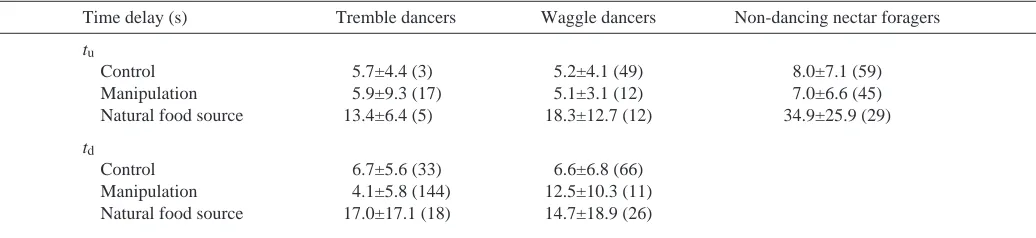
Fig.·3 shows dancing (waggle dancing, tremble dancing or no dancing) as a function of the time interval between a forager’s entrance into the hive and her first unloading contact (tu) or first dance (td). Mean values and sample sizes are given
in Table·1. Tremble dancers and waggle dancers did not differ in tu during either the control phase (Mann–Whitney U-test;
P=0.666) or the manipulation phase of the experiment (Mann–Whitney U-test; P=0.352). Tremble dancers and waggle dancers did not differ in tdduring the control phase
(Mann–Whitney U-test; P=0.784), but during the manipulation phase, tremble dancers had a significantly shorter td than
waggle dancers (Mann–Whitney U-test; P<0.001). Non-dancing nectar foragers did not differ in tufrom waggle dancers
or tremble dancers (Mann–Whitney U-test, P>0.07 for all comparisons).
Nectar foragers visiting natural food sources
To record unloading delays of unmanipulated nectar
0 25 50 75 100
A
B
0 25 50 75 100
Waggle dancers Tremble dancers Non-dancing nectar foragers
Percentage of total
Fig.·2. The percentage of waggle dancers, tremble dancers and non-dancing nectar foragers that had an unloading contact before they started to dance (white bars), and that started to dance before they had an unloading contact (black bars). (A) Data for the control phase, and (B) for the manipulation phase of the experiment. Statistics are given in the test. Data were pooled for Colonies 1 and 2.
Nectar foragers that unload first
0 25 50 75 100
A
C
B
D
0 25 50 75 100
5 10 15 20 60 5 10 15 20 60
Percentage of total
Nectar foragers that dance first
0 25 50 75
100 Waggle dance
Tremble dance No dance
0 25 50 75 100
td (s) tu (s)
Fig.·3. The distribution of unloading delays for waggle dancers, tremble dancers and non-dancing nectar foragers that either unloaded first (tu;
A,C) or danced first (td; B,D). (A) and (B) show the data for the control phase, (C) and (D) for the manipulation phase of the experiment.
foragers, I observed 38 waggle dancers, 23 tremble dancers, and 29 non-dancing nectar foragers that had visited natural food sources. 68% of the waggle dancers and 78% of the tremble dancers danced before they had their first unloading contact. Tremble dancers and waggle dancers did not differ in either tu (Mann–Whitney U-test; P=0.527) or td
(Mann–Whitney U-test; P=0.830). Non-dancing nectar foragers had a significantly longer tu than either tremble
dancers or waggle dancers (Mann–Whitney U-test; adjusted α -level 0.017, P>0.020). Values are given in Table·1.
Discussion
This study shows that tremble dancing can be stimulated by factors other than a long unloading delay. In particular, crowding of nectar foragers at the food source caused a fourfold increase in tremble dancing, which was not due to long delays to either the first unloading contact or the first dance. It is unlikely that tremble dancers reacted to long unloading delays after unobserved earlier trips, because nectar foragers experienced generally short unloading delays before they started to tremble dance.
Most tremble dancers (approximately 91%) started to dance before they had their first unloading contact, and usually started to dance as early as, or earlier than, waggle dancers. Because tremble dancers may dance for up to 1.5·h, and rarely stop dancing to unload (Seeley, 1992; Thom et al., 2003), these tremble dancers could have had their first unloading contact late during their stay in the hive. Therefore, Kirchner and Lindauer (1994), who measured the time to the first unloading contact, but not to the first dance, are likely to have reported longer unloading delays than tremble dancers actually experienced.
In comparison to the study by Seeley (1992), I observed (1) a higher level of tremble dancing during both control and manipulation phases of the experiment, and (2) possibly more tremble dancers that danced before they had the first unloading contact. Both observations suggest that nectar foragers had a higher motivation to tremble dance in this study
than in Seeley’s 1992 study. During the manipulation phase of the experiment, a higher motivation for tremble dancing could have been the different tremble dance stimulus (crowding instead of long unloading delays). During the control phase, nectar foragers may have had a higher motivation to tremble dance, e.g. because unwanted foragers may have released alarm pheromone when they were captured, or the many nectar foragers that visited the feeder simultaneously (47–76 bees) interfered at a low level with each other. Kirchner and Lindauer (1994), who also trained 200 foragers to a well-sized feeder, found even higher levels of tremble dancing (32% of all foragers) than this study (17% of all foragers). In general, crowding may have affected several parameters at the food source, including access to the feeder, efficiency of food loading, or concentration of alarm pheromone, which could have motivated nectar foragers to tremble dance.
Although the exact parameters that crowding changes at a food source are not yet identified, the short unloading delays of tremble dancers are not likely to be artefacts. Many tremble dancers that had visited natural food sources had equal, or shorter, unloading delays than waggle dancers. This suggests that tremble dancing is an adaptive reaction to stimuli external to the hive. These stimuli, like crowding, are likely to be related to a decrease in foraging efficiency. One example is given by von Frisch (1967), who reports that tremble dancing can be elicited by sticky food sources such as Asclepias (Asclepiadaceae) flowers. Therefore, the results of this study suggest that the tremble dance may have an additional function to the recruitment of nectar receiver bees. Tremble dancing in this study was not caused by a situation usually associated with a shortage of nectar receiver bees, and hence may not serve to adjust the number of nectar receiver bees. Instead, when tremble dancing is a reaction to a decrease in foraging efficiency at the food source, it may be supposed to direct foragers away from this, and possibly toward other, food sources.
[image:5.612.50.568.97.216.2]It may be important to notice that not only tremble dancers, but also waggle dancers often (48–57%) started to dance before Table 1. Measurements of unloading delay before contact (tu) or dance (td) for nectar foragers during the control and
manipulation phases of the experiment and for nectar foragers that returned from natural food sources
Time delay (s) Tremble dancers Waggle dancers Non-dancing nectar foragers
tu
Control 5.7±4.4 (3) 5.2±4.1 (49) 8.0±7.1 (59)
Manipulation 5.9±9.3 (17) 5.1±3.1 (12) 7.0±6.6 (45)
Natural food source 13.4±6.4 (5) 18.3±12.7 (12) 34.9±25.9 (29)
td
Control 6.7±5.6 (33) 6.6±6.8 (66)
Manipulation 4.1±5.8 (144) 12.5±10.3 (11)
Natural food source 17.0±17.1 (18) 14.7±18.9 (26)
Values are means ± 1 S.D.; sample sizes are given in parentheses.
they had their first unloading contact. Hence, these waggle dancers did not seem to have information about the availability of nectar receiver bees but, like tremble dancers, may have been stimulated to dance mostly by the quality of the food source. As neither the waggle dance nor the tremble dance seem to always regulate the number of nectar receiver bees, it can be supposed that nectar receiver bees regulate their activity themselves. For example, nectar receiver bees may often adjust their activity by assessing and reacting to the conditions on the dance floor. Unlike waiting, and thus inactive, foragers who miss valuable opportunities to gather nectar, inactive nectar receiver bees may impose a relatively small, or no, net cost on the colony. This could be because nectar receiver bees are usually middle-aged workers (Seeley et al., 1996), which have been suggested to be often unemployed (Seeley, 1995; Kühnholz and Seeley, 1997). Furthermore, nectar receiver bees might enhance colony foraging efficiency not only by unloading nectar foragers, but also by sampling the quality and availability of nectar, which may later enable them to chose more profitable food sources. Hence, it can be speculated that the net cost to the colony that these unemployed workers impose by waiting for nectar foragers may be low, and often negligible. Therefore, nectar receiver bees may often regulate their activity based on information they acquired by sampling nectar foragers, and only be recruited by the tremble dance when a sudden nectar influx requires an exceptionally fast increase in the number of nectar receiver bees.
I thank David C. Gilley, Prof. Harald E. Esch, Dr David R. Tarpy and Prof. Jürgen Tautz for reading and discussing the
manuscript, Elizabeth A. Tibbetts for discussions, and two anonymous referees for valuable comments. I thank Susanne Reuther, Holger Steger and Heinrich Demel for help with bees and hives. This study was financed by the GK 200 and the SFB 554.
References
Kirchner, W. H. (1993). Vibrational signals in the tremble dance of the honey
bee, Apis mellifera. Behav. Ecol. Sociobiol. 33, 169-172.
Kirchner, W. H. and Lindauer, M. (1994). The causes of the tremble dance. Behav. Ecol. Sociobiol. 35, 303-308.
Kühnholz, S. and Seeley, T. D. (1997). The control of water collection in
honey bee colonies. Behav. Ecol. Sociobiol. 41, 407-422.
Lindauer, M. (1948). Über die Einwirkung von Duft- und Geschmackstoffen
sowie anderer Faktoren auf die Tänze der Bienen. Z. vergl. Physiol. 31, 348-412.
Schick, W. (1953). Über die Wirkung von Giftstoffen auf die Tänze der
Bienen. Z. vergl. Physiol. 35, 105-128.
Schneider, F. (1949). Über die Vergiftung der Bienen mit Dinitrokresol. Mitt. Schweiz. Entomol. Gesellsch. 33, 223-237.
Seeley, T. D. (1986). Social foraging by honey bees: how colonies allocate
foragers among patches of flowers. Behav. Ecol. Sociobiol. 19, 343-354.
Seeley, T. D. (1992). The tremble dance of the honey bee: message and
meanings. Behav. Ecol. Sociobiol. 31, 375-383.
Seeley, T. D. (1995). The Wisdom of the Hive. Boston: Harvard University
Press.
Seeley, T. D., Kühnholz, S. and Weidenmüller, A. (1996). The honey bee’s
tremble dance stimulates additional bees to function as nectar receiver bees. Behav. Ecol. Sociobiol. 39, 419-427.
Sokal, R. R. and Rohlf, F. J. (1995). Biometry. 3rdedition. New York: W.H. Freeman and Company.
Thom, C., Gilley, D. C. and Tautz, J. (2003). Worker piping in honey bees:
the behavior of piping nectar foragers. Behav. Ecol. Sociobiol. 53,199-205.
von Frisch, K. (1923). Über die Sprache der Bienen, eine tierpsychologische
Untersuchung. Zool. JB. (Physiol.) 40, 1-186.
von Frisch, K. (1967). The Dance Language and Orientation of Bees.