Androctomus australis insect toxin (AaIT) is a single-chain neurotoxic polypeptide derived from the venom of the Buthid scorpion Androctonus australis Hector (Zlotkin et al., 1971b). It is composed of 70 amino acid residues cross-linked by four disulfide bridges (Darbon et al., 1982). The strict selectivity of AaIT for insects has been documented by toxicity, electrophysiological and ligand–receptor binding assays (Zlotkin et al., 1995). The latter have shown that various insect neuronal membranes posses a single class of non-interacting AaIT-binding sites of high affinity (KD=1–3 nmol l−1) and low capacity (0.5–2.0 pmol mg−1 protein) (Gordon et al., 1984; Gordon et al., 1985). The fast excitatory paralysis induced by AaIT is a result of the induction of repetitive firing in the terminal branches of the insect motor nerves, resulting in a massive and uncoordinated stimulation of the respective skeletal muscles (Walther et al., 1976; Fishman et al., 1991). The neuronal repetitive activity is attributed to an exclusive and specific perturbation of sodium conductance (Pelhate and Zlotkin, 1981) as a consequence of toxin binding to external loops of the insect
voltage-dependent sodium channel and modification of its gating mechanism (Gordon et al., 1992).
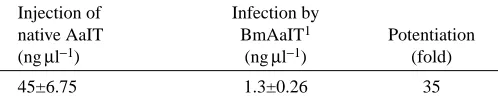
Our purpose being strictly agrotechnical, a recombinant baculovirus encoding the AaIT gene was constructed for use in insect pest control. Lepidopterous larvae infected with an AaIT-expressing recombinant baculovirus (RV), when compared to a wild-type virus (WV), show a significant reduction of survival time and amount of host plant damage (Cory et al., 1994; Maeda et al., 1991; McCutchen et al., 1991; Stewart et al., 1991). The expressed toxin found in the hemolymph of the infected insect: (i) is chemically identical to the native toxin (McCutchen et al., 1991; Stewart et al., 1991), (ii) mimics the native toxin’s symptoms of paralysis (McCutchen et al., 1991; Stewart et al., 1991), and (iii) requires a much lower hemolymph titer then the injected native toxin to induce a similar paralysis (Maeda et al., 1991; McCutchen et al., 1991; Table 1). The latter phenomenon, the enhanced effectiveness of the expressed toxin, is referred to as toxin potentiation.
Herrmann et al. (Herrmann et al., 1990; Herrmann et al., AaIT, an insect-selective neurotoxic polypeptide derived
from scorpion venom, has recently been used to engineer recombinant baculoviruses for insect pest control. Lepidopterous larvae infected with an AaIT-expressing baculovirus reveal symptoms of paralysis identical to those induced by injection of the native toxin. However, the paralyzed larvae treated by the recombinant virus possess an approximately 50-fold lower hemolymph toxin concentration than insects paralyzed by the native toxin. The mechanism of this potentiation effect was studied using immunocytochemistry, electrophysiology and toxicity assays. (i) Light microscopy, using peroxidase-conjugated antibodies, revealed the presence of toxin in virus-susceptible tissues, including tracheal epithelia located close to the central nervous system and beyond its lamellar enveloping sheath. (ii) High-resolution immunogold electron microscopical cytochemistry clearly revealed the presence of recombinant AaIT toxin inside
the thoracic and abdominal ganglia on neuronal cell bodies and axonal membranes. (iii) Ventral nerve cords dissected from silkworm larvae infected with the recombinant baculovirus exhibited a high degree of excitability, expressed as enhanced frequency and bursting mode of their spontaneous activity, when compared to nerve cords infected with the wild-type virus. We conclude that the recombinant-virus-infected tracheal epithelia, outbranching in the body of an infected insect, (i) locally supply a continuous, freshly produced toxin to its neuronal receptors and (ii) introduce the expressed toxin to the insect central nervous system, thus providing it with critical target sites that are inaccessible to the native toxin.
Key words: AaIT, CNS targeting, cooperativity, recombinant baculovirus, toxin potentiation.
Summary
1995) showed that the paralyzing doses (PD50) of injected AaIT for lepidopterous species such as the Egyptian cotton leafworm (Spodoptera littoralis) and tobacco budworm (Heliothis virescens) were 2.4 and 2.5µg 100 mg−1body mass, respectively. The onset of paralysis is indicated by spasmodic local contractions, which occur within 1 h of injection and progress to contraction of the body wall, which causes the larvae to shorten, and to complete immobility by 5–10 h postinjection (h.p.i.). Of special importance for the present study was the finding by McCutchen et al. (McCutchen et al., 1991) that if the toxin is delivered by oral infection with the recombinant baculovirus, paralysis is achieved while hemolymph concentrations are in the range 1 ngµl−1, as compared to a mean concentration of 70 ngµl−1at the PD50 for the injected toxin (Herrmann et al., 1995). As shown in Table 1, a similar potentiation was demonstrated in the present study in silkworm larvae infected with the recombinant Bombyx mori AaIT-expressing virus (BmAaIT). The present study examines the mechanism of this potentiation.
Preliminary observations revealed that infection with WV does not significantly affect the insect’s susceptibility to injected native toxin (data not shown). Therefore the assumption that the above potentiation is a consequence of a pharmacokinetic, targeting, cooperativity between the RV and its expressed toxin provides the working hypothesis of the present study.
Materials and methods
Toxin
The insect selective excitatory neurotoxin, AaIT, was isolated and purified from the venom of the North African scorpion Androctonus australis Hector by molecular exclusion and ion-exchange chromatography, according to a published procedure (Zlotkin et al., 1971b).
Baculovirus
Two kinds of genetically modified Bombyx mori nuclear
polyhedrosis baculoviruses (BmNPV), kindly provided by Prof. S. Maeda (Entomology, UC Davis, USA), were employed in the present study. The first was the strain designated BmM14, which is polyhedra deficient but mimics the pathology of WV when injected to silkworm larvae. The second was the recombinant virus BmAaIT (Maeda, 1989; Maeda et al., 1991).
Experimental insects
Silkworm larvae B. mori were bred at 28 °C on artificial diet according to the method of Marumoto et al. (Marumoto et al., 1987). Silkworm eggs were kindly provided by Katakura Industries (Tokyo, Japan). Larvae of the blowfly Sarcophaga falculata were bred in the laboratory.
Toxicity assays
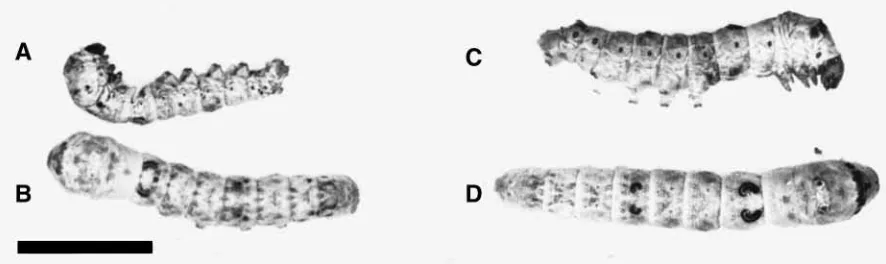
In order to monitor the toxicity of native and newly formed recombinant AaIT (Table 1), a sensitive assay that monitors a fast and transient paralysis (within seconds) of blowfly larvae, yielding the contraction paralysis unit (CPU) (Zlotkin et al., 1971a), was used. The second assay was aimed at quantifying the toxic potency of AaIT to silkworm larvae, monitoring the relatively slow, progressive paralysis process of Lepidopterous larvae (inability to move when mechanically stimulated or inability to turn to a normal position when inverted; see Fig. 1) yielding the paralytic unit (PD50) (Herrmann et al., 1990). Both assays are based on subcuticular injection (1–5µl into the body cavity) and the 50 % end-point determination according to the method of Reed and Muench (Reed and Muench, 1938). 25–30 test animals were used per single assay. The blowfly larvae were observed for a response immediately following injection, while still mounted on the needle of the syringe (Hamilton, USA). Complete immobility in a contracted form lasting for about 5 s is considered as positive. The experimental silkworm larvae were placed in the standard artificial diet (see above) and observed for 24 h to determine the response.
Antibody
[image:2.612.81.524.75.207.2]Fixation was performed by perfusion of 10 ml of fixative solution (0.5 % glutaraldehyde, 4 % paraformaldehyde, 5 % sucrose, 1 % picric acid, 0.05 % CaCl2in 0.1 mol l−1cacodylate buffer, pH 7.4) through the body cavity of decapitated animals. This was followed by a dorsal cut through the insect’s cuticle and fixation for 1 h at room temperature (22–25 °C). The ventral nerve cord (VNC) and fat body tissues were then dissected and exposed for an additional fixation in the cold (4 °C) for 24 h. At this stage fixative was supplemented with one drop of 30 % H2O2per 10 ml. Tissues were dehydrated in a series of ascending concentrations of ethanol and a final step of xylene and then embedded in Paraplast. Sections 10µm thick from fat body, thoracic and abdominal ganglia were cut and mounted on gelatin-coated glass slides. Sections were subjected for immunocytochemistry using the VectaStain ABC kit (Vector laboratories, Inc. Burlingame, CA, USA) with avidin-conjugated secondary antibody and biotinylated horseradish peroxidase according to an attached protocol (Hsu et al., 1981). Visualization of bound anitbody was achieved by incubation in 5 mg ml−1 diaminobenzidine solution supplemented with 0.1 % H2O2.
Electron microscopy
VNCs for electron microscopy were processed as described for light microscopy, with the addition of a postfixation step using 1 % OsO4 for 45 min in the dark. Following the post-fixation step, VNCs were dehydrated in a series of ascending concentrations of ethanol and embedded in Epon resin blocks. Ultra-thin sections (0.1µm) obtained from thoracic and abdominal ganglia were collected on nickel grids. The post-embedding immunogold-labeling method was employed on the sections (using 12 nm diameter particles) (Castel et al., 1993). Following labeling, sections were stained with uranyl acetate and lead citrate and viewed using a Joel CX100 electron microscope.
Electrical recording
Dissection and processing of VNCs were performed, essentially, according to the method of Weeks and Truman (Weeks and Truman, 1984). Briefly, silkworm larvae were immobilized by cooling, opened along the dorsal midline and pinned upright on a wax block. The gut, fat body and entire body wall were removed. The intact VNC was bathed with saline consisting of (in mmol l−1): NaCl 6.5, KCl 33.5, MgCl2 16.2, CaCl2 13.6, dextrose 166.5, KHCO31.25, KH2PO41.25,
Results
Potentiation
The increased effectivity of the virally expressed recombinant AaIT when compared to injected native toxin in tobacco budworm larvae (McCutchen et al., 1991; Herrmann et al., 1995; see Introduction) was reexamined in the present study using silkworm larvae infected by recombinant virus BmAaIT or injected with the native toxin (Table 1). The results show that the comparison of recombinant and native toxin titers in the hemolymph of the paralyzed larvae (both assessed by an identical bioassay, based on the contraction paralysis of blowfly larvae; see Materials and methods and Zlotkin et al., 1971a) reveals a 35-fold potentiation. A possible effect of the hemolymph medium on toxin activity was excluded by confirming that incubation of the toxin in silkworm hemolymph rather than saline did not affect the toxin (data not shown). Identical information was previously obtained with Spodoptera hemolymph (Herrmann et al., 1990).
Histopathology
[image:3.612.318.567.559.609.2]The histology of tracheal epithelium and fat body from insects infected with the RV BmAaIT was compared to those of WV and mock-infected insects. The infected insects have a characteristic histopathology of hypertrophied cells with
Table 1. Hemolymph concentration of recombinant or native AaIT toxin in paralyzed silkworm larvae
Injection of Infection by
native AaIT BmAaIT1 Potentiation
(ngµl−1) (ngµl−1) (fold)
45±6.75 1.3±0.26 35
BmAaIT, Bombyx mori AaIT-expressing virus.
Samples of hemolymph were collected from several paralyzed larvae by cutting an abdominal leg. Hemolymph was diluted in saline
(0.65%) and the PD50value of the diluted hemolymph was measured
by the contraction paralysis assay on Sarcophaga larvae (see Materials and methods; Zlotkin et al., 1971a) and translated to toxin mass on the basis of its preliminary calibration in the presence of silkworm hemolymph (see text).
1Fourth-instar larvae were infected by injection of 105
plaque-forming units of BmAaIT virus.
swollen nuclei (Fig. 2C–E). Immunocytochemistry confirmed the expression of AaIT in RV-infected cells (Fig. 2D,H,I). These findings are in accordance with early histopathology examinations of lepidopterous larvae infected by baculoviruses (Harpaz and Zlotkin, 1965; Tanada and Kaya, 1993) showing that hemocytes, tracheal epithelium, epidermis and fat body comprise the virus-susceptible tissues, which are responsible
for its systemic distribution in the body and its mass production.
Recombinant toxin in the CNS
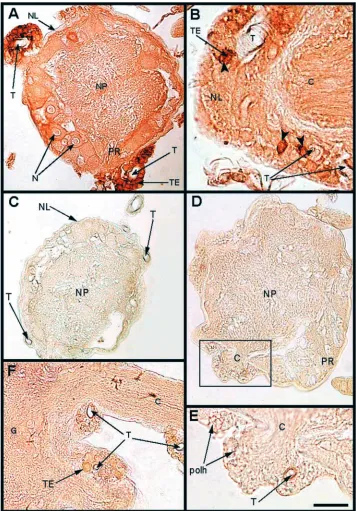
[image:4.612.107.502.71.510.2]the acellular, collagenous neural lamella and the cellular perineurium, composed substantially of gleal cells (Lane, 1974). Both layers are heavily tracheolated (Lane, 1974; Rothschild et al., 1986). Thus, the tracheal system surrounding the VNC is an integral part of the neural protective sheath. This aspect is demonstrated in Fig. 3B, which shows that the acellular neural lamella is enveloping the tracheae. Thus the anatomical and immunocytochemical information presented in
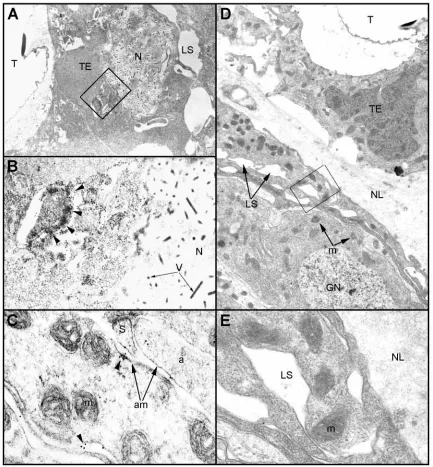
Fig. 3 suggests that the recombinant baculovirus provides the expressed toxin to the ventral nerve cord (VNC) by simply infecting the tracheal system located in the protective neural sheath. However, since the insect respiratory system is based on a separate supply of tracheae to individual cells, including centrally allocated neurons, the entire CNS is readily accessible to the recombinant toxin, as exemplified in Fig. 4, showing the presence of the recombinant toxin in the various inner part, the neuropile (NP). Note the
large trachea (T), which is an integral part of the neural lamella, and its epithelial cells (TE), filled with the recombinant toxin. (B) Small trachea (T) embedded within the neural lamella of the ganglion. The trachea is located at the site where the connective (C) attaches to the ganglion. Arrowheads indicate tracheal epithelial cells embedded in the neural lamella and show the presence of a recombinant AaIT. (C) An abdominal ganglion from a healthy larva fixed after being paralyzed by an injection of 3µg 100 mg−1 body mass of AaIT. The dissected CNS was processed for immunohistoctemistry (see E). The ganglion is devoid of any immunochemically detectable AaIT. (D) A ganglion derived from a larva that was orally infected by the wild-type virus BmNPV (1000 PBIs) and paralyzed by injection of 2µg 100 mg−1body mass of AaIT 48 h.p.i. The larva was fixed 6 h after injection, at a stage of advanced paralysis, and its CNS dissected and processed for LM immunohistochemistry (see Materials and methods). 10µm thick sections were incubated with the AaIT antibody. (E) An inset from the peripheral segment of the ganglion boxed in D, close to the connective (C) branching site. The ganglion is devoid of any immunochemically detectable traces of
[image:5.612.211.567.71.582.2]cellular elements of the CNS ganglia beyond the neural lamella, including a tracheal cell (Fig. 4A,B) and axonal membranes in the neuropile region (Fig. 4C).
Since the focus of this study was to define the difference between injected and virally produced AaIT it is essential to demonstrate that the injected toxin is not accessible to the CNS.
[image:6.612.86.519.71.538.2]This aspect has in fact been demonstrated in a series of control experiments, namely (i) demonstration of the specificity of the primary antibody (see Fig. 2G); (ii) absence of the injected AaIT in either peripheral (Fig. 2F) or CNS-allocated tissues (Fig. 3C–E and Fig. 4D,E) in healthy larvae (Fig. 3C, Fig. 4D,E) as well as in larvae infected by the wild-type virus (Fig. 3D,E).
Increased excitability of the CNS
The endogenous (spontaneous) electrical activity of an isolated VNC has been used in the past for behavioral (Roeder et al., 1960) and pharmacological (Neri et al., 1965) studies. In the present work we took advantage of the availability and technical simplicity of the above preparation. Our approach was based on the expectation that the presence of the recombinant toxin in the insect CNS should augment its excitability revealed by the increase of the extracellularly recorded spontaneous electrical activity. As shown below, this expectation was verified.
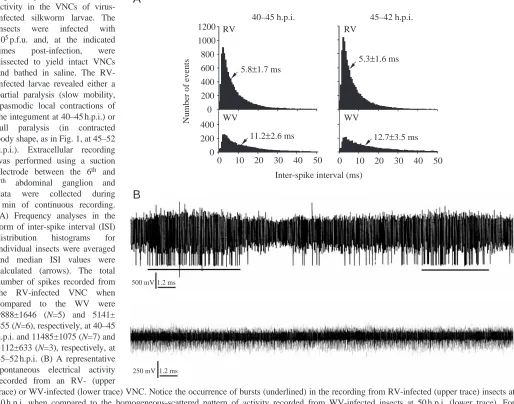
In these assays, four experimental groups of silkworm larvae each infected with 105plaque-forming units (p.f.u.) were used: WV infected, which were examined at 40–45 and 45–52 h post-infection (h.p.i.), both demonstrating normal mobility; and RV infected, examined at 40-45 h.p.i., revealing a slow motion and local spasmodic tremors, and at 45–52 h.p.i., when larvae were fully paralyzed in a contracted form (Fig. 1). The spontaneous
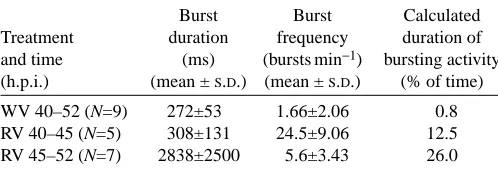
electrical activity (see Materials and methods) was recorded from the VNC of each experimental insect continuously for 5 min and analyzed by monitoring firstly, the inter-spike interval (ISI) (Fig. 5A) and secondly, the pattern of neuronal activity (namely the bursting characteristics) (Fig. 5B, Table 2). The RV has two main effects on the spontaneous electrical activity of the VNC. First there is an increase in the total number of the recorded electrical events (which was positively correlated to the degree of paralysis, Fig. 5A) and the reduction of the ISI median value, indicating an increase in the average frequency. Secondly, by changing the pattern of the electrical activity, from a random mode (as revealed by the WV infected VNC, Fig. 5B, lower trace) to a bursting mode in the RV infected insects (Table 2; Fig. 5B, upper trace). The bursting pattern has obtained two forms: more frequent bursts of short duration in the partially paralyzed insects and a low rate of bursts of longer duration, in the fully paralyzed insects (Table 2). In other words about 30 % of the recording time the full paralysis (in contracted
body shape, as in Fig. 1, at 45–52 h.p.i.). Extracellular recording was performed using a suction electrode between the 6th and 7th abdominal ganglion and data were collected during 5 min of continuous recording. (A) Frequency analyses in the form of inter-spike interval (ISI) distribution histograms for individual insects were averaged and median ISI values were calculated (arrows). The total number of spikes recorded from the RV-infected VNC when compared to the WV were 9888±1646 (N=5) and 5141± 855 (N=6), respectively, at 40–45 h.p.i. and 11485±1075 (N=7) and 5112±633 (N=3), respectively, at 45–52 h.p.i. (B) A representative spontaneous electrical activity recorded from an RV- (upper
trace) or WV-infected (lower trace) VNC. Notice the occurrence of bursts (underlined) in the recording from RV-infected (upper trace) insects at 50 h.p.i. when compared to the homogeneous-scattered pattern of activity recorded from WV-infected insects at 50 h.p.i. (lower trace). For technical reasons the amplitudes in such extracellular recordings are of no functional significance.
Inter-spike interval (ms) 0
200 400
0 10 20 30 40 50 0 10 20 30 40 50
11.2±2.6 ms 12.7±3.5 ms
B
250 mV 500 mV 1.2 ms
[image:7.612.53.567.82.486.2]VNC of RV infected, fully paralyzed, larvae is under a bursting mode of activity when compared to 1 % of bursting activity in non-paralyzed, freely mobile, WV-infected insect (Table 2).
Discussion
The choice of experimental approach for clarification of the RV-mediated potentiation phenomenon was directed by two pieces of previous information concerning the mechanism of AaIT-induced insect paralysis and AaIT-directed insect tolerance.
In the past a combination of electrophysiology (Walther et al., 1976) and microscopic autoradiography (Fishman et al., 1991) showed that the excitatory paralysis induced by AaIT is a consequence of a peripheral presynaptic effect on the neuromuscular junction. By the same methods it was shown that the VNC of cockroaches (D’Ajello et al., 1972; Fishman et al., 1991) and lepidopterous larvae (Herrmann et al., 1990) are impermeable to AaIT. However, once accessibility is experimentally provided by mechanical desheathing, AaIT is able to specifically bind to its receptors in the CNS (Fishman et al., 1991; Gordon et al., 1984; Gordon et al., 1985) and induce its typical repetitive firing (Pelhate and Zlotkin, 1981; Pelhate and Zlotkin, 1982). It was previously shown that the relative tolerance of lepidopterous larvae to AaIT is based on a combination of two separate factors. Firstly, there are difficulties of accessibility and availability (‘pharmacokinetic’), due to impermeability of the terminal motor branches and its degradation and elimination processes (Herrmann et al., 1990). Secondly, the lepidopteran receptor for AaIT binds the toxin more weakly, with a dissociation constant of the order of seconds, than that of highly susceptible insects such as the blowfly, which has a dissociation constant of the order of minutes (Fishman et al., 1997).
This tolerance mechanism, based on a combination of factors including metabolic inactivation, accessibility
problems and lability of the toxin-receptor complex (see Introduction), may be countered by a continuous supply of newly produced toxin in close proximity to its target sites. The present study reveals that the recombinant baculovirus serves as a local supplier of AaIT at a cellular distance from its natural target sites.
The second role that the RV fulfills in potentiating its expressed toxin is by providing the toxin with new critical, CNS-localized, target sites (Fig. 3, Fig. 4), which are inaccessible to the toxin through the natural route of scorpion envenomation. The functional significance of the virus-mediated presence of the recombinant toxin in the insects CNS was provided by the data in Fig. 5 and Table 2. These results indicate firstly, an increase in the spontaneous electrical activity (Fig. 5A) and secondly, its shift from a random mode such as occurs in the WV-infected VNC, to a bursting mode of electrical activity occurring in the RV-infected VNCs. However, since there is a small bursting component in the spontaneous activity in control animals (Table 2) the above stated homogeneous-scattered form should rather be termed ‘pseudorandom’. Both phenomena (the increase in frequency and the bursting) are correlated with the degree of paralysis (Table 2). We assume that the increased excitability of the infected VNCs is a reflection of the well-known action of AaIT on the voltage-gated sodium conductance (Pelhate and Zlotkin, 1981; Pelhate and Zlotkin, 1982; Walther et al., 1976).
The similarity in the symptoms of paralysis revealed by toxin-injected and RV-infected larvae (Fig. 1) follows from a presynaptic activation of skeletal muscles induced by AaIT (Walther et al., 1976). Thus, one can expect the same symptoms of paralysis regardless of whether the motor nerve is activated at its ganglionic segment or at the terminal branches. It is also noteworthy that the mechanism, which enables the recombinant toxin to affect the CNS, should similarly amplify its peripheral action.
[image:8.612.43.292.110.195.2]The next question refers to the manner by which the RV translocates its expressed toxin. This question is related to the process of systemic host infection produced by the budded form of a baculovirus. Engelhard et al. (Engelhard et al., 1994), employing Autographa californica multiple nuclear polyhedrosis virus (AcMNPV) containing a lacZ reporter gene, revealed that the major conduit for viral systemic infection, enabling its rapid spreading throughout the host insect, is supplied not by the hemocytes, but rather by the tracheal system, which is also accessible to external infection (Kirkpatrick et al., 1994). The latter conclusion was supported by a more recent study using a recombinant baculovirus expressing the green fluorescence protein (Barrett et al., 1998). The suitability of the tracheal system to guide the recombinant virus and its expressed neurotoxin follows from the fact that: (i) the tracheal system is distributed among the various tissues, is intimately associated with individual cells and is flexibly expanding and adapting itself to the growing organism by the aid of the tracheoblasts; (ii) the tracheoblasts cross the tissue-protective extracellular matrices (basal lamina), allowing the infecting virions to circumvent these barriers (Engelhard et al., 1994); (iii) the tracheal epidermis Table 2. The bursting nature of the spontaneous electrical
activity recorded from VNCs derived from baculovirus infected silkworm larvae
Burst Burst Calculated
Treatment duration frequency duration of
and time (ms) (bursts min−1) bursting activity
(h.p.i.) (mean ±S.D.) (mean ±S.D.) (% of time)
WV 40–52 (N=9) 272±53 1.66±2.06 0.8
RV 40–45 (N=5) 308±131 24.5±9.06 12.5
RV 45–52 (N=7) 2838±2500 5.6±3.43 26.0
Bursts were counted manually based on visual (using an oscilloscope with slow time base) and audio monitoring.
Burst duration is the average of at least three bursts from WV-treated VNCs and ten bursts from RV-WV-treated VNCs.
body of the baculovirus-infected insect. The spreading is performed through (i) the infection of existing tracheal epithelia, (ii) the branching of newly formed trachea from infected tracheoblasts, and (iii) the local release of the toxin from infected tracheal epithelia to their close surroundings in either the peripheral or the central nervous system.
We are grateful to the late Professor S. Maeda for providing the silkworm viruses and Mrs N. Feinstein and Dr L. Fishman for technical support in the EM studies. This work was supported by a grant of the Binational Agricultural Research and Development Foundation (BARD, IS2465-94) to E.Z.
References
Barrett, J. W., Brownwright, A. J., Primavera, M. J. and Palli, S. R.
(1998). Studies of the nucleopolyhedrosis infection process in insect by using the green fluorescence protein as a reporter. J. Virol. 72, 3377–3382.
Castel, M., Belenky, M., Cohen, S., Otterson, O. P. and Storm-Mathisen, J. (1993). Glutamate-like immunoreactivity in retinal terminals of the mouse
suprachiasmatic nucleus. Eur. J. Neurosci. 5, 368–381.
Cory, J. S., Hirst, M. L., Williams, T., Halls, R. S., Gouso, D., Carty, T. M., Possee, R. D., Cayley, P. J. and Bishop, D. H. L. (1994). Field trial
of genetically improved baculovirus insecticide. Nature 370, 138–140.
D’Ajello, V., Zlotkin, E., Miranda, F., Lissitzky, S. and Bettini, S. (1972).
The effect of scorpion venom and pure toxins on the cockroach central nervous system. Toxicon 10, 399–404.
Darbon, H., Zlotkin, E., Kopeyan, C., van Rietschoten, J. and Rochat, H.
(1982). Covalent structure of the insect toxin of the North African scorpion
Androctonus australis Hector. Int. J. Pept. Protein Res. 20, 320–330. Engelhard, E. K., Kam-Morgan, L. N., Washburn, J. O. and Volkman, L.
E. (1994). The insect tracheal system: a conduit for the systemic spread of Autographa californica M nuclear polyhedrosis virus. Proc. Natl. Acad. Sci. USA 91, 3224–3227.
Fishman, L., Herrmann, R., Gordon, D. and Zlotkin, E. (1997).
Insect tolerance to a neurotoxic polypeptide: pharmacokinetic and pharmacodynamic aspects. J. Exp. Biol. 200, 1115–1123.
Fishman, L., Kagan, M. L. and Zlotkin, E. (1991). Accessibility of the insect
nervus system to a neurotoxic polypeptide. J. Exp. Zool. 257, 10–23.
Gordon, D., Jover, E., Couraud, F. and Zlotkin, E. (1984). The binding of
the insect selective neurotoxin (AaIT) from scorpion venom to locust synaptosomal membranes. Biochim. Biophys. Acta 778, 349–358.
Gordon, D., Moskowitz, H., Eitan, M., Warner, C., Catterall, W. A. and Zlotkin, E. (1992). Localization of receptor sites for insect-selective toxins
on sodium channels by site-directed antibodies. Biochemistry 31, 7622–7628.
Gordon, D., Zlotkin, E. and Catterall, W. A. (1985). The binding of an insect
selective neurotoxin and saxitoxin to insect neuronal membranes. Biochim.
Biophys. Acta 821, 130–136.
Harpaz, I. and Zlotkin, E. (1965). A Nuclear-Polyhedrosis Virus of the
Safflower Leaf Worm Heliothis peltigera. Ann. Soc. Ent. Fr. 4, 963–972.
Herrmann, R., Fishman, L. and Zlotkin, E. (1990). The tolerance of
Maeda, S. (1989). Expression of foreign genes in insects using baculovirus
vectors. Ann. Rev. Entomol. 34, 351–372.
Maeda, S., Volrath, S. L., Hanzlik, T. N., Harper, S. A., Majima, K., Maddox, D. W., Hammock, B. D. and Fowler, E. (1991). Insecticidal
effects of an insect-specific neurotoxin expressed by a recombinant baculovirus. Virology 184, 777–780.
Marumoto, Y., Sato, Y., Fujiwara, H., Sakano, K., Saeki, Y., Agata, M., Furusawa, M. and Maeda, S. (1987). Hyperproduction of polyhedrin-IGF
II fusion protein in silkworm larvae infected with recombinant Bombyx mori nuclear polyhedrosis virus. J. Gen. Virol. 68, 2599–2606.
McCutchen, B. F., Choudary, P. V., Crenshaw, R., Maddox, D., Kamita, S. G., Palekar, N., Volrath, S., Fowler, E., Hammock, B. D. and Maeda, S. (1991). Development of a recombinant baculovirus expressing an
insect-selective neurotoxin: potential for pest control. Biotechnology (NY) 9, 848–852.
Neri, L., Bettini, S. and Frank, M. (1965). The effect of Latrodectus mactans tredecimguttatus venom on the endogenous activity of Periplaneta americana nerve cord. Toxicon 3, 95–99.
Pelhate, M. and Zlotkin, E. (1981). Voltage dependent slowing of the turn
off of Na+current in the cockroach giant axon induced by the scorpion
venom ‘insect’ toxin. J. Physiol. Lond. 319, 30–31.
Pelhate, M. and Zlotkin, E. (1982). Actions of insect toxin and other toxins
derived from the venom of the scorpion Androctonus australis on isolated giant axons of the cockroach (Periplaneta americana). J. Exp. Biol. 97, 67–77.
Reed, L. J. and Muench, S. (1938). A simple method of estimating
fifty-percent endpoint. Am. J. Hyg. 27, 493–497.
Roeder, K. D., Tozian, L. and Weiant, E. A. (1960). Endogenous nerve
activity and behaviour in the mantis and cockroach. J. Insect Physiol. 4, 45–52.
Rothschild, M., Schlein, Y. and Ito, S. (1986). A Color Atlas of Insect Tissues via the Flea, pp. 184. Wolfe Publishing Ltd.
Stewart, L. M., Hirst, M., Lopez Ferber, M., Merryweather, A. T., Cayley, P. J. and Possee, R. D. (1991). Construction of an improved baculovirus
insecticide containing an insect-specific toxin gene. Nature 352, 85–88.
Tanada, Y. and Kaya, H. K. (1993). Insect Pathology, pp. 666. San Diego:
Academic Press Inc.
Vaitukaitis, J. L. (1981). Immunochemical techniques, part B. In Methods in Enzymology, Vol. 73 (ed. J. J. Lanson and H. V. Vunkis), pp. 46–52. New
York: Academic Press.
Walther, C., Zlotkin, E. and Rathmayer, W. (1976). Action of different
toxins from the scorpion Androctonus australis on a locust nerve-muscle preparation. J. Insect Physiol. 22, 1187–1194.
Weeks, J. C. and Truman, J. W. (1984). Neural organization of
peptide-activated ecdysis behaviors during the metamorphosis of Manduca sexta. J.
Comp. Physiol. A 155, 407–422.
Zlotkin, E., Fraenkel, G., Miranda, F. and Lissitzky, S. (1971a). The effect
of scorpion venom on blowfly larvae – a new method for the evaluation of scorpion venom potency. Toxicon 9, 1–8.
Zlotkin, E., Moskowitz, H., Herrmann, R., Pelhate, M. and Gordon, D.
(1995). Insect sodium channel as a target for the insect-selective neurotoxins from scorpion venom. In Molecular Action of Insecticides on Ion Channels (ed. J. M. Clark), pp. 56–85. Washington DC: American Chemical Society.
Zlotkin, E., Rochat, H., Kopeyan, Miranda, F. and Lissitzky, S. (1971b).