Tone Activation and Tone Discrimination
John C. Strainer, John L. Ulmer, F. Zerrin Yetkin, Victor M. Haughton, David L. Daniels, and Steven J. Millen
PURPOSE: To use functional MR imaging to measure the effect of frequency (pitch), intensity (loudness), and complexity of auditory stimuli on activation in the primary and secondary auditory cortexes. METHODS: Multiplanar echo-planar images were acquired in healthy subjects with normal hearing to whom auditory stimuli were presented intermittently. Functional images were processed from the echo-planar images with conventional postprocessing methods. The stimuli included pure tones with a single frequency and intensity, pure tones with the frequency stepped between 1000, 2000, 3000, or 4000 Hz, and spoken text. The pixels activated by each task in the transverse temporal gyrus (TTG) and the auditory association areas were tabulated. RESULTS: The pure tone task activated the TTG. The 1000-Hz tone activated significantly more pixels in the TTG than did the 4000-Hz tone. The 4000-Hz tone activated pixels primarily in the medial TTG, whereas the 1000-Hz tone activated more pixels in the lateral TTG. Higher intensity tones activated significantly more pixels than did lower intensity tones at the same frequency. The stepped tones activated more pixels than the pure tones, but the difference was not significant. The text task produced significantly more activation than did the pure tones in the TTG and in the auditory association areas. The more complex tasks (stepped tones and listening to text) tended to activate more pixels in the left hemisphere than in the right, whereas the simpler tasks activated similar numbers of pixels in each hemisphere. CONCLUSION: Auditory stimuli activate the TTG and the association areas. Activation in the primary auditory cortex depends on frequency, intensity, and complexity of the auditory stimulus. Activation of the auditory association areas requires more complex auditory stimuli, such as the stepped tone task or text reading.
Index terms: Hearing; Magnetic resonance, functional
AJNR Am J Neuroradiol18:601–610, April 1997
Functional magnetic resonance (MR) imag-ing is a relatively new technique for detectimag-ing discrete areas of metabolic change within the brain resulting from neuronal activity. Indirect visualization of this neural activity is made pos-sible by the accompanying changes in regional cerebral blood flow (rCBF) and local blood
de-oxyhemoglobin concentration within the acti-vated cortex (1, 2). Functional MR imaging of-fers anatomic detail not available with positron emission tomography (PET) or other functional imaging techniques and more precise localiza-tion of activalocaliza-tion centers within the cerebral cortex. Investigators have shown the feasibility of using functional MR imaging to examine ce-rebral cortical activation in response to sensory, motor, and tactile stimuli (3– 6).
Recent studies with functional MR imaging have shown consistent signal changes within the superior temporal gyrus in response to var-ious auditory stimuli (7, 8). Thus far, these re-ports have described the effects of stimulus rates and content of auditory stimuli on the pat-tern of cortical activation from binaural stimuli. The focus of these efforts has been the function of auditory association areas in response to these stimuli. A recent investigation has
re-Dr Strainer received the Cornelius G. Dyke Memorial Award at the annual meeting of the American Society of Neuroradiology, Seattle, Wash, June 1996.
Received January 12, 1996, for Dyke award; received forAJNRApril 10; accepted after revision October 10.
From the Department of Radiology (J.C.S., J.L.U., F.Z.Y., V.M.H., D.L.D.), the Medical College of Wisconsin, Milwaukee, and Milwaukee Otologic (S.J.M.).
Address reprint requests to John L. Ulmer, MD, Department of Radiol-ogy, Medical College of Wisconsin, 9200 W Wisconsin Ave, Milwaukee, WI 53226.
AJNR 18:601–610, Apr 1997 0195-6108/97/1804 –0601
©American Society of Neuroradiology
vealed activation within the primary auditory cortex (transverse temporal gyrus [TTG]) in re-sponse to a simple pure tone stimulus (9). To date, the tonotopic organization of the primary auditory cortex and the effect of tone intensity on cortical activation have not been thoroughly studied by means of functional MR imaging techniques. The purpose of this study was to investigate the functional integration of the pri-mary auditory cortex and to develop tasks for probing both the primary and association areas of the auditory cortex. Specifically, our goal was to examine the effects of tone frequency, tone intensity, and tone complexity as they relate to activation within the auditory cortex.
Subjects and Methods
Subjects
Ten volunteers (three women and seven men, 22 to 32 years old) were studied. All subjects reported good health and no history of auditory abnormalities. All subjects were right-handed as determined by the Edinburg handedness inventory. Prior to testing, normal auditory thresholds were confirmed in all subjects. In accordance with institutional standards, all subjects gave written informed consent and received an hourly stipend for their participation. Subjects were positioned within the gantry after tightly occlusive ear plugs were placed to minimize ambient noise, and they were instructed not to move during image acquisitions.
Equipment and Scanning Procedure
A commercial 1.5-T scanner was used, equipped with a bird-cage prototype whole-volume echo-planar local
gra-dient three-axis head coil. An experimental program pro-vided a single-shot, blipped, echo-planar sequence with multisection or multirepetition capabilities with either a spin echo or gradient-echo. Chemical shift saturation was used before the excitation pulse to diminish ghost artifacts from the fat-containing tissues in the head.
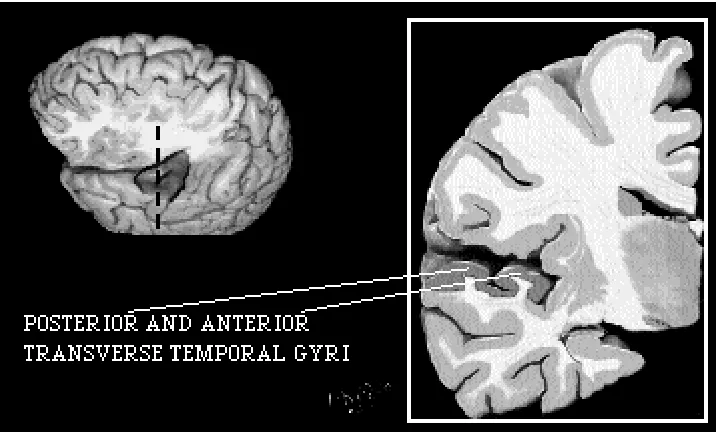
A series of localizer images was obtained in the sagittal and coronal planes. On the basis of these images, a coro-nal plane was selected (Fig 1) for obtaining the anatomic reference images upon which the functional data were superimposed. These anatomic reference images were ob-tained with parameters of 600/20/2 (repetition time/echo time/excitations), 24-cm field of view, 1283256 matrix, and 1-cm-thick sections.
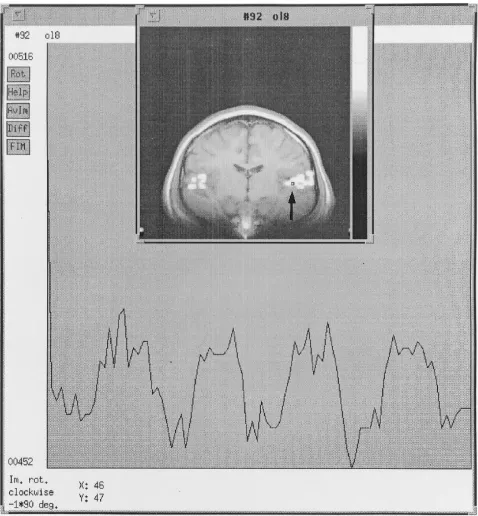
[image:2.587.189.547.84.300.2]Each functional image was generated from 90 images obtained in the selected plane at 2-second intervals. A series of 90 echo-planar images was collected, which con-sisted of four 20-second stimulation intervals, during which auditory stimuli were presented, alternating with four 20-second rest intervals, during which no auditory stimuli were presented (except ambient scanner noise). Technical parameters for the functional data acquisition included gradient echo-planar pulse sequences as follows: 2000/40, 64364 matrix, 24-cm field of view, and 1-cm-thick sections. The series of images was analyzed by view-ing the images consecutively in cine mode to determine whether the volunteer moved. If significant motion oc-curred, images for that task were not included in the data set. The time course of the signal intensity within each pixel over 180 seconds was plotted and compared with a reference pixel by means of an n-dimensional vector cross-correlation program. For each task, only those pix-els with clear, temporally correlated signal increases were considered to be activated and subsequently selected for referencing (Fig 2). Pixels that cross-correlated signifi-cantly with the reference pixel (P,.0001) were displayed in the functional images as activated pixels. The activated Fig 1. Illustration of the TTG
pixels in the functional image were then overlayed on the exactly corresponding coronal anatomic reference images by means of the image processing program. Regional ac-tivation was calculated as the number of pixels activated in the TTG, which encompasses the primary auditory cortex. Activated pixels were also assessed in the adjacent asso-ciative auditory cortex. The region of interest in which pixels were counted was identical for each subject.
Auditory Stimuli
Auditory stimuli were as follows: (a) pure tones of con-stant intensity (20 or 50 dB above threshold) and fre-quency (1000, 2000, 3000, or 4000 Hz) in separate series of pulsed tones; (b) pure tones of constant intensity vary-ing stepwise in frequency between 1, 2, 3, and 4 kHz; and (c) written text read to the subject at constant sound in-tensity (50 dB above threshold). Auditory stimuli during each functional imaging series were delivered in four 20-second intervals alternating with five 20-20-second rest inter-vals. The presentation of separate tone series was coun-terbalanced to minimize the effects of habituation or learning. Pure tones were generated by a calibrated audi-ometer. All auditory stimuli were delivered monaurally to
the right ear via an air conduction speaker system equipped with a pair of plastic tubes 4 ft in length. Detec-tion thresholds were established separately for text reading and for each frequency tone. In each subject, stimuli were delivered at intensities that were 20 or 50 dB above the subject’s threshold or sensation level (SL) (ie, 20 or 50 dB SL). Thresholds were determined with the subject in the gantry during scanner operation with the associated am-bient scanner noise present.
Results
Pure Tone Activation of the Primary Auditory Cortex
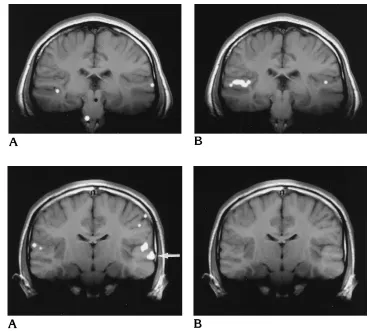
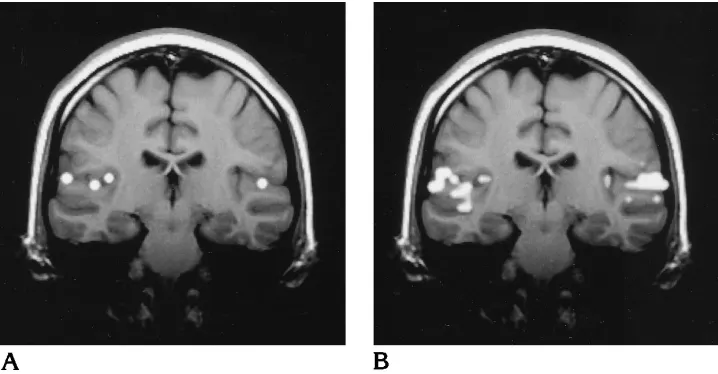
In all 10 subjects, pixels were activated over background levels in the region corresponding to the TTG after pure tone stimulation of 1000 Hz at 50 dB SL. On the other hand, only four of six subjects showed activation at a pure tone intensity of 20 dB SL. For 12 TTGs in six sub-jects, the mean number of pixels activated with a 20-dB SL stimulus was 4.3 compared with 11.0 with 50 dB SL, indicating a significantly greater neuronal response to the higher inten-sity (P,.05) (Fig 3). There was no significant difference between right and left TTG activation to pure tone stimuli, despite the fact that all tones were delivered monaurally to the right ear.
Primary Auditory Cortex: Response to Different Frequencies
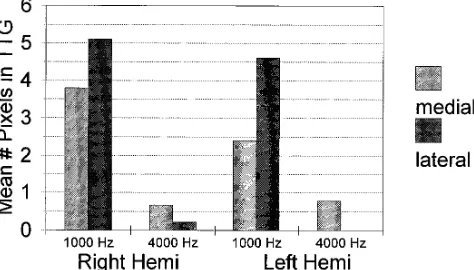
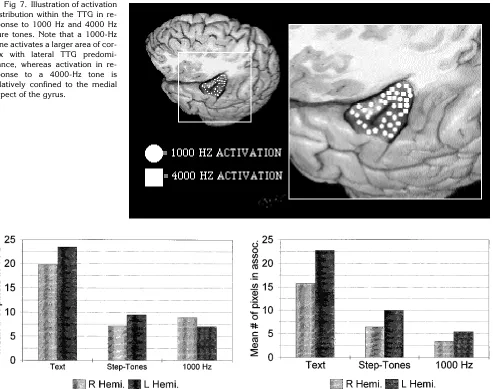
Our findings indicate an affinity of the pri-mary auditory cortex for tones in the lower (1000 to 2000 Hz) frequency range relative to tones in the higher (3000 to 4000 Hz) frequency range under our experimental conditions. This effect is illustrated in Figure 4, in which the number of pixels activated within the TTG is greater in response to 1000 Hz than to 4000 Hz. While all subjects showed TTG activation to a 1000-Hz tone stimulus, activation was detected in only 50% of subjects at 4000 Hz. Figure 5 illustrates a graded increase in activation of the TTG as tones of decreasing frequency were pre-sented, resulting in a significantly greater num-ber of pixels activated at 1000 Hz than at 4000 Hz (P ,.01).
[image:3.587.50.289.84.342.2]Analysis of tonotopic organization was per-formed by comparing the location of activation from low-frequency tones with high-frequency tones. For the 1000-Hz tone, the proportion of activated pixels in the lateral half of the TTG
was on average 67%. For the 4000-Hz tone, the proportion of activated pixels in themedialhalf of the TTG was 83%. Figures 6 and 7 illustrate this tonotopic distribution with predominant lat-eral activation following low-frequency stimula-tion and medial activastimula-tion with higher frequency tones.
Auditory Cortex: Stepped Frequencies
Delivery of stepwise increasing tones from 1000 to 4000 Hz resulted in TTG activation similar to that shown with single pure tone stim-uli (Fig 8). However, an increased total area of activation occurred when cortical areas outside the TTG were considered. These additional ar-eas of incrar-eased activity were located in adja-cent cortex, clearly separate from the primary auditory cortex. These regions have previously been designated as theassociation auditory cor-texand their activation here may be an indicator of functional tone discrimination. Although the increased activation of the association cortex to stepped tones was not statistically different
from that seen in response to pure tone stimuli, a definite trend was observed (Fig 9). A nonsig-nificant trend of dominant (left) hemisphere ac-tivation in the association cortex was also ob-served (Fig 9).
Auditory Cortex: Text Listening
As with stepwise tone delivery, listening to text also resulted in activation of not only the primary auditory cortex but also of the sur-rounding areas of association cortex. The area of activation in both the TTG (Fig 8) and the association cortex (Fig 9) was significantly greater than that seen with any other task (P ,
.05) (Fig 10), including the stepped frequen-cies. A graded activation response was noted with text listening, which activated more asso-ciation cortex than stepped tones, which in turn activated more than separate pure tones. As with the stepped tones stimulus, a nonsignifi-cant trend toward activation of the dominant (left) hemisphere association cortex was ob-served in response to listening to text (Fig 9).
Fig 3.A, Coronal section through the TTG shows no detect-able TTG activation in response to a 1000-Hz tone at 20 dB SL.
B, Image obtained from the same subject shows pronounced cortical activation within the right TTG and a small amount of acti-vation within the left TTG after de-livery of a 1000-Hz pure tone at 50 dB SL.
Fig 4.A, Coronal section shows prominent left and mild right cortical activation within the region of the TTG in response to a 1000-Hz pure tone (arrow indi-cates activity more inferiorly in ar-eas of auditory association cortex of the left temporal lobe).
[image:4.587.180.550.81.416.2]Discussion
The auditory cortex has been the subject of numerous investigations in both humans and animals. In 1937, Kornmuller (10) mapped the auditory cortex in cats by recording electrical responses to acoustical stimulation. Further pathologic and animal studies showed the com-plexity of the auditory cortex microstructure and its processing of auditory stimuli (11–13). In 1968, Braak (14) recorded human electrical responses to auditory stimuli in the lateral tem-poral lobe. Subsequently, efforts by Celesia and others (15–17) have obtained electrical re-sponses directly from the human primary audi-tory cortex within the TTG (Heschel’s gyrus) as well as from the posterosuperior temporal lobe and frontoparietal opercular regions. These
lat-ter areas of cortex have since been shown to play a role in associative auditory processing in animal species and humans (18 –20).
More recently, newer imaging techniques, such as PET and functional MR imaging, have been used to study cerebral activation in re-sponse to specific motor and sensory stimuli in vivo (21–28). Responses of the auditory cortex (ie, changes in rCBF) during a variety of listen-ing tasks, includlisten-ing rhythm sequences (29), tone sequences (30), single words (31), word lists, and tone intensity discrimination (32), have been evaluated with PET. However, these studies were limited by their inability to measure rCBF within the deep cortical regions (ie, TTG). The functional organization of the primary au-ditory cortex and surrounding areas of associa-tive auditory cortex have since been studied by others (33–37).
The feasibility of using functional MR imaging to evaluate the primary auditory cortex has re-cently been described (7–9). The superior tem-poral gyrus is activated in the perception and processing of auditory stimuli. Specifically, cor-tical activation from within the superior tempo-ral gyrus has been described in response to nonspeech noise, meaningless speech noise, single words, pure tone stimulation, and text reading.
[image:5.587.50.290.83.240.2]The results described in our investigation fur-ther substantiate the feasibility and usefulness of functional MR imaging in the evaluation of the complex functional organization within the pri-mary and association auditory cortex. Activa-tion localized to the TTG was greater in re-sponse to lower frequency tones than to higher frequency tones. While it is possible that this result was a function of our experimental con-ditions (ie, ambient scanner noise), there was no difference in detection thresholds across the range of pure tone frequencies delivered to our volunteers, and therefore all tones were deliv-ered at a constant intensity level. Thus, this finding could suggest an increased sensitivity of the primary auditory cortex to lower frequency stimuli, or it may indicate less efficient process-ing of low-frequency tones with a subsequently increased level of vascular recruitment. The preferential response of individual cochlear nerve cells to a specific sound frequency, known as characteristic frequencies, has been described (38). This spatial organization within the cochlear apparatus enables appropriate re-sponses to the full audible range of frequencies
Fig 5. Mean number of pixels activated within the right and left TTG in response to a variable range of frequencies from 1000 Hz to 4000 Hz (n59). Note that low-frequency pure tones result in significantly increased activation bilaterally within the TTG compared with higher frequency pure tones.
[image:5.587.51.288.309.444.2]perceived by humans (20 to 20 000 Hz). While it is known that the ear has an increased sensi-tivity to sounds between 500 and 8000 Hz, no preferential cortical response to specific frequencies within this range has yet been described in humans. The mechanism and sig-nificance of this greater activation with low-fre-quency tones seen in our investigation are un-certain and remain to be elucidated. However, our findings indicate that future research and clinical evaluation into the primary auditory cortex using similar methods would be opti-mized at frequencies near 1000 Hz.
Our results show a tonotopic relationship within the TTG, supporting early histologic,
[image:6.587.57.550.83.472.2]evoked potential, magnetoencephalographic, and PET studies (15, 39 – 41). We found pre-dominant activation within the lateral portion of the TTG with lower frequency tones (1000 Hz) and a relative confinement of activity to the medial portion of Heschel’s gyrus upon stimu-lation with higher frequency tones (4000 Hz). The structural tonotopic array of neurons within the cochlear apparatus is maintained in the complex neural pathways of the central audi-tory centers (42). This tonotopic organization was described by Woolsy et al (43) in 1943 and
Fig 7. Illustration of activation distribution within the TTG in re-sponse to 1000 Hz and 4000 Hz pure tones. Note that a 1000-Hz tone activates a larger area of cor-tex with lateral TTG predomi-nance, whereas activation in re-sponse to a 4000-Hz tone is relatively confined to the medial aspect of the gyrus.
Fig 8. Mean number of pixels activated within the right and left TTG in response to variable task stimulation. Note that while no significant difference in activation is seen between 1000-Hz pure tones (n59) and stepped tones (n57), listening to text (n59) results in significantly increased activity within both the right and left TTG relative to the other auditory tasks.
has also been demonstrated in recent PET stud-ies (21). Functional MR imaging, with its ability to detect this relationship, provides an addi-tional noninvasive means for probing the func-tional microstructure of the primary auditory cortex and should have even greater potential as higher resolution fast imaging techniques are developed. These findings suggest that patho-logic states affecting various frequency re-sponses within the auditory centers may be studied in the future with functional MR imaging. Larger areas of activation were also noted within the primary auditory cortex in response to auditory stimuli of increasing intensities. To date, this relationship has not been demon-strated with PET imaging. Future technical re-finements in functional MR imaging may further improve temporal and spatial resolution and al-low for even greater definition of sound ampli-tude response within the primary auditory cor-tex. The ear is not equally sensitive to all frequencies. Greater intensities are required to reach threshold at the lower and higher ends of the frequency scale than in the medium range (500 to 8000 Hz). However, the fact that less cortical activation was detected with the lower intensity tones most likely reflects the threshold criteria used in our study rather than a true lack of activation from such intensities. We investi-gated a limited range of sound intensities (20 dB SL and 50 dB SL) and frequencies (1000 Hz). The extent to which the combined effects of frequency and intensity variables affect activa-tion is an addiactiva-tional subject for further research with the use of similar functional MR imaging methodology.
The sequencing of four tones produced greater activation than did the individual tones presented separately. In particular, greater ac-tivation was noted in the auditory association cortex with the presentation of the stepped fre-quency tone series than with the pure tone stim-ulus. The presentation of spoken text showed even greater activation outside the primary au-ditory cortex than did stepped tones. Our results are in agreement with previous studies using auditory evoked potentials, which showed greater auditory cortical responses from modu-lated tones than from steady tones (44). Addi-tionally, previous PET and functional MR imag-ing studies have shown activation localized to the TTG in response to nonspeech (white) noise, whereas more widespread cortical acti-vation has been detected in response to speech (8, 45). Tone stimuli delivered rhythmically also resulted in rCBF increases in auditory associa-tion areas within the superior temporal gyrus (29). Findings in our study offer further evi-dence to support the hypothesis that the asso-ciation cortex is active in tone discrimination. A greater variety of frequencies should be studied. Additionally, studying activation patterns in musicians and nonmusicians may help us un-derstand the organization of auditory process-ing.
[image:7.587.49.408.84.271.2]The finding that spoken text results in greater activation in areas of association cortex than that produced by nonverbal cues may be attrib-uted to the cognitive processing required in the analysis of spoken words (21, 44, 46). In the-ory, then, the finding may be due to the activa-tion of addiactiva-tional areas of cortex known as the
Fig 10. A, Coronal image ob-tained through the TTG after acti-vation with a 1000-Hz pure tone delivered at 50 dB SL. Note the activation localized primarily to the TTG bilaterally.
semantic system (47–50), which requires pro-cess activation and implementation of previ-ously learned meaningful phenomes, word groups, and associations. These cognitive pro-cesses may occur without the subject’s aware-ness (51, 52). Another explanation for these findings is that the modulation present within spoken text is processed at a higher level within the auditory association cortex than are non-word stimuli. Future investigations of the pat-terns of brain activation in response to verbal and nonverbal stimuli may illuminate the cog-nitive pathways used in the processing of se-mantic stimuli.
Several authors have described relationships between monaural or binaural stimulation as it relates to sidedness of cortical stimulation. Re-sults in this area have been inconsistent from investigation to investigation. Some reports show increased contralateral temporal lobe ac-tivation with monaural stimulation (17–27, 29 –33, 35, 53, 54). Nishizawa et al (55) showed a left hemispheric activation dominance in response to speech stimuli and a right-sided dominance with nonverbal stimuli. Other investigators, us-ing both PET and functional MR imagus-ing tech-niques, have shown no significant difference in symmetry of cerebral activation (7, 34). Our results agree with these later findings in that they showed no significant asymmetry in TTG activation, although a trend toward left-domi-nant association cortex activation was seen with the presentation of increasingly complex stim-uli. Nevertheless, the reason for these discrep-ancies in the literature remains unknown. Sym-metry of cerebral activation may in part be determined by stimulus content and/or mode of presentation. Additionally, the variability of im-aging techniques in terms of their capacity to effectively quantitate activation magnitude may play a role in contributing to these apparent inconsistencies. Future work should help eluci-date the various factors affecting symmetry of brain activation.
Our results demonstrate the usefulness of functional MR imaging in investigating the func-tional anatomy and processing pathways of the primary auditory cortex. Future studies should produce higher spatial resolution and better de-fine the optimal methods for probing the audi-tory cortex. The clinical application of these techniques should be considered. Theoretical uses include differentiation of functional from nonorganic hearing loss and central from
pe-ripheral hearing loss. Additionally, functional MR imaging may prove useful in preoperative testing of cochlear implant patients. Since this imaging technique avoids the subjectivity inher-ent in audiometric testing, it may also prove useful in the evaluation of psychogenic auditory disorders.
In conclusion, we have shown the feasibility of using functional MR imaging to assess the functional organization of the primary auditory cortex. With the use of simple auditory stimuli, we showed greater primary auditory cortex ac-tivation in response to tones of increasing inten-sity. Additionally, increased activation of the primary auditory cortex to tones of lower
fre-quency (;1000 Hz) was shown, as was the
tonotopic organization within the primary audi-tory cortex. Areas of activation were described outside the primary auditory cortex within gions of the auditory association cortex in re-sponse to graded/stepwise frequency tones and spoken text. Future investigations are expected to produce refinements in technique and further information regarding the functional organiza-tion of the primary auditory cortex.
Acknowledgment
We thank Jane Harmeyer for her assistance.
References
1. Bandettini PA, Wong EC, Hinks RS, Tikofsky RS, Hyde HS. Time course EPI of human brain function during task activation.Magn Reson Med1992;25:390 –397
2. Kwong KK, Belliveau JW, Chesler DA, et al. Dynamic magnetic resonance imaging of human brain activity during primary sen-sory stimulation.Proc Natl Acad Sci U S A1992;89:5675–5679 3. Belliveau JW, Kennedy DN, McKinstry RC, et al. Functional
map-ping of the human visual cortex by magnetic resonance imaging.
Science1991;254:716 –719
4. Menon RS, Ogawa S, Kim S-G, et al. Functional brain mapping using magnetic resonance imaging: signal changes accompany-ing visual stimulation.Invest Radiol1992;27(Suppl 2):S47–S53 5. Belliveau JW, Kwong KK, Kennedy DN, et al. Magnetic resonance
imaging mapping of brain function: human visual cortex.Invest Radiol1992;27(Suppl 2):S59 –S65
6. Yetkin FZ, Mueller WM, Hammeke TA, et al. Functional magnetic resonance imaging mapping of the sensorimotor cortex with tac-tile stimulation.Neurosurgery1995;36:921–925
7. Binder JR, Rao SM, Hammeke TA, et al. Functional magnetic resonance imaging of human auditory cortex.Ann Neurol1994; 35:662– 672
8. Binder JR, Rao SM, Hammeke TA, et al. Effects of stimulus rate on signal response during functional magnetic resonance imaging of auditory cortex.Cogn Brain Res1994;2:31–38
10. Kornmuller AE. Lokalistationslehr Odor Ganshelt Des Zentralne-ruensystems.Neurol u Psychiatr1937;158:244 –246
11. Braak H. The pigment architecture of the human temporal lobe.
Anat Embryol1978;154:213–240
12. Galaburda A, Sanides F. Cytoarchitectonic organization of the human auditory cortex.J Comp Neurol1980;190:597– 610 13. Morel A, Kaas JH. Subdivisions and connections of auditory
cor-tex in owl monkeys.J Comp Neurol1992;318:27– 63
14. Braak E. Ultrastructure of the small pigmented stellate cell in lamina II of the human isocortex [in German]. Verh Anat Ges
1977:71:949 –952
15. Celesia GG. Organization of auditory cortical areas in man.Brain
1976;99:403– 414
16. Celesia GG, Puletti F. Auditory cortical areas of man.Neurology
1969;19:211–219
17. Liegeois-Chauvel C, Musolino A, Chauvel P. Localization of the primary auditory area in man.Brain1991;114:139 –153 18. Brugge JF. Auditory cortex in the primate. In: Woolsey CN, ed.
Cortical Sensory Organization. Multiple Auditory Areas.Clifton, NJ: Humana Press; 1982;3
19. Imig TJ, Reale RA, Brugge JF. The auditory cortex. Patterns of corticocortical projections related to physiological maps in the cat. In: Woolsey CN, ed.Cortical Sensory Organization. Multiple Auditory Areas.Clifton, NJ: Humana Press; 1982;3
20. Creutzfeldt O, Ojemann G, Lettich. Single neuron activity in the right and left human temporal lobe during listening and speaking. In: Engel J Jr, ed. Fundamental Mechanisms of Human Brain Function. New York, NY: Raven Press; 1987:69 – 81
21. Lauter JL, Herscovitch P, Formby C, et al. Tonotopic organization in human auditory cortex revealed by positron emission tomog-raphy.Hear Res1985;20:199 –205
22. Roland PE, Skinhoj E. Focal activation of the cerebral cortex during visual discrimination in man.Brain Res1981;222:166 –171 23. Price C, Wise R, Ramsay S, et al. Regional response differences
within the human auditory cortex when listening to words. Neuro-sci Lett1992;146:179 –182
24. Fox PT, Raichle ME. Stimulus rate dependence of regional cere-bral blood flow in human striate cortex, demonstrated by positron emission tomography.J Neurophysiol1984;51:1109 –1120 25. Fox PT, Raichle ME. Stimulus rate determines regional brain
blood flow in striate cortex.Ann Neurol1985;17:303–305 26. Mazziotta JC, Phelps ME, Carson RE, et al. Tomographic mapping
of human cerebral metabolism: subcortical responses to auditory and visual stimulation.Neurology1984;34:825– 828
27. Bartlett EJ, Brown JW, Wolf AP, et al. Correlation between glu-cose metabolic rates in brain regions of healthy male adults at rest and during language stimulation.Brain Lang1987;32:1–18 28. Rao SM, Binder JR, Bandettini PA, et al. Functional magnetic
resonance imaging of complex human movements. Neurology
1993;43:2311–2318
29. Roland PE, Skinhoj E, Lassen NA. Focal activations of human cerebral cortex during auditory discrimination. J Neurophysiol
1981;45:1139 –1151
30. Roland PE, Larsen B, Skinhoj E, et al. Regional cerebral blood flow increase due to treatment of somatosensory and auditive infor-mation in man. In: Meyer JS, Lechner H, Reivich M, eds.Cerebral Vascular Disease. Amsterdam, the Netherlands: Excerpta Medica; 1974:540 –541
31. Larsen B, Skinhoj E, Soh K, et al. The pattern of cortical activity provoked by listening and speech revealed by rCBF measure-ments. In: Ingvar DH, Lassen NA, eds.Cerebral Function Metab-olism and Circulation. Copenhagen, Denmark: Munksgaaard; 1975;56:268 –269
32. Knopman DS, Ruben AB, Klassen AC, et al. Regional cerebral blood flow patterns during verbal and non-verbal auditory activa-tion.Brain Lang1980;9:93–112
33. Greenberg JH, Reivich M, Alavi A, et al. Metabolic mapping of functional activity in human subjects with the [18F]fluorodeoxy-glucose technique.Science1981;212:678 – 680
34. Mazziotta JC, Phelps ME, Carson RE, et al. Tomographic mapping of human cerebral metabolism: auditory stimulation.Neurology
1982;32:921–937
35. Greenberg JH, Reivich M, Alavi A, et al. Metabolic mapping of functional activity in human subjects with the [18
F]fluorodeoxy-glucose technique.Science1981;212:678 – 680
36. Reivich M, Greenberg J, Alavi A, et al. The use of the 18F-fluorodeoxyglucose technique for mapping of functional neural pathways in man.Acta Neurol Scand1979;72(Suppl):198 –199 37. Petersen SE, Fox PT, Posner MI, et al. Positron emission
tomo-graphic studies of the cortical anatomy of single-word processing.
Nature1988;331:585–589
38. Liberman MC. The cochlea frequency map for the cat: labeling auditory-nerve fibers of known characteristic frequency.J Acoust Soc Am1982;72:1441
39. Roland PE. Language. In: Roland PE.Brain Activation. New York, NY: Wiley-Liss; 1993:158 –163
40. Liegeois-Chauvel C, Musolino A, Badier JM, Marquis P, Chauvel P. Evoked potentials recorded from the auditory cortex in man: evaluation and topography of the middle latency components.
Electroencephalogr Clin Neurophysiol1994;92:204 –214 41. Romani GL, Kaufman L. Tonotopic organization of the human
auditory cortex.Science1982;216:1339 –1340
42. Brugge JF. Neurophysiology of the central auditory and vestibular systems. In: Paparella MM. Otolaryngology. Philadelphia, Pa: Saunders; 1991;1:281–301
43. Woolsey CN, Marshall WH, Baird P. Note on organization of tactile sensory area of cerebral cortex of chimpanzee.J Neurophysiol
1943;6:287–291
44. Zatorre RJ, Evans AC, Meyer E, et al. Lateralization of phonetic and pitch discrimination in speech processing.Science1992;256: 846 – 849
45. Momose T, Sasaki Y, Nishikawa J, et al. Functional brain studies with H2(15)O-PET: Strategies and problems for approaching higher brain functions with H2(15)O-PET.Radiat Med 1991;9: 122–126
46. Wise R, Chollet F, Hadar U, et al. Distribution of cortical neural networks involved in word comprehension and word retrieval.
Brain1991;114:1803–1817
47. Sidman M. Reading and auditory-visual equivalences.J Speech Hear Res1971;14:5–13
48. Tulving E. Episodic and semantic memory. In: Tulving E, Donald-son W, eds.Organization of Memory. New York, NY: Academic Press; 1972:381– 403
49. Rosch E. Cognitive representation of semantic categories.J Exp Psychol Gen1975;104:192–233
50. Shallice T. Specialisation within the semantic system.Cogn Neu-ropsychol1988;5:133–142
51. Carr TH, McCauley C, Sperber RD, et al. Words, pictures, and priming: on semantic activation, conscious identification, and the automaticity of information processing.J Exp Psychol Hum Per-cept Perform1982;8:757–777
52. Marcel AJ. Conscious and unconscious perception: experiments on visual masking and word recognition.Cogn Psychol1983;15: 197–237
53. Nishizawa Y, Olsen TS, Larsen B, et al. Left-right cortical asym-metries of regional cerebral blood flow during listening to words.
54. Kushner M, Schwartz R, Alavi A, et al. Cerebral activation by nonmeaningful monaural verbal auditory stimulation.Brain Res
1987;409:79 – 87
55. Nishizawa Y, Olson TS, Larsen B, et al. Left-right cortical
asym-metries of regional cerebral blood flow during listening to words.
J Neurophysiol1982;48:458 – 465
56. Duvernoy HM.The Human Brain: Surface, Three-Dimensional Sec-tional Anatomy and MRI. New York, NY: Springer-Verlag; 1991