FORUM AND ITS IMPLEMENTATION
Christian Urban
A Thesis Submitted for the Degree of MPhil
at the
University of St Andrews
1997
Full metadata for this item is available in
St Andrews Research Repository
at:
http://research-repository.st-andrews.ac.uk/
Please use this identifier to cite or link to this item:
http://hdl.handle.net/10023/13443
Christian Urban
March 13, 1997
Presented to the University of St Andrews in partial fuliilment of the requirements for the degree of Master of Philosophy.
Supervisor; Dr Roy Dyckhoff (St Andrews)
Examiners: Prof. Ursula Martin (St Andrews) Dr David Pym (London)
Oi?EAN
ProQuest Number: 10167180
All rights reserved
INFORMATION TO ALL USERS
The qua lity of this reproduction is d e p e n d e n t upon the qua lity of the copy subm itted.
In the unlikely e v e n t that the author did not send a c o m p le te m anuscript and there are missing pages, these will be noted. Also, if m aterial had to be rem oved,
a n o te will in d ica te the deletion.
ues
t
ProQuest 10167180
Published by ProQuest LLO (2017). C o pyright of the Dissertation is held by the Author.
All rights reserved.
This work is protected against unauthorized copying under Title 17, United States C o d e M icroform Edition © ProQuest LLO.
ProQuest LLO.
789 East Eisenhower Parkway P.Q. Box 1346
A bstract
Miller presented Forum as a specification logic: Forum extends several existing logic programming languages, for example AProlog, LO and Lolli. The crucial change in Forum is the extension from single succèdent sequents, as in intuitionistic logic, to multiple succèdent sequents, as in classical logic, with a corresponding extension of the notion of uniform proof.
I, Christian Urban, hereby certify that this thesis, which is approximately 26000 words in length, has been written by me, that it is the record of work carried out by me, and that it has not been submitted in any previous application for a higher degree.
date signature of candidate__
I was admitted as a research student in September 1995 and as a candidate for the degree of Master of Philosophy in September 1995; the higher study of which this is a record was carried out in the University of St Andrews between 1995 and 1996.
signature of candidate _
date
I hereby certify that the candidate has fulfilled the conditions of the Resolution and Reg ulations appropriate for the degree of Master of Philosophy in the University of St Andrews and that the candidate is qualified to submit this thesis in application for that degree.
date
I ^
9“
___ signature of supervisor __ _In submitting this thesis to the University of St Andrews I understand that I am giving permission for it to be made available for use in accordance with the regulations of the University Library for the time being in force, subject to any copyright vested in the work not being affected thereby. I also understand that the title and abstract will be published, and that a copy of the work may be made and supplied to any bona fide library or research worker.
A ck
now ledgem ents
First, and above all, I must thank Dr Roy Dyckhoff, my supervisor, who brought this project on its way; without his guidance and help, this thesis would never have been written. I greatly benefited from his insight and introduction to various researchers, amongst them Prof. Philip Scott, Dr David Pym, Dr Gavin Bier man and Dr Martin Hyland with whom I have had many interesting discussions. I am happy to thank Dr Dyckhoff for his immense help in improving my English and my style of writing technical texts. Additionally, the delightful personal contacts I had with him and his family provide many pleasant memories.
I am happy to thank Prof. Steffen Holldobler, Prof. Werner Daniel and Dr Barbara Daniel, who, in diverse ways, taught me that science is fun and that research is a lifelong fascinating activity.
I appreciate the discussion with Dr Iliano Cervesato; I am happy to thank him for his valuable comments on an earlier version of the box calculus. I thank Prof. Joshua Hodas who made unpublished papers on FoRUM and Lolli available for me.
In May 1996, I was invited by Prof. Dale Miller to spend a month at the University of Pennsylvania. I learnt much from this visit and the thesis owes many ideas to Prof. Miller. I am happy to thank him for his kind invitation and the discussions with him on Forum.
Prof. Gopalan Nadathur and Philip Wickline gave me support that allowed me to im plement the calculi of this thesis in the logic programming language Terzo.
I thank Jacob Howe and Tom Kelsey for very carefully proofreading earlier versions of this thesis.
Special thanks to Alison Craig Frantz, Mai Spurlock, Melissa McPherson, Mark Killian Brewer, Chris King, Gabriele De Anna, and John Serrati (my friends in Deans Court) for their tremendous help in improving my English.
Finally, I thank my parents and my brother who gave me endless support—thank you for all they have done for me is not even close to adequate.
1 Introduction 5
1.1 Background on Linear L ogic... 5
1.2 Motivation ... 8
1.3 Terminology and N o tatio n ... 10
1.4 Outline and Results ... 10
2 Foundations of Logic Program m ing and PORUM 12 2.1 Single Succèdent Logics and Uniform P ro o fs... 12
2.1.1 Horn Logic and its F o rm u la e ... 15
2.1.2 First-Order Hereditary Harr op Form ulae... 15
2.1.3 Lolli and its F o rm u lae... 16
2.2 Extension of Uniform Proofs for Fo r u m... 16
2.3 Miller’s Proof System JT for Fo r u m ... 19
2.3.1 The Use of Contexts in S eq u en ts... 21
2.3.2 Behaviour of the Non-Primitive Connectives... ! ... 23
2.4 Modified Proof System T ' Including an Atom ic-Rule... 24
2.5 An Operational Reading of the Rules in ... 25
2.6 The Approach in L y g o n ... 31
2.7 Types and Terms in FoRUM... 32
2.7.1 Kinds and T y p e s ... 33
2.7.2 Simply Typed A-Terms ... 35
2.7.3 Definition of Fo r u m’s S y n tax ... 36
3 Efficient C ontext M anagem ent 38 3.1 Input-Output Model and the Box Calculus B ... 38
3.1.1 Soundness... 41
3.1.2 C om pleteness... 42
3.1.3 Im plem entation... 44
3.2 A New Box Calculus B ' ... 51
3.2.1 Soundness of B ' w.r.t. B ... 52
CONTENTS 4
3.2.3 Im plem entation... 64
3.3 Consideration of the Choose R u le s ... 71
3.4 Problems with Empty Headed Im p licatio n s... 72
4 E xam ples 74 4.1 A Simple Object L ogic... 74
4.2 A Conjunctive Planner in FoRUM... 80
4.3 A Program for Computing the Fibonacci S e rie s... 82
4.4 A Program for Finding Paths in Cyclic G ra p h s ... 84
5 R elated W ork 85 5.1 Context Management in L o lli... 85
5.2 Hodas’ and Polakow’s Approach Towards a Fo r u m Im p lem en tatio n ... 87
5.3 Context Management in L y g o n ... 88
6 C onclusion, O pen P ro b lem s an d F u rth e r W ork 90 6.1 Conclusion ... 90
6.2 Open P ro b lem s... 90
6.3 Further W o rk ... 91
A P ro ofs 96 A.l Soundness of B w.r.t. ... 96
A.2 Modification of a B -P ro o f... 101
A.3 Completeness of B w.r.t. T '...106
A.4 Soundness of B ' w.r.t. B ... 110
A.5 Completeness of 3 ' w.r.t. B ...113
B Source C ode 117 B .l Module aux.m o d ... 117
B.2 Module forum log.m od...119
B.3 Module choose test, mod ...120
B.4 Module forum.mod (Calculus ... 121
B.5 Module forum.mod (Box Calculus B ) ...124
Introduction
1.1 Background on Linear Logic
An important problem of designing programming languages is to provide techniques for the programmers to reason about the computation in their programs. Forum is presented as a specification logic in [Miller, 1994], [Miller, 1995] and [Miller, 1996]. The use of specification logics is to tell programmers precisely what they implement and also enables them to reason about computation (e.g., in state and transition systems). Two detailed Forum specifications can be found in [Chiriraar, 1995]: in this work. Forum is employed to model computations of programs and to encode states and transitions using formulae and proofs. For this purpose Forum is rather convenient because it is based on linear logic which offers extra expressivity (in comparison with traditional logics)^, and it includes a natural extension of first-order logic to higher-order logic, as used in AProlog.
The present thesis is an approach towards an implementation of Forum. The specification language Forum incorporates a certain amount of non-determinism, and therefore, for its implementation, the set of proofs is restricted in such a way that the construction of proofs can be carried out efficiently by a computer. Hence, our Forum implementation can express only a fragment of the problems that one could specify using it as a specification logic owing to the restrictions of the underlying proof search strategy. In order to make this difference explicit from now on, the term FORUM is used rather than Miller’s term Forum.
Fo r u m is based on linear logic; this will be introduced in the remainder of this section. However, a detailed treatment of linear logic is beyond the scope of the thesis and the reader is referred to [Girard, 1987], [Lincoln, 1992] or [Scedrov, 1993]. The latter includes an extensive bibliography on the topic.
One of the main contributions of [Girard, 1987] is the presentation of linear logic as a sequent-style calculus. Roughly speaking, linear logic is a logic that analyses resources and resource use. For expository purposes, it is convenient to use a sequent calculus for classical logic (CL), such as the calculus, as a point of the conceptual departure. {LK is regarded as a cut-free calculus, and combines L K and the ‘C ut’ rule.) A three-step modification of leads to the sequent calculus for classical linear logic (CLL).
Firstly, the structural rules ‘Contraction-L/-R’ and ‘Weakening-L/-R’ are banned from
CHAPTER 1. INTRODUCTION 6
since these rules are responsible for the loss of resource control in CL. The rules are as follows;
^ Weakening-L —r — Contraction-L
A , B = > r ^ A ,B
^ r ,R ^ Weakening-R ^ A = ^ r , R^ . U..k.. Contraction-R
The contexts A and F are regarded as multisets since this permits the suppression of the structural rules ‘Exchange-L/-R’ in the sequent calculus. The ‘Weakening-L/-R’ rules al low one to “throw awa.y” some formulae, and the duplication of formulae is possible using the ‘Contraction-L/-R’ rules. Without these four structural rules and an identity axiom formulated as follows:
Identity,
B B
Girard obtained a linear system where it is necessary to use each assumption exactly once. Secondly, the lack of ‘Contraction-L/-R' and ‘Weakening-L/-R’ causes a distinction between two forms of conjunction; similarly for disjunction and implication. In CL, the two formulations, for example, of the conjunction rules:
A = ^ B , T A = > C, F ^ ^ Ai = > R, Fi Ag = > C, F g A = > R A C , F Ai , A 2 = > R A C , F i , F 2
are equivalent, since it is possible to simulate the ‘ A-R^’ rule by liberal application of the ‘Contraction-L/-R’ rules and a subsequent use of the ‘ A-Rm’ rule as shown in the following proof fragment:
A = > B ,T A = > C ,F
A , A = ^ B A C , F , F _ ,
O o u t r etc 11011- L
Contraction-R
A J5 A G, F
The vice-versa case can be achieved by using the ‘Weakening-L/-R’ rules and the ‘ A-Ra’ rule. However in CLL, the ‘ A-Rg’ rule, the ‘A -R ^’ rule and the like become distinct, and accordingly, the corresponding connectives of CL are divided into the multiplicative
and into the additive connectives. Observe that none of them is quite the same as the corresponding connective in CL. The contexts A and F contain all passive formulae of a rule. The rules of multiplicative and additive connectives treat these contexts in a different manner. The multiplicative connectives forbid a sharing of resources in a rule that branches the proof. The contexts in the conclusion (see Section 1.3) are split into two parts. Each
premise receives a different portion from these contexts in the conclusion. In contrast, an additive rule that branches the proof tree requires a complete sharing of the contexts in the premises. That means both premises have the same context. Nevertheless, the quantifiers and the corresponding inference rules of CLL correspond to those in CL.
Thirdly, two new operators are introduced into the linear system, called exponentials.
exponential. Along with the introduction of the exponentials come natural mappings of all
Cl’s formulae into formulae in CLL (see for instance [Troelstra, 1992]); there are similar mappings for intuitionistic logic (IL) in [Girard, 1987], [Bierman, 1994] and [Negri, 1995]. This observation has led to the remark “Linear logic is a logic behind logics” [Lincoln, 1992]. In short, classical linear logic is based on the following connectives and logical constants:
multiplicative connectives and constants: -o, 0, 1, J_; additive connectives and constants: &, 0, T, 0;
exponentials: !, ?;
quantifiers: 3, V.
At this point, the linear negation is left out, but will be introduced later. The multiplicative connectives are called ‘linear implication’ or ‘lollipop’, ‘times’ and ‘par’. The corresponding logical constants are ‘one’ and ‘bottom ’. The additive connectives are ‘additive implication’^, ‘with’ and ‘plus’. The corresponding logical constants are ‘top’ and ‘zero’. The exponentials are named ‘bang’ and ‘query’. As in CL, each quantifier is either an ‘existential quantifier’ or a ‘universal quantifier’.
Some differences between CL’s and CLL’s connectives are illustrated by an example taken from [Perrier, 1995]. Accordingly, the fact that an identifier x has the value 5 is encoded as the proposition (æ = 5). The change of state is modelled by the intuitionistic implication. However, an attem pt to reassign a new value to the identifier x, i.e. a change of state, fails in CL because the following sequent is provable:
(æ = 2) , (z = 2) D (æ = 5) => (x = 2) A (æ = 5)
On the other hand, it is possible to encode the reassignment in CLL using the ‘- o ’ connective, and thus represent the notion of state. In CLL, the following sequent is provable:
(x = 2) , (x = 2)-o(x ~ 5) => (z = 5),
but neither (x = 2) , (x =2)—o(æ = 5) = > {x = 2) ® (z = 5) nor (æ = 2) , (x ~ 2)—o(x = 5) ==> (x = 2) & (x = 5)
is provable. This is what is meant by the aforementioned extra expressivity of linear logic. The notions of state, action and change as described above fit naturally into a linear logic setting.
In [Lincoln et al., 1992], it is shown that propositional linear logic is undecidable. By contrast, the propositional fragment of CL is decidable. The undecidability seems to be a discouraging result, but on the other hand, it is a symptom of the expressiveness of linear logic which is illustrated by some examples below.
An application which fits nicely into the propositional fragment of linear logic is the encoding of Petri nets into formulae and proofs (for a survey see [Peterson, 1981], but our presentation follows [Cervesato, 1995]). Petri nets consist of two kinds of static component (places and transitions) and one kind of dynamic component (tokens). A Petri net is gen erally presented as a directed graph, but here a more abstract presentation is used. It is
^The connective is often disregarded since it lacks some properties of an implication, e.g. A A \ s
CHAPTER 1. INTRODUCTION 8
assumed that places are stores for possibly infinitely many tokens. The state, when a cer tain place labelled with a unique name p stores three tokens, is represented as the multiset {|p,p,p|}. The transitions, on the other hand, are the connection links between the states. Each transition has a premultiset and a postmultiset: each of them is a collection of place names. A transition is enabled if it satisfies the condition that for each occurrence of a place in the premultiset there exists a token on that place. In the following example, the transition
t is enabled:
t’s premultiset: {|p, p, q|}
t ’s postmultiset: {|g|}
in any state with at least two tokens are on p and at least one is on q. Each of these states is represented as {|p,p, 9, . . . |}. (The dots stand for an arbitrary but fixed multiset of tokens stored in the Petri net.) When an enabled transition fires, tokens are removed from places according to the premultiset and added to places according to the postmultiset. This can be expressed in the example above by rewriting the multiset {|p,p, g ,... |} to {|g,... |} where the other tokens in it are unchanged.
In linear logic, the tokens on a place are encoded as atomic formulae. The transitions are encoded as linear implications; the transition t from above is encoded as follows:
\{p® p® q-oq)
where the implicans corresponds to the premultiset and the implicatum corresponds to the postmultiset. This implication is decorated with a bang because each time a transition is enabled the transition should be able to fire (i.e., it is a reusable resource). The elements of the pre- and postmultisets are connected by ‘0’ in the encoding. An empty multiset is represented by the constant ‘1’.
A Petri net is a simple system which appears to be very inexpressive. However, Petri nets are a powerful and flexible tool for describing concurrent processes. The permitted states of a concurrent system can be represented as the states of the Petri net that are reachable. (‘Reachable’ here means that a multiset of tokens which represents an initial state can by rewritten by firing transitions to a multiset of tokens which represent one of the aforementioned permitted states.) In terms of the encoding in linear logic, the reachability problem is represented as the following sequent:
tra n sitio n i, .. . ,transitionk,tokensi,. . tokens,^ = > token^^ 0 .. . 0 tokeUe^.
The tokens s* (1 < * < u) encode the initial state and the tokens Cj (1 < ji < m) represent the final state. The above sequent is provable if and only if there are transitions that transform the token multiset {|si,. .., s„|} into the token multiset {|ei, . . . ,6^1} (i.e., {jei,. .., em[} is a reachable state). These observations are well-studied in [Marti'-Oliet & Meseguer, 1989], [Brown, 1990] and [Cervesato, 1995].
1.2 M o
tivation
is rather expressive. In effect, Fo rum is sound and complete with respect to CLL. That means that sequents of CLL are provable if and only if the corresponding sequent is provable in Fo r u m®. This observation is not obvious because the proof search in Fo rum is rather restricted. However, Miller has shown the difficult part (the completeness) via a one-to-one conversion of FORUM proofs into a proof system developed by [Andreoli, 1992]. The proof can be found in [Miller, 1996]. Nevertheless, Miller did not introduce Fo r u m as a logic programming language. He called FoRUM a “multiple conclusion specification logic” . There are still unsolved problems (e.g., _L-headed implications occurring in the classical context of the antecedent) preventing its complete implementation as a logic programming language.
The main problem, the context splitting during proof search, is solved for other linear languages (it does not occur in traditional languages based on fragments of CL). The multi plicative rules of Fo r u m present an implementation challenge because the context splitting is a rather costly operation. The complication is best exemplified by the multiplicative conjunction rule, ‘0-R ’ (although, this formulation of the rule is not present in Fo r u m):
A i = > B, Li As = > G, Lg
0-R A i, Ag R 0 G, F i, Fs
Suppose that there are n formulae in a linear context. So, there are 2”' different ways to split this context. A naïve implementation of the splitting operation as a “don’t know” choice where all possible splits are “explored” until one is found with the desired properties is too inefficient for a non-trivial proof search. In [Hodas & Miller, 1991], the first work concerning this inefficiency was presented for Lolli.
This thesis attem pts to provide a basis from which further problems concerning Fo r u m
can be investigated. Therefore, the main emphasis of this thesis is an expressive prototype implementation which can be easily modified.
The calculus of Fo rum has been used already in the literature. Amongst the examples
of Fo r u m programs, Cervesato encoded Petri nets in several programming languages based
on linear logic (see [Cervesato, 1995]). He observed that Fo rum with multiple succedents
is the most appropriate calculus (of those he studied) to embed Petri nets. The convenience of Fo r u m in the field of concurrency can also be illustrated by a translation of Milner’s tt
-calculus, a powerful tool to describe concurrency. The multiple succedents in Fo r u m provide
a mechanism to express concurrency on the level of sequents. As a result, in [Miller, 1992] a preliminary report is given which encodes a fragment of Milner’s 7r-calculus as a Fo r u m
theory. In the disjunctive translation, the non-deterministic choice operator ‘-f-’ is translated into a ‘0’ and the parallel constructor ‘ |’ into a The conjunctive translation is completely dual and consists of a translation using and ‘0’, respectively.
Other examples are approaches towards the design of object-oriented programming lan guages in Fo r u m. In [Delzanno & Martelli, 1995], progress was made towards a calculus of
an object-oriented programming language in a sublanguage of Fo r u m, called ‘Forum and
Objects’ (F&O). In this approach, objects are represented as sets of atoms including an additional unique identifier for each object and the methods are encoded as program formu lae. The classes are templates to create an object; the encapsulation of data and methods is achieved by universal quantification as in AProlog for data abstraction. This calculus is an interesting proposal towards an integration of object-orientation and logic programming.
CHAPTER 1. INTRODUCTION 10
1.3 Ter
m inology and N otation
In the present thesis, we often refer to the various parts of sequents, formulae and inference rules. A precise terminology is introduced in order to distinguish between them. The structures are usually written as the following:
premises
conclusion antecedent succèdent
implicans D implicatum
An inference rule consists of some premises and a conclusion, a sequent consists of an
antecedent and a succèdent and an implication consists of an implicans and an implicatum.
The thesis mainly follows the notation generally in use. However, there are three minor differences from the terminology introduced by Miller. Fo r u m was introduced as ‘multiple conclusion logic’. To avoid clashes with our notation for inference rules and implications, it is called a ‘multiple succèdent logic’. The ‘decide’ rules are called ‘choose’ rules in the new calculi of this thesis. The motivation for calling these rules ‘choose’ rules rather than ‘decide’ rules is that the term “decide” suggests a deterministic behaviour rather than a “don’t know” action. The terminology of the ‘left’ rules in Miller’s calculus is changed into
stoup rules, following [Girard, 1991].
The variable A stands for atomic formulae; the variables B and C stand for arbitrary formulae. The term ^higher-order logic^ is used for a framework which uses A-terms and permits quantification over some predicates and functions.
1.4 O utline and R esults
The thesis is structured as follows:
- Chapter 2 considers the notion of ‘uniform proof’ for single succèdent logics. Three logics are briefly described for which single succèdent uniform proofs are complete. Subsequently, the extension of the notion of ‘uniform proof’ for the multiple succèdent logic Fo r u m is introduced. Miller’s work is described in some detail, including an examination of Fo r u m’s non-primitive connectives. Miller’s calculus F is modified in
Section 2.4 for more convenience in the following soundness and completeness proofs. Subsequently, we describe the operational reading of the modified sequent calculus F \ Miller’s approach towards multiple succèdent uniform proofs is compared and contrasted with the principles of Lygon’s proof search strategy. Finally, we consider the terms and types of Fo r u m and introduce a concrete syntax.
- Chapter 4 considers two examples of Fo r u m programs. Firstly, an object-logic is implemented in FoRUM using three different representations. Secondly, a small plan ning system illustrates Fo r u m’s convenience in a resource sensitive domain. Finally,
two small programs are translated into FORUM and they are used for illustrating the speed-ups of the box calculi.
- Chapter 5 compares and contrasts the approaches in Lolli and Lygon on the context management. Hodas’ and Polakow’s work on an implementation of FoRUM as a logic programming language is studied.
- In Chapter 6, the thesis concludes by consideration of some open problems and sug gestions for further work.
R esults
- A sequent calculus F ' based on multiset contexts in the succèdent is derived from Miller’s calculus F . Both calculi include the ‘?’ as primitive connective.
- A ‘box calculus B \ so called because the contexts of sequent are formalised with lots of components to emphasise their different purposes, is presented; it is an extension of the 10 model which deals efficiently with the context splitting. The soundness and completeness of this box calculus is proven relative to the sequent calculus F \
- A modified box calculus is presented which deals efficiently with the context splitting in the ‘T-R ’ rule. In contrast to the earlier approaches addressing this inefficiency, the output context is split into a strict and a slack part. In this calculus, there is no need to introduce additional inference rules which would be forced when applying the earlier approaches.
- The sequent calculus F ' and the box calculi are implemented in the logic programming ?
language Terzo.
- An object-logic O (suggested by Miller), which includes the classical connectives ‘ A ’, j and true, is implemented into Fo r u m in three different ways using the connect- j
ives ‘&’, ‘-o ’ and ‘T ’; ‘0’, ‘-o ’ and ‘T ’ and ‘>g’, ‘_L’ and ‘- o ’. The soundness and i
completeness for each of the three representations is proven. j
- A small deductive planner for conjunctive planning problems is implemented in Fo r u m; j
this has some features that have not been addressed earlier in a representation using 1
C h
apter 2
Foundations of Logic
Program m ing and
F
o r u m
2.1 Single Succèdent Logics and U niform P roofs
At first, we investigate the foundation of logic programming which can be applied to lan guages that are based on either traditional logics or linear logics. We approach logic pro gram execution by regarding it as a proof search method in a sequent calculus. Other views based on certain efficient calculi for rather restricted fragments of various logics (e.g. SLD- refutation in Prolog) are not considered. The sequent calculi are built upon certain sets of inference rules and grammars for formulae. The grammar serves, for example, for dis tinguishing program and goal formulae that appear on the left or on the right-hand side of sequents, respectively.
D efin itio n 1 A sequent is an expression of the form:
A
r
where A and P are syntactic variables for multisets of formulae called program formulae and goal formulae, respectively. A program formula is analysed by a left rule; a goal formula is analysed by a right rule.
Note our reverse use of Gentzen’s nomenclature [Gentzen, 1969] because A stands for a multiset of program (“definite”) formulae and T stands for a multiset of goal formulae. In [Miller, 1989b], a proof in a sequent system is defined as follows:
D efin ition 2 A proof of an arbitrary sequent A => T is a finite tree whose nodes are labelled such that:
1. the root is labelled with the sequent A => P;
2. the inner nodes are instances of inference rules;
3. the leaf nodes are labelled with initial sequents, i.e., axioms or premise-free rules.
A major foundation of all logic programming languages is searching in a certain space of proofs [Pym & Wallen, 1992]. In this thesis, the construction of a proof is carried out beginning from the root up to the leaves. Unfortunately, this construction of proofs in corporates much non-determinism. Suppose one wants to prove a sequent o-q. Following [Andreoli, 1992], a simple proof search could be initiated with SEARCH(cro) where SEARCH
is defined as follows:
P ro c e d u re se a r c h(o*)
1. Select an instance of an inference rule with the sequent a as the conclusion and the sequents cri,. .., (with n > 0) as the premises;
2. For each k — 1 ,... ,n start SEARCH((jfc).
The procedure s e a r c h is a root-upward construction of proofs. It starts with an end-
sequent in the root and gradually completes the proof by proving the premises of the inference rules.
In general. Step 1 of SEARCH is not determined and an implementation of it has to
explore all possible choices. This is a rather inefficient method for constructing proofs. An improvement of the search strategy employs some constraints which restrict the logic programming language to a certain fragment of the underlying logic. A key idea in logic programming language implementations is to use a cut-free formulation of the logic. The cut- elimination theorem ensures that the ‘C ut’ rule is admissible without a loss of expressivity. A ‘C ut’ rule looks as follows:
A ', A " =:> r , F ' Cut.
It is noteworthy that the ‘C ut’ rule has a formula B, the cut-formula, which appears only in the premises and not in the conclusion. An instantiation in our root-upward construction of proofs has to guess non-deterministically at what the needed cut-formula might be. This guessing is too inefficient and that is why only cut-free logics are of in terest in logic programming. However, this restriction is not serious because it is shown for: IL, CL ([Gentzen, 1969]), intuitionistic linear logic (ILL; [Bierman, 1994]), and CLL ([Girard, 1987]) that the ‘C ut’ rule is admissible.
A further restriction on the proof search construction deals with the selection of a formula that will be decomposed and the selection of a corresponding inference rule. For expository purposes, we first deal with logic programming languages which are based on single succèdent logics. The sequents of a single succèdent logic are constrained to have exactly one goal formula, i.e., the multiset F in Definition 1 consists only of one formula^.
The notion of uniform proof introduced in [Miller et al., 1991] restricts the proof con struction for logic programming languages based on a single succèdent logic (the definition, slightly modified, is taken from [Hodas, 1994]):
D efinitio n 3 In a cut-free single succèdent sequent calculus, a proof is uniform if for every occurrence of a sequent in the proof with a non-atomic goal formula, that occurrence is the conclusion of a right rule.
CHAPTER 2. FOUNDATIONS OF LOGIC PROGRAMMING AND FORUM 14
This restriction can affect the completeness of proofs with respect to the underlying logic. In IL, for example, there exists no uniform proof for the sequent p V g = > p V g, but a non-uniform proof is as follows:
P = > P V q_______ g V g
p \J q = = ^ p \/q (2.1) The reason that a logic programming language becomes incomplete after the restriction to the uniform proofs is that certain left and right rules do not permute over each other. In the intuitionistic proof above, for example, the ‘ V-L’ rule lies under some ‘ V-R’ rules and the proof cannot be rewritten such that the right rules lay under the left rule. The ‘3-L’ rule has the same troublesome property. However in a significant fragment of the logic, the proofs can be rewritten by permutations to uniform proofs. The following example shows two intuitionistic proofs of the same endsequent. In the first proof, a left rule lies under a right rule^:
A x n '.zzjL:' X Ax
p g— Kp Weakening-L Weakening-L
p ,q = ^ p iCq
A-L
p /\ q = > p A q
The proof can be permuted to a uniform proof:
Ax n « Ax
2? -»*»*/ 0 »'iiiiiiii^y ^
Weakening-L - Weakening-L
p , q = ^ p p , q
p A g = > p __________p A q = ^ q p A q P A q
After identification of a fragment where uniform proofs exist for every provable sequent, the method se a r c h described above can be modified for the search for uniform proofs. s e a r c h' is as follows:
P rocedure s e a r c h' (o-)
1. If the goal formula of cr is non-atomic, then select an instance of an inference rule, with premises an (with n > 0) and conclusion a, that analyses the outermost connective of the goal formula;
1’ otherwise, select an instance of an inference rule, with premises a \ , a n
(with n > 0) and conclusion a, that analyses a program formula; 2. For each k = 1 ,... ,n start s e a r c h'(cr^).
s e a r c h' focuses first on the goal formula and applies right rules until a sequent with an atomic goal formula is reached. This focusing on the goal formula, when analysing it, is called goal-directed or goal-conducted proof search. It reduces the amount of non determinism during the proof construction. The procedure s e a r c h' is complete for a logic where for every provable sequent there exists a uniform proof. The restriction to uniform proof leads to the definition of an “abstract logic programming language” which can be found in [Miller et al., 1991] and [Hodas, 1994]. The following definition is adapted from the former.
D efin itio n 4 A logic with a single succèdent sequent calculus proof system, is an abstract logic programming language if the restriction to uniform proofs does not lose completeness.
2.1.1 Horn Logic and its Formulae
The logic programming language Prolog is based on Horn logic which is a simple but inex pressive fragment of IL. In Horn logic, the sequents are as follows:
H iy... ,H2 ==> G
where Hi are Horn formulae and G is a goal formula. The Horn formulae are organised so that a disjunction or an existential quantifier do not occur during proof search as outermost connective of a formula on the left-hand side of sequents. The Horn restrictions on formulae are necessary in order to maintain the completeness with uniform proofs. On the other hand, the goal formulae of Horn logic are rather restricted as well (these restrictions can be relaxed as seen in the following section). As a result of these restrictions, a very efficient proof search strategy is developed for Horn logic.
The division of the sequent into Horn and goal formulae offers a convenient way to introduce a grammar for formulae of Horn logic.
G : : = T | A | G A G | G V G j 3xG H ■.-.= A \ G D H \ H A H \ \/xH
where A ranges over atomic formulae; G are called goal formulae; H are called Horn formulae which are also called definite formulae. The problematic inference rules (i.e., ‘ V-L’, ‘3-L’) of IL can be omitted because the grammar does not permit an occurrence of a disjunction or an existential quantifier on the left-hand side of a sequent. As a result, in [Miller et al., 1991] it is shown that uniform proofs are complete for Horn logic. Consequently, Horn logic is an abstract logic programming language. In the following section, it is shown that not all the imposed constraints are necessary in order to maintain the completeness of uniform proofs.
2.1.2 First-O rder H ereditary Harrop Formulae
First-order Hereditary Harrop formulae are an extension of the notion of Horn formula. As shown in Example 2,1, uniform proofs cannot be complete with IL because there does not exist a uniform proof for every intuitionistic provable sequent. However, all right rules of IL can be permitted in a logic programming language, and therefore, the limitation on goal formulae in Horn logic can be weakened. This extension supports some very useful pro gramming constructs such as modules; see [Miller, 1989b] and [Miller, 1993]. The formulae in first-order Hereditary Harrop logic are defined as follows:
G ::= T I A I G A G I G V G I 3zG I VzG \ Dd G
D : — A \ G d D \ D A D \ VzD
CHAPTER 2. FOUNDATIONS OF LOGIC PROGRAMMING AND FORUM 16
formula is restricted to be of the form of a definite formula since it only appears on the left- hand side of a sequent during the proof construction. On the other hand, the implicans of an implicative definite formula can be of the form G since it only appears on the right-hand side of a sequent.
In [Miller et al., 1991],^ it is shown that uniform proofs are complete with respect to the class of first-order Hereditary Harrop formulae. Some further restrictions force the unification of atomic formulae in higher-order Hereditary Harrop logic, but they will not be discussed here®. First-order Hereditary Harrop logic is the logic underlying a sublanguage of AProlog.
2.1.3 Lolli and its Formulae
Lolli is a language based on a fragment of ILL; it can be regarded as a linear refinement of first-order Hereditary Harrop logic [Hodas, 1992]. The goal and program formulae, respect ively, in Lolli are defined as follows;
G T 11 1 A i G0 G I G&G | G © G |!G | D -oG \ Dd G\ VzG | 3xG
D ::= T I A I D&D | Væ£> | G -oD | G D D
Remarks similar to those given for first-order Hereditary Harrop formulae can be made for the formulae defined above. For example, the ‘0-L’ rule cannot be permuted over all right rules. An example is the following proof:
Ax Ax
P = > P q = > q
p 0 g p 0 g (2.2)
Consequently, ’0’ is not used for constructing D-formulae. The ‘’S” connective is left out in the goal formulae because it is not meaningful in Lolli’s single succèdent calculus. However, some presentations of ILL include the connective on the right hand-side of sequents; for example [Hyland & de Paiva, 1993]. (Beth, Maehara and Takeuti presented a similar formulation of IL which allows multiple succedents; see for example [Beth, 1965].)
In [Hodas, 1994], it is proven that for every provable sequent using the formulae defined above there exists a uniform proof, i.e., this fragment of ILL is an abstract logic programming language. It is implemented as the logic programming language “Lolli” .
2.2 E xtension o f U niform P roofs for
F
orumSo far, the search procedure SEARCH' deals only with one goal formula. In the multiple
succèdent logic FoRUM, however, the succèdent of a sequent might consist of more than one goal formula. The thesis is restricted to an extension of uniform proofs for multiple succèdent logics based on linear logic. Nevertheless, in [Nadathur, 1995] there is an approach towards uniform proofs in CL. It encodes a fragment of CL into a suitable system where uniform and classical provability coincide.
The basic principles of uniform proofs in fragments of CLL are studied in [Andreoli, 1992] and [Pym & Harland, 1994]. The later work explores the permutability properties of CLL’s inference rules and focuses on an implementation of a large fragment of CLL as a logic programming language. Accordingly, in this fragment of CLL left rules can be permuted over right rules. Following this approach, the se a r c h' method can be augmented for multiple
succedents as follows:
Procedure s e a r c h" (cr)
1. If at least one goal formula in a is non-atomic, then select an instance of an inference rule, with premises a i , ... ,an (with n > 0) and conclusion cr, that analyses the outermost connective of one non-atomic goal formula;
1’ otherwise, select an instance of an inference rule, with premises cri,. .., <r„ (with n > 0) and conclusion cr, that analyses a program formula;
2. For each k — 1, . . . ,n start se a r c h " (c r /;).
The search procedure above focuses first on the goal side. However, along with the change in Step 1 comes a new source of non-determinism because the interpreter has to select a goal formula. In general, there might be some interdependencies between the goals as shown in the following proof (the analysed formula is underlined in each sequent):
-n ■ —V n A x n A x p ' - . n n —v p A x q q A x q ——^ q Ax
’S’-L J r , : „ &-L J. V... ’P-L -77——T— &-L
p ^q = » q,p pS^q = » p _ p ^q = » p, q p&q = > q ^
p&q^p^q ==> p0q,p
p&q,p^q
=>
P®q,q
p & q , p ^ q = > p ® q , P&q ^ ^
The proof is only constructible if the second goal p&q is chosen first. The interdependencies between goals are caused by the impermutability of certain pairs of right rules. In the case above, the ‘&-R’ and ‘0-R ’ rule are impermutable. To ensure that the s e a r c h" procedure is complete, all possible ways of selecting a goal formula may have to be explored. This is very inefficient and would exceed the efficiency criterion for a logic programming language. However, there are two different approaches for a large fragment of CLL which focus on this difficulty and on an implementation of a logic programming language for a multiple succèdent linear logic.
Firstly, the logic programming language Lygon (see [Harland & Winikoff, 1995b] and [Harland & Winikoff, 1996b]) is presented; this is implemented as a single-sided calculus with multiple goal formulae. In Section 2.6, this programming language will be compared with Fo r u m. Secondly, Miller described an extension of the notion of uniform proof in
multiple succèdent logics. This approach led to the definition of Fo r u m (see [Miller, 1994]).
The key idea is that two proofs which differ in the order of right rule applications are regarded as equivalent proofs. Consequently, the order of selecting the goal formulae does not matter. The following constraints are imposed on the inference rules of FORUM in order
to implement this idea:
all left rules have to permute over all right rules (to allow a proof search for uniform proofs), and
CHAPTER 2. FOUNDATIONS OF LOGIC PROGRAMMING AND FORUM 18
As a result, the logic behind Fo r u m is rather restricted to meet all these constraints.
Fo r u m’s connectives, a fragment of CLL, and the corresponding inference rules come from
[Andreoli, 1992] which is an investigation of permutation properties in a single sided sequent calculus. The first study of permutability properties of inference rules for CL appeared in [Kleene, 1952]. [Lincoln, 1991] presented first the complete permutation properties of a single-sided linear sequent calculus which are also studied in [Galmiche & Perrier, 1994].
A permutation is an exchange of two inference rules that has only local effects on the proof tree. A situation where two inferences are permutable is characterised by the following general pattern:
(7-1 0-» _ . . 4 R • • • -T- R
F -T : ^ ^
^ 5^^ S (2.3)
where the premises cr/. [k — 1, . . . , ?%) are obtained from the same endsequent ctq in two different ways.
In [Andreoli, 1992], the “asynchronous” connectives meet the property that the associ ated right rules permute over each other. They are as follows:
J_,T ,'9,& ,V and ?.
For expository purposes the “synchronous” connectives are introduced as well. They are as follows:
1,0,0,0,3 and !.
Miller added the implications ‘—o’ and ‘D’ to the set of “asynchronous” connectives; they do not occur in Andreoli’s single sided calculus. In Fo r u m, however, their right-rules also permute over all other right-rules. The uniform proofs for multiple succèdent sequents are defined as follows (slightly changed taken from [Miller, 1996]):
D efin itio n 5 A cut-free proof S is uniform if and only if for every subproof E' o fE and for every non-atomic formula occurrence B in the succèdent of the endsequent ofE', there
exists a proof E" such that:
1. the height of E" is not higher than the height ofE',
2. E" is equal to E' up to some permutations of inference rules,
3. the top-level logical connective of B is introduced by the last inference step ofE".
The first property is not included in Miller’s definition, but is important for the termination of the inductive definition. However in this context, it follows directly from the construction of S" because both proofs differ only in the order of inference rules and have the same height.
(The permutations are carried out with respect to the pattern in Display 2.3.)
P ro c e d u re SEARCH"'(ct)
1. If one goal formula of a is non-atomic then select a non-atomic goal formula that is analysed by an inference rule, with premises cti , . . . , cr„ (with n > 0) and conclusion a;
V otherwise, select an instance of an inference rule, with premises «ti, . .., cr„ (with n > 0) and conclusion a, that analyses a program formula;
2. For each k = 1,... ,n start se a r c h'"(<7^).
Step 1 is only slightly changed and is still not deterministic. However, the choice of a particular goal formula does not m atter because of the permutability property. Such non determinism is called “don’t care” non-determinism in contrast to the “don’t know” non determinism in Step 1 of the procedure se a r c h". The crucial improvement of s e a r c h'"
arises from the fact that one can omit the inefficient backtracking mechanism for exploring all possible choices in Step 1 (but not in Step 1’). The “don’t care” non-determinism causes no inefficiency in an implementation.
2.3 M
iller’s P ro o f System
T
for Forum
This section is based mainly on work taken from Miller’s papers on F o ru m ; [Miller, 1994] and [Miller, 1996]. He has presented'^ F o r u m with T , ±, &, %», - o , D, V and ? as primitive connectives. All formulae of FoRUM can be freely generated from this set. Thus, the formulae of FoRUM are defined as follows:
F ::= T I J_ I A I F&F | F '^F \ F -o F \ F D F \\/xF \?F (2.4) where the syntactic variable A ranges over atoms; the logical constants ‘T ’ and ‘J_’ are regarded as non-atomic formulae.
The rather restricted fragment of CLL using the formulae F (2.4) satisfies the uniform proof condition given in Definition 5. However, this does not mean that the expressiv ity of the language is restricted as well. The linear negation can be introduced using the primitive connectives since, in CLL, the formulae and R-oJ_ are equivalent. In what follows, the implications of the form R —oJ_ are called ‘X-headed implications’ (see
[Hodas &; Polalcow, 1996]).
The ‘0’ connective, for example, is excluded from the set of primitive connectives because its right rule does not meet the extended uniform proof condition. (An example was given for Lolli in Section 2.1.3 where a ‘0-L’ rule must be applied at first; the same argument can be applied in FoRUM.) However, Miller reintroduces the missing connectives of CLL using the linear negation, The following logical equivalences hold:
r-L = R_oj_ 0 = T -oX 1 = X—oX
!R = (R 3 X )^ X R 0 C = (R-L&G-L)-^ R 0 G = {B-^>?C^)^ 3 x . B = { V x . B ^ ) ^ .
This thesis uses the more recent version of the sequent calculus F for FoRUM (see [Miller, 1995, Miller, 1996]). This allows the introduction of the exponential ‘?’ as a prim itive connective rather than as an abbreviation. The right, decide and left rules of F are
'^To be consistent with our notation we change Miller’s => into 3 .
CHAPTER 2. FOUNDATIONS OF LOGIC PROGRAMMING AND FORUM 20
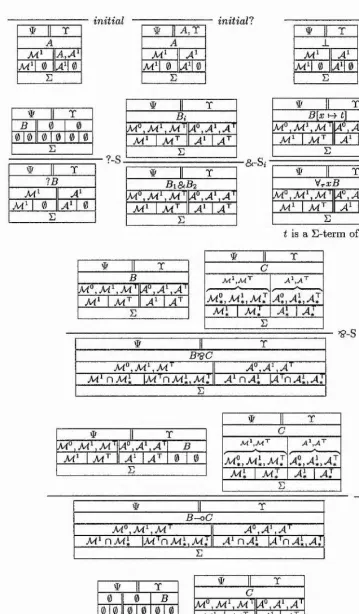
given in Figures 2.1, 2.2 and 2.3. The components of the sequents are described in Section 2.3.1.
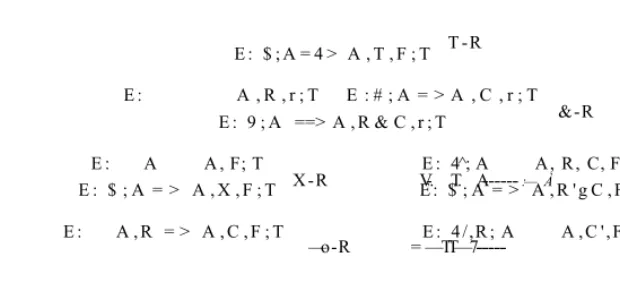
T -R E : $ ; A = 4 > A , T , F ; T
E : A , R , r ; T E : # ; A = > A , C , r ; T E : 9 ; A ==> A , R & C , r ; T &-R
E : A A , F; T E : 4^; A A, R, C, F; T
X-R V-. .T. A---:— À ’S*-R
E : $ ; A = > A , X , F ; T E: $ ; A = > A , R 'g C , F ; T
E : A , R = > A , C , F ; T E : 4/,R ; A A ,C ',F ;T
—o-R = —TT—7--- -—1— D- R
E : $ ; A A , B - o C , F ; T ^ E : # ; A = > X , B 3 C , F ; T
y : r , E : ’$’;A = 4 ^ A , R [ r c H - ? / ] , r ; T E : t ; A A ,F ; R, T E : W ;A = i> A ,V ra,'R ,F ;T E : t ; A A, ?R, F; T
[image:25.612.119.444.108.617.2]y is not declared in E
Figure 2.1: The ‘right’ rules in Miller’s proof system T .
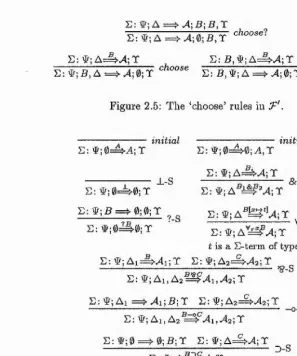
E : # ; A = 4 > A , R ; R , T
E : $;A==4^ A ; R , T decide'?
E : # ; A = ^ A ; T ^ E : R , # ; A = & A ; T ^ , E : W ; R , A = ^ A ; T E : R , # ; A A ; T
Figure 2.2: The ‘decide’ rules in Miller’s proof system F .
initial ---:--- initial?
E : # ; 0 = & A ; T E : $ ; 0 = 4 . [ ] ; A , T
E : ^ ; 0 = 4 [ ] ; T E : # ; A ^ 1 ^ " A ; T
E : $ ; R = > [ ] ; T E : W ; A ^ # * U ; T E : ’F ; 0 = ^ [ ] ; T E : ’ÿ; A'^=^^A;T
t is a E-term of type r E : ’F; Ai=4>-Ai; T E : 4^; A 2 = 4 A 2 ; T
E : W ; A i , A 2 ^ A i X A a i T
E : A i = > A i, R; T E : 4/; A2=4>A2j T ^ ^ E : $ ; A i , A 2 ^ A i X A z ^ T
E : $ ; 0 = > R ; T E : # ; A = ^ A ; T E : 4 r ; A ^ A ; T ^
Figure 2.3: The ‘left’ rules in Miller’s proof system F .
[image:25.612.132.442.125.275.2] [image:25.612.170.381.403.612.2]The terms in FoRUM are strongly typed using a fragment from Church’s simple theory of types (see Section 2.7.1). The S part is separated by a colon from the rest of the sequent. The antecedent and succèdent are separated, as usual, by the sequent arrow, but both of them are divided into zones. This will be described in more detail in Section 2.3.1.
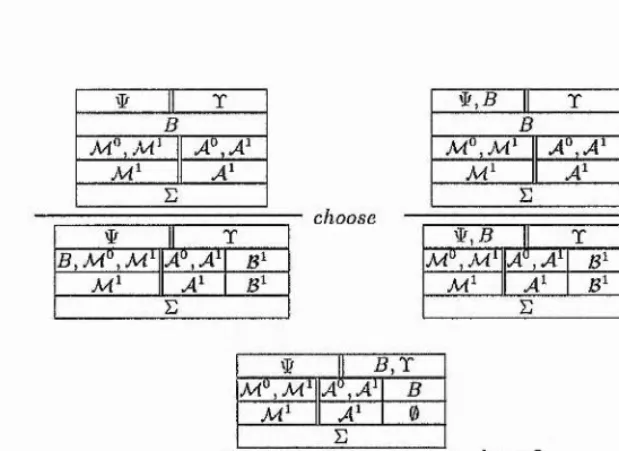
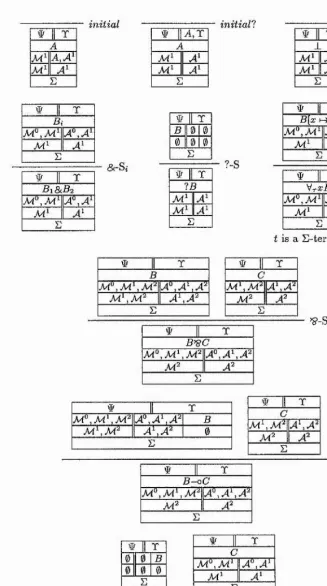
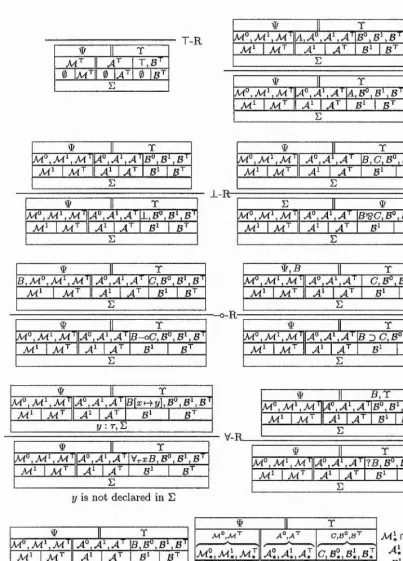
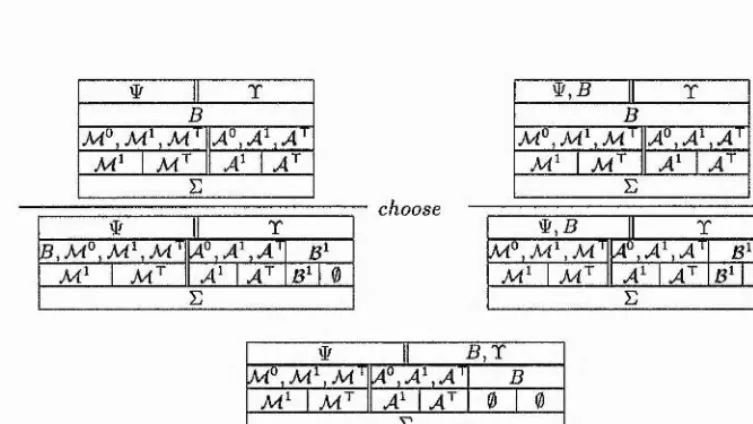
Each ‘right’ rule in T analyses a goal formula in the succèdent. The ‘decide’ rules are used when atomic goals are reached in the succedents. The ‘decide?’ rule serves for choosing a new goal formula from the classical context of the succèdent. The other two ‘decide’ rules pick up a formula from the antecedent which goes subsequently into the stoup. These two rules correspond to the selection of a program formula (Step 1’ in se a r c h'"). The ‘left’
rules analyse the stoup formula; it will be decomposed until atoms are reached. In effect, the proof search in F for a sioup-sequent is focused (in the sense of [Andreoli, 1992]) on one program formula. That means that a program formula that is selected has to lead to a proof where all leaves match with either a ‘initial’ rules or the ‘X-R’ rule. However, three rules are exceptions to this scheme. In the case where the stoup formula matches with ?R, the program is augmented with B] another program formula will be chosen to go into the stoup
or the succèdent can be augmented by the ‘decide?’ rule. This means that the focus of the rather restricted sitoi/p-sequents is lost. However, that is necessary since it maintains the completeness with respect to CLL (an example is given in Section 2.5). The other exceptions are the two rules that analyse an implication in the stoup. They branch the proof tree and in one premise the implicans is added to the succèdent as an additional goal formula which will be analysed by a ‘right’ or ‘decide’ rule.
2.3.1 The U se of C ontexts in Sequents
In linear logic, formulae in the antecedent with a ‘!’ as an outermost connective are dis chargeable; the other formulae in the antecedent are usable exactly once (the same behaviour in the succèdent is achieved by the exponential ‘?’). That means the structural rules for weakening and contraction are restricted to formulae with an exponential. These rules are defined in CLL as follows;
A , ! R = > r A ,!R ,!R =
Weakening !-L > r
A
A,!R Contraction !-L
A = > ? R ,r A = > ? R ,? R ,r
A = > ? R ,r
Weakening?-R
Contraction?-R
Consequently, the formulae decorated with an exponential behave to some extent as if they were classical formulae. In [Girard, 1993] this observation is used and a sequent calculus, called LU, is presented in order to unify CL, IL and CLL in one calculus. The sequents are divided into different zones—into classical and linear zones. Each zone allows a different usage of the structural rules weakening and contraction. In the classical zones, these rules are permitted; however, they are implemented implicitly in the inference rules. In the linear zones, both structural rules are forbidden.
CHAPTER 2. FOUNDATIONS OF LOGIC PROGRAMMING AND FORUM 22
until an occurrence of certain connectives, and it is built into the corresponding inference rules.
In logic programming languages, for example in Lolli, the implicit representation of the structural rules is preferred because of the fact that the ‘Contractionl-L’, ‘Weakening!-L’ and ‘?-L’ rule analysing formulae with an exponential violate the uniform proof condition. Consider the following proof in CLL (the example is from [Pym and Harland, 1994]):
p \ p A x p y p Ax
!-L r ---—P !-L - (»-R
\p, \p p ® p
Ip = > p 0 p Contraction!-L
The proof can not be rewritten such that the ‘0-R ’ rule lies under all left rules. Using an implicit formulation, the structural rules are admissible and can be simulated with the new zones. The ‘0-R ’ rule with zones could be formulated as follows (see [Girard, 1993]):
Ÿ ; A i = > R , r i ; T Aa C, Fa ; T _ Ai, Aa B 0 C, Ti, Fa ; T
The formulae in the zones Ÿ and T are given to both premises. In case where they are superfluous, it is permitted to “weaken” them. Miller’s calculus .F, for example, is formulated using sequents with zone; these zones are also called contexts^. An extension of this idea is described in [Hodas, 1993] for Lolli where four contexts exist: for intuitionistic, relevant, afSne, and linear logic. These contexts differ in the usage of the structural rules.
In Forum, each antecedent and each succèdent is divided into a classical and a lin
earcontext. The classical contexts represent reusable formulae; the formulae in the linear context are usable exactly once. Miller presented the sequents as follows:
2: Ÿ; A F;T and 2 : 4/; A=&yl;T
where the linear contexts (A, F and A) are grouped around the sequent arrow, and the classical contexts (^ ,T ) are grouped at the edge of the sequent (the purpose of 2 will be described in detail in Section 2.7). The linear contexts A in the antecedent are multisets of formulae; the classical contexts ^ and T are sets of formulae. The antecedent F in the sequents above is introduced as a list. The list starts with a part that consists only of atoms (the variable A stands for this part) and is followed by a part that consists of atomic or non-atomic formulae {B stands for this part). The part 5 of F is always empty in stoup
sequents. The stoup sequents (on the right-hand side above) have a stoup formula B written over the sequent arrow. Omitting the type information in 2, the sequents are intended to behave like the following sequents in CLL:
!x L ,A = ^ F ,?T and ! ^ ,A ,5 = > F .? T
where and ?T is a shorthand that stands for multisets where each formula is decorated with a '!’ or a respectively.
2,3.2 Beh
aviour of th e N on-P rim itive C onnectives
The non-primitive connectives, for example the ‘0’ connective, are excluded from the set of primitive connectives because their left rules cannot be permuted over all right rules or their right rules do not permute over all other right rules. They are reintroduced by some logical equivalences. Because of this fact, there are different opinions on whether FoRUM should count as a logic programming language for full CLL or not. Certainly, FORUM has a more direct relationship to CLL than logic languages, such as PROLOG, since the completeness is achieved without the help of a theory. All connectives of Fo r u m including the non-primitive ones fulfil the extended uniform proof condition (Definition 5 ). Consequently, Fo r u m can be seen as an abstract logic programming language as given in Definition 3.
However in Fo r u m, only for a provable sequent using primitive connectives in the suc cèdent does there exist a uniform proof which is goal-directed (see Step 1 in s e a r c h'). That means the corresponding formula can be decomposed efficiently using only right rules until atomic formulae are reached. Such a proof may not exist for the non-primitive connectives. The translation of the non-primitive connectives ensures that they fit into the scheme of uni form proof search. However, an occurrence of a non-primitive connective in the succèdent cannot be treated entirely with the “don’t care” non-determinism as in Step 1 of s e a r c h'". The translation into a _L-headed implication for formulae with an outermost non-primitive connective has the effect that an analysis of such a formula adds another formula to the ante cedent. Then, this additional formula in the antecedent is treated with less efficient “don’t know” choices. Therefore, only the core of Fo r u m (formulae with primitive connectives)
counts as a logic programming language if one has in mind that for all provable sequents there exists a goal directed proof.
In the following example, which is taken from page 17, a Fo r u m proof is given for a
formula with the non-primitive connective ‘0’ in the succèdent. The proof is presented using the calculus F of Fo r u m. The endsequent that will be proven is as follows:
S : p& g,p0 g;0.
It is assumed that S contains the appropriate declarations for p, q and the used connectives. W ith a usual formulation of the ‘0-R ’ rule the goal formulap® q has to be analysed first in order to obtain a proof. However in the sequent with the translated form of the 0-fbrmula, the order in which the goals appear is not significant. The sequent using the logically equivalent formula for p 0 g is as follows:
2 : 0;p & g,p ’9g = > p& q, (p-‘-’S’g-^)-oX ; 0
w h ere th e n e g a tio n s can b e ex p ressed b y L -h e a d e d im p lic a tio n s. T h is seq u en t w ill b e p rov en in Fo r u m b y a n a ly sin g th e ^ -fo r m u la first.
2; 0;p-^»Çg-^,P&g,p’S’g =A -p;0 , _ 2: 0;p-^'9g-^,p&g,p)9g g;0 , _
JL-R „ I I _ . ^ -L-R
2 : 0;p-^>S’g-‘-,p & g ,p ’S’g P, JL;0 _ 2 : 0;p-^ '9g-^ ,p& g,p'9g g ,T ; u _
-o-R ——--- -—I---r.---:—r -o-R 2 : 0;p&g,p’9g = > p, (p-‘->gg )-o-L; 0 2 : 0;p&g,p%’g ==> g, (p-*->$’g-*-)-oX;
2 : 0;p&g,p’S’g = > p&g, (p-‘-’S’g-‘-)-oL;i &-R
In the subproof S i, the new program formula p-^^q-^ must be chosen in order to find a proof for the endsequent. This is a “don’t know” choice and FORUM has to explore all
CHAPTER 2. FOUNDATIONS OF LOGIC PROGRAMMING AND FORUM 24
three possibilities. However, Fo r u m uses a simple heuristic: new program formulae, that were added by an implication in the succèdent, are considered first. In this case, it leads immediately to the successful proof, but this is not necessarily always the case. The subproof Si is as follows:
--- initial initial initial
2: 0; 0=>p; 0 ^ 2: 0; 0= > p;_0________ 2: 0; 0= » g ; 0 ^ ^ S : 0 ; 0 ^ p ; 0 dectdei ——z— --- ^ S : 0 ; 0 ^ p ,} ; 0 dectdei. . . .
2: 0;p&g p;0 , ' 2: 0;p»9g = > p, g; „
-o-L" T--- -o-L
2: 0;p&g^^^[]; 0 2: 0;p'9g '^ ^ p ; 0 2: 0;p&g,p’Çg^'=S p;0 decidel 'g-L 2: 0;p-^’S’g-^,p&g,p’S’g p;
The second premise in both ‘-o-Ll*’ inference rules is omitted. These premises have the logical constant ‘± ’ in the stoup and empty linear contexts; they can be proven immediately by the rule ‘T-L’. The subproof S2 is similar to S i, and so is omitted.
In [Hodas & Polakow, 1996] and [Harland & Winikoff, 1996b], similar remarks to those above are made: Fo r u m does not have goal-directed proofs for all sequents of CLL, but only for sequents having formulae with primitive connectives; the logic underlying FoRUM is as expressive as CLL because all of CLL’s sequents can be mapped into Fo r u m sequents via some logical equivalences and the provability is preserved when restricting to uniform proofs as given in Definition 5. However, the implementation of Fo r u m is not only restricted to a uniform proof search but also to a depth-first proof search. Therefore, Fo r u m for which we will present an implementation is not as expressive as the underlying logic. Further remarks on this aspect will be given in Section 2.5 and 3.4.
2.4 M o
dified P ro o f System JF' Including an A tom
ic-R ule
In the sequents of the calculus F , the variable F stands for a list and the expression -{-./Ig stands for a list obtained by interleaving A i and /Ig. That means the operator ‘-f’ preserves the order of both argument lists in the resulting list. However, for the soundness and completeness proofs, which will be given in Chapter 3, it is more convenient to use a multiset notation instead^. Miller chose a list structure for the goal formulae because the proof search in such a system is easier to implement. However, that is an arbitrary decision: Miller proved in Corollary 4 of [Miller, 1996] that the order of goal formulae is not crucial for the provability. Precisely, if for a non-stoup sequent there exists a proof, then for all sequents consisting of a permutation of the goal list there exists a proof as well. In Lemma 2 of the same paper, he also showed that the order of atoms in stoup- and non-stoup sequents is not significant for the provability of the sequent. Hence, all possible orders of goal achievements lead to the same result. The proof can be shown by the fact that all right rules of FoRUM
permute over each other (its connectives are chosen so that they satisfy the extended uniform proof definition and hence satisfy this condition).