A Surprisingly Simple Electrostatic Model Explains Bent vs. Linear
Structures in M
+-RG
2species
(M = Group 1 Metal, Li–Fr; RG = Rare Gas, He–Rn)
Anna Andrejevaa, W. H. Breckenridgeband Timothy G. Wrighta*
a
School of Chemistry, University of Nottingham, University Park, Nottingham, NG7 2RD, U.K.
b
Department of Chemistry, University of Utah, Salt Lake City, Utah, 84112, USA
A Surprisingly Simple Electrostatic Model Explains Bent vs. Linear
Structures in M
+-RG
2species
ABSTRACT
It is found that a simple electrostatic model involving competition between the attractive dispersive interaction and induced-dipole repulsion between the two RG atoms performs extremely well in rationalizing the M+-RG2geometries, where M = Group 1 metal and RG =
rare gas. The Li+-RG2 and Na+-RG2 complexes have previously been found to exhibit
quasilinear or linear minimum energy geometries, with the Na+-RG2 complexes having an
1. INTRODUCTION
Pairwise potentials are prevalent in determining the structures of large aggregates of atoms and molecules. The pairwise potentials are often calculated using quantum chemical calculations (perhaps evaluated against any available experimental data), and then applied to larger systems, which are computationally prohibitive for quantum chemistry methods. Simple Lennard-Jones type potentials are also popular, with parameters often determined via fitting to higher-quality quantum chemistry results or to experiment. For neutral species, the limitations of pairwise potentials have recently been reviewed1and workers have included three-body terms to obtain a more realistic representation of the interactions in such complexes – see, for example, refs. 2, 3 and work cited therein. Such treatments can be somewhat involved and uncertain. Here, we shall show that the addition of a single term to the pairwise model for simple M+-RG2 systems gives results that are in surprisingly good
agreement with our quantum-chemical results over a wide range of angles for all thirty six titular species.
Metal cation/ligand complexes are prototypes for a wide range of chemical and biochemical phenomena. Detailed consideration of the latter is often difficult, and hence studies on isolated complexes are used to build up a picture of how cumulative solvation is able to affect the physical and chemical properties of the cation, with rare gas (RG) atoms being the simplest such ligand. A large proportion of previous experimental and theoretical studies (see ref. 4 and references therein) have concentrated on a single metal cation interacting with a single rare gas (RG) atom, M+-RG. In previous work, we have extended the work in ref. 4 and studied a number of these complexes ourselves including both alkali5,6and alkaline earth metals.7,8,9It was shown for Group 1 complexes that interactions remain purely physical in nature, a fact reflected in their relatively low binding energies. In contrast, the Group 2 species showed significantly higher dissociation energies compared to their Group 1 counterparts, and this has been attributed to hybridization between the outer s orbital on the metal cation and the lowest unoccupied p or d orbital.10 This occurs as the RG atom approaches the metal center and leads to electron density being able to move away from the incoming RG atom, reducing electron repulsion; concomitantly, this movement of electron density leads to a greater exposure of the dicationic metal core, and so increasing attractive terms.
A study by Bauschlicher et al.20was one of the first to look at M+-RG2 complexes, whose
study was focused on RG = Ar with different M+ions, M = Li, Na, Mg, V, Ni and Cu. Since that work, only a few studies have been reported in which M+-RG2species have been the
focus of study; as an example, the Na+-Ar2 complex has been concluded to be linear
employing model potentials, including three-body terms, although the emphasis was on growth mechanisms for larger complexes.16To the best of our knowledge there have been no studies where geometric trends or spectroscopic constants for a whole series of M+-RG2
complexes have been studied and rationalized for a particular elemental group.
We have shown in our previous work on the Li+-RG2 and Na+-RG2 complexes,21that these
species have very flat angular potentials, and exhibit quasilinear or linear minimum energy geometries. Group 2 M+-RG2complexes for M = Be and Mg, however, were found21to be of
C2vsymmetry with bent minimum geometries. The latter was attributed to sp hybridisation of
the outer s orbital on the metal center with the lowest unoccupied p orbital, making it favourable for the second RG atom to approach M+from the same side; such hybridization is not possible for the Group 1 metals, as the unoccupied orbitals are too high in energy. However, in the present work we shall conclude that the M+-RG2 complexes involving the
heavier alkali metals are bent, and thus there is a need to rationalize this in contrast to the linear lighter species.
As far as we have been able to ascertain, the only previous study on the heavier M+-RG2(M
= K–Fr) complexes is by Hernández-Rojas and Wales,17
where the authors present candidate structures for the global minima points for then-atom rare gas clusters containing K+and Cs+ metal cations (n = 1–79). Their work, which involved model pairwise potentials rather than quantum chemistry calculations, showed that the K+-Ar2 and Cs+-Xe2 species hadC2vglobal
minimum geometries; no rationalization of these geometries was presented in ref. 17 since the emphasis was on the larger complexes. These bent structures are, of course, in contrast to the (quasi)linear structures we21
and others16,20 have reported for the lighter species (M = Li and Na). In the present work, we complete the overall study of alkali metal M+-RG2
complexes by reporting the results on the remaining twenty four systems involving M = K–Fr and RG = He–Rn. We find that all of these heavier complexes have a bent global minimum. We propose a simple rationalization of the bent and linear geometries found for the complete set of thirty six M+-RG2complexes in terms of a simple electrostatic model.
2. COMPUTATIONAL DETAILS
Geometry optimizations and harmonic vibrational frequency calculations of the M+-RG2
species (M = K, Rb, Cs and Fr; and RG = rare gas, He–Rn) were performed using the MP2
method, employing the quintuple-ζ quality basis sets described below. Linear and bent
A quintuple-ζ valence basis set for K+
, equivalent to aug-cc-pV5Z (no h functions) quality, (described fully in Ref. 22) is used here with the small-core quasirelativistic effective core potential, ECP10MWB. 23 For Rb+, Cs+ and Fr+, ECP28MWB,23 ECP60MWB23 and ECP78MWB24quasirelativistic effective core potentials were used, respectively; the valence basis sets for these metals are described in detail in ref. 25 and are of the same quality as the K+basis set.
For He and Ne, standard aug-cc-pV5Z basis sets26,27were utilized, whereas Ar utilized the standard aug-cc-pCV5Z basis set.28For the heavier rare gases, Kr, Xe and Rn, ECP28MWB, ECP46MWB and ECP78MWB quasirelativistic effective core potentials29,30were employed, respectively, along with the corresponding aug-cc-pwCV5Z-PP valence basis sets.31None of the rare gas basis sets included h or higher orbital angular momentum functions, consistent with the basis sets used for the metal species. These combinations of basis sets are simply referred to as aV5Z in the below.
In the MP2 method, the valence electrons of He–Ar were correlated, while for Kr, Xe and Rn all of the electrons not described by the ECP were correlated. All of the above calculations employed the MOLPRO suite of programs.32 In calculating dissociation energies, the counterpoise correction was not employed since we are using a quintuple- basis set where such basis set superposition errors are expected to be small; further, this would have been difficult to apply consistently through the range of calculations performed.
Three population analyses were undertaken: natural population analysis (NPA),33 atoms-in-molecules (AIM)34and Mulliken.35The AIM analyses utilised the AIMAll software package36 using WFX files produced by Gaussian09.37NPA analyses were performed using the NBO 6.038
software package and Mulliken analysis was used as implemented in Gaussian09. The calculations were performed with the MP2/aV5Z natural orbital density at the corresponding optimized geometries.
3. RESULTS AND DISCUSSION
A. Geometries
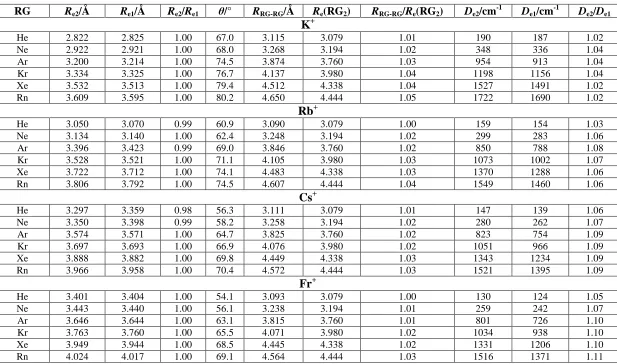
Table 1 shows the results of the geometry optimizations, where it can be seen that the entire set of the heavier M+-RG2species (M = K, Rb, Cs and Fr; and RG = rare gas, He–Rn) exhibit
Optimized internuclear separations between the metal cation and the rare gas atoms for the heavier alkali metals for both M+-RG2(denotedRe2) and M+-RG (denotedRe1) complexes are
given in Table 1, with the optimized geometries of the lighter species reported in ref. 21. Note that in Table 1, the Re1 values have been obtained in the present work from
optimizations using the same MP2/aV5Z method as used for the M+-RG2complexes. In all of
the M+-RG2 species studied, it was found that the M+-RG equilibrium separations are equal,
i.e. the symmetry is C2v. It may also be seen that the equilibrium separations in the M+-RG2
and M+-RG species are almost identical, suggesting that a dominant driving force for the interaction is achieving internuclear M+RG separations that are close to the optimal values in the diatomic M+-RG complexes; consequently, Re2/Re1 ratios are seen to be very close to
1.00 for these complexes (Table 1). As expected, these values increase monotonically as the atomic number of RG increases, as was noted in ref. 5 for the Re1 trends. The trend is
rationalized by the increasing attraction caused by the rise in the polarizabilities of the RG atom with atomic number,39which outweighs the concomitant increasing size. Additionally, for a fixed RG, theDe values fall monotonically with increasing atomic number of the metal
cation in line with the increasing internuclear separations – this clearly outweighs the increasing polarizability of the cation.
It may also be seen in Table 1 that the RG-M+-RG angle increases monotonically with increasing atomic number of the RG atom, which is in line with the increasing size of RG. A hint as to why a bent geometry is preferred to a linear one for the M+-RG2 complexes (M =
K–Fr) can be found by considering the internuclear separation between two RG atoms at the minimum energy geometry of the complex with the equilibrium value of the RG2 dimer,
Re(RG2). The latter values have been obtained at the same level of theory and using identical
basis sets as employed for the M+-RG2 calculations. It was found that in all of the species
studied, the RRG-RG values were slightly larger than the Re(RG2) values. This is consistent
with simple electrostatics arguments which will be considered shortly; however, first we examine the atomic charges.
B. Atomic Charges and Contour Plots
In Table 3, we present the results of three population analyses for the M+-RG2 complexes:
Mulliken, NPA and AIM. There is agreement between the AIM and NPA methods that there is very little charge transfer from the metal to the rare gas atoms. In contrast, Mulliken charge analysis gives small, but more significant charge transfer in both M+-RG2 and M+-RG
systems; however, it is well established that Mulliken populations can be unreliable. Both AIM (values in bold in Table 3) and NPA (values in square brackets in Table 3) results are in line with the expected very small charge movement for physical interactions; additionally, these results are consistent with those for the Li+-RG2and Na+-RG2complexes.21
Group 1 diatomic M+-RG complexes are described well by an essentially physical model.4,40,41Indications are that only for the heaviest species does a very small amount of charge transfer possibly occur, but even then this is likely within the reliability of the population method. The interactions in the Group 1 M+-RG and M+-RG2 systems are in
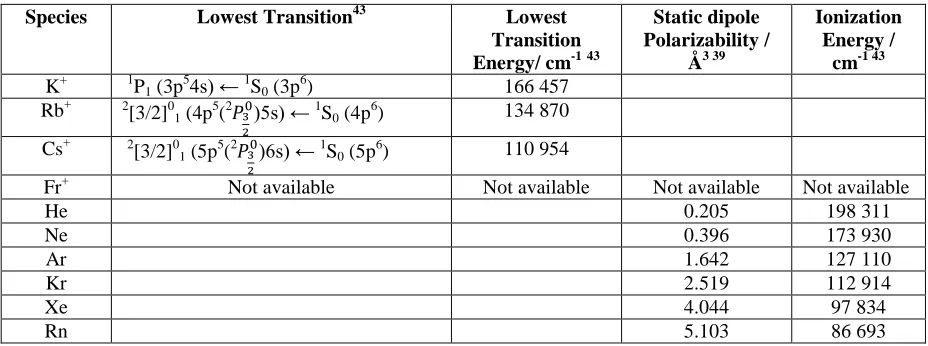
contrast to the corresponding Group 2 complexes with their facile sp and sd hybridization, which may be viewed as chemical effects.7,8,9,21,42Such hybridization is not possible for the Group 1 complexes, as there are no low-lying p or d orbitals43(see Table 4, and comments below).
The AIMAll software package was also used to obtain the total local energy density parameter, H(R), which is found by analysis of the electron density at so-called bond critical points, BCPs; for a covalent or other chemical bond, the local energy density H(R) will always be negative.44,45,46Analysis of the H(R) parameter at the BCPs of both the M+-RG2
and M+-RG complexes yielded positive values across the whole series, confirming the above conclusion that there is essentially no chemical bonding character in these systems.
Additionally, the NBO 6.0 program was used to determine natural bonding orbitals (NBOs) by performing the analysis of a many-electron molecular wavefunction in terms of localized electron-pair bonding units. It is well demonstrated in the literature that the method can determine the degree of hybridization successfully in terms of contributions of the atomic functions to the molecular orbitals.47 No such hybridization was seen for the Group 1 M+-RG2species, in line with expectations noted above.
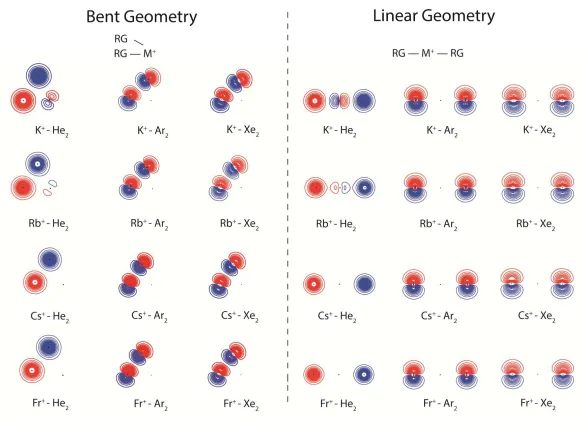
In Figure 1 we present the Hartree-Fock (HF) contour plots of the highest-occupied molecular orbital (HOMO) for selected M+-RG2 species, which have been calculated at both
the global bent minimum and at the linear geometry (which are sometimes local minima) at the MP2/quintuple- level of theory. The contour spacings employed are the same for all species. (We note that in unpublished work on a number of systems we have compared HF contour plots with those from natural orbitals from correlated calculations, MP2 and QCISD, obtaining excellent agreement, as long as the optimized geometry with the correlated method is employed.) As may be seen, the HOMOs correspond to antibonding combinations of the outermost occupied p orbitals of the RG atoms, or of the 1s orbitals in the case of He. It is also apparent that there is only very little perturbation of the atomic orbitals as a result of the interaction. The little effect that there is may be seen to correspond to a slight compression of the interacting lobes of the p orbitals in the heavier species as a result of the interactions pulling these atoms together. As a consequence, we conclude that the rationale for the bent geometries for the heavier Group 1 M+-RG2species is different to that for the corresponding
Group 2 ones.21
C. Dissociation Energies
Table 1 contains the calculated dissociation energies for the removal of a single RG atom from the heavier M+-RG2system,De2. These are also compared to the corresponding Group 1
M+-RG values, denotedDe1, and we also give theDe2/De1ratios. (We note that in refs. 21 and
were within a few percent of those obtained at the RCCSD(T) level using quintuple- basis sets, giving confidence in the present interaction energies.) De2 increases monotonically for
the M+-RG2species as the atomic number of the RG atom is increased and these observations
are in line with the correspondingDe1trends. (The same method and basis set were employed
for both the De1 and De2 calculations.) The increasing polarizability of the RG atoms with
atomic number appears to drive the increase in dissociation energies, and outweighs the increasing repulsion terms from the greater number of electrons. For the K+-RG2 complexes,
the De2/De1 ratios are quite close to unity, but are always greater; additionally, the ratios
generally increase with both the atomic number of M and RG, which we shall comment on in subsection (e). Similar results and discussions were presented in ref. 21 for the two lightest Group 1 M+-RG2species.
D. Angular Cuts Through the Potential Energy Surfaces
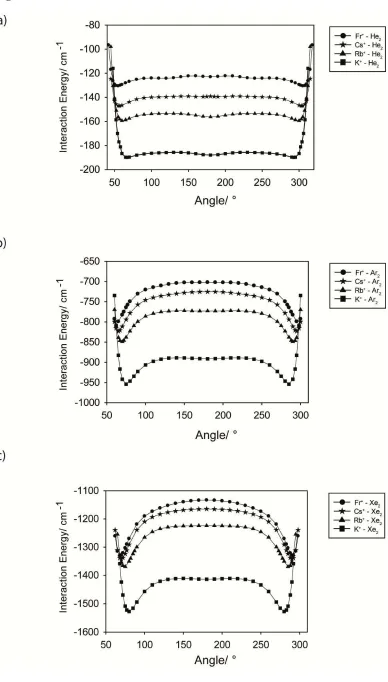
Figure 2 shows angular cuts through the M+-RG2 potential energy surfaces for the selected
species, M = K – Fr and RG = He, Ar and Xe. Potential energy surface cuts are presented for a range of angles that cover the linear region and bent geometries. In these calculations, the internuclear distances have been independently optimized at each fixed angular coordinate. We reiterate that the MP2 method is able to obtain reliable results for the more challenging
De values, and we expect the angular plots to be more reliable since we are not calculating
energy differences between fragments, but merely variations in energy with geometry. Figure 2a shows M+-He2 angular plots, with corresponding M+-Ar2 and M+-Xe2 ones presented in
Figures 2b and 2c, respectively. In all of these plots, a bent geometry can be seen to correspond to the global minimum, and the same is true for the M+-Ne2, M+-Kr2and M+-Rn2
systems (see Table 1). It is interesting that some of the plots appear “wobbly”, particularly for RG = He: we have checked this carefully, using tighter convergence criteria, and this is genuine. We suspect it arises owing to the small size of He and its sensitivity to the electronic environment, such as the ability for its electrons to access the Fr+ virtual orbitals (albeit to a very limited extent) – angular plots were presented in ref. 21 for the two lightest Group 1 M+-RG2species.
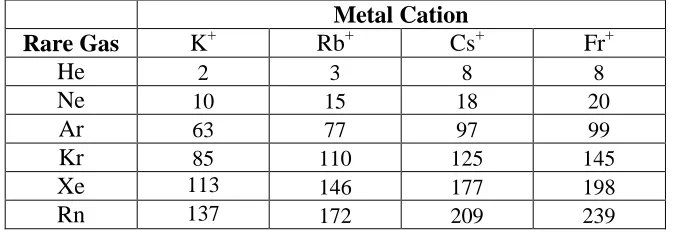
For the M+-RG2(M = K–Fr) complexes, energy differences between the linear structures and
the bent minima were calculated and these are presented in Table 5 (note that for M = Li and Na, the equilibrium structures were linear or quasilinear and so we do not include the energy differences for these). There can be seen to be a general increase in the bent-linear energy difference for a fixed RG when moving through the M = K –Fr species. Additionally, for a particular M, there is also such an increasing trend with atomic number of the RG atom, with the smallest energy difference for the He-containing species and largest ones for the Rn-containing complexes. Some of these energy differences suggest that the species will be quasilinear; for example, for the K+-He2and Rb+-He2 species the values are only ~2–3 cm-1,
suggesting that even with zero-point vibrational energy, the complex can sample a wide range of angles on the very flat potential energy surface. In contrast, for other complexes, such as Cs+-Xe2, the energy difference rises to over 175 cm-1, which suggests that this will be a truly
bent structure. The linear minima for Li+-RG2 and Na+-RG2 species were also very shallow
E. Simple Electrostatic Model
We now consider a simple electrostatic model which is found to replicate, surprisingly well, the observed linear and bent geometries, and even more quantitative aspects of the Group 1 M+-RG2 potential energy surfaces. As we shall note below, there are more complicated
versions of this model, but we shall conclude that a simple model suffices to explain the geometries of the whole set of thirty six M+-RG2complexes.
(i) “Zeroth-Order” Pairwise Model
We commence by considering a simple pairwise interaction potential. In this case, the RG atoms will move into a position whereby they maximize their interaction with both the M+ ion and also each other, independently. That is, they will take up a bent geometry of necessity, where the internuclear separations are the optimum diatomic separations, Re1 for
M+RG andRe(RG2) for RGRG; these values are given in Table 1 for M = K–Fr and in
reference 21 for M = Li and Na. The corresponding bond angles, pair, can be
straightforwardly calculated and are given in Table 6. We emphasise that this pairwise model, of necessity, predicts the geometries to be bent for all of the Group 1 M+-RG2 complexes,
including those for which we have already established a linear geometry.21As a consequence it is no surprise that the use of pairwise potentials, such as in refs. 14 and 17, produce such a bent geometry and in fact it is linear geometries which are in need of rationalization. In passing we also note the close agreement ofpairto the fully-optimized bond angle values,,
given in Table 1, for M = K–Fr.
For M = Group 2 metal, we have already discussed hybridization of the metal center as a mechanism for obtaining significantly-bound bent structures;21,42 however, we have also noted that for the Group 1 complexes, such hybridization is not possible since the excitation energy to the lowest unoccupied p and d orbitals is too high (Table 4),21 confirmed by the contour plots discussed above. In the absence of any other interaction, we would expect weakly-bound bent structures for all M+-RG2 complexes, including for M = Li and Na.
Clearly a repulsive interaction is required to overcome the RG2 interaction energy when
moving from bent to linear geometries, and there are two clear sources: Coulomb repulsion and induced-dipole repulsion. The former would arise if there were any charge transfer between the metal center and the RG atoms (and we have noted above that this is small, if it happens at all), while the latter occurs via a polarization of the RG electron density as it interacts with the charge on the metal center. We shall now outline a simple electrostatic model that considers the latter.
(ii) Simple Three-Body Model at the Pairwise Geometries
Assuming no charge transfer, and hence no Coulomb repulsion, in line with the AIM and NPA charges, we give a simple rationalization for the observed geometries in terms of interactions between the induced dipoles on the RG atoms. We commence by considering the complex at the “pairwise geometries”, as discussed above, i.e. a C2v M+-RG2 complex with
separation fixed to the optimized value in the RG2 dimer, Re(RG2), and hence with the
RG-M-RG bond angle,pair, given in Table 6.
A number of workers have considered three-body interactions in depth, which are not straightforward to implement and so still the subject of some controversy.1,2,3,48Part of the problem is the reliable inclusion of other terms – dispersion (Axilrod-Teller), exchange and (charge)-induction. One example that has been the subject of some discussion is the exchange quadrupole moment formed on the RG2dimer in the complex, where estimates of parameters
in the functional form need to be employed.2,3 As a consequence, the importance of such terms is unclear, and it has been suggested these may have been overestimated in previous work.48 Yourshaw et al.3 have given a very lucid discussion of the different types of interaction term present in both neutral and charged triatoms. In the case of a charged system, it was shown that the non-additive induction term was the largest type of term, with the sum of the exchange charge and multipole dispersion terms approximately balancing the triple-dipole dispersion term, by virtue of these having similar magnitudes and different signs. Since the non-additive induction term is the simplest to calculate with no “fitted” parameters, and is also the largest, we examine the effect of the former on the calculated geometries and binding energies. We find that the inclusion of this single term is sufficient to give close to quantitative agreement for geometries and the binding energy of the second RG atom; later, we shall comment on the other omitted terms.
The positive charge on the metal center will lead to an induced dipole being produced on each RG atom, pointing along the respective M+-RG direction, and these dipoles repel each other. Ignoring higher contributions, the magnitude of the induced dipole, ind, on each RG
center is given by the standard expression in atomic units:
ߤ୧୬ୢ=ܴߙݍ ୣଵଶ
(1)
where qM is the charge on the metal center, is the static dipole polarizability of the RG
atom, andRe1 is the optimized internuclear separation of the M+–RG diatom. The magnitude
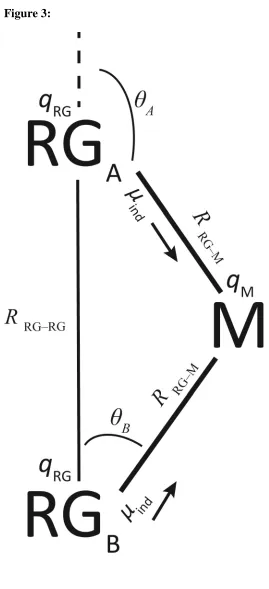
of the induced dipole will be the same for each RG atom, and in each case be directed along the respective M–RG direction, and oriented from negative to positive (i.e. pointing towards the metal center) – see Figure 3. Stone49,50has considered the interaction between two such dipoles in a general way, and we use a version of his equation for the interaction between the two dipoles in the present system. As may be seen from Figure 3, the induced dipoles are in the same plane and make angles AandBto a line passing through both of the RG centers.
The expression for the interaction energy between these two induced dipoles, U, in atomic units is given by:
ܷఓఓ = − ߤ୧୬ୢ ଶ
ܴୖୋିୖୋଷ(2ܿݏߠܿݏߠ−ݏ݅݊ߠݏ݅݊ߠ)
where, in the present model (at the pairwise geometry),ܴୖୋିୖୋ takes the value Re(RG2) in
Eq. 2. We have calculated this induced dipole repulsion for all M+–RG2complexes (M = Li–
Fr and RG = He–Rn), and tabulate these in Table 6. The U values have been calculated with an assumed metal charge of +1.00 (and hence the charge on the RG atom is zero). Also in this table we give the calculated dissociation energies of the RG2 complexes using the
quintuple-basis sets described earlier for M = K–Fr and the triple-ones noted in reference 21 and used for M = Li and Na.
We see from Table 6 that for the cases of M = Li and Na, the repulsive induced-dipole interaction is greater than De(RG2) in all cases except for Na+-Ne2, and thus the RGRG
interaction is overcome and these complexes prefer a linear geometry; on the other hand, for the complexes with M = K–Fr,Uis less thanDe(RG2) and it can be seen that in these cases
the complex retains a bent geometry. (In the case of Na+-Ne2,UandDe(RG2) are very close
and this would be consistent with a floppy, quasilinear complex.) Although this model is very simple – it gives a clear rationale for the observed geometries. As will be seen shortly, it is actually a close to quantitative model for the Group 1 M+-RG2complexes.
(iii) 3-Body Model at the Optimized Geometry
We now consider the interactions which are present at our quantum chemcial equilibrium geometry for each M+-RG2 complex. The emphasis here is on the examination of the
three-body term contribution to the angular potential and so we use a quantum chemical representation of the RG-RG potential. Hence, to test this simple model more quantitatively, we have calculated the RG2 potential as a function of the RGRG internuclear separation,
URG–RG, using the corresponding method and basis sets. At each RGRG separation in the
M+-RG2 complex, we have calculated the induced-dipole repulsion term, U, using Eq. 2,
assuming the M+RG internuclear separation remains fixed at the value in the optimized complex. We can identify the interaction term for the addition of the second RG atom,UMRG–
RG, as:
ܷ ୖୋ–ୖୋ = ܷఓఓ+ܷோீିோீ+ܦଵ
(3)
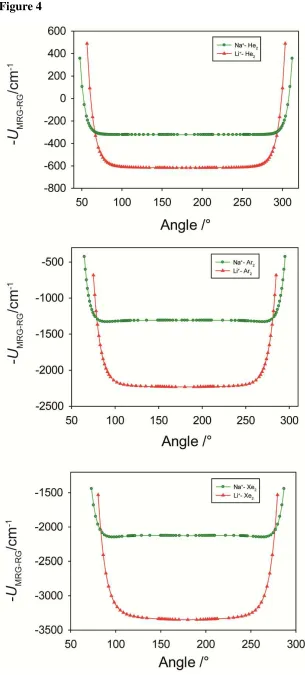
This is calculated at each RGRG separation, and we plot the results in Figure 4 for selected M+-RG2 (M = Li, Na) complexes, and in Figure 5 for selected heavier M+-RG2 (M = K–Fr)
complexes.
minima, with a very broad plateau around linearity. The quantum chemical calculations of ref. 21 actually showed global linear minima, but did show bent local minima. Again, with the approximations in the present approach and the shallowness of the potentials, these effects, although small, can have an effect on the resultant minimum energy angle. Overall, though, the similarity of the quantum chemical curves and the present electrostatic ones is striking. We also note that in ref. 16 the Na+-Ar2 complex was concluded to be linear, and
that this was attributable to the three-body terms, although both induced-dipole and Axilrod-Teller terms were considered simultaneously.
Moving onto the heavier metals, M = K–Fr, we see that the electrostatic potentials in Fig. 5 look very similar to the quantum chemical ones in Fig. 2, with a bent global minimum. This bent minimum is driven by two factors: the more deeply-bound RG-RG interaction potential,
URG–RG, with increasing atomic number of RG, and the smaller induced dipole on the RG
atoms caused by the corresponding increasing Re2 values, and hence smaller repulsion term
between these, exacerbated by the larger size of the RG atoms.
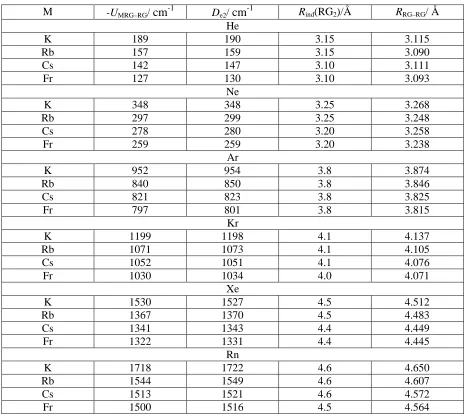
For all complexes, we identify the minimum value ofUMRG–RGfrom Eq. 3 and the results are
given in Table 7, where we compare these values to the respective De2values. As may be
seen, the agreement between the calculated minimum in this simple model and De2is almost
quantitative. Coupled with our previous work on the diatomic M+-RG complexes,40 and known behaviour of RG2, the current results strongly confirm the expectation that the
interactions in the Group 1 M+-RG2complexes are almost wholly physical, and that the
three-body interaction is well-described by a single electrostatic term. We also include the value of
R at which this minimum value of UMRG–RG occurs, denoted Rind(RG2), which can also be
seen to be in good agreement with the quantum chemical minimum (noting the latter occurs from a full optimization, while the former is estimated from a rather coarse pointwise potential).
We noted above that the De2/De1 ratios are quite close to unity (see Table 1), but are always
greater; additionally, the ratios generally increase with both the atomic number of M and RG. Our analysis of the electrostatic model shows that this arises as the induced dipoles become smaller with increasing atomic number of M and RG owing to the increased M+RG separation (Table 1 and Figure 1), and for the RG atoms, this overrides the increasing polarizability, although the latter has an effect in that it is increasingURG–RG.
Finally, in Figure 6 we show a comparison of angular plots using three approaches for three selected M+-RG2 complexes to represent the range of the series: Li+-He2, K+-Ar2 and
Cs+-Xe2. It is immediately clear that the pairwise potentials give bent geometries for all three
complexes (and indeed will always do so); additionally, the pairwise well depths are significantly overestimated compared to the electrostatic and quantum chemical potentials, showing the significance of the induced dipole repulsion term. For the latter two, there is very good agreement through a wide range of the angles, in particular covering the bent minima of K+-Ar2 and Cs+-Xe2. In all cases, there is a gradual deviation between the electrostatic and
even in the case of Cs+-Xe2. That the agreement is so good over a wide range of angles,
suggests that other terms (exchange, dispersion etc.) are either small or they fortuitously cancel, and we shall comment further on this below. Even though there is a large disparity between the well depths of the pairwise potential, and those of the electrostatic and quantum chemical approaches (which are very similar to each other), all potentials give very similar equilibrium bond angles for M = K–Fr.
4. FURTHER COMMENTS AND CONCLUSIONS
Bauschlicher et al.20 appear to be the first authors to have discussed the hybridization of Group 2 metal cations when interacting with two RG atoms, with a view to providing an explanation for the observed bent geometry of Mg+-Ar2; an explanation we expanded in our
work rationalizing the bent and linear geometries of the Group 2 M+-RG2 complexes.21,42
What was omitted from refs. 20 and 21 was the realization that there was actually a need for an explanation as to why the Li+-RG2 and Na+-RG2 complexes were linear (or quasilinear).
Indeed, we have noted above that in the pairwise approximation it would be expected that all M+-RG2 complexes would be bent, with the atoms at their optimum M+-RG and RG-RG
separations. We have now shown that the M+-RG2 complexes with M = K – Fr are all bent,
which is in line with expectations from a pairwise picture although the predicted binding energies are significantly different for the latter model. We have shown that the introduction of the induced dipole repulsion term explains both the observed bent geometries and the (quasi)linear ones for the M = Li and Na complexes. Indeed, this repulsion term appears to be the key to understanding the linear structures: if this is greater than the RG2 binding energy,
then linear equilibrium geometries result; if not, then bent geometries result. Although perhaps obvious, particularly in retrospect, this appears to be the first time that such geometries have been examined in detail consistently for an elemental group, and a clear explanation of the trend given.
agreement for thirty six complexes from Li+-He to Fr+-Rn suggests the single three-body term is largely sufficient for the present set of cationic complexes.
We emphasise that in cases where hybridization occurs, such as for the Group 2 complexes,21,42 the energy gain from hybridization is likely to outweigh the induced-dipole effect; indeed, NPA and AIM analyses suggest that in some cases charge transfer may also be present in those species and hence the situation will be more complicated than for the current Group 1, or other physically-bound complexes – we shall consider this further in future work – such comments likely apply to more “usual” ligands such as water.
The apparent success of the addition of a single term to three-body potentials suggests that it would be useful to investigate this simple addition to pairwise potentials of physically-bound species in wider-ranging studies to see the effect on larger complexes.
ACKNOWLEDGMENTS
Table 1: Spectroscopic Parameters for M+- RG2(M= K–Fr and RG = He to Rn)a
RG Re2/Å Re1/Å Re2/Re1 θ/° RRG-RG/Å Re(RG2) RRG-RG/Re(RG2) De2/cm -1
De1/cm -1
De2/De1
K+
He 2.822 2.825 1.00 67.0 3.115 3.079 1.01 190 187 1.02
Ne 2.922 2.921 1.00 68.0 3.268 3.194 1.02 348 336 1.04
Ar 3.200 3.214 1.00 74.5 3.874 3.760 1.03 954 913 1.04
Kr 3.334 3.325 1.00 76.7 4.137 3.980 1.04 1198 1156 1.04
Xe 3.532 3.513 1.00 79.4 4.512 4.338 1.04 1527 1491 1.02
Rn 3.609 3.595 1.00 80.2 4.650 4.444 1.05 1722 1690 1.02
Rb+
He 3.050 3.070 0.99 60.9 3.090 3.079 1.00 159 154 1.03
Ne 3.134 3.140 1.00 62.4 3.248 3.194 1.02 299 283 1.06
Ar 3.396 3.423 0.99 69.0 3.846 3.760 1.02 850 788 1.08
Kr 3.528 3.521 1.00 71.1 4.105 3.980 1.03 1073 1002 1.07
Xe 3.722 3.712 1.00 74.1 4.483 4.338 1.03 1370 1288 1.06
Rn 3.806 3.792 1.00 74.5 4.607 4.444 1.04 1549 1460 1.06
Cs+
He 3.297 3.359 0.98 56.3 3.111 3.079 1.01 147 139 1.06
Ne 3.350 3.398 0.99 58.2 3.258 3.194 1.02 280 262 1.07
Ar 3.574 3.571 1.00 64.7 3.825 3.760 1.02 823 754 1.09
Kr 3.697 3.693 1.00 66.9 4.076 3.980 1.02 1051 966 1.09
Xe 3.888 3.882 1.00 69.8 4.449 4.338 1.03 1343 1234 1.09
Rn 3.966 3.958 1.00 70.4 4.572 4.444 1.03 1521 1395 1.09
Fr+
He 3.401 3.404 1.00 54.1 3.093 3.079 1.00 130 124 1.05
Ne 3.443 3.440 1.00 56.1 3.238 3.194 1.01 259 242 1.07
Ar 3.646 3.644 1.00 63.1 3.815 3.760 1.01 801 726 1.10
Kr 3.763 3.760 1.00 65.5 4.071 3.980 1.02 1034 938 1.10
Xe 3.949 3.944 1.00 68.5 4.445 4.338 1.02 1331 1206 1.10
Rn 4.024 4.017 1.00 69.1 4.564 4.444 1.03 1516 1371 1.11
aR
e2is the M+- RG equilibrium bond length in M+- RG2, whereRe1is the M+- RG equilibrium bond length in M+- RG. θ is the RG- M+- RG bond angle,De2is the
dissociation energy of M+- RG + RG and De1is the dissociation energy of M+- RG.RRG-RGis the RG- RG internuclear distance in the M+–RG2complex;Re(RG2) is the
Table 2:Harmonic vibrational frequencies for M+-RG2(M = K, Rb, Cs and Fr; RG2= He to
Rn) species obtained at the RMP2/aV5Z level of theory (see text).a
Rare Gas 1/ cm-1 2/ cm-1 3/ cm-1
K+
He 109 22 104
Ne 77 20 67
Ar 90 26 77
Kr 81 18 68
Xe 77 14 66
Rn 76 12 65
Rb+
He 91 24 89
Ne 61 19 55
Ar 70 26 61
Kr 60 19 50
Xe 56 17 47
Rn 52 14 43
Cs+
He 80 23 79
Ne 53 18 49
Ar 62 23 55
Kr 52 20 44
Xe 48 17 40
Rn 44 15 36
Fr+
He 76 24 75
Ne 50 20 47
Ar 58 25 52
Kr 47 20 41
Xe 41 13 35
Rn 38 14 31
a
1and2correspond to the symmetric stretching and bending motions,3is the asymmetric
Table 3: Calculated charges on the metal center,qM, in the titular M+-RG2and M+-RG
species.a
M
+- RG
2M
+
- RG
K
+Rb
+Cs
+Fr
+K
+Rb
+Cs
+Fr
+He
1.00 [1.00] (1.00) 1.00 [1.00] (1.01) 1.00 [1.00] (1.01) 1.00 [1.00] (1.01) 1.00 [1.00] (1.00) 1.00 [1.00] (1.00) 1.00 [1.00] (1.00) 1.00 [1.00] (1.01)Ne
0.99 [1.00] (0.99) 1.00 [1.00] (0.99) 1.00 [1.00] (0.99) 1.00 [1.00] (0.99) 1.00 [1.00] (1.00) 1.00 [1.00] (1.00) 1.00 [1.00] (1.00) 1.00 [1.00] (1.00)Ar
0.98 [0.99] (0.99) 0.98 [0.99] (0.99) 0.99 [0.99] (0.99) 0.98 [0.99] (1.01) 0.99 [1.00] (0.99) 0.99 [1.00] (1.00) 0.99 [1.00] (0.99) 0.99 [1.00] (1.01)Kr
0.97 [0.98] (0.94) 0.98 [0.98] (0.94) 0.98 [0.99] (0.95) 0.98 [0.99] (0.94) 0.98 [0.99] (0.97) 0.99 [1.00] (0.97) 0.99 [1.00] (0.97) 0.99 [1.00] (0.97)Xe
0.96 [0.97] (0.90) 0.96 [0.98] (0.90) 0.96 [0.98] (0.93) 0.96 [0.98] (0.92) 0.98 [0.99] (0.95) 0.98 [0.99] (0.95) 0.98 [0.99] (0.96) 0.98 [0.99] (0.96)Rn
0.95 [0.97] (0.91) 0.96 [0.97] (0.89) 0.96 [0.98] (0.93) 0.96 [0.98] (0.92) 0.97 [0.99] (0.95) 0.97 [0.99] (0.94) 0.98 [0.99] (0.96) 0.98 [0.99] (0.96) aTable 4: Atomic Properties
Species Lowest Transition43 Lowest Transition Energy/ cm-1 43
Static dipole Polarizability /
Å3 39
Ionization Energy /
cm-1 43 K+ 1P1(3p54s) ← 1S0(3p6) 166 457
Rb+ 2[3/2]0
1(4p5(2ܲయ
మ
)5s) ← 1S
0(4p6) 134 870
Cs+ 2[3/2]0
1(5p5(2ܲయ
మ
)6s) ← 1S
0(5p6) 110 954
Fr+ Not available Not available Not available Not available
He 0.205 198 311
Ne 0.396 173 930
Ar 1.642 127 110
Kr 2.519 112 914
Xe 4.044 97 834
Table 5: Energy differences (cm-1) between the linear and (lower energy) bent minima for M+-RG2(M = K–Fr; RG = He- Rn) calculated at the MP2/aV5Z level (see text)
Metal Cation
Rare Gas K+ Rb+ Cs+ Fr+
He 2 3 8 8
Ne 10 15 18 20
Ar 63 77 97 99
Kr 85 110 125 145
Xe 113 146 177 198
Table 6: Calculated induced-dipole/induced-dipole interaction energies (cm-1) for the M+-RG2complexes and dissociation energies for the RG2dimers. The M+-RG internuclear
separations have been fixed at theRe1value (see Table 1), and the RG-RG separation has
been fixed atRe(RG2) (see Table 1), these parameters then fix the RG-M-RG bond angle,.
M pair/ U/ cm-1 De(RG2)
RG = He
Li 108.6 21
5a
Na 82.6 8
K 66.0 3
5b
Rb 60.2 2
Cs 54.6 2
Fr 53.8 2
RG = Ne
Li 101.1 52
29a
Na 79.0 21
K 66.3 10
22b
Rb 61.1 7
Cs 56.1 5
Fr 55.3 5
RG = Ar
Li 104.4 297
111a
Na 84.3 138
K 71.6 74
113b
Rb 66.6 56
Cs 63.5 46
Fr 62.1 42
M = Kr
Li 105.9 458
157a
Na 86.3 221
K 73.5 126
163b
Rb 68.8 97
Cs 65.2 79
Fr 63.9 73
M = Xe
Li 106.2 731
250a
Na 88.2 379
K 76.3 211
237b
Rb 71.5 164
Cs 67.9 134
Fr 66.7 125
M = Rn
Li 104.9 973
313a
Na 87.6 514
K 76.4 285
297b
Rb 71.7 224
Cs 70.6 185
Fr 67.2 173
a
Using aug-cc-pVTZ triple-zeta quality basis sets, as used in ref. 21.
b
Table 7:Electrostatic model quantities compared to those from quantum chemical calculations.
M -UMRG–RG/cm-1 De2/cm-1 Rind(RG2)/Å RRG–RG/ Å He
K 189 190 3.15 3.115
Rb 157 159 3.15 3.090
Cs 142 147 3.10 3.111
Fr 127 130 3.10 3.093
Ne
K 348 348 3.25 3.268
Rb 297 299 3.25 3.248
Cs 278 280 3.20 3.258
Fr 259 259 3.20 3.238
Ar
K 952 954 3.8 3.874
Rb 840 850 3.8 3.846
Cs 821 823 3.8 3.825
Fr 797 801 3.8 3.815
Kr
K 1199 1198 4.1 4.137
Rb 1071 1073 4.1 4.105
Cs 1052 1051 4.1 4.076
Fr 1030 1034 4.0 4.071
Xe
K 1530 1527 4.5 4.512
Rb 1367 1370 4.5 4.483
Cs 1341 1343 4.4 4.449
Fr 1322 1331 4.4 4.445
Rn
K 1718 1722 4.6 4.650
Rb 1544 1549 4.6 4.607
Cs 1513 1521 4.6 4.572
Figure 1:HF HOMO contour plots for M+- RG2complexes ( M = K, Rb, Cs and Fr; RG=
rare gas). The contour spacings employed are the same for all species.
Figure 2:Selected minimum energy angular paths for selected Group 1 M+-RG2angular
plots where a) RG= He b) RG= Ar and c) RG= Xe. The zero on the interaction energy axis corresponds to the M+- RG + RG asymptote.
Figure 3:Diagram showing the parameters involved in the electrostatic model underlying the bent/linear geometries – see text.
Figure 4:Angular plots ofUMRG–RGfor M+-RG2, M = Li, Na – see text for details. The zero
on the interaction energy axis corresponds to the M+- RG + RG asymptote.
Figure 5:Angular plots ofUMRG–RGfor M+-RG2, M = K–Fr – see text for details. The zero on
the interaction energy axis corresponds to the M+- RG + RG asymptote.
Figure 6:Comparison of quantum chemical angular plots (from Figure 2) with equivalent electrostatic model plots (from Figures 6 and 7). The deviations for small bond angles are due to the fixed internuclear separations in the electrostatic model; the deviations at angles close to linearity are thought to be due to higher-order terms coupled with their angular
References
1
Reilly, A. M.; Tkatchenko, A. van der Waals dispersion interactions in molecular materials:
beyond pairwise additivity.Chem. Sci.2015,6, 3289–3301.
2 Hutson, J. M.; Liu, S.; Moskowitz, J. W.; Bačič, Z. Nonadditive intermolecular forces in
Arn-HF van der Waals clusters: effects on the HF vibrational frequency shift.J. Chem. Phys.
1999,111, 8378–8383.
3
Yourshaw, I.; Zhao, Y.; Neumark, D. M. Many-body effects in weakly bound anion and
neutral clusters: zero electron kinetic energy spectroscopy and threshold photodetachment
spectroscopy of ArnBr-(n=2-9) and ArnI-(n=2-19).J. Chem. Phys.1996,105, 351–373.
4
Bellert, D.; Breckenridge, W. H. Bonding in ground-state and excited- state A+• Rg van der
Waals ions (A= atom, Rg= rare-gas atom): a model-potential analysis.Chem. Rev.2002,102, 1595–1622.
5
Hickling, H. L.; Viehland, L. A.; Shepherd, D. T.; Soldan, P.; Lee, E. P. F.; Wright, T. G.
Spectroscopy of M+.Rg and transport coefficients of M+in Rg (M = Rb-Fr; Rg = He-Rn).
Phys. Chem. Chem. Phys.2004,6, 4233–4239
6
Vieland, L. A.; Lozeille, J.; Soldan, P.; Lee, E. P. F.; Wright, T. G. Spectroscopy of K+.Rg
and transport coefficients of K+in Rg (Rg = He-Rn).J. Chem. Phys.2004,121, 341–351.
7
Gardner, A. M.; Withers, C. D.; Wright, T. G.; Kaplan, K. I.; Chapman, C. Y. N.; Viehland,
L. A.; Lee, E. P. F.; Breckenridge, W. H. Theoretical study of the bonding in Mn+-RG
complexes and the transport of Mn+through RG (M = Ca, Sr, Ra;n= 1,2; RG = He-Rn).J.
Chem. Phys.2010,132, 054302–11.
8
Gardner, A. M.; Withers, C. D.; Graneek, J. B.; Wright, T. G.; Viehland, L. A.;
Breckenridge, W. H. Theoretical study of M+-RG and M2+-RG complexes and transport of
M+through RG (M = Be and Mg; RG = He-Rn).J. Phys. Chem. A.2010,114, 7631–7641
9
McGuirk, M. F.; Viehland, L. A.; Lee, E. P. F. ; Breckenridge, W. H.; Withers, C. D.;
Gardner, A. M.; Plowright, R. J.; Wright, T. G. Theoretical study of Ban+-RG complexes and
transport of Ban+through RG (RG = He-Rn).J. Chem. Phys.2009,130, 194305–9
10
Harris, J. P.; Gardner, A. M.; Wright, T. G.; Breckenridge, W. H.; Viehland, L. A.
Interactions in the B+-RG complexes and comparison with Be+-RG (RG = He-Rn): evidence
for chemical bonding.J. Phys. Chem. A2012,116, 4995–5007.
11
Castleman, A. W. Jr.; Keesee, R. G. Clusters: properties and formation.Ann. Rev. Phys.
12
Walker, N. R.; Walters, R. S.; Duncan, M. A. Frontiers in the infrared spectroscopy of gas
phase metal ion complexes.New J. Chem.2005,29, 1495–1503.
13
Froudakis, G. E.; Farantos, S. C.; Velegrakis, M. Mass spectra and theoretical modeling of
Li+Nen, Li+Arnand Li+Krnclusters.Chem. Phys.2000,258, 13–20. 14
Dhiflaoui, J.; Bouzouita, H.; Berriche, H. Theoretical study of the Na+Krnand
NaKrn (n=1−25) small clusters.Phys. Proc.2009,2, 1175–1184.
15
Prekas, D.; Luder, C.; Velegrakis, M. Structural transitions in metal ion-doped noble gas
clusters: experiments and molecular dynamics simulations.J. Chem. Phys.1998,108, 4450– 4459.
16
El Hadj Rhouma, M. B.; Calvo, F.; Spiegelman, F. Solvation of Na+in Argon Clusters. J.
Phys. Chem. A2006,110, 5010–5016.
17
Hernández-Rojas, J.; Wales, D. J. Global minima for rare gas clusters containing one alkali
metal ion.J. Chem. Phys.2003,119, 7800–7804.
18
Fanourgakis, G. S.; Farantos, S. C.; Lüder, Ch.; Velegrakis, M.; Xantheas, S. S.
Photofragmentation spectra and potential energy surfaces of Sr+Ar2.Phys. Chem. Chem.
Phys.1999,1, 977–981. 19
Fanourgakis, G. S.; Farantos, S. C.; Potential functions and static and dynamic properties
of Mgm+Arn(m= 1, 2;n = 1−18) clusters. J. Phys. Chem.1996,100, 3900–3909.
20
Bauschlicher, C. W. Jr.; Partridge, H.; Langhoff, S. R. Comparison of the bonding between
ML+and ML2+(M= metal, L= noble gas).Chem. Phys. Lett.1990,165, 272–276. 21
Andrejeva, A.; Gardner, A. M.; Graneek, J. B.; Plowright, R. J.; Breckenridge, W. H.;
Wright, T. G. Theoretical study of M+−RG2(M+ = Li, Na, Be, Mg; RG = He−Rn). J. Phys.
Chem. A2013,117, 13578–13590.
22
Lee, E. P. F.; Wright, T. G. The ionization energy of KO2(X2A2) and dissociation energies
of KO2and KO2+.Chem. Phys. Lett.2002,363, 139–144. 23
Leininger, T.; Nicklass, A.; Küchle, W.; Stoll, H.; Dolg, M.; Bergner, A. The accuracy of
the pseudopotential approximation: non-frozen-core effects for spectroscopic constants of
alkali fluorides XF (X = K, Rb, Cs). Chem. Phys. Lett.1996,255, 274–280.
24
Lim, I. S.; Schwerdtfeger, P.; Metz, B.; Stoll, H. All-electron and relativistic
pseudopotential studies for the group 1 element polarizabilities from K to element 119. J.
25
Hickling, H. L.; Viehland, L. A.; Shepherd, D. T.; Soldan, P.; Lee, E. P. F.; Wright, T. G.
Spectroscopy of M+.Rg and transport coefficients of M+in Rg (M = Rb-Fr; Rg = He-Rn).
Phys. Chem. Chem. Phys.2004,6, 4233–4239.
26
Woon, D. E.; Dunning, T. H. Jr. Gaussian basis sets for use in correlated molecular
calculations. IV. Calculation of static electrical response properties.J. Chem. Phys.1994,
100, 2975–2988.
27
Dunning, T.H. Jr. Gaussian basis sets for use in correlated molecular calculations. I. The
atoms boron through neon and hydrogen.J. Chem. Phys.1989,90, 1007–1023.
28
Peterson, K. A.; Dunning, T. H. Jr. Accurate correlation consistent basis sets for molecular
core–valence correlation effects: the second row atoms Al–Ar, and the first row atoms B–Ne
revisited.J. Chem. Phys.2002,117, 10548–10560.
29
Nicklass, A.; Dolg, M.; Stoll, H.; Preuss, H.Ab initioenergy‐adjusted pseudopotentials for
the noble gases Ne through Xe: Calculation of atomic dipole and quadrupole polarizabilities.
J. Chem. Phys.1995,102, 8942–8952.
30
Küchle, W.; Dolg, M.; Stoll, H.; Preuss, H. Ab initio pseudopotentials for Hg through Rn:
I. Parameter sets and atomic calculations.Mol. Phys.1991,74, 1245–1263.
31
Peterson, K. A.; Yousaf, K. E. Molecular core-valence correlation effects involving the
post-d elements Ga–Rn: Benchmarks and new pseudopotential-based correlation consistent
basis sets.J. Chem. Phys.2010,133, 174116–8.
32
MOLPRO, version 2012.1, a package of ab initio programs, Werner, H.-J.; Knowles, P. J.;
Knizia, G.; Manby, F. R.; Schütz, M.et al.
33
Reed, A. E.; Weinstock, R. B.; Weinhold, F. Natural population analysis.J. Chem. Phys.
1985,83, 735–746.
34
Bader, R. F. W.Atoms in Molecules- A Quantum Theory, Oxford University Press: Oxford,
U. K. (1990).
35
Mulliken, R. S. Electronic population analysis on LCAO–MO molecular wave functions. I.
J. Chem. Phys.1955,23, 1833–1840.
36
Keith, T. A.; T. K. Gristmill Software, AIMAll, Overland Park, KS, 2011.
37
Frisch, M. J.; Trucks, G. W.; Schlegel, H. B.; Scuseria, G. E.; Robb, M. A.; Cheeseman, J.
R.; Scalmani, G.; Barone, V.; Mennucci, B.; Petersson, G. A.; et al. Gaussian 09, Revision
38
Glendening, E. D.; Badenhoop, J. K.; Reed, A. E.; Carpenter, J. E.; Bohmann, J. A.;
Morales, C. A.; Landis, C. R.; Weinhold, F. NBO 6.0, Theoretical Chemistry Institute,
University of Wisconsin, Madison, 2013
39
Soldán, P.; Lee, E. P. F.; Wright, T. G. Static dipole polarizabilities () and static second
hyperpolarizablities () of the rare gas atoms (He-Rn).Phys. Chem. Chem. Phys.2001,3, 4661–4666.
40
Breckenridge, W. H.; Ayles, V. L.; Wright, T. G. Analysis of the bonding in
alkali-cation/Rg complexes (Rg = He-Xe) using a simple model potential.Chem. Phys.2007,333, 77–84.
41
Lozeille, J.; Winata, E.; Viehland, L. A.; Soldán, P.; Lee, E. P. F.; Wright, T. G.
Spectroscopy of Li+.Rg complexes and transport properties of Li+-Rg (Rg = He-Rn).Phys.
Chem. Chem. Phys.2002,4, 3601–3610.
42
Andrejeva, A.; Gardner, A. M.; Graneek, J. B.; Breckenridge, W. H.; Wright, T.
G.Theoretical study of M+–RG2: (M+= Ca, Sr, Ba and Ra; RG = He–Rn).J. Phys. Chem. A
2015,119, 5995–6005.
43
Kramida, A.; Ralchenko, Yu.; Reader, J. and NIST ASD Team (2014). NIST Atomic
Spectra Database (ver. 5.2), [Online].. National Institute of Standards and Technology,
Gaithersburg, MD, USA.
44
Cremer, D.; Kraka, E. Chemical bonds without bonding electron density does the
difference electron-density analysis suffice for a description of the chemical bond?Angew.
Chem. Int. Ed. Engl.1984,23, 627–628.
45
Gervasio, G.; Biancchi, R.; Marabello, D. About the topological classification of the
metal–metal bond. Chem. Phys Lett.2004,387, 481–484. 46
Koritsanszky, T. S.; Coppers, P. Chemical applications of X-ray charge-density analysis.
Chem. Rev.2001,101, 1583–1627.
47
Harris, J. P.; Dobson, H.; Breckenridge, W. H.; Wright, T. G. HM+and HM+-He (M =
Group 2 metal): Chemical or physical interactions?J. Chem. Phys.2014,141, 094306–9.
48
Donchev, A. G.Ab initiocorrelated calculations of rare-gas dimer quadrupolesPhys. Rev.
A2007,76, 042713–5
49
Stone, A. J.The Theory of Intermolecular Forces, Oxford, Clarendon Press,1996.
50