Jointly Learning to Embed and Predict with Multiple Languages
Daniel C. Ferreira∗ André F. T. Martins†∗] Mariana S. C. Almeida∗] ∗Priberam Labs, Alameda D. Afonso Henriques, 41, 2o, 1000-123 Lisboa, Portugal
†Unbabel Lda, Rua Visconde de Santarém, 67-B, 1000-286 Lisboa, Portugal ]Instituto de Telecomunicações, Instituto Superior Técnico, 1049-001 Lisboa, Portugal
{dcf,mla}@priberam.pt,{andre.martins}@unbabel.com
Abstract
We propose a joint formulation for learn-ing task-specific cross-llearn-ingual word em-beddings, along with classifiers for that task. Unlike prior work, which first learns the embeddings from parallel data and then plugs them in a supervised learning problem, our approach is one-shot: a single optimization problem com-bines a co-regularizer for the multilin-gual embeddings with a task-specific loss. We present theoretical results showing the limitation of Euclidean co-regularizers to increase the embedding dimension, a limitation which does not exist for other co-regularizers (such as the `1
-distance). Despite its simplicity, our method achieves state-of-the-art accura-cies on the RCV1/RCV2 dataset when transferring from English to German, with training times below 1 minute. On the TED Corpus, we obtain the highest re-ported scores on 10 out of 11 languages.
1 Introduction
Distributed representations of text (embeddings) have been the target of much research in natural language processing (Collobert and Weston, 2008; Mikolov et al., 2013; Pennington et al., 2014; Levy et al., 2015). Word embeddings partially capture semantic and syntactic properties of text in the form of dense real vectors, making them apt for a wide variety of tasks, such as language model-ing (Bengio et al., 2003), sentence taggmodel-ing (Turian et al., 2010; Collobert et al., 2011), sentiment anal-ysis (Socher et al., 2011), parsing (Chen and Man-ning, 2014), and machine translation (Zou et al., 2013).
At the same time, there has been a consis-tent progress in devising “universal” multilin-gual models via cross-linmultilin-gual transfer techniques of various kinds (Hwa et al., 2005; Zeman and Resnik, 2008; McDonald et al., 2011; Ganchev and Das, 2013; Martins, 2015). This line of re-search seeks ways of using data from resource-rich languages to solve tasks in resource-poor languages. Given the difficulty of handcrafting language-independent features, it is highly appeal-ing to obtain rich, delexicalized, multilappeal-ingual rep-resentations embedded in a shared space.
A string of work started with Klementiev et al. (2012) on learning bilingual embeddings for text classification. Hermann and Blunsom (2014) pro-posed a noise-contrastive objective to push the embeddings of parallel sentences to be close in space. A bilingual auto-encoder was proposed by Chandar et al. (2014), while Faruqui and Dyer (2014) applied canonical correlation analysis to parallel data to improve monolingual embeddings. Other works optimize a sum of monolingual and cross-lingual terms (Gouws et al., 2015; Soyer et al., 2015), or introduce bilingual variants of skip-gram (Luong et al., 2015; Coulmance et al., 2015). Recently, Pham et al. (2015) extended the non-compositional paragraph vectors of Le and Mikolov (2014) to a bilingual setting, achieving a new state of the art at the cost of more expensive (and non-deterministic) prediction.
In this paper, we propose an alternative joint formulation that learns embeddings suited to a par-ticular task, together with the corresponding clas-sifier for that task. We do this by minimizing a combination of a supervised loss function and a multilingual regularization term. Our approach leads to a convex optimization problem and makes a bridge between classical co-regularization ap-proaches for semi-supervised learning (Sindhwani et al., 2005; Altun et al., 2005; Ganchev et al.,
2008) and modern representation learning. In addition, we show that Euclidean co-regularizers have serious limitations to learn rich embeddings, when the number of task labels is small. We es-tablish this by proving that the resulting embed-ding matrices have their rank upper bounded by the number of labels. This limitation does not ex-ist for other regularizers (convex or not), such as the`1-distance and noise-contrastive distances.
Our experiments in the RCV1/RCV2 dataset yield state-of-the-art accuracy (92.7%) with this simple convex formulation, when transferring from English to German, without the need of neg-ative sampling, extra monolingual data, or non-additive representations. For the reverse direction, our best number (79.3%), while far behind the re-centpara_docapproach (Pham et al., 2015), is on par with current compositional methods.
On the TED corpus, we obtained general pur-pose multilingual embeddings for 11 target lan-guages, by considering the (auxiliary) task of reconstructing pre-trained English word vectors. The resulting embeddings led to cross-lingual multi-label classifiers that achieved the highest re-ported scores on 10 out of these 11 languages.1 2 Cross-Lingual Text Classification
We consider across-lingual classification frame-work, where a classifier is trained on a dataset from a source language (such as English) and ap-plied to a target language (such as German). Later, we generalize this setting to multiple target lan-guages and to other tasks besides classification.
The following data are assumed available: 1. Alabeled datasetDl := {hx(m), y(m))}Mm=1,
consisting of text documentsxin the source lan-guage categorized with a labely∈ {1, . . . , L}. 2. An unlabeled parallel corpus Du :=
{(s(n),t(n))}N
n=1, containing sentencessin the
source language paired with their translationst
in the target language (but no information about their categories).
LetVSandVTbe the vocabulary size of the source
and target languages, respectively. Throughout, we represent sentences s ∈ RVS and t ∈ RVT
as vectors of word counts, and documents x as an average of sentence vectors. We assume that
1We provide the trained embeddings athttp://www.
cs.cmu.edu/~afm/projects/multilingual_ embeddings.html.
the unlabeled sentences largely outnumber the la-beled documents,N M, and that the number of labelsLis relatively small. The goal is to use the data above to learn a classifier h : RVT →
{1, . . . , L}for the target language.
This problem is usually tackled with a two-stage approach: in the first step, bilingual word embed-dings P ∈ RVS×K andQ ∈ RVT×K are learned
fromDu, where each row of these matrices
con-tains aKth dimensional word representation in a shared vector space. In the second step, a standard classifier is trained onDl, using the source
embed-dings P ∈ RVS×K. Since the embeddings are in
a shared space, the trained model can be applied directly to classify documents in the target lan-guage. We describe next these two steps in more detail. We assume throughout an additive repre-sentation for sentences and documents (denoted
ADD by Hermann and Blunsom (2014)). These
representations can be expressed algebraically as
P>x,P>s,Q>t∈RK, respectively.
Step 1: Learning the Embeddings. The
cross-lingual embeddings P and Q are trained so that the representations of paired sentences (s,t) ∈ Duhave a small (squared) Euclidean distance
d`2(s,t) = 1
2kP>s−Q>tk2. (1) Since a direct minimization of Eq. 1 leads to a de-generate solution (P =0,Q =0), Hermann and Blunsom (2014) use instead a noise-contrastive large-margin distance obtained via negative sam-pling,
dns(s,t,n) = [m+d`2(s,t)−d`2(s,n)]+, (2)
wherenis a random (unpaired) target sentence,m is a “margin” parameter, and[x]+ := max{0, x}.
LettingJ be the number of negative examples in each sample, they arrive at the following objective function to be minimized:
Rns(P,Q) := N1 N
X
n=1 J
X
j=1
dns(s(n),t(n),n(n,j)).
Step 2: Training the Classifier. Once we have the bilingual embeddingsP andQ, we can com-pute the representationP>x∈RKof each
docu-mentxin the labeled datasetDl. LetV ∈RK×L
be a matrix of parameters (weights), with one col-umnvy per label. A linear model is used to make
predictions, according to
b
y = argmaxy∈{1,...,L}v>yP>x
= argmaxy∈{1,...,L}w>yx, (4)
wherewy is a column of the matrixW :=P V ∈ RVS×L. In prior work, the perceptron algorithm
was used to learn the weightsV from the labeled examples inDl(Klementiev et al., 2012; Hermann
and Blunsom, 2014). Note that, at test time, it is not necessary to store the full embeddings: if L K, we may simply precomputeW := P V
(one weight per word and label) if the input is in the source language—orQV, if the input is in the target language—and treat this as a regular bag-of-words linear model.
3 Jointly Learning to Embed and Classify
Instead of a two-stage approach, we propose to learn the bilingual embeddings and the classifier
jointlyonDl∪ Du, as described next.
Our formulation optimizes a combination of a
co-regularization function R, whose goal is to
push the embeddings of paired sentences inDu to
stay close, and a loss function L, which fits the model to the labeled data inDl.
The simplest choice forRis a simple Euclidean co-regularization function:
R`2(P,Q) = 1 N
N
X
n=1
d`2(s(n),t(n)) (5)
=2N1
N
X
n=1
kP>s(n)−Q>t(n)k2.
An alternative is the`1-distance:
R`1(P,Q) = 1 N
N
X
n=1
kP>s(n)−Q>t(n)k1. (6)
One possible advantage of R`1(P,Q) over R`2(P,Q) is that the `1-distance is more robust to outliers, hence it is less sensitive to differences in the parallel sentences. Note that both functions in Eqs. 5–6 are jointly convex onP andQ, un-like the one in Eq. 3. They are also simpler and do
not require negative sampling. While these func-tions have a degenerate behavior in isolation (since they are both minimized byP = 0andQ =0), we will see that they become useful when plugged into a joint optimization framework.
The next step is to define the loss functionLto leverage the labeled data inDl. We consider a
log-linear model P(y|x;W) ∝ exp(w>
yx), which
leads to the following logistic loss function:
LLL(W) =−M1 M
X
m=1
logP(y(m)|x(m);W). (7) We impose thatW is of the formW =P V for a fixedV ∈RK×L, whose choice we discuss below.
Putting the pieces together and adding some ex-tra regularization terms, we formulate our joint ob-jective function as follows:
F(P,Q) = µR(P,Q) +L(P V) + µS
2 kPk2F+ µT
2 kQk2F, (8)
whereµ, µS, µT ≥ 0are regularization constants.
By minimizing a combination of L(P V) and R(P,Q), we expect to obtain embeddings Q∗
that lead to an accurate classifierh for the target language. Note that P = 0 and Q = 0 is no longer a solution, due to the presence of the loss termL(P V)in the objective.
Choice ofV. In Eq. 8, we chose to keepV fixed
rather than optimize it. The rationale is that there are many more degrees of freedom in the embed-ding matrices P and Q than in V (concretely, O(K(VS+VT))versusO(KL), where we are
as-suming a small number of labels,L VS+VT).
Our assumption is that we have enough degrees of freedom to obtain an accurate model, regardless of the choice ofV. These claims will be backed in §4 by a more rigorous theoretical result. Keeping
V fixed has another important advantage: it al-lows to minimizeFwith respect toP andQonly, which makes it a convex optimization problem if we chooseRandLto be both convex—e.g., set-tingR ∈ {R`2,R`1}andL:=LLL.
Relation to Multi-View Learning. An
interest-ing particular case of this formulation arises if K = L and V = IL (the identity matrix). In
models. In this case, we may interpret the co-regularizerR(P,Q)in Eq. 8 as a term that pushes the label scoresof paired sentences P>s(n) and
Q>t(n) to be similar, while the source-based
log-linear model is fit viaL(W). The same idea un-derlies various semi-supervised co-regularization methods that seek agreement between multiple views (Sindhwani et al., 2005; Altun et al., 2005; Ganchev et al., 2008). In fact, we may regard the joint optimization in Eq. 8 as a generalization of those methods, making a bridge between those methods and representation learning.
Multilingual Embeddings. It is straightforward
to extend the framework herein presented to the case where there aremultipletarget languages (say Rof them), and we want to learn one embedding matrix for each,{Q1, . . . ,QR}. The simplest way
is to consider a sum of pairwise co-regularizers,
R0(P,{Q1, . . . ,QR}) := R
X
r=1
R(P,Qr). (9)
IfRis additive over the parallel sentences (which is the case forR`2, R`1 andRns), then this pro-cedure is equivalent to concatenating all the par-allel sentences (regardless of the target language) and adding a language suffix to the words to dis-tinguish them. This reduces directly to a problem in the same form as Eq. 8.
Pre-Trained Source Embeddings. In practice,
it is often the case that pre-trained embeddings for the source language are already available (let P¯
be the available embedding matrix). It would be foolish not to exploit those resources. In this sce-nario, the goal is to use P¯ and the dataset Du
to obtain “good” embeddings for the target lan-guages (possibly tweaking the source embeddings too,P ≈ P¯). Our joint formulation in Eq. 8 can also be used to address this problem. It suffices to set K = L andV = IL (as in the multi-view
learning case discussed above) and to define an auxiliary task that pushesP andP¯ to be similar. The simplest way is to use a reconstruction loss:
L`2(P,P¯) := 1
2kP −P¯k2F. (10) The resulting optimization problem has resem-blances with the retrofitting approach of Faruqui et al. (2015), except that the goal here is to ex-tend the embeddings to other languages, instead of pushing monolingual embeddings to agree with
a semantic lexicon. We will present some experi-ments in §5.2 using this framework.
4 Limitations of the Euclidean Co-Regularizer
One may wonder how much the embedding di-mension K influences the learned classifier. The next proposition shows the (surprising) result that, with the formulation in Eq. 8 with R = R`2, it makes absolutely no difference to increaseKpast the number of labelsL. Below,T ∈ RVT×N
de-notes the matrix with columnst(1), . . . ,t(N).
Proposition 1. LetR = R`2 and assumeT has
full row rank.2 Then, for any choice of V ∈
RK×L, possibly withK > L, the following holds:
1. There is an alternative, low-dimensional,V0∈ RK0×L
withK0≤Lsuch that the classifier
ob-tained (for both languages) by optimizing Eq. 8 usingV0 is the same as if usingV.3
2. This classifier depends onV only via theL
-by-LmatrixV>V.
3. IfP∗,Q∗are the optimal embeddings obtained
with V, then we always haverank(P∗) ≤ L
andrank(Q∗)≤Lregardless ofK.
Proof. See App. A.1 in the supplemental material.
Let us reflect for a moment on the practical im-pact of Prop. 1. This result shows the limitation of the Euclidean co-regularizerR`2 in a very con-crete manner: whenR = R`2, we only need to consider representations of dimensionK≤L.
Note also that a corollary of Prop. 1 arises when
V>V = I
L, i.e., when V is chosen to have
orthonormal columns (a sensible choice, since it corresponds to seeking embeddings that leave the label weights “uncorrelated”). Then, the second statement of Prop. 1 tells us that the resulting clas-sifier will be the same as if we had simply set
V =IL(the particular case discussed in §3). We
will see in §5.1 that, despite this limitation, this classifier is actually a very strong baseline. Of course, if the number of labelsLis large enough,
2This assumption is not too restrictive: it holds ifN≥V T
and if no target sentence can be written as a linear combina-tion of the others (this can be accomplished if we remove redundant parallel sentences).
3LetP∗,Q∗ and P0∗,Q0∗ be the optimal embeddings
this limitation might not be a reason for concern.4
An instance will be presented in §5.2, where we will see that the Euclidean co-regularizer excels.
Finally, one might wonder whether Prop. 1 ap-plies only to the (Euclidean)`2norm or if it holds
for arbitrary regularizers. In fact, we show in App. A.2 that this limitation applies more gener-ally to Mahalanobis-Frobenius norms, which are essentially Euclidean norms after a linear trans-formation of the vector space. However, it turns out that for general norms such limitation doesnot
exist, as shown below.
Proposition 2. IfR=R`1 in Eq. 8, then the
anal-ogous to Proposition 1 does not hold. It also does not hold for the`∞-norm and the`0-“norm.”
Proof. See App. A.3 in the supplemental material.
This result suggests that, for other regulariz-ers R 6= R`2, we may eventually obtain bet-ter classifiers by increasing K past L. As such, in the next section, we experiment with R ∈ {R`2,R`1,Rns}, where Rns is the (non-convex) noise-contrastive regularizer of Eq. 3.
5 Experiments
We report results on two experiments: one on cross-lingual classification on the Reuters RCV1/RCV2 dataset, and another on multi-label classification with multilingual embeddings on the TED Corpus.5
5.1 Reuters RCV1/RCV2
We evaluate our framework on the cross-lingual document classification task introduced by Kle-mentiev et al. (2012). Following prior work, our dataset Du consists of 500,000 parallel
sen-tences from the Europarl v7 English-German cor-pus (Koehn, 2005); and our labeled dataset Dl
consists of English and German documents from the RCV1/RCV2 corpora (Lewis et al., 2004), each categorized with one out ofL= 4labels. We used the same split as Klementiev et al. (2012): 1,000 documents for training, of which 200 are held out as validation data, and 5,000 for testing.
4For regression tasks (such as the one presented in the last
paragraph of 3), instead of the “number of labels,”Lshould be regarded as the number of output variables to regress.
5Our code is available at https:
//github.com/dcferreira/ multilingual-joint-embeddings.
Note that, in this dataset, we are classifying documents based on their bag-of-word representa-tions, and learning word embeddings by bringing the bag-of-word representations of parallel sen-tences to be close together. In this sense, we are bringing together these multiple levels of repre-sentations (document, sentence and word).
We experimented with the joint formulation in Eq. 8, withL:= LLL andR ∈ {R`2,R`1,Rns}. We optimized with AdaGrad (Duchi et al., 2011) with a stepsize of1.0, using mini-batches of 100 Reuters RCV1/RCV2 documents and 50,000 Eu-roparl v7 parallel sentences. We found no need to run more than 100 iterations, with most of our runs converging under 50. Our vocabulary has 69,714 and 175,650 words for English and German, re-spectively, when training on the English portion of the Reuters RCV1/RCV2 corpus, and 61,120 and 183,888 words for English and German, when training in the German portion of the corpus. This difference is due to the inclusion of words in the training data into the vocabulary. We do not re-move any words from the vocabulary, for simplic-ity. We used the validation set to tune the hyper-parameters{µ, µS, µT}and to choose the iteration
number. When usingK =L, we choseV =IL;
otherwise, we choseV randomly, sampling its en-tries from a GaussianN(0,0.1).
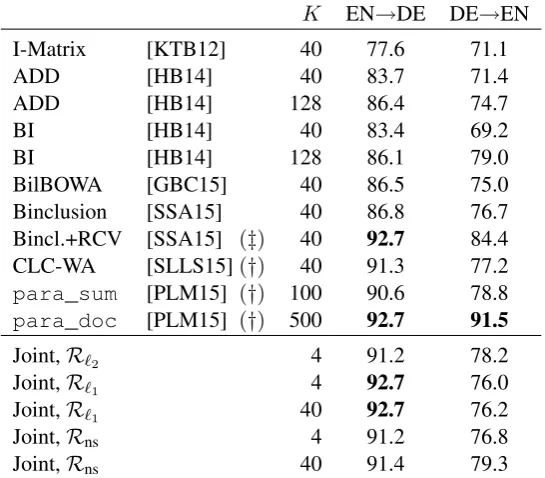
Table 1 shows the results. We include for com-parison the most competitive systems published to date. The first thing to note is that our joint system with Euclidean co-regularization performs very well for this task, despite the theoretical lim-itations shown in §4. Although its embedding size is only K = 4(one dimension per label), it out-performed all the two-stage systems trained on the same data, in both directions.
For the EN→DE direction, our joint system with`1 co-regularization achieved state-of-the-art
results (92.7%), matching two-stage systems that use extra monolingual data, negative sampling, or non-additive document representations. It is con-ceivable that the better results of R`1 over R`2 come from its higher robustness to differences in the parallel sentences.
K EN→DE DE→EN
I-Matrix [KTB12] 40 77.6 71.1
ADD [HB14] 40 83.7 71.4
ADD [HB14] 128 86.4 74.7
BI [HB14] 40 83.4 69.2
BI [HB14] 128 86.1 79.0
BilBOWA [GBC15] 40 86.5 75.0
Binclusion [SSA15] 40 86.8 76.7
Bincl.+RCV [SSA15] (‡) 40 92.7 84.4
CLC-WA [SLLS15](†) 40 91.3 77.2
para_sum [PLM15] (†) 100 90.6 78.8
para_doc [PLM15] (†) 500 92.7 91.5
Joint,R`2 4 91.2 78.2
Joint,R`1 4 92.7 76.0
Joint,R`1 40 92.7 76.2
Joint,Rns 4 91.2 76.8
[image:6.595.163.436.62.301.2]Joint,Rns 40 91.4 79.3
Table 1: Accuracies in the RCV1/RCV2 dataset. Shown for comparison are Klementiev et al. (2012) [KTB12], Hermann and Blunsom (2014) [HB14], Gouws et al. (2015) [GBC15], Soyer et al. (2015) [SSA15], Shi et al. (2015) [SLLS15], and Pham et al. (2015) [PLM15]. Systems marked with(†)used the full 1.8M parallel sentences in Europarl. The one with(‡)used additional target monolingual data from RCV1/RCV2. The bottom rows refer to our joint method, with Euclidean (`2), `1, and
noise-contrastive co-regularization.
(hence many more parameters), was trained on more parallel sentences, and requires more expen-sive (and non-deterministic) computation at test time to compute a document’s embedding. Our method has the advantage of being simple and very fast to train: it took less than 1 minute to train the joint-R`1 system for EN→DE, using a single core on an Intel Xeon @2.5 GHz. This can be compared with Klementiev et al. (2012), who took 10 days on a single core, or Coulmance et al. (2015), who took 10 minutes with 6 cores.6
Although our theoretical results suggest that in-creasingK when using the`1 norm may increase
the expressiveness of our embeddings, our results do not support this claim (the improvements in DE→EN from K = 4 to K = 40 were tiny). However, it led to a gain of 2.5 points when us-ing negative samplus-ing. ForK = 40, this system is much more accurate than Hermann and Blunsom (2014), which confirms that learning the embed-dings together with the task is highly beneficial.
6Coulmance et al. (2015) reports accuracies of 87.8%
(EN→DE) and 78.7% (DE→EN), when using 10,000 train-ing documents from the RCV1/RCV2 corpora.
5.2 TED Corpus
To assess the ability of our framework to han-dle multiple target languages, we ran a second set of experiments on the TED corpus (Cettolo et al., 2012), using the training and test parti-tions created by Hermann and Blunsom (2014), downloaded fromhttp://www.clg.ox.ac. uk/tedcorpus. The corpus contains English transcriptions and multilingual, sentence-aligned translations of talks from the TED conference in 12 different languages, with 12,078 parallel docu-ments in the training partition (totalling 1,641,985 parallel sentences). Following their prior work, we used this corpus both as parallel data (Du) and as
the task dataset (Dl). There areL= 15labels and
documents can have multiple labels.
We experimented with two different strategies:
vali-dation data).
• A two-stage approach (Joint w/ Aux), where we first obtain multilingual embeddings by apply-ing our framework with an auxiliary task with pre-trained English embeddings (as described in Eq. 10 and in the last paragraph of §3), and then use the resulting multilingual representations to train the multi-label classifier. We address this multi-label classification problem with indepen-dent binary logistic regressors (one per label), trained by running 100 iterations of L-BFGS (Liu and Nocedal, 1989). At test time, we se-lect those labels whose posterior probability are above 0.5.
For the Joint w/ Aux strategy, we used the 300-dimensional GloVe-840B vectors (Penning-ton et al., 2014), downloaded from http://
nlp.stanford.edu/projects/glove/.
Table 2 shows the results for cross-lingual clas-sification, where we use English as source and each of the other 11 languages as target. We compare our two strategies above with the strong Machine Translation (MT) baseline used by Her-mann and Blunsom (2014) (which translates the input documents to English with a state-of-the-art MT system) and with their two strongest sys-tems, which build document-level representations from embeddings trained bilingually or multi-lingually (called DOC/ADD single and DOC/ADD
joint, respectively).7 Overall, our Joint system
with`2 regularization outperforms both Hermann
and Blunsom (2014)’s systems (but not the MT baseline) for 8 out of 11 languages, performing generally better than our `1-regularized system.
However, the clear winner is our `2-regularized
Joint w/ Auxsystem, which wins over all systems (including the MT baseline) by a substantial mar-gin, for all languages. This shows that pre-trained source embeddings can be extremely helpful in bootstrapping multilingual ones.8 On the other
hand, the performance of the Joint w/ Aux sys-tem with`1 regularization is rather disappointing.
Note that the limitations of R`2 shown in §4 are not a concern here, since the auxiliary task has
7Note that, despite the name, the Hermann and Blunsom
(2014)’sjointsystems are not doing joint training as we are.
8Note however that, overall, our Joint w/ Aux systems
have access to more data than our Joint systems and also than Hermann and Blunsom (2014)’s systems, since the pre-trained embeddings were pre-trained on a large amount of En-glish monolingual data. Yet, the amount of target language data is the same.
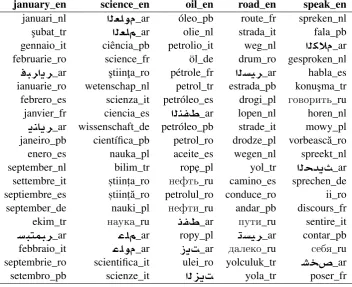
L = 300 dimensions (the dimension of the pre-trained embeddings). A small sample of the mul-tilingual embeddings produced by the winner sys-tem is shown in Table 4.
Finally, we did a last experiment in which we use our multilingual embeddings obtained with
Joint w/ Auxto train monolingual systems for each language. This time, we compare with a bag-of-words naïve Bayes system (reported by Hermann and Blunsom (2014)), a system trained on the Polyglot embeddings from Al-Rfou et al. (2013) (which are multilingual, but not in a shared rep-resentation space), and the two systems developed by Hermann and Blunsom (2014). The results are shown in Table 3. We observe that, with the excep-tion of Turkish, our systems consistently outper-form all the competitors. Comparing the bottom two rows of Tables 2 and 3 we also observe that, for the `2-regularized system, there is not much
degradation caused by cross-lingual training ver-sus training on the target language directly (in fact, for Spanish, Polish, and Brazilian Portuguese, the former scores are even higher). This suggests that the multilingual embeddings have high quality.
6 Conclusions
We proposed a new formulation which jointly minimizes a combination of a supervised loss function with a multilingual co-regularization term using unlabeled parallel data. This allows learning task-specific multilingual embeddings to-gether with a classifier for the task. Our method achieved state-of-the-art accuracy on the Reuters RCV1/RCV2 cross-lingual classification task in the English to German direction, while being ex-tremely simple and computationally efficient. Our results in the Reuters RCV1/RCV2 task, obtained using Europarl v7 as parallel data, show that our method has no trouble handling different levels of representations simutaneously (document, sen-tence and word). On the TED Corpus, we obtained the highest reported scores for 10 out of 11 lan-guages, using an auxiliary task with pre-trained English embeddings.
Acknowledgments
Ara. Ger. Spa. Fre. Ita. Dut. Pol. Br. Pt. Rom. Rus. Tur. MT Baseline [HB14] 42.9 46.5 51.8 52.6 51.4 50.5 44.5 47.0 49.3 43.2 40.9
DOC/ADDsingle [HB14] 41.0 42.4 38.3 47.6 48.5 26.4 40.2 35.4 41.8 44.8 45.2
[image:8.595.72.509.73.157.2]DOC/ADDjoint [HB14] 39.2 40.5 44.3 44.7 47.5 45.3 39.4 40.9 44.6 47.6 41.7 Joint,R`2,K= 15 41.8 46.6 46.6 46.0 48.7 52.5 39.5 40.8 47.6 44.9 47.2 Joint,R`1,K= 15 44.0 44.7 49.4 40.1 46.1 49.4 35.7 43.5 40.5 42.2 43.4 Joint w/ Aux,R`2,K= 300 46.9 52.0 59.4 54.6 56.0 53.6 51.0 51.7 53.9 52.3 49.5 Joint w/ Aux,R`1,K= 300 44.0 40.4 40.4 39.5 38.6 38.1 43.2 36.6 35.1 44.3 44.4
Table 2: Cross-lingual experiments on the TED Corpus using English as a source language. Reported are the micro-averaged F1 scores for a machine translation baseline and the two strongest systems of
Hermann and Blunsom (2014), our one-stage joint system (Joint), and our two-stage system that trains the multilingual embeddings jointly with the auxiliary task of fitting pre-trained English embeddings (Joint w/ Aux), with both`1and`2regularization. Bold indicates the best result for each target language.
Ara. Ger. Spa. Fre. Ita. Dut. Pol. Br. Pt. Rom. Rus. Tur. BOW baseline [HB14] 46.9 47.1 52.6 53.2 52.4 52.2 41.5 46.5 50.9 46.5 51.3 Polyglot [HB14] 41.6 27.0 41.8 36.1 33.2 22.8 32.3 19.4 30.0 40.2 29.5 DOC/ADD Single [HB14] 42.2 42.9 39.4 48.1 45.8 25.2 38.5 36.3 43.1 47.1 43.5 DOC/ADD Joint [HB14] 37.1 38.6 47.2 45.1 39.8 43.9 30.4 39.4 45.3 40.2 44.1 Joint w/ Aux,R`2,K= 300 48.6 54.4 57.5 55.8 56.9 54.5 46.1 51.3 56.5 53.0 49.5 Joint w/ Aux,R`1,K= 300 52.4 47.8 57.8 50.0 53.3 52.3 47.6 49.0 49.2 51.4 50.9
Table 3: Monolingual experiments on the TED Corpus. Shown are the micro-averagedF1 scores for a
bag-of-words baseline, a system trained on Polyglot embeddings, the two strongest systems of Hermann and Blunsom (2014), and ourJoint w/ Auxsystem with`1and`2regularization.
january_en science_en oil_en road_en speak_en
januari_nl
`lw
_ar óleo_pb route_fr spreken_nl¸subat_tr
`l
_ar olie_nl strada_it fala_pbgennaio_it ciência_pb petrolio_it weg_nl
k®
_arfebruarie_ro science_fr öl_de drum_ro gesproken_nl
br §r
_ar ¸stiin¸ta_ro pétrole_frsyr
_ar habla_esianuarie_ro wetenschap_nl petrol_tr estrada_pb konu¸sma_tr febrero_es scienza_it petróleo_es drogi_pl ãîâîðèòü_ru janvier_fr ciencia_es
nfX
_ar lopen_nl horen_nl§nA§r
_ar wissenschaft_de petróleo_pb strade_it mowy_pljaneiro_pb científica_pb petrol_ro drodze_pl vorbeasc˘a_ro enero_es nauka_pl aceite_es wegen_nl spreekt_nl
september_nl bilim_tr rop˛e_pl yol_tr
d§
_arsettembre_it s,tiint,a_ro íåôòü_ru camino_es sprechen_de
septiembre_es s,tiint,˘a_ro petrolul_ro conduce_ro ii_ro
september_de nauki_pl íåôòè_ru andar_pb discours_fr ekim_tr íàóêà_ru
fX
_ar ïóòè_ru sentire_itFbtmbr
_arl
_ar ropy_plsyr
_ar contar_pbfebbraio_it
lw
_arE§
_ar äàëåêî_ru ñåáÿ_ruseptembrie_ro scientifica_it ulei_ro yolculuk_tr
JP
_arsetembro_pb scienze_it
z§
yola_tr poser_frTable 4: Examples of nearest neighbor words for the multilingual embeddings trained with our Joint w/ Auxsystem with`2 regularization. Shown for each English word are the 20 closest target words in
[image:8.595.123.476.422.709.2]through contracts UID/EEA/50008/2013, through the LearnBig project (PTDC/EEI-SII/7092/2014), and the GoLocal project (grant CMUPERI/TIC/0046/2014).
References
Rami Al-Rfou, Bryan Perozzi, and Steven Skiena. 2013. Polyglot: Distributed word represen-tations for multilingual NLP. arXiv preprint arXiv:1307.1662.
Yasemin Altun, Mikhail Belkin, and David A. McAllester. 2005. Maximum Margin Semi-Supervised Learning for Structured Variables. InAdvances in Neural Information Processing Systems 18. pages 33–40.
Yoshua Bengio, Réjean Ducharme, Pascal Vin-cent, and Christian Janvin. 2003. A neural prob-abilistic language model. Journal of Machine Learning Research3:1137–1155.
Mauro Cettolo, Christian Girardi, and Marcello Federico. 2012. Wit3: Web inventory of tran-scribed and translated talks. In Proc. of the 16th Conference of the European Association for Machine Translation. pages 261–268. Sarath Chandar, Stanislas Lauly, Hugo Larochelle,
Mitesh M. Khapra, Balaraman Ravindran, Vikas Raykar, and Amrita Saha. 2014. An Autoencoder Approach to Learning Bilingual Word Representations.
Danqi Chen and Christopher D Manning. 2014. A fast and accurate dependency parser using neu-ral networks. InProc. of Empirical Methods for Natural Language Processing. pages 740–750. Ronan Collobert and Jason Weston. 2008. A
uni-fied architecture for natural language process-ing: Deep neural networks with multitask learn-ing. InProc. of the International Conference on Machine Learning. ACM, pages 160–167. Ronan Collobert, Jason Weston, Léon Bottou,
Michael Karlen, Koray Kavukcuoglu, and Pavel Kuksa. 2011. Natural language processing (al-most) from scratch. Journal of Machine Learn-ing Research12:2493–2537.
Jocelyn Coulmance, Jean-Marc Marty, Guillaume Wenzek, and Amine Benhalloum. 2015. Trans-gram, Fast Cross-lingual Word-embeddings.
Proceedings of the 2015 Conference on Empir-ical Methods in Natural Language Processing
(EMNLP)pages 1109–1113.
John Duchi, Elad Hazan, and Yoram Singer. 2011. Adaptive Subgradient Methods for Online Learning and Stochastic Optimization. Journal of Machine Learning Research12:2121–2159. Manaal Faruqui, Jesse Dodge, Sujay K Jauhar,
Chris Dyer, Eduard Hovy, and Noah A Smith. 2015. Retrofitting word vectors to semantic lex-icons. InProc. of Annual Meeting of the North-American Chapter of the Association for Com-putational Linguistics.
Manaal Faruqui and Chris Dyer. 2014. Improving vector space word representations using multi-lingual correlation. In Proc. of Annual Meet-ing of the European Chapter of the Association for Computational Linguistics. Association for Computational Linguistics.
Kuzman Ganchev and Dipanjan Das. 2013. Cross-lingual discriminative learning of sequence models with posterior regularization. In Proc. of Empirical Methods in Natural Language Pro-cessing.
Kuzman Ganchev, Joao Graca, John Blitzer, and Ben Taskar. 2008. Multi-view learning over structured and non-identical outputs. In Proc. of Conference on Uncertainty in Artificial Intel-ligence.
Stephan Gouws, Yoshua Bengio, and Greg Cor-rado. 2015. BilBOWA: Fast Bilingual Dis-tributed Representations without Word Align-ments. Proceedings of the 32nd International Conference on Machine Learning (2015)pages 748–756.
Karl Moritz Hermann and Phil Blunsom. 2014. Multilingual Models for Compositional Dis-tributed Semantics. Proceedings of ACLpages 58–68.
Rebecca Hwa, Philip Resnik, Amy Weinberg, Clara Cabezas, and Okan Kolak. 2005. Boot-strapping parsers via syntactic projection across parallel texts. Natural language engineering
11(3):311–325.
Alexandre Klementiev, Ivan Titov, and Binod Bhattarai. 2012. Inducing crosslingual dis-tributed representations of words. 24th Inter-national Conference on Computational Linguis-tics - Proceedings of COLING 2012: Technical Papers (2012)pages 1459–1474.
for statistical machine translation. MT summit
11.
Quoc Le and Tomas Mikolov. 2014. Distributed Representations of Sentences and Documents.
International Conference on Machine Learning
- ICML 201432:1188–1196.
Omer Levy, Yoav Goldberg, and Ido Dagan. 2015. Improving distributional similarity with lessons learned from word embeddings.Transactions of the Association for Computational Linguistics
3:211–225.
David D. Lewis, Yiming Yang, Tony G. Rose, and Fan Li. 2004. RCV1: A New Benchmark Col-lection for Text Categorization Research. Jour-nal of Machine Learning Research5:361–397. D. C. Liu and J. Nocedal. 1989. On the limited
memory BFGS method for large scale optimiza-tion. Mathematical Programming45:503–528. Minh-Thang Luong, Hieu Pham, and
Christo-pher D. Manning. 2015. Bilingual Word Repre-sentations with Monolingual Quality in Mind.
Workshop on Vector Modeling for NLP pages
151–159.
André F. T. Martins. 2015. Transferring corefer-ence resolvers with posterior regularization. In
ACL.
Ryan McDonald, Slav Petrov, and Keith Hall. 2011. Multi-source transfer of delexicalized de-pendency parsers. In Proc. of Empirical Meth-ods in Natural Language Processing.
Tomas Mikolov, Greg Corrado, Kai Chen, and Jef-frey Dean. 2013. Efficient Estimation of Word Representations in Vector Space. Proceedings of the International Conference on Learning Representations (ICLR 2013)pages 1–12. Jeffrey Pennington, Richard Socher, and
Christo-pher D Manning. 2014. GloVe: Global Vectors for Word Representation. InProceedings of the 2014 Conference on Empirical Methods in Nat-ural Language Processing. pages 1532–1543. Kaare Brandt Petersen and Michael Syskind
Ped-ersen. 2012. The Matrix Cookbook.
Hieu Pham, Minh-Thang Luong, and Christo-pher D. Manning. 2015. Learning Dis-tributed Representations for Multilingual Text Sequences. Workshop on Vector Modeling for NLPpages 88–94.
Tianze Shi, Zhiyuan Liu, Yang Liu, and Maosong Sun. 2015. Learning Cross-lingual Word Em-beddings via Matrix Co-factorization. Annual Meeting of the Association for Computational Linguisticspages 567–572.
Vikas Sindhwani, Partha Niyogi, and Mikhail Belkin. 2005. A co-regularization approach to semi-supervised learning with multiple views. InProceedings of ICML workshop on learning with multiple views. Citeseer, pages 74–79. Richard Socher, Jeffrey Pennington, and
Eh Huang. 2011. Semi-supervised recur-sive autoencoders for predicting sentiment distributions. In Conference on Empirical
Methods in Natural Language Processing.
pages 151–161.
Hubert Soyer, Pontus Stenetorp, and Akiko Aizawa. 2015. Leveraging Monolingual Data for Crosslingual Compositional Word Repre-sentations. Proceedings of the 2015 Interna-tional Conference on Learning Representations (ICLR).
Joseph Turian, Lev Ratinov, and Yoshua Bengio. 2010. Word representations: a simple and gen-eral method for semi-supervised learning. In
Proc. of the Annual Meeting of the Association for Computational Linguistics.
Daniel Zeman and Philip Resnik. 2008. Cross-language parser adaptation between related lan-guages. InIJCNLP. pages 35–42.