Proceedings of the 4th Workshop on Representation Learning for NLP (RepL4NLP-2019), pages 61–71 61
Learning Bilingual Sentence Embeddings via Autoencoding
and Computing Similarities with a Multilayer Perceptron
Yunsu Kim2 Hendrik Rosendahl1,2 Nick Rossenbach2 Jan Rosendahl2 Shahram Khadivi1 Hermann Ney2
1eBay, Inc., Aachen, Germany
{hrosendahl,skhadivi}@ebay.com
2RWTH Aachen University, Aachen, Germany
{surname}@cs.rwth-aachen.de
Abstract
We propose a novel model architecture and training algorithm to learn bilingual sentence embeddings from a combination of parallel and monolingual data. Our method connects autoencoding and neural machine translation to force the source and target sentence embed-dings to share the same space without the help of a pivot language or an additional trans-formation. We train a multilayer perceptron on top of the sentence embeddings to extract good bilingual sentence pairs from nonparallel or noisy parallel data. Our approach shows promising performance on sentence align-ment recovery and the WMT 2018 parallel corpus filtering tasks with only a single model.
1 Introduction
Data crawling is increasingly important in ma-chine translation (MT), especially for neural net-work models. Without sufficient bilingual data, neural machine translation (NMT) fails to learn meaningful translation parameters (Koehn and Knowles,2017). Even for high-resource language pairs, it is common to augment the training data with web-crawled bilingual sentences to improve the translation performance (Bojar et al.,2018).
Using crawled data in MT typically involves two core steps: mining and filtering. Mining parallel sentences, i.e. aligning source and tar-get sentences, is usually done with lots of heuris-tics and features: document/URL meta infor-mation (Resnik and Smith, 2003; Espl´a-Gomis and Forcada, 2009), sentence lengths with self-induced lexicon (Moore,2002;Varga et al.,2005; Etchegoyhen and Azpeitia,2016), word alignment statistics and linguistic tags (S.tef˘anescu et al., 2012;Kaufmann,2012).
Filtering aligned sentence pairs also often in-volves heavy feature engineering (Taghipour et al.,
2011;Xu and Koehn,2017). Most of the partici-pants in the WMT 2018 parallel corpus filtering task use large-scale neural MT models and lan-guage models as the features (Koehn et al.,2018). Bilingual sentence embeddings can be an ele-gant and unified solution for parallel corpus min-ing and filtermin-ing. They compress the information of each sentence into a single vector, which lies in a shared space between source and target lan-guages. Scoring a source-target sentence pair is done by computing similarity between the source embedding vector and the target embedding vec-tor. It is much more efficient than scoring by de-coding, e.g. with a translation model.
Bilingual sentence embeddings have been stud-ied primarily for transfer learning of monolingual downstream tasks across languages (Hermann and Blunsom, 2014; Pham et al., 2015; Zhou et al., 2016). However, few papers apply it to bilin-gual corpus mining; many of them require paral-lel training data with additional pivot languages (Espana-Bonet et al., 2017; Schwenk, 2018) or lack an investigation into similarity between the embeddings (Guo et al.,2018).
This work solves these issues as follows:
• We propose a simple end-to-end training approach of bilingual sentence embeddings with parallel and monolingual data only of the corresponding language pair.
• We use a multilayer perceptron (MLP) as a trainable similarity measure to match source and target sentence embeddings.
• We compare various similarity measures for embeddings in terms of score distribution, geometric interpretation, and performance in downstream tasks.
cor-pus filtering tasks without a complex combi-nation of translation/language models.
• We analyze the effect of negative examples on training an MLP similarity, using different levels of negativity.
2 Related Work
Bilingual representation of a sentence was at first built by averaging pre-trained bilingual word em-beddings (Huang et al., 2012; Klementiev et al., 2012). The compositionality from words to sen-tences is integrated into end-to-end training in Hermann and Blunsom(2014).
Explicit modeling of a sentence-level bilingual embedding was first discussed in Chandar et al. (2013), training an autoencoder on monolingual sentence embeddings of two languages. Pham et al. (2015) jointly learn bilingual sentence and word embeddings by feeding a shared sentence embedding ton-gram models. Zhou et al.(2016) add document-level alignment information to this model as a constraint in training.
Recently, sequence-to-sequence NMT models were adapted to learn cross-lingual sentence em-beddings. Schwenk and Douze (2017) connect multiple source encoders to a shared decoder of a pivot target language, forcing the consistency of encoder representations. Schwenk(2018) extend this work to use a single encoder for many source languages. Both methods rely onN-way parallel training data, which are seriously limited to cer-tain languages and domains.Artetxe and Schwenk (2018b) relax this data condition to pairwise paral-lel data including the pivot language, but it is still unrealistic for many scenarios (see Section 4.2). In contrast, our method needs only parallel and monolingual data for source and target languages of concern without any pivot languages.
Hassan et al. (2018) train a bidirectional NMT model with a single encoder-decoder, taking the average of top-layer encoder states as the sentence embedding. They do not include any details on the data or translation performance before/after the fil-tering with this embedding. Junczys-Dowmunt (2018) apply this method to WMT 2018 paral-lel corpus filtering task, yet showing significantly worse performance than a combination of trans-lation/language models. Our method shows com-parable results to such model combinations in the same task.
Guo et al. (2018) replace the decoder with a
feedforward network and use the parallel sen-tences as input to the two encoders. Similarly to our work, the feedforward network measures the similarity of sentence pairs, except that the source and target sentence embeddings are combined via dot product instead of concatenation. Their model, however, is not directly optimizing the source and target sentences to be translations of each other; it only attaches two encoders in the output level without a decoder.
Based on the model of Artetxe and Schwenk (2018b), Artetxe and Schwenk (2018a) scale cosine similarity between sentence embeddings with average similarity of the nearest neighbors. Searching for the nearest neighbors among hun-dreds of millions of sentences may cause a huge computational problem. On the other hand, our similarity calculation is much quicker and support batch computation while preserving strong perfor-mance in parallel corpus filtering.
Neither of the above-mentioned methods utilize monolingual data. We integrate autoencoding into NMT to maximize the usage of parallel and mono-lingual data together in learning bimono-lingual sentence embeddings.
3 Bilingual Sentence Embeddings
A bilingual sentence embedding function maps sentences from both the source and target lan-guage into a single joint vector space. Once we obtain such a space, we can search for a similar target sentence embedding given a source sentence embedding, or vice versa.
3.1 Model
In this work, we learn bilingual sentence embed-dings via NMT and autoencoding given parallel and monolingual corpora. Since our purpose is to pair source and target sentences, translation is a natural base task to connect sentences in two different languages. We adopt a basic encoder-decoder approach from Sutskever et al. (2014). The encoder produces a fixed-length embedding of a source sentence, which is used by the decoder to generate the target hypothesis.
First, the encoder takes a source sentencefJ
1 = f1, ..., fj, ..., fJ (lengthJ) as input, where eachfj is a source word. It computes hidden representa-tionshj ∈RDfor all source positionsj:
. . .
Element-wise Max-pooling
. . .
. . .
Element-wise Max-pooling
f1 f2 fJ e1 e2 eI
h1 h2 hJ h¯1 h¯2 h¯I
e0 ei−1
s0 s1 sI
[image:3.595.80.282.53.243.2]e1 eI
Figure 1: Our proposed model for learning bilingual sentence embeddings. A decoder (above) is shared over two encoders (below). The decoder accepts a max-pooled representation from either one of the encoders as its first states0, depending on the training objective (Equation7and8).
encsrcis implemented as a bidirectional recurrent neural network (RNN). We denote a target output sentence byeI1 = e1, ..., ei, ..., eI (length I). The decoder is an unidirectional RNN whose internal state for a target positioniis:
si = dec(si−1, ei−1) (2)
where its initial state is element-wise max-pooling of the encoder representationshJ1:
s0 = maxpool(hJ1)
=
max
j=1,...,Jhj1, ... , j=1max,...,JhjD >
(3)
We empirically found that the max-pooling per-forms much better than averaging or choosing the first (h1) or last (hJ) representation. Finally, an output layer predicts a target wordei:
pθ(ei|ei−1 1, f
J
1) = softmax(linear(si)) (4)
whereθdenotes a set of model parameters. Note that the decoder has access to the source sentence only through s0, which we take as the
sentence embedding of f1J. This assumes that the source sentence embedding contains sufficient information for translating to a target sentence, which is desired for a bilingual embedding space.
However, this plain NMT model can generate only source sentence embeddings through the en-coder. The decoder cannot process a new target
sentence without a proper source language input. We can perform decoding with an empty source input and take the last decoder state sI as the sentence embedding of eI1, but it is not compati-ble with the source embedding and contradicts the way in which the model is trained.
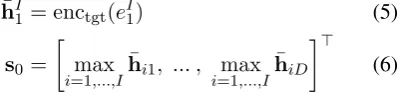
Therefore, we attach another encoder of the tar-get language to the same (tartar-get) decoder:
¯
hI1 = enctgt(eI1) (5)
s0 =
max
i=1,...,I
¯
hi1, ... , max
i=1,...,I
¯
hiD
> (6)
enctgt has the same architecture as encsrc. The model has now an additional information flow from a target input sentence to the same target (output) sentence, also known as sequential au-toencoder (Li et al.,2015).
Figure1is a diagram of our model. A decoder is shared between NMT and autoencoding parts; it takes either source or target sentence embedding and does not differentiate between the two when producing an output. The two encoders are con-strained to provide mathematically consistent rep-resentations over the languages (to the decoder).
Note that our model does not have any attention component (Bahdanau et al., 2014). The atten-tion mechanism in NMT makes the decoder attend to encoder representations at all source positions. This is counterintuitive for our purpose; we need to optimize the encoder to produce a single rep-resentation vector, but the attention model allows the encoder to distribute information over many different positions. In our initial experiments, the same model with the attention mechanism showed exorbitantly bad performance, so we removed it in the main experiments of Section4.
3.2 Training and Inference
Let θencsrc, θenctgt, and θdec the parameters of
the source encoder, the target encoder, and the (shared) decoder, respectively. Given a paral-lel corpus P and a target monolingual corpus
Mtgt, the training criterion of our model is the cross-entropy on two input-output paths. The NMT objective (Equation7) is for trainingθ1 = {θencsrc, θdec}, and the autoencoding objective
(Equation8) is for trainingθ2 ={θenctgt, θdec}:
Lemb(θ) = −
X
(fJ
1,eI1)∈P logpθ1(e
I
[image:3.595.326.525.187.237.2]−X
eI
1∈Mtgt
logpθ2(e
I
1|eI1) (8)
where θ = {θ1, θ2}. During the training, each mini-batch contains examples of the both objec-tives with a 1:1 ratio. In this way, we prevent one encoder from being optimized more than the other, forcing the two encoders produce balanced sentence embeddings that fit to the same decoder.
The autoencoding part can be trained with a separate target monolingual corpus. To provide a stronger training signal for the shared embedding space, we use also the target side ofP; the model learns to produce the same target sentence from the corresponding source and target inputs.
In order to guide the training to bilingual repre-sentations, we initialize the word embedding lay-ers with a pre-trained bilingual word embedding. The word embedding for each language is trained with a skip-gram algorithm (Mikolov et al.,2013), later mapped across the languages with adversarial training (Conneau et al.,2018) and self-dictionary refinements (Artetxe et al.,2017).
Our model can be built also in the opposite di-rection, i.e. with a target-to-source NMT model and a source autoencoder:
Lemb(θ) = −
X
(fJ
1,eI1)∈P logpθ2(f
J
1|eI1) (9)
− X
fJ
1∈Msrc logpθ1(f
J
1|f1J) (10)
Once the model is trained, we need only the en-coders to query sentence embeddings. Leta and
b be embeddings of a source sentence f1J and a target sentenceeI1, respectively:
a= maxpool(encsrc(f1J)) (11)
b= maxpool(enctgt(eI1)) (12)
3.3 Computing Similarities
The next step is to evaluate how close the two em-beddings are to each other, i.e. to compute a sim-ilarity measure between them. In this paper, we consider two types of similarity measures.
Predefined mathematical functions Cosine
similarity is a conventional choice for measuring the similarity in vector space modeling of infor-mation retrieval or text mining (Singhal,2001). It computes the angle between two vectors (rotation) and ignore the lengths:
cos(a,b) = a·b
kakkbk (13)
Euclidean distance indicates how much distance must be traveled to move from the end of a vector to that of the other (transition). We reverse this distance to use it as a similarity measure:
Euclidean(a,b) =−ka−bk (14)
However, these simple measures, i.e. a single rotation or transition, might not be sufficient to define the similarity of complex natural language sentences across different languages. Also, the learned joint embedding space is not necessarily perfect in the sense of vector space geometry; even if we train it with a decent algorithm, the structure and quality of the embedding space are highly de-pendent on the amount of parallel training data and its domain. This might hinder the simple functions from working well for our purpose.
Trainable multilayer perceptron To model
re-lations of sentence embeddings by combining ro-tation, shift, and even nonlinear transformations, We train a small multilayer perceptron (MLP) (Bishop et al.,1995) and use it as a similarity mea-sure. We design the MLP network q(a,b) as a simple binary classifier whose input is a concate-nation of source and target sentence embeddings:
[a;b]>. It is passed through feedforward hidden layers with nonlinear activations. The output layer has a single node with sigmoid activation, repre-senting how probable the source and target sen-tences are translations of each other.
To train this model, we must have positive ex-amples (real parallel sentence pairs, Ppos) and
negative examples (nonparallel or noisy sentence pairs,Pneg). The training criterion is:
Lsim= − X (a,b)∈Ppos
logq(a,b)
− X
(a,b)∈Pneg
(1−logq(a,b)) (15)
which naturally fits to the main task of interest: parallel corpus filtering (Section 4.2). Note that the output of the MLP can be quite biased to the extremes (0 or 1) in order to clearly distinguish good and bad examples. This has both advantages and disadvantages as explained in Section5.1.
not only nonparallel sentence pairs but also out-of-domain instances.
4 Evaluation
We evaluated our bilingual sentence embedding and the MLP similarity on two tasks: sentence alignment recovery and parallel corpus filtering. The sentence embedding was trained with WMT 2018 English-German parallel data and 100M German sentences from the News Crawl mono-lingual data1, where we use German as the au-toencoded language. All sentences were lower-cased and limited to the length of 60. We learned the byte pair encoding (Sennrich et al., 2016) jointly for the two languages with 20k merge oper-ations. We pre-trained bilingual word embeddings on 100M sentences from the News Crawl data for each language using FASTTEXT (Bojanowski et al.,2017) and MUSE (Conneau et al.,2018).
Our sentence embedding model has 1-layer RNN encoder/decoder, where the word embed-ding and hidden layers have a size of 512. The training was done with stochastic gradient descent with initial learning rate of 1.0, batch size of 120 sentences, and maximum 800k updates. After 100k updates, we reduced the learning rate by a factor of 0.9 for every 50k updates.
Our MLP similarity model has 2 hidden lay-ers of size 512 with ReLU (Nair and Hinton, 2010), trained with SCIKIT-LEARN (Pedregosa et al.,2011) with maximum 1,000 updates. For a positive training set, we used newstest2007-2015 from WMT (around 21k sentences). Unless other-wise noted, we took a comparable size of negative examples from the worst-scored sentence pairs of ParaCrawl2English-German corpus. The scoring was done with our bilingual sentence embedding and cosine similarity.
Note that the negative examples are selected via cosine similarity but the similarity values are not used in the MLP training (Equation 15). Thus it does not learn to mimic the cosine similarity function again, but has a new sorting of sentence pairs—also encoding the domain information.
4.1 Sentence Alignment Recovery
In this task, we corrupt the sentence alignments of a parallel test set by shuffling one side, and find
1
http://www.statmt.org/wmt18/translation-task.html
2https://www.paracrawl.eu/
the original alignments; also known as corpus re-construction (Schwenk and Douze,2017).
Given a source sentence, we compute a simi-larity score with every possible target sentence in the data and take the top-scored one as the align-ment. The error rate is the number of incorrect sentence alignments divided by the total number of sentences. We compute this also in the oppo-site direction and take an average of the two error rates. It is an intrinsic evaluation for parallel cor-pus mining. We choose two test sets: WMT new-stest2018 (2998 lines) and IWSLT tst2015 (1080 lines).
As baselines, we used character-level Leven-shtein distance and length-normalized posterior scores of German→English/English→German NMT models. Each NMT model is a 3-layer base Transformer (Vaswani et al.,2017) trained on the same training data as the sentence embedding.
Error [%]
Method WMT IWSLT
Levenshtein distance 37.4 54.6
NMT de-en + en-de 1.7 13.3
Our method (Cosine similarity) 4.3 13.8 Our method (MLP similarity) 89.9 72.6
Table 1: Sentence alignment recovery results. Our method results use cosine similarity except the last row.
Table1shows the results. The Levenshtein dis-tance gives a poor performance. NMT models are better than the other methods, but takes too long to compute posteriors for all possible pairs of source and target sentences (about 12 hours for the WMT test set). This is absolutely not feasible for a real mining task with hundreds of millions of sentences.
Our bilingual sentence embeddings (with us-ing cosine similarity) show error rates close to the NMT models, especially in the IWSLT test set. Computing similarities between embeddings is ex-tremely fast (about 3 minutes for the WMT test set), which perfectly fits to mining scenarios.
BLEU[%]
10M words 100M words
Method test2017 test2018 test2017 test2018
Random sampling 19.1 23.1 23.2 29.3
Pivot-based embedding (Schwenk and Douze,2017) 26.1 32.4 30.0 37.5
NMT + LM, 4 models (Rossenbach et al.,2018) 29.1 35.2 31.3 38.2
Our method (cosine similarity) 23.0 28.4 27.9 34.4
[image:6.595.75.525.69.189.2]Our method (MLP similarity) 29.2 35.4 30.6 37.5
Table 2: Parallel corpus filtering results (German→English).
4.2 Parallel Corpus Filtering
We also test our methods in the WMT 2018 paral-lel corpus filtering task (Koehn et al.,2018).
Data The task is to score each line of a very noisy, web-crawled corpus of 104M parallel lines (ParaCrawl English-German). We pre-filtered the given raw corpus with the heuristics of Rossen-bach et al.(2018). Only the data for WMT 2018 English-German news translation task is allowed to train scoring models. The evaluation procedure is: subsample top-scored lines which amounts to 10M/100M words, train a small NMT model with the subsampled data, and check its translation per-formance. We follow the official pipeline except that we train 3-layer Transformer NMT model us-ing Sockeye (Hieber et al.,2017) for evaluation.
Baselines We have three comparative baselines:
1) random sampling, 2) bilingual sentence em-bedding learned with a third pivot target lan-guage (Schwenk and Douze, 2017), 3) combina-tion of source-to-target/target-to-source NMT and source/target LM (Rossenbach et al.,2018), a top-ranked system in the official evaluation.
Note that the second method violates the of-ficial data condition of the task since it requires parallel data in German-Pivot and English-Pivot. This method is not practical when learning mul-tilingual embeddings for English and other lan-guages, since it is hard to collect pairwise parallel data involving a non-English pivot language (ex-cept among European languages). We trained this method withN-way parallel UN corpus (Ziemski et al., 2016) with French as the pivot language. The size of this model is the same as that of our autoencoding-based model except the word em-bedding layers.
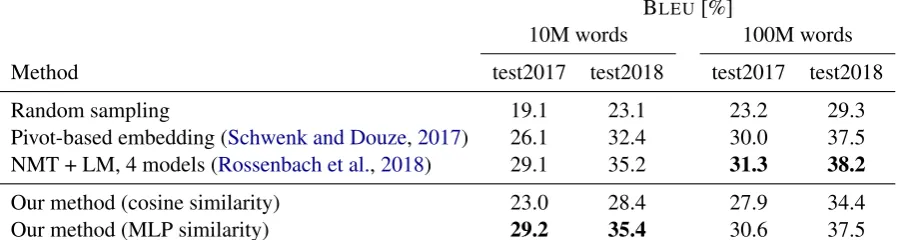
The results are shown in Table2, where cosine
similarity was used by default for sentence embed-ding methods except the last row. Pivot-based sen-tence embedding (Schwenk and Douze,2017) im-proves upon the random sampling, but it has an impractical data condition. The four-model com-bination of NMT models and LMs (Rossenbach et al., 2018) provide 1-3% more BLEU improve-ment. Note that, for the third method, each model costs 1-2 weeks to train.
Our bilingual sentence embedding method greatly improves over the random sampling base-line up to 5.3% BLEU in the 10M-word case and 5.1% BLEU in the 100M-word case. With our MLP similarity, the improvement in BLEU is up to 12.3% and 8.2% in the 10M-word case and the 100M-word case, respectively. It outperforms the pivot-based embedding method significantly and gets close to the performance of the four-model combination. Note that we use only a single model trained with only given parallel/monolingual data for the corresponding language pair, i.e. English-German. In contrast to sentence alignment recov-ery experiments, the MLP similarity boosts the fil-tering performance by a large margin.
5 Analysis
In this section, we provide more in-depth analyses to compare 1) various similarity measures and 2) different choices of the negative training set for the MLP similarity model.
5.1 Similarity Measures
In Table 3, we compare sentence alignment re-covery performance with different similarity mea-sures.
Error [%] Similarity de-en en-de Average
Euclidean 7.9 99.8 53.8
Cosine 4.3 4.2 4.3
CSLS 1.9 2.2 2.1
[image:7.595.92.272.63.156.2]MLP 85.0 94.8 89.9
Table 3: Sentence alignment recovery results with dif-ferent similarity measures (newstest2018).
vectors. Particularly, the English→German direc-tion has a peculiarly bad result with Euclidean dis-tance. This is due to a hubness problem in a high-dimensional space, where some vectors are highly likely to be nearest neighbors of many others.
a1
a2
a3
a4
b1 b2
b3
[image:7.595.119.240.296.419.2]b4
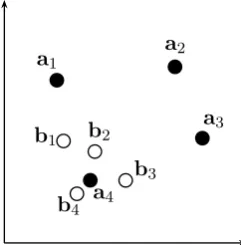
Figure 2: Schematic diagram of the hubness problem. Filled circles indicate German sentence embeddings, while empty circles denote English sentence embed-dings. All embeddings are assumed to be normalized.
Figure 2 illustrates that Euclidean distance is more prone to the hubs than cosine similarity. As-sume that German sentence embeddings an and English sentence embeddingsbnshould match to each other with the same index n, e.g. (a1,b1)
is a correct match. With cosine similarity, the nearest neighbor ofan is alwaysbn for alln =
1, ...,4 and vice versa, considering only the an-gles between the vectors. However, when us-ing Euclidean distance, there is a discrepancy be-tween German→English and English→German directions: The nearest neighbor of each an is
bn, but the nearest neighbor of allbn is always
a4. This leads to a serious performance drop only
in English→German. The figure is depicted in a two-dimensional space for simplicity, but the hub-ness problem becomes worse for an actual high-dimensional space of sentence embeddings.
Cross-domain similarity local scaling (CSLS) is developed to counteract the hubness problem by
0 1 2 3 4
0 0.2 0.4 0.6 0.8 1
sentence index (×107)
similarity
score
(a) Cosine similarity
0 1 2 3 4
0 0.2 0.4 0.6 0.8 1
sentence index (×107)
similarity
score
(b) MLP similarity
Figure 3: The score distribution of similarity measures. The sentences are sorted by their similarity scores. Co-sine similarity values are linearly rescaled to[0,1].
penalizing similarity values in dense areas of the embedding distribution (Conneau et al.,2018):
CSLS(a,b) = 2·cos(a,b) (16)
− 1 K
X
b0∈NN(a)
cos(a,b0) (17)
− 1 K
X
a0∈NN(b)
cos(a0,b) (18)
where K is the number of nearest neighbors. CSLS outperforms cosine similarity in our exper-iments. For a large-scale mining scenario, how-ever, the measure requires heavy computations for the penalty terms (Equation17and18), i.e. near-est neighbor search in all combinations of source and target sentences and sorting the scores over e.g. a few hundred million instances.
[image:7.595.319.526.495.580.2]Similarity
German sentence English sentence Cosine MLP
the requested URL / dictionary / m / mar eisimpleir.htm was not found on this server.
additionally, a 404 Not Found error was encountered while trying to use an Er-rorDocument to handle the request.
0.185 0.000
becoming Prestigious In The Right Way how I Feel About School 0.199 0.000
nach dieser Aussage sollte die t¨urkische Armee somit eine internationale Inter-vention gegen Syrien provozieren .
according to his report, the Turkish army was aiming to provoke an inter-national intervention against Syria.
0.563 1.000
allen Menschen und Besch¨aftigten, die um Freiheit k¨ampfen oder bei Kundge-bungen ums Leben kamen, Achtung zu bezeugen und die unverz¨ugliche Freilassung aller Inhaftierten zu fordern
to pay tribute to all people and work-ers who have been fighting for freedom or fallen in demonstrations and demand the immediate release of all detainees
[image:8.595.77.523.74.288.2]0.427 0.999
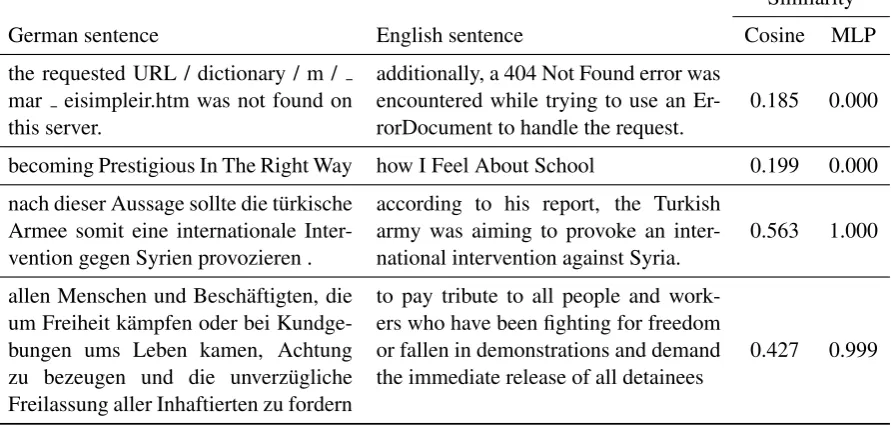
Table 4: Example sentence pairs in the ParaCrawl corpus (Section4.2) with their similarity values.
a small fraction of the corpus is given low- or high-range scores (smaller than 0.2 or larger than 0.6). The remaining sentences are distributed al-most uniformly within the score range inbetween. The distribution curve of the MLP similarity has a completely different shape. It has a strong ten-dency to classify a sentence pair to be extremely bad or extremely good: nearly 80% of the corpus is scored with zero and only 3.25% gets scores be-tween 0.99 and 1.0. Table4shows some example sentence pairs with extreme MLP similarity val-ues.
This is the reason why the MLP similarity does a good job in filtering, especially in selecting a small portion (10M-word) of good parallel sen-tences. Table 4 compares cosine similarities and the MLP scores for some sentence pairs in the raw corpus for our filtering task (Section 4.2). The first two sentence pairs are absolutely nonparallel; both similarity measures give low scores, while the MLP similarity emphasizes the bad quality with zero scores. The third example is a decent parallel sentence pair with a minor ambiguity, i.e. hisin English can be a translation ofdieserin Ger-man or not, depending on the document-level con-text. Both measures see this sentence pair as a pos-itive example.
The last example is parallel but the translation involves severe reordering: long-distance changes in verb positions, switching the order of relative clauses, etc. Here, cosine similarity has trouble in rating this case highly even if it is perfectly
parallel, eventually filtering it out from the train-ing data. On the other hand, our MLP similarity correctly evaluates this difficult case by giving a nearly perfect score.
However, the MLP is not optimized for precise differentiation among the good parallel matches. It is thus not appropriate for sentence alignment recovery that requires exact 1-1 matching of po-tential source-target pairs. A steep drop in the curve of Figure3b also explains why it performs slightly inferior to the best system in the 100M-word filtering task (Table2). The subsampling ex-ceeds the dropping region and includes many zero-scored sentence pairs, where the MLP similarity cannot measure the quality well.
5.2 Negative Training Examples
In the MLP similarity training, we can use pub-licly available parallel corpora as the positive sets. For the negative sets, however, it is not clear which dataset we should use: entirely nonparallel sen-tences, partly parallel sensen-tences, or sentence pairs of quality inbetween. We experimented with nega-tive examples of different quality in Table5. Here is how we vary the negativity:
1. Score the sentence pairs of the ParaCrawl corpus with our bilingual sentence embed-ding using cosine similarity.
2. Sort the sentence pairs by the scores.
Negative examples BLEU[%]
Random sampling 33.3
20% worst 29.9
40% worst 33.3
60% worst 33.7
80% worst 32.1
100% worst 25.7
Table 5: Parallel corpus filtering results (10M-word task) with different negative sets for training MLP sim-ilarity (newstest2016, i.e. the validation set).
100%.
4. Take the last 100k lines for each portion.
A negative set from the 20%-worst part stands for relatively less problematic sentence pairs, in-tending for elaborate classification among perfect parallel sentences (positive set) and almost perfect ones. With the 100%-worst examples, we focus on removing absolutely nonsense pairing of sen-tences. As a simple baseline, we also take 100k sentences randomly without scoring, representing mixed levels of negativity.
The results in Table 5 show that a moderate level of negativity (60%-worst) is most suitable for training an MLP similarity model. If the neg-ative set contains too many excellent examples, the model may mark acceptable parallel sentence pairs with zero scores. If the negative set con-sists only of certainly nonparallel sentence pairs, the model is weak in discriminating mid-quality instances, some of which are crucial to improve the translation system.
Random selection of sentence pairs also works surprisingly well compared to carefully tailored negative sets. It does not require us to score and sort the raw corpus, so it is very efficient, sacrific-ing performance slightly. We hypothesize that the average negative level of this random set is also moderate and similar to that of the 60%-worst.
6 Conclusion
In this work, we present a simple method to train bilingual sentence embeddings by combin-ing vanilla RNN NMT (without attention compo-nent) and sequential autoencoder. By optimizing a shared decoder with combined training objectives, we force the source and target sentence embed-dings to share their space. Our model is trained
with parallel and monolingual data of the corre-sponding language pair, with neither pivot lan-guages norN-way parallel data. We also propose to use a binary classification MLP as a similarity measure for matching source and target sentence embeddings.
Our bilingual sentence embeddings show con-sistently strong performance in both sentence alignment recovery and the WMT 2018 parallel corpus filtering tasks with only a single model. We compare various similarity measures for bilingual sentence matching, verifying that cosine similarity is preferred for a mining task and our MLP simi-larity is very effective in a filtering task. We also show that a moderate level of negativity is appro-priate for training the MLP similarity, using either random examples or mid-range scored examples from a noisy parallel corpus.
Future work would be regularizing the MLP training to obtain a smoother distribution of the similarity scores, which could supplement the weakness of the MLP similarity (Section 5.1). Furthermore, we plan to adjust our learning pro-cedure towards the downstream tasks, e.g. with an additional training objective to maximize the co-sine similarity between the source and target en-coders (Arivazhagan et al., 2019). Our method should be tested also on many other language pairs which do not have parallel data involving a pivot language.
Acknowledgments
References
Naveen Arivazhagan, Ankur Bapna, Orhan Firat, Roee Aharoni, Melvin Johnson, and Wolfgang Macherey. 2019. The missing ingredient in zero-shot neural machine translation. arXiv:1903.07091.
Mikel Artetxe, Gorka Labaka, and Eneko Agirre. 2017. Learning bilingual word embeddings with (almost) no bilingual data. In Proceedings of the 55th An-nual Meeting of the Association for Computational Linguistics (ACL 2017), volume 1, pages 451–462.
Mikel Artetxe and Holger Schwenk. 2018a. Margin-based parallel corpus mining with multilingual sen-tence embeddings. arXiv:1811.01136.
Mikel Artetxe and Holger Schwenk. 2018b. Mas-sively multilingual sentence embeddings for zero-shot cross-lingual transfer and beyond. arXiv:1812.10464.
Dzmitry Bahdanau, Kyunghyun Cho, and Yoshua Ben-gio. 2014. Neural machine translation by jointly learning to align and translate. arXiv, pages arXiv– 1409.
Christopher M Bishop et al. 1995. Neural networks for pattern recognition. Oxford university press.
Piotr Bojanowski, Edouard Grave, Armand Joulin, and Tomas Mikolov. 2017. Enriching word vectors with subword information. Transactions of the Associa-tion for ComputaAssocia-tional Linguistics, 5:135–146.
Ondˇrej Bojar, Christian Federmann, Mark Fishel, Yvette Graham, Barry Haddow, Matthias Huck, Philipp Koehn, and Christof Monz. 2018. Find-ings of the 2018 conference on machine translation (wmt18). In Proceedings of the Third Conference on Machine Translation, Volume 2: Shared Task Pa-pers, pages 272–307, Belgium, Brussels.
AP Sarath Chandar, Mitesh M Khapra, Balaraman Ravindran, Vikas Raykar, and Amrita Saha. 2013. Multilingual deep learning. InDeep Learning Work-shop at NIPS.
Alexis Conneau, Guillaume Lample, Marc’Aurelio Ranzato, Ludovic Denoyer, and Herv´e J´egou. 2018. Word translation without parallel data. In Proceed-ings of 6th International Conference on Learning Representations (ICLR 2018).
Dan S.tef˘anescu, Radu Ion, and Sabine Hunsicker. 2012. Hybrid parallel sentence mining from com-parable corpora. In Proceedings of the 16th Con-ference of the European Association for Machine Translation, pages 137–144.
Cristina Espana-Bonet, Ad´am Csaba Varga, Alberto Barr´on-Cede˜no, and Josef van Genabith. 2017. An empirical analysis of nmt-derived interlingual em-beddings and their use in parallel sentence identifi-cation. IEEE Journal of Selected Topics in Signal Processing, 11(8):1340–1350.
Miquel Espl´a-Gomis and Mikel L. Forcada. 2009. Bi-textor, a free/open-source software to harvest trans-lation memories from multilingual websites. In Pro-ceedings of MT Summit XII, Ottawa, Canada.
Thierry Etchegoyhen and Andoni Azpeitia. 2016. Set-theoretic alignment for comparable corpora. In Pro-ceedings of the 54th Annual Meeting of the Associa-tion for ComputaAssocia-tional Linguistics (Volume 1: Long Papers), volume 1, pages 2009–2018.
Mandy Guo, Qinlan Shen, Yinfei Yang, Heming Ge, Daniel Cer, Gustavo Hernandez Abrego, Keith Stevens, Noah Constant, Yun-hsuan Sung, Brian Strope, et al. 2018. Effective parallel corpus mining using bilingual sentence embeddings. In Proceed-ings of the Third Conference on Machine Transla-tion: Research Papers, pages 165–176.
Hany Hassan, Anthony Aue, Chang Chen, Vishal Chowdhary, Jonathan Clark, Christian Feder-mann, Xuedong Huang, Marcin Junczys-Dowmunt, William Lewis, Mu Li, et al. 2018. Achieving hu-man parity on automatic chinese to english news translation.arXiv preprint arXiv:1803.05567.
Karl Moritz Hermann and Phil Blunsom. 2014. Multi-lingual models for compositional distributed seman-tics. InProceedings of the 52nd Annual Meeting of the Association for Computational Linguistics (Vol-ume 1: Long Papers), volume 1, pages 58–68.
Felix Hieber, Tobias Domhan, Michael Denkowski, David Vilar, Artem Sokolov, Ann Clifton, and Matt Post. 2017. Sockeye: A toolkit for neural machine translation.arXiv preprint arXiv:1712.05690.
Eric H Huang, Richard Socher, Christopher D Man-ning, and Andrew Y Ng. 2012. Improving word representations via global context and multiple word prototypes. InProceedings of the 50th Annual Meet-ing of the Association for Computational LMeet-inguis- Linguis-tics: Long Papers-Volume 1, pages 873–882. Asso-ciation for Computational Linguistics.
Marcin Junczys-Dowmunt. 2018. Dual conditional cross-entropy filtering of noisy parallel corpora. In Proceedings of the Third Conference on Machine Translation: Shared Task Papers, pages 888–895.
Max Kaufmann. 2012. Jmaxalign: A maximum en-tropy parallel sentence alignment tool. Proceedings of COLING 2012: Demonstration Papers, pages 277–288.
Alexandre Klementiev, Ivan Titov, and Binod Bhat-tarai. 2012. Inducing crosslingual distributed rep-resentations of words. InProceedings of COLING 2012, pages 1459–1474.
Philipp Koehn and Rebecca Knowles. 2017. Six chal-lenges for neural machine translation. In Proceed-ings of the 1st ACL Workshop on Neural Machine Translation (WNMT 2017), pages 28–39.
Jiwei Li, Thang Luong, and Dan Jurafsky. 2015. A hierarchical neural autoencoder for paragraphs and documents. In Proceedings of the 53rd Annual Meeting of the Association for Computational Lin-guistics and the 7th International Joint Conference on Natural Language Processing (Volume 1: Long Papers), volume 1, pages 1106–1115.
Tomas Mikolov, Kai Chen, Greg Corrado, and Jef-frey Dean. 2013. Efficient estimation of word representations in vector space. arXiv preprint arXiv:1301.3781.
Robert C Moore. 2002. Fast and accurate sentence alignment of bilingual corpora. InConference of the Association for Machine Translation in the Ameri-cas, pages 135–144. Springer.
Vinod Nair and Geoffrey E Hinton. 2010. Rectified linear units improve restricted boltzmann machines. InProceedings of the 27th international conference on machine learning (ICML-10), pages 807–814.
F. Pedregosa, G. Varoquaux, A. Gramfort, V. Michel, B. Thirion, O. Grisel, M. Blondel, P. Pretten-hofer, R. Weiss, V. Dubourg, J. Vanderplas, A. Pas-sos, D. Cournapeau, M. Brucher, M. Perrot, and E. Duchesnay. 2011. Scikit-learn: Machine learning in Python. Journal of Machine Learning Research, 12:2825–2830.
Hieu Pham, Thang Luong, and Christopher Manning. 2015. Learning distributed representations for mul-tilingual text sequences. In Proceedings of the 1st Workshop on Vector Space Modeling for Natural Language Processing, pages 88–94.
Philip Resnik and Noah A Smith. 2003. The web as a parallel corpus. Computational Linguistics, 29(3).
Nick Rossenbach, Jan Rosendahl, Yunsu Kim, Miguel Grac¸a, Aman Gokrani, and Hermann Ney. 2018. The rwth aachen university filtering system for the wmt 2018 parallel corpus filtering task. In Proceed-ings of the Third Conference on Machine Transla-tion: Shared Task Papers, pages 946–954.
Holger Schwenk. 2018. Filtering and mining paral-lel data in a joint multilingual space. In Proceed-ings of the 56th Annual Meeting of the Association for Computational Linguistics (Volume 2: Short Pa-pers), pages 228–234.
Holger Schwenk and Matthijs Douze. 2017. Learn-ing joint multilLearn-ingual sentence representations with neural machine translation. In Proceedings of the 2nd Workshop on Representation Learning for NLP, pages 157–167.
Rico Sennrich, Barry Haddow, and Alexandra Birch. 2016. Neural machine translation of rare words with subword units. InProceedings of the 54th Annual Meeting of the Association for Computational Lin-guistics (Volume 1: Long Papers), volume 1, pages 1715–1725.
Amit Singhal. 2001. Modern information retrieval: A brief overview. Bulletin of the Technical Committee on, page 35.
Ilya Sutskever, Oriol Vinyals, and Quoc V Le. 2014. Sequence to sequence learning with neural net-works. In Proceedings of the 27th Interna-tional Conference on Neural Information Processing Systems-Volume 2, pages 3104–3112. MIT Press.
Kaveh Taghipour, Shahram Khadivi, and Jia Xu. 2011. Parallel corpus refinement as an outlier detection al-gorithm. InProceedings of the 13th Machine Trans-lation Summit (MT Summit XIII), pages 414–421.
D´aniel Varga, Andr´as Kornai, Viktor Nagy, L´aszl´o N´emeth, and Viktor Tr´on. 2005. Parallel corpora for medium density languages. In Proceedings of RANLP 2005, pages 590–596.
Ashish Vaswani, Noam Shazeer, Niki Parmar, Jakob Uszkoreit, Llion Jones, Aidan N Gomez, Łukasz Kaiser, and Illia Polosukhin. 2017. Attention is all you need. InAdvances in Neural Information Pro-cessing Systems, pages 5998–6008.
Hainan Xu and Philipp Koehn. 2017. Zipporah: a fast and scalable data cleaning system for noisy web-crawled parallel corpora. InProceedings of the 2017 Conference on Empirical Methods in Natural Lan-guage Processing, pages 2945–2950.
Xinjie Zhou, Xiaojun Wan, and Jianguo Xiao. 2016. Cross-lingual sentiment classification with bilingual document representation learning. In Proceedings of the 54th Annual Meeting of the Association for Computational Linguistics (Volume 1: Long Pa-pers), volume 1, pages 1403–1412.