6339
A Multi-Task Architecture on Relevance-based Neural Query Translation
Sheikh Muhammad Sarwar Hamed Bonab James Allan
Center for Intelligent Information Retrieval College of Information and Computer Sciences
University of Massachusetts Amherst Amherst, MA 01003
{smsarwar, bonab, allan}@cs.umass.edu
Abstract
We describe a multi-task learning approach to train a Neural Machine Translation (NMT) model with a Relevance-based Auxiliary Task (RAT) for search query translation. The trans-lation process for Cross-lingual Information Retrieval (CLIR) task is usually treated as a black box and it is performed as an indepen-dent step. However, an NMT model trained on sentence-level parallel data is not aware of the vocabulary distribution of the retrieval cor-pus. We address this problem with our multi-task learning architecture that achieves 16% improvement over a strong NMT baseline on Italian-English query-document dataset. We show using both quantitative and qualitative analysis that our model generates balanced and precise translations with the regulariza-tion effect it achieves from multi-task learning paradigm.
1 Introduction
CLIR systems retrieve documents written in a lan-guage that is different from search query lanlan-guage (Nie,2010). The primary objective of CLIR is to translate or project a query into the language of the document repository (Sokokov et al.,2013), which we refer to as Retrieval Corpus (RC). To this end, common CLIR approaches translate search queries using a Machine Translation (MT) model and then use a monolingual IR system to retrieve from RC. In this process, a translation model is treated as a black box (Sokolov et al.,2014), and it is usually trained on a sentence level parallel corpus, which we refer to as Translation Corpus (TC).
We address a pitfall of using existing MT models for query translation (Sokokov et al., 2013). An MT model trained on TC does not have any knowl-edge of RC. In an extreme setting, where there are no common terms between the target side of TC and RC, a well trained and tested translation
model would fail because of vocabulary mismatch between the translated query and documents of RC. Assuming a relaxed scenario where some com-monality exists between two corpora, a translation model might still perform poorly, favoring terms that are more likely in TC but rare in RC. Our hy-pothesis is that a search query translation model would perform better if a translated query term is likely to appear in the both retrieval and translation corpora, a property we callbalanced translation.
To achieve balanced translations, it is desired to construct an MT model that is aware of RC vo-cabulary. Different types of MT approaches have been adopted for CLIR task, such as dictionary-based MT, rule-dictionary-based MT, statistical MT etc. (Zhou et al.,2012). However, to the best of our knowl-edge, a neural search query translation approach has yet to be taken by the community. NMT models with attention based encoder-decoder techniques have achieved state-of-the-art performance for sev-eral language pairs (Bahdanau et al., 2015). We propose a multi-task learning NMT architecture that takes RC vocabulary into account by learn-ing Relevance-based Auxiliary Task (RAT). RAT is inspired from two word embedding learning approaches: Relevance-based Word Embedding (RWE) (Zamani and Croft,2017) and Continuous Bag of Words (CBOW) embedding (Mikolov et al.,
2013). We show that learning NMT with RAT en-ables it to generate balanced translation.
roughly achieves 16% improvement over the base-line. Using a qualitative analysis, we further show that RAT works as a regularizer and prohibits NMT to overfit to TC vocabulary.
2 Balanced Translation Approach
We train NMT with RAT to achieve better query translations. We improve a recently proposed NMT baseline, Transformer, that achieves state-of-the-art results for sentence pairs in some languages (Vaswani et al.,2017). We discuss Transformer, RAT, and our multi-task learning architecture that achieves balanced translation.
2.1 NMT and Transformer
In principle, we could adopt any NMT and com-bine it with RAT. An NMT system directly mod-els the conditional probabilityP(ti|si)of
translat-ing a source sentence,si =s1i, . . . , sni, to a target
sentence ti = t1i, . . . , tni. A basic form of NMT
comprises two components: (a) an encoderthat computes the representations or meaning ofsiand
(b) adecoderthat generates one target word at a time. State-of-the-art NMT models have an atten-tion component that “searches for a set of posiatten-tions in a source sentence where the most relevant infor-mation is concentrated” (Bahdanau et al.,2015).
For this study, we use a state-of-the-art NMT model, Transformer (Vaswani et al., 2017), that uses positional encoding and self attention mech-anism to achieve three benefits over the existing convolutional or recurrent neural network based models: (a) reduced computational complexity of each layer, (b) parallel computation, and (c) path length between long-range dependencies.
2.2 Relevance-based Auxiliary Task (RAT)
We define RAT a variant of word embedding task (Mikolov et al.,2013). Word embedding ap-proaches learn high dimensional dense representa-tions for words and their objective funcrepresenta-tions aim to capture contextual information around a word.
[image:2.595.307.528.64.212.2]Zamani and Croft(2017) proposed a model that learns word vectors by predicting words in relevant documents retrieved against a search query. We follow the same idea but use a simpler learning approach that is suitable for our task. They tried to predict words from the relevance model (Lavrenko and Croft,2001) computed from a query, which does not work for our task because the connection between a query and ranked sentences falls rapidly
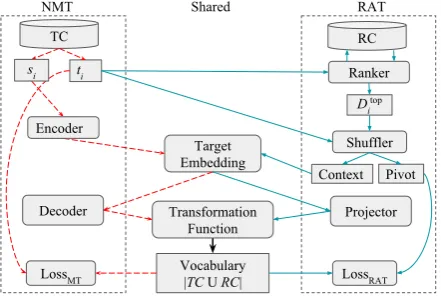
Figure 1: The architecture of our multi-task NMT. Note that, rectangles indicate data sources and rectangles with rounded corners indicate functions or layers.
after the top one (see below).
We consider two data sources for learning NMT and RAT jointly. The first one is a sentence-level parallel corpus, which we refer to as translation corpus,T C ={(si, ti);i= 1,2, . . . m}. The
sec-ond one is the retrieval corpus, which is a collec-tion ofk documentsRC = {D1, D2, . . . Dk}in
the same language asti. Our word-embedding
ap-proach takes eachti ∈ T C, uses it as a query to
retrieve the top documentDtopi . After that we ob-taint0iby concatenatingtiwithDtopi and randomly
shuffling the words in the combined sequence. We then augment T C using t0i and obtain a dataset,
T C0 = {(si, ti, t0i);i= 1,2, . . . m}. We uset0ito
learn a continuous bag of words (CBOW) embed-ding as proposed byMikolov et al.(2013). This learning component shares two layers with the NMT model. The goal is to expose the retrieval corpus’ vocabulary to the NMT model. We discuss layer sharing in the next section.
We select the single top document retrieved against a sentencetibecause a sentence is a weak
representation of information need. As a result, documents at lower ranks show heavy shift from the context of the sentence query. We verified this by observing that a relevance model constructed from the topkdocuments does not perform well in this setting. We thus deviate from the relevance model based approach taken byZamani and Croft
(2017) and learn over the random shuffling oftiand
a single document. Random shuffling has shown reasonable effectiveness for word embedding con-struction for comparable corpus (Vuli´c and Moens,
2.3 Multi-task NMT Architecture
Our balanced translation architecture is presented in Figure1. This architecture is NMT-model ag-nostic as we only propose to share two layers com-mon to most NMTs: the trainable target embedding layer and the transformation function (Luong et al.,
2015) that outputs a probability distribution over the union of the vocabulary of TC and RC. Hence, the size of the vocabulary, |RC ∪T C|, is much larger compared to TC and it enables the model to access RC. In order to show task sharing clearly we placed two shared layers between NMT and RAT in Figure1. We also show the two different paths taken by two different tasks at training time: the NMT path in shown with red arrows while the RAT path is shown in green arrows.
On NMT path training loss is computed as the sum of term-wise softmax with cross-entropy loss of the predicted translation and the human transla-tion and it summed over a batch of sentence pairs,
LN M T = P(si,ti)∈T
P|ti|
j=1−logP(t
j i|t
<j i , si).
We also use a similar loss function to train word embedding over a set of context (ctx) and pivot (pvt) pairs formed using ti as query to retrieve
Dtopi using Query Likelihood (QL) ranker,LW E =
α P
(ctx,pvt)
−logP(pvt|ctx). This objective is
sim-ilar to CBOW word embedding as context is used to predict pivot word Here, we use a scaling factor
α, to have a balance between the gradients from the NMT loss and RAT loss. For RAT, the context is drawn from a context window followingMikolov et al.(2013).
In the figure,(si, ti)∈T CandDtopi represents
the top document retrieved againstti. The shuffler
component shufflestiandDtopi and creates
(con-text, pivot) pairs. After that those data points are passed through a fully connected linear projection layer and eventually to the transformation function. Intuitively, the word embedding task is similar to NMT as it tries to assign a large probability mass to a target word given a context. However, it enables the transformation function and decoding layer to assign probability mass not only to terms from TC, but also to terms from RC. This implicitly pro-hibits NMT to overfit and provides a regularization effect. A similar technique was proposed by Kat-suki Chousa(2018) to handle out-of-vocabulary or less frequent words for NMT. For these terms they enabled the transformation (also called the softmax cross-entropy layer) to fairly distribute probability
mass among similar words. In contrast, we focus onrelevantterms rather than similar terms.
3 Experiments and Results
Data. We experiment on two language pairs:
{Italian, Finnish} →English. Topics and relevance judgments are obtained from the Cross-Language Evaluation Forum (CLEF) 2000-2003 campaigns for bilingual ad-hoc retrieval tracks1. The Italian and French topics are human translations of a set of two hundred English topics. Our retrieval corpus is the Los Angeles Times (LAT94) comprising over 113k news articles.
Topics without any relevant documents on LAT94 are excluded resulting in 151 topics for both Italian and Finnish language. Among the 151 top-ics in our dataset, we randomly selected 50 queries for validation and 101 queries for test. In the CLEF literature, queries are constructed from either the
titlefield or a concatenation oftitleanddescription
fields of the topic sets. FollowingVuli´c and Moens
(2015), we work on the longer queries.
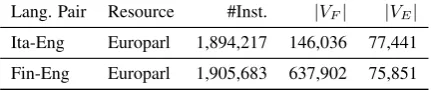
For TC we use Europarl v7 sentence-aligned corpus (Koehn, 2005). TC statistics in Table 1
indicates that we had around two million sentence pairs for each language pairs.
Lang. Pair Resource #Inst. |VF| |VE|
Ita-Eng Europarl 1,894,217 146,036 77,441
[image:3.595.309.525.440.485.2]Fin-Eng Europarl 1,905,683 637,902 75,851
Table 1: Statistics of resources used for training. |VF| and |VE| are the vocabulary size for the source lan-guage and the target English lanlan-guage, respectively.
Text Pre-processing. For having text consis-tency across TC and RC, we apply the following pre-processing steps. Characters are normalized by mapping diacritic characters to the correspond-ing unmarked characters and lower-cascorrespond-ing. We remove non-alphabetic, non-printable, and punctu-ation characters from each word. The NLTK library (Bird and Loper,2004) is used for tokenization and stop-word removal. No stemming is performed.
Retrieval. For ranking documents, after query translation, we use the Galago’s implementation2 of query likelihood using Dirichlet smoothing (Zhai and Lafferty,2004) with default parameters.
1
catalog.elra.info/en-us/repository/browse/ELRA-E0008/
Italian→English Finnish→English
Models Val Test Val Test
Transformer 0.192 0.179 0.127 0.077 Our model 0.230 0.211 0.126 0.097
Table 2: Results for ranking with query translation models, in terms of MAP.
Training Technique. Before applying multi-tasking we train the transformer to obtain a rea-sonable MAP on the Val set. Then we spawn our multi-task transformer from that point, also con-tinuing to train the transformer. We use an early stopping criterion to stop both the models, and eval-uate performance on the test set. For NMT training we use Stochastic Gradient Descent (SGD) with Adam Optimizer and learning rate of 0.01. We found that a learning rate of10−5 with the same optimizer works well for the word embedding loss minimization. From a training batch (we use dy-namic size training batches), more data points are actually created for the word embedding task be-cause of large number of (context, pivot) pairs. We allow the gradients from word embedding loss to pass through the multi-tasking model at first, and then apply NMT loss. Setting a lower learning rate for the word embedding optimizer, and α = 0.1 allows the NMT gradient updates to be competitive.
Evaluation. Given that in CLIR the primary goal is to get a better ranked list of documents against a translated query, we only report Mean Average Precision (MAP).
3.1 Results and Analysis
Table2shows the effectiveness of our model (multi-task transformer) over the baseline transformer (Vaswani et al., 2017). Our model achieves sig-nificant performance gains in the test sets over the baseline for both Italian and Finnish query transla-tion. The overall low MAP for NMT can possibly be improved with larger TC. Moreover, our model validation approach requires access to RC index, and it slows down overall training process. Hence, we could not train our model for a large number of epochs - it may be another cause of the low performance.
[image:4.595.311.522.64.197.2]Balance of Translations. We want to show that translation terms generated by our multi-task trans-former are roughly equally likely to be seen in the Europarl corpus (TC) or the CLEF corpus (RC). Given a translation termt, we compute the ratio of
[image:4.595.310.522.242.373.2]Figure 2: Balance values of a sample of val queries
Figure 3: Balance values of a sample of test queries
the probability of seeingtin TC and RC, PT C(t)
PRC(t).
Here,PT C(t) = P countT C(t)
t∈T CcountT C(t) andPRC(t)is
calculated similarly. Given a queryqiand its
trans-lationTm(qi)provided by modelm, we calculate
the balance ofm,B(Tm(qi)) =
P
t∈Tm(q)PT C (t)
PRC(t)
|Tm(q)| . If B(Tm(qi)) is close to 1, the translation terms
are as likely in TC as in RC. Figure2 shows the balance values for transformer and our model for a random sample of 20 queries from the validation set of Italian queries, respectively. Figure3shows the balance values for transformer and our model for a random sample of 20 queries from the test set of Italian queries, respectively. It is evident that our model achieves better balance compared to baseline transformer, except for a very few cases.
Precision and Recall of Translations. Given a queryQ , considerQ0 = {q10, q01, . . . , q0p}as the set of terms from human translation of Q and
QM = {qM1 , q2M, . . . , qMq } as the set of transla-tion terms generated by model M. We define
PM(Q) = Q
M∩Q0
|QM| andRM(Q) =
QM∩Q0
|Q0| as
trans-Italian→English Finnish→English Models Val Test Val Test
Transformer (0.44,0.45) (0.43,0.46) (0.24, 0.23) (0.25,0.26) Our model (0.62,0.45) (0.57, 0.41) (0.31,0.25) (0.30, 0.24) Table 3: Average precision and recall of translated queries, respectively reported in tuples.
former and our model across our train and valida-tion query set over two language pairs. Our model generates precise translation,i.e. it avoids terms that might be useless or even harmful for retrieval. Generally, from our observation, avoided terms are highly likely terms from TC and they are gener-ated because of translation model overfitting. Our model achieves a regularization effect through an auxiliary task. This confirms results from existing multi-tasking literature (Ruder,2017).
To explore translation quality, consider pair of sample translations provided by two models. For example, against an Italian query, medaglia oro super vinse medaglia oro super olimpiadi invernali lillehammer, translated term set from our model is
{gold, coin, super, free, harmonising, won, winter, olympics}, while transformer output is{olympic, gold, one, coin, super, years, won, parliament, also, two, winter}. Term set from human translation is:
{super, gold, medal, won, lillehammer, olypmic, winter, games}. Transformer comes up with terms likeparliament,also,twoandyearsthat never ap-pears in human translation. We found that these terms are very likely in Europarl and rare in CLEF. Our model also generates terms such as harmon-ising, free, olympicsthat not generated by trans-former. However, we found that these terms are equally likely in Europarl and CLEF.
4 Conclusion
We present a multi-task learning architecture to learn NMT for search query translation. As the motivating task is CLIR, we evaluated the rank-ing effectiveness of our proposed architecture. We used sentences from the target side of the parallel corpus as queries to retrieve relevant document and use terms from those documents to train a word embedding model along with NMT. One big chal-lenge in this landscape is to sample meaningful queries from sentences as sentences do not directly convey information need. In the future, we hope to learn models that are able to sample search queries or information needs from sentences and use the output of that model to get relevant documents.
Acknowledgments
This work was supported in part by the Center for Intelligent Information Retrieval and in part by the Air Force Research Laboratory (AFRL) and IARPA under contract #FA8650-17-C-9118 under subcon-tract #14775 from Raytheon BBN Technologies Corporation. Any opinions, findings and conclu-sions or recommendations expressed in this mate-rial are those of the authors and do not necessarily reflect those of the sponsor.
References
Dzmitry Bahdanau, Kyunghyun Cho, and Yoshua Ben-gio. 2015. Neural machine translation by jointly learning to align and translate. InInternational Con-ference on Learning Representations (ICLR).
Steven Bird and Edward Loper. 2004. NLTK: The nat-ural language toolkit. In Proceedings of the ACL Interactive Poster and Demonstration Sessions.
Satoshi Nakamura Katsuki Chousa, Katsuhito Sudoh. 2018. Training neural machine translation us-ing word embeddus-ing-based loss. arXiv preprint arXiv:1807.11219.
Philipp Koehn. 2005. Europarl: A parallel corpus for statistical machine translation. In MT summit, vol-ume 5, pages 79–86.
Victor Lavrenko and W. Bruce Croft. 2001. Relevance-based language models. InSIGIR 2001: Proceed-ings of the 24th Annual International ACM SIGIR Conference on Research and Development in In-formation Retrieval, pages 120–127, New Orleans, Louisiana, USA.
Thang Luong, Hieu Pham, and Christopher D. Man-ning. 2015. Effective approaches to attention-based neural machine translation. InProceedings of the 2015 Conference on Empirical Methods in Natural Language Processing (EMNLP), pages 1412–1421, Lisbon, Portugal.
Tomas Mikolov, Ilya Sutskever, Kai Chen, Greg S Cor-rado, and Jeff Dean. 2013. Distributed representa-tions of words and phrases and their composition-ality. InAdvances in Neural Information Process-ing Systems 26: 27th Annual Conference on Neural Information Processing Systems,NIPS, pages 3111– 3119, Lake Tahoe, Nevada, USA.
Jian-Yun Nie. 2010. Cross-Language Information Re-trieval. Synthesis Lectures on Human Language Technologies. Morgan & Claypool Publishers.
Artem Sokokov, Laura Jehl, Felix Hieber, and Stefan Riezler. 2013. Boosting cross-language retrieval by learning bilingual phrase associations from rel-evance rankings. InProceedings of the 2013 Con-ference on Empirical Methods in Natural Language Processing (EMNLP), pages 1688–1699, Seattle, Washington, USA.
Artem Sokolov, Felix Hieber, and Stefan Riezler. 2014. Learning to translate queries for CLIR. InThe 37th International ACM SIGIR Conference on Research and Development in Information Retrieval, pages 1179–1182, Gold Coast , QLD, Australia.
Ashish Vaswani, Noam Shazeer, Niki Parmar, Jakob Uszkoreit, Llion Jones, Aidan N Gomez, Ł ukasz Kaiser, and Illia Polosukhin. 2017. Attention is all you need. In I. Guyon, U. V. Luxburg, S. Bengio, H. Wallach, R. Fergus, S. Vishwanathan, and R. Gar-nett, editors, Advances in Neural Information Pro-cessing Systems 30, pages 5998–6008. Curran Asso-ciates, Inc.
Ivan Vuli´c and Marie-Francine Moens. 2015. Monolin-gual and cross-linMonolin-gual information retrieval models based on (bilingual) word embeddings. In Proceed-ings of the 38th International ACM SIGIR Confer-ence on Research and Development in Information Retrieval, pages 363–372, Santiago, Chile.
Hamed Zamani and W. Bruce Croft. 2017. Relevance-based word embedding. InProceedings of the 40th International ACM SIGIR Conference on Research and Development in Information Retrieval, Tokyo, Japan.
Chengxiang Zhai and John Lafferty. 2004. A study of smoothing methods for language models applied to information retrieval. ACM Transactions on Infor-mation Systems (TOIS), 22(2):179–214.
Dong Zhou, Mark Truran, Tim J. Brailsford, Vin-cent Wade, and Helen Ashman. 2012. Translation techniques in cross-language information retrieval. ACM Computing Surveys, 45(1):1:1–1:44.
A Loss Function and Validation Performance Analysis
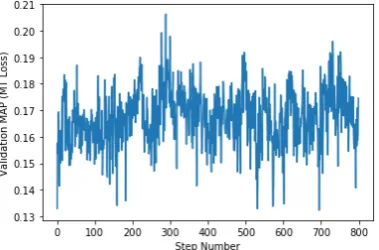
[image:6.595.321.511.65.195.2]We show the loss function analysis of transformer and our model. Figure7shows the validation per-formance of transformer against global training steps. Figure5show the validation performance of our model for the same number of global steps. Fig-ure6shows that NMT loss is going down with the number of steps, while Figure4shows the degra-dation of the loss of our proposed RAT task.
[image:6.595.322.512.246.372.2]Figure 4: RAT loss of our model on Italian-English training data
Figure 5: Validation performance of our model on Italian-English validation data
Figure 6: NMT loss of our model on Italian-English training data
[image:6.595.322.512.422.550.2] [image:6.595.322.512.599.724.2]