422
Annotating and Analyzing Semantic Role of Elementary Units and
Relations in Online Persuasive Arguments
Ryo Egawa Tokyo University of Agriculture and Technology
Koganei, Tokyo, Japan
Gaku Morio∗ Hitachi, Ltd.
Central Research Laboratory Kokubunji, Tokyo, Japan
Katsuhide Fujita Tokyo University of Agriculture and Technology
Koganei, Tokyo, Japan
Abstract
For analyzing online persuasions, one of the important goals is to semantically understand how people construct comments to persuade others. However, analyzing the semantic role of arguments for online persuasion has been less emphasized. Therefore, in this study, we propose a novel annotation scheme that captures the semantic role of arguments in a popular online persuasion forum, so-called ChangeMyView. Through this study, we have made the following contributions: (i) propos-ing a scheme that includes five types of el-ementary units (EUs) and two types of rela-tions; (ii) annotatingChangeMyViewwhich re-sults in 4612 EUs and 2713 relations in 345 posts; and (iii) analyzing the semantic role of persuasive arguments. Our analyses cap-tured certain characteristic phenomena for on-line persuasion.
1 Introduction
Changing a person’s opinion is a difficult process because one has to first understand his/her opinion and reasons. Recent studies in the field of argu-ment mining and persuasion detection have inves-tigated the feature of persuasiveness in the doc-uments of a persuasive forum (Tan et al., 2016; Hidey et al., 2017). Many existing studies ana-lyzing the features of persuasion have focused on lexical features (Tan et al., 2016; Habernal and Gurevych,2016) and argumentative features such as post-to-post interaction (Ji et al.,2018), conces-sions (Musi et al.,2018), and semantic types of ar-gument components. Although these analyses are important, we argue that it is also important to un-derstand the fine-grained strategy by analyzing the semantic roles of arguments.
∗
The work of this paper was performed when he was a student at Tokyo University of Agriculture and Technology (to contact: [email protected].)
!"# $%&'()
* +,$)-$#./0&$
1#&'234#!"#$!#%&'"$()*&*"+,-.&%#/,*#& 0$!%+)*&1(!"&2$2(#*&,)-#**&(!3*&$&%$!#.& 4&5+6(#!"#$%&'(5#6789:
;(#0$%#)!*&'$)&!$7#&!"#(%&2$2(#*&$).& )+!&1+%%8&$2+,!&.(*!,%2()9&+!"#%*
!)*$+,(5#678<:
:+,%&1$)!()9&!+&*##&$& 5+6(#&.+#*&)+!&#)!(!-#& 8+,&!+&%,()#%8+)#& #-*#3*&#;0#%(#)'#&!"$!& !"#8&0$(.&5+)#8&/+%
!)*$+,(5#678=:
+0<!(!-#=&>&2#-(#6#&0#+0-#&*"+,-.&)+!&2#&$--+1#.&!+&2%()9&2$2(#*&()& $&5+6(#&!"#$!#%&#;'#0!&(/&(!3*&$&???&6>$?()#@0$2A:
"(;2&2B/
1#&'234#2$))()9&$)8+)#&(*&$& *!,0(.&(.#$!)*$+,(5#678C:
@"#)&58&!1()*&1#%#&$& 1##7&$).&$&"$-/&+-.&1#&!++7& !"#5&$-+)9&1(!"&,*&$).& +,%&???&!-,./%0#1'(5# 678D:
#6#%8+)#&)##.*&!+&2#& %#*0#'!/,-&+/&+!"#%&0$!%+)*
!"#$%&'(5#678E:
>/&+)#&+%&2+!"&+/&58&2$2(#*& "$.&2##)&/,**8&$).& ()'+)*+-$2-#&>&1+,-.&"$6#& !$7#)&!"#5&+,!&+/&!"#&!"#$!%#& (55#.($!#-8!)*$+,(5 678F:
G/H$&2B/
%#*0+)*(2-#&0$%#)!*&.+)3!&)##.&$&2$)&()&+%.#%&!+&)+!&2+!"#%& +!"#%&0#+0-#A&$).&()'+)*(.#%$!#&$**"+-#*&1(--&$-1$8*&2#& ()'+)*(.#%$!#&%#9$%.-#**&+/&1"$!&8+,&2$)!)*$+,(5#678I:
B6#%8+)#C&D,*!&)##.*&!+&EFGH&()&!"#&!"#$!#%A&$).&-#$6#&I1(!"& 0$%#)!*&(/&)#'#**$%8J&(/&!"#8&5$7#&)+(*#!"#$%&'(5#678J:
[image:1.595.311.527.223.485.2]:+,&.+)3!&)##.&$)8&*+%!&+/&2$)&2#8+).&!"$!!)*$+,(5#678=K: L%MM()&
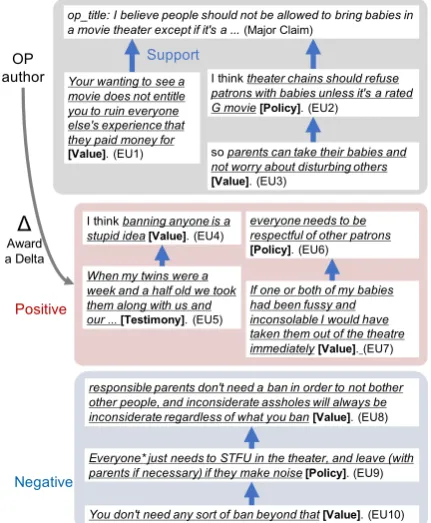
Figure 1: An overview of our annotation in Change-MyView. EUs have five types and the relations between the EUs have two types (refer to Section3.2).
In this study, we investigate the semantic roles of arguments in a persuasive forum by proposing an annotation scheme on a data set of
Change-MyView (Tan et al., 2016). ChangeMyView is a
subreddit in which users post an opinion (named aView) to change their perspective through com-ments of a challenger. When theViewis changed, the user who posted the original post (OP) awards a Delta point (∆) to the challenger who changed theView. Figure 1is an overview of our annota-tion inChangeMyViewin which the Positive post is an awarded post that won a∆and the Negative post is a non-awarded one.
Fact, Testimony, Value, Policy, and Rhetorical Statement) and two types of relation between EUs (i.e., Support and Attack). Moreover, We demon-strated that EUs and these relations are effective for characterizing persuasive arguments.
The contributions of this study can be summa-rized as follows: (i) We have proposed an annota-tion scheme for EUs and its relaannota-tions for
Change-MyView; (ii) We annotated 4612 EUs and 2713
re-lations in 115 threads, and we computed an inter-annotator agreement using Krippendorff’s alpha. Note that αEU = .677andαRel = .532are bet-ter than those of existing studies; (iii) A significant difference in the distribution of each EU exists be-tween OP and reply posts; however, no significant difference in the types of EU and relation is ob-served between persuasive and non-persuasive ar-guments.
2 Related Work
Recent studies in argument mining investigated the characteristics of an argument by considering the role of argumentative discourse units and re-lations (Ghosh et al., 2014; Peldszus and Stede, 2015;Stab and Gurevych, 2014). Moreover, re-cent studies have focused on the semantics of ar-gument components (Park et al.,2015;Al Khatib et al., 2016; Becker et al., 2016). For example, Hollihan and Baaske(2004) proposed three types of claims, i.e., fact, value, and policy, in which fact can be verified with objective evidence, value is an interpretation or judgment, and policy is an asser-tion of what should be done.Park et al.(2015) ex-tended this argument model with types of claims such as testimony and reference. Al Khatib et al. (2016) proposed the argument model for analyz-ing the argumentation strategy in news editorials. This model separated an editorial into argumen-tative discourse units of six different types, such as Common Ground, Assumption, and Testimony. Because persuasion is often based on facts and testimony, this type of semantic classification of claim is valid for our study.
Several studies have focused on the semantics for analyzing the characteristics of persuasive ar-guments.Wachsmuth et al.(2018) investigated the rhetorical strategy for effectively persuading to the other, and Hidey et al. (2017) focused on the se-mantics of premise and claim.
3 Annotation Study
3.1 Data Source
In our study, a dataset of ChangeMyView (Tan et al., 2016) is introduced. ChangeMyView is a forum in which users initiate the discussion by posting an Original Post (OP) and describing their View (or we call it as Major Claim) in the title. An OP user has to describe his/her reason behind theView. Then, certain challengers post a reply to change the OP’sView. If the challenger succeeds at changing the OP’sView, the OP user awards a ∆to the challenger.
In this study, we extracted 115 threads from the
ChangeMyViewdataset through a simple random
sampling. Each thread contained a triple of OP, Positive (which won a ∆), and Negative (which is a non-awarded one). Therefore, we used 345 posts (115×(OP, Positive, Negative)) for our an-notation.
3.2 Annotation Scheme
We defined the five types of EUs and two types of relations between the EUs. This scheme en-ables us to capture the semantic roles of elemen-tary units and how we build an argument based on the semantic units.
3.2.1 Type of Elementary Units
There are five types of EUs that are similar to the scheme ofPark et al.(2015) pertaining to eRule-making comments. The motivation for the intro-duction of the scheme is based on our expecta-tion that we can feature persuasive arguments by considering personal experience, facts, and value judgments. The five types of EUs are defined as follows:
Fact: This is a proposition describing objective facts as perceived without any distortion by per-sonal feelings, prejudices, or interpretations. Un-like Testimony, this proposition can be verified with objective evidence; therefore, it captures the evidential facts for persuasion. Certain examples of Fact are as follows:“they did exactly this in the
U.K. about thirty or so years ago”and“this study
shows that women are 75% less likely to speak up
in a space when outnumbered”.
Testimony: This is an objective proposition
children”and“I’ve heard suggestions of an
exor-bitant tax on ammunition”.
Value: This is a proposition that refers to
sub-jective value judgments without providing a state-ment on what should be done. This proposition is nearly similar to an opinion. Certain examples of Value are as follows: “this is completely
unwork-able”and“it is absolutely terrifying”.
Policy: This is a proposition that offers a
spe-cific course of action to be taken or what should be done. It typically contains modal verbs, such
asshould, or imperative forms. Certain examples
of Policy are as follows: “everyone needs to be
respectful of other patrons”and “intelligent
stu-dents should be able to see that”.
Finally, because ChangeMyView users usually utilize a rhetorical question (Blankenship and Craig, 2006) to increase their persuasion, this study provides a novel EU type that is useful for determining a rhetorical strategy.
Rhetorical Statement: This unit implicitly states
the subjective value judgment by expressing fig-urative phrases, emotions, or rhetorical questions. Therefore, we can regard it as a subset of Value1. Certain examples of Rhetorical Statement are as follows:“You can observe this phenomenon
your-self!” and“if one is paying equal fees to all other
students why is one not allowed equal access and
how is this a good thing?”.
3.2.2 Type of Relations
The two types of relations between EUs are de-fined as follows:
Support: An EU X has support relation to the
other EU Y if X provides positive reasoning for Y. It is typically linked by connectives such as there-fore. An example of support relation is as follows:
X: “Every state in the U.S. allows
homeschool-ing” (Fact) support Y: “if you are ideologically opposed to the public school system, you are free
to opt out”(Value).
Attack: An EU X has attack relation to the other
EU Y if X provides negative reasoning for Y. It is typically linked by connectives such ashowever. An example of attack relation is as follows: X: “Young men are the most likely demographic to
get into an accident”(Value) attackY:“that does
not warrant discriminating against every
individ-ual in the group”(Value).
1Unlike Value, we allow the Rhetorical Statement to be
an incomplete sentence because it is usually expressed im-plicitly.
3.3 Annotation Process
The annotation task includes two subtasks: (1) segmentation and classification of EUs and (2) re-lation identification. We recruited 19 non-native students who are English proficient as annotators with all annotations being performed over origi-nal English texts. Each annotator was asked to read the guideline as well as the entire post be-fore the actual annotation. Moreover, we held sev-eral meetings for each subtask to train the annota-tors. Furthermore, because the annotators are non-native speakers, to ensure the understanding of the posts is consistent among the annotators, the posts are translated into their language. The translation was conducted by two annotators per document: one for the translation and the other for the valida-tion. Note that the translated documents are only used as a reference for the annotators.
In the EU annotation, three annotators inde-pendently annotated 87 threads, whereas the re-maining 28 threads were annotated by eight ex-pert annotators who were selected from 19 anno-tators. From the 87 threads, using a majority vote, a gold standard is established by merging three annotation results. To extract accurate minimal EU boundary and remove irrelevant tokens, such
as therefore and punctuation, we considered the
token-level annotation rather than the sentence-level. Token-level annotation enables us to dis-tinguish an inference step that one of the proposi-tions can be a claim and the other can be a premise. Here is an example of inference step: <“Empire Theatres in Canada has a ”Reel Babies”
show-ing for certain movies”[Fact]>so<“parents can
take their babies and not worry about disturbing
others”[Value]>. Moreover, all EU boundaries,
except a Rhetorical Statement, should contain a complete sentence to render EU propositions.
In the relation annotation, two annotators inde-pendently annotated 50 threads, whereas the re-maining 65 threads were annotated by eight expert annotators. In the 50 threads, to establish the gold standard by merging two annotation results, expert annotators were assigned to each thread. We mod-eled the structure of each argument with a
one-claim approach (Stab and Gurevych, 2016) that
Post type #Fact #Testimony #Value #Policy #RS #Total #Support #Attack #Total
OP 52 134 914 44 157 1301 864 128 992
Positive 127 134 1338 55 327 1981 924 108 1032
Negative 78 86 882 41 243 1330 595 94 689
Table 1: Annotation results of EUs and relations
3.4 Annotation Result
Table1 shows an overview of the annotated cor-pus. Our corpus contains 4612 EUs and 2713 re-lations between units in 345 posts. As can be seen from the table, 68% of EUs were Values and 15% of EUs were Rhetorical Statements. Although the Value ratio is 45% in the dataset of Park and Cardie(2018), Value occupies most of the EUs in our corpus. We estimate this because Value of-ten gives a subjective opinion by the characteris-tics of persuasive forum. Moreover, 88% of rela-tions were Support relarela-tions. This result indicates an Attack inference seldom appears in online per-suasions.
We computed an inter-annotator agreement (IAA) using Krippendorff’sα. Consequently, the IAA of EUs is αEU = 0.677 and that of rela-tions is αRel = 0.532. Note that the IAA val-ues are higher than the result of Park and Cardie (2018) in the eRulemaking annotation with respect to EUs (α = 0.648) and relations (α = 0.441).
2 Furthermore, our IAA of EUs is higher than
the result of Hidey et al. (2017) (α = 0.65) in
theChangeMyViewannotation3. We consider the
higher agreement is because of the token-level an-notations as the sentence-level anan-notations cannot accurately distinguish an inference step.
Most of the disagreement in EU annotation oc-curred between Value and the other types. In Value vs. Fact situation, a disagreement occurred when a unit is described in a general way, such as “many people” and “generally”, and incorrectly marked as a Fact, although the unit should be Value. More-over, in Value vs. Testimony situation, a disagree-ment occurred when a unit is incorrectly inter-preted as a Value. For example, “I am an athe-ist” was incorrectly marked as Value, although it should be labeled Testimony because the unit de-scribes a personal state.
2Note that the relation annotation of Park and Cardie
(2018) is only limited to the Support relation.
3Note that the IAA result of relations cannot be compared
because the labeling of relations is not conducted inHidey
et al.(2017)
4 Corpus Analysis
To examine the features of persuasive arguments, we analyzed the EUs and the relation between units in each case, i.e.,OP vs. Reply (Positive and
Negative)andPositive vs. Negative.
We investigated how the number of EU in a post contributes to the persuasive strategy. We used the Mann-Whitney U test and identified that there exists a significant difference in Testimony and Rhetorical Statement in OP vs. Reply. Testimony is more likely to appear in OP (10.3%) than in Re-ply (6.6%) and Rhetorical Statement is more likely to appear in Reply (17.2%) than in OP (12.1%). Therefore, an OP author tends to describe their View based on their own experience or state and Rhetorical Statement tends to appear more in Re-ply as the reRe-ply post is for trying to change the OP’sView. This result is consistent with intuition; however, there is no significant difference between positive and negative in any type of the EU and the p-value of Testimony, Policy, and Rhetorical Statement isp >0.85. This indicates that the fre-quency of occurrence of the EU cannot be a per-suasive feature.
Figure 2 shows the annotation result of Rela-tions between units in each post, in whichsource means the type of supporting EU andtargetmeans the type of supported unit. Most of the targets is Value type. Note that Testimony is reasoning more in OP than in reply and Rhetorical Statement is reasoning more in reply than in OP; moreover, the relation between Values is more in positive than in negative.
Next, to investigate the logical strength of an argument (Wachsmuth et al., 2017), we examine
degreeanddepth. The degree means the number
of supporting EUs to a supported unit. For exam-ple, in Figure1, Major Claim is supported by EU1 and EU2; thus, thedegree= 2and thedepth= 2. However, EU4 is only supported by EU5; thus, the
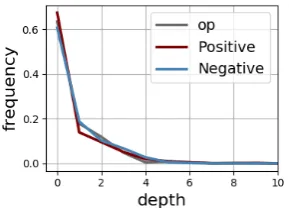
degree = 1and thedepth = 1. Figures3 and4
Figure 2: Transition matrix of Support and Attack relations
[image:5.595.109.254.396.500.2]Figure 3: Histogram of the degree in each post.
Figure 4: Histogram of the depth in each post.
is a power-law distribution. Most of the EUs have two or less relations, and the depths of arguments are less than three. This indicates that the logical strength of argument may not contribute to persua-siveness. Moreover, because it indicates that there are many arguments that have a stance attribute to the OP’sView, how they interact with the OP may contribute to persuasion.
To clarify the role of EUs as arguments, we in-vestigated the position of each type of EUs in an argument. Figure5shows a histogram of the po-sition in the argument, where the popo-sition means normalized depth at the root node to 0.0 and at the terminal node to 1.0. For instance, normalized depth of the following argument can be described
Figure 5: The distribution of positions in an argument in each type of EU.
as follows:
In Positive and Negative post, Fact and Testimony often appear at near the terminal node of an argu-ment structure, which indicates that trying to per-suade is based on facts and personal experiences. Moreover, Value and Policy appear at near the root node, which indicates trying to change the View by finally describing an opinion or what should be done as a conclusion. These results are consistent with intuitive results; moreover, an interesting re-sult is that Rhetorical Statement tends to appear at near the terminal node of the argument. This in-dicates that people tend to use rhetorical phrases for appealing to the emotions first and then assert their opinion as their persuasive strategy.
[image:5.595.329.479.421.498.2]sig-nificant difference exists in the position distribu-tion of Fact by KS test (p <0.05), and Policy by Levene test (p <0.01). This indicates that people tend to make an assertion based on objective facts as a persuasion strategy.
5 Conclusion
In this study, we proposed an annotation scheme for capturing the semantic role of EUs and re-lations in online persuasions. We annotated five types of EUs and two types of relations that re-sulted in 4612 EU and 2713 relation annotations. The analyses revealed that the existence of Rhetor-ical Statement and the position of Fact in an argu-ment structure characterizes the persuasive posts that try to change theView. In future studies, we will focus on the following: (i) the expansion of our corpus data by annotating the post-to-post in-teraction and (ii) the application of our data to training sets of machine learning, i.e., automat-ically identifying the argument structure and de-tecting the persuasive posts.
Acknowledgment
This work was supported by JST AIP-PRISM (JPMJCR18ZL) and JST CREST (JPMJCR15E1), Japan.
References
Khalid Al Khatib, Henning Wachsmuth, Johannes Kiesel, Matthias Hagen, and Benno Stein. 2016.
A news editorial corpus for mining argumentation
strategies. In Proceedings of COLING 2016, the
26th International Conference on Computational Linguistics: Technical Papers, pages 3433–3443, Osaka, Japan. The COLING 2016 Organizing Com-mittee.
Maria Becker, Alexis Palmer, and Anette Frank. 2016.
Argumentative texts and clause types. In
Proceed-ings of the Third Workshop on Argument Mining (ArgMining2016), pages 21–30, Berlin, Germany. Association for Computational Linguistics.
Kevin L. Blankenship and Traci Y. Craig. 2006.
Rhetorical question use and resistance to persuasion:
An attitude strength analysis. Journal of Language
and Social Psychology, 25(2):111–128.
Debanjan Ghosh, Smaranda Muresan, Nina Wacholder, Mark Aakhus, and Matthew Mitsui. 2014. Ana-lyzing argumentative discourse units in online
in-teractions. In Proceedings of the First Workshop
on Argumentation Mining, pages 39–48, Baltimore, Maryland. Association for Computational Linguis-tics.
Ivan Habernal and Iryna Gurevych. 2016. Which ar-gument is more convincing? analyzing and predict-ing convincpredict-ingness of web arguments uspredict-ing
bidirec-tional lstm. InProceedings of the 54th Annual
Meet-ing of the Association for Computational LMeet-inguistics (Volume 1: Long Papers), pages 1589–1599, Berlin, Germany. Association for Computational Linguis-tics.
Christopher Hidey, Elena Musi, Alyssa Hwang, Smaranda Muresan, and Kathy McKeown. 2017.
Analyzing the semantic types of claims and
premises in an online persuasive forum. In
Proceed-ings of the 4th Workshop on Argument Mining, pages 11–21. Association for Computational Linguistics.
T.A. Hollihan and K.T. Baaske. 2004. Arguments and Arguing: The Products and Process of Human De-cision Making, Second Edition. Waveland Press.
Lu Ji, Zhongyu Wei, Xiangkun Hu, Yang Liu, Qi Zhang, and Xuanjing Huang. 2018. Incorporat-ing argument-level interactions for persuasion
com-ments evaluation using co-attention model. In
Pro-ceedings of the 27th International Conference on Computational Linguistics, pages 3703–3714, Santa Fe, New Mexico, USA. Association for Computa-tional Linguistics.
Elena Musi, Debanjan Ghosh, and Smaranda Mure-san. 2018. Changemyview through concessions:
Do concessions increase persuasion? CoRR,
abs/1806.03223.
Joonsuk Park, Cheryl Blake, and Claire Cardie. 2015.
Toward machine-assisted participation in
erulemak-ing: An argumentation model of evaluability. In
Proceedings of the 15th International Conference on Artificial Intelligence and Law, ICAIL ’15, pages 206–210, New York, NY, USA. ACM.
Joonsuk Park and Claire Cardie. 2018. A corpus of erulemaking user comments for measuring
evalu-ability of arguments. In Proceedings of the 11th
Language Resources and Evaluation Conference, Miyazaki, Japan. European Language Resource As-sociation.
Andreas Peldszus and Manfred Stede. 2015.Joint pre-diction in mst-style discourse parsing for
argumen-tation mining. InProceedings of the 2015
Confer-ence on Empirical Methods in Natural Language Processing, pages 938–948, Lisbon, Portugal. As-sociation for Computational Linguistics.
Christian Stab and Iryna Gurevych. 2014. Annotating argument components and relations in persuasive es-says. In COLING 2014, 25th International Con-ference on Computational Linguistics, Proceedings of the Conference: Technical Papers, August 23-29, 2014, Dublin, Ireland, pages 1501–1510.
Christian Stab and Iryna Gurevych. 2016. Parsing
ar-gumentation structures in persuasive essays. CoRR,
Chenhao Tan, Vlad Niculae, Cristian Danescu-Niculescu-Mizil, and Lillian Lee. 2016. Winning arguments: Interaction dynamics and persuasion
strategies in good-faith online discussions. CoRR,
abs/1602.01103.
Henning Wachsmuth, Nona Naderi, Ivan Habernal, Yufang Hou, Graeme Hirst, Iryna Gurevych, and Benno Stein. 2017. Argumentation quality
assess-ment: Theory vs. practice. In Proceedings of the
55th Annual Meeting of the Association for Compu-tational Linguistics (Volume 2: Short Papers), pages 250–255. Association for Computational Linguis-tics.
Henning Wachsmuth, Manfred Stede, Roxanne El Baff, Khalid Al Khatib, Maria Skeppstedt, and Benno Stein. 2018. Argumentation synthesis
following rhetorical strategies. In Proceedings