Proceedings of the 57th Annual Meeting of the Association for Computational Linguistics: System Demonstrations, pages 201–206 201
MoNoise: A Multi-lingual and Easy-to-use Lexical Normalization Tool
Rob van der Goot
Center for Language and Cognition University of Groningen
Abstract
In this paper, we introduce and demonstrate the online demo as well as the command line interface of a lexical normalization system (MoNoise) for a variety of languages. We further improve this model by using features from the original word for every normalization candidate. For comparison with future work, we propose the bundling of seven datasets in six languages to form a new benchmark, together with a novel evaluation metric which is particularly suitable for cross-dataset com-parisons. MoNoise reaches a new state-of-art performance for six out of seven of these datasets. Furthermore, we allow the user to tune the ‘aggressiveness’ of the normal-ization, and show how the model can be made more efficient with only a small loss in performance. The online demo can be found on: http://www.robvandergoot. com/monoise and the corresponding code on: https://bitbucket.org/ robvanderg/monoise/
1 Lexical Normalization
Because many natural language processing (NLP) systems are designed with standard texts in mind, they suffer performance drops when applied to texts from other domains. In recent years, social media has become a major source of information. Due to their hasty and spontaneous nature, texts on social media are particularly non-standard.
One solution to adapt NLP systems, is to ‘trans-late’ these non-standard texts to their standard equivalent. This task is also called lexical nor-malization, see Figure 1for the normalization of “most social pple r troublesome”. Previous work on normalization is fragmented; a variety of ap-proaches is evaluated on a variety of benchmarks, using a variety of evaluation metrics and assump-tions. Furthermore, most normalization systems are not opensource or publicly available.
most social pple r troublesome
most social people are troublesome
Figure 1: Example normalization of “most social pple r troublesome”
In this paper, we present MoNoise, an easy-to-use normalization system, consisting of an online demo as well a more elaborate command line in-terface. We include benchmarks, results and pre-trained models for a variety of languages.
2 Multi-lingual Normalization Benchmark
The manually annotated datasets on which we will evaluate MoNoise are summarized in Table1. In all datasets, gold tokenization was assumed. When 1-N is indicated in the table, this means that split-ting of words was included in the annotation, and in some rare cases also merging. Since capital-ization is usually not corrected (merely kept) in almost all of these datasets, we will lowercase ev-erything in our evaluation. For datasets with ex-isting splits, those are used, in other cases the data is split 80%-10%-10% (train-dev-test). For LexNorm1.2 we use LiLiu as training and devel-opment data, in line with previous work (Li and Liu,2014,2015).1.
3 MoNoise
In this section, we will give a summary of the nor-malization model MoNoise (van der Goot and van Noord,2017). Additionally, we added one group of features which improves the performance of this model.
1This benchmark can be obtained by running
Corpus Words Lang. %normed 1-N Caps Source
GhentNorm 12,901 NL 4.8 + +-De Clercq et al.(2014)
TweetNorm 13,542 ES 6.3 + +-Alegria et al.(2013)
LexNorm1.2 10,576 EN 11.6 - -Yang and Eisenstein(2013)
LiLiu 40,560 EN 10.5 - +-Li and +-Liu(2014)
LexNorm2015 73,806 EN 9.1 + -Baldwin et al.(2015)
IWT 38,918 TR 8.5 + +
Eryiˇgit and Torunoˇg-Selamet(2017)
Janes-Norm 75,276 SL 15.0 - +-Erjavec et al.(2017)
ReLDI-hr 89,052 HR 9.0 - +-Ljubeˇsi´c et al.(2017a)
[image:2.595.74.288.66.320.2]ReLDI-sr 91,738 SR 8.0 - +-Ljubeˇsi´c et al.(2017b)
Table 1: Comparison of the normalization corpora used in this work. %normed indicates the percentage of words which is normalized. The ‘1-N’ column indi-cates whether words are split/merged in the annota-tion, the ‘caps’ column indicates whether everything was lowercased (-), capitalization was transferred to the normalization (+-), or corrected (+).
3.1 The Architecture
MoNoise splits the normalization task in two sub-tasks; candidate generation and candidate rank-ing. In contrast to most other systems, no error detection is performed beforehand, the decision whether to normalize is made during ranking. Be-cause the normalization task consists of a variety of replacement types (van der Goot et al.,2018), MoNoise is developed in a modular way. Some of the modules are based on raw, external data. This dependency allows the model to be transferred to new domains and timespans more easily. For both sub-tasks a variety of modules is designed, which are described in the following two paragraphs.
Important modules for candidate generation are Aspell2, a dictionary learned from the training data and word embeddings (Mikolov et al.,2013) trained on non-standard data (where the 40 clos-ests words using cosine distance are used). Be-cause no normalization detection is done, the orig-inal word is also included as a candidate.
For the ranking of candidates, features from the
2http://aspell.net/
generation are complemented with additional fea-tures. The additional features are: N-gram proba-bilities over non-standard text as well as standard texts, a feature which indicates whether a word contains alphanumeric characters or is a domain-specific token (hashtags, usernames and URLs) and the length of the original word and the candi-date. All these features are combined in a random forest classifier, and the probability that a candi-date belongs to the ‘correct’ class is used to rank the candidates.
3.2 Re-use Features of Original Word
A word should only be normalized when a sub-stantially better candidate is found, this was not taken into account in the original model. To incor-porate this intuition, we copy the features from the orginal word to all the other normalization candi-dates as additional features.
3.3 Models
For reproducability and reusability of the system, we provide pre-trained models for all the lan-guages available in our multi-lingual benchmark (Section2). These models are all trained using the default settings of MoNoise. These models exploit raw data from the source (non-standard) as well as the target (standard) domain, as n-gram probabili-ties and word embeddings are derived from these. As target domain data we use Wikipedia dumps from 01-01-20193. For the non-standard data, we use raw data based on an in-house twitter collec-tion4. In contrast tovan der Goot and van Noord
(2017), we do not not use language specific collec-tions, but collect random tweets provided by the Twitter API during 2012 and 2018, and filter these by language based on the FastText language iden-tifier (Joulin et al., 2016). Furthermore, we train embeddings with only 100 dimensions as opposed tovan der Goot and van Noord (2017), who used 400. Because of these new embeddings, MoNoise uses 2-3 times less RAM, while experiencing only a very minor performance loss.
The pre-trained models can be found on: http://www.robvandergoot.com/ data/monoise
3
cleaned with https://github.com/attardi/ wikiextractor
Corpus Lang ERR Precision Recall Prev. SOTA Metric Prev. MoNoise
GhentNorm NL 44.62 89.19 50.77 Schulz et al.(2016) WER 3.2 1.365 TweetNorm ES 38.73 94.37 41.19 Porta and Sancho(2013) OOV-Precision 63.4 70.40 LexNorm1.2 EN 59.21 80.87 77.56 Li and Liu(2015) OOV Accuracy 87.58 87.63 LexNorm2015 EN 77.09 95.49 80.91 Jin(2015) F1 84.21 86.58 IWT TR 28.94 96.24 30.12 Eryiˇgit et al. (2017) OOV Accuracy 67.37 48.99 Janes-Norm SL 31.67 85.19 0.3833 Ljubeˇsic et al.(2016) L1 CER 0.38 0.53 Janes-Norm SL 63.90 95.66 0.6694 Ljubeˇsic et al.(2016) L3 CER 1.58 2.24 ReLDI-hr HR 51.65 95.66 0.541
ReLDI-sr SR 64.61 94.70 68.43
Table 2: Results of MoNoise on the test data and a comparison with previous benchmarks. For WER and CER lower scores are better. Words normalized to the wrong candidate are classified as false positive (recall).
4 Evaluation
In this section, we first discuss existing evaluation metrics and their shortcomings and then introduce our novel metric. Secondly, we evaluate MoNoise on the test-splits of the multi-lingual benchmark, this is done twofold: using our preferred metric as well as a comparison to previous work.
4.1 Evaluation Metrics
Evaluation beyond word-level Some previous work used evaluation metrics which allow for evaluation beyond the word level. However, most of the normalization corpora do not include anno-tation beyond the word-level, except for the work ofZhang et al.(2013). Sometimes, BLEU score is used, whereas others use word error rate (WER) or character error rate (CER). We consider these met-rics to be overly complex, since the word-order is not altered during annotation.
F1 In the shared task on normalization hosted at WNUT (Baldwin et al., 2015), F1 score was used as main evaluation. During development of MoNoise, we found multiple reasons why this might not be the preferable metric:
• Hard to interpret (how much of the problem is solved with an F1 score of 0.35?)
• It is unclear what to do with a word which should be normalized, but is normalized in-correctly, does this harm recall (false posi-tive), precision (false negative) or both?6
• Because of the previous point, reproducibil-ity and comparison with previous work can be difficult.
5Results are not directly comparable as different splits and
tokenization is used
6For a more extensive discussion on this, we refer
tovan der Goot(2019). In the WNUT share task, they are FP and FN, in this paper they are considered only FP (recall).
Accuracy Early work on normalization often used accuracy over the words in need of nor-malization as main evaluation (Han and Baldwin,
2011;Liu et al.,2012) (OOV accuracy in Table2). However, in this setting, the detection of which words need to be normalized is not taken into ac-count. To include the full task of normalization, accuracy over all the words could be used. Accu-racy is much easier interpretable compared to F1 score. However, accuracy does not allow for easy comparison across corpora, as different percent-ages of words might be in need of normalization. This is the main motivation for a novel evaluation metric, discussed in the next paragraph.
Error Reduction Rate Because previous met-rics are overly complicated, hard to interpret or do not allow for an easy comparison between dif-ferent datasets, we introduce the Error Reduction Rate (ERR). Error reduction rate can be inter-preted as accuracy normalized for the number of words that are normalized in the gold standard. This allows for a direct comparison with a baseline which always copies the original word, the accu-racy of such a baseline is equal to the percentage of words which need to be normalized. The for-mula for ERR is:
ERR= Accuracysystem−Accuracybaseline 1.0−Accuracybaseline
0.0 0.2 0.4 0.6 0.8 1.0 1.2 1.4 1.6 Weight
0.0 0.1 0.2 0.3 0.4 0.5 0.6 0.7
ERR
[image:4.595.75.294.61.179.2]GhentNorm TweetNorm LexNorm1.2 LexNorm2015 IWT Janes-Norm ReLDI-hr ReLDI-sr
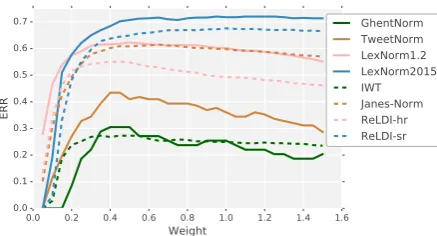
Figure 2: The effect of tuning the weight of the original candidate. A low weight indicates a more aggressive system.
detailed discussion on the motivation behind ERR can be found in (van der Goot,2019).
4.2 Results
We present the results on all corpora of the multi-lingual benchmark in Table2. We report the ERR, precision, recall, as well as the standard metric for each dataset. During development, no tuning was done on the test data, as described in more detail in (van der Goot and van Noord,2017).
As mentioned in Section 4.1, it is disputable whether words which are normalized to the wrong normalization candidate should be counted as false positive or false negative. We choose to cat-egorize these as false negatives, and thus be ac-counted for in the recall.
The ERR differs quite substantially across the datasets, this is due to different sizes of train-ing data as well as differences in annotation. In the LexNorm2015 dataset, for example, phrasal abbreviations are expanded (‘lol’7→‘laughing out loud’), leading to a lot of very common replace-ments, which can easily be learned from the train-ing data. On all datasets, the precision is higher than the recall. In other words, the model is con-servative. This is arguably a desirable result, as it is important to avoid over-normalization.
When we look at the comparison to the previous state-of-the-art systems, we see that MoNoise per-forms highly competitive. Only on the Slovenian and Turkish datasets, the previous state-of-the-art is not surpassed.
5 Aggressiveness
To gain more control over the output normaliza-tion, we introduce a parameter which controls for the aggressiveness of the model. This is done by weighing the confidence score estimated for the
original word (see also Section3.1). If this is given a high weight, the original word is more likely to rank high.
The effect of tuning this parameter is plotted in Figure2. It becomes apparent that the default weight of 1.0 leads to rather stable performance. For some datasets, minor gains can be achieved by a more aggressive setting. Furthermore, we can see that the parameter only becomes effective with extreme values, which is because the classi-fier is relatively certain about its predictions, and often gives very high scores to a certain candi-date (>0.99). Although this parameter only leads to minor gains, it can still be useful to adapt the model to other domains, or to inspect whether the model was close to the correct normalization.
6 Efficiency
The main bottleneck for efficiency in the model is the searching of the 40 closest words in the word-embeddings. In the original word2vec (Mikolov et al.,2013) code, this is done by a for-loop which iterates through the whole vocabulary, and calcu-lates the cosine distance for every word. There are more efficient techniques to calculate these distance, like the one used by Gensim (Reh˚uˇrekˇ and Sojka,2010). However, this still takes half a second per word on a modern pc for our English embeddings with a vocabulary size of 4,500,000. Therefore, we cache the 40 closest candidates in the embeddings for each word. We included the cached embeddings with each of our models.7
The next bottleneck of the model is the random forest classifier. So, further gains in efficiency can be gained by limiting the number of allowed can-didates, as previously done by (Jin, 2015). This can be done by only considering words which oc-cur in the corrected data, or a larger list by also including the Aspell dictionary.
The effect of filtering the candidates on the LiLiu dataset is shown in Table 3. Results on the other datasets showed similar trends. Filter-ing candidates based on only the trainFilter-ing data re-sults in a huge speedup, however also substan-tially harms performance. However, if we add the Aspell dictionary to the list of allowed candi-dates, performance remains relatively close, and a speedup of factor 2 is achieved.
7The code to cache embeddings (including a python
wrapper) is available at: https://bitbucket.org/
Restrictions ERR avg. cands words/ trainTime sec (seconds)
[image:5.595.312.529.63.209.2]None 61.83 84 29 2,171 Train 51.64 12 137 280 Train + Aspell 61.12 43 62 1,104
Table 3: ERR when filtering candidates before ranking, and speed of the model when predicting and training. All reported results are the average of five runs on the LiLiu development set.
7 Interface
We provide two interfaces to use MoNoise; a com-mand line application and a demo website.
7.1 Command Line
The only requirement to install MoNoise is a somewhat recent c++ compiler (c++11 or newer). In this section, we will highlight the most useful commands, for the full list of options we refer to the repository.
--cands N Outputs at most N candidates for each word and their probability. These proba-bilities are obtained by normalizing the confidence scores of the classifier so that they sum to 1.0.
--caps Do not lowercase everything, can be used during training as well as testing/running. This parameter is enabled for the online demo.
--feats Lets you provide a bytestring with which specific modules can be disabled, the mod-ules are explained invan der Goot and van Noord
(2017) and listed inutils/feats.txt. --known N Only allow normalization can-didates which occur in the normalized version of the training data(N=1), or allow candidates which occur in the training data or the Aspell dictio-nary(N=2).
--tokenize Employ a conservative to-kenizer, which splits sequences of punctuation (∗.”?!(){} :;/, \˜&) from the beginning and end of a word. Here, we assume that the normalization model will take care of other irregularities.
--weight N Weigh the confidence of the original word with N, thereby tuning the aggres-siveness (Section5).
7.2 Online
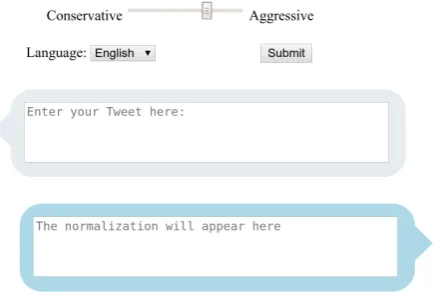
In the online interface (Figure 3), the user can type a sentence and get the predicted normaliza-tion. The dropdown menu includes all languages for which a pre-trained model is available. The aggressiveness (Section 5) can be tuned with a
Figure 3: The layout of the online demo on a low reso-lution screen.
slider which converts this agressiveness factor to a weight for the original word. This allows the user to inspect beyond the top-1 predicted nor-malization sequence. Additionally, some exam-ple social media posts are displayed for the user, which are not shown in Figure3due to privacy is-sues. The online demo can be used on: http: //www.robvandergoot.com/monoise
8 Conclusion
In this paper, we have demonstrated the online in-terface and command line inin-terface of MoNoise. For this system, we release models for 6 differ-ent languages, of which a new state-of-the-art is reached for multiple datasets. The system is easy to install and use on Unix-based systems and has many useful extra options. For even easier usage, the online demo can be used from any device with internet access and a browser. We discussed multi-ple practical issues, like evaluation, efficiency, and extra tuning parameters.
Acknowledgements
References
Inaki Alegria, Nora Aranberri, V´ıctor Fresno, Pablo Gamallo, Lluis Padr´o, Inaki San Vicente, Jordi Turmo, and Arkaitz Zubiaga. 2013. Introducci´on a la tarea compartida Tweet-Norm 2013: Normal-izaci´on l´exica de tuits en espa˜nol. InTweet-Norm@
SEPLN, pages 1–9.
Timothy Baldwin, Marie-Catherine de Marneffe, Bo Han, Young-Bum Kim, Alan Ritter, and Wei Xu. 2015. Shared tasks of the 2015 workshop on noisy user-generated text: Twitter lexical
normal-ization and named entity recognition. In
Proceed-ings of the Workshop on Noisy User-generated Text,
pages 126–135, Beijing, China.
Orph´ee De Clercq, Sarah Schulz, Bart Desmet, and V´eronique Hoste. 2014. Towards shared datasets for normalization research. InProceedings of the Ninth International Conference on Language Resources
and Evaluation (LREC’14), Reykjavik, Iceland.
Eu-ropean Language Resources Association (ELRA).
Tomaˇz Erjavec, Darja Fiˇser, Jaka Cibej,ˇ ˇSpela Arhar Holdt, Nikola Ljubeˇsi´c, and Katja Zupan. 2017.CMC training corpus janes-tag 2.0.
G¨uls¸en Eryiˇgit and Dilara Torunoˇg-Selamet. 2017. So-cial media text normalization for turkish. Natural
Language Engineering, 23(6):835–875.
Rob van der Goot. 2019. Normalization and Parsing Algorithms for Uncertain Input. Ph.D. thesis, Uni-versity of Groningen.
Rob van der Goot and Gertjan van Noord. 2017. MoNoise: Modeling noise using a modular normal-ization system. Computational Linguistics in the
Netherlands Journal, 7:129–144.
Rob van der Goot, Rik van Noord, and Gertjan van Noord. 2018. A taxonomy for in-depth evaluation of normalization for user generated content. In
Proceedings of the Eleventh International Confer-ence on Language Resources and Evaluation (LREC
2018), Miyazaki, Japan. European Language
Re-sources Association (ELRA).
Bo Han and Timothy Baldwin. 2011. Lexical normal-isation of short text messages: Makn sens a
#twit-ter. InProceedings of the 49th Annual Meeting of
the Association for Computational Linguistics:
Hu-man Language Technologies, pages 368–378,
Port-land, Oregon, USA.
Ning Jin. 2015. NCSU-SAS-Ning: Candidate gener-ation and feature engineering for supervised lexical
normalization. In Proceedings of the Workshop on
Noisy User-generated Text, pages 87–92, Beijing,
China.
Armand Joulin, Edouard Grave, Piotr Bojanowski, and Tomas Mikolov. 2016. Bag of tricks for efficient text classification. arXiv preprint arXiv:1607.01759.
Chen Li and Yang Liu. 2014. Improving text normal-ization via unsupervised model and discriminative
reranking. InProceedings of the ACL 2014 Student
Research Workshop, pages 86–93, Baltimore,
Mary-land, USA.
Chen Li and Yang Liu. 2015. Joint POS tagging and text normalization for informal text. InProceedings of IJCAI 2015, Buenos Aires, Argentina, July 25-31, 2015, pages 1263–1269.
Fei Liu, Fuliang Weng, and Xiao Jiang. 2012.A broad-coverage normalization system for social media
lan-guage. In Proceedings of the 50th Annual
Meet-ing of the Association for Computational LMeet-inguistics
(Volume 1: Long Papers), pages 1035–1044, Jeju
Is-land, Korea.
Nikola Ljubeˇsi´c, Tomaˇz Erjavec, Maja Miliˇcevi´c, and Tanja Samardˇzi´c. 2017a. Croatian Twitter training
corpus ReLDI-NormTagNER-hr 2.0.
Nikola Ljubeˇsi´c, Tomaˇz Erjavec, Maja Miliˇcevi´c, and Tanja Samardˇzi´c. 2017b. Serbian Twitter training
corpus ReLDI-NormTagNER-sr 2.0.
Nikola Ljubeˇsic, Katja Zupan, Darja Fiˇser, and Tomaz Erjavec. 2016. Normalising slovene data: historical texts vs. user-generated content. Bochumer
Linguis-tische Arbeitsberichte.
Tomas Mikolov, Kai Chen, Greg Corrado, and Jeffrey Dean. 2013. Efficient estimation of word represen-tations in vector space. Proceedings of Workshop at
ICLR.
Jordi Porta and Jos´e-Luis Sancho. 2013. Word nor-malization in Twitter using finite-state transducers.
Tweet-Norm@ SEPLN, 1086:49–53.
Radim ˇReh˚uˇrek and Petr Sojka. 2010. Software Frame-work for Topic Modelling with Large Corpora. In
Proceedings of the LREC 2010 Workshop on New
Challenges for NLP Frameworks, pages 45–50,
Val-letta, Malta. ELRA.
Sarah Schulz, Guy De Pauw, Orph´ee De Clercq, Bart Desmet, V´eronique Hoste, Walter Daelemans, and Lieve Macken. 2016. Multimodular text
normaliza-tion of Dutch user-generated content. ACM
Trans-actions on Intelligent Systems Technology, 7(4):1–
22.
Yi Yang and Jacob Eisenstein. 2013. A log-linear model for unsupervised text normalization. In Pro-ceedings of the 2013 Conference on Empirical
Meth-ods in Natural Language Processing, pages 61–72,
Seattle, Washington, USA.
Congle Zhang, Tyler Baldwin, Howard Ho, Benny Kimelfeld, and Yunyao Li. 2013. Adaptive
parser-centric text normalization. In Proceedings of the
51st Annual Meeting of the Association for
Compu-tational Linguistics (Volume 1: Long Papers), pages