Munich Personal RePEc Archive
Job assignment and fairness concerns
Danková, Katarína and Morita, Hodaka and Servátka, Maroš
and Zhang, Le
MGSM Experimental Economics Laboratory, Institute of Economic
Research at Hitotsubashi University and UNSW Business School,
MGSM Experimental Economics Laboratory, Macquarie Graduate
School of Management and University of Economics in Bratislava,
MGSM Experimental Economics Laboratory, Macquarie Graduate
School of Management
6 September 2019
Online at
https://mpra.ub.uni-muenchen.de/95918/
Job assignment and fairness concerns
Katarína Danková
MGSM Experimental Economics Laboratory
Hodaka Morita
Institute of Economic Research at Hitotsubashi University and UNSW Business School
Maroš Servátka
MGSM Experimental Economics Laboratory, Macquarie Graduate School of Management and University of Economics in Bratislava
Le Zhang
MGSM Experimental Economics Laboratory, Macquarie Graduate School of Management
September 6, 2019
Abstract
How does job assignment affect fairness concerns between coworkers? We experimentally examine
agents’ horizontal fairness concerns in a three-person ultimatum game in which all agents are asked to complete a general knowledge quiz before being assigned to a high productivity or low productivity position. Job positions differ in the stakes that are available to be split between the principal and the agent. We disentangle two possible channels through which job assignment impacts fairness concerns, wage differences and the principal’s intentions, by comparing cases in which the job assignment is determined randomly or by the principal. The knowledge quiz signifies the distinction between the two cases as it provides a basis on which the principal can make the assignment decision. We find that the principal’s intentions, combined with the associated wage differences, significantly impact fairness concerns of the agents assigned to the lower productivity position, but wage differences themselves do not. We also find that better-performing agents assigned by the principal to the lower productivity position exhibit significant fairness concerns toward their peers. We discuss managerial implications of our findings.
Keywords: job assignment, fairness concerns, experiment, ultimatum game, wage differences, intentions
1. Introduction
How does job assignment affect fairness concerns between coworkers, often referred to as horizontal fairness concerns? Job assignment can cause wage differences, which in turn affect fairness concerns. Regarding the link between wage differences and fairness concerns, there is an influential notion that workers’ fairness concerns depend, at least in part, on the wages paid to their co-workers (Charness and Kuhn, 2007), and a recent trend of making wages publicly available increases transparency and makes it easier for workers to compare their wages.1 Regarding the link between job assignment and wage differences, an important feature of careers in organizations is the assignment of workers to job positions within the firm, and, within large firms, there is typically significant heterogeneity in terms of the tasks associated with jobs at the same level of the job ladder (Gibbons and Waldman, 1999, 2004). Job assignment is then an important source of wage differences across workers because the amount a worker can contribute to production typically depends on which job the worker performs (Sattinger, 1993).2
We investigate our research question in a controlled laboratory experiment. A workplace typically has a number of job positions with heterogeneous productivity; that is, some positions often yield relatively high outputs while other positions yield relatively low outputs. To mimic the key features of heterogeneous productivity positions in the workplace that are relevant for horizontal fairness concerns, we adopt a three-person ultimatum game with unequal stakes, in which the principal assigns one agent to a higher stake (representing a high productivity position) and the other agent to a lower stake (representing a low productivity position). This setup enables us to create situations in which a high productivity position tends to yield higher wages and a low productivity position tends to yield lower wages, affecting horizontal fairness concerns of agents assigned to positions with different productivity.
In our setup, we identify two possible channels through which job assignment affects horizontal fairness concerns: wage differences and the principal’s intention revealed by job assignment. A key novelty of our experiment is that it allows us to disentangle these two channels. To this end, we compare the case of principal assignment, where the agents are assigned to their respective stakes by the principal (who is thus accountable for the outcome), with the case of random assignment, in which it is known that the agents are assigned to the stakes independently of their performance. If agents exhibit fairness concerns in the random assignment case, these concerns are driven solely by wage differences stemming from the assignment itself. In the principal assignment case, the assignment creates wage differences that can cause fairness concerns; however, the
assignment also reveals principal intentions, potentially exacerbating the agents’ concerns.
A manager typically assigns his subordinates to positions with heterogenous productivity based on the evaluation of their performance. In our experiment, to mimic features of performance evaluation in the workplace, agents complete a general knowledge quiz before they are assigned to different stakes. The quiz performance establishes entitlement, in the sense that an agent who performed better on the quiz feels entitled to be assigned to the higher stake. This is a key feature of our experiment, given that entitlements to property rights constitute an important element of fairness concerns (see e.g. Hoffman, McCabe, Shachat, and Smith, 1994). The knowledge quiz
1 See, for example European Commission Recommendation C(2014) 1405. The reason behind the recommendation is
to encourage firms to reveal their employees’ wages to combat discrimination based on gender.
2
signifies the distinction between the case of principal assignment and the case of random assignment because it provides a basis on which the principal can make the assignment decision. Without the knowledge quiz the assignment would be de facto random even in the case of principal assignment because the principal would have no basis for his assignment decision.
We conjecture that an agent assigned to the low stake position (henceforth referred to as Agent L) exhibits stronger fairness concerns under principal assignment than under random assignment, because in the former job assignment outcomes can be attributed to the principal’s intentions. In the case of random assignment, since assignment outcome is beyond the principal’s control, the principal is not responsible for Agent L being assigned to the low stake position. In contrast, in the case of principal assignment, we suppose that Agent L holds the principal accountable, strengthening Agent L’s fairness concerns. Through analogous logic we conjecture that an agent assigned to the high stake position (Agent H) exhibits weaker fairness concerns under principal assignment than under random assignment. Being assigned to the high stake position, Agent H is likely to receive a higher offer in absolute terms than Agent L. In the case of principal assignment, Agent H appreciates the Principal assigning him to the high stake position and understands if the Principal increases the offer to stake size ratio to compensate Agent L. In case of random assignment, Agent H understands that the Principal is not responsible for assigning him to the high stake position and is less understanding (i.e. has higher sensitivity) to the Principal increasing the offer ratio of Agent L.
Performance evaluation likely affects agents’ sense of entitlements. From the perspective of performance evaluation, job assignment can be merit-based, meaning that a better performer is assigned to a high productivity position and a worse performer is assigned to a low productivity position or reverse merit-based where the better performer is assigned to a low productivity position and vice versa. The merit-based assignment may not always be achieved due to reasons such as inside politics and nepotism. Imprecise assessment of job performance may also result in a reverse merit-based assignment.3 We explore whether the strength of fairness concerns differs between merit-based and reverse merit-based assignments, a comparison hard to gauge from happenstance data because of the lack of counterfactuals. We conjecture that an agent exhibits stronger fairness concerns when he has been assigned to a low productivity position under reverse merit-based assignment than under merit-based assignment. This is because, under reverse merit-based assignment, the agent who has been assigned to a low productivity position has achieved a better performance compared to the agent who has been assigned to a high productivity position. The better performing agent therefore feels entitled to the higher wage received by the worse performing agent and this feeling of entitlement strengthens the better performing agent’s horizontal fairness concerns.
Our experimental findings support our conjecture that Agent L exhibits stronger fairness concerns under principal assignment than under random assignment. We find that agents do not exhibit statistically significant horizontal fairness concerns in the random assignment case, suggesting that wage differences themselves do not have a strong enough impact on fairness concerns in our setup. At the same time, consistent with our conjecture about the different strength of fairness concerns under reverse merit-based assignment and under merit-based assignment, we
3
find the strongest and statistically significant fairness concerns when the better-performing agent is assigned by the principal to the low stake position.
These findings yield the following managerial implication. Consider, as an example, an employer who has two new salesperson positions, where one position serves a geographical area with wealthy customers (a rich area) and the other position serves an area with average customers (an average area). The employer would like to assign more capable salesperson to the rich area and less capable one to the average area, because the marginal return to sales capability is higher in the rich area than in the average area. The employer screens candidates through checking their resume and reference letters and interviewing them. He narrows down the list to two candidates and assigns the better candidate to the rich area and the other one to the average area. Our experimental findings suggest that the employer should carefully explain the reason behind the job assignment decision to the candidate assigned to the average area, so that the candidate understands that he has been assigned to the average area because the other candidate performed better in the screening process. Such a convincing explanation is important because, if the candidate feels that the job assignment is reverse merit-based, he might exhibit fairness concerns and withhold his effort as a consequence. If it is not possible for the employer to offer a convincing explanation or observable proof supporting the job assignment, the employer might need to compress wages between the two salespersons in order to mitigate the fairness concerns.
2. Relationship to the literature
The goal of our study is to investigate the impact of job assignment on fairness concerns. We contribute to the literature on horizontal fairness concerns (sometimes referred to as social or peer comparisons) by experimentally studying wage differences and the principal’s intention revealed by job assignment as two possible channels through which those concerns can be impacted. As such, our paper brings together the literature on fairness concerns and the literature on intentionality of actions. Recall also that our design includes a knowledge quiz, which mimics features of performance evaluation in the workplace. Given that the quiz likely affects agents’ sense of entitlements, our paper is related to the literature on perceived property rights entitlements. In what follows, we discuss our paper’s relationships and contributions to these literature streams.
While the notion of fairness considerations goes back to Smith (1759), it has gained more attention in economics research following two prominent studies by Güth, Schmittberger, and Schwarze (1982) and Kahneman, Knetsch, and Thaler (1986). Anecdotal and empirical evidence of other-regarding behavior subsequently lead to economics models of other-regarding preferences incorporating both distributional and reciprocal concerns in situations with salient fairness considerations (e.g. Bolton and Ockenfels, 2000; Charness and Rabin, 2002; Cooper and Kagel, 2016; Cox, Friedman, and Sadiraj, 2008; Dufwenberg and Kirchsteiger, 2004; Fehr and Schmidt, 1999; Rabin, 1993).
findings are robust to stake size (Slonim and Roth, 1998) but when stake sizes vary and are unknown to agents, the principals make lower offers and agents accept lower offers (Güth, Huck, and Ockenfels, 1996). Relatedly, Bohnet and Zeckhauser (2004) find that agents’ rejection rates increase when average offers (without asymmetric information about pie size) are revealed to them in two-player ultimatum games. Also, lower offers are more likely to be rejected when they are intentional than when they are clearly unintentional (Kagel, Kim, and Moser, 1996). Another popular vehicle for studying the vertical fairness is the gift exchange game (see Camerer, 2003 and Charness and Kuhn, 2011 for reviews of the literature), in which the principal offers the agent a wage and the agent responds with exerting costly effort. Usually, a higher wage is correlated with higher effort, but the intentionality behind the offered wage also plays an important role (e.g. Charness, 2004).
Studying horizontal fairness requires a multi-agent setting. In a three-player (one principal-two agents) ultimatum game, Knez and Camerer (1995) implement a setup in which the players receive an outside option in case the offer is rejected (the principal receives $3 if his offer to either agent is rejected, agent 1 receives $4 and agent 2 receives $2). The principal makes an offer to each of the two agents while the agents provide their respective minimum acceptable offers (MAOs), which could be based on possible amounts offered to the other agent. Knez and Camerer (1995) find that agents reject offers more frequently if they are offered less than the other agent but principals do not seem to take this into consideration and do not adjust the offers. Ho and Su (2009) analyze two independent ultimatum games with identical stake sizes played sequentially by a
principal and two agents to test if the agents take the other agent’s offer as a reference to evaluate their own offer. Ho and Su (2009) result suggests that the second agent may be reluctant to accept an offer that is inferior to that of a peer. Both of these studies represent a point of departure for our experiment as they clearly indicate that agents do take the other agent’s offer into consideration
when deciding on their response to the principal’s offer.
We contribute to the literature on horizontal fairness concerns by investigating job assignment as their new and unexplored source. Job assignment or fairness concerns resulting from the assignment outcome are not considered by either Knez and Camerer (1995) or Ho and Su (2009). In both of those experiments, two agents are assigned to an equal stake size, and they find that an agent is more likely to reject an offer when the agent observes (Knez and Camerer, 1995) or estimates (Ho and Su, 2009) that the other agent receives a higher offer from the principal. In our experiment, in order for job assignment to play a role, agents are assigned to unequal stake sizes. We compare the case of random assignment and the case of principal assignment, where (in one treatment as will be explained later) the principal could base his decision on the agents’ performance on the knowledge quiz.
In a multi-agent setting of the gift exchange game, the principal decides not only on the absolute wage for each agent but also on their relative wages, which introduces (various aspects of) social comparisons if the wages are observable. Charness and Kuhn (2007) conjecture that an
agent’s sensitivity to other agent’s wage should lead the principal to compress wages. In their
experiment the subjects are randomly assigned to be either a principal, high productivity agent, or low productivity agent. In the treatment that allows for social comparisons, wages of both agents are made public before the agents choose their effort levels, whereas in the control treatment the wages remain private information. They find that the exerted effort is not sensitive to the other
Our experiment bears some similarity to Charness and Kuhn (2007)’s design in that we also have high and low productivity positions (high and low stake sizes) to give principals an incentive to differentiate offers. A key difference is that assignment to high and low productivity positions is random in Charness and Kuhn (2007), whereas, given our focus on job assignment, our experiment includes both the random assignment case and the principal assignment case. By comparing the two
cases, we study effects of principal’s intentionality associated with the agent’s job assignment.4 Regarding intentionality of actions, economics experiments have found that intentions influence the vertical perception of fairness in bilateral principal-agent relationships (e.g. Blount, 1995; Cox, 2004; Falk, Fehr, and Fischbacher, 2008; McCabe, Rigdon, and Smith, 2003; Offerman, 2002).5 The experimental designs studying the role of intentions allow for their presence in one condition and remove them in the control treatment by either implementing the choice of the decision-maker exogenously by the experimenter (e.g. Charness, 2004; Cox, 2004), using a randomizing device (e.g. Charness, 2004; Cox and Deck, 2005; Gächter and Thöni, 2010), by forcing a particular choice through limiting the choice set to one alternative (e.g. McCabe et al., 2003) or by varying the nature of intentions (Stanca, Bruni, and Corazzini, 2009; Woods and Servátka, 2019) or whether the action was an act of commission or omission (Cox, Servátka, and
Vadovič, 2017).
In the context of horizontal fairness concerns, Gächter and Thöni (2010) study effects of intentionality revealed by the allocation of surplus in a three-player gift-exchange game. A key difference between Gächter and Thöni (2010) and our paper is that we study principal’s intentionality revealed by job assignment, whereas they study principal’s intentionality revealed by wage differences. By including a treatment in which wages are generated randomly and thus the principals are not responsible for the resulting wage differences, Gächter and Thöni (2010) identify whether wage comparison effects are due to intentional wage discrimination or due to wage differences themselves. They find that it is the principal’s intentions to discriminate wages rather than the mere wage differences that trigger the wage comparison effect. They also provide evidence that disadvantageous wage discrimination lowers agent’s effort while advantageous discrimination does not increase it.
Finally, in the literature on perceived property rights entitlements, it has been shown that whether the assignment to positions triggers fairness concerns often depends on agent’s perceived entitlements (sometimes also referred to as legitimacy). Earlier literature provides ample evidence that fairness concerns are closely related to real effort and relative performance (e.g. Bosman, Sutter, and van Winden, 2005; Cameron, Chaudhuri, Erkal, and Gangadharan, 2009; Cherry, Frykblom, and Shogren, 2002; Danková and Servátka, 2015; Hoffman and Spitzer, 1985; Oxoby and Spraggon,
4 Multi-agent settings of the gift exchange game with equal productivity between agents have been employed in several
other studies related to horizontal fairness concerns and wage observability. For example, Abeler, Altmann, Kube, and Wibral (2010) show that agents who are paid equal wages exert significantly lower efforts than the agents who are paid individually. In a complementary study, Nosenzo (2013) observes that if agents are paid different wages, pay disclosure can be detrimental to effort provision. Güth, Königstein, Kovács, and Zala-Mezõ (2001) also use two-agent setup, but with unequal productivities to show that largely differing offers trigger rejection or low effort. Finally, Charness, Cobo-Reyes, Lacomba, Lagos, and Pérez (2016) in their experiment on wage delegation observe that agents are concerned with both their own salaries and their relative wages with respect to other agents working for the same principal and make lower effort choices when they cannot choose their own wage while the other agents can.
5 See also Camerer (2003), Chaudhuri (2011), Fehr and Gächter (2000), Fehr and Schmidt (2006), and Sobel (2005)
2008). In an influential study on this topic, Hoffman et al. (1994) have their subjects “earn” the right to be the principal (proposer) in the ultimatum game by scoring higher on a general knowledge quiz. The counterpart who scored lower is assigned to be the responder. Performance in this real effort task and the resulting assignment also affects the perceived entitlements and results in principals offering on average a lower share of the pie to their matched agents who are more likely to accept compared to a situation when the rights to be the principal are assigned randomly.
We incorporate this design feature into our three-person ultimatum game experiment with the main difference that it is the entitlement to the high productivity position rather than the right to be the principal that is created by the knowledge quiz performance. We posit that in our setup the perceived entitlements between agents will trigger fairness concerns, manifested by an agent’s sensitivity to accept a particular offer in response to observing the offer to stake size ratio made to the other agent.
3. Experimental design and hypotheses
We employ a three-person ultimatum game (Güth et al., 1982; Knez and Camerer, 1995) that consists of one principal and two agents. In the experiment, each subject is randomly paired with another two subjects to form an anonymous group of three persons and assigned to be either the principal (referred to as the Proposer in the instructions) or one of the two agents (Responders). In Stage 1, all agents have 10 minutes to complete a general knowledge quiz, while the principals are asked to wait patiently and quietly. The instructions specify that within each group, the two agents are ranked based on their quiz scores. If both agents have the same quiz score, the agent who completes the quiz faster is ranked higher. The agents are informed about their relative performance (and thus their ranking) in all treatments. Whether or not the principal is informed about the relative performance of agents depends on the treatment.6
In Stage 2, each agent is assigned to one of the positions representing the available stake size (L = 100 francs or H = 200 francs; subsequently we will refer to the agent assigned to the low stake position as Agent L and to the agent assigned to the high stake position as Agent H). The assignment to positions is common knowledge and depends on the experimental treatment. Stage 3 is a three-player ultimatum game, in which a principal moves first and offers OL, OL<=L, to the agent who is assigned to the low stake position, and OH, OH<=H, to the agent assigned to the high stake position (where each offer is interpreted as a wage). Agent behavior is elicited using the strategy method (Brandts and Charness, 2011; Selten, 1967).7 This means that neither agent observes the offer that the principal made to him; instead, each agent observes the offer that the principal made to the other agent. Observing the other agent’s offer can trigger horizontal fairness concerns. After observing the other agent’s offer, each agent states his own minimum acceptable offer. If the offer made by the principal is greater than or equal to MAO, the offer is accepted (ai=1). As a result, the agent receives the number of francs stated in the offer, and the principal keeps the remainder. However, if the offer is less than MAO then the offer is rejected (ai=0) and both the
6 Recall that incorporating Stage 1 into the design is crucial from the perspective of our research question as it not only
introduces performance evaluation and allows us to classify assignments as merit-based or reverse merit-based, but also to make the principal assignment meaningful in the sense that the agents have established entitlements and make the principal accountable for the assignment outcome.
7 Armantier (2006) does not find differences in MAOs in an ultimatum game using the strategy method versus the direct
principal and the agent receive nothing. The principal receives earnings from both interactions while each of the agent receives earnings only from the interaction he participated in. The principal thus receives a1(π1-O1)+a2(π2-O2) and each agent receives his respective offer Oi.
Upon the completion of the experiment the subjects are asked to complete a questionnaire for which they are paid additional 5 NZD. The ultimatum game earnings are converted from francs into New Zealand Dollars at the exchange rate 1 franc = 0.1 NZD as announced in the instructions at the beginning of the session. The participants are then called one by one to collect their payment in private in the control room in the back of the laboratory.
The participants played the game only once. All sessions were run under a single-blind social distance protocol. The experiment was programmed and conducted with z-Tree (Fischbacher, 2007). The treatments were implemented in a between-subject design, in which each participant is exposed to only one treatment. As there is no extant literature employing the same design to address the same research question, we calculate our sample size based on raw data (Ho and Su, 2009). In order to achieve a power of 80% (i.e., 20% type II error) along with 5% type I error, we need to have a sample size of 15 in each treatment. A total of 285 subjects (95 triads across three treatments) participated in the experiment conducted in the New Zealand Experimental Economics Laboratory (NZEEL) at the University of Canterbury. The participants were recruited using the online database system ORSEE (Greiner, 2004). The number of participants in a session varied from 27 to 36, always in multiples of three. On average, a session lasted 50 minutes including the payment and participants earned on average 12.80 NZD.8
We implement three treatments (Principal/Informed, Principal/Uninformed, and
Random/Informed treatments) that vary whether the assignment is determined by the principal or randomly, and whether or not the principal is informed of the relative quiz performance by agents (in the instructions referred to as ranking based on quiz scores). In the Principal/Informed treatment, the principal is informed about the relative performance of the two agents and then he assigns them to positions. If agents’ relative performance created sufficiently strong entitlements for studying fairness concerns, they will be recognized also by the principal who might use the relative performance as the basis for assignment. If that is the case, the principal is more likely to create a merit-based assignment, i.e. assign the better performer to the high stake position and the worse performer to the low stake position. While we expect the Principal/Informed treatment to predominantly generate merit-based assignments, reverse merit-based assignments (in which the lower performer is assigned to the high stake position and vice versa) might also be possible.
The Principal/Uninformed treatment is designed to generate more instances of reverse merit-based assignment. In this treatment it is again the principal who assigns the agents to their positions, but this time he is not informed about their relative performance when making the decision. The agents know that it is the principal who assigns positions, but are not informed about the fact that the principal does not know the relative performance.
In the two treatments, the knowledge quiz parallels everyday practice in organizations as it makes the principal’s assignment meaningful because it allows him to assign agents to positions based on the observed performance. We argue that, without such a basis, the principal’s assignment is likely to be viewed by the agents as de facto random. Since the agents see the relative performance
8 At the time of the experiment this was approximately 11 USD and the adult minimum wage in New Zealand was 14.25
on their screens after the quiz, they are likely to think that the principal determines the assignment based on the quiz performance. Importantly for our design, apart from being the source of exogenous variation of assignment, our Principal/Uninformed treatment can be seen as creating counterfactuals that are unobservable (or hard to verify) in everyday life and thus allow us to
evaluate the importance of the assignment on agents’ fairness concerns.9
In the Random/Informed treatment the principal is informed about the relative performance of agents but the assignment to positions is random, and agents know the random nature of the assignment. Hence, the assignment does not convey the principal’s intentions. The assignment to different stakes can still be a source of horizontal fairness concerns because it drives the difference in offers received by the agents. In contrast, in the other two treatments, it is not only the difference in offers but also the principal’s intentions revealed by the assignment that can act as potential channels through which the job assignment impacts fairness concerns. We can therefore disentangle the two possible channels by comparing the outcomes in the Random/Informed treatment to the outcomes in the Principal/Informed and the Principal/Uninformed treatments.
We investigate the strength of horizontal fairness concerns, that is, the extent to which agents look to the other agent to evaluate whether they are treated fairly by the principal. We measure the
strength of horizontal fairness concerns by the sensitivity of an agent’s MAO ratio (defined as the ratio of the agent’s MAO to the size of own stake) to the other agent’s offer ratio (defined as the
ratio of the offer that the principal made to the other agent to the stake size assigned to the other agent). We postulate that both Agent L and Agent H exhibit fairness concerns in the following sense. Since the same principal makes offers to both Agent L and Agent H (and thus also decides on the size of the offer relative to the stake size of the position), each agent looks at what share the principal offered to the other agent to evaluate the fairness of his own offer. Hence each agent expects to receive more from the principal when the other agent receives more from the principal. It is this relationship that we have in mind when we develop our hypotheses below.
We conjecture that being able to attribute job assignment outcomes to the principal’s
intentions matters. Our hypothesis here is that Agent L exhibits stronger fairness concerns when assignment is determined by the principal rather than when it is determined randomly. In the case
of random assignment, since assignment outcome is beyond the principal’s control, the principal
cannot be blamed for Agent L being assigned to the low stake position. In contrast, in the case of principal assignment, we suppose that Agent L holds the principal accountable for being assigned to the low stake position, inducing Agent L to require a higher offer (relative to the stake size) from the principal compared to the offer made to Agent H. Hence, we hypothesize that Agent L exhibits stronger fairness concerns under principal assignment than under random assignment. As for Agent H, through analogous logic we hypothesize that Agent H exhibits weaker fairness concerns under principal assignment than under random assignment. Being assigned to the high stake position, Agent H is likely to receive a higher offer than Agent L. In the case of principal assignment, we hypothesize that Agent H appreciates not being assigned to the low stake position and understands if the Principal increases the offer ratio to compensate Agent L. Such reasoning is weaker in the case of random assignment, meaning that Agent H understands that the Principal is not responsible
9 The manipulation was indeed successful as 16 out of 32 Principals’ assignments in the Principal/Uninformed treatment
for assigning him to the high stake position and has higher sensitivity to the Principal’s increasing the offer ratio of Agent L.
Our conjectures regarding the accountability for the assignment are translated into the following two main hypotheses:
Hypothesis 1: Agent L’s MAO ratio increases more as the other offer ratio increases if the
assignment is determined by the principal than when it is determined randomly.
Hypothesis 2: Agent H’s MAO ratio increases less as the other offer ratio increases if the assignment is determined by the principal than when it is determined randomly.
Since there are two possible assignment outcomes (merit-based and reverse merit-based), the above two hypotheses are expected to be robust to both assignment outcomes. Therefore, we have the following four more specific hypotheses.
Hypothesis 1a: Under merit-based assignment, Agent L’s MAO ratio increases more as the other offer ratio increases if the assignment is determined by the principal than when it is determined randomly.
Hypothesis 1b: Under reverse merit-based assignment, Agent L’s MAO ratio increases more as the other offer ratio increases if the assignment is determined by the principal than when it is determined randomly.
Hypothesis 2a: Under merit-based assignment, Agent H’s MAO ratio increases less as the other offer ratio increases if the assignment is determined by the principal than when it is determined randomly.
Hypothesis 2b: Under reverse merit-based assignment, Agent H’s MAO ratio increases less as the other offer ratio increases if the assignment is determined by the principal than when it is determined randomly.
Next, we present the arguments regarding the difference in the strength of fairness concerns under merit-based assignment and reverse merit-based assignment. We begin by supposing that under merit-based assignment the fairness concerns of both Agent L and Agent H depend on the offer made to the other agent. In particular, for both types of agents, MAO ratio increases as the other offer ratio increases under merit-based assignment, a supposition testable from our data.
sense of entitlement increases Agent L’s sensitivity to the offer received by Agent H, strengthening
Agent L’s fairness concerns.
As for Agent H, we suppose that Agent H feels no entitlement to the offer that Agent L receives since it is expected to be lower than the offer that Agent H receives. We conjecture that Agent H exhibits weaker fairness concerns under reverse based assignment than under merit-based assignment through the following reasoning. Agent H understands that the principal needs to make a relatively high offer to Agent L in order to satisfy Agent L’s sense of entitlement under reverse merit-based assignment. Agent H also understands that the principal has to do so because Agent H himself is assigned to the high stake position despite scoring lower on the quiz. This leads Agent H to understand that he himself is partially ‘responsible’ for the higher offer that the principal has to make to Agent L, reducing Agent H’s sensitivity to the offer received by Agent L. The fairness concerns of Agent H (if any) are thus overshadowed by the fact that he has been assigned to the high stake position.
Our conjectures regarding the comparison between merit-based and reverse merit-based assignments are translated into the following testable hypotheses:
Hypothesis 3:Agent L’s MAO ratio increases more as the other offer ratio increases under reverse
merit-based assignment than under merit-based assignment.
Hypothesis 4:Agent H’s MAO ratio increases less as the other offer ratio increases under reverse
merit-based assignment than under merit-based assignment.
Since the assignment outcomes can be determined either randomly or by the principal, the above two hypotheses are expected to be robust to both assignment processes. Therefore, we have the following four more specific hypotheses.
Hypothesis 3a: Under random assignment, Agent L’s MAO ratio increases more as the other offer ratio increases under reverse merit-based assignment than under merit-based assignment.
Hypothesis 3b: Under principal assignment, Agent L’s MAO ratio increases more as the other offer ratio increases under reverse merit-based assignment than under merit-based assignment.
Hypothesis 4a: Under random assignment, Agent H’s MAO ratio increases less as the other offer ratio increases under reverse merit-based assignment than under merit-based assignment.
Hypothesis 4b: Under principal assignment, Agent H’s MAO ratio increases less as the other offer ratio increases under reverse merit-based assignment than under merit-based assignment.
4. Results
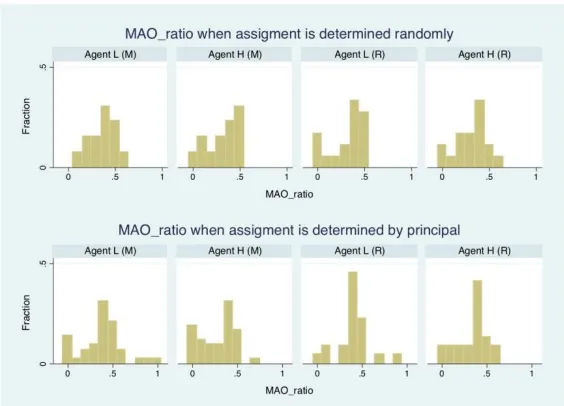
Agent L on average asks for a share of 37%, while Agent H asks for a share of 33%. The difference is statistically insignificant (two-sided Mann-Whitney test, p-value=0.658). In the case of random reverse merit-based assignment, Agent L and Agent H request a share of 32% and 33%, respectively, with the difference also being statistically insignificant (two-sided Mann-Whitney test, p-value=0.898). Under merit-based assignment determined by the principal, we find that Agents’ MAO ratios are statistically different from one another: Agent L requests a share of 39% while Agent H asks only for 29% (two-sided Mann-Whitney test, p-value=0.042). Finally, under reverse merit-based assignment determined by the principal, Agent L requests 41% while Agent H’s requests is 35%, with the difference being statistically insignificant (two-sided Mann-Whitney test, p-value=0.390). The histogram of MAO ratio for each case is presented in Figure 1.
Table 1: Summary statistics of MAO ratio, separately for each assignment outcome
Treatment Assignment Agent L Agent H N
Random assignment Merit-based 0.37 (0.14) 0.33 (0.18) 13 Reverse merit-based 0.32 (0.18) 0.33 (0.18) 18 Principal's assignment Merit-based 0.39 (0.23) 0.29 (0.20) 42 Reverse merit-based 0.41 (0.19) 0.35 (0.17) 22
[image:13.595.185.467.393.596.2]St. dev. in parentheses.
Figure 1: Histogram of MAO ratio, separately for each assignment outcome
Note: “M” refers to the merit-based assignment and “R” refers to the reverse merit-based assignment.
including the interaction terms of the other offer ratio with dummy variables. The dummy variable
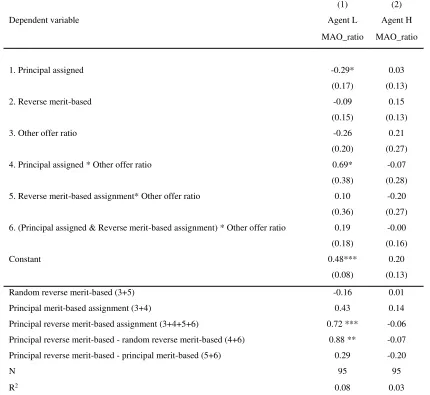
[image:14.595.87.517.285.680.2]“Principal assigned” is equal to 1 for assignments determined by the principal (including both merit-based and reverse merit-merit-based) and 0 for assignments determined randomly (again including both merit-based and reverse merit-based). It measures the difference in the MAO ratio between random and principal assignment under the merit-based assignment outcome, when the principal offers nothing to the other agent. The dummy variable “Reverse merit-based assignment” is equal to 1 when the agent who scored higher in the quiz is assigned to the low stake position (including assignments determined both by the principal and randomly), and 0 otherwise (again, including assignments determined both by the principal and randomly). It captures the difference in MAO ratio between the random merit-based and random reverse merit-based assignment, when the principal offers nothing to the other agent.
Table 2: The effects of horizontal concerns on MAO ratio of Agent L and Agent H
(1) (2) Dependent variable Agent L Agent H
MAO_ratio MAO_ratio
1. Principal assigned -0.29* 0.03 (0.17) (0.13) 2. Reverse merit-based -0.09 0.15
(0.15) (0.13) 3. Other offer ratio -0.26 0.21
(0.20) (0.27) 4. Principal assigned * Other offer ratio 0.69* -0.07 (0.38) (0.28) 5. Reverse merit-based assignment* Other offer ratio 0.10 -0.20 (0.36) (0.27) 6. (Principal assigned & Reverse merit-based assignment) * Other offer ratio 0.19 -0.00 (0.18) (0.16)
Constant 0.48*** 0.20
(0.08) (0.13) Random reverse merit-based (3+5) -0.16 0.01 Principal merit-based assignment (3+4) 0.43 0.14 Principal reverse merit-based assignment (3+4+5+6) 0.72 *** -0.06 Principal reverse merit-based - random reverse merit-based (4+6) 0.88 ** -0.07 Principal reverse merit-based - principal merit-based (5+6) 0.29 -0.20
N 95 95
R2 0.08 0.03
We test our hypotheses by verifying the coefficient of four variables: “Other offer ratio”, the interaction term of “Other offer ratio” and “Principal assigned”, the interaction term of “Other offer ratio” and “Reverse merit-based assignment”, and the interaction terms of “Other offer ratio”,
“Principal assigned”and “Reverse merit-based assignment”.
• “Other offer ratio” measures the agent’s horizontal fairness concerns (sensitivity of agent’s response to the share offered by the principal to the other agent) in the random merit-based assignment case as the baseline.
• “Principal assigned * Other offer ratio” captures the effect of the principal assignment compared to the random assignment, when the assignment outcome is merit-based (corresponding to Hypotheses 1a and 2a);
• “Reverse merit-based assignment * Other offer ratio” measures the effect of reverse merit-based assignment outcome compared to the merit-based outcome, when the assignment is determined randomly (corresponding to Hypotheses 3a and 4a);
• “(Principal assigned & Reverse merit-based assignment) * Other offer ratio” is an interaction
term, so that the sum of “(Principal assigned & Reverse merit-based assignment) * Other offer ratio” and “Principal assigned * Other offer ratio” refers to the effect of the principal assignment compared to random, when the assignment outcome is reverse merit-based (corresponding to Hypotheses 1b and 2b). Similarly, the sum of “(Principal assigned & Reverse merit-based assignment) * Other offer ratio” and “Reverse merit-based assignment* Other offer ratio” refers to the effect of the reverse merit-based assignment outcome compared to the merit-based outcome, when the assignment is determined by the principal (corresponding to Hypotheses 3b and 4b).
Before testing our hypotheses, we verify whether or not agents exhibit horizontal fairness concerns in the random assignment case. Recall that in the random assignment case fairness concerns are affected by wage differences stemming from the assignment to positions but not affected by the principal’s intentions simply because agents know that the assignment is random. We find that, in the random assignment case, agents do not exhibit statistically significant horizontal fairness concerns under merit-based or reverse merit-based assignment. The result suggests that wage differences themselves do not have a strong enough impact on agents’ horizontal fairness concerns in our setup.
Let us now turn to testing our hypotheses pertaining to Agent L by investigating the estimates from Model 1 presented in Table 2. We first test Hypothesis 1a, i.e. the effect of principal assignment under the merit-based assignment outcome. When the other offer ratio increases from 0% to 100% in the case of random assignment, Agent L reduces his MAO ratio by 26 percentage points. This decrease in MAO, however, is statistically insignificant (see the marginal effects of
Result 1a: Under merit-based assignment, Agent L’s MAO ratio increases more as the other offer ratio increases if the assignment is determined by the principal than when it is determined randomly.
Hypothesis 1b concerns the effect of principal assignment under the reverse merit-based assignment outcome. When the other offer ratio increases from 0% to 100% in the case of random assignment, Agent L reduces his MAO ratio by 16 percentage points, with the effect being statistically insignificant (see the sum of marginal effects of variable “Other offer ratio” and
“Reverse merit-based assignment * Other offer ratio”). Agent L’s MAO ratio is 88 percentage points higher if the assignment is determined by the principal than if the assignment is determined randomly (see the sum of the marginal effects of the variable “Principal assigned * Other offer ratio” and “(Principal assigned & Reverse merit-based assignment) * Other offer ratio”), with the difference being statistically significant and thus providing support for Hypothesis 1b. Overall, Agent L increases his MAO ratio by 72 percentage points in the case of principal reverse merit-based assignment when the other offer ratio is increased from 0% to 100%, with the effect being statistically significant.
Result 1b: Under reverse merit-based assignment, Agent L’s MAO ratio increases more as the other offer ratio increases if the assignment is determined by the principal than when it is determined randomly.
Next we test our hypotheses pertaining to Agent H by investigating the estimates from Model 2 presented in Table 2. When the other offer ratio increases from 0% to 100% in the case of random assignment, Agent H increases his MAO ratio by 21 percentage points, with the effect being statistically significant (see the marginal effects of variable “Other offer ratio”). Agent H’s MAO ratio is 7 percentage points lower if the assignment is determined by the principal than if it is determined randomly (see the marginal effects of the variable “Principal assigned * Other offer ratio”), with the difference being statistically insignificant. We therefore reject Hypothesis 2a. Overall, Agent H increases his MAO ratio by 14 percentage points in the case of principal reverse merit-based assignment when the other offer ratio is increased from 0% to 100%, with the effect being statistically insignificant.
Result 2a: Under merit-based assignment, Agent H’s MAO ratio does not increase less as the other offer ratio increases if the assignment is determined by the principal than when it is determined randomly.
statistically insignificant. Therefore, we reject Hypothesis 2b as well. Overall, Agent H reduces his MAO ratio by 6 percentage points in the case of principal reverse merit-based assignment when the other offer ratio is increased from 0% to 100%, with the effect being statistically significant.
Result 2b: Under reverse merit-based assignment, Agent H’s MAO ratio does not increase less as the other offer ratio increases if the assignment is determined by the principal than when it is determined randomly.
The next hypotheses explore the effect of reverse merit-based job assignment. We first test our hypotheses pertaining to Agent L by investigating the estimates from Model 1 presented in Table 2. Hypothesis 3a concerns the effect of reverse merit-based assignment when the assignment is determined randomly. When the other offer ratio increases from 0% to 100% in the case of merit-based assignment, Agent L reduces his MAO ratio by 26 percentage points, which is statistically insignificant. Agent L’s MAO ratio is 10 percentage points higher if the assignment outcome is reverse merit-based than if it is merit-based (see the marginal effects of variable “Reverse merit -based*Other offer ratio”), with the difference being statistically insignificant. We therefore reject Hypothesis 3a. Overall, Agent L reduces his MAO ratio by 16 percentage points in the case of random reverse merit-based assignment when the other offer ratio is increased from 0% to 100% (see the sum of marginal effects of variable “Other offer ratio”and “Reverse merit-based * Other offer ratio”), with the effect being statistically insignificant.
Result 3a: Under random assignment, Agent L’s MAO ratio does not increase more as the other offer ratio increases under reverse merit-based assignment than under merit-based assignment.
Hypothesis 3b concerns the effect of reverse merit-based assignment when the assignment is determined by the principal. When the other offer ratio increases from 0% to 100% in the case of merit-based assignment, Agent L reduces his MAO ratio by 43 percentage points, which is statistically insignificant (see the sum of marginal effects of variable “Other offer ratio” and
“Principal assigned * Other offer ratio”). Agent L’s MAO ratio is 29 percentage points higher when the assignment outcome is reverse merit-based than when it is merit-based (see the sum of marginal
effects of variable “Reverse merit-based * Other offer ratio” and “(Principal assigned & Reverse merit-based assignment) * Other offer ratio”), with the difference being statistically insignificant. We therefore reject Hypothesis 3a. Overall, Agent L increases his MAO ratio by 72 percentage points in the case of principal reverse merit-based assignment when the other offer ratio is increased from 0% to 100%, with the effect being statistically significant.
Result 3b: Under principal assignment, Agent H’s MAO ratio does not increase less as the other offer ratio increases under reverse merit-based assignment than under merit-based assignment.
lower when the assignment is reverse merit-based than when it is merit-based (see the marginal
effects of variable “Reverse merit-based*Other offer ratio”), with the difference being statistically insignificant. We thus reject Hypothesis 4a. Overall, Agent H increases his MAO ratio by 1 percentage point in the case of random reverse merit-based assignment when the other offer ratio is increased from 0% to 100% (see the sum of marginal effects of variable “Other offer ratio” and
“Reverse merit-based * Other offer ratio”), with the effect being statistically insignificant.
Result 4a: Under random assignment, Agent H’s MAO ratio does not increase more as the other offer ratio increases under reverse merit-based assignment than under merit-based assignment.
Next we test Hypothesis 4b concerning the effect of reverse merit-based assignment when the assignment is determined by the principal. When the other offer ratio increases from 0% to 100% in the case of merit-based assignment, Agent H reduces his MAO ratio by 14 percentage points, which is statistically insignificant (see the sum of marginal effects of variable “Other offer ratio”
and “Principal assigned * Other offer ratio”.) Agent H’s MAO ratio is 20 percentage points lower when the assignment is reverse merit-based than when it is merit-based (see the sum of the marginal
effects of variable “Reverse merit-based*Other offer ratio” and “(Principal assigned & Reverse merit-based assignment) * Other offer ratio”), with the difference being statistically insignificant. We thus reject Hypothesis 4b. Overall, Agent H reduces his MAO ratio by 6 percentage points in the case of principal reverse merit-based assignment when the other offer ratio is increased from 0% to 100% (see the sum of marginal effects of variable “Other offer ratio”, “Principal assigned* Other offer ratio”, “Reverse merit-based * Other offer ratio” and “(Principal assigned & Reverse merit-based assignment) * Other offer ratio”), with the effect being statistically insignificant.
Result 4b: Under principal assignment, Agent H’s MAO ratio does not increase less as the other offer ratio increases under reverse merit-based assignment than under merit-based assignment.
Having tested all our hypotheses, we ask, “In which cases do agents exhibit statistically
significant horizontal fairness concerns?” As mentioned earlier, agents do not exhibit horizontal
fairness concerns in the random assignment case, no matter whether the assignment to positions is merit-based or reverse merit-based. But the principal’s intentions and/or agents’ sense of entitlements may lead to strong enough fairness concerns. We find that, in the principal assignment case, while agents (H or L) do not exhibit fairness concerns under merit-based assignment, agent L exhibits fairness concerns under the reverse merit-based assignment. This finding yields a managerial implication detailed in the Introduction.
Our final observation is related to behavior of principals. Do the principals compress wages and if so, does the wage compression depend on the assignment process (i.e., whether the assignment is determined by the principals or randomly) and assignment outcomes being merit-based or reverse merit-merit-based?
in all three treatments (two-sided Mann-Whitney rank-sum test, p-values are 0.08, 0.001 and 0.001, respectively).
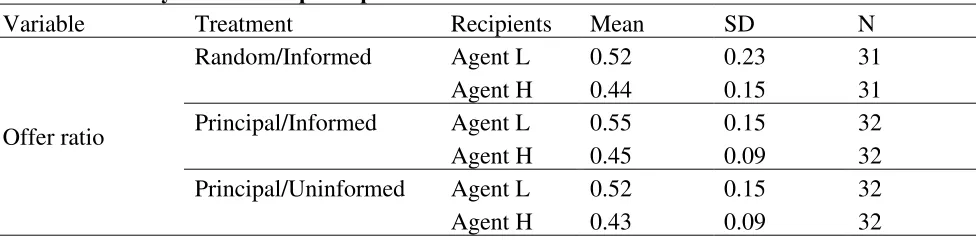
Table 3: Summary statistics of principals’ offer ratios
Variable Treatment Recipients Mean SD N
Offer ratio
Random/Informed Agent L 0.52 0.23 31
Agent H 0.44 0.15 31
Principal/Informed Agent L 0.55 0.15 32
Agent H 0.45 0.09 32
Principal/Uninformed Agent L 0.52 0.15 32
Agent H 0.43 0.09 32
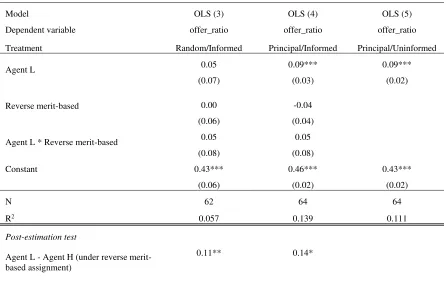
We next examine whether the principal’s offer ratio is affected by the assignment process being merit-based or reverse merit-based, and by being determined by the principal or randomly. Table 4 displays OLS regressions of the share the principal offers to agents given the merit-based vs. reverse merit-based nature of the assignment outcome. The results of the Random/Informed treatment are presented in Model 3. The principal offers 43% to Agent H, and offers 5 percentage points more of the entire stake to Agent L, when the random assignment is merit-based, however, this difference is statistically insignificant. The principal offers statistically significant 11 percentage points more of the stake to the “unlucky” Agent L who ranked higher on the quiz. When the principal is informed about the agents’ rankings on the quiz and determines the job assignment himself, he offers 9 percentage points more to Agent L when he assigns roles based on the merit, and 14 percentage points more to Agent L when the assignment outcome is reverse merit-based, with both differences being statistically significant. In the Principal/Uninformed treatment, the principal assigns roles without having information about agents’ performance on the quiz (Model 5). As also shown in Table 4, the principal offers 43% to Agent H and 52% to Agent L (9 percentage points more) with the difference being statistically significant.
Table 4: The effects of job assignment on wage compression
Model OLS (3) OLS (4) OLS (5) Dependent variable offer_ratio offer_ratio offer_ratio Treatment Random/Informed Principal/Informed Principal/Uninformed Agent L 0.05 0.09*** 0.09***
(0.07) (0.03) (0.02)
Reverse merit-based 0.00 -0.04 (0.06) (0.04) Agent L * Reverse merit-based 0.05 0.05
(0.08) (0.08)
Constant 0.43*** 0.46*** 0.43*** (0.06) (0.02) (0.02)
N 62 64 64
R2 0.057 0.139 0.111
Post-estimation test
Agent L - Agent H (under reverse merit-based assignment)
0.11** 0.14*
Note: The results are robust to using fractional logit models (details available upon request). Standard errors clustered at the pair level and reported in parentheses. *, **, and *** indicate significance at the 10%, 5%, and 1%-level, respectively.
5. Discussion and Conclusion
Job assignment is a significant source of wage differences across agents, and the process of job assignment may affect agents’ fairness perceptions. We conduct a three-person ultimatum game experiment to investigate the effect of intentionality of assignment and wage differences resulting from the job assignment on agents’ horizontal fairness concerns and vary the assignment process to be either random or determined by the principal. In the experiment, all agents are asked to complete a general knowledge quiz before being assigned to a job position, represented by a different stake size, implemented to mimic features of performance evaluation in the workplace. The knowledge quiz signifies the distinction between the principal assignment and the random assignment cases because it provides an underlying foundation on which the principal can make the assignment decision. At the same time, this experimental design allows us to study the effects of agents’ entitlements associated with the link between job assignment and quiz performance. To this end, we test whether the agents’ fairness perceptions differ under the merit-based versus the reverse merit-based assignments.
significant differences in fairness concerns between the principal assignment and the random assignment or between the merit-based and the reverse merit-based assignment outcomes. Although the difference in fairness perceptions between Agents H and L is not our research question, the result seems consistent with the previous experimental findings that people tend to be concerned with inequity predominantly when it is disadvantageous (see e.g. Bellemare, Kröger, and Van Soest, 2008) or undeserved (Lefgren, Sims, and Stoddard, 2016).
Overall, we find statistically significant horizontal fairness concerns when an agent is assigned to a low stake position by the principal and the outcome is reverse merit-based. That is, Agent L exhibits fairness concerns when intentionality of job assignment is supplemented by its entitlement effects. As detailed in the Introduction, this finding yields a managerial implication that an employer should carefully explain the reason for job assignment especially to employees who are assigned to relatively low productivity positions compared to their peers.
Our experimental findings also suggest that one way to mitigate horizontal fairness concerns in an organization could be to separate the process of job assignment from that of making wage offers. This can be achieved by making it clear to employees that it is the human resource manager
who makes job assignment decisions and it is the employee’s immediate line manager who makes
decisions regarding wages.
We contribute to the literature on horizontal fairness concerns by studying job assignment
as a new source of wage inequality and effects of intentionality and entitlements on agents’
perceptions of horizontal fairness. By incorporating performance evaluation and perceived entitlements to property rights into the experimental design, side by side with the assignment to positions, we create a rich and realistic environment that is necessary to answer our research questions. Our approach could therefore be considered as a step in the direction of increasing the external validity of experimental research of social comparisons and horizontal fairness concerns.
As a direction for future research, we find it meaningful to incorporate in the experiment enriching features that one might encounter in everyday business practice. For example, not all performance can be clearly measured or directly compared, in which case the principal might have to subjectively evaluate the performance of agents. While in our design, in order to allow for causal inference, we make it unambiguous whether an agent scored higher or lower than his counterpart, in some workplace environments the difference in performance is not sharply defined. Furthermore, an employer might choose to make the performance evaluation intentionally vague in order to mitigate fairness concerns between employees. We view investigations along these lines as a fruitful avenue for future experimental research on the importance of the job assignment process for fairness concerns inside an organization.
Acknowledgements: This paper is based on Katarína Danková’s dissertation chapter written at the University of Canterbury (Danková, 2015). We are thankful to Hongyi Li, John Spraggon, Daniel Woods, and the participants of the 2014 Ronald Coase Institute Workshop in Manila as well as the participants of the 2018 ESA Asia Pacific Meeting in Brisbane for helpful comments and suggestions. Financial support was provided by the University of Canterbury, College of Business and Economics and Macquarie Graduate School of Management. Maroš Servátka thanks University of Alaska – Anchorage for their kind hospitality while working on this paper.
References
Abeler, J., Altmann, S., Kube, S., & Wibral, M. (2010). Gift Exchange and Workers' Fairness Concerns: When Equality Is Unfair. Journal of the European Economic Association, 8(6), 1299-1324.
Armantier, O. (2006). Do wealth differences affect fairness considerations? International Economic Review, 47(2), 391-429.
Babcock, L., Recalde, M. P., Vesterlund, L., & Weingart, L. (2017). Gender differences in accepting and receiving requests for tasks with low promotability. American Economic Review, 107(3), 714-747.
Bellemare, C., Kröger, S., & Van Soest, A. (2008). Measuring inequity aversion in a
heterogeneous population using experimental decisions and subjective probabilities.
Econometrica, 76(4), 815-839.
Blount, S. (1995). When social outcomes aren′ t fair: The effect of causal attributions on preferences. Organizational behavior and human decision processes, 63(2), 131-144. Bohnet, I., & Zeckhauser, R. (2004). Social comparisons in ultimatum bargaining. Scandinavian
Journal of Economics, 106(3), 495-510.
Bolton, G. E., & Ockenfels, A. (2000). ERC: A theory of equity, reciprocity, and competition.
American Economic Review, 166-193.
Bosman, R., Sutter, M., & van Winden, F. (2005). The impact of real effort and emotions in the power-to-take game. Journal of Economic Psychology, 26(3), 407-429.
Brandts, J., & Charness, G. (2011). The strategy versus the direct-response method: a first survey of experimental comparisons. Experimental Economics, 14(3), 375-398.
Camerer, C. (2003). Behavioral game theory: Experiments in strategic interaction: Princeton University Press.
Camerer, C. F. (2003). Behavioural studies of strategic thinking in games. Trends in cognitive sciences, 7(5), 225-231.
Cameron, L., Chaudhuri, A., Erkal, N., & Gangadharan, L. (2009). Propensities to engage in and punish corrupt behavior: Experimental evidence from Australia, India, Indonesia and Singapore. Journal of Public Economics, 93(7-8), 843-851.
Charness, G. (2004). Attribution and reciprocity in an experimental labor market. Journal of labor economics, 22(3), 665-688.
Charness, G., Cobo-Reyes, R., Lacomba, J. A., Lagos, F., & Pérez, J. M. (2016). Social
comparisons in wage delegation: Experimental evidence. Experimental Economics, 19(2), 433-459.
Charness, G., & Kuhn, P. (2007). Does pay inequality affect worker effort? Experimental evidence. Journal of labor economics, 25(4), 693-723.
Charness, G., & Kuhn, P. (2011). Lab labor: What can labor economists learn from the lab? In
Charness, G., & Rabin, M. (2002). Understanding social preferences with simple tests. The Quarterly Journal of Economics, 117(3), 817-869.
Chaudhuri, A. (2011). Sustaining cooperation in laboratory public goods experiments: a selective survey of the literature. Experimental Economics, 14(1), 47-83.
Cherry, T. L., Frykblom, P., & Shogren, J. F. (2002). Hardnose the dictator. American Economic Review, 92(4), 1218-1221.
Cooper, D. J., & Kagel, J. (2016). Other-regarding preferences. The handbook of experimental economics, 2, 217.
Costrell, R. M., & Loury, G. C. (2004). Distribution of ability and earnings in a hierarchical job assignment model. Journal of political Economy, 112(6), 1322-1363.
Cox, J. C. (2004). How to identify trust and reciprocity. Games and economic behavior, 46(2), 260-281.
Cox, J. C., & Deck, C. A. (2005). On the nature of reciprocal motives. Economic Inquiry, 43(3), 623-635.
Cox, J. C., Friedman, D., & Sadiraj, V. (2008). Revealed Altruism 1. Econometrica, 76(1), 31-69.
Cox, J. C., Servátka, M., & Vadovič, R. (2017). Status quo effects in fairness games: reciprocal responses to acts of commission versus acts of omission. Experimental Economics, 20(1), 1-18.
Danková, K. (2015). Experiments on reciprocity, social comparison and overconfidence. Mimeo: University of Canterbury.
Danková, K., & Servátka, M. (2015). The house money effect and negative reciprocity. Journal of Economic Psychology, 48, 60-71.
Dufwenberg, M., & Kirchsteiger, G. (2004). A theory of sequential reciprocity. Games and economic behavior, 47(2), 268-298.
Falk, A., Fehr, E., & Fischbacher, U. (2008). Testing theories of fairness—Intentions matter.
Games and economic behavior, 62(1), 287-303.
Fehr, E., & Gächter, S. (2000). Fairness and retaliation: The economics of reciprocity. Journal of economic perspectives, 14(3), 159-181.
Fehr, E., & Schmidt, K. M. (1999). A theory of fairness, competition, and cooperation. The Quarterly Journal of Economics, 114(3), 817-868.
Fehr, E., & Schmidt, K. M. (2006). The economics of fairness, reciprocity and altruism–
experimental evidence and new theories. Handbook of the economics of giving, altruism and reciprocity, 1, 615-691.
Fischbacher, U. (2007). z-Tree: Zurich toolbox for ready-made economic experiments.
Experimental Economics, 10(2), 171-178.
Gächter, S., & Thöni, C. (2010). Social comparison and performance: Experimental evidence on the fair wage–effort hypothesis. Journal of Economic Behavior & Organization, 76(3), 531-543.
Gibbons, R., & Waldman, M. (1999). A theory of wage and promotion dynamics inside firms. The Quarterly Journal of Economics, 114(4), 1321-1358.
Gibbons, R., & Waldman, M. (2004). Task-specific human capital. American Economic Review, 94(2), 203-207.
Greiner, B. (2004). An Online Recruitment System for Economic Experiments. In K. Kremer & V. Macho (Eds.).
Güth, W., Huck, S., & Ockenfels, P. (1996). Two-level ultimatum bargaining with incomplete information: An experimental study. The Economic Journal, 593-604.
Güth, W., Königstein, M., Kovács, J., & Zala-Mezõ, E. (2001). Fairness within firms: The case of one principal and multiple agents. Schmalenbach Business Review, 53(2), 82-101.
Ho, T.-H., & Su, X. (2009). Peer-induced fairness in games. The American economic review, 99(5), 2022-2049.
Hoffman, E., McCabe, K., Shachat, K., & Smith, V. (1994). Preferences, property rights, and anonymity in bargaining games. Games and economic behavior, 7(3), 346-380. Hoffman, E., & Spitzer, M. L. (1985). Entitlements, rights, and fairness: An experimental
examination of subjects' concepts of distributive justice. The Journal of Legal Studies, 14(2), 259-297.
Kagel, J. H., Kim, C., & Moser, D. (1996). Fairness in ultimatum games with asymmetric information and asymmetric payoffs. Games and economic behavior, 13(1), 100-110. Kahneman, D., Knetsch, J. L., & Thaler, R. (1986). Fairness as a constraint on profit seeking:
Entitlements in the market. The American economic review, 728-741.
Knez, M. J., & Camerer, C. F. (1995). Outside options and social comparison in three-player ultimatum game experiments. Games and economic behavior, 10(1), 65-94.
Lefgren, L. J., Sims, D. P., & Stoddard, O. B. (2016). Effort, luck, and voting for redistribution.
Journal of Public Economics, 143, 89-97.
McCabe, K. A., Rigdon, M. L., & Smith, V. L. (2003). Positive reciprocity and intentions in trust games. Journal of Economic Behavior & Organization, 52(2), 267-275.
Nosenzo, D. (2013). Pay secrecy and effort provision. Economic Inquiry, 51(3), 1779-1794. Offerman, T. (2002). Hurting hurts more than helping helps. European Economic Review, 46(8),
1423-1437.
Oxoby, R. J., & Spraggon, J. (2008). Mine and yours: Property rights in dictator games. Journal of Economic Behavior & Organization, 65(3-4), 703-713.
Rabin, M. (1993). Incorporating fairness into game theory and economics. The American economic review, 1281-1302.
Sattinger, M. (1993). Assignment models of the distribution of earnings. Journal of economic literature, 31(2), 831-880.
Selten, R. (1967). Ein Marktexperiment. W: H. Sauermann (red.). Beiträge zur experimentellen Wirtschaftsforschung, 1.
Slonim, R., & Roth, A. E. (1998). Learning in high stakes ultimatum games: An experiment in the Slovak Republic. Econometrica, 569-596.
Smith, A. (1759). The theory of moral sentiments. Printed for Andrew Millar, in the Strand; and Alexander Kincaid and J. Bell, in Edinburgh.
Sobel, J. (2005). Interdependent preferences and reciprocity. Journal of economic literature, 43(2), 392-436.
Stanca, L., Bruni, L., & Corazzini, L. (2009). Testing theories of reciprocity: Do motivations matter? Journal of Economic Behavior & Organization, 71(2), 233-245.