Proceedings of the 57th Annual Meeting of the Association for Computational Linguistics, pages 547–556 547
Transfer Capsule Network for Aspect Level Sentiment Classification
Zhuang Chen, Tieyun Qian∗
School of Computer Science, Wuhan University, China
{zhchen18, qty}@whu.edu.cn
Abstract
Aspect-level sentiment classification aims to determine the sentiment polarity of a sentence towards an aspect. Due to the high cost in an-notation, the lack of aspect-level labeled data becomes a major obstacle in this area. On the other hand, document-level labeled data like reviews are easily accessible from online web-sites. These reviews encode sentiment knowl-edge in abundant contexts. In this paper, we propose a Transfer Capsule Network (Tran-sCap) model for transferring document-level knowledge to aspect-level sentiment classi-fication. To this end, we first develop an aspect routing approach to encapsulate the sentence-level semantic representations into semantic capsules from both aspect-level and document-level data. We thenextend the dy-namic routingapproach to adaptively couple the semantic capsules with the class capsules under the transfer learning framework. Exper-iments on SemEval datasets demonstrate the effectiveness of TransCap.
1 Introduction
Aspect-level sentiment classification (ASC) is a fine-grained subtask in sentiment analysis. Given a sentence and an aspect occurring in the sentence, ASC aims to determine the sentiment polarity of the aspect. Traditional methods mostly use ma-chine learning models with handcrafted features to build sentiment classifiers for ASC tasks (Jiang et al.,2011;Mohammad et al.,2013). Such meth-ods need either laborious feature engineering or massive linguistic resources. With the develop-ment of deep learning technique, a number of neural models have been proposed (Wang et al., 2016b; Tang et al., 2016;Chen et al., 2017) for ASC tasks. All these models train classifiers in a supervised manner and require sufficient
num-*Corresponding author.
ber of labeled data to get promising results. How-ever, the annotation of opinion targets in ASC is extremely expensive.
The lack of labeled data is a major obstacle in this field. Publicly available datasets for ASC of-ten contain limited number of training samples. On the other hand, document-level labeled data like reviews are easily accessible from online web-sites such as Yelp and Amazon. Since each re-view has an accompanying rating score indicating user’s overall satisfaction towards an item, such a score can naturally serve as the label of sentiment polarity of the review document.
Intuitively, the document-level data contain use-ful sentiment knowledge for analysis on aspect-level data since they may share many linguistic and semantic patterns. Unfortunately, for ASC tasks, only one study (He et al., 2018) has taken the utilization of document-level data into ac-count. The PRET+MULT framework proposed in (He et al., 2018) is a successful attempt by adopting pre-training and multi-task learning ap-proaches. However, their model only shares shal-low embedding and LSTM layers between ASC and DSC (document-level sentiment classifica-tion) tasks. In other words, the document-level knowledge is merely used for improving the word representations in ASC. Consequently, it is unable for PRET+MULT to handle complicated patterns like euphemism and irony which require high-level semantic knowledge from the entire sen-tence. For example, given a sentence “The staff should be a bit more friendly”, PRET+MULT will make a wrong prediction (the detail will be given in the analysis part).
which uses capsule vectors and the dynamic rout-ing approach to store and cluster features, but we move one step further in that we develop an aspect routing approach which can generate sentence-level semantic features shared by ASC and DSC. Moreover, weextend the dynamic rout-ing approachby adapting it to the transfer learning framework. We conduct extensive experiments on two SemEval datasets. Results demonstrate that our TransCap model consistently outperforms the state-of-the-art methods.
2 Related Work
Aspect-level Sentiment Classification Tradi-tional methods for sentiment classification (Nak-agawa et al., 2010; Jiang et al., 2011; Taboada et al., 2011;Mohammad et al.,2013) mostly use machine learning algorithms to build sentiment classifiers with carefully extracted features, which take massive time and resources to collect. Early studies focus on document-level sentiment classi-fication (DSC) tasks. In recent years, a number of deep learning methods have been proposed for aspect-level sentiment classification (ASC) tasks (Dong et al., 2014; Vo and Zhang, 2015; Tang et al.,2016;Wang et al.,2016a;Ma et al.,2017;Li et al.,2018;Ma et al.,2018;Wang et al.,2018a).
In general, there are three types of neural net-works for ASC tasks: LSTM based (Wang et al., 2016b;Ma et al.,2017;Tay et al.,2018), memory based (Tang et al., 2016; Chen et al., 2017;Zhu and Qian,2018), and hybrid methods (Xue and Li, 2018). For example, Wang et al. (2016b) use at-tention mechanism to model the inter-dependence between LSTM hidden units and aspects. Tang et al.(2016) utilize memory network to store con-text words and conduct multi-hop attention to get the sentiment representation towards aspects. Chen et al. (2017) apply recurrent attention to multi-layer memory. Xue and Li(2018) employ CNN and gating mechanism to extract aspect-specific information from contexts.
Although various types of approaches have been proposed, the inherent obstacle, i.e., the lack of labeled data, is still a big challenge for all ASC tasks. Without sufficient labeled data, training procedures in these approaches are likely to con-verge in a sub-optimal state. We differentiate our work from aforementioned models in that we aim to utilize the abundant labeled DSC data to allevi-ate the scarcity of labeled data in ASC tasks.
Transfer Learning Transfer learning aims to extract knowledge from one or more source tasks and then apply the knowledge to a target task. It can be categorized into three types based on different situations in the source and target do-mains/tasks (Pan and Yang, 2010). Our work be-longs to “inductive transfer learning (ITL)” type since ASC (target) and DSC (source) in our frame-work are different but related tasks. In this case, ITL is similar to multi-task learning (MTL) with a slight difference: ITL only aims at achieving high performance in the target task while MTL tries to improve both simultaneously.
Several recent attempts have taken ITL or MTL methods for sentiment classification tasks. Dong and de Melo (2018) present a transfer learning framework by utilizing trained models. Xiao et al. (2018) employ capsule network for multi-task learning. Both these methods are designed for document-level text/sentiment classification tasks, and are inappropriate for the fine-grained ASC task in this work. He et al.(2018) propose a multi-task framework to combine ASC with DSC multi-tasks together. This is the closest work to ours. How-ever, the method in (He et al.,2018) is based on an existing AT-LSTM model (Wang et al.,2016b), whereas our framework is a totally new one which employs capsule network with carefully designed strategies for ASC tasks.
3 Our Proposed TransCap Model
In this section, we introduce our Transfer Cap-sule Network (TransCap) model. TransCap is pro-posed to conduct aspect-level sentiment classifica-tion with the auxiliary knowledge transferred from document-level data. We first present the problem definitions and preliminary. We then illustrate the architecture of TransCap in detail.
3.1 Definitions and Preliminary
Definition 1 (T ransCap) Given a source document-level corpus CD and the learning task
TD, a target aspect-level corpusCAand the learn-ing task TA, TransCap aims to help improve the learning of the target predictive functionfA(·) in
TAusing the knowledge transferred fromTD.
Definition 2 (TAandTD)Given a sentenceS=
ofStowardswa. Note there might be multiple as-pects in one sentence. Given an opinion sentence (or document) D ∈ CD, a document-level senti-ment classification task TD aims at assigning an overall sentiment polarity for D. Note that TA is the main task andTD is only for providing auxil-iary knowledge in our TransCap model.
Preliminary (CapsN et) Capsule network is first proposed for image classification in computer vision (Hinton et al., 2011;Sabour et al., 2017). Compared with CNN, it replaces the scalar-output feature detectors with vector-output capsules and has the ability to preserve additional information such as position and thickness. The vanilla Cap-sNet consists of two capsule layers. The primary layer stores low-level image feature maps and the class layer generates the classification probability with each capsule corresponding to one class.
Recently, CapsNet has been applied to several NLP tasks like text classification and relation ex-traction (Yang et al., 2018b; Gong et al., 2018; Xiao et al.,2018;Zhang et al.,2018;Wang et al., 2018b). CapsNet is able to adaptively decide the information transferred between layers by using dynamic routing. Furthermore, each class in Cap-sNet has distinctive parameters to aggregate fea-tures and an independent probability to be existed. Therefore, CapsNet meets our needs in the trans-fer learning scenario which includes multiple po-larities and tasks. Our TransCap model is the first attempt to exploit the power of CapsNet under the transfer learning framework for ASC tasks.
3.2 An Overview of Architecture
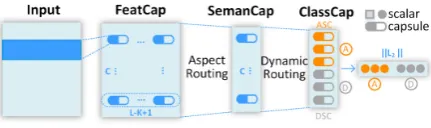
The architecture of TransCap is shown in Figure1. It consists of four layers: 1) Input layer converts words in a sentence into low-dimensional real-valued vectors, 2) FeatCap layer extracts N-gram features from word vectors and transforms them into feature capsules, 3) SemanCap layer aggre-gates feature capsules into a set of aspect-related sentence-level semantic capsules, and 4) ClassCap layer generates class capsules which correspond to sentiment polarities inTAandTD, respectively.
[image:3.595.311.527.65.129.2]Note that TAandTD tasks share the first three layers, and they separate only in the last ClassCap layer. SinceTAandTD are related tasks both aim-ing to identify the sentiment polarity, features use-ful for one task might be useuse-ful for the other. We expect the features produced by the shared layers can be improved in a mutual way.
Figure 1: TransCap Architecture.
3.3 Input Layer
The input layer consists of two lookup layers. Let
Ew∈Rdw×|V|be the pre-trained word embedding
lookup table, wheredw is the dimension of word vectors and|V|is the vocabulary size. The word lookup layer maps the word sequence inS(D)to a list of word vectors{e1, ...,ea, ...,eL} ∈Rdw×L.
Following (Gu et al.,2018), we also use another position lookup layer. ForTA, by calculating the absolute distance from every context word wi to aspect wordwa, we can get an additional position sequence forS. ForTD, the position sequence is a zero sequence since there is no aspect informa-tion. LetEl ∈Rdl×|L|be the position embedding
lookup table with random initialization, the posi-tion lookup layer maps the posiposi-tion sequence to a list of position vectors{l1, ...,la, ...,lL} ∈Rdl×L.
The final representation of each wordwi is cal-culated as xi = (ei ⊕li) ∈ Rdh where ⊕
de-notes concatenation anddh =dw+dl. The sen-tenceS(D)is transformed into a sentence embed-dingX={x1, ...,xL} ∈Rdh×L.
3.4 Feature Capsule Layer
This layer is used to extract n-gram features from sentence embedding X. N-gram features contain raw and local semantic meaning in a fixed window. We apply multiple convolution operations to thei -th n-gram inXand get its feature vectorri:
ri=Xi:i+K∗F+b, (1)
where F ∈ Rdp×(dh×K) is the kernel group,
(dh×K) is the size of one convolutional kernel,
K is the n-gram size anddp is the dimension of one feature capsule. After slidingFinX, we get a set of feature capsulesr∈Rdp×(L−K+1)
encap-sulating n-gram features extracted from the whole sentenceS(D).
Since one kernel group F corresponds to one category of semantic meaning, we repeat the above procedure C times with different kernel groups, and get multiple channels of feature cap-sules representingCcategories of semantic mean-ing. The final output of feature capsule layer is arranged asR∈RC×dp×(L−K+1):
3.5 Semantic Capsule Layer
Aspect Routing Approach The sentence or document in two corpora CA and CD differs
in whether an aspect term occurs in the sen-tence/document. The TD task does not contain aspects. Meanwhile, it is crucial for theTA task to determine the relation between contexts and as-pects. Especially when a sentence contains two opposite sentiment polarities, different contexts must be separated for different aspects. For exam-ple, given a sentence“Great food but the service is dreadful !”, the context word “dreadful” should be strengthened for the aspect “service” and be weak-ened for the aspect “food”.
To this end, we propose a novel aspect rout-ingapproach to compute the aspect weight for the context words ofK-size window inTA. Formally, we apply a fusing convolution operation to the sentence embeddingXwith a kernelFa∈Rdh×K,
and we get the aspect routing weightai:
ai=sigmoid(Xi:i+K∗Fa+Taea+ba), (3)
whereeais the aspect embedding (or average
em-bedding in the case of multi-word aspect), Ta ∈
R1×dw is a transfer matrix to map ea to a scalar
value, andbais bias. The generated routing weight
ai ∈ [0,1] fuses aspect information with respect to its context. It controls how much information in the current context can be transmitted to the next layer. Ifai is zero, the feature capsule would be totally blocked.
A minor challenge is that, for aTDtask, there is actually no aspect in the document and we need to distinguish two types of sources fromCAandCD. Hence we design a piecewise functiongifor calcu-lating the aspect routing weightgifor an arbitrary feature vectorrifromXas:
gi=
(
ai X∈ CA
1.0 X∈ CD
(4)
After sliding inX, we can get g ∈ R1×(L−K+1) for the whole sentence S(D). Since we have C
channels of feature capsules, we repeat the above procedureCtimes to get the entire aspect routing weightsG∈RC×1×(L−K+1)as:
G= [g1,g2, ...,gC], (5)
Finally, the feature capsules are routed using these weights:
P=RG, (6)
where P ∈ RC×dp×(L−K+1) are the
aspect-customized feature capsules, and denotes element-wise multiplication (with broadcasting).
Semantic Capsule Generation The above gen-erated P are transformed from the n-gram fea-ture capsules. Though encoding aspect-related information, P are still local features without a sentence-level view. Moreover, the large num-ber of capsules in P may prevent the next layer from learning robust representations. Hence we adopt the element-wise maximum function (Lai et al.,2015) inPto aggregate all feature capsules in same channel horizontally.
U=Cmax×dp
t=1 Pt, (7)
whereU∈RC×dpare the generated semantic
cap-sules. Eq. 7 condenses all local features in each channel and thus we can obtain more precise and global semantic representations from subtle ex-pressions, e.g., an euphemistic sentence. Finally, we want the length of each semantic capsuleuito
represent the probability thatui’s semantic
mean-ing is present in the current input, so we use a non-linear “squash” function (Sabour et al., 2017) to limit its length in [0,1] as
ui←
kuik2
1 +kuik2
ui
kuik
(8)
3.6 Class Capsule Layer
In the original capsule network, there is only one classification task and it uses class capsules to denote classes and their lengths as classification probabilities. However, there are two different tasks in our problem, and it is necessary to dis-cern sentiment polarities (classes) in these tasks. To achieve this, we introduce two types of class capsules into TransCap, with six capsules in total. Such a structure makes it possible for our model to trainTAandTDin a unified framework.
Given input data from two tasks in turn, the first three layers share most parameters (except those in Eq.3) to jointly trainTDandTA, so that knowl-edge from document-level data can be success-fully transferred into aspect-level task. In the last layer, each class capsule is used for calculating the classification probability of each class inTD and
TA separately. Hence each class capsule should have its own routing weights to adaptively aggre-gate semantic capsules from the previous layer. Below we give the detail.
A semantic capsule i generates a “prediction vector”uˆj|itowards a class capsulejas:
ˆ
uj|i=Wijui, (9)
dc are the dimensions of semantic capsule i and class capsule j, ui is the vector representation of
semantic capsulei. All “prediction vectors” gen-erated by semantic capsules are summed up with weightscij to obtain the vector representationsj
of class capsulej:
sj=
X
icijuˆj|i, (10)
where cij is a coupling coefficient defined by a “routing softmax”:
cij=
exp(bij)
P
kexp(bik)
, (11)
where each bij is the log prior probability that a semantic capsuleishould pass to a class capsulej. It is computed using adynamic routingapproach which will be presented later.
After that, we again apply the non-linear “squash” function (Sabour et al., 2017) to sj in
Eq. 10 to get a final representation vj for class
capsulej.
vj=squash(sj), (12)
where the length ofvj is limited in [0,1] to
repre-sent the active probability of class capsulej.
Dynamic Routing Approach The logit bij in Eq.11 determines the intensity of the connection between the semantic capsuleiand the class cap-sulej. It is initialized with 0 and is updated with an agreement coefficientaij.
aij=uˆj|i·vj (13)
This agreement coefficient is added to the initial logit bij before computing the new values for all coupling coefficientscij linking semantic capsules to class capsules.
bij←bij+aij (14)
The dynamic routing procedure can be summa-rized as (Eq.11→10→12→13→14). The pro-cedure can be repeated forriterations.
3.7 Margin Loss
The length of a class capsule is used to represent the probability of the sentiment polarity. The cap-sule length of the active class should be larger than others. Hence we adopt a separate margin lossLj for each class capsulejin each task:
Lj =Yjmax(0, m+− kvjk) 2
+λ(1−Yj)max(0,kvjk −m−)2,
(15)
where Yj=1 if the sentiment polarity is present in class capsule j, and we simply set m+=0.9,
m−=0.1,λ=0.5 following those in (Sabour et al., 2017). The loss for a single task isLT =PJ
j=1Lj,
whereTis eitherAorD, denoting the lossLAand
LDfor taskTAandTD, respectively. The final loss
Lfor our TransCap model is the linear combina-tion of two losses on single tasks.
L=LA+γLD (16)
where γ ∈[0,1] is a hyper-parameter controlling the weight of TD. When training converges, the class capsule with the largest active probability in a task is chosen as the prediction of sentiment po-larities.
4 Experiments
4.1 Datasets and Settings
Datasets for TA We evaluate TransCap on two aspect-level datasets from SemEval2014 Task 4 (Pontiki et al., 2014). The datasets contain re-views from Restaurant and Laptop domains re-spectively with 3-way sentiment polarity labels: positive, neutral and negative 1. Both datasets have a fixed training/test split. We further ran-domly sample 20% training data as the develop-ment set, and use the remaining 80% for training.
Datasets for TD We use three document-level datasets to transfer knowledge: Yelp,Amazonand Twitter. All the documents (reviews) in Yelp Re-view (Zhang et al.,2015) and Amazon Electronics (McAuley et al.,2015) datasets have accompany-ing five-star rataccompany-ings (1..5). We consider reviews with a score<3 asnegative, =3 asneutraland>3 aspositive. TheTwitterdataset is collected from SemEval 2013 to 2017, where the original tweets are already labeled with 3-way polarities. Each dataset forTD contains 30,000 samples with bal-anced class labels. All samples in these datasets are used for auxiliary training. We do not report performance for theTDtask since it is not our fo-cus.
Also note that the first two datasets in TD are of the same topics as those inTA, while the top-ics in Twitter are more general and less relevant to our main task TA. There are two combina-tions for TransCap: {Y,A} denotes {Res.+Yelp, Lap.+Amazon}, {T,T} denotes {Res.+Twitter, Lap.+Twitter}. By doing so, we wish to investi-gate how our proposed model performs on various types of auxiliary information. The statistics for these datasets are summarized in Table1.
1We remove samples with
Task Dataset Type Pos. Neu. Neg.
TA
Restaurant train 2164 633 805
test 728 196 196
Laptop train 987 460 866
test 341 169 128
TD
Yelp train 10k 10k 10k
Amazon train 10k 10k 10k
[image:6.595.307.525.63.273.2]Twitter train 10k 10k 10k
Table 1: The statistics for datasets.
Settings We use Glove vectors with 840B to-kens (Pennington et al.,2014) as the pre-trained word embeddings. r=3 following Sabour et al. (2017). The rest of hyperparameters are tuned on the development set. We setdw=300,dl=100,
K=3, C=16, dp=16, dc=24. γ={0.7, 0.8, 0.8, 0.3} for the{R,Y},{R,T},{L,A}, {L,T}dataset combinations, respectively. We use Adam opti-mizer (Kingma and Ba, 2014) with learning rate 0.001 and batch size 128. We train all models for 50 epochs with early-stopping, i.e., stop training if the performance on the development set does not improve among 5 epochs. The averaged accuracy (Acc.) and Macro-F1 (F1) scores are reported over 5 runs with random initialization on the same split of evaluation datasets2.
Compared Methods To demonstrate the su-periority of our TransCap for ASC tasks, we compare it with followings baselines: ATAE-LSTM (Wang et al., 2016b), IAN (Ma et al., 2017), AF-LSTM(CONV) (Tay et al.,2018), AF-LSTM(CORR) (Tay et al., 2018), PBAN (Gu et al.,2018), MemNN (Tang et al., 2016), RAM (Chen et al., 2017), CEA (Yang et al., 2018a), DAuM (Zhu and Qian,2018), IARM (Majumder et al.,2018), PRET+MULT (He et al.,2018) and GCAE (Xue and Li, 2018). Most of them are the latest methods published in 2018. The rest are frequently-used classical models.
4.2 Main Results
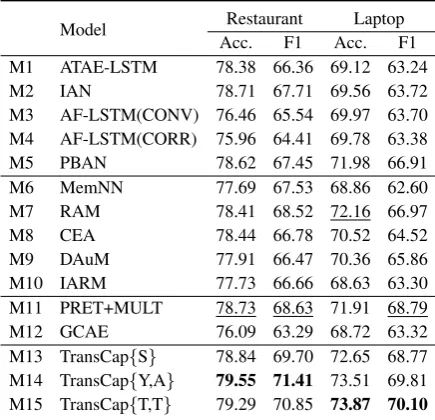
The comparison results for all models are shown in Table2. For clarity, we classify the models into four categories: the first is the LSTM-based meth-ods (from M1 to M5), the second is the memory-based ones (from M6 to M10), the third is the hybrid ones (M11 and M12), and the last three lines (M13 to M15) are the variants of our model, where TransCap{S}denotes the one withTAtask only, TransCap{Y,A} and TransCap{T,T}utilize the knowledge from different sources inTD.
2Our code and data are available at https://github.com/
NLPWM-WHU/TransCap.
Model Restaurant Laptop
Acc. F1 Acc. F1
M1 ATAE-LSTM 78.38 66.36 69.12 63.24
M2 IAN 78.71 67.71 69.56 63.72
M3 AF-LSTM(CONV) 76.46 65.54 69.97 63.70 M4 AF-LSTM(CORR) 75.96 64.41 69.78 63.38
M5 PBAN 78.62 67.45 71.98 66.91
M6 MemNN 77.69 67.53 68.86 62.60
M7 RAM 78.41 68.52 72.16 66.97
M8 CEA 78.44 66.78 70.52 64.52
M9 DAuM 77.91 66.47 70.36 65.86
M10 IARM 77.73 66.66 68.63 63.30
M11 PRET+MULT 78.73 68.63 71.91 68.79
M12 GCAE 76.09 63.29 68.72 63.32
M13 TransCap{S} 78.84 69.70 72.65 68.77 M14 TransCap{Y,A} 79.55 71.41 73.51 69.81 M15 TransCap{T,T} 79.29 70.85 73.87 70.10
Table 2: Comparison of different methods. Best scores are in bold, and the second best ones (except those in our variants) are underlined.
It is clear that our TransCap model consistently outperforms all baselines on both datasets. The hybrid model PRET+MULT, which is a multi-task learning based model, also has the overall better performance than other baselines. Both these demonstrate that the aspect-level sentiment classification task TA can benefit a lot by trans-ferring knowledge from the auxiliary task TD. PRET+MULT is inferior to our model. The reason is that it only shares low-level features and trans-fers limited knowledge between tasks.
We also find that two multi-task variants of our model, TransCap{Y,A} and TransCap{T,T}, achieve similar performance. {Y,A} provides knowledge from relevant domains, but their la-bels are not very accurate since they may contain a lot of noises. Though the knowledge in {T,T}
are from tweets of mixed and less relevant top-ics, their labels are manually-annotated and thus are quite reliable. Overall, given the sufficient number of training samples in the auxiliary task
TD, the performance of TA tasks can be signif-icantly enhanced over its single task counterpart TransCap{S}.
5 Analysis
5.1 Ablation Study
To investigate the effects of different components in our model, we conduct the following ablation study on TransCap. (i)“- A”: We remove the as-pect routing approach, and set same weights 1.0 for all feature capsules. (ii)“- S”: We remove se-mantic capsules, and pass weighted feature cap-sules directly to class capcap-sules. (iii)“- D”: We re-move the dynamic routing approach, i.e., a seman-tic capsule would be coupled to all class capsules with equal probabilities.
Results for the ablation study are shown in Ta-ble3, where “Ori.” denotes results for the original TransCap model, and “-*” for those removing the corresponding components.
Restaurant Laptop
{Y,A} {T,T} {Y,A} {T,T}
[image:7.595.310.523.56.135.2]Acc. F1 Acc. F1 Acc. F1 Acc. F1 Ori. 79.55 71.41 79.29 70.85 73.51 69.81 73.87 70.10 - A. 3.75↓6.49↓2.63↓3.95↓2.98↓5.34↓3.34↓3.80↓ - S.4.01↓5.14↓1.45↓2.08↓2.35↓3.64↓2.40↓2.15↓ - D. 2.80↓4.06↓0.54↓1.01↓3.29↓6.03↓1.14↓1.75↓
Table 3: Ablation study for TransCap. ↓denotes the drop of performance. The worst scores are in bold.
As expected, results for the simplified mod-els all drop a lot. This clearly demonstrates the effectiveness of these components. Specifically, TransCap-A performs the worst, since it cannot generate aspect-related feature capsules after re-moving aspect routing from TransCap. Dynamic routing is critical as it helps TransCap to reduce the interference between TA and TD. The drop of performance of TransCap-S also shows that se-mantic capsules are important for building robust and precise connections between features and po-larities.
5.2 Parameter Analysis
Influence of Auxiliary Corpus Size To show the influence of DSC task on our major ASC task, we vary the size of auxiliary document-level cor-pus CD and observe the performance changes in
TA. We use a percentage ∈ [0,1]to control the ratio ofCD and present results in Figure2.
As can be seen, all curves in Figure 2 tend to rise with the increasing amount of document-level knowledge. This shows the effectiveness of our model by transferring knowledge from document-level data. At the initial stages where only 20%
Figure 2: Influence ofCDsize.
or 40% of CD are introduced, we find small de-creases of performance. The reason may be that when the auxiliary document-level corpus CD is small, the model inTD has not been well trained. Hence it provides limited transferable knowledge to train the shared input, feature capsule and se-mantic capsule layers. Consequently, ASC task
TAgets misleading information from these layers and then performs worse. After getting sufficient document-level data,TD becomes robust and sta-ble, andTAalso improves its performance.
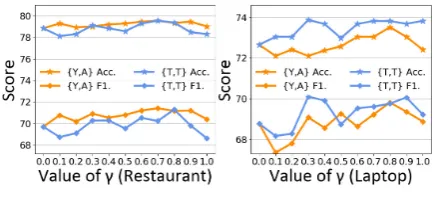
Effects of Balance Factorγ The balance factor
γ determines how important the DSC taskTD is in the model. To evaluate its effects, we varyγ in range [0,1] and present results in Figure3.
Figure 3: Effects ofγ.
The key observation from Figure3is that there are Turning Points (denoted as TP) for both two datasets: TP≈0.7 forRestaurantand TP≈0.3 for Laptop. The curves have an overall upward trend whenγ <TP, but become flat or downward once
γ >TP. This phenomenon can be explained with multi-task learning mechanism. In upward part, lots of useful sentiment knowledge is transferred from document-level data to aspect-level data, thus the performance ofTAgets improved. Once the weight forTD exceeds TP,TD begins to dom-inate the whole TransCap model whileTA gradu-ally loses the mastership and performs worse.
5.3 Case Study
To have a close look, we further select three sam-ples from different datasets for a case study.
[image:7.595.307.525.381.480.2]Laptop where the target is enclosed in [] with a subscript denoting its true polarity:
[image:8.595.312.523.159.248.2]1.“It has so much more speed and the [screen]posis very sharp.”
Humans can easily identify thepositivepolarity towards aspect [screen]. However, the single-task variant TransCap{S} and most baselines give a falsenegativeprediction. This is because “sharp” is a multi-polarity word in the training set as the following two examples show:
2.“Once open, the [leading edge]neg is razor sharp.”
3.“[Graphics]pos are clean and sharp, internet interfaces are seamless.”
The training set inLaptopcontains only 8 sam-ples including “sharp” with 5 of them are labeled as negative. It is hard for single-task models to learn a correct meaning for “sharp” with several contradictory samples. Hence they simply con-sider it as anegativetoken due to the superiority of this polarity and make false predictions. How-ever, for TransCap{Y,A}, the auxiliary Amazon dataset contains 294 samples where “sharp” co-occurs with lots of different contexts. With the help of sufficient training samples, three shared layers have learned to recognize the true polar-ity of “sharp” with respect to its contexts, thus the class capsule layer in TransCap{Y,A} finally makes a correct prediction.
Part 2 This part aims to visualize the decision-making process of TransCap with an example fromRestaurantdataset:
4.“Great [food]pos but the [service]neg is dreadful !”.
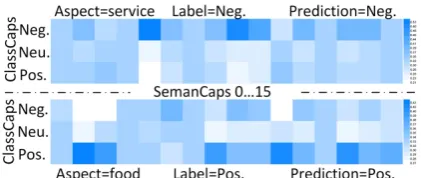
The coupling coefficientscij ∈[0,1] for this ex-ample are visualized in Figure 4, which presents the cij between each pair of (semantic capsule, class capsule) after dynamic routing with respect to different aspects. Note that the sum ofcijin ev-erycolumn(not row as that in the attention mech-anism) is 1.0.
When the input aspect is [service] (the upper part in Figure 4), the detailed decision-making process is as follow. Firstly, several semantic cap-sules such as 4 and 8 have already captured cor-responding sentence-level semantic meaning from the review’s content. Secondly, by calculating the coupling coefficientcij after dynamic routing, these semantic capsules are highly coupled with thenegative class capsule, and thus thisnegative capsule gets a higher active probability than other
class capsules. As a result, TransCap makes the negativeprediction for the aspect [service]. Sim-ilarly, when the input aspect is [food] (the lower part in Figure4), thepositiveclass capsule gets a high active probability and TransCap then makes a correct prediction for this aspect.
Figure 4: Visualization of coupling coefficientscij af-ter dynamic routing.
Part 3 In last part, we present an example from Restaurant to show the advantage of TransCap over PRET+MULT (He et al.,2018):
5.“The [staff]negshould be a bit more friendly.” This is an euphemisticnegativereview towards the aspect [staff] though each word in the sen-tence itself does not convey a negative senti-ment. PRET+MULT generates features and trans-fers knowledge only at the word level. Although embedding for each word is enhanced by the aux-iliary document-level data, PRET+MULT can not recognize the overall negative sentiment behind each word and makes a false positive prediction due to the word “friendly”. In contrast, TransCap generates sentence-level semantic capsules con-taining overall semantic meanings of the sentence, and shares these sentence-level features between ASC and DSC tasks. Both these help TransCap make a correct decision.
6 Conclusion
Acknowledgments
The work described in this paper is supported by the NSFC projects (61572376, 91646206), and the 111 project (B07037).
References
Peng Chen, Zhongqian Sun, Lidong Bing, and Wei Yang. 2017. Recurrent attention network on mem-ory for aspect sentiment analysis. InConference on Empirical Methods in Natural Language Processing (EMNLP 2017).
Li Dong, Furu Wei, Chuanqi Tan, Duyu Tang, Ming Zhou, and Ke Xu. 2014. Adaptive recursive neural network for target-dependent twitter sentiment clas-sification. InAnnual Meeting of the Association for Computational Linguistics (ACL 2014).
Xin Dong and Gerard de Melo. 2018. A helping hand: Transfer learning for deep sentiment analysis. In
Annual Meeting of the Association for Computa-tional Linguistics (ACL 2018).
Jingjing Gong, Xipeng Qiu, Shaojing Wang, and Xuan-jing Huang. 2018. Information aggregation via dy-namic routing for sequence encoding. InConference on Computational Linguistics (COLING 2018).
Shuqin Gu, Lipeng Zhang, Yuexian Hou, and Yin Song. 2018. A position-aware bidirectional atten-tion network for aspect-level sentiment analysis. In
Conference on Computational Linguistics (COLING 2018).
Ruidan He, Wee Sun Lee, Hwee Tou Ng, and Daniel Dahlmeier. 2018. Exploiting document knowledge for aspect-level sentiment classification. InAnnual Meeting of the Association for Computational Lin-guistics (ACL 2018).
Geoffrey E. Hinton, Alex Krizhevsky, and Sida D. Wang. 2011. Transforming auto-encoders. In Inter-national Conference on Artificial Neural Networks (ICANN 2011).
Long Jiang, Mo Yu, Ming Zhou, Xiaohua Liu, and Tiejun Zhao. 2011. Target-dependent twitter senti-ment classification. InAnnual Meeting of the Asso-ciation for Computational Linguistics (ACL 2011).
Diederik P. Kingma and Jimmy Ba. 2014. Adam: A method for stochastic optimization. Computer Sci-ence.
Siwei Lai, Liheng Xu, Kang Liu, and Jun Zhao. 2015. Recurrent convolutional neural networks for text classification. InAAAI Conference on Artificial In-telligence (AAAI 2015).
Xin Li, Lidong Bing, Wai Lam, and Bei Shi. 2018. Transformation networks for target-oriented senti-ment classification. InAnnual Meeting of the Asso-ciation for Computational Linguistics (ACL 2018).
Dehong Ma, Sujian Li, Xiaodong Zhang, and Houfeng Wang. 2017. Interactive attention networks for aspect-level sentiment classification. In Interna-tional Joint Conference on Artificial Intelligence (IJ-CAI 2017).
Yukun Ma, Haiyun Peng, and Erik Cambria. 2018. Targeted aspect-based sentiment analysis via em-bedding commonsense knowledge into an attentive LSTM. In AAAI Conference on Artificial Intelli-gence (AAAI 2018).
Navonil Majumder, Soujanya Poria, Alexander F. Gel-bukh, Md. Shad Akhtar, Erik Cambria, and Asif Ek-bal. 2018. IARM: Inter-aspect relation modeling with memory networks in aspect-based sentiment analysis. In Conference on Empirical Methods in Natural Language Processing (EMNLP 2018).
Julian J. McAuley, Christopher Targett, Qinfeng Shi, and Anton van den Hengel. 2015. Image-based rec-ommendations on styles and substitutes. In Confer-ence on Research and Development in Information Retrieval (SIGIR 2015).
Saif Mohammad, Svetlana Kiritchenko, and Xiao-dan Zhu. 2013. NRC-Canada: Building the state-of-the-art in sentiment analysis of tweets. In
International Workshop on Semantic Evaluation, (SemEval@NAACL-HLT 2013).
Tetsuji Nakagawa, Kentaro Inui, and Sadao Kurohashi. 2010. Dependency tree-based sentiment classifica-tion using CRFs with hidden variables. InAnnual Conference of the North American Chapter of the Association for Computational Linguistics (NAACL 2010).
Sinno Jialin Pan and Qiang Yang. 2010. A survey on transfer learning. IEEE Transactions on Knowledge and Data Engineering.
Jeffrey Pennington, Richard Socher, and Christo-pher D. Manning. 2014. Glove: Global vectors for word representation. In Conference on Empirical Methods in Natural Language Processing (EMNLP 2014).
Maria Pontiki, Dimitris Galanis, John Pavlopoulos, Harris Papageorgiou, Ion Androutsopoulos, and Suresh Manandhar. 2014. SemEval-2014 task 4: Aspect based sentiment analysis. InProceedings of the 8th International Workshop on Semantic Evalu-ation (SemEval 2014).
Sara Sabour, Nicholas Frosst, and Geoffrey E. Hinton. 2017. Dynamic routing between capsules. In Con-ference on Neural Information Processing Systems (NIPS 2017).
Duyu Tang, Bing Qin, and Ting Liu. 2016. Aspect level sentiment classification with deep memory net-work. InConference on Empirical Methods in Nat-ural Language Processing (EMNLP 2016).
Yi Tay, Luu Anh Tuan, and Siu Cheung Hui. 2018. Learning to attend via word-aspect associative fu-sion for aspect-based sentiment analysis. In AAAI Conference on Artificial Intelligence (AAAI 2018).
Duy-Tin Vo and Yue Zhang. 2015. Target dependent twitter sentiment classification with rich automatic features. InInternational Joint Conferences on Ar-tificial Intelligence (IJCAI 2015).
Shuai Wang, Sahisnu Mazumder, Bing Liu, Mianwei Zhou, and Yi Chang. 2018a. Target-sensitive mem-ory networks for aspect sentiment classification. In
Annual Meeting of the Association for Computa-tional Linguistics (ACL 2018).
Wenya Wang, Sinno Jialin Pan, Daniel Dahlmeier, and Xiaokui Xiao. 2016a. Recursive neural conditional random fields for aspect-based sentiment analysis. In Conference on Empirical Methods in Natural Language Processing (EMNLP 2016).
Yequan Wang, Minlie Huang, Xiaoyan Zhu, and Li Zhao. 2016b. Attention-based LSTM for aspect-level sentiment classification. InConference on Em-pirical Methods in Natural Language Processing (EMNLP 2016).
Yequan Wang, Aixin Sun, Jialong Han, Ying Liu, and Xiaoyan Zhu. 2018b. Sentiment analysis by cap-sules. In Conference on World Wide Web (WWW 2018).
Liqiang Xiao, Honglun Zhang, Wenqing Chen, Yongkun Wang, and Yaohui Jin. 2018. MCapsNet: Capsule network for text with multi-task learning. In Conference on Empirical Methods in Natural Language Processing (EMNLP 2018).
Wei Xue and Tao Li. 2018. Aspect based sentiment analysis with gated convolutional networks. In An-nual Meeting of the Association for Computational Linguistics (ACL 2018).
Jun Yang, Runqi Yang, Chongjun Wang, and Junyuan Xie. 2018a. Multi-entity aspect-based sentiment analysis with context, entity and aspect memory. In
AAAI Conference on Artificial Intelligence (AAAI 2018).
Min Yang, Wei Zhao, Jianbo Ye, Zeyang Lei, Zhou Zhao, and Soufei Zhang. 2018b. Investigating cap-sule networks with dynamic routing for text classifi-cation. InConference on Empirical Methods in Nat-ural Language Processing (EMNLP 2018).
Ningyu Zhang, Shumin Deng, Zhanlin Sun, Xi Chen, Wei Zhang, and Huajun Chen. 2018. Attention-based capsule networks with dynamic routing for relation extraction. In Conference on Empirical Methods in Natural Language Processing (EMNLP 2018).
Xiang Zhang, Junbo Jake Zhao, and Yann LeCun. 2015. Character-level convolutional networks for text classification. In Conference on Neural Infor-mation Processing Systems (NIPS 2015).