Liquid-Liquid Extraction of V(IV) from Sulphate
Medium by Cyanex 301 Dissolved in Kerosene
Ranjit Kumar Biswas*, Aneek Krishna Karmakar
Department of Applied Chemistry and Chemical Engineering, Rajshahi University, Rajshahi, Bangladesh Email: *[email protected]
Received November 21, 2012; revised December 20, 2012; accepted January 5, 2013
ABSTRACT
The equilibrium of extraction of V(IV) in the
24
V IV -SO (H+, Na+)-Cyanex 301 (HA)-kerosene system has been
studied. Significant extraction occurs above pH 1 within 10 min. CD (extraction ratio at constant pH
(eq) and [HA](o,eq))
value is slightly decreased with increasing [V(IV)](ini). CD is found to be directly proportional to [H+]−n (n ≤ 2), [HA]2
and ( ). The process is endothermic (H = 16 kJ/mol). Apparent Kex values at 303 K are 10−1.419 and
10−0.94 in 0.10 and 1.50 mol/L medium, respectively. The loading capacity is calculated to be 7.87 g V(IV) per
100 g Cyanex 301. Kerosene appears as the best diluent. Stripping to the extents of 100%, 94% and 97.7% are possible
in single stage by 1 mol/L H2SO4, HCl and HNO3, respectively. Separations of V(IV) from Cu(II) (at pH 0), Zn(II) (at
pH 0.5) and Fe(III) (at pH 1.0) by Cyanex 301 are possible.
2 4
1 1.58 SO
2 4
SO
Keywords: Extraction Equilibrium; Vanadium(IV); Cyanex 301; Kerosene; Sulphate
1. Introduction
Vanadium is widely used to prepare ferro-vanadium and
the oxidative catalyst, V2O5. Almost 90% vanadium is
used to prepare ferro-vanadium (0.1% - 0.3% V) for automobile parts and high speed tools. Besides its use as oxidative catalyst, vanadium compounds are used in ink, dye, paint and varnish, insecticide, photographic chemi- cals, medicine and glass industries [1]. From carnotite
(K2U2V2O11·3H2O), it is extracted with uranium by the
DAPEX process. It is also extracted from vanadinite
(3Pb3(VO4)2·PbCl2). But in the present world, these ores
together with patronite (V2S3) are rare on the earth’s
crust. So to meet up the demand, the processing of low grade ores and waste materials (tar sand, waste desul-
phurization catalyst, waste SO2-oxidation catalyst of
contact process, slag, ash, rock etc.) are desirable. Prior roas- ting and leaching [2,3] followed by solvent extrac-tion is convenient for such purpose. It can build up con-centra- tion by using low organic to aqueous phase ratio (O/A) in ex- traction and high O/A in stripping.
Works published before 1976 on solvent extraction of V(IV) by various extractants have been summarized by Sekine and Hasegawa [4]. D2EHPA is a promising ex- tractant for V(IV) and V(V) [5-11]. Saji and Reddy [12] have reported the extractions of V(IV) and V(V) by
EHEHPA. In the field of solvent extraction, a delayed development is the use of organo-phosphinic compounds (Cyanex reagents) introduced by American Cyanamid and Cytec Canada Inc. Cyanex 302 and Cyanex 301 are mono-and di-sulphide analogues of Cyanex 272 (bis- 2,4,4-trimethylpentylphosphinic acid). The sulphur sub-
stitution decreases the pKa values (6.4, 5.6 and 2.6 for
Cyanex 272 [13], Cyanex 302 [14] and Cyanex 301 [15], respectively) permitting to work at lower pH [16]. Cyanex reagents differ from other commercial organo- phosphorous reagents (e.g. D2EHPA, DDPA, TBP, EHEHPA etc.) in that the former reagents contain P-C bonding, whereas the latter reagents contain P-O-C bonding. The presence of P-C bonding in Cyanex re- agents renders them to be less susceptible to hydrolysis and less soluble in water [17].
In recent past, the extraction behavior of V(IV) from
2 4
SO medium by Cyanex 272 [18,19] and by Cyanex
302 [20] and of V(IV) and V(V) in presence of Mo(VI),
W(VI), U(VI), Ti(IV), Al(III), Cr(III), Fe(III) from Cl
-medium by Cyanex 272 and HA [17] had been reported. There is no report on the equilibrium of the extraction of
V(IV) from 2
4
SO medium by HA. The present paper
reports the extraction characteristics of V(IV) from
2 4
SO medium by HA dissolved in kerosene in order to
determine the effects of various parameters on extraction
ratio and the value of Kex; and also to propose mecha-
nism. The loading of HA by V(IV) and the stripping ability of various mineral acids are also investigated. Finally, the possibilities of separation of V(IV) from
some 3d-block cations in binary mixtures have been ex-
amined.
2. Materials and Methods
2.1. MaterialsCyanex 301 is a product of Cytec Canada Inc. and re-
ceived as a gift. It contains 75% - 83% R2PS2H, 5% - 8%
R3PS, 3% - 6% R2PSOH and ~2% unknown compound
[21] and used without further purification since R3PS and
R2PSOH have the extracting powers too. Kerosene pur-
chased from the local market is distilled (200˚C - 260˚C)
to collect the colorless aliphatic fraction. As-received
NH4VO3 (99%, Riedel-deHaen) and VOSO4·xH2O (99.9%,
Alfa Aesar-Johnson-Mathey), H2O2 (30% (w/v), Merck-
Germany) are used. Analytically pure diluents (besides kerosene) are the products of Riedel-deHaen and E. Merck-India.
2.2. Analytical
The aqueous [V(IV)] has been measured by the HNO3
oxidative-H2O2 method [22] at 450 nm using a UV-visi-
ble Spectrophotometer (UV-1650 PC, Shimadzu, Japan).
For standard and test solution preparations, NH4VO3 and
VOSO4·xH2O, respectively, are used. A Mettler Toledo
pH meter (model MP 220) is used for pH measurement.
2.3. Procedure for Extraction
The procedure for extraction is given elsewhere [20,23]. Two phases are agitated at O/A = 1 (O = 20 mL) and 303 K (otherwise stated) for a predetermined time (15 min). The phase separation is quick; and the aqueous phase
after disengagement is analyzed for its pH(eq) and V(IV)-
content. Then “D” is calculated as usual [20,23].
2.4. Procedure for Loading
The loading procedure is given elsewhere [24]. An ali- quot of 100 mL 0.20 mol/L HA-kerosene solution has been used for V(IV)-loading from an aqueous solution con-
taining 1.0 g/L V(IV) and 0.10 mol/L at pH(ini) =
2.60. After each stage of contact, cumulative [V(IV)](o,eq)
is calculated to monitor the progress of stripping.
2 4
SO
2.5. Procedure for Stripping
The stripping procedure is similar to the extraction pro- cedure. The fully loaded organic solution obtained in the loading study is diluted to contain 200 mg/L V(IV) and 0.10 mol/L HA in kerosene. Vanadium(IV) in this solu-
tion has been stripped by (0.1, 0.3 or 1.0) mol/L (H2SO4,
HCl or HNO3) solution. A shaking time of 1 h is allowed
arbitrarily. After equilibration and phase separation, the aqueous phase is analyzed for its [V(IV)] in order to cal- culate % V(IV) stripped by:
V IV aq,eq V IV (o,ini)
1002.6. Treatment of Extraction Equilibrium Data
R2PS2H is the principal constituent of Cyanex 301. This
species is monomeric in non-polar diluents (owing to low electronegativity of sulphur) [21,25]. Consequently, Cyanex 301 has been abbreviated as HA. In aqueous so-
lution, VO2+ can form complexes with co-existing OH
-and HSO4
or 2 4
SO . On considering the existence of
[VO(OH)jLk] (L is HSO4
or and the charge of
the complex is neglected for simplicity) in the aqueous phase and the monomeric charge-less extracted complex
does not contain any OH- and
4 or 2
4
SO
HSO 2
4
SO , the
equilibrium for its extraction by HA can be represented
as (“x”, “2 − j” and “k” are experimental extractant, pH
and co-existing ligand dependences, respectively):
2
o o
2
VO OH L xHA VOA x 2 HA
L 2 H H O k
j
k j j
(1)
On defining “D” as
2 o
VOA x 2 HA VO OH Lj k
Kex of Equation (1) can be expressed as:
ex eq
o,eq eq
log D log K 2 pH
xlog H A log L
j
k
(2)
The Equation (2) represents the basic equation for sol- vated chelate formation by reaction of a metal ion with an acidic extractant. All concentration terms and pH in Equation (2) refer to the equilibrium values. Although it is difficult to collect D-values experimentally at a con-
stant set of pH(eq), [HA](o,eq) and [ ](eq), it is possible
to modify the experimental D-values to CD values at a
chosen set of constant pH(eq), [HA](o,eq) and [
2 4
SO
2 4
SO]
(eq).
Since in almost all experiments, 0.10 mol/L 2
4
SO (~25
times greater than [V(IV)]) has been used; it can be as-
sumed that [ 2
4
SO ]
(eq) will not be significantly changed
from [ 2
4
SO ](ini). Consequently, after determining the ap-
proximate pH and extractant dependences and rounding
up these values, log CD can be calculated by:
C
eq eq
o, eq
o, ini o, eq
log D
log D 2 constant pH chosen pH exptl.
x log constant HA chosen
log HA x V IV
j
Moreover, [H2A2](o,eq) is equal to
H A2 2
o,ini x V IV
o,eqConsequently, according to Equation (2), log CD
should be independent of [V(IV)] if the solutions behave
ideally; while it should depend on pH(eq), [HA](eq) or [L]
at a constant set of other parameters. Moreover, as Kex is
related to temperature by Van’t Hoff equation, log CD
will also depend on temperature.
3. Results and Discussion
3.1. Extraction EquilibriumSome preliminary experiments indicate that V(IV) is extractable by HA at pH ~ 0.50. When 0.20 g/L V(IV)
containing 0.10 mol/L at pH(ini) of 2.30 is ex-
tracted by 0.10 mol/L HA in kerosene at 303 K and O/A
= 1, then it is found that [V(IV)](o) is increased up to
phase contact of 10 min. It is therefore concluded that the equilibration time is 10 min (15 min is allowed in subse- quent experiments).
2 4
SO
Variation of “D” with [V(IV)](ini) is found out at four
different set of experimental parameters. It is found in all
cases that [V(IV)](o) is increased, but ‘D’ is decreased
continuously with increasing [V(IV)](ini) in the aqueous
phase. This is contrary to Equation (2) which is valid at
constant [HA](o,eq) and pH(eq). The observed decreasing
behavior might be due to the non-constancy of [HA](o,eq)
and pH(eq) for various extents of V(IV) extraction. On
calculating log CD (by Equation (3) on considering “2 −
j” = 1.50 at constant pH(eq) of 1.40 or 1.67 at constant
pH(eq) of 1.80 and x = 2.00 for all systems), log CD vs.
log ([V(IV)](ini), mol/L) plots are drawn in Figure 1.
Plots indicate the independency of CD on [V(IV)] at least
up to 300 mg/L. Systems with higher [V(IV] behave non- ideally.
At a constant [HA](o, eq), the plot of log D vs pH(eq)
should be a straight line with slope equaling to “2 −j” (cf.
Equation (2)). For low [ ] of 0.10 mol/L, Figure 2
represents log CD vs pH
(eq) plots at constant [HA](o,eq) of
0.20 and 0.30 mol/L. In both cases, straight lines are not
obtained. Three or four points at lpHr produce straight
lines of slope 2. At hpHr, the slope is decreased gradu-
ally and at pH 2.15, it becomes 1.6. It is concluded that
single type of extractable species is formed from two
different types of aqueous V(IV) species, viz. VO2+ and
VO(OH)+. In the first case, two H+ are liberated; whereas,
in the second case, one H+ is liberated, per V(IV) being
extracted into the organic phase. As an evidence to this statement, the formation of same extractable species
from VO2+, VO(OH)+ and VO(OH)
2 by D2EHPA may be
cited [5]. The effect of pH on extraction at hcr of [
2 4
SO
2 4
SO]
(1.50 mol/L) has also been investigated (cf. Figure 2). A
-3.0 -2.5 -2.0 -1.5
-0.5 0.0 0.5 1.0 1.5
log {[V(IV)](ini), mol/L}
lo
g
[image:3.595.321.527.88.246.2]CD
Figure 1. Effect of [V(IV)] on its extraction. Temp. = 303 K, [ ] = 0.10 mol/L, Equilibration time = 15 min, O/A = 1 (O = 20 mL). (), pH(ini) = 1.52, constant pH(eq) chosen = 1.4,
[HA](o,ini) = 0.30 mol/L = [HA](o,eq); (), pH(ini) = 1.52, , con-
stant pH(eq) chosen = 1.42, [HA](o,ini) = 0.20 mol/L = [HA](o,eq);
(), pH(ini) = 1.90, constant pH(eq) chosen = 1.78, [HA](o,ini) =
0.30 mol/L = [HA](o,eq); and (), pH(ini) = 1.90, constant
pH(eq) chosen = 1.78 [HA](o,ini) = 0.20 mol/L = [HA](o,eq). 2
4
SO
-0 1 2 3 4 5
-2 -1 0 1 2
31.0 1.5 2.0 2.5
-0.5 0.0 0.5 1.0 1.5 2.0
pH(eq)
S = 2.12, I = -2.50
S = 1.72, I = -2.50
lo
g
C D
lo
g
C D
S = 2.05, I = -2.65
pH(eq)
Figure 2. Effect of pH(eq) on extraction. [V(IV)](ini) = 200
mg/L. (), [HA](o,ini) = 0.30 mol/L = [HA](o,eq); (), [HA](o,ini)
= 0.20 mol/L = [HA](o,eq); (), [ ] = 1.50 mol/L,
[image:3.595.321.525.357.517.2][HA](o,ini) = 0.15 mol/L= [HA](o,eq). Other parameters are as in
Figure 1.
2 4
SO
-straight line having slope of 1.72 is obtained. It is there- fore concluded that the pH dependency in the present
system depends on [ 2
4
SO ]. As [ ] is increased, pH
dependency is decreased.
2 4
SO
According to Equation (2), the plot of log CD vs. log
[HA](o, eq) at a constant pH(eq) should be a straight line
with slope giving moles of HA(x) associated with 1 mol
of V(IV) in extracted species. The log D vs log [HA](o, ini)
plots (as there will be a very little variation between pH(ini) and pH(eq) and between [HA](o, ini) and [HA](o, eq))
are shown in Figure 3. Straight lines having slope of 2
are indeed obtained at both lcr and hcr of SO24
-2.0 -1.5 -1.0 -0.5 0.0 -2.0 -1.5 -1.0 -0.5 0.0 0.5 1.0 1.5 2.0
log {[HA](o, ini), mol/L}
lo
g D
[image:4.595.63.288.77.261.2](), S = 2.00, I = 2.22 (), S = 2.00, I = 1.65 (), S = 1.97, I = 2.07
Figure 3. Effect of [HA](o,eq) on extraction. (), pH(ini) = 2.00;
(), pH(ini) = 1.50; (), pH(ini) = 1.40, [ ] = 1.50 mol/L.
Other parameters are as in Figure 1.
2 4
SO
-therefore concluded that the HA-dependency is always 2
irrespective of [ ], though the pH-dependency is
dependent of [SO ].
2 4
SO
2 4
[image:4.595.313.535.86.266.2] [image:4.595.310.536.439.617.2]The log CD vs log ([ ], mol/L) plot is displayed in
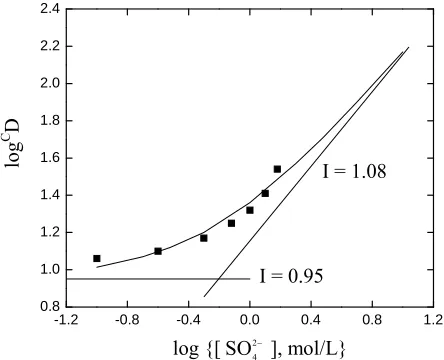
Figure 4. Experimental points fall on a curve. In lcr of
, CD is seldom changed; whilst in the
hcr, it is con-
siderably increased with increasing [ ]. The curve in
the figure is theoretical and represented by:
2 4 SO 2 4 SO 2 4 SO
C 4log D 0.95 log 1 1.58 SO 2 (4)
which is obtained to fit experimental points as de-
scribed in the caption of Figure 4. It is seen that [ 2
4
SO] has little effect on extraction when its concentration is
kept ~0.10 mol/L; but at hcr of [ ], log CD is almost
directly proportional to log [SO ].
2 4 SO 2 4
The Van’t Hoff plots are shown in Figure 5. It is
found that CD is increased with increasing temperature
and the straight line relationship holds. Slopes of the
lines are −870 (H = 16.70 kJ/mol) and −830 (H =
15.95 kJ/mol) for pH = 1.35 and 1.25 systems, respect- tively. Therefore, the process is endothermic with low H value of ~16 kJ/mol.
It is evident from these studies that the value of “x” is 2 irrespective of the experimental parameter but the value of “k” is 0 at low [SO24
] and −1 at high [ 2
4
SO ].
The value of “2 − j” is 2 in low pH(eq) and <2 in high
pH(eq). At lcr of and at lpH(eq)r, “2 − j” = 2
im-plies that “j” = 0; but at hpH(eq)r, “2 − j” < 2 (but >1)
implies that 1 < j < 2. On the other hand, at hcr of SO4
2-and at both lpH(eq)r and hpH(eq)r, “2 −j” < 2 implies j > 0.
2 4
SO
3.2. Evaluation of Extraction Equilibrium Constant
The foregoing results give the equation for logCD at 303
-1.2 -0.8 -0.4 0.0 0.4 0.8 1.2
0.8 1.0 1.2 1.4 1.6 1.8 2.0 2.2 2.4
log {[ 2
4
SO ], mol/L}
log
C D
I = 0.95 I = 1.08
Figure 4. Effect of [ ] on extraction. pH(ini) = 2.00 =
pH(eq), [HA](o,ini) = 0.225 mol/L = [HA](o,eq). Other
parame-ters are as in Figure 1. Experimental points fall on a curve represented by: logCD = constant + log(1 + ]).
The curve possesses two asymptotes: at lcr of : logCD = constant (represented by horizontal line) and at hcr of
: logCD = constant + log + log[ ]
(repre-sented by inclined line). At the point of intersection of two asymptotes: log + log[ ] = 0; or, log
−log[ ] = −(−0.20) = 0.20; or, log = 1.58. Intercept of asymptote at hcr is 1.08 and that at lcr is 0.95.
2 4 SO -4 4 SO K [ 2 4 SO -2 4 SO -2 4 SO -4 SO K = 2 4 SO -4 SO K 2 4 SO -SO K 2 4 SO -4 SO K
3.10 3.15 3.20 3.25 3.30 3.35 3.40 3.45
-0.2 -0.1 0.0 0.1 0.2 0.3 0.4 0.5 0.6
(1/T) 103, K-1
lo
g
CD
(), S = −0.87, I = 3.18; H = 16.70 kJ/mol (), S = −0.83, I = 2.71; H = 15.95 kJ/mol
Figure 5. Effect of temperature on extraction. (), pH(ini) =
1.35, [HA](o,ini) = 0.30 mol/L = [HA](o,ini); (), pH(ini) = 1.25,
[HA](ini) = 0.20 mol/L = [HA](o,ini). Other parameters are as
in Figure 1.
K in lcr of sulphate as:
C
ex eq o, eq
2 4
log D log K 2 pH 2 log HA
log 1 1.58 SO
Based on Equation (5), value of log Kex has been
evaluated from intercepts of the straight lines or asymp-
totic lines in Figures (2)-(4) and tabulated (Table 1).
The average log Kex is −1.419 at lcr of with stand.
dev. of 0.105. Besides, log CD at 303 K in hcr of
2 4
SO
2 4
SO
can be put as:
C
ex eq o, eq
2 4
log D log K 1.72 pH 2 log HA
log 1.58 log SO
(6)
On using Equation (6), log Kex is evaluated as −0.94
with stand. dev. of 0.026.
3.3. Extraction Mechanism
The empirical equation for Kex at 303 K is:
o1.42 ex
1
2 2
4 o
2
K 10
V IV H 1 1.58 SO
V IV HA
(7)
The 1st and 2nd ionization constants of H2SO4 are 103
[26] and 10−2 [27], respectively. These values suggest
that 2 will be more available than 4
4
SO HSO in the
working pH region. So, L in Equation (1) represents
. As the values of “x”, “k”, “l” and “(2 − j)” are
known at different experimental conditions, Equation (1) will provide extraction mechanisms. Although in Equa-tion (1), “L” is presented as a product (liberated during complex formation); experimental results indicate that it is associated with V(IV) during complex formation. As
“x” is always 2, non-solvated chelate (VOA2) is formed
at lcr of , whereas, solvated complex
(VOSO4·2HA) is formed at hcr of . Typical
equi-libria are suggested as:
2 4
SO
SO2 4
2 4
SO
1) in lcr of SO24 and lpHr:
2
2
o o
VO2 HA VOA 2 H
(8)
2) in lcr of SO24 and hpHr (limiting):
o
2
o 2VO OH 2 HA VOA H O H (9)
3) in hcr of SO24 (limiting):
o4 o
VO2SO22 HA VO SO 2HA
4 (10)
An alternative option of the formation of
[VO·SO4·2HA](o) may be the formation of
[VO(HSO4)(A)·HA](o) with the simultaneous liberation
of a proton. These are only presumptions from the ex- perimental results and not proven by other means.
3.4. Effect of Diluent
In order to determine the effect of diluent on V(IV)-dis- tribution, D-values have been measured when the same
aqueous phase has been extracted separately by 0.10 mol/L HA in different diluents keeping all other para-
metric conditions ([V(IV)] = 200 mg/L, pH(ini) = 2.00 and
[ 2
4
SO] = 0.01 mol/L) identical. It is observed that the
extraction ratio increases in the following order with the
variation of diluent: CHCl3 ( = 4.807; D = 0.42) <
1,2-C2H4Cl2 ( = 10.42; D = 0.54) < C6H4-(CH3)2 ( =
2.26; D = 0.68) < cyclo-C6H12 ( = 2.02; D = 1.31) =
C6H5Cl ( = 5.69; D = 1.31) < C6H5-CH3 ( = 2.385; D =
1.64) < n-C7H16 ( = 1.921; D = 2.08) = C6H6 ( = 2.274;
D = 2.08) < CCl4 ( = 2.228; D = 2.34) < petroleum ben-
zin (D = 3.62) < kerosene ( = 2.00; D = 3.93). The study helps draw the conclusion that kerosene is a very good
diluent followed by petroleum benzin and CCl4 for the
extraction of V(IV) by Cyanex 301. CHCl3, 1,2-C2H4Cl2
and C6H4 (CH3)2 are not recommended. 79.72% V(IV)
extraction in kerosene phase is decreased to only 29.70%
V(IV) extraction in CHCl3 phase.
3.5. Loading of Cyanex 301 with V(IV)
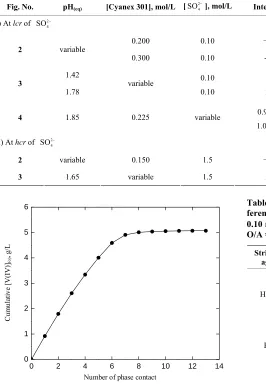
The cumulative [V(IV)](o) (g/L) has been plotted against
the number of phase contact in Figure 6. It is observed
that the loading of V(IV) in the organic phase is ended up
at the 13th contact. An aliquot of 1 L 0.20 mol/L HA is
saturated with 5.07 g V(IV) and so the loading capacity is calculated as 7.87 g V(IV) per 100 g HA. The loading capacity is considerably high, and so it can be recom- mended for a large scale separation of V(IV) from an aqueous solution. The extraction of 5.07 g V(IV)/L by 1 L 0.20 molar HA at saturated loading implies the HA/V(IV) mole ratio of 2.01 which is identical to that obtained from the extractant dependence study. The loading results indicate that the mechanism of extraction at high loading is not changed from that suggested at low loading.
3.6. Stripping of V(IV)-Loaded Organic Phase by Mineral Acids
The maximum V(IV) loaded organic phase containing 5.07 g/L V(IV) with theoretically no free extractant, after
proper dilution and adjustment of free [HA], has been
subjected for stripping by 0.1, 0.3 and 1.0 mol/L H2SO4,
HNO3 and HCl solutions 303 K and O/A = 1. The strip-
ping results are given in Table 2. It is found that strip-
ping percentage is more or less acceptable in all three acids used alone. In all cases, stripping percentage is in- creased with increasing concentration of acid. It is seen
that 71.50% stripping by 0.10 mol/L H2SO4 is increased
to 100% stripping by 1 mol/L H2SO4. Similarly, 45%
stripping by 0.10 mol/L HCl is increased to 94% strip- ping with 1 mol/L HCl; whereas, 78% stripping by 0.10
mol/L HNO3 is increased to ~98% stripping by 1 mol/L
HNO3. Sulphuric acid (1 mol/L) is sufficient to strip off
Table 1. Evaluation of the values of Kex at 303 K.
Fig. No. pH(eq) [Cyanex 301], mol/L [SO24
], mol/L
Intercept, I log Kex Avg. log Kex Stand. dev.
i) At lcr of 2 4
SO
0.200 0.10 −2.65 -1.313
2 variable
0.300 0.10 -2.50 −1.517
1.42 0.10 1.65 −1.253
3
1.78 variable 0.10 2.22 −1.403
0.90 (lcr) −1.504
4 1.85 0.225 variable
1.08 (hcr) −1.523
−1.419 0.105
ii) At hcr of 2 4
SO
2 variable 0.150 1.5 −2.43 −0.958
3 1.65 variable 1.5 2.06 −0.921 −0.940 0.026
0 2 4 6 8 10 12 0
1 2 3 4 5 6
14
Number of phase contact
C
um
ula
tiv
e [
V
(I
V
)](o
)
, g
/L
Table 2. Stripping of V(IV) loaded organic phase using dif- ferent acid solutions. [V(IV)](o) = 200 mg/L, [Cyanex 301] =
0.10 mol/L, Equilibration time = 1 h, Temp. = (303 0.5) K, O/A = 1 (O = 20 mL).
Stripping agent
Acid concentration, mol/L
[V(IV)](aq),
mg/L
% of V(IV) stripped
0.10 140.0 71.5
0.30 190.0 95.0
H2SO4
1.00 200.0 100.0
0.10 90.0 45.0
0.30 170.0 85.0
HCl
1.00 180.0 94.0
0.10 156.0 78.0
0.30 165.6 82.8
HNO3
[image:6.595.47.541.107.468.2]1.00 195.3 97.7
Figure 6. Loading of HA with V(IV). [V(IV)](ini) = 1000 mg/L,
[ ] = 0.10 mol/L, pH(ini) = 2.60, [HA] = 0.20 mol/L, Stage
equilibration time = 15 min, Temp. = 303 K, O/A = 1 (O = 100 mL).
2 4
SO
-3.7. Separation Ability of V(IV) from Some Other Metal Ions
can also be used in stripping if two stage stripping is
practiced. In order to examine the effectiveness of HA towards the
mutual separations of some 3d-block metal ions viz.
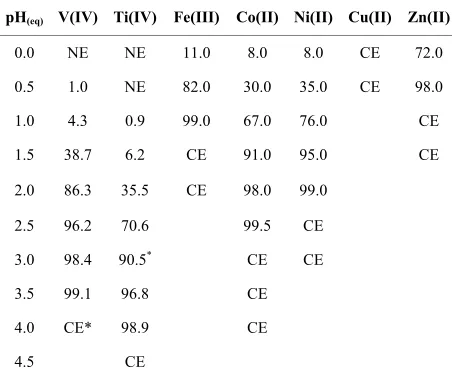
Ti(IV), V(IV), Fe(III), Co(II), Ni(II), Cu(II) and Zn(II), the extraction percentages of these metal ions have been estimated. For this purpose, 0.20 g/L metal ion is ex-
tracted from 0.10 mol/L (or, [ ] = H2SO4
when [H2SO4] > 0.10 mol/L) medium at different pH(eq)
values by 0.10 mol/L HA in kerosene at 303 K and O/A = 1 (O = 20 mL) on equilibration for 1 h. The extraction
results given in Table 3 predict the following:
2 4
SO 2
4
SO
It is reported that Cyanex 302 and Cyanex 301 un- dergo oxidation in oxidizing environment [28-31] (oxida-
tion products being R2(P=S)-S-S-(S=P)R2, R2(P=S)OH
and R2(P=O)OH). It can be demonstrated, however, that
when V(IV) is extracted repeatedly from fresh aqueous
solutions ([V(IV)] = 0.20 g/L, [ ] = 0.10 mol/L,
pH(ini) = 1.50) by 0.30 mol/L HA in kerosene (fresh in the
first step and regenerated afterwards) and stripped sub-
sequently with 1 mol/L H2SO4, then (79 2)% extraction
and 100% stripping are observed from the 1st - 25th ex- traction-stripping steps. It is therefore concluded that HA does not undergo any sort of oxidation as also reported by Sole et al. [32].
2 4
SO
1) V(IV) can be separated from Cu(II) at pH 0 in sin- gle step (0% V(IV) extraction and 100% Cu(II) extrac- tion).
[image:6.595.308.538.350.528.2]Table 3. Solvent extraction data of some 3d-block elements by Cyanex 301 dissolved in kerosene. [Cyanex 301] = 0.10 mol/L (in kerosene); [Metal ion] = 0.20 g/L; [ ] = [H2SO4] or 0.10 mol/L, Temp = 303 K, O/A = 1 (O = 20 mL),
Equilibration time = 1 h.
2 4
SO
-pH(eq) V(IV) Ti(IV) Fe(III) Co(II) Ni(II) Cu(II) Zn(II)
0.0 NE NE 11.0 8.0 8.0 CE 72.0
0.5 1.0 NE 82.0 30.0 35.0 CE 98.0
1.0 4.3 0.9 99.0 67.0 76.0 CE
1.5 38.7 6.2 CE 91.0 95.0 CE
2.0 86.3 35.5 CE 98.0 99.0
2.5 96.2 70.6 99.5 CE
3.0 98.4 90.5* CE CE
3.5 99.1 96.8 CE
4.0 CE* 98.9 CE
4.5 CE
NE: non-extractable, CE: complete extraction; *Aqueous solution becomes cloudy before extraction but becomes clear after extraction.
can be separated from:
Zn(II) at pH ~ 0.5 (1% V(IV) extraction and 98%
Zn(II) extraction),
Fe(III) at pH 1.0 (4.3% V(IV)-extraction and 99%
Fe(III)-extraction),
Co(II) at pH 1.5 (38.7% V(IV)-extraction and 91%
Co(II) extraction), and
Ni(II) at pH 1.5 (38.7% V(IV)-extraction and 95%
Ni(II) extraction).
3) Separation of V(IV) from Ti(IV) is difficult but not impossible. Separation can be achieved at pH 2.0 on us- ing counter-current multistage extraction.
4. Conclusions
The following conclusions are drawn:
1) Vanadium(IV) can be extracted by HA at pH above 1. The equilibration time 10 min. Up to at least 0.30 g/L V(IV), the extraction ratio (D) is independent of V(IV) concentration in the aqueous phase.
2) The corrected extraction ratio (CD) is proportional
to [H+]−2 at its
lcr, [HA]2 and the factor (1 + 1.58
[ ]). The Kex values at 303 K are 10-1.419 and 10−0.94
in 0.10 and 1.50 mol/L medium, respectively.
2 4
SO
2 4
SO
3) The extraction process is endothermic with a H value of 16 kJ/mol.
4) The extracted species are VOA2 at lcr and
VO·HSO4·A·HA or VOSO4 at hcr of SO24 .
5) 100 g HA can extract as much as 7.87 g V(IV). This gives HA/V(IV) mole ratio of 2.01 indicating that the mechanism of extraction is not changed with loading.
6) Among the diluents used, kerosene is the best. The
least effective diluent is CHCl3 followed by 1,2-C2H4Cl2
and xylene.
7) 1 mol/L H2SO4, HCl and HNO3 can strip off 100%,
94% and 97.7% V(IV), respectively, in single step. 8) Using HA as extractant, V(IV) can be separated from Cu(II). It can be separated from Zn(II) at pH 0.5 but for clear-cut separation counter-current 2-3 stage ex- tractions may be required. In a similar way, V(IV) can be separated from Fe(III) at pH 1.
Separations V(IV) from Ti(IV), Co(II) and Ni(II) by HA appear to be difficult.
REFERENCES
[1] S. Prakash, G. D. Tuli, S. K. Banu and R. D. Madan, “Advanced Inorganic Chemistry,” S. Chand and Com- pany Ltd., New Delhi, 1990.
[2] R. K. Biswas, M. Wakihara and M. Taniguchi, “Recovery of Vanadium and Molybdenum from Heavy Oil Desul-phurization Waste Catalyst,” Hydrometallurgy, Vol. 14,
No. 2, 1985, pp. 219-230. doi:10.1016/0304-386X(85)90034-9
[3] C. O. Gomez-Bueno, D. R. Spink and G. L. Rempel, “Ex-traction of Vanadium from Athabasca Tar Sands Fly Ash,” Metallurgical and Materials Transactions B, Vol.
12, No. 2, 1981, pp. 341-352.
[4] T. Sekine and Y. Hasegawa, “Solvent Extraction Chemis-try: Fundamentals and Applications,” Marcel Dekker, Inc., New York, 1977, pp. 564-567.
[5] F. Islam and R. K. Biswas, “The Solvent Extraction of Vanadium(IV) with HDEHP in Benzene and Kerosene: The Solvent Extraction of Vanadium(IV) from Sulphuric Acid Solution with Bis-(2-Ehylhexyl) Phosphoric Acid in Benzene and Kerosene,” Journal of Inorganic and Nu-clear Chemistry, Vol. 42, 1980, pp. 415-420.
doi:10.1016/0022-1902(80)80018-2
[6] F. Islam and R. K. Biswas, “Kinetics of Solvent Extrac-tion of Metal Ions with HDEHP-II: Kinetics and Mecha-nism of Solvent Extraction of V(IV) from Acidic Aque-ous Solutions with Bis-(2-Ethylhexyl)Phosphoric Acid in Benzene” Journal of Inorganic and Nuclear Chemistry,
Vol. 42, No. 3, 1980, pp. 421-429. doi:10.1016/0022-1902(80)80019-4
[7] T. Sato, T. Nakamura and M. Kawamura, “The Extraction of Vanadium(IV) from Hydrochloric Acid Solutions by Di-(2-Ethylhexyl)-Phosphoric Acid,” Journal of Inor-ganic and Nuclear Chemistry, Vol. 40, No. 5, 1978, pp.
853-856. doi:10.1016/0022-1902(78)80164-X
[8] J. P. Brunette, F. Rastegar and M. J. F. Leroy, “Solvent Extraction of Vanadium(V) by Di-(2-Ethylhexyl)-Phos- phoric Acid from Nitric Acid Solutions,” Journal of In- organic and Nuclear Chemistry, Vol. 41, No. 5, 1979, pp.
735-737. doi:10.1016/0022-1902(79)80364-4
Technique,” Hydrometallurgy, Vol. 26, No. 3, 1991, pp.
281-297. doi:10.1016/0304-386X(91)90005-7
[10] R. S. Juang and R. H. Lo, “Stoichiometry of Vana-dium(IV) Extraction from Sulfate Solutions with Di(2- Ethylhexyl) Phosphoric Acid Dissolved in Kerosene,”
Journal of Chemical Engineering of Japan, Vol. 26, No.
2, 1993, pp. 219-222. doi:10.1252/jcej.26.219
[11] R. K. Biswas and M. G. K. Mondal, “Kinetics of VO2+
Extraction by D2EHPA,” Hydrometallurgy, Vol. 69, No.
1-3, 2003, pp. 117-133.
doi:10.1016/S0304-386X(02)00208-6
[12] J. Saji and M. L. P. Reddy, “Solvent Extraction Separa-tion of Vanadium(V) from Multivalent Metal Chloride Solution Using 2-Ethylhexyl Phosphonic Acid Mono-2- Ethylhexyl Ester,” Journal of Chemical Technology and Biotechnology, Vol. 77, No. 10, 2002, pp. 1149-1156. doi:10.1002/jctb.690
[13] J. Saji and M. L. P. Reddy, “Selective Extraction and Separation of Titanium(IV) from Multivalent Metal Chlo- ride Solutions Using 2-Ethylhexyl Phosphonic Acid Mono 2-Ethylhexyl Ester,” Separation Science and Tech-nology, Vol. 38, No. 2, 2003, pp. 427-441.
doi:10.1081/SS-120016583
[14] J. Saji, J. K. Saji and M. L. P. Reddy, “Liquid-Liquid Extraction of Tetravalent Titanium from Acidic Chloride Solutions by Bis(2,4,4-Trimethylpentyl)Phosphinic Acid,”
Solvent Extraction and Ion Exchange, Vol. 18, No. 5, 2000, pp. 877-894. doi:10.1080/07366290008934712 [15] M. Ulewicz and W. Walkowiak, “Selective Removal of
Transition Metal Ions in Transport through Polymer In-clusion Memberances with Organophosphorus Acid,”
Environment Protection Engineering, Vol. 31, No. 3-4, 2005, pp. 74-81.
[16] W. A. Rickelton, “Novel Uses for Thiophosphinic Acids in Solvent Extraction,” Journal of Metals, Vol. 44, No. 5,
1992, pp. 52-54.
[17] A. Saily and S. N. Tandon, “Liquid-Liquid Extraction Behavior of V(IV) Using Phosphinic Acids as Extrac-tants,” Fresenius’ Journal of Analytical Chemistry, Vol. 360, No. 2, 1998, pp. 266-270.
doi:10.1007/s002160050688
[18] P. Zhang, K. Inoue and H. Tsuyama, “Recovery of Mo-lybdenum and Vanadium from Spent Hydrodesulfuriza-tion Catalysts by Means of Liquid-Liquid ExtracHydrodesulfuriza-tion,”
Kagaku KogakuRonbunshu, Vol. 21, No. 1, 1995, pp. 451-
456. doi:10.1252/kakoronbunshu.21.451
[19] P. Zhang, K. Inoue, K. Yoshizuka and H. Tsuyama, “Sol-vent Extraction of Vanadium(IV) from Sulfuric Acid So-lution by Bis(2,4,4-Trimethylpentyl)Phosphinic Acid in Exxsol D80,” Journal of Chemical Engineering of Japan,
Vol. 29, No. 1, 1996, pp. 82-87. doi:10.1252/jcej.29.82 [20] R. K. Biswas and A. K. Karmakar, “Equilibrium of the
Extraction of V(IV) in the V(IV)-SO42-(H+, Na+)- Cyanex
302-Kerosene System,” International Journal of
Nonfer-rous Metallurgy, Vol. 1, 2012, pp. 23-31.
[21] K. C. Sole and J. B. Hiskey, “Solvent Extraction Charac-teristics of Thio Substituted Organophosphinic Acid Ex-tractants,” Hydrometallurgy, Vol. 30, 1992, pp. 345-365. doi:10.1016/0304-386X(92)90093-F
[22] J. Bassett, R. C. Denney, G. H. Jeffery and J. Mendham, “Vogel’s Textbook of Quantitative Inorganic Analysis in-cluding Elementary Instrumental Analysis,” 4th Edition, ELBS and Longman, London, 1979, pp. 752-753. [23] M. R. Ali, R. K. Biswas, S. M. A. Salam, A. Akhter, A. K.
Karmakar and M. H. Ullah, “Cyanex 302: An Extractant for Fe3+ from Chloride Medium,”
Bangladesh Journal of Scientific and Industrial Research, Vol. 46, No. 4, 2011,
pp. 407-414.
[24] R. K. Biswas and D. A. Begum, “Solvent Extraction of Fe(III) from Chloride Solution by D2EHPA in Kero- sene,” Hydrometallurgy, Vol. 50, No. 2, 1998, pp. 153-
168. doi:10.1016/S0304-386X(98)00048-6
[25] E. Paatero, T. Lantto and P. Ernola, “The Effect of Trioc-tylphosphine Oxide on Phase and Extraction Equilibria in Systems Containing Bis(2,4,4-Trimethylpentyl) Phosphi- nic Acid,” Solvent Extraction and Ion Exchange, Vol. 8,
No. 3, 1990, pp. 371-388. doi:10.1080/07366299008918006
[26] E. C. Potterr, “Electrochemical Principles and Applica-tions,” Cleaver House Press, London, 1961, p. 51. [27] R. M. Smith and A. E. Martell, “Critical Stability
Con-stants,” Inorganic Complexes, Vol. 4, Plenum Press, New
York and London, 1976.
[28] N. E. El-Hefny, “Kinetics and Mechanism of Extraction of Cu(II) by Cyanex 302 from Nitrate Medium and Oxi-dative Stripping of Cu(I) using Lewis Cell,” Chemical Engineering and Processing, Vol. 49, No. 12, 2010, pp.
84-90. doi:10.1016/j.cep.2009.11.012
[29] K. C. Sole and J. B. Hiskey, “Solvent Extraction of Cop-per by Cyanex 272, Cyanex 302 and Cyanex 301,” Hy-drometallurgy, Vol. 37, No. 2, 1995, pp. 129-147. doi:10.1016/0304-386X(94)00023-V
[30] A. Bhattacharyya, P. K. Mohapatra and V. K. Manchanda, “Seperation of Americium(III) and Europium(III) from Nitrate Medium Using a Binary Mixture of Cyanex 301 with N-Donor Ligands,” Solvent Extraction and Ion Ex-change, Vol. 24, 2006, pp. 1-17.
doi:10.1080/07366290500388459
[31] B. Menoya, M. P. Elizalde and A. Almela, “Determina-tion of the Degrada“Determina-tion Compounds Formed by the Oxi-dation of Thiophosphinic Acids and Phosphine Sulphides with Nitric Acid,” Analytical Sciences, Vol. 18, 2002, pp.
799-804. doi:10.2116/analsci.18.799
Notations and Abbreviations
H Apparent enthalpy change
Dielectric constant
CD D at a constant pH
(eq) and [HA](o, eq)
D Extraction or distribution ratio
HA Cyanex 301 (monomeric)
hcr Higher concentration region
hpHr Higher pH region
Kex Extraction equilibrium constant
4
SO
K A proportionality constant in sulphate dependence study
L Co-existing anion except OH- in the aqueous phase
lcr Lower concentration region
lpHr Lower pH region
R CH3-C(CH3)2-CH2-CH(CH3)-CH2-
[ ] Sign of complex species
[ ] Sign of concentration
Suffix (o) Organic phase
(ini) Initial
(eq) Equilibrium
![Figure 1. Effect of [V(IV)] on its extraction. Temp. = 303 K, 4-] = 0.10 mol/L, Equilibration time = 15 min, O/A = 1 ), pH(0.30 mol/L = [HA][SO2(O = 20 mL)](https://thumb-us.123doks.com/thumbv2/123dok_us/173918.511624/3.595.321.525.357.517/figure-effect-iv-extraction-temp-mol-equilibration-time.webp)