3952
The K
NOWR
EFCoreference Corpus: Removing Gender and Number
Cues for Difficult Pronominal Anaphora Resolution
Ali Emami*1, Paul Trichelair*1, Adam Trischler2, Kaheer Suleman2, Hannes Schulz2, and Jackie Chi Kit Cheung1
1School of Computer Science, Mila/McGill University 2Microsoft Research Montreal
{ali.emami, paul.trichelair}@mail.mcgill.ca
{adam.trischler, kasulema, hannes.schulz}@microsoft.com [email protected]
Abstract
We introduce a new benchmark for corefer-ence resolution and NLI, KNOWREF, that tar-gets common-sense understanding and world knowledge. Previous coreference resolution tasks can largely be solved by exploiting the number and gender of the antecedents, or have been handcrafted and do not reflect the diver-sity of naturally occurring text. We present a corpus of over 8,000 annotated text pas-sages with ambiguous pronominal anaphora. These instances are both challenging and re-alistic. We show that various coreference systems, whether rule-based, feature-rich, or neural, perform significantly worse on the task than humans, who display high inter-annotator agreement. To explain this perfor-mance gap, we show empirically that state-of-the art models often fail to capture context, in-stead relying on the gender or number of can-didate antecedents to make a decision. We then use problem-specific insights to propose a data-augmentation trick called antecedent switching to alleviate this tendency in mod-els. Finally, we show that antecedent switch-ing yields promisswitch-ing results on other tasks as well: we use it to achieve state-of-the-art re-sults on the GAP coreference task.
1 Introduction
Coreference resolution is one of the best known tasks in Natural Language Processing (NLP). De-spite a large body of work in the area over the last few decades (Morton,2000;Bean and Riloff,
2004;McCallum and Wellner,2005;Rahman and Ng, 2009), the task remains challenging. Many resolution decisions require extensive world knowl-edge and understanding common points of refer-ence (Pradhan et al.,2011). In the case of pronomi-nal anaphora resolution, these forms of “common sense” become much more important when cues
*equal contribution
like gender and number do not by themselves indi-cate the correct resolution (Trichelair et al.,2018). To date, most existing methods for coreference resolution (Raghunathan et al., 2010;Lee et al.,
2011;Durrett et al.,2013;Lee et al.,2017,2018) have been evaluated on a few popular datasets, in-cluding the CoNLL 2011 and 2012 shared corefer-ence resolution tasks (Pradhan et al.,2011,2012). These datasets were proposed as the first compre-hensively tagged and large-scale corpora for coref-erence resolution, to spur progress in state-of-the-art techniques. According to Durrett and Klein
(2013), this progress would contribute in the “up-hill battle” of modelling not just syntax and dis-course, but also semantic compatibility based on world knowledge and context.
Despite improvements in benchmark dataset per-formance, the question of what exactly current sys-tems learn or exploit remains open, particularly with recent neural coreference resolution models.
Lee et al.(2017) note that their model does “little in the uphill battle of making coreference decisions that require world knowledge,” and highlight a few examples in the CoNLL 2012 task that rely on more complex understanding or inference. Because these cases are infrequent in the data, systems can per-form very well on the CoNLL tasks according to standard metrics by exploiting surface cues. High-performing models have also been observed to rely on social stereotypes present in the data, which could unfairly impact their decisions for some de-mographics (Zhao et al.,2018).
There is a recent trend, therefore, to develop more challenging and diverse coreference tasks. Perhaps the most popular of these is the Winograd Schema Challenge (WSC), which has emerged as an alternative to the Turing test (Levesque et al.,
obvious syntactic/semantic cues are ineffective. Previous approaches to common sense reasoning, based on logical formalisms (Bailey et al.,2015) or deep neural models (Liu et al.,2016), have solved only restricted subsets of the WSC with high preci-sion. These shortcomings can in part be attributed to the limited size of the corpus (273 instances), which is a side effect of its hand-crafted nature.
Webster et al.(2018) recently presented a corpus called GAP that consists of about 4,000 unique bi-nary coreference instances from English Wikipedia. This corpus is intended to address gender bias and the mentioned size limitations of the WSC. We be-lieve that gender bias in coreference resolution is part and parcel of a more general problem: current models are unable to abstract away from the enti-ties in the sentence to take advantage of the wider context to make a coreference decision.
To tackle this issue, we present a coreference res-olution corpus called KNOWREFthat specifically targets the ability of systems to reason about a situ-ation described in the context.1 We designed this task to be challenging, large-scale, and based on natural text. The main contributions of this paper are as follows:
1. We develop mechanisms by which we con-struct a human-labeled corpus of 8,724 Winograd-like text samples whose resolution requires significant common sense and back-ground knowledge. As an example:
Marcus is undoubtedly faster than Jarrett right now but in [his] prime the gap wasn’t all that big.(answer: Jarrett)
2. We propose a task-specific metric called con-sistencythat measures the extent to which a model uses the full context (as opposed to a surface cue) to make a coreference decision. We use this metric to analyze the behavior of state-of-the-art methods and demonstrate that they generally under-utilize context informa-tion.
3. We find that a fine-tuned version of the recent large-scale language model, BERT (Devlin et al.,2018), performs significantly better than other methods on KNOWREF, although with
1The corpus, the code to scrape the sentences
from the source texts, as well as the code to repro-duce all of our experimental results are available at https://github.com/aemami1/KnowRef.
substantial room for improvement to match human performance.
4. We demonstrate the benefits of a data-augmentation technique called antecedent switchingin expanding our corpus, further de-terring models from exploiting surface cues, as well as in transferring to models trained on other co-reference tasks like GAP, leading to state-of-the-art results.
2 Related Work
2.1 General coreference resolution
Automated techniques for standard coreference res-olution — that is, the task of correctly partitioning the entities and events that occur in a document into resolution classes — date back to decision trees and hand-written rules (Hobbs,1977;McCarthy,1995). The earliest evaluation corpora were the Message Understanding Conferences (MUC) (Grishman and Sundheim,1996) and the ACE (Doddington et al.,
2004). These focused on noun phrases tagged with coreference information, but were limited in either size or annotation coverage.
The datasets ofPradhan et al.(2011,2012) from the CoNLL-2011 and CoNLL-2012 Shared Tasks were proposed as large-scale corpora with high inter-annotator agreement. They were constructed by restricting the data to coreference phenomena with highly consistent annotations, and were pack-aged with a standard evaluation framework to facil-itate performance comparisons.
The quality of these tasks led to their widespread use and the emergence of many resolution systems, ranging from hand-engineered methods to deep-learning approaches. The multi-pass sieve system ofRaghunathan et al.(2010) is fully deterministic and makes use of mention attributes like gender and number; it maintained the best results on the CoNLL 2011 task for a number of years (Lee et al.,
2011). Later, lexical learning approaches emerged as the new state of the art (Durrett and Klein,2013), followed more recently by neural models ( Wise-man et al.,2016;Clark and Manning,2016). The current state-of-the-art result on the CoNLL 2012 task is by an end-to-end neural model fromLee et al.(2018) that does not rely on a syntactic parser or a hand-engineered mention detector.
2.2 Gender bias in general coreference resolution
methods for coreference resolution become gender-biased, exploiting various stereotypes that leak from society into data. They devise a dataset of 3,160 manually written sentences calledWinoBias that serves both as a gender-bias test for corefer-ence resolution models and as a training set to counter stereotypes in existing corpora (i.e., the two CoNLL tasks). The following example is rep-resentative:
(1) The physician hired the secretary because he was overwhelmed with clients.
(2) The physician hired the secretary because she was overwhelmed with clients.
Experiments conducted on various models demon-strated that an end-to-end neural model (Lee et al.,
2017) maintains its performance without the gen-der bias when trained partially on both the previous datasets and onWinoBias.
A concurrent work by Rudinger et al. (2018) also proposed an empirical study of the biases in coreference resolution systems. In contrast toZhao et al.(2018), who attribute the bias in part to the datasets, they conjecture that the gender bias comes primarily from the models themselves. Based on statistics from the Bureau of Labor, they show that various systems all exhibit significant gender bias. This work on gender stereotypes provides some insight into the behavior of current models. In the example above, ifsheis predicted incorrectly to refer tothe secretary, it is likely because the model learned a representation for the secretary profession that encodes gender information. Current models do not capture the context nor the relation between was overwhelmedandhiredthat lead to the correct resolution. The subject of our work is to investigate the potential for models to capture contextual rela-tionships instead of cues from, e.g., gender stereo-types. Unlike WinoBias, our task is composed of passages that occur naturally in text and it is several times larger.
2.3 Difficult cases in coreference resolution
As the creators of the CoNLL tasks note, most coreference techniques rely primarily on surface-level features, like the proximity between mentions, or shallow semantic features like number, gender, named entities, semantic class, etc., rather than knowledge and context.
To address this,Levesque et al.(2011) manually constructed a dataset of challenging pronoun disam-biguation problems called the Winograd Schema
Challenge. The goal was that any successful system would necessarily use common-sense knowledge. Although the WSC is an important step in evalu-ating systems en route to human-like language un-derstanding, its size and other characteristics are a bottleneck for progress in pronoun disambiguation (Trichelair et al.,2018). A Winograd-like expanded corpus was proposed byRahman and Ng (2012) to address the WSC’s size limitations; however, systems that perform well on the expanded dataset do not transfer successfully to the original WSC (Rahman and Ng,2012;Peng et al.,2015), likely due to loosened constraints in the former.
The task that we propose distinguishes itself from the WSC by building on sentences that occur in natural text. This yields highly diverse problem instances. It is particularly important that, as well as being challenging, tasks are representative of natural text, so that improvements are more likely to transfer to the full coreference setting.
Recently,Webster et al.(2018) presented a cor-pus called GAP that consists of 4,4542unique bi-nary coreference instances from English Wikipedia. It is meant to address gender bias and the described size limitation of the WSC. For instance, it exposes the unbalanced performance of current state-of-the-art resolvers, which more accurately resolve masculine pronouns than feminine pronouns. As for the difficulty of the task, the models tested on GAP were not trained directly on the corpus, which does not give a clear picture of the task’s difficulty. A simple heuristic calledParallelism+URL, which is based on using the syntactic distance between antecedents and the target pronoun, is so far the strongest GAP baseline, at above 70% accuracy. This suggests that GAP is vulnerable to exploits that circumvent a need for knowledge, albeit not the gender and number cues that coreference re-solvers have exploited before. Finally, our corpus construction process differs from that of GAP’s by more strictly requiring that the sentences are in WSC-format, that is, there are exactly two named entities that occur strictly before the pronoun and only one of which may co-refer with the pronoun (in GAP, the pronoun may occur between and be-fore the named entities and may in fact co-refer with both named entities). In addition, our cor-pus construction process exploits the fact that the named entities can be replaced with any name in
or-2In GAP, one unique coreference instance corresponds to
Initial filtering: Clean up raw text and split it
into sentences.
Connective Filtering: Ensure the occurrence of a single connective
in the sentence.
Antecedent Filtering: Use POS information to ensure the occurrence of exactly two NPs before the connective.
Training set (Reddit Comments): Heuristically predict the labels to a filtered set of sentences for which there
is a gender “giveaway”.
Test Set (Wikipedia + OpenSubtitles): Human annotators predict the labels to the collected
sentences.
Quality Control: Human annotators examine collected
sentences
>100 million
sentences >1 million sentences
>100 thousands sentences
8,724 sentences Label
[image:4.595.89.511.61.221.2]Generation
Figure 1: The corpus construction process for KNOWREF
der to increase the task difficulty by automatically removing gender giveaways as well as to signifi-cantly increase the size of the corpus by switching the named entities to create a new task instance.
As such, our paper seeks to explore a wider prob-lem of which gender bias may be one facet: current models do not effectively abstract away from the entities (and instead rely on exploits using gender or plurality) to make the coreference resolution. By developing a benchmark task consisting strictly of sentences for which such cues are ineffective, we seek to challenge and potentially improve current coreference resolution models. In addition, based on our new benchmark, KNOWREF, we introduce a data-augmentation mechanism, calledantecedent switching, to encourage models to perform this ab-straction.
3 The KNOWREFCoreference Task
We develop a coreference task called KNOWREF
that features 8,724 difficult pronoun disambigua-tion problems. Each instance is a short passage containing a target pronoun that must be correctly resolved to one of two possible antecedents.
Formally, each problem instance can be de-scribed as a tupleP = {S, C1, C2, T, K}, where
Sis the sentence,C1andC2are the candidate
an-tecedents,T is the target pronoun to be resolved to one ofC1 andC2, andKindicates the correct
antecedent. Note that C1, C2, T and K appear
in S. KNOWREF provides {S, C1, C2, T} as
in-put for models, which must predictK(e.g., as the output of a binary classification overC1, C2). A
representative sentenceSis the following.
(3) {Paul} helped {Lionel} hide when [he] was pursued by the authorities.
Here, C1 = Paul, C2 = Lionel, T = he, and
K =C2 =Lionel.
We control the text so as not to give away the pronoun’s correct antecedent in surface-level cues involving syntactic salience or the number and gen-der of the antecedent. Successful systems must instead make use of the context, which may require world knowledge and common-sense inferences; i.e., that someone who is being helped to hide may be one who is being pursued by the authorities.
In the following section, we describe the method-ology used to construct our corpus, provide a glimpse of a few of its instances and their resolu-tion raresolu-tionales, outline the task’s evaluaresolu-tion criteria, and describe its characteristics.
3.1 Corpus construction
To construct KNOWREF, we scrape text samples
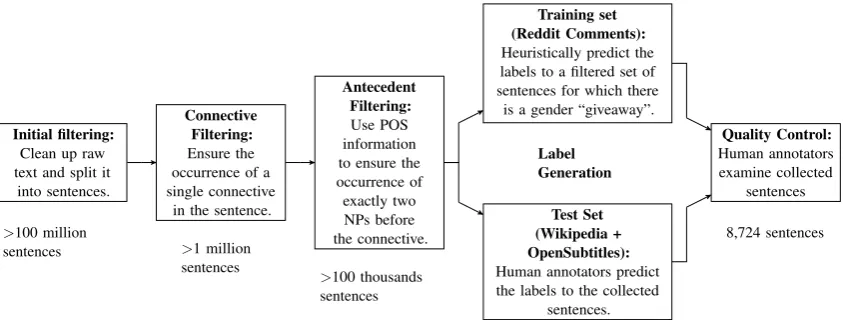
from a large collection of documents: the combi-nation of 2018 English Wikipedia, OpenSubtitles, and Reddit comments dating from 2006–2018. We filter this text through a multi-stage process to en-sure quality and diversity as depicted in Figure1, and described in more detail below.
3.1.1 Initial Filtering
After removing markup, non-ASCII characters, par-enthetical expressions, headings and lists, we split the text into sentences. We keep sentences of token length between 9 and 33 words after na¨ıve tok-enization, which start with an upper case letter, and which contain no math.
3.1.2 Connective Filtering
con-KNOWREFExample 1: {Radu}appeared to be killed by{Brother Paulo}, but [he] reappears a short while later injured, but alive. (K=Radu)
Original sentence: Radu appeared to be killed by Sister Paula, but he reappears a short while later injured, but alive.
KNOWREFExample 2: {Wanda}tries to apologize to{Rose}, but [she] refuses to accept. (K=Rose) Original sentence: Warren tries to apologize to Rose, but she refuses to accept.
[image:5.595.73.527.67.150.2]KNOWREFExample 3: {Tom}arrives to where{Alex}was tied, but [he] has come free of his lead. (K=Alex) Original sentence: Tom arrives to where Vanessa was tied, but she has come free of her lead.
Table 1: Examples of KNOWREFinstances.
tains connectives.3 We use a regular expression to ensure that there is only one connective cluster (e.g. “, and though”), and that there are at least two non-stopwords before this connective and a pro-noun after it. As a final check, we ensure that no pronoun occurs before the connective, which tends to remove sentences which are not self-contained.
3.1.3 Antecedent Filtering
On the remaining set of sentences, we use Stan-ford’s Maxent tagger (Toutanova et al.,2003) to infer a flat part-of-speech (POS) labelling. Using the inferred POS tags, we ensure that there are ex-actly two noun phrases (NPs) before the connective that do not re-occur after it (a re-occurrence after the connective means that the pronoun likely refers to the non-repeated noun phrase).
The mentioned checks resulted in roughly 100,000 sentences across all three corpora. At least some of these remaining sentences have similar properties to Winograd schema sentences; that is, the two noun phrases (NPs) and the pronoun share the same type. From here, we keep only sentences where the type indicates that both NPs correspond to persons, which further filters the remaining sen-tences. We do this because NPs that denote people are often named entities or can easily be replaced by named entities without loss of information. We targeted these instances also because we investigate how resolution systems use gender cues and most gendered pronouns occur with person-type NPs.
3.1.4 Label Generation
We generate our training and test sets from distinct sources of text using two different methods.
Training set: We automatically collect 70,000 sentences from Reddit that have passed the fil-ters described above, and filter these down to roughly 7,500 sentences for which the antecedents are named entities of different genders. We use
3comma, semicolon,or,since,but,because,although, etc.
a Python library4to infer the genders, based on a list of 40,000 names categorized as female or male compiled by J¨org Michael. Given the pronoun and the distinct predicted genders for the antecedents, we can infer the label for the pronoun’s correct res-olution with high accuracy and without the need for expensive human annotation. After assigning this label, we remove the gender giveaway by replac-ing one of the named entities so that both entities and the pronoun all match in gender (e.g., in a sentence with “James”, “Jessica”, and “she” as the NPs and pronoun, we replace “James” with “Jane”). These sentences form our training set. To assess its quality, we gave an annotator a random sample of 100 training instances with their heuristically determined labels. The annotator then evaluated each sentence as “correctly labelled”, “incorrectly labelled”, or “unresolvable” if neither of the two candidates were more suitable than the other to corefer with the pronoun.5 In total, 86% of the in-stances were deemed to be labelled correctly, 11% incorrectly labelled, and 3% were not resolvable, implying that our automatic selection heuristic is strong but imperfect.
Test set: Human annotators examined all col-lected sentences for quality control. We also use a source for the test sentences that is distinct from that of the training set, directing our pipeline to col-lect sentences from Wikipedia and OpenSubtitles rather than Reddit. This is to ensure that stylistic cues common in the training source cannot be ex-ploited by models at test time. In total, roughly 10,000 candidate sentences were extracted initially. As before, we automatically remove gender give-aways by replacing the named entities with names of the same gender, rendering the pronoun ambigu-ous. Then, six human annotators predicted which antecedent was the correct coreferent of the pro-noun for a sample of 2,000 candidate sentences, or
4
https://pypi.org/project/SexMachine/
5The details and result of this quality-testing study will
Sentence Characteristic % of Data
Masculine target pronouns 52.7
Feminine target pronouns 47.3
First Antecedent Correct 50.7
Second Antecedent Correct 49.2
Table 2: Characteristics of the dataset, in terms of pro-noun distribution and correct label.
they labeled the sentence with “neither” (in the case where neither antecedent feasibly corefers with the pronoun) or “unclear” (if the sentence was not in-telligible). Sentences that have a strong agreement from 5 or more annotators on a single antecedent (and which are not labeled as “neither” or “un-clear”) are kept for testing. This yielded 1,269 test sentences. We measured high inter-annotator agreement on the test set with a Fleiss’ Kappa of κ= 0.78.
Our pipeline thus yields a total of 8,724 sen-tences (7,455 training and 1,269 test) whose pro-noun disambiguation should not be clear from shal-low features like gender, number, and semantic type – they should instead require varying degrees of external knowledge. These sentences consti-tute the KNOWREF corpus. Examples of some instances are given in Table1. As these examples reveal, each instance may require a unique bit of common sense knowledge to resolve.
In the first example, the common understanding that death (by way of killing) causes a disappear-ance helps us to conclude that Radu, the victim of murder, is the one to who reappears.
In the next example, human readers recognize that toacceptis something one does with an apol-ogy. Therefore,sherefers to the one that accepts the apology, i.e., Rose.
For the third example, an understanding that be-ing tied is related to being deprived of freedom leads us to conclude that Alex has come free.
3.2 Task Characteristics
In Table2, we report several statistical characteris-tics of the data. These suggest a near-equal distri-bution of feminine and masculine target pronouns (he/him/hisvs.she/her) as well as an equal distri-bution of the two labels, which keeps chance-based performance at 50% expected accuracy.
3.3 Evaluation
Our task requires a model to choose between two candidates, but classical coreference models build clusters of expressions that refer to the same entity. With respect to our setting, several errors can be made by these existing models: predicting that the two entities and the pronoun share a similar clus-ter (Both Antecedents Predicted), that none of the two candidates shares a cluster with the pronoun (No Decision), or creating a cluster that contains the pronoun with the wrong candidate (Incorrect Decision). To obtain a score specific to our task, we compute a Task-Specific Accuracywhich dis-cards all of the cases in which the model makes no decision relevant to the target pronoun or chooses both entities as co-referring to the target pronoun.
4 Experiments and Results
In this section, we compare the performance of five representative coreference systems on our task: Stanford’s rule-based system (Raghunathan et al., 2010) (Rule), Stanford’s statistical sys-tem (Clark and Manning, 2015) (Stat), Clark and Manning(2016)’s deep reinforcement learn-ing system (Deep-RL), Martschat and Strube
(2015)’s latent tree model (Latent), andLee et al.
(2018)’s end-to-end neural system (E2E). We also report the accuracy of the state-of-the-art model, E2E, after retraining on KNOWREF and on KNOWREF+CoNLL.
Additionally, we develop a task-specific model for KNOWREF: a discriminatively trained fine-tuned instance of Bidirectional Encoder Represen-tations from Transformers (BERT) (Devlin et al.,
2018). We train our task-specific BERT accord-ing to recent work on language models (LMs) for the WSC (Trinh and Le,2018). We first construct a modified version of the data wherein we dupli-cate each sentence, replacing the pronoun with one of the two antecedents in each copy. The task, akin to NLI, is then to predict which of the two modified sentences is most probable. To compute probabilities, we add a softmax layer with task-specific parameter vector v ∈ RH. Denote by
hS1∈ RH (respectivelyhS2) the final hidden state
for the sentence copy with the pronoun replaced by the first antecedent (respectively the second). Then the probability assigned to the first antecedent is
P1 =
ev>hS1 ev>h
Model Both Antecedents
Predicted
No Decision Incorrect Decision
Correct Decision
Task-Specific Accuracy
Random – – – – 0.50
Human5 – – – – 0.92
Rule 0.001 0.12 0.43 0.45 0.52
Stat 0.006 0.09 0.45 0.45 0.50
Deep-RL 0.001 0.09 0.46 0.45 0.49
Latent 0.000 0.12 0.41 0.47 0.54
E2E (CoNLL only) 0.01 0.42 0.23 0.35 0.60
E2E (KNOWREF) 0.000 0.26 0.31 0.43 0.58
E2E
(KNOWREF+CoNLL)
0.000 0.19 0.28 0.52 0.65
[image:7.595.75.525.63.273.2]BERT (KNOWREF) 0.000 0.000 0.39 0.61 0.61
Table 3: Coverage and performance of various representative systems on the KNOWREFTest set.
The probability assigned to the second antecedent isP2 = 1−P1. We useH= 768hidden units in
our BERT implementation and learnvby minimiz-ing the binary cross entropy with the ground-truth antecedent labels (in one-hot format).
Human Performance: We determined human performance on KNOWREFby collecting the pre-dictions of six native English speakers on a ran-domly generated sub-sample of 100 problem in-stances; we consider correct those predictions that agreed with the majority decision and matched the ground-truth label derived from the original sen-tence. We report the performance of the five coref-erence systems and the human baseline in Table3. The human performance of 0.92 attests to the task’s viability. The performance of the auto-matic systems pretrained on CoNLL, at random or slightly above random, demonstrates that state-of-the-art coreference resolution systems are unable to solve the task. This suggests the existence in the wild of difficult but realistic coreference problems that may be under-represented in CoNLL.
After training on KNOWREF,E2Eimproves by more than 5% in task-specific accuracy. We can infer from this result that the model can make some use of context to make predictions if trained ap-propriately, but that the CoNLL shared tasks may not contain enough of such instances for models to generalize from them. Finally our task-specific model reaches an accuracy of at best 65%, far be-low human performance despite having access to
the two candidates.
4.1 Analysis by Switching Entities
Inspired byTrichelair et al.(2018), we propose to use a task-specific metric,consistency, to measure the ability of a model to use context in its corefer-ence prediction, as opposed to relying on gender and number cues related to the entities. Account-ing for this is critical, as we desire models that can capture social, situational, or physical awareness.
To measure consistency in the KNOWREF cor-pus, we duplicate the data set but switch the can-didate antecedents each time they appear in a sen-tence. This changes the correct resolution. If a coreference model relies on knowledge and con-textual understanding, its prediction should change as well, thus it could be called consistent in its decision process. If, however, its decision is influ-enced solely by the antecedent, its output would stay the same despite the change in context induced by switching. We define theconsistencyscore as the percentage of predictions that change from the original instances to the switched instances. An example of a switching is:
(4) Original: {Alex} tells{Paulo}, but [he] does not believe him.
Switched: {Paulo}tells{Alex}, but [he] does not believe him.
The correct answer switches fromK =Paulo to K =Alex.
Model Consistency
Rule 0%
Stat 76%
Deep-RL 66%
Latent 78%
E2E 62%
E2E (KNOWREF) 66%
E2E (KNOWREF+CoNLL) 67%
BERT (KNOWREF) 69%
Table 4: The sensitivity of various systems to the instance antecedents, according to the number of changed decisions when the antecedents are switched. Higher is better.
Table4shows the consistency scores of the vari-ous baseline models evaluated on the original and switched duplicates of KNOWREF. The rule-based system (Raghunathan et al.,2010) always resolves to the same entity, suggesting that context is ig-nored. Indeed, the mechanisms underlying this model mostly rely on a gender and number dic-tionary (Bergsma and Lin,2006). This dictionary informs a count-based approach that assigns a mas-culine, feminine, neutral, and plural score to each word. If the pronoun ishis, the candidate with the higher masculine score is likely to be linked to the pronoun.
The other models, Stat, Deep-RL, E2E, Latent and BERT are much more robust to the switching procedure, demonstrating that the resolution par-tially relies on context cues. RegardingE2E, we can observe that training the model on KNOWREF
forces the model to rely more on the context, lead-ing to an improvement of 5%. It further demon-strates the usefulness of the corpus to obtain a better representation of the context.
4.2 Data Augmentation by Switching
Inspired by the switching experiment, we propose to extend the KNOWREFtraining set by switching
every entity pair (thereby doubling the number of instances). We hypothesize that this data augmen-tation trick could force the model to abstract away from the entities to the context in order to boost per-formance, since it encounters the same contextual scenario in the doubled sentences.
Training on the augmented data, we observe an improvement of 10% for fine-tuned BERT (Ta-ble 5), yielding a task-specific accuracy of 71%
Model Accuracy ∆ Consistency
BERT (KNOWREF)
71% +10% 89%
E2E
(KNOWREF)
61% +3% 71%
E2E
(KNOWREF+CoNLL)
[image:8.595.73.291.64.201.2]66% +1% 75%
Table 5: Accuracy on the KNOWREFtest set for each model after augmenting the training set, as well as the difference from the result without data augmentation.
on the KNOWREFtest set. The improvement in ac-curacy is marginal forE2E, but we observe a large gain in consistency. We suspected that the data aug-mentation trick might also be useful in mitigating a model’s gender bias, by encouraging the model to rely more on the context than on gendered entity names. To test this hypothesis, we train the same model with and without the data augmentation trick on the recently released GAP corpus (Webster et al.,
2018).
Model F1F
FM 1
F1
Parallelism6 0.93 66.9
Parallelism+URL6 0.95 70.6
BERT (GAP) 1.02 69.2
BERT (GAP) + Data Aug. 1.00 71.1
Table 6: Performance on the GAP test set
BERT fine-tuned on GAP achieves a state of the artF1 of 71.1 after data augmentation (Table6).
Not only does the augmentation improve the over-all performance (+1.9) but it further balances the predictions’ female:male ratio to 1:1.
4.3 Error Analysis
We show examples of BERT’s performance (trained on KNOWREF) on our test set in Table
7. This includes instances on which it succeeds and fails for both original and switched sentences. In general, it is not clear why certain instances are more difficult for BERT to resolve, although training BERT on the augmented, switched corpus significantly reduces the frequency of inconsistent resolutions (from 31% to 11%).
[image:8.595.307.526.381.466.2]Sentence Type Sentence Answer
Original Switched
Kara is in love with Tanya but she is too shy to tell [her]. Tanya is in love with Kara but she is too shy to tell [her].
TanyaX
KaraX
(consistently correct)
Original Switched
Peter had not realised how old Henry was until [he] sees his daughter. Henry had not realised how old Peter was until [he] sees his daughter.
Henry7
Peter7
(consistently incorrect)
Original Switched
Poulidor was no match for Merckx, although [he] offered much resistance . Merckx was no match for Poulidor, although [he] offered much resistance .
PoulidorX
Poulidor7
[image:9.595.84.519.62.182.2](inconsistent)
Table 7: Examples of various success/failure cases of BERT on the KNOWREFtest set
derstand, compared to humans who can reason about them with ease.
5 Conclusion
We present a new corpus and task, KNOWREF, for coreference resolution. Our corpus contains difficult problem instances that require a signifi-cant degree of common sense and world knowl-edge for accurate coreference link prediction, and is larger than previous similar datasets. Using a task-specific metric, consistency, we demonstrate that training coreference models on KNOWREF im-proves their ability to build better representations of the context. We also show that progress in this capability is linked to reducing gender bias, with our proposed model setting the state of the art on GAP.
In the future, we wish to study the use of KNOWREF to improve performance on general
coreference resolution tasks (e.g., the CoNLL 2012 Shared Tasks). We also plan to develop new mod-els on KNOWREF and transfer them to difficult
common sense reasoning tasks.
Acknowledgements
This work was supported by the Natural Sciences and Engineering Research Council of Canada and by Microsoft Research. Jackie Chi Kit Cheung is supported by the Canada CIFAR AI Chair program.
References
Dan Bailey, Amelia Harrison, Yuliya Lierler, Vladimir Lifschitz, and Julian Michael. 2015. The winograd schema challenge and reasoning about correlation. InWorking Notes of the Symposium on Logical For-malizations of Commonsense Reasoning.
David Bean and Ellen Riloff. 2004. Unsupervised learning of contextual role knowledge for corefer-ence resolution. InProceedings of the Human
Lan-guage Technology Conference of the North Ameri-can Chapter of the Association for Computational Linguistics: HLT-NAACL 2004.
Shane Bergsma and Dekang Lin. 2006. Bootstrapping path-based pronoun resolution. In Proceedings of the 21st International Conference on Computational Linguistics and the 44th annual meeting of the Asso-ciation for Computational Linguistics.
Kevin Clark and Christopher D Manning. 2015. Entity-centric coreference resolution with model stacking. In Proceedings of the 53rd Annual Meeting of the Association for Computational Linguistics and the 7th International Joint Conference on Natural Lan-guage Processing.
Kevin Clark and Christopher D Manning. 2016. Deep reinforcement learning for mention-ranking corefer-ence models. In Proceedings of the 2016 Confer-ence on Empirical Methods in Natural Language Processing.
Jacob Devlin, Ming-Wei Chang, Kenton Lee, and Kristina Toutanova. 2018. Bert: Pre-training of deep bidirectional transformers for language understand-ing.arXiv preprint arXiv:1810.04805.
George R Doddington, Alexis Mitchell, Mark A Przy-bocki, Lance A Ramshaw, Stephanie Strassel, and Ralph M Weischedel. 2004. The automatic content extraction (ace) program-tasks, data, and evaluation. InLREC.
Greg Durrett, David Hall, and Dan Klein. 2013. Decen-tralized entity-level modeling for coreference resolu-tion. InProceedings of the 51st Annual Meeting of the Association for Computational Linguistics.
Greg Durrett and Dan Klein. 2013. Easy victories and uphill battles in coreference resolution. In Proceed-ings of the 2013 Conference on Empirical Methods in Natural Language Processing.
Jerry R Hobbs. 1977. Pronoun resolution. ACM SIGART Bulletin.
Heeyoung Lee, Yves Peirsman, Angel Chang, Nathanael Chambers, Mihai Surdeanu, and Dan Jurafsky. 2011. Stanford’s multi-pass sieve coref-erence resolution system at the conll-2011 shared task. In Proceedings of the fifteenth conference on computational natural language learning: Shared task.
Kenton Lee, Luheng He, Mike Lewis, and Luke Zettle-moyer. 2017. End-to-end neural coreference resolu-tion. InProceedings of the 2017 Conference on Em-pirical Methods in Natural Language Processing.
Kenton Lee, Luheng He, and Luke Zettlemoyer. 2018. Higher-order coreference resolution with coarse-to-fine inference. InProceedings of the 2018 Confer-ence of the North American Chapter of the Associ-ation for ComputAssoci-ational Linguistics: Human Lan-guage Technologies.
Hector J Levesque, Ernest Davis, and Leora Morgen-stern. 2011. The winograd schema challenge. In AAAI Spring Symposium: Logical Formalizations of Commonsense Reasoning.
Quan Liu, Hui Jiang, Andrew Evdokimov, Zhen-Hua Ling, Xiaodan Zhu, Si Wei, and Yu Hu. 2016. Prob-abilistic reasoning via deep learning: Neural associ-ation models.arXiv preprint arXiv:1603.07704.
Sebastian Martschat and Michael Strube. 2015. Latent structures for coreference resolution. Transactions of the Association of Computational Linguistics.
Andrew McCallum and Ben Wellner. 2005. Condi-tional models of identity uncertainty with applica-tion to noun coreference. InAdvances in neural in-formation processing systems.
JF McCarthy. 1995. Using decision trees for corefer-ence resolution. In Proc. 14th International Joint Conf. on Artificial Intelligence.
Thomas S Morton. 2000. Coreference for nlp applica-tions. InProceedings of the 38th Annual Meeting on Association for Computational Linguistics. Associa-tion for ComputaAssocia-tional Linguistics.
Haoruo Peng, Daniel Khashabi, and Dan Roth. 2015. Solving hard coreference problems. Urbana.
Sameer Pradhan, Alessandro Moschitti, Nianwen Xue, Olga Uryupina, and Yuchen Zhang. 2012. Conll-2012 shared task: Modeling multilingual unre-stricted coreference in ontonotes. In Joint Confer-ence on EMNLP and CoNLL-Shared Task.
Sameer Pradhan, Lance Ramshaw, Mitchell Marcus, Martha Palmer, Ralph Weischedel, and Nianwen Xue. 2011. Conll-2011 shared task: Modeling un-restricted coreference in ontonotes. InProceedings of the Fifteenth Conference on Computational Natu-ral Language Learning: Shared Task.
Karthik Raghunathan, Heeyoung Lee, Sudarshan Ran-garajan, Nathanael Chambers, Mihai Surdeanu, Dan Jurafsky, and Christopher Manning. 2010. A multi-pass sieve for coreference resolution. In Proceed-ings of the 2010 Conference on Empirical Methods in Natural Language Processing. Association for Computational Linguistics.
Altaf Rahman and Vincent Ng. 2009. Supervised mod-els for coreference resolution. In Proceedings of the 2009 Conference on Empirical Methods in Natu-ral Language Processing. Association for Computa-tional Linguistics.
Altaf Rahman and Vincent Ng. 2012. Resolving complex cases of definite pronouns: the winograd schema challenge. InProceedings of the 2012 Joint Conference on Empirical Methods in Natural guage Processing and Computational Natural Lan-guage Learning.
Rachel Rudinger, Jason Naradowsky, Brian Leonard, and Benjamin Van Durme. 2018. Gender bias in coreference resolution. InProceedings of the 2018 Conference of the North American Chapter of the Association for Computational Linguistics: Human Language Technologies.
Kristina Toutanova, Dan Klein, Christopher D Man-ning, and Yoram Singer. 2003. Feature-rich part-of-speech tagging with a cyclic dependency network. InProceedings of the 2003 Conference of the North American Chapter of the Association for Computa-tional Linguistics on Human Language Technology.
Paul Trichelair, Ali Emami, Jackie Chi Kit Cheung, Adam Trischler, Kaheer Suleman, and Fernando Diaz. 2018. On the evaluation of common-sense reasoning in natural language understanding. The NeurIPS Workshop on Critiquing and Correcting Trends in Machine Learning.
Trieu H Trinh and Quoc V Le. 2018. A simple method for commonsense reasoning. arXiv preprint arXiv:1806.02847.
Kellie Webster, Marta Recasens, Vera Axelrod, and Ja-son Baldridge. 2018. Mind the gap: A balanced corpus of gendered ambiguous pronouns. Transac-tions of the Association for Computational Linguis-tics, 6:605–617.
Sam Wiseman, Alexander M Rush, and Stuart M Shieber. 2016. Learning global features for coref-erence resolution. InProceedings of NAACL-HLT.