Proceedings of the 56th Annual Meeting of the Association for Computational Linguistics-System Demonstrations, pages 37–42 37
NextGen AML: Distributed Deep Learning based Language Technologies
to Augment Anti Money Laundering Investigation
Jingguang Han†, Utsab Barman†§‡, Jer Hayes†, Jinhua Du†§, Edward Burgin†, Dadong Wan† †Accenture Labs Dublin, Ireland
§ADAPT Centre, Dublin City University, Ireland ‡University College Dublin, Ireland
{jingguang.han, jeremiah.hayes, edward.burgin, dadong.wan}@accenture.com [email protected], [email protected]
Abstract
Most of the current anti money launder-ing (AML) systems, uslaunder-ing handcrafted rules, are heavily reliant on existing struc-tured databases, which are not capable of effectively and efficiently identifying hidden and complex ML activities, es-pecially those with dynamic and time-varying characteristics, resulting in a high percentage of false positives. Therefore,
analysts1 are engaged for further
inves-tigation which significantly increases hu-man capital cost and processing time. To alleviate these issues, this paper presents a novel framework for the next gener-ation AML by applying and visualiz-ing deep learnvisualiz-ing-driven natural language processing (NLP) technologies in a dis-tributed and scalable manner to augment AML monitoring and investigation. The proposed distributed framework performs
news and tweet sentiment analysis, en-tity recognition, relation extraction, en-tity linking and link analysis on differ-ent data sources (e.g. news articles and tweets) to provide additional evidence to human investigators for final decision-making. Each NLP module is evaluated on a task-specific data set, and the over-all experiments are performed on synthetic and real-world datasets. Feedback from AML practitioners suggests that our sys-tem can reduce approximately 30% time and cost compared to their previous man-ual approaches of AML investigation.
1One of our banking clients has about 10,000 analysts globally to investigate over 400,000 red-alerted transactions weekly. With the data privacy and non-disclosure agreement, we are not entitled to release any clients’ or entities’ names.
1 Introduction
Money laundering (ML) is the process of transfer-ring criminal and illegal proceeds into ostensibly legitimate assets, and it has long been considered as the world’s third largest “industry”. ML is of-ten associated with terrorism financing, drug and human trafficking, so that it is a severe threat to the stability and security of the economy and pol-itics globally. The International Monetary Fund (IMF) estimates that the aggregate size of ML in the world could be somewhere between 2% and 5% of the global Gross Domestic Product (GDP), which is equivalent to $590 billion to $3.2 trillion USD approximately. The annual growth rate of the volume of illicit funds traveling through ML
channels is estimated as 2.7% (Jorisch,2009).
AML is one of the long-standing challenges in the financial sector. A number of systematic frameworks have been proposed for AML
sys-tems (Gao and Xu, 2007; Gao and Ye, 2007;
Gao and Xu,2010; Gombiro and Jantjies, 2015) following a multi-stage procedure with data de-scription and transaction evaluation approaches. Moreover, several techniques have been applied in this area: rule-based, link-analysis and risk-classification/scoring-based methods.
In the traditional AML system, financial trans-actions are consistently monitored using complex rules and thresholds to identify suspicious ML pat-terns and generate red alerts, e.g. unexpected high amounts or high frequent transactions. These rules are rigid and restrictive to ensure the blockage of ML transactions, resulting in a high amount of false positives (transactions blocked by
mis-take) (Pellegrina et al.,2009;Helmy et al.,2014).
procedure which involves gathering intelligence information from different sources about the par-ties involved in a red-alerted transaction. More-over, the manual process of gathering intelligence involves: (1) news search; (2) name screening; and (3) consultation of existing fraud database or crim-inal records to determine if any of the parties has a criminal record, fraud offense, or some other sus-picious activities. The main drawbacks of most of current AML systems are: (1) a high volume of red ML alerts forces organizations to increase the amount of investigation costs in terms of time and human effort; (2) yet fewer ML alerts result in a limited number of checks, which heavily affects the recall of the system by allowing the suspicious transaction to pass through the compliance
proce-dure (Gao et al.,2006); Several global banking
or-ganizations were heavily fined by AML regulators
for ineffective AML practices (Martin,2017).
We propose a novel framework that can
drasti-cally decrease the time and effort offalse positive
validation(FPV) for AML solutions. We harness multiple data sources, and apply deep learning-based NLP techniques within a distributed archi-tecture to create a recommendation system to sup-port human analysts for a more efficient and ac-curate decision-making. The salient contributions of this paper include: (1) Harnessing heteroge-neous open data (e.g. social media, news articles and fraud bases) in AML compliance to make it more robust and updated; (2) Using different lev-els of sentiment analysis (SA) to identify negative evidence of a target entity; (3) Using name entity recognition (NER) and relation extraction (RE) to build the relation network of a target entity, and analyze the hidden and complex connections be-tween the target entity and existing suspicious en-tities from the fraud bases; and (4) developing a distributed communication architecture for scaling the deployment of various NLP modules.
To the best of our knowledge, harnessing un-structured social and news content to facilitate the investigation and compliance has never been at-tempted in the recent literature of AML, nor any industrial systems.
2 System Architecture
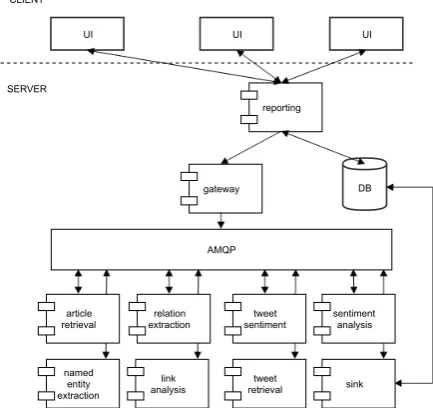
The proposed novel AML framework follows a distributed architecture to integrate different deep learning-based NLP modules to facilitate the in-vestigations of suspicious ML transactions. The
architecture of the system is presented in Figure1.
article retrieval
relation extraction
tweet retrieval
tweet sentiment
sentiment analysis
named entity extraction
link analysis
AMQP
gateway DB
reporting
UI UI UI
CLIENT
SERVER
[image:2.595.307.524.91.295.2]sink
Figure 1: Architecture of the novel AML frame-work.
The system follows an extensible micro-service oriented distributed architecture where each ponent acts as a separate micro-service and com-municates with others via an Advanced Message Queuing Protocol (AMQP) platform. AMQP is an open standard application layer protocol used for queuing and routing messages between the
ser-vices in a secure and reliable way2.
Communi-cations between the components are chained to achieve incremental data processing. This archi-tecture also supports dynamic routing topologies.
In this framework, each AML component is independently configurable, deployable, scalable and replaceable which makes it flexible on where and how to run it. Thus, it can conveniently dis-tribute the AML components over a cluster of ma-chines where allocation of resources could be ad-justed on demand depending on the needs regard-ing the processregard-ing time or memory consumption.
In Figure1, the User Interfaces (UI) connect to
the reporting service that provides the results in-formation from the database (DB). The UI can also trigger the processing pipeline, calling the report-ing service to make the gateway start processreport-ing data regarding new transactions.
The reporting service provides representational state transfer (REST) endpoints for the interaction between the UI and the system. This service al-lows analysts/experts to retrieve information
re-2https://www.rabbitmq.com/
lated to a specific transaction and the set of pro-cessed results that will lead to the human analyst to approve or block this transaction.
The information processing pipeline is a com-bination of different modules (micro-services) via different routings. Different routings encapsulate different customized functionalities for the end user. Using the route configuration file, the route is embedded in the message that is passed around, so the component knows where it should direct the message next.
In this architecture, the data layer is constructed using Cassandra, Neo4j and MySQL along with news and Twitter engines to govern, collect, man-age and store various type of data (e.g. banking data and open data). The data layer maintains a bidirectional access with other modules in the sys-tem. Two types of data are handled in the data layer: banking and open data. Banking data refers to a wide variety of financial data, for example: data related to Know Your Customer (KYC), client profiles, customer accounts, and real-time transac-tions. On the other hand open data refers to finan-cial news articles, sofinan-cial media, finanfinan-cial report, existing and open source fraud base etc.
3 Work-flow and Functionalities
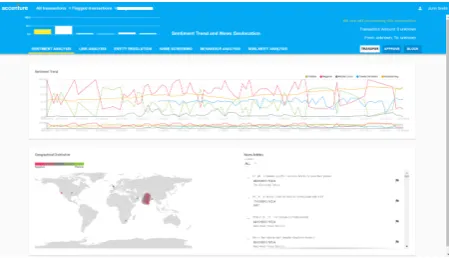
The main UI of our system is shown in Figures2–
4. We will explicitly detail the functionality of
[image:3.595.307.509.225.351.2]each NLP module while following the work-flow of the system:
Figure 2: Sentiment Analysis of Target Entity
The system starts with transaction monitoring (TM) that identifies suspicious transaction using complex rules and generates red alerts. Suspicious transactions are flagged and reside in a queue for further investigation. Information such as name, location, account details of the parties (involved in a flagged) are extracted for further usage.
The name screening module filters out ML offenders or criminals have previous records of
fraud, illegal activities (e.g. terrorism) and
[image:3.595.73.298.505.634.2]fi-nancial crimes by looking at a sanction list or ML cases from bank records and other fraud bases. The name screening employs fuzzy match-ing techniques as an initial filter like many off-the-self AML solutions. If the target entity is matched with some entities in the list, it will increase the probability of a ML transaction, so the system is triggered for more evidence gathering.
Figure 3: Knowledge Graph of Fraud Base: Each Node is an entity and edges are relations. Sensitive entities are blocked with white boxes according to data privacy agreement.
The target entity with its properties are stored in a knowledge graph (KG) which is con-structed from a combination of publicly available
fraud/ML bases3. Figure3shows part of the KG,
where each node represents an entity and the edge represents a relation. Persons and organizations that occur in this KG and are red-alerted by the TM system, are strongly considered to be involved in illegal activities. Entity disambiguation is used when the the query of the target entity to the KG is to be made. If the target entity is matched, then we directly submit the evidence to human inves-tigators. The system also considers human judg-ment in this process, mainly for two reasons: (1) Often fake identities, aliases are captured by ana-lyzing the neighbors of the target entities (e.g. the associate entities remain same) (2) Often indirect connection to a suspicious entity validates the ML claim of a transaction.
Sentiment Analysis is a key module of our sys-tem that can be viewed as a sequential and as well
3https://www.icij.org/investigations/
as a parallel component for evidence mining. At any given point of time the module starts fetching data from different sources, such as news sources and social media in order to find clues of the tar-get entity, after that it analyses the sentiment of collected news and other data sources and projects the results into a geo-graph and a time-series chart to identify geo and temporal patterns. The goal of this module is to identify potential negative ev-idence involving crime, fraud and ML etc. As
shown in Figure2, the results are visualized with
the time-stamp to reveal the trend. The idea behind
viewing the sentiment over time is that
continu-ously growingnegative enduring sentiment for an entity indicates something suspicious and the
ne-cessity of in-depth investigation. In Figure2,Red
indicates the negative sentiment,Greenrepresents
the positive sentiment, and Yellow is the average
sentiment of target entity’s competitors. Blue is
[image:4.595.72.297.466.616.2]the averaged sentiment from Twitter data. It can be seen that negative sentiment regarding to financial fraud is dominant for the target entity, and hence an in-depth investigation is necessary. The news are complied and presented along with the graph so that the actual content can also be presented. Geographical distribution in terms of sentiment re-garding the target entity is also visualized, which reflects the risks of the target entity involved in the ML activities in terms of location.
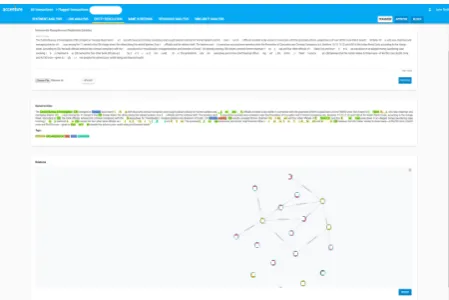
Figure 4: Knowledge Graph from News Article
The next part of our system is designed to per-form entity resolution and linking through NER, RE, link analysis (LA). NER and RE are per-formed over collected unstructured negative news data to extract relational facts in real time and build an entity-specific KG regarding the target
entity as shown in Figure 4. Subsequently, these
entity-specific KGs are merged with the existing
knowledge graph by entity linking. In this process, an entity disambiguation technique is also used to find out the same entity with different mentions. Given the updated KG, we then carry out inspec-tion and reasoning regarding the suspicious entity considering that a direct or indirect connection be-tween a target entity and any number of existing ML/fraud entities. Direct and indirect connections can be a strong evidence implying that the inves-tigated transaction might be illegal. This process not only serves evidence mining for a particular suspicious transaction but also enriches the exist-ing KB continuously by addexist-ing a large number of entities that are collected from different sources.
Finally, for a suspicious transaction, confidence scores are generated along with evidences from each module: TM, fraud-base name screening, fraud KB matching, SA trend and entity
disam-biguation module. The scores are normalized
within a range of 0.00 to 1.00 for each module
and are presented to a user. Based on these scores, the user approves, blocks or transfers the transac-tion to higher authorities for actransac-tion. The goal of our solution is not to replace human compliance personnels, but to augment their capability and to make a more accurate decision efficiently.
4 NLP Models
In this section, we introduce the modeling details for each NLP modules in our system.
4.1 Sentiment Analysis
Sentiment analysis is a task of identifying the po-larity of sentiment (e.g. positive, neutral or neg-ative) in a content at different levels, e.g. term, aspect, sentence and document.
For our AML task, we develop two different SA models, namely the document-level and sentence-level models. The former is a multi-channel con-volutional neural network (CNN) based sentiment
classifier (Kim, 2014) and used to process
finan-cial news articles; the latter is also a CNN based
model (Tang et al., 2014;Deriu et al., 2016) for
social media data.
One challenge for the document-level SA model is that annotated resources in the financial domain are hard to obtain. To solve this problem, we pro-pose a voting scheme to label the training data as follows: Financial news are gathered using a list of
keywords4and news search APIs, afterwards they
4
(headlines and the first paragraph of a news) go through some public sentiment APIs to generate the sentiment score. Finally, a voting mechanism is used to obtain the final result in terms of posi-tive or negaposi-tive sentiment for each document. Our document-level SA classifier, trained on automatic labeled 12,467 of such financial news articles, and it achieves 76.96% in terms of accuracy compared
to a public sentiment API5 on the RT-polarity6
data set. With respect to the Twitter SA classi-fier, it is trained and evaluated on SemEval-2016
task 47 data set, and achieves 63.10% in terms of
accuracy, comparable to the best system (63.30%) in the shared task. Different from previous shared tasks, the SemEval-2016 task 4 is designed to es-timate the percentage of tweets that are positive and the percentage of tweets that are negative in a given set of tweets about a topic. Thus, in this circumstance, this dataset is very helpful for us to verify our SA models for AML scenario because in one period there might have many tweets dis-cussing a suspicious entity (e.g. an organisation).
4.2 Relation Extraction
Relation extraction involves the prediction of se-mantic relations between pairs of nominals or
en-tities in a sentence (Bunescu and Mooney,2005).
We use the pipeline modeling methods for rela-tion extracrela-tion tasks, i.e. recognising and
disam-biguating named entities (Wang et al.,2012) first,
and then performing relation extraction on these recognised entities. NER is performed using a combined strategy: (1) Stanford NER Recognizer; (2) a neural NRE which is implemented using
a LSTM-CRF framework (Lample et al., 2016);
and (3) we combine the recognised named enti-ties from these two models, and select out those that we want based on specific types. Seven dif-ferent types of named entities are defined in our
system, namely Person, Organisation, Location,
Date,Time,MoneyandMiscellaneous. Given two entities and a sentence containing these two enti-ties, our LSTM-based model predicts the relation between them. We evaluate it on SemEval 2010
task 8 (Hendrickx et al.,2010) data and it achieves
Lists.html
5
We use https://www.ibm.com/watson/ alchemy-api.htmland it achieves 75.56% in terms of accuracy.
6https://www.cs.cornell.edu/people/
pabo/movie-review-data/rt-polaritydata. README.1.0.txt
7Prediction of five-point scale polarity of a tweet.
80.62% in terms of macro-F1 measure.
Moreover, to handle multi-instance problem in the distant supervision RE (i.e. for one entity pair, there exists multiple instances containing this en-tity pair, where some instances are valid and some are noise), we develop an attentive RNN
frame-work (Lin et al., 2016) with a word-level and a
sentence-level attentions for relation prediction, where the word-level attention can learn lexical contexts and the sentence-level attention can se-lect valid instances for relation prediction. We evaluate our model on the publicly available New York Time data set and achives 88.00% accuracy
in terms of P@100 measure.
5 Evaluation and Feedbacks from AML Practitioners
As discussed in above section, different valida-tion and evaluavalida-tion methods are applied to dif-ferent NLP models, where the tweet SA model, news SA model or attentive RE model achieves or is comparable to the state-of-the-art in terms of accuracy. At present, the entire system is at pi-loting stage with our banking clients across US, Europe and Asia. It is currently being tested and evaluated by professional AML practitioners for AML and KYC investigations. From the feed-backs that we collected so far, the end users are optimistic on achieving the objective of reducing on average 30% of their time of investigating the red-alerted suspicious transactions and making a decision more efficiently. We have been invited to give keynote talks about different aspects (not the entire one) of this system at highly respected events, such as World Mobile Conference (WMC) 2018, Europe Financial Information Management
Conference (FIMA) 2017 etc. Worth
mention-ing that some of our NLP models were also uti-lized by our clients in different domains. For in-stance, one of our diamond clients adopted our news and tweets sentiment analysis models for monitoring their brand reputation. Given the sen-sitivity of their business, they cannot release the performance metrics to us. However, their overall feedback and experience have been very positive.
6 Conclusions and Future Work
is modularized and distributed which enables it to be deployed on scale and on demand. Each component is a micro-service which allows mul-tiple instances of the same module to be created and deployed and used in tandem. By harness-ing knowledge graph, sentiment analysis, name screening, named entity recognition, relation ex-traction, entity linking and link analysis, our sys-tem can provide different evidence extracted and analyzed from different data sources to facilitate human investigators. From the human evaluation and clients’ feedback, our system can reduce by 30% in terms of human investigation effort.
In the future, we will (1) improve our mod-els with more domain specific data, and fine tune the parameters; (2) scale and deploy the system on cloud-based servers for real-time processing of large volume of data; (3) tailor the solution and evaluate it in other domains such as KYC, and (4) adapt our system to multilingual use cases.
Acknowledgements
Many thanks to the reviewers for their
insight-ful comments and suggestions. This work is
supported by Accenture Labs Dublin, Enter-prise Ireland under the Research Programme (Grant EI.IP20170626) and Science Foundation Ireland (SFI) Industry Fellowship Programme 2016 (Grant 16/IFB/4490).
References
Razvan Bunescu and Raymond J Mooney. 2005. Sub-sequence kernels for relation extraction. InIn Pro-ceedings of NIPS, pages 171–178.
Jan Deriu, Maurice Gonzenbach, Fatih Uzdilli, Au-relien Lucchi, Valeria De Luca, and Martin Jaggi. 2016. Swisscheese at semeval-2016 task 4: Senti-ment classification using an ensemble of convolu-tional neural networks with distant supervision. In Proceedings of the 10th International Workshop on Semantic Evaluation, EPFL-CONF-229234, pages 1124–1128.
Shijia Gao and Dongming Xu. 2007. Conceptual modeling and development of an intelligent agent-assisted decision support system for anti-money laundering.Expert Systems with Applications.
Shijia Gao and Dongming Xu. 2010. Real-time excep-tion management decision model (rtemdm): appli-cations in intelligent agent-assisted decision support in logistics and anti-money laundering domains. In-ternational Conference on System Sciences.
Shijia Gao, Dongming Xu, Huaiqing Wang, and Yingfent Wang. 2006. Intelligent anti-money laun-dering system. International Conference on Service Operations and Logistics, and Informatics.
Zengan Gao and Mao Ye. 2007. A framework for data mining-based anti-money laundering research. Journal of Money Laundering Control.
Cross Gombiro and Mmaki Jantjies. 2015. A concep-tual framework for detecting financial crime in mo-bile money transactions. Journal of Governance and Regulation.
T.H. Helmy, M. Zaki, T. Salah, and B.K. Tarek. 2014. Design of a monitor for detecting money laundering and terrorist financing. Journal of Theoretical and Applied Information Technology, 1(1):1–11.
Iris Hendrickx, Su Nam Kim, Zornitsa Kozareva, Preslav Nakov, Diarmuid ´O S´eaghdha, Sebastian Pad´o, Marco Pennacchiotti, Lorenza Romano, and Stan Szpakowicz. 2010. Semeval-2010 task 8: Multi-way classification of semantic relations be-tween pairs of nominals. In Proceedings of the Workshop on Semantic Evaluations: Recent Achievements and Future Directions, pages 94–99.
Avi Jorisch. 2009. Tainted Money: Are we losing the war on money laundering and terrorism financing? Red Cell Intelligence Group.
Yoon Kim. 2014. Convolutional neural net-works for sentence classification. arXiv preprint arXiv:1408.5882.
Guillaume Lample, Miguel Ballesteros, Sandeep Sub-ramanian, Kazuya Kawakami, and Chris Dyer. 2016.
Neural architectures for named entity recognition. CoRR, abs/1603.01360.
Yankai Lin, Shiqi Shen, Zhiyuan Liu, Huanbo Luan, and Maosong Sun. 2016. Neural relation extraction with selective attention over instances. In Proceed-ings of the 54th ACL, pages 2124–2133.
Ben Martin. 2017. Deutsche bank hit with pounds 500m money laundering fines. http://www.telegraph.co.uk/business/2017/01/31/deutsche-bank-hit-500m-money-laundering-fines/.
D. Pellegrina, L. Donato, and M. Donato. 2009. The risk based approach in the new european anti-money laundering legislation: a law and economics view. Computing Reviews, 5(2):290–317.
Duyu Tang, Furu Wei, Nan Yang, Ming Zhou, Ting Liu, and Bing Qin. 2014. Learning sentiment-specific word embedding for twitter sentiment clas-sification. In Proceedings of the 52nd ACL, pages 1555–1565.