712
Learning Simplifications for Specific Target Audiences
Carolina Scarton and Lucia Specia
Department of Computer Science, University of Sheffield Regent Court, 211 Portobello Street, Sheffield, S1 4DP, UK
{c.scarton,l.specia}@sheffield.ac.uk
Abstract
Text simplification (TS) is a monolingual text-to-text transformation task where an original (complex) text is transformed into a target (simpler) text. Most recent work is based on sequence-to-sequence neural models similar to those used for machine translation (MT). Different from MT, TS data comprises more elaborate transforma-tions, such as sentence splitting. It can also contain multiple simplifications of the same original text targeting different au-diences, such as school grade levels. We explore these two features of TS to build models tailored for specific grade levels. Our approach uses a standard sequence-to-sequence architecture where the origi-nal sequence is annotated with informa-tion about the target audience and/or the (predicted) type of simplification opera-tion. We show that it outperforms
state-of-the-art TS approaches (up to 3and 12
BLEU and SARI points, respectively), in-cluding when training data for the specific complex-simple combination of grade lev-els is not available, i.e. zero-shot learning.
1 Introduction
Text simplification (TS) is the task of modifying an original text into a simpler version of it. One of the main parameters for defining a suitable simpli-fication is the target audience. Examples include elderly, children, cognitively impaired users, non-native speakers and low-literacy readers.
Traditionally, work on TS has been divided in lexical simplification (LS) and syntactic simplifi-cation (SS). LS (Paetzold, 2016) deals with the identification and replacement of complex words
or phrases. SS (Siddharthan, 2011) performs
structural transformations such as changing a sen-tence from passive to active voice. However, most recent approaches learn transformations from cor-pora, addressing simplification at lexical and syn-tactic levels altogether. These include either learn-ing tree-based transformations (Woodsend and La-pata, 2011; Paetzold and Specia, 2013) or using machine translation (MT)-based techniques (Zhu et al., 2010; Coster and Kauchak, 2011a; Wubben et al., 2012; Narayan and Gardent, 2014; Nisioi et al., 2017; Zhang and Lapata, 2017). This paper uses the latter type of technique, which treats TS as a monolingual MT task, where an original text is “translated” into its simplified version.
In order to build MT-based models, a parallel corpus of original texts with their simplified coun-terparts is needed. For English, two main such cor-pora are available: Wikipedia-Simple Wikipedia (W-SW) (Zhu et al., 2010) and the Newsela
Arti-cle Corpus.1 The former is a collection of
orig-inal Wikipedia articles and their simplified ver-sions created by volunteers. The latter consists of news articles professionally simplified for var-ious specific audiences following the US school grade system. To build simplification models, the pairs of articles in these corpora have been aligned at the level of smaller units using standard algo-rithms (Coster and Kauchak, 2011b; Paetzold and Specia, 2016; ˇStajner et al., 2017). Based on the number of sentences involved in these alignments, one can categorise alignments into four types of coarse-grained simplification operations:
• Identical: an original sentence is aligned to
itself, i.e. no simplification is performed.
• Elaboration: an original sentence is aligned
to a single, rewritten simplified sentence.
• One-to-many: splitting – an original sentence
is aligned to 2+ simplified sentences.
• Many-to-one: joining – 2+ original sentences are aligned to a single simplified sentence.
We hereafter refer to the unit of simplification, i.e. one or more original or simplified sentences, as
instances.
The Newsela corpus is seen as having higher quality than W-SW because its simplifications are created by professionals, following well defined
guidelines (Xu et al., 2015). It is also larger
which is preferable for training corpus-based mod-els. More interestingly, the Newsela corpus has a feature that has been ignored thus far: Each in-stance in the corpus was created for readers with a certain school grade level. Each original article has a label indicating its corresponding grade level
(from 12 to 2), and may have various simplified
versions, each for a different grade level. For
ex-ample, a level12article may have simplified
coun-terparts for levels8and4. In other words, the
cor-pus contains instances where the same input leads to different outputs. Disregarding this factor may lead to suboptimal models. To avoid this prob-lem, previous work (Alva-Manchego et al., 2017; Zhang and Lapata, 2017; Scarton et al., 2018b) has used subsets of the corpus with only certain com-binations of complex-simplified article pairs, e.g. adjacent or non-adjacent pairs. This however re-duces the amount of data available for training.
We propose a way of making use of this infor-mation to build more informed TS models that are aware of different types of target audiences, while still making use of the full dataset for learning. In-spired by the work of Johnson et al. (2017) for MT, we add to each original instance an artificial to-ken that represents the target grade level of that in-stance in order to guide a sequence-to-sequence at-tentional encoder-decoder neural approach
(Bah-danau et al., 2015) (§2). In a similar vein, we
also annotate the coarse-grained type of operation that should be performed to simplify the original instance, under the hypothesis that certain opera-tions are more often used to simplify into certain grade levels. Deciding on the operation is an easier problem than performing the actual operation. We rely on both gold and predicted operation types.
Experiments with models built with these ar-tificial tokens outperform state-of-the-art neural models for TS, with the best approach combining
grade level and type of operation (§3).
Interest-ingly, such an approach also enables zero-shot TS, where a simplification for a grade level pair unseen
at training time can still be generated during test-ing. We show that our zero-shot learning models perform virtually as well as our
grade/operation-informed models (§4). To the best of our
knowl-edge, this is the first work to build TS models for specific target audiences and to explore zero-shot learning for this application.
2 System architecture
Our approach follows that of Johnson et al. (2017), a multilingual MT approach that adds an artificial token to encode the target language to the begin-ning of each source sentence in the parallel corpus. With this modified version of the corpus, a single encoder-decoder architecture is used to deal with different language pairs. Based on the tokens, the source sentences are encoded differently accord-ing to the target language they have been paired with in the corpus. Such an approach enables zero-shot MT, where a model is able to provide transla-tions for language pairs it has not seem at training time.
We apply three types of data manipulation, where artificial tokens are added to the beginning of original side of both training and test instances: • to-grade: the token corresponds to the grade
level of the target instance,
• operation: the token is one of the four possi-ble coarse-grained operations that transforms the original into the simplified instance, • to-grade-operation: concatenation of the
two above tokens.
Different from the grade level, which can be available at test time simply by knowing the in-tended reader of the text, information about the operations to be performed, which we extracted from the parallel corpus, will not be available at test time. We use gold labels extracted from the parallel corpus for an oracle experiment but also use a classifier that predicts the operations for the test set based on those in the training data. We built a simple Naive Bayes classifier using the
scikit-learntoolkit (Pedregosa et al., 2011) and nine features (Scarton et al., 2017):
• number of tokens / punctuation / content
words / clauses,
• ratio of the number of verbs / nouns /
adjec-tives / adverbs / connecadjec-tives to the number of content words.
simpli-to grade level 4 to grade level 2 to-grade <4>dusty handprints stood out against the rust of the
fence near Sasabe.
<2>dusty handprints stood out against the rust of the fence near Sasabe.
operation <identical>dusty handprints stood out against the rust of the fence near Sasabe.
<elaboration>dusty handprints stood out against the rust of the fence near Sasabe.
to-grade-operation <4-identical>dusty handprints stood out against the rust of the fence near Sasabe.
<2-elaboration>dusty handprints stood out against the rust of the fence near Sasabe.
reference dusty handprints stood out against the rust of the fence near Sasabe.
[image:3.595.82.520.61.152.2]dusty handprints could be seen on the fence near Sasabe.
Table 1: Examples of artificial tokens used.
fied to grade level4or grade level2. Since the
ref-erence for grade level4is a copy of the original,
the operation token for this case is <identical>.
For level 2 the reference is a rewrite and,
there-fore, the operation token is<elaboration>.
We use OpenNMT2 as our encoder-decoder
architecture. Both encoder and decoder have
two LSTM layers, hidden states of size 500 and
dropout = 0.3. Global attention combined with
input-feeding is used, as describe in (Luong et al., 2015). A model is trained for each dataset
con-structed with different artificial tokens for 13
epochs. The best model is selected according
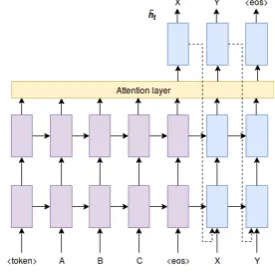
to perplexity on the development set. Figure 1 shows the architecture of the neural network, in-cluding attention and input-feeding. In this
exam-ple,<token>represents the artificial token added
[image:3.595.111.249.454.591.2]to the pre-processed data.
Figure 1: Neural model architecture.
We evaluate our models with BLEU3(Papineni
et al., 2002) (a proxy for grammaticality
assess-ment), SARI (Xu et al., 2016)4 (a proxy for
sim-plicity assessment) and Flesch Reading Ease5 (a
2
Torch version:http://opennmt.net/OpenNMT/
3
The multi-blue.perl script from https://github. com/moses-smt/mosesdecoder
4
https://github.com/cocoxu/ simplification
5https://github.com/mmautner/
readability
proxy for readability assessment). According to Xu et al. (2016), BLEU shows high correlation with human scores for grammaticality and mean-ing preservation, whilst SARI shows high
cor-relation with human scores for simplicity.
Al-though previous work have also relied on human judgements of grammaticality, meaning preserva-tion and simplicity, in our case such a type of eval-uation is infeasible: we would need to involve judges with specific grade levels or rely on pro-fessionals who are experts in grade level-specific simplification to make such assessments.
3 Reader-specific TS models
Our version of the Newsela corpus has 550,644
instance pairs (11M original tokens and 10M
target tokens), which we randomly divided into
training (440,516instances: 80%), development
(55,064 instances: 10%) and test (55,064
in-stances: 10%) sets. Instances were aligned using
the method by Paetzold and Specia (2016). Xu
et al. (2015) report over 56K original sentences
and approximately305K sentences including the
original ones and all simplification types. Our
number of instance pairs is higher because we al-lowed alignments from original to all simplified versions and among simplified versions. An
orig-inal article0may be aligned to up to four
simpli-fied versions: 1,2,3 and4. For each article, the
alignments were extracted between0-{1,2,3,4},1
-{2,3,4}, 2-{3,4} and 3-4, where available. Our
corpus is also larger than the ones used in (Alva-Manchego et al., 2017; Scarton et al., 2018b) and (Zhang and Lapata, 2017). While the former use
only adjacent levels (e.g. 0-1, 1-2) and the latter
only non-adjacent levels (e.g. 0-2,1-4), we make
use of the full dataset.
As baseline we trained a model using Open-NMT and the same hyperparameters as described
in §2 on the entire Newsela corpus but without
state-of-the-art model is represented by NTS, which was also trained on the entire corpus using a similar Open-NMT architecture with the same hyperparameters but additional pre-trained word embeddings as
de-scribed in Nisioi et al. (2017).6
As shown in Table 2 the NTS system performs slightly worse than the baseline system accord-ing to BLEU and SARI. Although concatenataccord-ing global and local embeddings has led to improve-ments for the W-SW corpus in (Nisioi et al., 2017), this does not seem to be the case for the Newsela corpus. Our models outperform both the baseline and NTS systems by a large margin. Examples of outputs from all systems can be found in the Sup-plementary Material.
BLEU↑ SARI↑ Flesch↑
[image:4.595.319.513.239.357.2]NTS 61.60 33.40 79.95 s2s 61.78 33.72 79.86 s2s+to-grade 62.91 41.04 82.91 s2s+operation (pred) 59.83 37.36 84.96 s2s+to-grade+operation (pred) 61.48 40.56 83.11 s2s+operation (gold) 63.24 41.81 84.47 s2s+to-grade+operation (gold) 64.78 45.41 85.44
Table 2: Results on the Newsela test set.
The best model is the one built with the <
to-grade+operation>token with gold operations
an-notations (last row). The second best system
uses the gold <operation> token only.
There-fore, knowing the operation type to be performed for a given instance provides valuable informa-tion. Even though the models with predicted op-erations (‘pred’ in Table 2) still outperform the baseline, they lag behind their counterparts built using gold operations. The main reason for that is the very simplistic classifier we used (average
accuracy = 0.51, calculated using 10-fold
cross-validation). In summary, s2s+to-grade is the best performing model in a real world scenario, given the low performance of ‘pred’ systems. A more in-formed classifier should lead to better results, but this left for future work; our goal was to show the potential of this information.
The improvements in SARI are substantial: 7
points over the baseline even with the predicted
operations. However, SARI aims to measure
simplicity in general (not for specific grade lev-els). Since human evaluation of the targeted sim-plification performed by our models is not fea-sible, we can only approximate the usefulness of our models by using readability metrics such
6Equivalent to their best performing “NTS-w2v” version.
as the Flesch-Kincaid Grade Level. This
met-ric maps a text into a US grade level, which is the same grading provided in the Newsela
cor-pus and, therefore, relevant for our study.
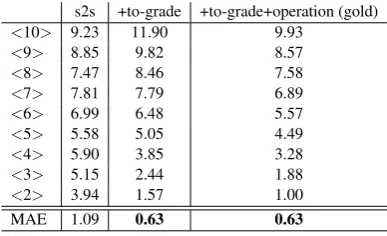
Ta-ble 3 shows the Flesch-Kincaid results for the test set divided into the appropriate grade levels considering the outputs of s2s, s2s+to-grade and
s2s+to-grade+operation (gold) models.
Simpli-fications generated by grade and s2s+to-grade+operation are scored consistently closer to the appropriate grade, which does not happen with s2s.
s2s +to-grade +to-grade+operation (gold)
<10> 9.23 11.90 9.93
<9> 8.85 9.82 8.57
<8> 7.47 8.46 7.58
<7> 7.81 7.79 6.89
<6> 6.99 6.48 5.57
<5> 5.58 5.05 4.49
<4> 5.90 3.85 3.28
<3> 5.15 2.44 1.88
[image:4.595.73.294.279.362.2]<2> 3.94 1.57 1.00 MAE 1.09 0.63 0.63
Table 3: Flesch-Kincaid scores for instances of
each grade level simplified using s2s, s2s+to-grade and s2s+to-grade+operation (gold) models.
The last row of Table 3 shows the Mean Abso-lute Error (MAE) considering the Flesch-Kincaid Grade Level scores for the system outputs as the hypothesis and the expected grade level as
the gold scores. Our grade and
s2s+to-grade+operation (gold) models show lower error scores than the baseline system, which supports our hypothesis that such models produce more ad-equate outputs for targeted grade levels.
3.1 Usefulness of the s2s+to-grade model
original We want to reassure you that we take fire safety very seriously and we are doing everything we can to make sure our residents are safe. s2s We want to reassure you that we take fire safety very seriously and we are doing everything we can to make sure our residents are safe. <10> We want to reassure you that we take fire safety very seriously and we are doing everything we can to make sure our residents are safe. <9> We want to reassure you that we take fire safety very seriously and we are doing everything we can to make sure our residents are safe. <8> We want to reassure you that we take fire safety very seriously and we are doing everything we can to make sure our residents are safe. <7> We want to reassure you that we take fire safety very seriously and we are doing everything we can to make sure our residents are safe. <6> We want to reassure you that we take fire safety very seriously. Weare doing everything we can to make sure our residents are safe. <5> We want to reassure you that we take fire safety very seriously. Weare doing everything we can to make sure our residents are safe. <4> We want tomake surewe take fire safety very seriously. Weare doing everything we can to make sure ourpeopleare safe. <3> We want tomake surepeople take fire safety very seriously. Weare doing everything we can to make sure ourpeopleare safe. <2> We want tomake surepeople take fire safety very seriously. Weare doing everything we can to make surepeopleare safe.
Table 4: Examples of s2s+to-grade outputs when an original instance is simplified into different levels.
4 Zero-shot TS models
To show that zero-shot TS is possible, we build models on training data without instances of a cer-tain grade level pair and test them on instances of that grade level pair. Consider the grade level pair< go, gt >, wherego is the grade level of an
original instance o, gt of a target instance t, and
t is aligned to o. We test if our “s2s+to-grade”
model can generalise for instances of< gˆo,gˆt >
that have not been seen at training time.
Due to space restrictions, we only show results for three representative grade level pairs. These pairs have a large enough number of training and test instances and cover levels that are closer or further apart from each other. In addition, after removing them the training corpus still has enough
instances of thegˆtas target grade level. Instances
of the target but not the original level (or of the target language in MT) must exist for zero-shot to be possible. The distributions of the selected grade level pairs is shown in Table 5.
# training # test # of remaininggˆt
<12,7> 30,246 3,825 34,545
<12,4> 22,709 2,867 104,833
[image:5.595.330.505.303.435.2]<6,5> 18,122 2,239 79,546
Table 5: Zero-shot data distribution.
In Table 6, the s2s and s2s+to-grade models are the same as in Section 3, i.e. trained with the entire dataset without artificial tokens (s2s) or with arti-ficial tokens (s2s+to-grade). The zero-shot
mod-els (s2s+to-grade+zs) are trained with<to-grade>
data, but after removing instances of the grade
level pair< gˆo,gˆt >under investigation, i.e. on
a smaller dataset. For< 12,7 >and< 12,4 >,
the zero-shot models outperform the baseline
ac-cording to all metrics. In terms of SARI, for
<12,7>the zero-shot model is only marginally
worse than the s2s+to-grade model. Conversely,
s2s+to-grade+zs outperforms s2s+to-grade for <
12,4>, which is an impressive result. Finally, for
<6,5 >all three models perform similarly. This
may be explained by the proximity of gˆo andgˆt,
which means that instances must be considerably close to each other and therefore simplifications will be minor and have little impact in the scores.
BLEU↑ SARI↑ Flesch↑ <12,7>
s2s 63.02 38.43 73.83 s2s+to-grade 64.16 40.61 74.43 s2s+to-grade+zs 64.50 39.83 74.09
<12,4>
s2s 44.56 37.56 79.50 s2s+to-grade 49.43 50.76 91.04 s2s+to-grade+zs 50.18 50.85 91.08
<6,5>
s2s 69.71 26.47 84.74 s2s+to-grade 69.39 26.32 87.07 s2s+to-grade+zs 68.78 26.23 86.80
Table 6: Results of zero-shot experiments for TS.
5 Conclusions
We have presented an approach for TS that bene-fits from corpora built for various target audiences and allows building better models than general-purpose ones. We have also shown that zero-shot learning is possible for TS, where instances of the original-target audience do not exist. As future work we intend to investigate (i) better classifiers to predict operation types and (ii) multi-task learn-ing as an alternative way of buildlearn-ing a slearn-ingle TS model for various specific target audiences. We also plan to run experiments with the W-SW cor-pus and using an improved classifier to train mod-els with information on operations.
Acknowledgements
[image:5.595.92.271.513.554.2]References
Fernando Alva-Manchego, Joachim Bingel, Gustavo Paetzold, Carolina Scarton, and Lucia Specia. 2017. Learning how to simplify from explicit
la-beling of complex-simplified text pairs. In
Pro-ceedings of the Eighth International Joint Confer-ence on Natural Language Processing (Volume 1: Long Papers). Asian Federation of Natural Lan-guage Processing, Taipei, Taiwan, pages 295–305. http://www.aclweb.org/anthology/I17-1030.
Dzmitry Bahdanau, Kyunghyun Cho, and Yoshua
Ben-gio. 2015. Neural machine translation by jointly
learning to align and translate. In Proceedings
of the 3rd International Conference on Learn-ing Representations. San Diego, CA, ICLR ’15. https://arxiv.org/pdf/1409.0473.pdf.
William Coster and David Kauchak. 2011a.
Learn-ing to simplify sentences using wikipedia.
In Proceedings of the Workshop on
Mono-lingual Text-To-Text Generation. ACL,
Port-land, Oregon, MTTG ’11, pages 1–9.
http://dl.acm.org/citation.cfm?id=2107679.2107680.
William Coster and David Kauchak. 2011b. Simple english wikipedia: A new text simplification task. In Proceedings of the 49th Annual Meeting of the Association for Computational Linguistics: Human Language Technologies: Short Papers - Volume
2. Association for Computational Linguistics,
Stroudsburg, PA, USA, HLT ’11, pages 665–669. http://dl.acm.org/citation.cfm?id=2002736.2002865.
Melvin Johnson, Mike Schuster, Quoc V. Le, Maxim Krikun, Yonghui Wu, Zhifeng Chen, Nikhil Thorat, Fernanda Vi´egas, Martin Wattenberg, Greg Corrado, Macduff Hughes, and Jeffrey Dean. 2017. Google’s Multilingual Neural Machine Translation System:
Enabling Zero-Shot Translation. Transactions of the
Association for Computational Linguistics 5:339– 351. http://aclweb.org/anthology/Q17-1024.
Thang Luong, Hieu Pham, and Christopher D. Man-ning. 2015. Effective approaches to attention-based
neural machine translation. In Proceedings of the
2015 Conference on Empirical Methods in Natu-ral Language Processing. Association for Compu-tational Linguistics, Lisbon, Portugal, pages 1412– 1421. http://aclweb.org/anthology/D15-1166.
Shashi Narayan and Claire Gardent. 2014. Hybrid sim-plification using deep semantics and machine
trans-lation. In Proceedings of the 52nd Annual
Meet-ing of the Association for Computational LMeet-inguistics (Volume 1: Long Papers). Association for Computa-tional Linguistics, Baltimore, Maryland, pages 435– 445. http://www.aclweb.org/anthology/P14-1041.
Sergiu Nisioi, Sanja ˇStajner, Simone Paolo Ponzetto, and Liviu P. Dinu. 2017. Exploring neural text
sim-plification models. In Proceedings of the 55th
An-nual Meeting of the Association for Computational Linguistics (Volume 2: Short Papers). Association
for Computational Linguistics, Vancouver, Canada,
pages 85–91.
http://aclweb.org/anthology/P17-2014.
Gustavo Paetzold and Lucia Specia. 2013. Text
sim-plification as tree transduction. In Proceedings of
the 9th Brazilian Symposium in Information and Hu-man Language Technology. Fortaleza, Brazil, STIL, pages 116–125. http://aclweb.org/anthology/W13-4813.
Gustavo Henrique Paetzold. 2016. Lexical
Simpli-fication for Non-Native English Speakers. Ph.D. thesis, University of Sheffield, Sheffield, UK. http://etheses.whiterose.ac.uk/15332/.
Gustavo Henrique Paetzold and Lucia Specia. 2016. Vicinity-driven paragraph and sentence alignment
for comparable corpora. CoRR abs/1612.04113.
http://arxiv.org/abs/1612.04113.
Kishore Papineni, Salim Roukos, Todd Ward, and
Wei-Jing Zhu. 2002. Bleu: A method for
auto-matic evaluation of machine translation. In
Pro-ceedings of the 40th Annual Meeting on Associa-tion for ComputaAssocia-tional Linguistics. ACL, Philadel-phia, Pennsylvania, ACL ’02, pages 311–318. https://doi.org/10.3115/1073083.1073135.
F. Pedregosa, G. Varoquaux, A. Gramfort, V. Michel, B. Thirion, O. Grisel, M. Blondel, P. Pretten-hofer, R. Weiss, V. Dubourg, J. Vanderplas, A. Pas-sos, D. Cournapeau, M. Brucher, M. Perrot, and E. Duchesnay. 2011. Scikit-learn: Machine learning
in Python. Journal of Machine Learning Research.
Carolina Scarton, Gustavo Henrique Paetzold, and
Lucia Specia. 2018a. SimPA: A Sentence-Level
Simplification Corpus for the Public
Adminis-tration Domain. In Proceedings of the Eleventh
International Conference on Language
Re-sources and Evaluation. European Language
Resources Association (ELRA), Miyazaki,
Japan, pages 4333–4338.
http://www.lrec-conf.org/proceedings/lrec2018/pdf/542.pdf.
Carolina Scarton, Gustavo Henrique Paetzold, and Lucia Specia. 2018b. Text Simplification from
Pro-fessionally Produced Corpora. In Proceedings of
the Eleventh International Conference on Language Resources and Evaluation. European Language
Resources Association (ELRA), Miyazaki,
Japan, pages 3504–3510.
http://www.lrec-conf.org/proceedings/lrec2018/pdf/1063.pdf.
Carolina Scarton, Alessio Palmero Aprosio, Sara Tonelli, Tamara Mart´ın Wanton, and Lucia Specia. 2017. MUSST: A Multilingual Syntactic
Simplifi-cation Tool. InProceedings of the Eighth
Advaith Siddharthan. 2011. Text simplification using typed dependencies: A comparison of the robustness
of different generation strategies. InProceedings of
the 13th European Workshop on Natural Language Generation. Association for Computational Linguis-tics, Stroudsburg, PA, USA, ENLG ’11, pages 2–11. http://dl.acm.org/citation.cfm?id=2187681.2187684.
Sanja ˇStajner, Marc Franco-Salvador, Simone Paolo Ponzetto, Paolo Rosso, and Heiner Stuckenschmidt.
2017. Sentence alignment methods for
improv-ing text simplification systems. In
Proceed-ings of the 55th Annual Meeting of the As-sociation for Computational Linguistics (Volume 2: Short Papers). Association for Computational Linguistics, Vancouver, Canada, pages 97–102. http://aclweb.org/anthology/P17-2016.
Kristian Woodsend and Mirella Lapata. 2011.
Learning to Simplify Sentences with
Quasi-Synchronous Grammar and Integer
Program-ming. In Proceedings of the 2011 Conference
on Empirical Methods in Natural Language
Processing. Association for Computational Lin-guistics, Edinburgh, Scotland, UK., pages 409–420. http://www.aclweb.org/anthology/D11-1038.
Sander Wubben, Antal van den Bosch, and Emiel Krahmer. 2012. Sentence simplification by
mono-lingual machine translation. In Proceedings of
the 50th Annual Meeting of the Association for Computational Linguistics: Long Papers - Vol-ume 1. Association for Computational Linguistics, Stroudsburg, PA, USA, ACL ’12, pages 1015–1024. http://www.aclweb.org/anthology/P12-1107.
Wei Xu, Chris Callison-Burch, and Courtney Napoles.
2015. Problems in current text simplification
re-search: New data can help. Transactions of the
As-sociation for Computational Linguistics3:283–297. http://www.aclweb.org/anthology/Q15-1021.
Wei Xu, Courtney Napoles, Ellie Pavlick, Quanze
Chen, and Chris Callison-Burch. 2016.
Op-timizing statistical machine translation for text
simplification. Transactions of the
Associa-tion for ComputaAssocia-tional Linguistics 4:401–415. http://www.aclweb.org/anthology/Q16-1029.
Xingxing Zhang and Mirella Lapata. 2017.
Sen-tence simplification with deep reinforcement
learn-ing. In Proceedings of the 2017
Confer-ence on Empirical Methods in Natural Language Processing. Association for Computational Lin-guistics, Copenhagen, Denmark, pages 595–605. https://www.aclweb.org/anthology/D17-1063.
Zhemin Zhu, Delphine Bernhard, and Iryna Gurevych.
2010. A monolingual tree-based translation
model for sentence simplification. In
Pro-ceedings of the 23rd International Conference on Computational Linguistics. Association
for Computational Linguistics, Stroudsburg,
PA, USA, COLING ’10, pages 1353–1361.