957
Target-Sensitive Memory Networks for Aspect Sentiment Classification
Shuai Wang†, Sahisnu Mazumder†, Bing Liu†, Mianwei Zhou‡, Yi Chang§ †Department of Computer Science, University of Illinois at Chicago, USA
‡Plus.AI, USA §
Artificial Intelligence School, Jilin University, China
[email protected], [email protected] [email protected], [email protected], [email protected]
Abstract
Aspect sentiment classification (ASC) is a fundamental task in sentiment analy-sis. Given an aspect/target and a sentence, the task classifies the sentiment polarity expressed on the target in the sentence. Memory networks (MNs) have been used for this task recently and have achieved state-of-the-art results. In MNs, attention mechanism plays a crucial role in detect-ing the sentiment context for the given target. However, we found an important problem with the current MNs in perform-ing the ASC task. Simply improvperform-ing the attention mechanism will not solve it. The problem is referred to as target-sensitive sentiment, which means that the sentiment polarity of the (detected) context is de-pendent on the given target and it cannot be inferred from the context alone. To tackle this problem, we propose the target-sensitive memory networks(TMNs). Sev-eral alternative techniques are designed for the implementation of TMNs and their ef-fectiveness is experimentally evaluated.
1 Introduction
Aspect sentiment classification (ASC) is a core problem of sentiment analysis (Liu,2012). Given an aspect and a sentence containing the aspect, ASC classifies the sentiment polarity expressed in the sentence about the aspect, namely, positive, neutral, or negative. Aspects are also called opin-ion targets(or simplytargets), which are usually product/service features in customer reviews. In this paper, we use aspect and target interchange-ably. In practice, aspects can be specified by the user or extracted automatically using an aspect ex-traction technique (Liu, 2012). In this work, we assume the aspect terms are given and only focus on the classification task.
Due to their impressive results in many NLP tasks (Deng et al., 2014), neural networks have been applied to ASC (see the survey (Zhang et al.,
2018)). Memory networks (MNs), a type of neu-ral networks which were first proposed for ques-tion answering (Weston et al., 2015; Sukhbaatar et al.,2015), have achieved the state-of-the-art re-sults in ASC (Tang et al.,2016). A key factor for their success is the attention mechanism. How-ever, we found that using existing MNs to deal with ASC has an important problem and simply relying on attention modeling cannot solve it. That is, their performance degrades when the sentiment of a context word is sensitive to the given target.
Let us consider the following sentences:
(1)The screen resolution isexcellentbut the price isridiculous.
(2)The screen resolution isexcellentbut the price ishigh.
(3)The price ishigh.
(4)The screen resolution ishigh.
is relatively easy as “excellent” and “ridiculous” are both target-independent sentiment words, i.e., the words themselves already indicate clear senti-ments.
As illustrated above, the attention mechanism addressing the targeted-context detection problem is very useful for ASC, and it helps classify many sentences like sentence (1) accurately. This also led to existing and potential research in improving attention modeling (discussed in Section5). How-ever, we observed that simply focusing on tackling the target-context detection problem and learning better attention are not sufficient to solve the prob-lem found in sentences (2), (3) and (4).
Sentence (2) is similar to sentence (1) ex-cept that the (sentiment) context modifying as-pect/target price is “high”. In this case, when “high” is assigned the correct attention for the as-pectprice, the model also needs to capture the sen-timent interaction between “high” andpricein or-der to identify the correct sentiment polarity. This is not as easy as sentence (1) because “high” itself indicates no clear sentiment. Instead, its sentiment polarity is dependent on the given target.
Looking at sentences (3) and (4), we further see the importance of this problem and also why relying on attention mechanism alone is insuffi-cient. In these two sentences, sentiment contexts are both “high” (i.e., same attention), but sentence (3) is negative and sentence (4) is positive simply because their target aspects are different. There-fore, focusing on improving attention will not help in these cases. We will give a theoretical insight about this problem with MNs in Section3.
In this work, we aim to solve this problem. To distinguish it from the aforementioned targeted-context detection problem as shown by sentence (1), we refer to the problem in (2), (3) and (4) as thetarget-sensitive sentiment(or target-dependent sentiment) problem, which means that the senti-ment polarity of a detected/attended context word is conditioned on the target and cannot be directly inferred from the context word alone, unlike “ex-cellent” and “ridiculous”. To address this prob-lem, we proposetarget-sensitive memory networks
(TMNs), which can capture the sentiment interac-tion between targets and contexts. We present sev-eral approaches to implementing TMNs and ex-perimentally evaluate their effectiveness.
2 Memory Network for ASC
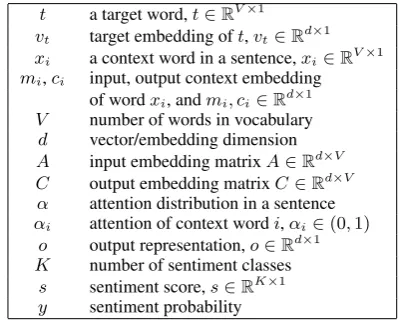
This section describes our basic memory network for ASC, also as a background knowledge. It does not include the proposed target-sensitive sen-timent solutions, which are introduced in Sec-tion 4. The model design follows previous stud-ies (Sukhbaatar et al.,2015;Tang et al.,2016) ex-cept that a different attention alignment function is used (shown in Eq.1). Their original models will be compared in our experiments as well. The def-initions of related notations are given in Table1.
t a target word,t∈RV×1 vt target embedding oft,vt∈Rd×1 xi a context word in a sentence,xi∈RV×1 mi,ci input, output context embedding
of wordxi, andmi, ci∈Rd×1 V number of words in vocabulary
d vector/embedding dimension
A input embedding matrixA∈Rd×V C output embedding matrixC∈Rd×V α attention distribution in a sentence
αi attention of context wordi,αi∈(0,1)
o output representation,o∈Rd×1 K number of sentiment classes
s sentiment score,s∈RK×1 y sentiment probability
Table 1: Definition of Notations
Input Representation: Given a target aspectt, an embedding matrix A is used to convertt into a vector representation, vt(vt = At). Similarly, each context word (non-aspect word in a sentence)
xi ∈ {x1, x2, ...xn} is also projected to the con-tinuous space stored in memory, denoted by mi
(mi = Axi) ∈ {m1, m2, ...mn}. Here n is the number of words in a sentence andiis the word position/index. Bothtandxiare one-hot vectors. For an aspect expression with multiple words, its aspect representationvt is the averaged vector of those words (Tang et al.,2016).
Attention: Attention can be obtained based on the above input representation. Specifically, an at-tention weightαi for the context wordxi is com-puted based on the alignment function:
αi =sof tmax(vtTM mi) (1)
where M ∈ Rd×d is the general learning ma-trix suggested by Luong et al. (2015). In this manner, attention α = {α1, α2, ..αn} is rep-resented as a vector of probabilities, indicating the weight/importance of context words towards a given target. Note thatαi∈(0,1)andP
i
[image:2.595.315.515.230.391.2]Output Representation: Another embedding matrixCis used for generating the individual (out-put) continuous vectorci(ci =Cxi)for each con-text word xi. A final response/output vectorois produced by summing over these vectors weighted with the attentionα, i.e.,o=P
i
αici.
Sentiment Score (or Logit): The aspect sen-timent scores (also called logits) for positive, neutral, and negative classes are then calculated, where a sentiment-specific weight matrix W ∈
RK×d is used. The sentiment scores are repre-sented in a vectors∈RK×1, whereKis the num-ber of (sentiment) classes, which is 3 in ASC.
s=W(o+vt) (2)
The final sentiment probabilityyis produced with asof tmaxoperation, i.e.,y=sof tmax(s).
3 Problem of the above Model for Target-Sensitive Sentiment
This section analyzes the problem of target-sensitive sentiment in the above model. The anal-ysis can be generalized to many existing MNs as long as their improvements are on attentionαonly. We first expand the sentiment score calculation from Eq.2to its individual terms:
s=W(o+vt) =W(
X
i
αici+vt)
=α1W c1+α2W c2+...αnW cn+W vt (3)
where “+” denotes element-wise summation. In Eq.3,αiW cican be viewed as the individual sen-timent logit for a context word and W vt is the sentiment logit of an aspect. They are linearly combined to determine the final sentiment scores. This can be problematic in ASC. First, an aspect word often expresses no sentiment, for example, “screen”. However, if the aspect term vt is sim-ply removed from Eq. 3, it also causes the prob-lem that the model cannot handle target-dependent sentiment. For instance, the sentences (3) and (4) in Section 1 will then be treated as identical if their aspect words are not considered. Second, if an aspect word is considered and it directly bears some positive or negative sentiment, then when an aspect word occurs with different context words for expressing opposite sentiments, a contradic-tion can be resulted from them, especially in the case that the context word is a target-sensitive sen-timent word. We explain it as follows.
Let us say we have two target wordspriceand
resolution (denoted as p and r). We also have two possible context words “high” and “low” (de-noted ash andl). As these two sentiment words can modify both aspects, we can construct four snippets “high price”, “low price”, “high resolu-tion” and “low resoluresolu-tion”. Their sentiments are negative, positive, positive, and negative respec-tively. Let us setW toR1×d so thatsbecomes a 1-dimensional sentiment score indicator. s > 0
indicates a positive sentiment and s < 0 indi-cates a negative sentiment. Based on the above example snippets or phrases we have four corre-sponding inequalities: (a)W(αhch+vp)<0, (b)
W(αlcl+vp)>0, (c)W(αhch+vr)>0and (d)
W(αlcl+vr) <0. We can drop allαterms here as they all equal to 1, i.e., they are the only context word in the snippets to attend to (the target words are not contexts). From (a) and (b) we can infer (e)W ch < −W vp < W cl. From (c) and (d) we can infer (f)W cl<−W vr < W ch. From (e) and (f) we have (g)W ch < W cl < W ch, which is a contradiction.
This contradiction means that MNs cannot learn a set of parameters W and C to correctly clas-sify the above four snippets/sentences at the same time. This contradiction also generalizes to real-world sentences. That is, although real-world review sentences are usually longer and contain more words, since the attention mechanism makes MNs focus on the most important sentiment con-text (the concon-text with highαiscores), the problem is essentially the same. For example, in sentences (2) and (3) in Section 1, when price is targeted, the main attention will be placed on “high”. For MNs, these situations are nearly the same as that for classifying the snippet “high price”. We will also show real examples in the experiment section.
chang-ingαi). Second, other irrelevant/unimportant con-text words often carry no or little sentiment infor-mation, so increasing or decreasing their weights does not help. For example, in the sentence “the price is high”, adjusting the weights of context words “the” and “is” will neither help solve the problem nor be intuitive to do so.
4 The Proposed Approaches
This section introduces six (6) alternative target-sensitive memory networks (TMNs), which all can deal with the target-sensitive sentiment problem. Each of them has its characteristics.
Non-linear Projection (NP): This is the first approach that utilizes a non-linear projection to capture the interplay between an aspect and its context. Instead of directly following the common linear combination as shown in Eq. 3, we use a non-linear projection (tanh) as the replacement to calculate the aspect-specific sentiment score.
s=W ·tanh(X
i
αici+vt) (4)
As shown in Eq.4, by applying a non-linear pro-jection over attention-weightedci andvt, the con-text and aspect information are coupled in a way that the final sentiment score cannot be obtained by simply summing their individual contributions (compared with Eq.3). This technique is also in-tuitive in neural networks. However, notice that by using the non-linear projection (or adding more sophisticated hidden layers) over them in this way, we sacrifice some interpretability. For example, we may have difficulty in tracking how each indi-vidual context word (ci) affects the final sentiment score s, as all context and target representations are coupled. To avoid this, we can use the follow-ing five alternative techniques.
Contextual Non-linear Projection (CNP): Despite the fact that it also uses the non-linear pro-jection, this approach incorporates the interplay between a context word and the given target into its (output) context representation. We thus name it Contextual Non-linear Projection (CNP).
s=W X
i
αi·tanh(ci+vt) (5)
From Eq.5, we can see that this approach can keep the linearity of attention-weighted context aggre-gation while taking into account the aspect infor-mation with non-linear projection, which works
in a different way compared to NP. If we define
˜
ci = tanh(ci + vt), c˜i can be viewed as the target-aware context representation of context xi and the final sentiment score is calculated based on the aggregation of such c˜i. This could be a more reasonable way to carry the aspect informa-tion rather than simply summing the aspect repre-sentation (Eq.3).
However, one potential disadvantage is that this setting uses the same set of vector representa-tions (learned by embeddingsC) for multiple pur-poses, i.e., to learn output (context) representa-tions and to capture the interplay between contexts and aspects. This may degenerate its model per-formance when the computational layers in mem-ory networks (called “hops”) are deep, because too much information is required to be encoded in such cases and a sole set of vectors may fail to capture all of it.
To overcome this, we suggest the involvement of an additional new set of embeddings/vectors, which is exclusively designed for modeling the sentiment interaction between an aspect and its context. The key idea is to decouple different functioning components with different representa-tions, but still make them work jointly. The fol-lowing four techniques are based on this idea.
Interaction Term (IT): The third approach is to formulate explicit target-context sentiment inter-action terms. Different from the targeted-context detection problem which is captured by atten-tion (discussed in Secatten-tion 1), here the target-context sentiment (TCS) interactionmeasures the sentiment-oriented interaction effect between tar-gets and contexts, which we refer to asTCS inter-action (or sentiment interaction) for short in the rest of this paper. Such sentiment interaction is captured by a new set of vectors, and we thus also call such vectorsTCS vectors.
s=X
i
αi(Wsci+wIhdi, dti) (6)
In Eq.6,Ws ∈ RK×dandwI ∈ RK×1 are used instead ofW in Eq.3. Ws models the direct sen-timent effect fromci whilewI works withdi and
dt together for learning the TCS interaction. di anddtare TCS vector representations of context
xi and aspectt, produced from a new embedding matrixD, i.e., di = Dxi, dt = Dt (D ∈ Rd×V anddi, dt∈Rd×1).
Unlike input and output embeddingsA andC,
interac-tion. The vectors fromDaffect the final sentiment score throughwIhdi, dti, wherewIis a sentiment-specific vector and hdi, dti ∈ R denotes the dot product of the two TCS vectorsdi anddt. Com-pared to the basic MNs, this model can better cap-ture target-sensitive sentiment because the inter-actions between a context word h and different aspect words (say,p andr) can be different, i.e.,
hdh, dpi 6=hdh, dri.
The key advantage is that now the sentiment ef-fect is explicitly dependent on its target and con-text. For example,hdh, dpican help shift the final sentiment to negative and hdh, dri can help shift it to positive. Note thatα is still needed to con-trol the importance of different contexts. In this manner, targeted-context detection (attention) and TCS interaction are jointly modeled and work to-gether for sentiment inference. The proposed tech-niques introduced below also follow this core idea but with different implementations or properties. We thus will not repeat similar discussions.
Coupled Interaction (CI): This proposed tech-nique associates the TCS interaction with an ad-ditional set of context representation. This rep-resentation is for capturing the global correlation between context and different sentiment classes.
s=X
i
αi(Wsci+WIhdi, dtiei) (7)
Specifically,eiis another output representation for
xi, which is coupled with the sentiment interaction factorhdi, dti. For each context wordxi,eiis gen-erated asei =ExiwhereE ∈Rd×V is an embed-ding matrix. hdi, dtiandei function together as a target-sensitive context vector and are used to pro-duce sentiment scores withWI (WI ∈RK×d).
Joint Coupled Interaction (JCI): A natural variant of the above model is to replace ei with
ci, which means to learn a joint output representa-tion. This can also reduce the number of learning parameters and simplify the CI model.
s=X
i
αi(Wsci+WIhdi, dtici) (8)
Joint Projected Interaction (JPI): This model also employs a unified output representation like JCI, but a context output vectorciwill be projected to two different continuous spaces before senti-ment score calculation. To achieve the goal, two projection matrices W1, W2 and the non-linear
projection functiontanhare used. The intuition is
that, when we want to reduce the (embedding) pa-rameters and still learn a joint representation, two different sentiment effects need to be separated in different vector spaces. The two sentiment effects are modeled as two terms:
s=X
i
αiWJtanh(W1ci)
+X
i
αiWJhdi, dtitanh(W2ci)
(9)
where the first term can be viewed as learn-ing target-independent sentiment effect while the second term captures the TCS interaction. A joint sentiment-specific weight matrixWJ(WJ ∈ RK×d) is used to control/balance the interplay be-tween these two effects.
Discussions: (a) In IT, CI, JCI, and JPI, their first-order terms are still needed, because not in all cases sentiment inference needs TCS interac-tion. For some simple examples like “the battery is good”, the context word “good” simply indicates clear sentiment, which can be captured by their first-order term. However, notice that the mod-eling of second-order terms offers additional help in both general and target-sensitive scenarios. (b) TCS interaction can be calculated by other model-ing functions. We have tried several methods and found that using the dot producthdi, dtiordTi W dt (with a projection matrixW) generally produces good results. (c) One may ask whether we can use fewer embeddings or just use one universal em-bedding to replaceA, C andD(the definition of
Dcan be found in the introduction of IT). We have investigated them as well. We found that merging
A and C is basically workable. But mergingD
andA/C produces poor results because they es-sentially function with different purposes. While
AandChandle targeted-context detection (atten-tion),Dcaptures the TCS interaction. (d) Except NP, we do not apply non-linear projection to the sentiment score layer. Although adding non-linear transformation to it may further improve model performance, the individual sentiment effect from each context will become untraceable, i.e., losing some interpretability. In order to show the effec-tiveness of learning TCS interaction and for anal-ysis purpose, we do not use it in this work. But it can be flexibly added for specific tasks/analyses that do not require strong interpretability.
target aspect asxandtrespectively. They appear together in a pair format(x, t)as input and all such pairs construct the dataset H. g(x,t) is a one-hot
vector and gk(x,t) ∈ {0,1} denotes a gold senti-ment label, i.e., whether(x, t)shows sentimentk.
yx,t is the model-predicted sentiment distribution for (x, t). yx,tk denotes its probability in classk. Based on them, the training loss is constructed as:
loss=− X
(x,t)∈H
X
k∈K
g(kx,t)logyk(x,t) (10)
5 Related Work
Aspect sentiment classification (ASC) (Hu and Liu, 2004), which is different from document or sentence level sentiment classification (Pang et al.,
2002;Kim,2014;Yang et al.,2016), has recently been tackled by neural networks with promising results (Dong et al., 2014; Nguyen and Shirai,
2015) (also see the survey (Zhang et al., 2018)). Later on, the seminal work of using attention mechanism for neural machine translation ( Bah-danau et al.,2015) popularized the application of the attention mechanism in many NLP tasks ( Her-mann et al.,2015;Cho et al.,2015;Luong et al.,
2015), including ASC.
Memory networks (MNs) (Weston et al.,2015;
Sukhbaatar et al.,2015) are a type of neural mod-els that involve such attention mechanisms ( Bah-danau et al., 2015), and they can be applied to ASC. Tang et al. (2016) proposed an MN vari-ant to ASC and achieved the state-of-the-art per-formance. Another common neural model using attention mechanism is the RNN/LSTM (Wang et al.,2016).
As discussed in Section 1, the attention mech-anism is suitable for ASC because it effectively addresses the targeted-context detection problem. Along this direction, researchers have studied more sophisticated attentions to further help the ASC task (Chen et al.,2017;Ma et al.,2017;Liu and Zhang,2017). Chen et al.(2017) proposed to use a recurrent attention mechanism. Ma et al.
(2017) used multiple sets of attentions, one for modeling the attention of aspect words and one for modeling the attention of context words. Liu and Zhang (2017) also used multiple sets of at-tentions, one obtained from the left context and one obtained from the right context of a given tar-get. Notice that our work does not lie in this direc-tion. Our goal is to solve the target-sensitive
sen-timent and to capture the TCS interaction, which is a different problem. This direction is also finer-grained, and none of the above works addresses this problem. Certainly, both directions can im-prove the ASC task. We will also show in our ex-periments that our work can be integrated with an improved attention mechanism.
To the best of our knowledge, none of the ex-isting studies addresses the target-sensitive senti-ment problem in ASC under the purely data-driven and supervised learning setting. Other concepts like sentiment shifter (Polanyi and Zaenen,2006) and sentiment composition (Moilanen and Pul-man,2007;Choi and Cardie,2008;Socher et al.,
2013) are also related, but they are not learned automatically and require rule/patterns or external resources (Liu, 2012). Note that our approaches do not rely on handcrafted patterns (Ding et al.,
2008; Wu and Wen, 2010), manually compiled sentiment constraints and review ratings (Lu et al.,
2011), or parse trees (Socher et al.,2013).
6 Experiments
We perform experiments on the datasets of Se-mEval Task 2014 (Pontiki et al., 2014), which contain online reviews from domain Laptop and
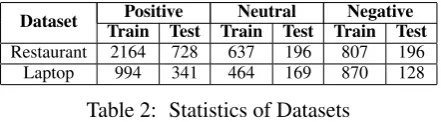
Restaurant. In these datasets, aspect sentiment polarities are labeled. The training and test sets have also been provided. Full statistics of the datasets are given in Table2.
Dataset Positive Neutral Negative Train Test Train Test Train Test
Restaurant 2164 728 637 196 807 196
[image:6.595.307.528.480.541.2]Laptop 994 341 464 169 870 128
Table 2: Statistics of Datasets
6.1 Candidate Models for Comparison
MN: The classic end-to-end memory
net-work (Sukhbaatar et al.,2015).
with a state-of-the-art attention-based LSTM for ASC, AE-LSTM (Wang et al.,2016).
ATAE-LSTM: Another attention-based LSTM for ASC reported in (Wang et al.,2016).
Target-sensitive Memory Networks (TMNs): The six proposed techniques, NP, CNP, IT, CI, JCI, and JPI give six target-sensitive memory networks.
Note that other non-neural network based mod-els like SVM and neural modmod-els without atten-tion mechanism like tradiatten-tional LSTMs have been compared and reported with inferior performance in the ASC task (Dong et al., 2014; Tang et al.,
2016; Wang et al., 2016), so they are excluded from comparisons here. Also, note that non-neural models like SVMs require feature engineering to manually encode aspect information, while this work aims to improve the aspect representation learning based approaches.
6.2 Evaluation Measure
Since we have a three-class classification task (positive, negative and neutral) and the classes are imbalanced as shown in Table2, we use F1-score as our evaluation measure. We report both F1-Macro over all classes and all individual class-based F1 scores. As our problem requires fine-grained sentiment interaction, the class-based F1 provides more indicative information. In addition, we report the accuracy (same as F1-Micro), as it is used in previous studies. However, we suggest us-ing F1-score because accuracy biases towards the majority class.
6.3 Training Details
We use the open-domain word embeddings1 for the initialization of word vectors. We initialize other model parameters from a uniform distribu-tion U(-0.05, 0.05). The dimension of the word embedding and the size of the hidden layers are 300. The learning rate is set to 0.01 and the dropout rate is set to 0.1. Stochastic gradient de-scent is used as our optimizer. The position encod-ing is also used (Tang et al.,2016). We also pare the memory networks in their multiple com-putational layers version (i.e., multiple hops) and the number of hops is set to 3 as used in the men-tioned previous studies. We implemented all mod-els in the TensorFlow environment using same in-put, embedding size, dropout rate, optimizer, etc.
1
https://github.com/mmihaltz/word2vec-GoogleNews-vectors
so as to test our hypotheses, i.e., to make sure the achieved improvements do not come from else-where. Meanwhile, we can also report all evalua-tion measures discussed above2. 10% of the train-ing data is used as the development set. We report the best results for all models based on their F-1 Macro scores.
6.3.1 Result Analysis
The classification results are shown in Table 3. Note that the candidate models are all based on classic/standard attention mechanism, i.e., without sophisticated or multiple attentions involved. We compare the 1-hop and 3-hop memory networks as two different settings. The top three F1-Macro scores are marked in bold. Based on them, we have the following observations:
1. Comparing the 1-hop memory networks (first nine rows), we see significant performance gains achieved by CNP, CI, JCI, and JPI on both datasets, where each of them hasp <
0.01 over the strongest baseline (BL-MN) from pairedt-test using F1-Macro. IT also outperforms the other baselines while NP has similar performance to BL-MN. This indi-cates that TCS interaction is very useful, as BL-MN and NP do not model it.
2. In the 3-hop setting, TMNs achieve much better results on Restaurant. JCI, IT, and CI achieve the best scores, outperforming the strongest baseline AMN by 2.38%, 2.18%, and 2.03%. On Laptop, BL-MN and most TMNs (except CNP and JPI) perform sim-ilarly. However, BL-MN performs poorly on Restaurant (only better than two models) while TMNs show more stable performance. 3. Comparing all TMNs, we see that JCI works the best as it always obtains the top-three scores on two datasets and in two settings. CI and JPI also perform well in most cases. IT, NP, and CNP can achieve very good scores in some cases but are less stable. We also ana-lyzed their potential issues in Section4. 4. It is important to note that these
improve-ments are quite large because in many cases sentiment interactions may not be necessary (like sentence (1) in Section 1). The overall good results obtained by TMNs demonstrate their capability of handling both general and target-sensitive sentiments, i.e., the proposed
Restaurant Laptop
Model Macro Neg. Neu. Pos. Micro Model Macro Neg. Neu. Pos. Micro
MN 58.91 57.07 36.81 82.86 71.52 MN 56.16 47.06 45.81 75.63 61.91
AMN 63.82 61.76 43.56 86.15 75.68 AMN 60.01 52.67 47.89 79.48 66.14
BL-MN 64.34 61.96 45.86 85.19 75.30 BL-MN 62.89 57.16 49.51 81.99 68.90
NP 64.62 64.89 43.21 85.78 75.93 NP 62.63 56.43 49.62 81.83 68.65
CNP 65.58 62.97 47.65 86.12 75.97 CNP 64.38 57.92 53.23 81.98 69.62
IT 65.37 65.22 44.44 86.46 76.98 IT 63.07 57.01 50.62 81.58 68.38
[image:8.595.75.521.62.288.2]CI 66.78 65.49 48.32 86.51 76.96 CI 63.65 57.33 52.60 81.02 68.65 JCI 66.21 65.74 46.23 86.65 77.16 JCI 64.19 58.49 53.69 80.40 68.42 JPI 66.58 65.44 47.60 86.71 76.96 JPI 64.53 58.62 51.71 83.25 70.06 AE-LSTM 66.45 64.22 49.40 85.73 76.43 AE-LSTM 62.45 55.26 50.35 81.74 68.50 ATAE-LSTM 65.41 66.19 43.34 86.71 76.61 ATAE-LSTM 59.41 55.27 42.15 80.81 67.40 MN (hops) 62.68 60.35 44.57 83.11 72.86 MN (hops) 60.61 55.59 45.94 80.29 66.61 AMN (hops) 66.46 65.57 46.64 87.16 77.27 AMN (hops) 65.16 60.00 52.56 82.91 70.38 BL-MN (hops) 65.71 63.83 46.91 86.39 76.45 BL-MN (hops) 67.11 63.10 54.53 83.69 72.15 NP (hops) 65.98 64.18 47.86 85.90 75.73 NP (hops) 67.79 63.17 56.27 83.92 72.43 CNP (hops) 66.87 65.32 49.07 86.22 76.65 CNP (hops) 64.85 58.84 53.29 82.43 70.25 IT (hops) 68.64 67.11 51.47 87.33 78.55 IT (hops) 66.23 61.43 53.69 83.57 71.37 CI (hops) 68.49 64.83 53.03 87.60 78.69 CI (hops) 66.79 61.80 55.30 83.26 71.67 JCI (hops) 68.84 66.28 52.06 88.19 78.79 JCI (hops) 67.23 61.08 57.49 83.11 71.79 JPI (hops) 67.86 66.72 49.63 87.24 77.95 JPI (hops) 65.16 59.01 54.25 82.20 70.18
Table 3: Results of all models on two datasets. Top three F1-Macro scores are marked in bold. The first nine models are 1-hop memory networks. The last nine models are 3-hop memory networks.
techniques do not bring harm while capturing additional target-sensitive signals.
5. Micro-F1/accuracy is greatly affected by the majority class, as we can see the scores from Pos. and Micro are very consistent. TMNs, in fact, effectively improve the minority classes, which are reflected in Neg. and Neu., for example, JCI improves BL-MN by 3.78% in Neg. on Restaurant. This indicates their use-fulness of capturing fine-grained sentiment signals. We will give qualitative examples in next section to show their modeling superior-ity for identifying target-sensitive sentiments.
Restaurant
Model Macro Neg. Neu. Pos. Micro TRMN 69.00 68.66 50.66 87.70 78.86 RMN 67.48 66.48 49.11 86.85 77.14
Laptop
Model Macro Neg. Neu. Pos. Micro TRMN 68.18 62.63 57.37 84.30 72.92 RMN 67.17 62.65 55.31 83.55 72.07
Table 4: Results with Recurrent Attention
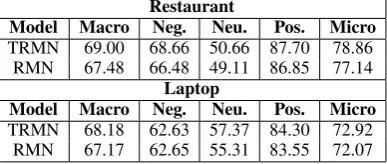
Integration with Improved Attention: As dis-cussed, the goal of this work is not for learn-ing better attention but addresslearn-ing the target-sensitive sentiment. In fact, solely improving at-tention does not solve our problem (see Sections1
and 3). However, better attention can certainly help achieve an overall better performance for the ASC task, as it makes the targeted-context detec-tion more accurate. Here we integrate our
pro-posed technique JCI with a state-of-the-art sophis-ticated attention mechanism, namely, the recurrent attention framework, which involves multiple at-tentions learned iteratively (Kumar et al., 2016;
Chen et al.,2017). We name our model with this integration as Target-sensitive Recurrent-attention Memory Network (TRMN) and the basic memory network with the recurrent attention as Recurrent-attention Memory Network (RMN). Their results are given in Table4. TRMN achieves significant performance gain withp <0.05in pairedt-test.
6.4 Effect of TCS Interaction for Identifying Target-Sensitive Sentiment
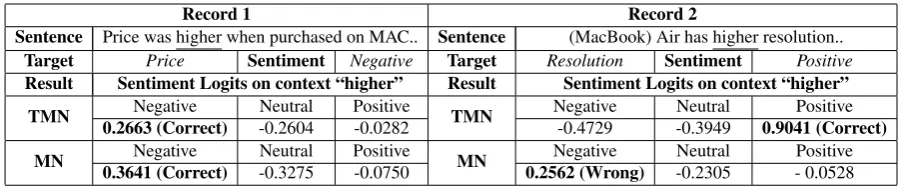
We now give some real examples to show the effectiveness of modeling TCS interaction for identifying target-sensitive sentiments, by com-paring a regular MN and a TMN. Specifically,
BL-MN and JPI are used. Other MNs/TMNs
have similar performances to BL-MN/JPI qual-itatively, so we do not list all of them here. For BL-MN and JPI, their sentiment scores of a single context word i are calculated by
αiW ci (from Eq. 3) and αiWJtanh(W1ci) +
αiWJhdi, dtitanh(W2ci) (from Eq. 9), each of which results in a 3-dimensional vector.
[image:8.595.85.279.532.614.2]Record 1 Record 2
Sentence Price was higher when purchased on MAC.. Sentence (MacBook) Air has higher resolution.. Target Price Sentiment Negative Target Resolution Sentiment Positive Result Sentiment Logits on context “higher” Result Sentiment Logits on context “higher”
TMN Negative Neutral Positive TMN Negative Neutral Positive
0.2663 (Correct) -0.2604 -0.0282 -0.4729 -0.3949 0.9041 (Correct)
MN Negative Neutral Positive MN Negative Neutral Positive
[image:9.595.73.525.61.154.2]0.3641 (Correct) -0.3275 -0.0750 0.2562 (Wrong) -0.2305 - 0.0528
Table 5: Sample Records and Model Comparison between MN and TMN
specific sentiment scores of the word “higher” to-wards negative, neutral and positive classes in both models are reported. We can see both models accurately assign the highest sentiment scores to the negative class. We also observe that in MN the negative score (0.3641) in the 3-dimension vector{0.3641,−0.3275,−0.0750}calculated by
αiW ci is greater than neutral (−0.3275) and pos-itive (−0.0750) scores. Notice that αi is always positive (ranging in (0,1)), so it can be inferred that the first value in vector W ci is greater than the other two values. Here ci denotes the vec-tor representation of “higher” so we usechigher to highlight it and we have {W chigher}N egative >
{W chigher}N eutral/P ositiveas an inference. In record 2, the target isresolutionand its sen-timent is positive in the presented sentence. Al-though we have the same context word “higher”, different from record 1, it requires a positive sen-timent interaction with the current target. Look-ing at the results, we see TMN assigns the high-est sentiment score of word “higher” to positive class correctly, whereas MN assigns it to neg-ative class. This error is expected if we con-sider the above inference {W chigher}N egative >
{W chigher}N eutral/P ositive in MN. The cause of this unavoidable error is that W ci is not conditioned on the target. In contrast,
WJhdi,·dtitanh(W2ci)can change the sentiment polarity with the aspect vectordtencoded. Other TMNs also achieve it (likeWIhdi, dticiin JCI).
One may notice that the aspect information (vt) is actually also considered in the form ofαiW ci+
W vtin MNs and wonder whetherW vtmay help address the problem given differentvt. Let us as-sume it helps, which means in the above exam-ple an MN makesW vresolution favor the positive class and W vprice favor the negative class. But then we will have trouble when the context word is “lower”, where it requiresW vresolutionto favor the negative class and W vprice to favor the posi-tive class. This contradiction reflects the theoreti-cal problem discussed in Section 3.
Other Examples:We also found other interesting target-sensitive sentiment expressions like “large bill” and “large portion”, “small tip” and “small portion” from Restaurant. Notice that TMNs can also improve the neutral sentiment (see Ta-ble3). For instance, TMN generates a sentiment score vector of the context “over” for target as-pect price: {0.1373, 0.0066, -0.1433} (negative) and for target aspect dinner: {0.0496, 0.0591, -0.1128} (neutral) accurately. But MN produces both negative scores {0.0069, 0.0025, -0.0090}
(negative) and {0.0078, 0.0028, -0.0102} (nega-tive) for the two different targets. The latter one in MN is incorrect.
7 Conclusion and Future Work
In this paper, we first introduced the target-sensitive sentiment problem in ASC. After that, we discussed the basic memory network for ASC and analyzed the reason why it is incapable of cap-turing such sentiment from a theoretical perspec-tive. We then presented six techniques to construct target-sensitive memory networks. Finally, we re-ported the experimental results quantitatively and qualitatively to show their effectiveness.
Since ASC is a fine-grained and complex task, there are many other directions that can be further explored, like handling sentiment negation, better embedding for multi-word phrase, analyzing sen-timent composition, and learning better attention. We believe all these can help improve the ASC task. The work presented in this paper lies in the direction of addressing target-sensitive sentiment, and we have demonstrated the usefulness of cap-turing this signal. We believe that there will be more effective solutions coming in the near future.
Acknowledgments
References
Dzmitry Bahdanau, Kyunghyun Cho, and Yoshua
Ben-gio. 2015. Neural machine translation by jointly
learning to align and translate. InInternational Con-ference on Learning Representations.
Peng Chen, Zhongqian Sun, Lidong Bing, and Wei Yang. 2017. Recurrent attention network on
mem-ory for aspect sentiment analysis. In Empirical
Methods in Natural Language Processing, pages 452–461.
Kyunghyun Cho, Aaron Courville, and Yoshua
Ben-gio. 2015. Describing multimedia content
us-ing attention-based encoder-decoder networks. In IEEE Transactions on Multimedia, pages 1875– 1886. IEEE.
Yejin Choi and Claire Cardie. 2008. Learning with
compositional semantics as structural inference for
subsentential sentiment analysis. In Empirical
Methods in Natural Language Processing, pages 793–801.
Li Deng, Dong Yu, et al. 2014. Deep learning: methods
and applications. In Foundations and TrendsR in
Signal Processing, pages 197–387. Now Publishers, Inc.
Xiaowen Ding, Bing Liu, and Philip S Yu. 2008. A holistic lexicon-based approach to opinion mining. In ACM International Conference on Web Search and Data Mining, pages 231–240.
Li Dong, Furu Wei, Chuanqi Tan, Duyu Tang, Ming Zhou, and Ke Xu. 2014. Adaptive recursive neural network for target-dependent twitter sentiment clas-sification. InAnnual Meeting of the Association for Computational Linguistics, pages 49–54.
Karl Moritz Hermann, Tomas Kocisky, Edward
Grefenstette, Lasse Espeholt, Will Kay, Mustafa
Su-leyman, and Phil Blunsom. 2015. Teaching
ma-chines to read and comprehend. InAdvances in
Neu-ral Information Processing Systems, pages 1693– 1701.
Minqing Hu and Bing Liu. 2004. Mining and
summa-rizing customer reviews. In ACM SIGKDD
Inter-national Conference on Knowledge Discovery and Data Mining, pages 168–177.
Yoon Kim. 2014. Convolutional neural networks for
sentence classification. In Empirical Methods in
Natural Language Processing, pages 1746–1751.
Ankit Kumar, Ozan Irsoy, Peter Ondruska, Mohit Iyyer, James Bradbury, Ishaan Gulrajani, Victor Zhong, Romain Paulus, and Richard Socher. 2016. Ask me anything: Dynamic memory networks for
natural language processing. InInternational
Con-ference on Machine Learning, pages 1378–1387.
Bing Liu. 2012. Sentiment analysis and opinion
min-ing. InSynthesis lectures on human language
tech-nologies. Morgan & Claypool Publishers.
Jiangming Liu and Yue Zhang. 2017. Attention
mod-eling for targeted sentiment. In European
Chap-ter of the Association for Computational Linguistics, pages 572–577.
Yue Lu, Malu Castellanos, Umeshwar Dayal, and
ChengXiang Zhai. 2011. Automatic construction
of a context-aware sentiment lexicon: an
optimiza-tion approach. InACM International Conference on
World Wide Web, pages 347–356.
Thang Luong, Hieu Pham, and Christopher D Man-ning. 2015. Effective approaches to attention-based neural machine translation. InEmpirical Methods in Natural Language Processing, pages 1412–1421.
Dehong Ma, Sujian Li, Xiaodong Zhang, and Houfeng
Wang. 2017. Interactive attention networks for
aspect-level sentiment classification. In
Interna-tional Joint Conference on Artificial Intelligence, pages 4068–4074.
Karo Moilanen and Stephen Pulman. 2007. Sentiment
composition. InRANLP, pages 378–382.
Thien Hai Nguyen and Kiyoaki Shirai. 2015.
Phrasernn: Phrase recursive neural network for
aspect-based sentiment analysis. In Empirical
Methods in Natural Language Processing, pages 2509–2514.
Bo Pang, Lillian Lee, and Shivakumar Vaithyanathan. 2002. Thumbs up?: sentiment classification using
machine learning techniques. InEmpirical Methods
in Natural Language Processing, pages 79–86.
Livia Polanyi and Annie Zaenen. 2006. Contextual va-lence shifters. InComputing attitude and affect in text: Theory and applications, pages 1–10. Springer.
Maria Pontiki, Dimitris Galanis, John Pavlopoulos, Haris Papageorgiou, Ion Androutsopoulos, and Suresh Manandhar. 2014. Semeval-2014 task4:
As-pect based sentiment analysis. InProWorkshop on
Semantic Evaluation (SemEval-2014). Association for Computational Linguistics.
Richard Socher, Alex Perelygin, Jean Wu, Jason Chuang, Christopher D Manning, Andrew Ng, and
Christopher Potts. 2013. Recursive deep models
for semantic compositionality over a sentiment
tree-bank. InEmpirical Methods in Natural Language
Processing, pages 1631–1642.
Sainbayar Sukhbaatar, Jason Weston, Rob Fergus, et al.
2015. End-to-end memory networks. InAdvances
in neural information processing systems, pages 2440–2448.
Duyu Tang, Bing Qin, and Ting Liu. 2016. Aspect level sentiment classification with deep memory
net-work. InEmpirical Methods in Natural Language
Yequan Wang, Minlie Huang, Li Zhao, et al. 2016. Attention-based lstm for aspect-level sentiment
clas-sification. In Empirical Methods in Natural
Lan-guage Processing, pages 606–615.
Jason Weston, Sumit Chopra, and Antoine Bordes.
2015. Memory networks. InInternational
Confer-ence on Learning Representations.
Yunfang Wu and Miaomiao Wen. 2010.
Disambiguat-ing dynamic sentiment ambiguous adjectives. In
In-ternational Conference on Computational Linguis-tics, pages 1191–1199.
Zichao Yang, Diyi Yang, Chris Dyer, Xiaodong He, Alex Smola, and Eduard Hovy. 2016. Hierarchi-cal attention networks for document classification. In North American Chapter of the Association for Computational Linguistics: Human Language Tech-nologies, pages 1480–1489.