Munich Personal RePEc Archive
Modelling the impact of social media
influencers on behavioural intentions of
millennials: The case of tourism in rural
areas in Greece
Chatzigeorgiou, Chryssoula
Alexander Technological Institute of Thessaloniki
31 December 2017
Online at
https://mpra.ub.uni-muenchen.de/87916/
Modelling the impact of social media influencers on
behavioural intentions of millennials: The case of
tourism in rural areas in Greece
Chryssoula Chatzigeorgiou
Alexander Technological Institute of Thessaloniki
Some rights reserved.
Except otherwise noted, this work is licensed under:
https://creativecommons.org/licenses/by-nc-nd/4.0
A previous version of this paper was published in: Journal of Tourism, Heritage & Services Marketing,
Volume 3, Issue 2, 2017, pp. 25-29,
http://doi.org/10.5281/zenodo.1209125
Abstract: This paper examines the ways rural businesses can become attractive to millennials using the Internet and the social media. It has become evident that the prominent way to reach out to millennials is via social media accounts. Rural businesses need to use the personal relationships they develop with their customers and expand these relationships on social media. It is also apparent that traditional marketing fails to apply to small rural businesses, whereas influencer marketing becomes a valuable asset for tourism. The proposed model connects fame, image and activities with the Social Media influencer and the way the decision making of the millennials is influenced when choosing to visit a rural tourism destination, resulting to economic growth and development of rural areas.
Keywords: Rural tourism marketing, social media, influencer marketing, millennials
JEL Classification: L83, M1, O1
Biographical note: Chryssoula Chatzigeorgiou holds a doctorate in agrotourism marketing from the University of the Aegean and is a staff member of the Alexander Technological Educational Institute of Thessaloniki, Greece. Corresponding author: Chryssoula Chatzigeorgiou, e-mail: [email protected]
1 INTRODUCTION
Service quality, customer satisfaction and re-visit intentions are some of the factors greatly researched being the key factors to ensure profitability and viability of a business (Christou, 2015). Marketing experts relied on developing guest loyalty through service quality aiming at returning customers. Emotions have also been examined to contribute in that sense (Chatzigeorgiou et al., 2009).
The relationship among service quality, guest satisfaction and re-visit intentions in rural tourism have also been researched (Chatzigeorgiou & Simeli, 2017). The key element, though, behind purchase is the concept of trust (Christou, 2015). Trust needs to be further examined in order to establish the factors needed to form trust in a brand. Social media, on the other hand, is also a significant factor, which influences trust and is directly linked to viral marketing. Viral marketing is the process of individuals marketing to each other (Subramani & Rajagopalan, 2003).
According to Christou (2015), individuals who may act as social media influencers are trusted based on their reputation, predictability and competence.
Woods (2016) supports that force of persuasion rather than share voice is more powerful when it comes to measure the influential power of the influencer on the decision maker. Market reach, frequency of impact quality of impact and closeness to decision are the criteria of a four-dimension metric used by Brown and Hayes (2008) to measure influence. The present study aims to identify the key factors when measuring influence related to rural tourism.
2 SOCIAL MEDIA AND TOURISM
Television traditionally had the largest share in paid advertising but in 2017 digital advertising spending surpassed it (Woods, 2016).
Nowadays, anyone can become an influencer. Social media provide the tool to anyone who builds an audience, to influence that audience. The marketing industry needed to cope with the growth of social media users and especially the millennials, the generation with the biggest purchasing power.
Recent studies reveal that consumers tend to believe recommendations from friends over all forms of advertising (Woods, 2016) and it is proved to trigger 11 times more return on investment than other forms of advertising (Kirkpatrick, 2018).
In 2017, 67% of the individuals who used the Internet logged in their Social Media account at least once a day (Eurostat, 2018), while 50% of individuals aged 16 to 74 (close to the EU - 28 respective percentage, which in 2017 was 54%) use the Internet to participate in social networks.
A person's identity comprises, nowadays, of daily posts, shared photos, profile updates and post comments. In order to maintain personal relationships and be socially active, a Social Media account is by far a prerequisite. (Tsay-Vogel, 2016).
3 RURAL TOURISM, MARKETING AND MILLENNIALS
Each generation has its own values, expectation, skills and interests.
Generation Y includes people whose birth years are 1988-2002 and it is split into three different age groups: Generation Why (1982-1985), Millennials (MilGens 1985-1999) and iGeneration (1999-2002). Millennials are the central part of the Y generation (Pendergast, 2010).
Bennett (2014) claims that 74% of consumers make their purchasing decisions based on social media. The millennials are the age group with the most purchasing power and the most active one in social media. It is the age group where connecting to others is highly important.
Generation Y is also the hero generation based on their stage of cycle, digital natives (Prensky, 2012) and their main features include digital competences, conventional, committed, they produce key influential international leaders. Furthermore, Generation Y focus on how they feel, their friends and they are the most educated generation ever. They constitute the new visitors in the tourism market (Pendergast, 2010).
According to Iakovidou et al., (2005) the majority of rural tourists comprises of young people (19-35 years old - millennials), highly educated who choose a rural destination according to the remarkable natural resources the destination has to offer. Millennials is the target age group of the current study.
Rural tourism was considered to be a small scale, low-impact phenomenon a "niche" within tourism markets stemming from sustainable development (Hall & Roberts, 2004, Lane, 1995, Küçükaltan, 2016) in contrast to the contemporary state where tourists are motivated by a wide spectrum of factors not necessarily related to the rural landscape. Recreation has become a significant factor and raises questions regarding the proper planning and management of rural areas (Hall, et al., 2017).
Traditional marketing operations may not apply in small rural businesses making it hard for the owners to realize the market within which their business operates (Lane, 1995, Gossling and Lane, 2014). However, they are usually well aware of their customers' needs. Rural economies have by now diversified from agriculturally - centered to service - based economies (Gossling and Lane, 2014), making the way tourists consume the services, the experience of tourism, more important than both the tourist and the service (Hold, 1995).
Tourism in rural areas includes tourism in natural landscape, tourism focusing on wildlife and tourism aiming at preserving the natural environment (Hall and Boyd, 2005). It has been proved that the location itself is less important than the activities carried out in the rural areas. Now, tourists explore countryside in greater numbers compared to the smaller numbers in the past (Hall et al., 2017). Rural tourism providers need to identify those activities that may be carried out in the countryside and be attractive to millenials. Thus, tourism in rural areas may come much closer to millenials and their lifestyle. Marketing those activities and tourism in rural areas should also become compatible to millennials. As millennials are the digital natives (Prensky, 2012), Internet - based booking platforms became a necessity for the survival of tourism businesses. Rural tourism businesses could not afford to ignore this marketing trend bringing fundamental changes in rural tourism marketing (Gossling & Lane, 2014).
Combining this necessity with Internet based booking platforms and social media, the owners of rural properties have now the opportunity of an e-adoption ladder (Martin, 2004) including email, social media (Facebook, Instagram, etc).
Social media is the ability for anyone to communicate with everyone. It includes six broad categories:, forums and message boards, review and opinion sites, social networks, blogging, microbloogging, bookmarking and media sharing (Sterve, 2010). Research on social media is carried out in various fields, museums (Zafiropoulos et al., 2015), destination image (Hernandez et al., 2016), travel information (Xiang & Gretzel, 2010), etc.
The impact of written reviews on social media can be damaging for a business (Papathanassis & Knowlle, 2011) making the social media engagement a one way road in the thrive of a rural business to survive and adopt to the rapidly changing marketing environment (Jeong & Jeon, 2008).
4 FORMULATION OF HYPOTHESES AND PROPOSED MODEL
Rural businesses in Greece made a huge contribution within the economic crisis for young people. Well-educated, unemployed young people searching for a dignified employment pursued their professional future by returning to families' homes and businesses in rural areas. Young people who are digital competent and seek to attract people of their age to seek authenticity and experience activities in rural areas.
2017). Millennials tend to accept meanings from Social media influencers whom they admire or consider as a resemblance to themselves. In this framework social media famous people (actors, singers ets) may use their digital expertise in order to influence millennials to visit rural area settlements (Hypothesis 1: Famous people strongly influence millennials to visit a rural tourism settlement).
According to Hall et al., 2017, influencer marketing is defined according to the number of friends/followers the influencer supports. It is hypothesised that: The number of followers of the influencer positively influences the trust of a millennial in an influencer marketing (Hypothesis 2).
However, since the millennials are well-educated young people, they need to identify that the influencer actually believes in rural tourism values and authenticity is one of the features of the influencer's personality. It is therefore hypothesised that:
- The rural tourism values the influencer marketing embraces affect the trust of a millennial in an influencer marketing (Hypotheses 3)
- The authentic experience the influencer marketing communicates via social media influences the trust of a millennial in an influencer marketing (Hypotheses 4) Finally, the fee an influencer marketing may receive in order to promote a product or a service may act as a burden in the efficacy of the campaign. It is therefore hypothesized that The fee an influencer marketing receives negatively influences the target audience (Hypothesis 5).
The final hypothesis is connected to the average use of social media. It is hypothesized that the daily use of social media affects the influential rate of the influencer marketing (Hypothesis 6).
[image:4.595.313.557.416.769.2]The proposed model is as follows:
Figure 1: Research model
5 FINDINGS AND TESTING OF HYPOTHESES
The target population for the study was millennials (age group 19-33). Respondents were given a structured questionnaire and were asked to think of their social media accounts and their attitudes when interacting in social media when responding.
The measures of each construct derived from multiple sources; participants were asked to record the average daily use of Social Media (Shrum et al., 1998). Trust was measured via the respondent's faith in the social media used (Christou,
2011) whereas brand linking involved the millenial's preference of a social media brand over others. Brand experience and satisfaction were also measured using Oliver's scale (1997) and influencers were measured using Sheer & Stern (1992) metrics.
The questionnaire was pilot tested by 23 millennials. There were 273 usable questionnaires out of which 93 (33,8) were filled in by men and 180 (65,5%) were responded by women. The sample size satisfies the required minimum sample size for the use of structural equation modelling technique (Bollen, 1989).
The respondents were approached during three youth festivals which took place in Athens, Thessaloniki and Patras respectively.
There were no problems with convergent and discriminant validity and factor analysis was used to examine the construct validity of the measures. Cronbach alpha of 0.70 as needed by Nunnally (1978) was exceeded by all scales.
AMOS extension in the SPSS 24.0 was used to test the hypotheses. The fitness of the measurement model to the data was initially examined and then the fitness of the theoretical model was tested.
An important prerequisite in order to use SEM methodology is for the data to be normally distributed. In the current study both skewness and kurtosis are within the acceptable range so as to use SEM.
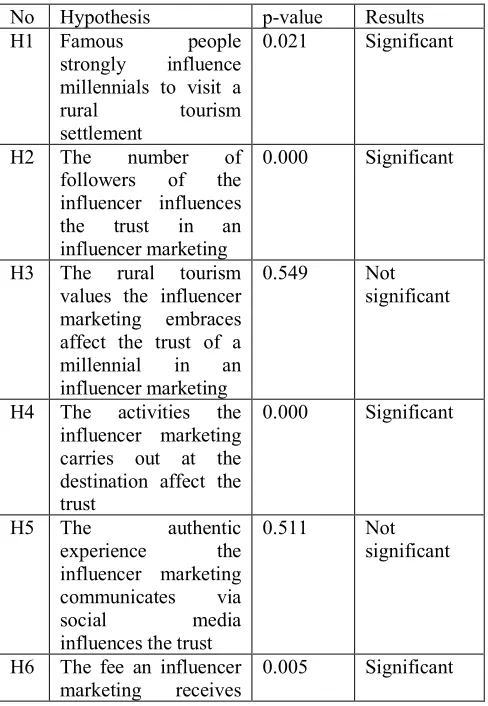
[image:4.595.47.297.459.639.2]According to table 1, four out of six hypotheses tested were found significant.
Table 1: Hypotheses significance test
No Hypothesis p-value Results H1 Famous people
strongly influence millennials to visit a rural tourism settlement
0.021 Significant
H2 The number of followers of the influencer influences the trust in an influencer marketing
0.000 Significant
H3 The rural tourism values the influencer marketing embraces affect the trust of a millennial in an influencer marketing
0.549 Not significant
H4 The activities the influencer marketing carries out at the destination affect the trust
0.000 Significant
H5 The authentic experience the influencer marketing communicates via
social media
influences the trust
0.511 Not significant
H6 The fee an influencer marketing receives
0.005 Significant
negatively influences the target audience H7 The daily use of social
media affects the influential rate of the influencer marketing
0.003 Significant
Results showed a strong negative relationship between the number of followers and the attitude of the social media users when it comes to influencer marketing reviews (Pearson's r=-0,778). As stated by previous studies, millennials focus on their friends and families and trust their reviews regarding a destination (r=0,633) and they consider their friends' reviews to be realistic. However, this is not the case when it comes to influencer marketing since millennials trust one of their friends or one of their age better over a famous influencer marketing. It appears that the age of the influencer marketing is an important factor when measuring the influence over the millennials.
The fit indices for the structural model (NFCI=0.92, RNFI=0.99) provide evidence that the number of followers, the personality and the authenticity of the activities strongly influence the trust of the millennials in an influencer marketing when discussing tourism in rural areas who in turn influences the millennials when they make a decision to visit a rural tourism area.
6 CONCLUDING REMARKS
The present study is of great importance to rural business owners. Firstly, because due to economic crisis the rural business owners seem to be younger in age in contract to previous years when the owners were over 50 years of age. Secondly, because the influencer marketing is a tool of viral marketing that can be of great use to owners who do not have the necessary skills to market their own businesses. And finally, because millennials are the new force in the tourism market and they need to be approached in their own terms of communication which is social media. Combining the three afore mentioned key elements the present study introduces a new approach to viable businesses in rural areas.
This study suggests that influencer marketing influences the decision making of millennials when choosing a rural tourism area as a potential destination. Millennials' trust in influencer marketing is defined by the number of followers the influencer marketing has, the personality expressed through social media posts and remarks and the activities presented using photos, videos and posts.
To increase the attractiveness of tourism in rural areas, business owners need to turn to millennials and use the tools the technology may provide in order to cope with the digital development of the era.
Further study needs to be developed in order to identify the activities that would be more attractive to millennials who are the active players through creating content and communicating images, videos or audio files. Realizing their potential may lead to a new era for tourism in rural areas.
REFERENCES
Bennett, S. (2014). Social media business statistics, facts, figures & trends 2014. Social Times. Available at http://www.adweek.com/socialtimes/social-business-trends-2014/498129 (accessed 6-11-2017).
Bollen, K.A. (1989). Structural equations with latent variables. New York: John Wiley and Sons.
Brown, D., Hayes, N. (2008). Influencer Marketing: Who really influences your customers? Oxford: Elsevier
Chatzigeorgiou, C., Simeli, I. (2017). Perception of service quality in agrotourism accommodations: Impact on guest loyalty and re-visit intentions. Journal of Tourism, Heritage & Services Marketing, Vol. 3, No. 1, pp 33-41
Chatzigeorgiou, C., Christou, E., Kassianidis, P., Sigala, M. (2009). Examining the relationship between emotions, customer satisfaction and future behavioural intentions in agrotourism. TOURISMOS: AN INTERNATIONAL MULTIDISCIPLINARY JOURNAL OF TOURISM, Volume 4, Number 4, pp. 145-161
Christou, E. (2015). Branding social media in the travel industry. Social and Behavioral Sciences, Vol. 175, pp 607-614.
Christou, E. (2011). Exploring online sales promotions in the hospitality industry. Journal of Hospitality Marketing & management, Vol. 20, No. 7 pp 814-829.
Eurostat (2018). Individuals who used the internet, frequency of use and activities Available at appso.eurostat.ec.europa.eu/nui/show.do?dataset=isoc_r_iuse _i&lang=en (accessed 6-11-2017).
Facebook (2017). Facebook Reports Fourth Quarter and Full Year 2017 Results. Available at https://investor.fb.com/investor- news/press-release-details/2018/Facebook-Reports-Fourth-Quarter-and-Full-Year-2017-Results/default.aspx, (accessed 20/12/2017)
Gossling, S., Lane, B. (2014). Rural tourism and the development of Internet - based accommodation booking platforms: a study in the advantages, dangers and implications of innovation. Journal of Sustainable Tourism, DOI: 10.080/09669582.2014.909448.
Hall, D., Roberts, L., Mitchell, M. (2017). New directions in rural tourism. Routledge.
Hall, C.M., Boyd, S., (eds) (2005). Aspects of tourism: Nature – based tourism in peripheral areas: Development or Disaster? Clevedon: Channel View Publications.
Hall, D., Roberts, L. (2004). Consuming the countryside: Marketing for rural tourism. Journal of Vacation Marketing, Vol. 10, No. 3, pp: 253-263.
Holt, D (1995). How consumers consume: A typology of consumption practices. Journal of Consumer Research, Vol 22, pp 1-16.
Iakovidou, O., Koutsou, S., Vlahou, H. (2005). Mediterranena tourism beyond the shores: New trends in tourism and social organization of landscape (In Greek). Thessaloniki: Ziti Editions
Jeong, M., Jeon, M.M. (2008). Customer reviews of hotel experineces through consumer generated media (CGM). Journal of Hospitality & Leisure Marketing, Vol. 17, No. 1-2, pp: 121-138.
Kirkpatrick, N. (2018). Sport business and marketing collaboration in higher education. Journal of Hospitality, Leisure, Sport & Tourism Education, Vol. 22, pp. 7-13.
Küçükaltan, G. & Pirnar, I. (2016). Competitiveness factors of a tourism destination and impact on residents' quality of life: The case of Cittaslow - Seferihisar. Journal of Tourism, Heritage & Services Marketing, Vol. 2, No. 1, pp 22-29. http://doi.org/10.5281/zenodo.376332.
Lane, B. (1995). Niche markets and rural development, OECD, Paris.
Lim, X.J., Radzol, M., Cheah, J.H., Wong, M.W. (2017). The impact of social media influencers on purchase intention and the mediation effect of customer attitude. Asian Journal of Business Research, Vol. 7 No. 2, pp19-36.
Martin, L.M. (2004). E-innovation: Internet impacts on small UK hospitality firms. International Journal on Contemporary Hospitality Management, Vol. 166, No. 2, pp. 82-90. Oliver, R.L., (1997). Satisfaction: A behavioral perspective on the
customer, New York: McGraw-Hill.
Papathanassis, A., Knolle, F. (2011). Exploring the adoption and processing of online holiday reviews: A grounded theory approach. Tourism Management, Vol. 32, pp 215-224.
Pendergast, D (2010). Getting to know the Y generation in tourism. In Tourism and Generation Y. Edited by Benckendorf, P., Moscardo G and Pendergast D. CABI.
Prensky, M. (2012). From digital natives to digital wisdom. SAGE.
Sammis, K., Lincoln, C., Pomponi, S. (2016). Influencer Marketing for Dummies. New Jersey: John Wiley & Sons.
Sheer, L. & Stern, L (1992). The effect of influence type and performance outcomes on attitutde toward the influencer. Journal of marketing research, Vol. XXIX, pp128-142.
Shrum, LJ, Wyer, RS, O'Guinn, TC (1998). The effects of television consumption on social perceptions: the use of priming procedures to investigate psychological processes. Journal of Consumer Research, Vol. 24, pp. 447-458.
Sterve, J. (2010). Social media metrics. How to measure and optimize your marketing investment. New Jersey: John Wiley & Sons.
Subramani, M.R. & Rajagopalan, B. (2003). Knowledge - sharing and influence in online social networks via viral marketing. Communications of the ACM, Vol. 46, No. 12, pp 300-307.
Tsay-Voger, M., Shanahan, J., Signorielli, N. (2018). Social media cultivating perceptions of privacy: A 5-year analysis of privacy attitudes and self - disclosure behaviors among Social Media users. New Media & Society, Vol. 20, No. 1, pp. 141-161.
Woods, S. (2016). #Sponsored: The emergence of influencer marketing. University of Tennessee Honors Thesis Projects.
Xiang, Z. & Gretzel, U. (2010). Role of social media in online travel information search. Tourism Management, Vol. 31, Issue 2, pp 179-188.