Proceedings of the 55th Annual Meeting of the Association for Computational Linguistics, pages 793–805 Vancouver, Canada, July 30 - August 4, 2017. c2017 Association for Computational Linguistics
Proceedings of the 55th Annual Meeting of the Association for Computational Linguistics, pages 793–805 Vancouver, Canada, July 30 - August 4, 2017. c2017 Association for Computational Linguistics
Automatic Annotation and Evaluation of Error Types
for Grammatical Error Correction
Christopher Bryant Mariano Felice Ted Briscoe
ALTA Institute Computer Laboratory University of Cambridge
Cambridge, UK
{cjb255, mf501, ejb}@cl.cam.ac.uk
Abstract
Until now, error type performance for Grammatical Error Correction (GEC) sys-tems could only be measured in terms of recall because system output is not anno-tated. To overcome this problem, we in-troduce ERRANT, a grammatical ERRor ANnotation Toolkit designed to automat-ically extract edits from parallel original and corrected sentences and classify them according to a new, dataset-agnostic, rule-based framework. This not only facilitates error type evaluation at different levels of granularity, but can also be used to reduce annotator workload and standardise exist-ing GEC datasets. Human experts rated the automatic edits as “Good” or “Accept-able” in at least 95% of cases, so we ap-plied ERRANT to the system output of the CoNLL-2014 shared task to carry out a de-tailed error type analysis for the first time.
1 Introduction
Grammatical Error Correction (GEC) systems are often only evaluated in terms of overall perfor-mance because system hypotheses are not anno-tated. This can be misleading however, and a sys-tem that performs poorly overall may in fact out-perform others at specific error types. This is sig-nificant because a robustspecialisedsystem is ac-tually more desirable than a mediocregeneral sys-tem. Without an error type analysis however, this information is completely unknown.
The main aim of this paper is hence to rec-tify this situation and provide a method by which parallel error correction data can be automatically annotated with error type information. This not only facilitates error type evaluation, but can also be used to provide detailed error type feedback
to non-native learners. Given that different cor-pora are also annotated according to different stan-dards, we also attempted to standardise existing datasets under a common error type framework.
Our approach consists of two main steps. First, we automatically extract the edits between paral-lel original and corrected sentences by means of a linguistically-enhanced alignment algorithm (Fe-lice et al.,2016) and second, we classify them ac-cording to a new, rule-based framework that re-lies solely on dataset-agnostic information such as lemma and part-of-speech. We demonstrate the value of our approach, which we call the ERRor ANnotation Toolkit (ERRANT)1, by carrying out a detailed error type analysis of each system in the CoNLL-2014 shared task on grammatical er-ror correction (Ng et al.,2014).
It is worth mentioning that despite an in-creased interest in GEC evaluation in recent years (Dahlmeier and Ng, 2012; Felice and Briscoe, 2015;Bryant and Ng,2015;Napoles et al.,2015; Grundkiewicz et al.,2015;Sakaguchi et al.,2016), ERRANT is the only toolkit currently capable of producing error types scores.
2 Edit Extraction
The first stage of automatic annotation isedit ex-traction. Specifically, given an original and cor-rected sentence pair, we need to determine the start and end boundaries of any edits. This is funda-mentally an alignment problem:
We took a guide tour on center city .
We took a guided tour of the city center .
Table 1: A sample alignment between an original and corrected sentence (Felice et al.,2016).
1https://github.com/chrisjbryant/errant
The first attempt at automatic edit extraction was made bySwanson and Yamangil(2012), who simply used the Levenshtein distance to align par-allel original and corrected sentences. As the Levenshtein distance only aligns individual to-kens however, they also merged all adjacent non-matches in an effort to capture multi-token edits. Xue and Hwa (2014) subsequently improved on Swanson and Yamangil’s work by training a max-imum entropy classifier to predict whether edits should be merged or not.
Most recently, Felice et al. (2016) pro-posed a new method of edit extraction using a linguistically-enhanced alignment algorithm sup-ported by a set of merging rules. More specifi-cally, they incorporated various linguistic informa-tion, such as part-of-speech and lemma, into the cost function of the Damerau-Levenshtein2 algo-rithm to make it more likely that tokens with sim-ilar linguistic properties aligned. This approach ultimately proved most effective at approximating human edits in several datasets (80-85% F1), and
so we use it in the present study.
3 Automatic Error Typing
Having extracted the edits, the next step is to as-sign them error types. While Swanson and Ya-mangil (2012) did this by means of maximum entropy classifiers, one disadvantage of this ap-proach is that such classifiers are biased towards their particular training corpora. For example, a classifier trained on the First Certificate in English (FCE) corpus (Yannakoudakis et al.,2011) is un-likely to perform as well on the National Univer-sity of Singapore Corpus of Learner English (NU-CLE) (Dahlmeier and Ng,2012) or vice versa, be-cause both corpora have been annotated according to different standards (cf. Xue and Hwa(2014)). Instead, a dataset-agnostic error type classifier is much more desirable.
3.1 A Rule-Based Error Type Framework To solve this problem, we took inspiration from Swanson and Yamangil’s (2012) observation that most error types are based on part-of-speech (POS) categories, and wrote a rule to classify an edit based only on its automatic POS tags. We then added another rule to similarly differenti-ate between Missing, Unnecessary and
Replace-2Damerau-Levenshtein is an extension of Levenshtein
that also handles transpositions; e.g. AB→BA
ment errors depending on whether tokens were inserted, deleted or substituted. Finally, we ex-tended our approach to classify errors that are not well-characterised by POS, such as Spelling or Word Order, and ultimately assigned all error types based solely on automatically-obtained, ob-jective properties of the data.
In total, we wrote roughly 50 rules. While many of them are very straightforward, significant atten-tion was paid to discriminating between different kinds of verb errors. For example, despite all hav-ing the same correction, the followhav-ing sentences contain different types of common learner errors:
(a) He IS asleep now. [IS→is]: orthography (b) He iss asleep now. [iss→is]: spelling (c) He has asleep now. [has→is]: verb (d) He being asleep now. [being→is]: form (e) He was asleep now. [was→is]: tense
(f) He are asleep now. [are→is]: SVA
To handle these cases, we hence wrote the fol-lowing ordered rules:
1. Are the lower case forms of both sides of the edit the same? (a)
2. Is the original token a real word? (b)
3. Do both sides of the edit have the same lemma? (c)
4. Is one side of the edit a gerund (VBG) or par-ticiple (VBN)? (d)
5. Is one side of the edit in the past tense (VBD)? (e)
6. Is one side of the edit in the 3rd person present tense (VBZ)? (f)
Code Meaning Description / Example
ADJ Adjective big→wide
ADJ:FORM Adjective Form Comparative or superlative adjective errors.goodest→best, bigger→biggest, more easy→easier
ADV Adverb speedily→quickly
CONJ Conjunction and→but
CONTR Contraction n’t→not
DET Determiner the→a
MORPH Morphology Tokens have the same lemma but nothing else in common.quick (adj)→quickly (adv)
NOUN Noun person→people
NOUN:INFL Noun Inflection Count-mass noun errors.informations→information
NOUN:NUM Noun Number cat→cats
NOUN:POSS Noun Possessive friends→friend’s
ORTH Orthography Case and/or whitespace errors.Bestfriend→best friend
OTHER Other Errors that do not fall into any other category (e.g. paraphrasing).at his best→well, job→professional
PART Particle (look) in→(look) at
PREP Preposition of→at
PRON Pronoun ours→ourselves
PUNCT Punctuation !→.
SPELL Spelling genectic→genetic, color→colour
UNK Unknown The annotator detected an error but was unable to correct it.
VERB Verb ambulate→walk
VERB:FORM Verb Form Infinitives (with or without “to”), gerunds (-ing) and participles.to eat→eating, dancing→danced
VERB:INFL Verb Inflection Misapplication of tense morphology.getted→got, fliped→flipped
VERB:SVA Subject-Verb Agreement (He) have→(He) has
VERB:TENSE Verb Tense Includes inflectional and periphrastic tense, modal verbs and passivization.eats→ate, eats→has eaten, eats→can eat, eats→was eaten
[image:3.595.71.527.58.415.2]WO Word Order only can→can only
Table 2: The list of 25 main error categories in our new framework with examples and explanations.
3.2 A Dataset-Agnostic Classifier
One of the key strengths of a rule-based ap-proach is that by being dependent only on auto-matic mark-up information, our classifier is en-tirely dataset independent and does not require la-belled training data. This is in contrast with ma-chine learning approaches which not only learn dataset specific biases, but also presuppose the ex-istence of sufficient quantities of training data.
A second significant advantage of our approach is that it is also always possible to determine precisely why an edit was assigned a particular error category. In contrast, human and machine learning classification decisions are often much less transparent.
Finally, by being fully deterministic, our ap-proach bypasses bias effects altogether and should hence be more consistent.
3.3 Automatic Markup
The prerequisites for our rule-based classifier are that each token in both the original and corrected
sentence is POS tagged, lemmatized, stemmed and dependency parsed. We use spaCy3v1.7.3 for all but the stemming, which is performed by the Lan-caster Stemmer in NLTK.4Since fine-grained POS tags are often too detailed for the purposes of error evaluation, we also map spaCy’s Penn Treebank style tags to the coarser set of Universal Depen-dency tags.5 We use the latest Hunspell GB-large word list6 to help classify non-word errors. The marked-up tokens in an edit span are then input to the classifier and an error type is returned.
3.4 Error Categories
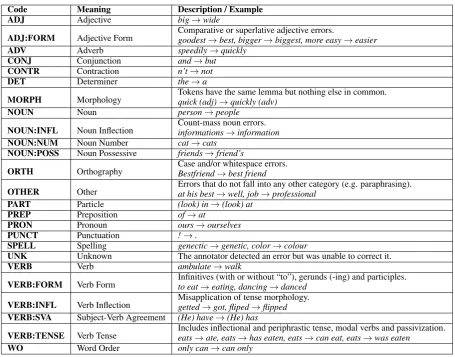
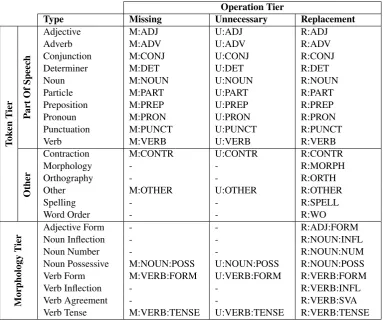
The complete list of 25 error types in our new framework is shown in Table 2. Note that most of them can be prefixed with ‘M:’, ‘R:’ or ‘U:’, depending on whether they describe a Missing, Replacement, or Unnecessary edit, to enable
3https://spacy.io/ 4http://www.nltk.org/
5http://universaldependencies.org/tagset-conversion/
en-penn-uposf.html
6https://sourceforge.net/projects/wordlist/files/speller/
evaluation at different levels of granularity (see Appendix A for all valid combinations). This means we can choose to evaluate, for exam-ple, only replacement errors (anything prefixed by ‘R:’), only noun errors (anything suffixed with ‘NOUN’) or only replacement noun errors (‘R:NOUN’). This flexibility allows us to make more detailed observations about different aspects of system performance.
One caveat concerning error scheme design is that it is always possible to add new categories for increasingly detailed error types; for instance, we currently label [could→should] a tense error, when it might otherwise be considered a modal error. The reason we do not call it a modal er-ror, however, is because it would then become less clear how to handle other cases such as [can
→ should] and [has eaten→ should eat], which might be considered a more complex combination of modal and tense error. As it is impractical to create new categories and rules to differentiate be-tween such narrow distinctions however, our final framework aims to be a compromise between in-formativeness and practicality.
3.5 Classifier Evaluation
As our new error scheme is based solely on au-tomatically obtained properties of the data, there are no gold standard labels against which to evalu-ate classifier performance. For this reason, we in-stead carried out a small-scale manual evaluation, where we simply asked 5 GEC researchers to rate the appropriateness of the predicted error types for 200 randomly chosen edits in context (100 from FCE-test and 100 from CoNLL-2014) as “Good”, “Acceptable” or “Bad”. “Good’ meant the chosen type was the most appropriate for the given edit, “Acceptable” meant the chosen type was appropri-ate, but probably not optimum, while “Bad” meant the chosen type was not appropriate for the edit. Raters were warned that the edit boundaries had been determined automatically and hence might be unusual, but that they should focus on the appropriateness of the error type regardless of whether they agreed with the boundary or not.
It is worth stating that the main purpose of this evaluation was not to evaluate the specific strengths and weaknesses of the classifier, but rather ascertain how well humans believed the pre-dicted error types characterised each edit. GEC is known to be a highly subjective task (Bryant and
Rater Good Acceptable Bad
1 92.0% 4.0% 4.0%
2 89.5% 6.5% 4.0%
3 83.0% 13.0% 4.0%
4 84.5% 11.0% 4.5%
5 82.5% 15.5% 2.0%
[image:4.595.310.522.62.160.2]OVERALL 86.3% 10.0% 3.7%
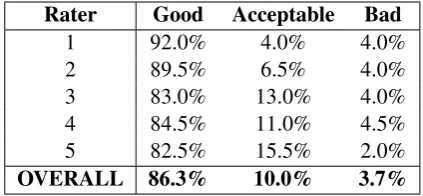
Table 3: The percent distribution for how each ex-pert rated the appropriateness of the predicted er-ror types. E.g. Rater 3 considered 83% of all pre-dicted types to be “Good”.
Ng,2015) and so we were more interested in over-all judgements than specific disagreements.
The results from this evaluation are shown in Table 3. Significantly, all 5 raters considered at least 95% of the predicted error types to be ei-ther “Good” or “Acceptable”, despite the degree of noise introduced by automatic edit extraction. Furthermore, whenever raters judged an edit as “Bad”, this could usually be traced back to a POS or parse error; e.g. [ring → rings] might be considered a NOUN:NUM or VERB:SVA er-ror depending on whether the POS tagger consid-ered both sides of the edit nouns or verbs. Inter-annotator agreement was also good at 0.724κf ree (Randolph,2005).
In contrast, although incomparable on account of the different metric and error scheme, the best results using machine learning were between 50-70% F1 (Felice et al.,2016). Ultimately however,
we believe the high scores awarded by the raters validates the efficacy of our rule-based approach.
4 Error Type Scoring
Having described how to automatically annotate parallel sentences with ERRANT, we now also have a method to annotate system hypotheses; this is the first step towards an error type evaluation. Since no scorer is currently capable of calculating error type performance however (Dahlmeier and Ng,2012;Felice and Briscoe,2015;Napoles et al., 2015), we instead built our own.
true positive (TP), while unmatched edits in the hypothesis and references are false positives (FP) and false negatives (FN) respectively. These re-sults can then be grouped by error type for the pur-poses of error type evaluation.
Finally, it is worth noting that this scorer is much simpler than other scorers in GEC which typically incorporate edit extraction or alignment directly into their algorithms. Our approach, on the other hand, treats edit extraction and evalua-tion as separate tasks.
4.1 Gold Reference vs. Auto Reference Before evaluating an automatically annotated hy-pothesis against its reference, we must also ad-dress another mismatch: namely that hypothe-sis edits must be extracted and classified auto-matically, while reference edits are typically ex-tracted and classified manually using a different framework. Since evaluation is now reduced to a straightforward comparison between two files however, it is especially important that the hypoth-esis and references are both processed in the same way. For instance, a hypothesis edit [have eating
→ has eaten] will not match the reference edits
[have → has] and [eating → eaten] because the former is one edit while the latter is two edits, even though they equate to the same thing.
To solve this problem, we can reprocess the ref-erences in the same way as the hypotheses. In other words, we can apply ERRANT to the refer-ences such that each reference edit is subject to the same automatic extraction and classification crite-ria as each hypothesis edit. While it may seem un-orthodox to discard gold reference information in favour of automatic reference information, this is necessary to minimise the difference between hy-pothesis and reference edits and also standardise error type annotations.
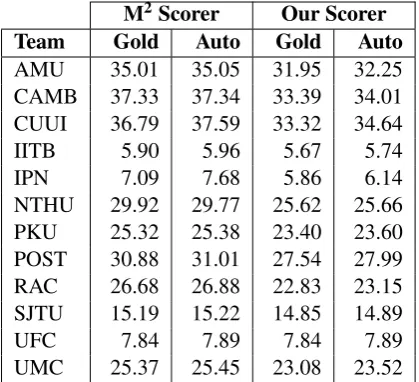
To show that automatic references are feasible alternatives to gold references, we evaluated each team in the CoNLL-2014 shared task using both types of reference with the M2scorer (Dahlmeier and Ng, 2012), the de facto standard of GEC evaluation, and our own scorer. Table 4 hence shows that there is little difference between the overall scores for each team, and we formally validated this hypothesis for precision, recall and F0.5 by means of bootstrap significance
testing (Efron and Tibshirani, 1993). Ultimately, we found no statistically significant difference
M2Scorer Our Scorer
[image:5.595.312.522.62.253.2]Team Gold Auto Gold Auto AMU 35.01 35.05 31.95 32.25 CAMB 37.33 37.34 33.39 34.01 CUUI 36.79 37.59 33.32 34.64 IITB 5.90 5.96 5.67 5.74 IPN 7.09 7.68 5.86 6.14 NTHU 29.92 29.77 25.62 25.66 PKU 25.32 25.38 23.40 23.60 POST 30.88 31.01 27.54 27.99 RAC 26.68 26.88 22.83 23.15 SJTU 15.19 15.22 14.85 14.89 UFC 7.84 7.89 7.84 7.89 UMC 25.37 25.45 23.08 23.52
Table 4: Overall scores for each team in CoNLL-2014 using gold and auto references with both the M2 scorer and our simpler edit comparison ap-proach. All scores are in terms of F0.5.
between automatic and gold references (1,000 iterations, p > .05) which leads us to conclude
that our automatic references are qualitatively as good as human references.
4.2 Comparison with the M2Scorer
Despite using the same metric, Table4also shows that the M2scorer tends to produce slightly higher F0.5 scores than our own. This initially led us to
believe that our scorer was underestimating per-formance, but we subsequently found that instead the M2 scorer tends to overestimate performance (cf. Felice and Briscoe(2015) andNapoles et al. (2015)).
In particular, given a choice between matching [have eating → has eaten] from Annotator 1 or [have → has] and [eating→ eaten] from
Anno-tator 2, the M2 scorer will always choose Anno-tator 2 because two true positives (TP) are worth more than one. Similarly, whenever the scorer encounters two false positives (FP) within a cer-tain distance of each other,7 it merges them and treats them as one false positive; e.g. [is a cat
→are a cats] is selected over [is→are] and [cat
→cats] even though these edits are best handled separately. In other words, the M2scorer exploits its dynamic edit boundary prediction to artificially maximise true positives and minimise false posi-tives and hence produce slightly inflated scores.
7The distance is controlled by themax unchanged words
AMU CAMB CUUI IITB
Type P R F0.5 P R F0.5 P R F0.5 P R F0.5
Missing 43.94 14.32 31.08 45.96 29.71 41.43 26.37 18.16 24.18 15.38 0.59 2.56 Replacement 37.22 26.92 34.57 37.53 28.12 35.18 45.90 22.98 38.27 29.85 1.49 6.22 Unnecessary - - - 25.51 27.47 25.88 34.20 33.33 34.02 46.15 1.53 6.77
IPN NTHU PKU POST
Type P R F0.5 P R F0.5 P R F0.5 P R F0.5
Missing 2.86 0.29 1.04 34.33 11.39 24.47 33.33 4.37 14.34 31.14 13.13 24.44 Replacement 9.87 3.86 7.53 27.61 19.15 25.37 29.62 18.33 26.37 33.16 19.33 29.01 Unnecessary 0.00 0.00 0.00 34.76 15.97 28.14 0.00 0.00 0.00 26.32 32.84 27.40
RAC SJTU UFC UMC
Type P R F0.5 P R F0.5 P R F0.5 P R F0.5
[image:6.595.74.525.61.255.2]Missing 1.52 0.27 0.79 62.50 4.44 17.28 - - - 40.08 23.57 35.16 Replacement 29.41 20.82 27.17 50.54 3.43 13.47 72.00 2.64 11.52 34.71 9.70 22.90 Unnecessary 0.00 0.00 0.00 17.65 11.36 15.89 - - - 16.86 17.17 16.92
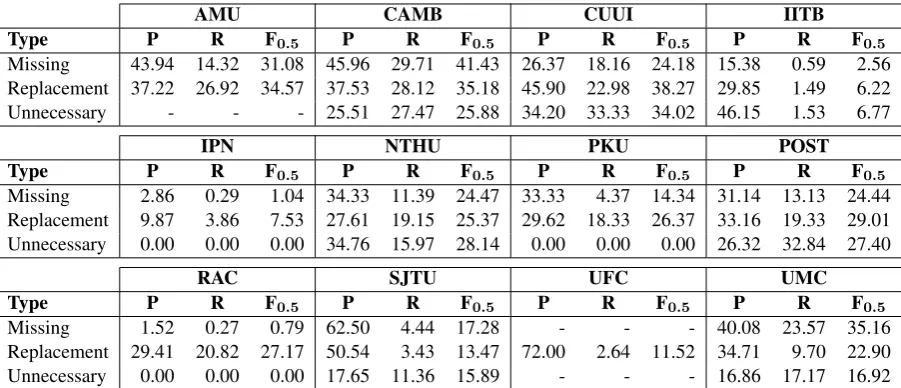
Table 5: Precision, recall and F0.5 for Missing, Unnecessary, and Replacement errors for each team.
A dash indicates the team’s system did not attempt to correct the given error type (TP+FP = 0).
5 CoNLL-2014 Shared Task Analysis
To demonstrate the value of ERRANT, we applied it to the data produced in the CoNLL-2014 shared task (Ng et al.,2014). Specifically, we automati-cally annotated all the system hypotheses and offi-cial reference files.8 Although ERRANT can be applied to any dataset of parallel sentences, we chose to evaluate on CoNLL-2014 because it rep-resents the largest collection of publicly available GEC system output. For more information about the systems in CoNLL-2014, we refer the reader to the shared task paper.
5.1 Edit Operation
In our first category experiment, we simply inves-tigated the performance of each system in terms of Missing, Replacement and Unnecessary edits. The results are shown in Table5 with additional information in AppendixB, Table10.
The most surprising result is that five teams (AMU, IPN, PKU, RAC, UFC) failed to correct any unnecessary token errors at all. This is note-worthy because unnecessary token errors account for roughly 25% of all errors in the CoNLL-2014 test data and so failing to address them signifi-cantly limits a system’s maximum performance. While the reason for this is clear in some cases, e.g. UFC’s rule-based system was never designed to tackle unnecessary tokens (Gupta, 2014), it is less clear in others, e.g. there is no obvious rea-son why AMU’s SMT system failed to learn when
8http://www.comp.nus.edu.sg/∼nlp/conll14st.html
to delete tokens (Junczys-Dowmunt and Grund-kiewicz, 2014). AMU’s result is especially re-markable given that their system still came 3rd overall despite this limitation.
In contrast, CUUI’s classifier approach (Ro-zovskaya et al., 2014) was the most successful at correcting not only unnecessary token errors, but also replacement token errors, while CAMB’s hybrid MT approach (Felice et al., 2014) signif-icantly outperformed all others in terms of miss-ing token errors. It would hence make sense to combine these two approaches, and indeed recent research has shown this improves overall perfor-mance (Rozovskaya and Roth,2016).
5.2 General Error Types
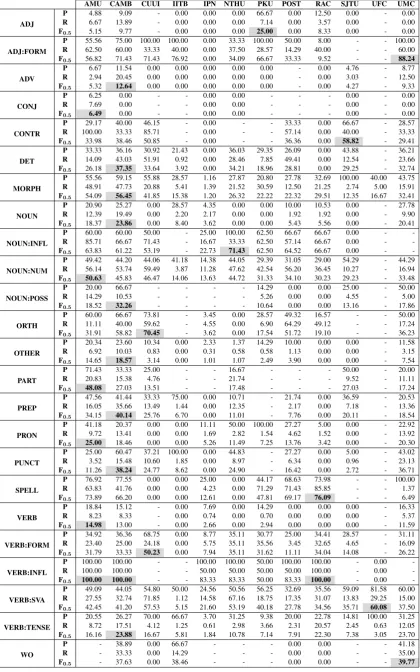
Table6 shows precision, recall and F0.5 for each
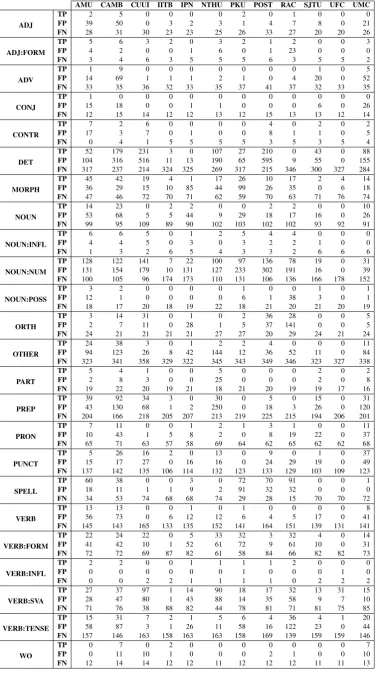
of the error types in our proposed framework for each team in CoNLL-2014. As some error types are more common than others, we also provide the TP, FP and FN counts used to make this table in AppendixB, Table11.
Overall, CAMB was the most successful team in terms of error types, achieving the highest F-score in 10 (out of 24) error categories, followed by AMU, who scored highest in 6 categories. All but 3 teams (IITB, IPN and POST) achieved the best score in at least 1 category, which suggests that different approaches to GEC complement dif-ferent error types. Only CAMB attempted to cor-rect at least 1 error from every category.
AMU CAMB CUUI IITB IPN NTHU PKU POST RAC SJTU UFC UMC
ADJ
P 4.88 9.09 - 0.00 0.00 0.00 66.67 0.00 12.50 0.00 - 0.00
R 6.67 13.89 - 0.00 0.00 0.00 7.14 0.00 3.57 0.00 - 0.00
F0.5 5.15 9.77 - 0.00 0.00 0.00 25.00 0.00 8.33 0.00 - 0.00
ADJ:FORM
P 55.56 75.00 100.00 100.00 0.00 33.33 100.00 50.00 8.00 - - 100.00
R 62.50 60.00 33.33 40.00 0.00 37.50 28.57 14.29 40.00 - - 60.00
F0.5 56.82 71.43 71.43 76.92 0.00 34.09 66.67 33.33 9.52 - - 88.24
ADV
P 6.67 11.54 0.00 0.00 0.00 0.00 0.00 - 0.00 4.76 - 8.77
R 2.94 20.45 0.00 0.00 0.00 0.00 0.00 - 0.00 3.03 - 12.50
F0.5 5.32 12.64 0.00 0.00 0.00 0.00 0.00 - 0.00 4.27 - 9.33
CONJ
P 6.25 0.00 - - 0.00 0.00 - - - 0.00 - 0.00
R 7.69 0.00 - - 0.00 0.00 - - - 0.00 - 0.00
F0.5 6.49 0.00 - - 0.00 0.00 - - - 0.00 - 0.00
CONTR
P 29.17 40.00 46.15 - 0.00 - - 33.33 0.00 66.67 - 28.57
R 100.00 33.33 85.71 - 0.00 - - 57.14 0.00 40.00 - 33.33
F0.5 33.98 38.46 50.85 - 0.00 - - 36.36 0.00 58.82 - 29.41
DET
P 33.33 36.16 30.92 21.43 0.00 36.03 29.35 26.09 0.00 43.88 - 36.21
R 14.09 43.03 51.91 0.92 0.00 28.46 7.85 49.41 0.00 12.54 - 23.66
F0.5 26.18 37.35 33.64 3.92 0.00 34.21 18.96 28.81 0.00 29.25 - 32.74
MORPH
P 55.56 59.15 55.88 28.57 1.16 27.87 20.80 27.78 32.69 100.00 40.00 43.75
R 48.91 47.73 20.88 5.41 1.39 21.52 30.59 12.50 21.25 2.74 5.00 15.91
F0.5 54.09 56.45 41.85 15.38 1.20 26.32 22.22 22.32 29.51 12.35 16.67 32.41
NOUN
P 20.90 25.27 0.00 28.57 4.35 0.00 0.00 10.00 10.53 0.00 - 27.78
R 12.39 19.49 0.00 2.20 2.17 0.00 0.00 1.92 1.92 0.00 - 9.90
F0.5 18.37 23.86 0.00 8.40 3.62 0.00 0.00 5.43 5.56 0.00 - 20.41
NOUN:INFL
P 60.00 60.00 50.00 - 25.00 100.00 62.50 66.67 66.67 0.00 -
-R 85.71 66.67 71.43 - 16.67 33.33 62.50 57.14 66.67 0.00 -
-F0.5 63.83 61.22 53.19 - 22.73 71.43 62.50 64.52 66.67 0.00 -
-NOUN:NUM
P 49.42 44.20 44.06 41.18 14.38 44.05 29.39 31.05 29.00 54.29 - 44.29
R 56.14 53.74 59.49 3.87 11.28 47.62 42.54 56.20 36.45 10.27 - 16.94
F0.5 50.63 45.83 46.47 14.06 13.63 44.72 31.33 34.10 30.23 29.23 - 33.48
NOUN:POSS
P 20.00 66.67 - - - - 14.29 0.00 0.00 25.00 - 50.00
R 14.29 10.53 - - - - 5.26 0.00 0.00 4.55 - 5.00
F0.5 18.52 32.26 - - - - 10.64 0.00 0.00 13.16 - 17.86
ORTH
P 60.00 66.67 73.81 - 3.45 0.00 28.57 49.32 16.57 - - 50.00
R 11.11 40.00 59.62 - 4.55 0.00 6.90 64.29 49.12 - - 17.24
F0.5 31.91 58.82 70.45 - 3.62 0.00 17.54 51.72 19.10 - - 36.23
OTHER
P 20.34 23.60 10.34 0.00 2.33 1.37 14.29 10.00 0.00 0.00 - 11.58
R 6.92 10.03 0.83 0.00 0.31 0.58 0.58 1.13 0.00 0.00 - 3.15
F0.5 14.65 18.57 3.14 0.00 1.01 1.07 2.49 3.90 0.00 0.00 - 7.54
PART
P 71.43 33.33 25.00 - - 16.67 - - - 50.00 - 20.00
R 20.83 15.38 4.76 - - 21.74 - - - 9.52 - 11.11
F0.5 48.08 27.03 13.51 - - 17.48 - - - 27.03 - 17.24
PREP
P 47.56 41.44 33.33 75.00 0.00 10.71 - 21.74 0.00 36.59 - 20.53
R 16.05 35.66 13.49 1.44 0.00 12.35 - 2.17 0.00 7.18 - 13.36
F0.5 34.15 40.14 25.76 6.70 0.00 11.01 - 7.76 0.00 20.11 - 18.54
PRON
P 41.18 20.37 0.00 0.00 11.11 50.00 100.00 27.27 5.00 0.00 - 22.92
R 9.72 13.41 0.00 0.00 1.69 2.82 1.54 4.62 1.52 0.00 - 13.92
F0.5 25.00 18.46 0.00 0.00 5.26 11.49 7.25 13.76 3.42 0.00 - 20.30
PUNCT
P 25.00 60.47 37.21 100.00 0.00 44.83 - 27.27 0.00 5.00 - 43.02
R 3.52 15.48 10.60 1.85 0.00 8.97 - 6.34 0.00 0.96 - 23.13
F0.5 11.26 38.24 24.77 8.62 0.00 24.90 - 16.42 0.00 2.72 - 36.71
SPELL
P 76.92 77.55 0.00 0.00 25.00 0.00 44.17 68.63 73.98 - - 100.00
R 63.83 41.76 0.00 0.00 4.23 0.00 71.29 71.43 85.85 - - 1.37
F0.5 73.89 66.20 0.00 0.00 12.61 0.00 47.81 69.17 76.09 - - 6.49
VERB
P 18.84 15.12 - 0.00 7.69 0.00 14.29 0.00 0.00 0.00 - 16.33
R 8.23 8.33 - 0.00 0.74 0.00 0.70 0.00 0.00 0.00 - 5.37
F0.5 14.98 13.00 - 0.00 2.66 0.00 2.94 0.00 0.00 0.00 - 11.59
VERB:FORM
P 34.92 36.36 68.75 0.00 8.77 35.11 30.77 25.00 34.41 28.57 - 31.11
R 23.40 25.00 24.18 0.00 5.75 35.11 35.56 3.45 32.65 4.65 - 16.09
F0.5 31.79 33.33 50.23 0.00 7.94 35.11 31.62 11.11 34.04 14.08 - 26.22
VERB:INFL
P 100.00 100.00 - - 100.00 100.00 50.00 100.00 100.00 - 0.00
-R 100.00 100.00 - - 50.00 50.00 50.00 50.00 100.00 - 0.00
-F0.5 100.00 100.00 - - 83.33 83.33 50.00 83.33 100.00 - 0.00
-VERB:SVA
P 49.09 44.05 54.80 50.00 24.56 50.56 56.25 32.69 35.56 59.09 81.58 60.00
R 27.55 32.74 71.85 1.12 14.58 67.16 18.75 17.35 31.07 13.83 29.25 15.00
F0.5 42.45 41.20 57.53 5.15 21.60 53.19 40.18 27.78 34.56 35.71 60.08 37.50
VERB:TENSE
P 20.55 26.27 70.00 66.67 3.70 31.25 9.38 20.00 22.78 14.81 100.00 31.25
R 8.72 17.51 4.12 1.25 0.61 2.98 3.66 2.31 20.57 2.45 0.63 12.05
F0.5 16.16 23.88 16.67 5.81 1.84 10.78 7.14 7.91 22.30 7.38 3.05 23.70
WO
P - 38.89 0.00 66.67 - - - 0.00 0.00 - - 41.18
R - 33.33 0.00 14.29 - - - 0.00 0.00 - - 35.00
[image:7.595.89.510.63.736.2]F0.5 - 37.63 0.00 38.46 - - - 0.00 0.00 - - 39.77
Table 6: Precision, recall and F0.5 for each team and error type. A dash indicates the team’s system did
CAMB
Type P R F0.5
M:DET 43.20 51.77 44.68 R:DET 19.33 35.37 21.26 U:DET 43.75 39.90 42.92 DET 36.16 43.03 37.35
CUUI
Type P R F0.5
[image:8.595.102.261.61.233.2]M:DET 23.86 45.00 26.34 R:DET 27.03 24.39 26.46 U:DET 36.19 66.37 39.81 DET 30.92 51.91 33.64
Table 7: Detailed breakdown of Determiner errors for two teams.
• Despite the prevalence of spell checkers
nowadays, many teams did not seem to em-ploy them; this would have been an easy way to boost overall performance.
• Although several teams built specialised clas-sifiers for DET and PREP errors, CAMB’s hybrid MT approach still outperformed them. This might be because the classifiers were trained using a different error type framework however.
• CUUI’s classifiers significantly
outper-formed all other approaches at ORTH and VERB:FORM errors. This suggests classi-fiers are well-suited to these error types.
• Although UFC’s rule-based approach was the best at VERB:SVA errors, CUUI’s classifier was not very far behind.
• Only AMU managed to correct any CONJ
errors.
• Content word errors (i.e. ADJ, ADV, NOUN
and VERB) were unsurprisingly very difficult for all teams.
5.3 Detailed Error Types
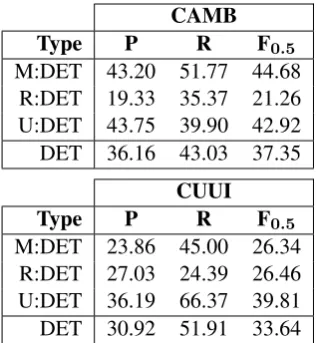
In addition to analysing general error types, the modular design of our framework also allows us to evaluate error type performance at an even greater level of detail. For example, Table 7 shows the breakdown of Determiner errors for two teams us-ing different approaches in terms of edit operation. Note that this is a representative example of de-tailed error type performance, as an analysis of all error type combinations for all teams would take up too much space.
Team P R F0.5
AMU 16.90 5.33 11.79 CAMB 27.22 17.06 24.32 CUUI 15.69 3.67 9.48 IITB 28.57 0.94 4.15 IPN 3.33 0.47 1.51 NTHU 0.00 0.00 0.00 PKU 25.00 1.40 5.73 POST 12.77 2.82 7.48 RAC 2.96 2.82 2.93 SJTU 10.00 0.47 1.99
UFC - -
[image:8.595.340.495.61.241.2]-UMC 19.82 9.82 16.47
Table 8: Each team’s performance at correcting multi-token edits; i.e. there are at least two tokens on one side of the edit.
While CAMB’s hybrid MT approach achieved a higher score than CUUI’s classifier overall, our more detailed evaluation reveals that CUUI actu-ally outperformed CAMB at Replacement Deter-miner errors. We also learn that CAMB scored twice as highly on M:DET and U:DET than it did on R:DET and that CUUI’s significantly higher U:DET recall was offset by a lower precision. Ul-timately, this shows that even though one approach might be better than another overall, different ap-proaches may still have complementary strengths.
5.4 Multi Token Errors
Another benefit of explicitly annotating all hy-pothesis edits is that edit spans become fixed; this means we can evaluate system performance in terms of edit size. Table8hence shows the over-all performance for each team at correcting multi-token edits, where a multi-multi-token edit is an edit that has at least two tokens on either side. In the CoNLL-2014 test set, there are roughly 220 such edits (about 10% of all edits).
In general, teams did not do well at multi-token edits. In fact only three teams achieved scores greater than 10% F0.5 and all of them used MT
AMU CAMB CUUI IITB IPN NTHU PKU POST RA
C
SJTU UFC UMC
0 10 20 30 40 50
F0.5
[image:9.595.81.287.63.277.2]Detection Correction
Figure 1: The difference between detection and correction scores for each team overall.
5.5 Detection vs. Correction
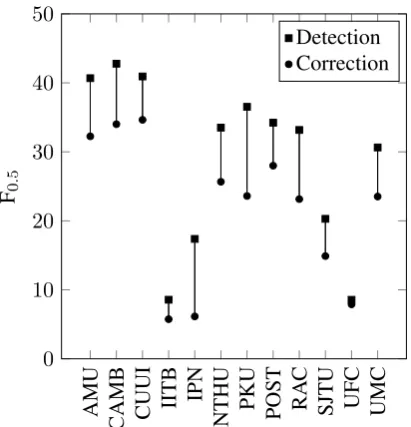
Another important aspect of GEC that is seldom reported in the literature is that of error detection; i.e. the extent to which a system can identify er-roneous tokens in text. This can be calculated by comparing the edit overlap between the hypothesis and reference filesregardless of the proposed cor-rectionin a manner similar to Recognition evalu-ation in the HOO shared tasks for GEC (Dale and Kilgarriff,2011).
Figure 1 hence shows how each team’s score for detection differed in relation to their score for correction. While CAMB scored highest for de-tection overall, it is interesting to note that CUUI ultimately performed slightly better than CAMB at correction. This suggests CUUI was more suc-cessful at correcting the errors they detected than CAMB. In contrast, IPN and PKU are notable for detecting significantly more errors than they were able to correct. Nevertheless, a system’s ability to detect errors, even if it is unable to correct them, is still likely to be valuable information to a learner (Rei and Yannakoudakis,2016).
Finally, although we do not do so here, our scorer is also capable of providing a detailed er-ror type breakdown for detection.
6 Conclusion
In this paper, we described ERRANT, a grammat-ical ERRor ANnotation Toolkit designed to
au-tomatically annotate parallel error correction data with explicit edit spans and error type information. ERRANT can be used to not only facilitate a de-tailed error type evaluation in GEC, but also to standardise existing error correction corpora and reduce annotator workload. We release ERRANT with this paper.
Our approach makes use of previous work to align sentences based on linguistic intuition and then introduces a new rule-based framework to classify edits. This framework is entirely dataset independent, and relies only on automatically obtained information such as POS tags and lemmas. A small-scale evaluation of our classifier found that each rater considered >95% of the
predicted error types as either “Good” (85%) or “Acceptable” (10%).
We demonstrated the value of ERRANT by car-rying out a detailed evaluation of system error type performance for all teams in the CoNLL-2014 shared task on Grammatical Error Correc-tion. We found that different systems had differ-ent strengths and weaknesses which we hope re-searchers can exploit to further improve general performance.
References
Christopher Bryant and Hwee Tou Ng. 2015. How far are we from fully automatic high quality gram-matical error correction? In Proceedings of the 53rd Annual Meeting of the Association for Compu-tational Linguistics and the 7th International Joint Conference on Natural Language Processing (Vol-ume 1: Long Papers). Association for Computa-tional Linguistics, Beijing, China, pages 697–707. http://www.aclweb.org/anthology/P15-1068. Daniel Dahlmeier and Hwee Tou Ng. 2012.
Bet-ter evaluation for grammatical error correction. In Proceedings of the 2012 Conference of the North American Chapter of the Association for Computational Linguistics: Human Language Technologies. Association for Computational Linguistics, Montr´eal, Canada, pages 568–572. http://www.aclweb.org/anthology/N12-1067. Robert Dale and Adam Kilgarriff. 2011.
Help-ing Our Own: The HOO 2011 pilot shared task. In Proceedings of the 13th European Workshop on Natural Language Generation. Association for Computational Linguistics, Strouds-burg, PA, USA, ENLG ’11, pages 242–249. http://dl.acm.org/citation.cfm?id=2187681.2187725. Bradley Efron and Robert J. Tibshirani. 1993. An
Mariano Felice and Ted Briscoe. 2015. Towards a stan-dard evaluation method for grammatical error de-tection and correction. InProceedings of the 2015 Conference of the North American Chapter of the Association for Computational Linguistics: Human Language Technologies. Association for Computa-tional Linguistics, Denver, Colorado, pages 578– 587. http://www.aclweb.org/anthology/N15-1060.
Mariano Felice, Christopher Bryant, and Ted Briscoe. 2016. Automatic extraction of learner errors in ESL sentences using linguistically enhanced align-ments. InProceedings of COLING 2016, the 26th International Conference on Computational Lin-guistics: Technical Papers. The COLING 2016 Or-ganizing Committee, Osaka, Japan, pages 825–835. http://aclweb.org/anthology/C16-1079.
Mariano Felice, Zheng Yuan, Øistein E. Andersen, He-len Yannakoudakis, and Ekaterina Kochmar. 2014. Grammatical error correction using hybrid systems and type filtering. InProceedings of the Eighteenth Conference on Computational Natural Language Learning: Shared Task. Association for Computa-tional Linguistics, Baltimore, Maryland, pages 15– 24.http://www.aclweb.org/anthology/W14-1702.
Roman Grundkiewicz, Marcin Junczys-Dowmunt, and Edward Gillian. 2015. Human evaluation of gram-matical error correction systems. InProceedings of the 2015 Conference on Empirical Methods in Natu-ral Language Processing. Association for Computa-tional Linguistics, Lisbon, Portugal, pages 461–470. http://aclweb.org/anthology/D15-1052.
Anubhav Gupta. 2014. Grammatical error detec-tion using tagger disagreement. In Proceedings of the Eighteenth Conference on Computa-tional Natural Language Learning: Shared Task. Association for Computational Lin-guistics, Baltimore, Maryland, pages 49–52. http://www.aclweb.org/anthology/W14-1706.
Marcin Junczys-Dowmunt and Roman Grundkiewicz. 2014. The AMU system in the CoNLL-2014 shared task: Grammatical error correction by data-intensive and feature-rich statistical machine trans-lation. In Proceedings of the Eighteenth Confer-ence on Computational Natural Language Learn-ing: Shared Task. Association for Computational Linguistics, Baltimore, Maryland, pages 25–33. http://www.aclweb.org/anthology/W14-1703.
Courtney Napoles, Keisuke Sakaguchi, Matt Post, and Joel Tetreault. 2015. Ground truth for grammati-cal error correction metrics. InProceedings of the 53rd Annual Meeting of the Association for Compu-tational Linguistics and the 7th International Joint Conference on Natural Language Processing (Vol-ume 2: Short Papers). Association for Computa-tional Linguistics, Beijing, China, pages 588–593. http://www.aclweb.org/anthology/P15-2097.
Hwee Tou Ng, Siew Mei Wu, Ted Briscoe, Chris-tian Hadiwinoto, Raymond Hendy Susanto, and
Christopher Bryant. 2014. The CoNLL-2014 shared task on grammatical error correction. In Pro-ceedings of the Eighteenth Conference on Com-putational Natural Language Learning: Shared Task. ACL, Baltimore, Maryland, USA, pages 1–14. http://aclweb.org/anthology/W/W14/W14-1701.pdf.
Justus J. Randolph. 2005. Free-marginal mul-tirater kappa: An alternative to Fleiss’ fixed-marginal multirater kappa. Joensuu Uni-versity Learning and Instruction Symposium
http://files.eric.ed.gov/fulltext/ED490661.pdf.
Marek Rei and Helen Yannakoudakis. 2016. Com-positional sequence labeling models for error detection in learner writing. In Proceedings of the 54th Annual Meeting of the Associa-tion for ComputaAssocia-tional Linguistics (Volume 1: Long Papers). Association for Computational Lin-guistics, Berlin, Germany, pages 1181–1191. http://www.aclweb.org/anthology/P16-1112.
Alla Rozovskaya, Kai-Wei Chang, Mark Sammons, Dan Roth, and Nizar Habash. 2014. The Illinois-Columbia system in the CoNLL-2014 shared task. In Proceedings of the Eighteenth Confer-ence on Computational Natural Language Learn-ing: Shared Task. Association for Computational Linguistics, Baltimore, Maryland, pages 34–42. http://www.aclweb.org/anthology/W14-1704.
Alla Rozovskaya and Dan Roth. 2016. Gram-matical error correction: Machine translation and classifiers. In Proceedings of the 54th An-nual Meeting of the Association for Computa-tional Linguistics. Association for Computational Linguistics, Berlin, Germany, pages 2205–2215. http://aclweb.org/anthology/P16-1208.
Keisuke Sakaguchi, Courtney Napoles, Matt Post, and Joel Tetreault. 2016. Reassessing the goals of grammatical error correction: Fluency instead of grammaticality. Transactions of the Asso-ciation for Computational Linguistics 4:169–182. https://tacl2013.cs.columbia.edu/ojs/index.php/tacl/ article/view/800.
Ben Swanson and Elif Yamangil. 2012. Correction detection and error type selection as an ESL ed-ucational aid. In Proceedings of the 2012 Con-ference of the North American Chapter of the As-sociation for Computational Linguistics: Human Language Technologies. Association for Computa-tional Linguistics, Montr´eal, Canada, pages 357– 361. http://www.aclweb.org/anthology/N12-1037.
Huichao Xue and Rebecca Hwa. 2014. Improved correction detection in revised ESL sentences. In
A Complete list of valid error code combinations
Operation Tier
Type Missing Unnecessary Replacement
Tok
en
Tier Part
Of
Speech
Adjective M:ADJ U:ADJ R:ADJ
Adverb M:ADV U:ADV R:ADV
Conjunction M:CONJ U:CONJ R:CONJ
Determiner M:DET U:DET R:DET
Noun M:NOUN U:NOUN R:NOUN
Particle M:PART U:PART R:PART
Preposition M:PREP U:PREP R:PREP
Pronoun M:PRON U:PRON R:PRON
Punctuation M:PUNCT U:PUNCT R:PUNCT
Verb M:VERB U:VERB R:VERB
Other
Contraction M:CONTR U:CONTR R:CONTR
Morphology - - R:MORPH
Orthography - - R:ORTH
Other M:OTHER U:OTHER R:OTHER
Spelling - - R:SPELL
Word Order - - R:WO
Mor
phology
Tier
Adjective Form - - R:ADJ:FORM
Noun Inflection - - R:NOUN:INFL
Noun Number - - R:NOUN:NUM
Noun Possessive M:NOUN:POSS U:NOUN:POSS R:NOUN:POSS Verb Form M:VERB:FORM U:VERB:FORM R:VERB:FORM
Verb Inflection - - R:VERB:INFL
Verb Agreement - - R:VERB:SVA
[image:12.595.109.493.94.415.2]Verb Tense M:VERB:TENSE U:VERB:TENSE R:VERB:TENSE
Table 9: There are 55 total possible error types. This table shows all of them except UNK, which indicates an uncorrected error. A dash indicates an impossible combination.
B TP, FP and FN counts for various CoNLL-2014 results
AMU CAMB CUUI IITB
Type TP FP FN TP FP FN TP FP FN TP FP FN
Missing 58 74 347 131 154 310 77 215 347 2 11 336 Replacement 428 722 1162 477 794 1219 381 449 1277 20 47 1320 Unnecessary 0 0 412 125 365 330 158 304 316 6 7 385
IPN NTHU PKU POST
Type TP FP FN TP FP FN TP FP FN TP FP FN
Missing 1 34 339 46 88 358 16 32 350 52 115 344 Replacement 53 484 1319 299 784 1262 279 663 1243 312 629 1302 Unnecessary 0 2 389 65 122 342 0 1 397 155 434 317
RAC SJTU UFC UMC
Type TP FP FN TP FP FN TP FP FN TP FP FN
Missing 1 65 368 15 9 323 0 0 339 99 148 321 Replacement 325 780 1236 47 46 1325 36 14 1326 143 269 1331 Unnecessary 0 5 407 45 210 351 0 0 381 74 365 357
[image:12.595.103.497.500.697.2]AMU CAMB CUUI IITB IPN NTHU PKU POST RAC SJTU UFC UMC
ADJ
TP 2 5 0 0 0 0 2 0 1 0 0 0
FP 39 50 0 3 2 3 1 4 7 8 0 21
FN 28 31 30 23 23 25 26 33 27 20 20 26
ADJ:FORM
TP 5 6 3 2 0 3 2 1 2 0 0 3
FP 4 2 0 0 1 6 0 1 23 0 0 0
FN 3 4 6 3 5 5 5 6 3 5 5 2
ADV
TP 1 9 0 0 0 0 0 0 0 1 0 5
FP 14 69 1 1 1 2 1 0 4 20 0 52
FN 33 35 36 32 33 35 37 41 37 32 33 35
CONJ
TP 1 0 0 0 0 0 0 0 0 0 0 0
FP 15 18 0 0 1 1 0 0 0 6 0 26
FN 12 15 14 12 12 13 12 15 13 13 12 14
CONTR
TP 7 2 6 0 0 0 0 4 0 2 0 2
FP 17 3 7 0 1 0 0 8 1 1 0 5
FN 0 4 1 5 5 5 5 3 5 3 5 4
DET
TP 52 179 231 3 0 107 27 210 0 43 0 88
FP 104 316 516 11 13 190 65 595 9 55 0 155
FN 317 237 214 324 325 269 317 215 346 300 327 284
MORPH
TP 45 42 19 4 1 17 26 10 17 2 4 14
FP 36 29 15 10 85 44 99 26 35 0 6 18
FN 47 46 72 70 71 62 59 70 63 71 76 74
NOUN
TP 14 23 0 2 2 0 0 2 2 0 0 10
FP 53 68 5 5 44 9 29 18 17 16 0 26
FN 99 95 109 89 90 102 103 102 102 93 92 91
NOUN:INFL
TP 6 6 5 0 1 2 5 4 4 0 0 0
FP 4 4 5 0 3 0 3 2 2 1 0 0
FN 1 3 2 6 5 4 3 3 2 6 6 6
NOUN:NUM
TP 128 122 141 7 22 100 97 136 78 19 0 31
FP 131 154 179 10 131 127 233 302 191 16 0 39
FN 100 105 96 174 173 110 131 106 136 166 178 152
NOUN:POSS
TP 3 2 0 0 0 0 1 0 0 1 0 1
FP 12 1 0 0 0 0 6 1 38 3 0 1
FN 18 17 20 18 19 22 18 21 20 21 20 19
ORTH
TP 3 14 31 0 1 0 2 36 28 0 0 5
FP 2 7 11 0 28 1 5 37 141 0 0 5
FN 24 21 21 21 21 27 27 20 29 24 21 24
OTHER
TP 24 38 3 0 1 2 2 4 0 0 0 11
FP 94 123 26 8 42 144 12 36 52 11 0 84
FN 323 341 358 329 322 345 343 349 346 323 327 338
PART
TP 5 4 1 0 0 5 0 0 0 2 0 2
FP 2 8 3 0 0 25 0 0 0 2 0 8
FN 19 22 20 19 21 18 21 20 19 19 17 16
PREP
TP 39 92 34 3 0 30 0 5 0 15 0 31
FP 43 130 68 1 2 250 0 18 3 26 0 120
FN 204 166 218 205 207 213 219 225 215 194 206 201
PRON
TP 7 11 0 0 1 2 1 3 1 0 0 11
FP 10 43 1 5 8 2 0 8 19 22 0 37
FN 65 71 63 57 58 69 64 62 65 62 62 68
PUNCT
TP 5 26 16 2 0 13 0 9 0 1 0 37
FP 15 17 27 0 16 16 0 24 29 19 0 49
FN 137 142 135 106 114 132 123 133 129 103 109 123
SPELL
TP 60 38 0 0 3 0 72 70 91 0 0 1
FP 18 11 1 1 9 2 91 32 32 0 0 0
FN 34 53 74 68 68 74 29 28 15 70 70 72
VERB
TP 13 13 0 0 1 0 1 0 0 0 0 8
FP 56 73 0 6 12 12 6 4 5 17 0 41
FN 145 143 165 133 135 152 141 164 151 139 131 141
VERB:FORM
TP 22 24 22 0 5 33 32 3 32 4 0 14
FP 41 42 10 1 52 61 72 9 61 10 0 31
FN 72 72 69 87 82 61 58 84 66 82 82 73
VERB:INFL
TP 2 2 0 0 1 1 1 1 2 0 0 0
FP 0 0 0 0 0 0 1 0 0 0 1 0
FN 0 0 2 2 1 1 1 1 0 2 2 2
VERB:SVA
TP 27 37 97 1 14 90 18 17 32 13 31 15
FP 28 47 80 1 43 88 14 35 58 9 7 10
FN 71 76 38 88 82 44 78 81 71 81 75 85
VERB:TENSE
TP 15 31 7 2 1 5 6 4 36 4 1 20
FP 58 87 3 1 26 11 58 16 122 23 0 44
FN 157 146 163 158 163 163 158 169 139 159 159 146
WO
TP 0 7 0 2 0 0 0 0 0 0 0 7
FP 0 11 10 1 0 0 0 2 1 0 0 10
[image:13.595.112.489.62.737.2]FN 12 14 14 12 12 11 12 12 12 11 11 13