Proceedings of the 55th Annual Meeting of the Association for Computational Linguistics, pages 243–254 Proceedings of the 55th Annual Meeting of the Association for Computational Linguistics, pages 243–254
Obtaining referential word meanings from visual and distributional
information: Experiments on object naming
Sina Zarrieß and David Schlangen
Dialogue Systems Group // CITEC // Faculty of Linguistics and Literary Studies Bielefeld University, Germany
{sina.zarriess,david.schlangen}@uni-bielefeld.de
Abstract
We investigate object naming, which is an important sub-task of referring expression generation on real-world images. As op-posed to mutually exclusive labels used in object recognition, object names are more flexible, subject to communicative pref-erences and semantically related to each other. Therefore, we investigate models of referential word meaning that link vi-sual to lexical information which we as-sume to be given through distributional word embeddings. We present a model that learns individual predictors for object names that link visual and distributional aspects of word meaning during training. We show that this is particularly benefi-cial for zero-shot learning, as compared to projecting visual objects directly into the distributional space. In a standard object naming task, we find that different ways of combining lexical and visual information achieve very similar performance, though experiments on model combination sug-gest that they capture complementary as-pects of referential meaning.
1 Introduction
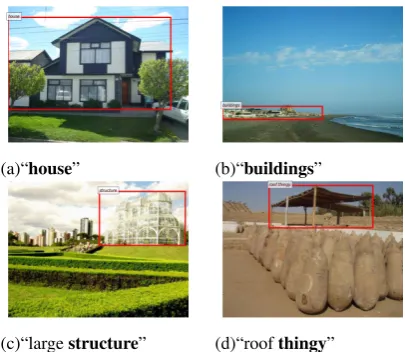
Expressions referring to objects in visual scenes typically include a word naming the type of the object: E.g., house in Figure 1 (a), or, as a very general type, thingy in Figure 1 (d). Determin-ing such a name is a crucial step for referrDetermin-ing expression generation (REG) systems, as many other decisions concerning, e.g., the selection of attributes follow from it (Dale and Reiter, 1995; Krahmer and Van Deemter, 2012). For a long time, however, research on REG mostly assumed the availability of symbolic representations of
ref-(a)“house” (b)“buildings”
(c)“largestructure” (d)“roofthingy”
Figure 1: Examples of object names in the
REFERITcorpus referring to instances of buildings
erent and scene, and sidestepped questions about how speakers actually choose these names, due to the lack of models capable of capturing what a word likehouserefers to in the real world.
Recent advances in image processing promise to fill this gap, with state-of-the-art computer vi-sion systems being able to classify images into thousands of different categories (e.g. Szegedy et al. (2015)). However, classification is not nam-ing (Ordonez et al., 2016). Standard object clas-sification schemes are inherently “flat”, and treat object labels as mutually exclusive (Deng et al., 2014). A state-of-the-art object recognition sys-tem would be trained to classify the object in e.g. Figure 1 (a) as eitherhouseorbuilding, ignoring the lexical similarity between these two names. In contrast, humans seem to be more flexible as to the chosen level of generality. Depending on the prototypicality of the object to name, and possi-bly other visual properties, a general name might be more or less appropriate. For instance, a robin can be namedbird, but a penguin is better referred
[image:1.595.310.513.220.396.2]to as “penguin” (Rosch, 1978); along the same lines, the rather unusual building in Figure 1 (c) that is not easy to otherwise categorise was named “structure”.
Other work at the intersection of image and language processing has investigated models that learn to directly associate visual objects with a continuous representation of word meaning, i.e. through cross-modal transfer into distributional vector spaces (Frome et al., 2013; Norouzi et al., 2013). Here, the idea is to exploit a powerful model of lexical similarity induced from large amounts text for being able to capture inherent lex-ical relations between object categories. Thus, un-der the assumption that such semantic spaces rep-resent, in some form at least, taxonomic knowl-edge, this makes labels on different levels of speci-ficity available for a given object. Moreover, if the mapping is sufficiently general, it should be able to map objects to an appropriate label, even if dur-ing traindur-ing of the mappdur-ing this label has not been seen (zero-shot learning).
While cross-modal transfer seems to be a con-ceptually attractive model for learning object names, it is based on an important assumption that, in our view, has not received sufficient attention in previous works: it assumes that a given distri-butional vector space constitutes an optimal target representation that visual instances of objects can be mapped to. However, distributional represen-tations of word meaning are known to capture a rather fuzzy notion of lexical similarity, e.g.caris similar tovanand tostreet. A cross-modal transfer model is “forced” to learn to map objects into the same area in the semantic space if their names are distributionally similar, but regardless of their ac-tual visual similarity. Indeed, we have found in a recent study that the contribution of distributional information to learning referential word meanings is restricted to certain types of words and does not generalize across the vocabulary (Zarrieß and Schlangen, 2017).
The goal of this work is to learn a model of referential word meaning that makes accurate ob-ject naming predictions and goes beyond treat-ing words as independent, mutually exclusive la-bels in a flat classification scheme. We extend upon work on learning models of referential word use from corpora of images paired with referring expressions (Schlangen et al., 2016; Zarrieß and Schlangen, 2017) that treats words as individual
predictors capturing referential appropriateness. We explore different ways of linking these predic-tors to distributional knowledge, during applica-tion and during training. We find that these differ-ent models achieve very similar performance in a standard object naming task, though experiments on model combination suggest that they capture complementary aspects of referential meaning. In a zero-shot setup of an object naming task, we find that combining lexical and visual information dur-ing traindur-ing is most beneficial, outperformdur-ing vari-ants of cross-modal transfer.
2 Related Work
to actual words via various translation procedures. We are interested in learning referential appropri-ateness and extensional word meanings directly from actual human referring expressions (REs) paired with objects in images, using an existing object recognizer for feature extraction.
Multi-modal distributional semantics Distri-butional semantic models are a well-known method for capturing lexical word meaning in a variety of tasks (Turney and Pantel, 2010; Mikolov et al., 2013; Erk, 2016). Recent work on multi-modal distributional vector spaces (Feng and La-pata, 2010; Silberer and LaLa-pata, 2014; Kiela and Bottou, 2014; Lazaridou et al., 2015b; Kottur et al., 2016) has aimed at capturing semantic simi-larity even more accurately by integrating distri-butional and perceptual features associated with words (mostly taken from images) into a single representation.
Cross-modal transfer Rather than fusing dif-ferent modalities into a single, joint space, other work has looked at cross-modal mapping between spaces. Herbelot and Vecchi (2015) present a model that learns to map vectors in a distributional space to vectors in a set-theoretic space, showing that there is a functional relationship between dis-tributional information and conceptual knowledge representing quantifiers and predicates. More re-lated to our work are cross-modal mapping mod-els,that learn to transfer from a representation of an object or image in the visual space to a vec-tor in a distributional space (Socher et al., 2013; Frome et al., 2013; Norouzi et al., 2013; Lazari-dou et al., 2014). Here, the motivation is to exploit the rich lexical knowledge encoded in a distribu-tional space for learning visual classifications. In practice, these models are mostly used for zero-shot learning where the test set contains object categories not observed during training. When tested on standard object recognition tasks, trans-fer, however, comes at a price. Frome et al. (2013) and Norouzi et al. (2013) both find that it slightly degrades performance as compared to a plain object classification using standard accu-racy metrics (called flat “hit @k metric” in their paper). Interestingly though, Frome et al. (2013) report better performance using “hierarchical cision”, which essentially means that transfer pre-dicts words that are ontologically closer to the gold label and makes “semantically more reasonable
er-rors”. To the best of our knowledge, this pattern has not been systematically investigated any fur-ther. Another known problem with cross-modal transfer is that it seems to generalize less well than expected, i.e. tends to reproduce word vectors ob-served during training (Lazaridou et al., 2015a). In this work, we present a model that exploits distri-butional knowledge for learning referential word meaning as well, but explore and compare differ-ent ways of combining visual and lexical aspects of referential word meaning.
3 Task and Data
We defineobject namingas follows: Given an ob-jectx in an image, the task is to predict a word w that could be used as the head noun of a real-istic referring expression. (Cf. discussion above: “bird” when naming a robin, but “penguin” when naming a penguin.) To get at this, we develop our approach using a corpus of referring expressions produced by human users under natural, interac-tive conditions (Kazemzadeh et al., 2014), and train and test on the corresponding head nouns in these REs. This is similar to picture naming setups used in psycholinguistic research (cf. Levelt et al. (1991)) and based on the simplifying assumption that the name used for referring to an object can be determined successfully without looking at other objects in the image.
We now summarise the details of our setup:
Corpus We train and test on the REFERIT
cor-pus (Kazemzadeh et al., 2014), which is based on theSAIAPRimage collection (Grubinger et al.,
2006) (99.5k image regions;120K REs). We fol-low (Schlangen et al., 2016) and select words with a minimum frequency of 40 in these two data sets, which gives us a vocabulary of 793 words.
Names For most of our experiments, we only use a subset of this vocabulary, namely the set of object names. As the REs contain nouns that can-not be considered to be object names (background, bottom, etc.), we extract a list of names from the semantically annotated held-out set released with the REFERIT. These correspond to ‘entry-level’
to (Ordonez et al., 2016). Nevertheless, the data is challenging, as the corpus contains references to objects that fall outside of the object labeling scheme that available object recognition systems are typically optimized for, cf. Hu et al. (2015)’s discussion on “stuff” entities such “sky” or “grass” in the REFERIT data. For testing, we remove
re-lational REs (containing a rere-lational preposition such as ‘left of X’), because here we cannot be sure that the head noun of the target is fully infor-mative; we also remove REs with more than one head noun from our list (i.e. these are mostly rela-tional expressions as well such as ‘girl laughing at boy’). We pair each image region from the test set with its corresponding names from the remaining REs.
Image and Word Embeddings Following Schlangen et al. (2016), we derive representations of our visual inputs with a convolutional neural network, ‘GoogleNet’ (Szegedy et al., 2015), which was trained on the ImageNet corpus (Deng et al., 2009), and extract the final fully-connected layer before the classification layer, to give us a 1024 dimensional representation of the region. We add 7 features that encode information about the region relative to the image, thus representing each object as a vector of 1031 features. As dis-tributional word vectors, we use the word2vec representations provided by Baroni et al. (2014) (trained with CBOW, 5-word context window, 10 negative samples, 400 dimensions).
4 Three Models of Interfacing Visual and Distributional Information
4.1 Direct Cross-Modal Mapping
Following Lazaridou et al. (2014), referential meaning can be represented as a translation func-tion that projects visual representafunc-tions of objects to linguistic representations of words in a distribu-tional vector space. Thus, in contrast to standard object recognition systems or the other models we will use here, cross-modal mapping does not treat words as individual labels or classifiers, but learns to directly predict continuous representations of words in a vector space, such as the space defined by theword2vecembeddings that we use in this work. This model will be calledTRANSFERbelow.
During training, we pair each object with the distributional embedding of its name, and use standard Ridge regression for learning the
trans-formation. Lazaridou et al. (2014) and Lazaridou et al. (2015a) test a range of technical tweaks and different algorithms for cross-modal mapping. For ease of comparison with other models, we stick with simple Ridge Regression in this work.
For decoding, we map an object into the dis-tributional space, and retrieve the nearest neigh-bors of the predicted vector using cosine similar-ity. In theory, the model should generalize easily to words that it has not observed in a pair with an object during training as it can map an object any-where in the distributional space.
4.2 Lexical Mapping Through Individual Word Classifiers
Another approach is to keep visual and distribu-tional information separate, by training a separate visual classifier for each word w in the vocabu-lary. Predictions can then be mapped into distribu-tional space during application time via the vectors of the predicted words. Here, we use Schlangen et al. (2016)’s WAC model, building the training
set for each wordwas follows: all visual objects in a corpus that have been referred to as w are used as positive instances, the remaining objects as negative instances. Thus, the classifiers learn to predict referential appropriateness for individ-ual words based on the visindivid-ual features of the ob-jects they refer to, in isolation of other words.
During decoding, we apply all word classifiers from the model’s vocabulary to the given object, and take the argmax over the individual word probabilities. The model predicts names directly, without links into a distributional space.
In order to extend the model’s vocabulary for zero-shot learning, we follow Norouzi et al. (2013) and associate the top n words with their corre-sponding distributional vector and compute the convex combination of these vectors. Then, in par-allel to cross-modal mapping, we retrieve the near-est neighbors of the combined embedding from the distributional space. Thus, with this model, we use two different modes of decoding: one that projects into distributional space, one that only applies the available word classifiers.
4.3 Word Prediction via Cross-Modal Similarity Mapping
Finally, we implement an approach that combines ideas from cross-modal mapping with the WAC
model: we train individual predictors for each word in the vocabulary, but, during training, we exploit lexical similarity relations encoded in a distributional space. Instead of treating a word as a binary classifier, we annotate its training instances with a fine-grained similarity signal according to their object names. When building the training set for such a word predictorw, instead of simply di-viding objects intowand¬winstances, we label each object with a real-valued similarity obtained from cosine similarity betweenw andv in a dis-tributional vector space, where vis the word that was used to refer to the object. Thus, we task the model with jointly learning similarities and refer-ential appropriateness, by training it with Ridge regression on a continuous output space. Object instances wherev=w(i.e., the positive instances in the binary setup) have maximal similarity; the remaining instances have a lower value which is more or less close to maximal similarity. This is theSIM-WAPmodel, recently proposed in Zarrieß
and Schlangen (2017).
Importantly, and going beyond Zarrieß and Schlangen (2017), this model allows for an in-novative treatment of words that only exist in a distributional space (without being paired with vi-sual referents in the image corpus): as the predic-tors are trained on a continuous output space, no genuine positive instances of a word’s referent are needed. When training a predictor for such a word w, we use all available objects from our corpus and annotate them with the expected lexical similarity betweenw and the actual object namesv, which for all objects will be below the maximal value that marks genuine positive instances. During decod-ing, this model does not need to project its pre-dictions into a distributional space, but it simply applies all available predictors to the object, and takes the argmax over the predicted referential ap-propriateness scores.
5 Experiment 1: Naming Objects
This Section reports on experiments in a stan-dard setup of the object naming task where all object names are paired with visual instances of their referents during training. In a compara-ble task, i.e. object recognition with known
ob-ject categories, cross-modal proob-jection or trans-fer approaches have been reported to perform worse than standard object classification methods (Frome et al., 2013; Norouzi et al., 2013). This seems to suggest that lexical or at least distri-butional knowledge is detrimental when learning what a word refers to in the real world and that referential meaning should potentially be learned from visual object representation only.
5.1 Model comparison
Setup We use the train/test split ofREFERITdata
as in (Schlangen et al., 2016). We consider image regions with non-relational referring expressions that contain at least one of the 159 head nouns from the list of entry-level nouns (see section 3). This amounts to 6208 image regions for testing and 73K instances for training.
Results Table 1 shows accuracies in the object naming task for the TRANSFER, WAC and SIM -WAP models according to their accuracies in the
top n, including two variants of WAC where its
top 5 and top 10 predictions are projected into the distributional space. Overall, the models achieve very similar performance. However, there is an in-teresting pattern when comparing accuracies @1 and @2 to accuracies in the top 5 predictions. Thus, looking at accuracies for the top (two) pre-dictions, the various models that link referential meaning to word representations in the distribu-tional space all perform slightly worse than the plain WAC model, i.e. individual word classifiers
trained on visual features only. This might sug-gest that certain aspects of referential word mean-ing are learned less accurately when mappmean-ing from visual to distributional space (which replicates re-sults reported in the literature on standard object recognition benchmarks). On the other hand, the
SIM-WAPmodel is on a par withWACin terms of
the @5 accuracy. This effect suggests that dis-tributional knowledge that SIM-WAP has access
to during training sometimes distracts the model from predicting the exact name chosen by a hu-man speaker, but thatSIM-WAPis still able to rank
hit @k(%)
@1 @2 @5
transfer 48.34 60.49 74.89
wac 49.34 61.86 75.35
wac, project top5 48.73 61.10 74.07 wac, project top10 48.68 61.23 74.31
[image:6.595.83.280.63.145.2]sim-wap 48.13 60.60 75.40
Table 1: Accuracies in object naming
hit @k(%)
1 5 10
sim-wap + transfer 49.10 61.78 75.81 sim-wap + wac 51.10 63.45 77.92 transfer + wac 51.13 63.76 77.84 wac + transfer + sim-wap 52.19 64.71 78.40
Table 2: Object naming acc., combined models
5.2 Model combination
In order to get more insight into why theTRANS -FERandSIM-WAPmodels produce slightly worse
results than individual visual word classifiers, we now test to what extent the different models are complementary and combine them by aggregating over their naming predictions. If the models are complementary, their combination should lead to more confident and accurate naming decisions. Setup We combine TRANSFER, SIM-WAP and WAC by aggregating the scores they predict for
different object names for a given object. Dur-ing testDur-ing, we apply all models to an image re-gion and consider words ranked among the top 10. We first normalize the referential appropri-ateness scores in each top-10 list and then com-pute their sum. This aggregation scheme will give more weight to words that appear in the top 10 list of different models, and less weight to words that only get top-ranked by a single model. We test on the same data as in Section 5.1.
Results Table 2 shows that all model combi-nations improve over the results of their isolated models in Table 1, suggesting thatWAC, TRANS -FERandSIM-WAPindeed do capture
complemen-tary aspects of referential word meaning. On their own, the distributionally informed models are less tuned to specific word occurrences than the visual word classifiers in the WAC model, but they can
add useful information which leads to a clear over-all improvement. We take this as a promising find-ing, supporting our initial hypothesis that knowl-edge on lexical distributional meaning should and
Av. cosine similarity among top k gold - top k
5 10 5 10
transfer 0.32 0.27 0.28 0.25
wac 0.18 0.20 0.18 0.16
[image:6.595.326.508.65.135.2]sim-wap 0.32 0.26 0.28 0.25
Table 3: Cosine similarities between word2vec embeddings of nouns generated in the top k
can be exploited when learning how to use words for reference.
5.3 Analysis
Figure 2 illustrates objects from our test set where the combination of TRANSFER, SIM-WAP and WACpredicts an accurate name, whereas the
mod-els in isolation do not. These examples give some interesting insight into why the models capture different aspects of referential word meaning.
Word Similarities Many of the examples in Figure 2 suggest that the object names ranked among the top 3 by the TRANSFER and SIM -WAPmodel are semantically similar to each other,
whereasWAC generates object names on top that
describe very different underlying object cate-gories, such asseal/rockin Figure 2(a),animal/
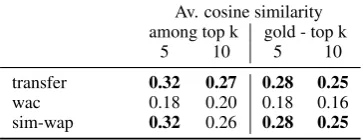
lampin Figure 2(g) orchair/shirtin Figure 2(c). To quantify this general impression, Table 3 shows cosine similarities among words in the topn gen-erated by our models, using their word2vec em-beddings. The average cosine similarity between words in our vocabulary is 0.17. TheTRANSFER
and SIM-WAP model rank words on top that are
clearly more similar to each other than word pairs on average, whereas words ranked top by theWAC
model are more dissimilar to each other. Another remarkable finding is that the words generated by
TRANSFERandSIM-WAPare not only more
simi-lar among the top predictions, but also more sim-ilar to the gold name (Table 3 , right columns). This result is noteworthy since the accuracies for the top predictions shown in Table 1 are slightly belowWAC. In general, this suggests that there is
[image:6.595.80.284.183.254.2]not improving accuracies for object recognition, see discussion in Section 2. Additional evaluation metrics, such as success rates in a human evalua-tion (cf. Zarrieß and Schlangen (2016)), would be an interesting direction for more detailed investi-gation here.
Word Use But even though theWAC classifiers
lack knowledge on lexical similarities, they seem to able to detect relatively specific instances of word use such ashutin Figure 2(b),shirtin 2(c) or
lampin 2(h). Here, the combination withTRANS -FERandSIM-WAP is helpful to give more weight
to the object name that is taxonomically correct (sometimes pushing up words below the top-3 and hence not shown in Figure 2). In Figure 1(e),SIM -WAP and TRANSFERgive more weight to typical
names for persons, whereas WAC top-ranks more
unusual names, reflecting that the person is diffi-cult to identify visually. Another observation is that the mapping models have difficulties deal-ing with object names in sdeal-ingular and plural. As these words have very similar representations in the distributional space, they are often predicted as likely variants among the top 10 bySIM-WAPand TRANSFER, whereas theWACmodel seems to
pre-dict inappropriate plural words less often among the top 3. Such specific phenomena at the intersec-tion of visual and semantic similarity have found very little attention in the literature. We will in-vestigate them further in our Experiments on zero-shot naming in the following Section.
6 Zero-Shot Naming
Zero-shot learning is an attractive prospect for REG from images, as it promises to overcome de-pendence on pairings of visual instances and nat-ural names being available for all names, if vi-sual/referential data can be generalised from other types of information. Previous work has looked at the feasibility of zero-shot learning as a func-tion of semantic similarity or ontological close-ness between unknown and known categories, and confirmed the intuition that the task is harder the less close unknown categories are to known ones (Frome et al., 2013; Norouzi et al., 2013).
Our experiments on object naming in Section 5 suggest that lexical similarities encoded in a dis-tributional space might not always fully carry over to referential meaning. This could constitute an additional challenge for zero-shot learning, as dis-tributional similarities might be misleading when
the model has to fully rely on them for learning referential word meanings. Therefore, the fol-lowing experiments investigate the performance of our models in zero-shot naming as a function of the lexical relation between unknown and known object names, i.e. namely hypernyms and singu-lar/plurals. Both relations are typically captured by distributional models of word meaning in terms of closeness in the vector space, but their visual and referential relation is clearly different.
6.1 Vocabulary Splits and Testsets
Random As in previous work on zero-shot learning, we consider zero-shot naming for words of varying degrees of similarity. We randomly split our 159 names from Experiment 1 into 10 subsets. We train the models on 90% of the nouns (and all their visual instances in the image cor-pus) and test on the set of image regions that are named with words which the model did not ob-serve during training. Results reported in Table 4 on the random test set correspond to averaged scores from cross-validation over the 10 splits.
Hypernyms We manually split the model’s vo-cabulary into set of hypernyms (see Appendix A) and the remaining nouns. We train the models on those 84K image regions that where not named with a hypernym, and test on 8895 image regions that were named with a hypernym in the corpus. We checked that for each of these hypernyms, the vocabulary contains at least one or two names that can be considered as hyponyms, i.e. the model sees objects during training that are instances of
vehicle for example, but never encounters actual uses of that name. This test set is particularly inter-esting from an REG perspective, as objects named with very general terms by human speakers are of-ten difficult to describe with more common, but more specific terms, as is illustrated by the uses of
structureandthingyin Figure 1.
(a)
wac: seal, rock, water sim-wap: side, rock,rocks transfer: rocks, rock, water combination: rock
(c)
wac: chair, shirt, guy sim-wap: woman, man, girl transfer: door, woman, window combination: shirt
(e)
wac: chick, person, guy sim-wap: man, person, woman transfer: man, guy, girl combination: person
(g)
wac: animal, lamp, table sim-wap: man, girl, person transfer: man, clouds, cloud combination: person
(b)
wac: cactus, hut, mountain sim-wap: side, rock, mountain transfer: mountain, rocks, rock combination: hut
(d)
wac: roof, house, building sim-wap: building, house, trees transfer: building, house, trees combination: house
(f)
wac: bush, bushes, tree sim-wap: trees, tree, grass transfer: trees, tree, bushes combination: bushes
(h)
[image:8.595.76.533.82.449.2]wac: post, light, lamp sim-wap: tree, sky, pole transfer: tree, sky, trees combination: lamp
Figure 2: Examples from object naming experiment where model combination is accurate
Zero-shot Model full vocab disjoint vocab
names @1 @2 @5 @10 @1 @2
Random
transfer 0.05 2.38 16.57 35.71 41.49 62.34 wac, project top10 0.00 4.42 21.16 39.17 38.03 58.07 wac, project top5 0.00 4.39 21.63 40.01 37.46 57.36 sim-wap 3.71 13.13 36.49 54.44 42.28 64.26
Hypernyms
transfer 0.07 1.25 7.75 29.93 59.88 73.88 wac, project top10 0.00 3.01 15.55 36.99 50.51 66.33 wac, project top5 0.00 2.78 16.75 38.13 47.73 64.38 sim-wap 3.16 10.33 31.14 49.62 57.55 70.15
Singulars/Plurals
transfer 0.01 22.84 44.30 72.85 34.56 51.79 wac, project top10 0.00 22.21 43.43 68.95 31.46 48.76 wac, project top5 0.00 22.18 43.93 69.33 31.46 48.88 sim-wap 15.39 34.73 56.62 77.32 37.24 54.02
[image:8.595.102.498.512.722.2]6.2 Evaluation
Some previous work on zero-shot image labeling assumes additional components that first identify whether an image should be labelled by a known or unknown word (Frome et al., 2013). We fol-low Lazaridou et al. (2014) and let the model de-cide whether to refer to an object by a known or unknown name. Related to that, distinct evalua-tion procedures have been used in the literature on zero-shot learning:
Testing on full vocabulary A realistic way to test zero-shot learning performance is to consider all words from a given vocabulary during testing, though the testset only contains instances of ob-jects that have been named with a ‘zero-shot word’ (for which no visual instances were seen during training). Accuracies in this setup reflect how well the model is able to generalize, i.e. how often it decides to deviate from the words it was trained on, and (implicitly) predicts that the given object requires a “new” name. In case of the (i) hyper-nym and (ii) singular/plural test set, this accuracy also reflects to what extent the model is able to de-tect cases where (i) a more general or vague term is needed, where (ii) an unknown singular/plural counterpart of a known object type occurs.
Testing on disjoint vocabulary Alternatively, the model’s vocabulary can be restricted during testing to zero-shot words only, such that names encountered during training and testing are dis-joint, see e.g. (Lampert et al., 2009, 2013). This setup factors out the generalization problem, and assesses to what extent a model is able to cap-ture the referential meaning of a word that does not have instances in the training data.
6.3 Results
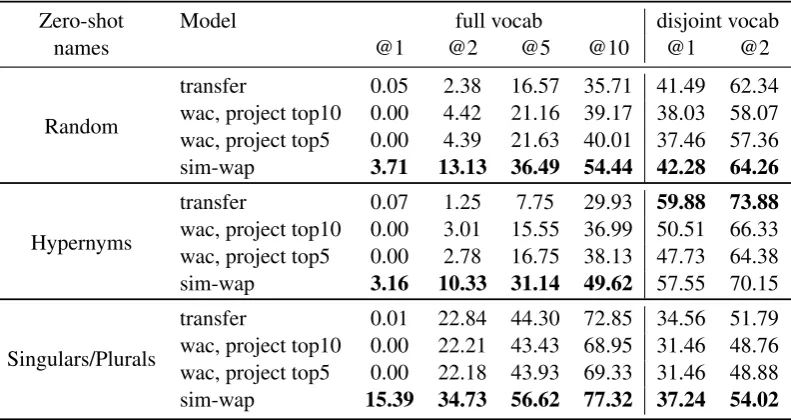
As compared to Experiment 1 where models achieved similar performance, differences are more pronounced in the zero-shot setup, as shown in Table 4. In particular, we find that the SIM -WAP model which induces individual predictors
for words that have not been observed in the train-ing data is clearly more successful than TRANS -FER orWAC that project predictions into the
dis-tributional space. When tested on the full vocabu-lary, we find thatTRANSFERandWACvery rarely
generate names whose referents were excluded from training, which is in line with observations made by Lazaridou et al. (2015a). The SIM-WAP
predictors generalize much better, in particular on the singular/plural testset.
An interesting exception is the good perfor-mance of theTRANSFERmodel on the hypernym
test set, when evaluated with a disjoint vocabu-lary. This corroborates evidence from Experiment 1, namely that the transfer model captures tax-onomic aspects of object names better than the other models. Projection via individual word clas-sifiers, on the other hand, seems to generalize bet-ter than TRANSFER, at least when looking at
ac-curacies @2 ... @10. Thus, combining several vectors predicted by a model of referential word meaning can provide additional information, as compared to mapping an object to a single vec-tor in distributional space. More work is needed to establish how these approaches can be integrated more effectively.
7 Discussion and Conclusion
Acknowledgments
We acknowledge support by the Cluster of Excellence “Cognitive Interaction Technology” (CITEC; EXC 277) at Bielefeld University, which is funded by the German Research Foundation (DFG). We thank the anonymous reviewers for their very valuable, very detailed and highly in-teresting comments.
References
Marco Baroni, Georgiana Dinu, and Germ´an Kruszewski. 2014. Don’t count, predict! a systematic comparison of context-counting vs. context-predicting semantic vectors. InProceedings of the 52nd Annual Meeting of the Association for Computational Linguistics (Volume 1: Long Papers). Association for Computational Lin-guistics, Baltimore, Maryland, pages 238–247. http://www.aclweb.org/anthology/P14-1023. Robert Dale and Ehud Reiter. 1995. Computational
interpretations of the gricean maxims in the gener-ation of referring expressions. Cognitive Science
19(2):233–263.
Abhishek Das, Satwik Kottur, Khushi Gupta, Avi Singh, Deshraj Yadav, Jos´e M. F. Moura, Devi Parikh, and Dhruv Batra. 2016. Visual dialog. CoRR abs/1611.08669. http://arxiv.org/abs/1611.08669.
Jia Deng, Nan Ding, Yangqing Jia, Andrea Frome, Kevin Murphy, Samy Bengio, Yuan Li, Hartmut Neven, and Hartwig Adam. 2014. Large-scale ob-ject classification using label relation graphs. In Eu-ropean Conference on Computer Vision. Springer, pages 48–64.
Jia Deng, W. Dong, Richard Socher, L.-J. Li, K. Li, and L. Fei-Fei. 2009. ImageNet: A Large-Scale Hierar-chical Image Database. InCVPR09.
Katrin Erk. 2016. What do you know about an alligator when you know the company it keeps? Semantics and Pragmatics 9(17):1–63. https://doi.org/10.3765/sp.9.17.
Yansong Feng and Mirella Lapata. 2010. Visual in-formation in semantic representation. In Human Language Technologies: The 2010 Annual Confer-ence of the North American Chapter of the Associa-tion for ComputaAssocia-tional Linguistics. Association for Computational Linguistics, pages 91–99.
Andrea Frome, Greg S Corrado, Jon Shlens, Samy Bengio, Jeff Dean, Marc Aurelio Ranzato, and Tomas Mikolov. 2013. Devise: A deep visual-semantic embedding model. In C. J. C. Burges, L. Bottou, M. Welling, Z. Ghahramani, and K. Q. Weinberger, editors, Advances in Neural Informa-tion Processing Systems 26, Curran Associates, Inc., pages 2121–2129.
Dimitra Gkatzia, Verena Rieser, Phil Bartie, and William Mackaness. 2015. From the virtual to the realworld: Referring to objects in real-world spatial scenes. In Proceedings of the 2015 Con-ference on Empirical Methods in Natural Lan-guage Processing. Association for Computational Linguistics, Lisbon, Portugal, pages 1936–1942. http://aclweb.org/anthology/D15-1224.
Michael Grubinger, Paul Clough, Henning M¨uller, and Thomas Deselaers. 2006. The IAPR TC-12 bench-mark: a new evaluation resource for visual informa-tion systems. In Proceedings of the International Conference on Language Resources and Evaluation (LREC 2006). Genoa, Italy, pages 13–23.
Aur´elie Herbelot and Eva Maria Vecchi. 2015. Build-ing a shared world: mappBuild-ing distributional to model-theoretic semantic spaces. In Proceedings of the 2015 Conference on Empirical Methods in Natu-ral Language Processing. Association for Compu-tational Linguistics, Lisbon, Portugal, pages 22–32. http://aclweb.org/anthology/D15-1003.
Ronghang Hu, Huazhe Xu, Marcus Rohrbach, Jiashi Feng, Kate Saenko, and Trevor Darrell. 2015. Natu-ral language object retrieval. CoRRabs/1511.04164. http://arxiv.org/abs/1511.04164.
Sahar Kazemzadeh, Vicente Ordonez, Mark Matten, and Tamara L Berg. 2014. ReferItGame: Referring to Objects in Photographs of Natural Scenes. In Pro-ceedings of the Conference on Empirical Methods in Natural Language Processing (EMNLP 2014). Doha, Qatar, pages 787–798.
Douwe Kiela and L´eon Bottou. 2014. Learning image embeddings using convolutional neural networks for improved multi-modal semantics. InProceedings of the 2014 Conference on Empirical Methods in Natu-ral Language Processing (EMNLP). Association for Computational Linguistics, Doha, Qatar, pages 36– 45. http://www.aclweb.org/anthology/D14-1005. Satwik Kottur, Ramakrishna Vedantam, Jos´e MF
Moura, and Devi Parikh. 2016. Visual word2vec (vis-w2v): Learning visually grounded word embed-dings using abstract scenes. InProceedings of the IEEE Conference on Computer Vision and Pattern Recognition. pages 4985–4994.
Emiel Krahmer and Kees Van Deemter. 2012. Compu-tational generation of referring expressions: A sur-vey. Computational Linguistics38(1):173–218. Christoph H Lampert, Hannes Nickisch, and Stefan
Harmeling. 2009. Learning to detect unseen object classes by between-class attribute transfer. InIEEE Computer Vision and Pattern Recognition. IEEE, pages 951–958.
Angeliki Lazaridou, Elia Bruni, and Marco Baroni. 2014. Is this a wampimuk? Cross-modal map-ping between distributional semantics and the visual world. In Proceedings of the 52nd Annual Meet-ing of the Association for Computational LMeet-inguistics (Volume 1: Long Papers). pages 1403–1414.
Angeliki Lazaridou, Georgiana Dinu, and Marco Baroni. 2015a. Hubness and pollution: Delv-ing into cross-space mappDelv-ing for zero-shot learn-ing. In Proceedings of the 53rd Annual Meet-ing of the Association for Computational Lin-guistics and the 7th International Joint Con-ference on Natural Language Processing (Vol-ume 1: Long Papers). Association for Computa-tional Linguistics, Beijing, China, pages 270–280. http://www.aclweb.org/anthology/P15-1027.
Angeliki Lazaridou, Nghia The Pham, and Marco Ba-roni. 2015b. Combining language and vision with a multimodal skip-gram model. InProceedings of the 2015 Conference of the North American Chapter of the Association for Computational Linguistics: Hu-man Language Technologies. Association for Com-putational Linguistics, Denver, Colorado, pages 153–163. http://www.aclweb.org/anthology/N15-1016.
Willem JM Levelt, Herbert Schriefers, Dirk Vor-berg, Antje S Meyer, Thomas Pechmann, and Jaap Havinga. 1991. The time course of lexical access in speech production: A study of picture naming. Psy-chological review98(1):122.
Junhua Mao, Jonathan Huang, Alexander Toshev, Oana Camburu, Alan L. Yuille, and Kevin Murphy. 2015. Generation and comprehension of unambiguous ob-ject descriptions. ArXiv / CoRR abs/1511.02283. http://arxiv.org/abs/1511.02283.
Tomas Mikolov, Ilya Sutskever, Kai Chen, Greg Corrado, and Jeffrey Dean. 2013. Distributed representations of words and phrases and their compositionality. In Proceedings of the 26th International Conference on Neural Information Processing Systems. Curran As-sociates Inc., USA, NIPS’13, pages 3111–3119. http://dl.acm.org/citation.cfm?id=2999792.2999959.
Mohammad Norouzi, Tomas Mikolov, Samy Bengio, Yoram Singer, Jonathon Shlens, Andrea Frome, Greg S Corrado, and Jeffrey Dean. 2013. Zero-shot learning by convex combination of semantic embed-dings. International Conference on Learning Rep-resentations (ICLR).
Vicente Ordonez, Wei Liu, Jia Deng, Yejin Choi, Alexander C. Berg, and Tamara L. Berg. 2016. Learning to name objects. Commun. ACM
59(3):108–115.
Eleanor Rosch. 1978. Principles of Categorization. In Eleanor Rosch and Barbara B. Lloyd, editors,
Cognition and Categorization, Lawrence Erlbaum, Hillsdale, N.J., USA, pages 27—-48.
Deb Roy. 2005. Grounding words in perception and action: Computational insights. Trends in Cognitive Sciene9(8):389–396.
Deb Roy, Peter Gorniak, Niloy Mukherjee, and Josh Juster. 2002. A trainable spoken language under-standing system for visual object selection. In Pro-ceedings of the International Conference on Speech and Language Processing 2002 (ICSLP 2002). Col-orado, USA.
Deb K. Roy. 2002. Learning visually-grounded words and syntax for a scene description task. Computer Speech and Language16(3).
David Schlangen, Sina Zarriess, and Casey Kenning-ton. 2016. Resolving references to objects in pho-tographs using the words-as-classifiers model. In
Proceedings of the 54rd Annual Meeting of the Asso-ciation for Computational Linguistics (ACL 2016).
Carina Silberer and Mirella Lapata. 2014. Learn-ing grounded meanLearn-ing representations with autoen-coders. In Proceedings of the 52nd Annual Meet-ing of the Association for Computational LMeet-inguistics (Volume 1: Long Papers). Association for Computa-tional Linguistics, Baltimore, Maryland, pages 721– 732. http://www.aclweb.org/anthology/P14-1068.
Richard Socher, Milind Ganjoo, Christopher D Man-ning, and Andrew Ng. 2013. Zero-shot learning through cross-modal transfer. In Advances in neu-ral information processing systems. pages 935–943.
Christian Szegedy, Wei Liu, Yangqing Jia, Pierre Sermanet, Scott Reed, Dragomir Anguelov, Du-mitru Erhan, Vincent Vanhoucke, and Andrew Ra-binovich. 2015. Going deeper with convolutions. In
CVPR 2015. Boston, MA, USA.
Peter D Turney and Patrick Pantel. 2010. From fre-quency to meaning: Vector space models of se-mantics. Journal of artificial intelligence research
37(1):141–188.
Sina Zarrieß and David Schlangen. 2016. Easy things first: Installments improve referring expres-sion generation for objects in photographs. In
Proceedings of the 54th Annual Meeting of the Association for Computational Linguistics (Vol-ume 1: Long Papers). Association for Computa-tional Linguistics, Berlin, Germany, pages 610–620. http://www.aclweb.org/anthology/P16-1058.
A Vocabulary Splits for Zero-Shot Naming
Hypernyms animal, animals, plant, plants, ve-hicle, person, persons, food, thing, object, area, things, thingy, toy, anyone, clothes, dish, building, land, structure, item, water
Singulars/Plurals . . .
. . . training on instances of: animals, plants, cars, people, buildings, trees, man, kid, guy, girl, boy, flower, bird, hill, orange, cloud, curtain, window, shrub, apple, light, house, glass, bottle, dude, leg, book, wall, bananas, carrots, pillows, bushes, mountains, bags