Proceedings of the 55th Annual Meeting of the Association for Computational Linguistics, pages 1171–1181 Vancouver, Canada, July 30 - August 4, 2017. c2017 Association for Computational Linguistics Proceedings of the 55th Annual Meeting of the Association for Computational Linguistics, pages 1171–1181
Vancouver, Canada, July 30 - August 4, 2017. c2017 Association for Computational Linguistics
Abstractive Document Summarization with a Graph-Based
Attentional Neural Model
Jiwei Tan, Xiaojun Wan and Jianguo Xiao
Institute of Computer Science and Technology, Peking University The MOE Key Laboratory of Computational Linguistics, Peking University
{tanjiwei,wanxiaojun,xiaojianguo}@pku.edu.cn
Abstract
Abstractive summarization is the ultimate goal of document summarization research, but previously it is less investigated due to the immaturity of text generation tech-niques. Recently impressive progress has been made to abstractive sentence sum-marization using neural models. Unfor-tunately, attempts on abstractive docu-ment summarization are still in a primi-tive stage, and the evaluation results are worse than extractive methods on bench-mark datasets. In this paper, we review the difficulties of neural abstractive docu-ment summarization, and propose a novel graph-based attention mechanism in the sequence-to-sequence framework. The in-tuition is to address the saliency factor of summarization, which has been over-looked by prior works. Experimental re-sults demonstrate our model is able to achieve considerable improvement over previous neural abstractive models. The data-driven neural abstractive method is also competitive with state-of-the-art ex-tractive methods.
1 Introduction
Document summarization is a task to generate a fluent, condensed summary for a document, and keep important information. As a useful tech-nique to alleviate the information overload peo-ple are facing today, document summarization has been extensively investigated. Efforts on docu-ment summarization can be categorized to extrac-tive and abstracextrac-tive methods. Extracextrac-tive methods produce the summary of a document by extracting sentences from the original document. They have the advantage of producing fluent sentences and
preserving the meaning of original documents, but also inevitably face the drawbacks of information redundancy and incoherence between sentences. Moreover, extraction is far from the way humans write summaries.
On the contrary, abstractive methods are able to generate better summaries with the use of ar-bitrary words and expressions, but generating ab-stractive summaries is much more difficult in prac-tice. Abstractive summarization involves sophis-ticated techniques including meaning representa-tion, content organizarepresenta-tion, and surface realization. Each of these techniques has large space to be im-proved (Yao et al.,2017). Due to the immaturity of natural language generation techniques, fully ab-stractive approaches are still at the beginning and cannot always ensure grammatical abstracts.
Recent neural networks enable an end-to-end framework for natural language generation. Suc-cess has been witnessed on tasks like machine translation and image captioning, together with the abstractive sentence summarization (Rush et al.,2015). Unfortunately, the extension of sen-tence abstractive methods to the document sum-marization task is not straightforward. Encoding and decoding for a long sequence of multiple sen-tences, currently still lack satisfactory solutions (Yao et al., 2017). Recent abstractive document summarization models are yet not able to achieve convincing performance, with a considerable gap from extractive methods.
In this paper, we review the key factors of doc-ument summarization, i.e., the saliency, fluency, coherence, and novelty requirements of the gener-ated summary. Fluency is what neural generation models are naturally good at, but the other factors are less considered in previous neural abstractive models. A recent study (Chen et al.,2016) starts to consider the factor of novelty, using a distrac-tion mechanism to avoid redundancy. As far as we
know, however, saliency has not been addressed by existing neural abstractive models, despite its importance for summary generation.
In this work, we study how neural summariza-tion models can discover the salient informasummariza-tion of a document. Inspired by the graph-based extrac-tive summarization methods, we introduce a novel graph-based attention mechanism in the encoder-decoder framework. Moreover, we investigate the challenges of accepting and generating long se-quences for sequence-to-sequence (seq2seq) mod-els, and propose a new hierarchical decoding al-gorithm with a reference mechanism to generate the abstractive summaries. The proposed method is able to tackle the constraints of saliency, non-redundancy, information correctness, and fluency under a unified framework.
We conduct experiments on two large-scale cor-pora with human generated summaries. Experi-mental results demonstrate that our approach con-sistently outperforms previous neural abstractive summarization models, and is also competitive with state-of-the-art extractive methods.
We organize the paper as follows. Section 2 introduces related work. Section 3 describes our method. In Section 4 we present the experiments and have discussion. Finally in Section 5 we con-clude this paper.
2 Related Work
2.1 Extractive Summarization Methods Document summarization can be categorized to extractive methods and abstractive methods. Ex-tractive methods extract sentences from the orig-inal document to form the summary. Notable early works include (Edmundson,1969;Carbonell and Goldstein,1998;McDonald,2007). In recent years much progress has also been made under traditional extractive frameworks (Li et al.,2013;
Dasgupta et al.,2013;Nishikawa et al.,2014). Neural networks have also been widely investi-gated on the extractive summarization task. Ear-lier works explore to use deep learning techniques in the traditional framework (Kobayashi et al.,
2015; Yin and Pei, 2015; Cao et al., 2015a,b). More recent works predict the extraction of sen-tences in a more data-driven way. Cheng and La-pata(2016) propose an encoder-decoder approach where the encoder learns the representation of sen-tences and documents while the decoder classifies each sentence using an attention mechanism.
Nal-lapati et al.(2017) propose a recurrent neural net-work (RNN)-based sequence model for extractive summarization of documents. Neural sentence ex-tractive models are able to leverage large-scale training data and achieve performance better than traditional extractive summarization methods.
2.2 Abstractive Summarization Methods Abstractive summarization aims at generating the summary based on understanding the input text. It involves multiple subproblems like simplifica-tion, paraphrasing, and fusion. Previous research is mostly restricted in one or a few of the subprob-lems or specific domains (Woodsend and Lapata,
2012;Thadani and McKeown,2013;Cheung and Penn,2014;Pighin et al.,2014;Sun et al.,2015).
As for neural network models, success is achieved on sentence abstractive summarization.
Rush et al. (2015) train a neural attention model on a large corpus of news documents and their headlines, and later Chopra et al. (2016) extend their work with an attentive recurrent neural net-work framenet-work.Nallapati et al.(2016) introduce various effective techniques in the RNN seq2seq framework. These neural sentence abstraction models are able to achieve state-of-the-art results on the DUC competition of generating headline-level summaries for news documents.
Some recent works investigate neural abstrac-tive models on the document summarization task.
Cheng and Lapata (2016) also adopt a word ex-traction model, which is restricted to use the words of the source document to generate a summary, al-though the performance is much worse than the sentence extractive model. Nallapati et al.(2016) extend the sentence summarization model by try-ing a hierarchical attention architecture and a lim-ited vocabulary during the decoding phase. How-ever these models still investigate few properties of the document summarization task. Chen et al.
(2016) first attempt to explore the novelty factor of summarization, and propose a distraction-based attentional model. Unfortunately these state-of-the-art neural abstractive summarization models are still not competitive to extractive methods, and there are several problems remain to be solved.
3 Our Method
3.1 Overview
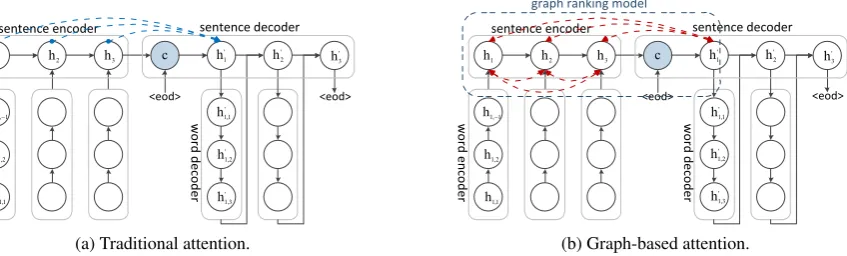
widely used in machine translation (Bahdanau et al.,2014) and dialog systems (Mou et al.,2016), etc. In particular, we use a hierarchical encoder-decoder framework similar to (Li et al.,2015), as shown in Figure 1. The main distinction of this work is that we introduce a graph-based attention mechanism which is illustrated in Figure1b, and we propose a hierarchical decoding algorithm with a reference mechanism to tackle the difficulty of abstractive summary generation. In the following parts, we will first introduce the encoder-decoder framework, and then describe the graph-based at-tention and the hierarchical decoding algorithm.
3.2 Encoder
The goal of the encoder is to map the input doc-ument to a vector representation. A docdoc-ument d
is a sequence of sentences d = {si}, and a
sen-tencesiis a sequence of wordssi ={wi,k}. Each
word wi,k is represented by its distributed
repre-sentationei,k, which is mapped by a word
embed-ding matrixEv. We adopt a hierarchical encoder
framework, where we use a word encoderencword to encode the words of a sentencesi into the
sen-tence representation, and use a sensen-tence encoder
encsent to encode the sentences of a document d into the document representation. The input to the word encoder is the word sequence of a sen-tence, appended with an “<eos>” token
indicat-ing the end of a sentence. The word encoder se-quentially updates its hidden state after receiving each word, as hi,k = encword(hi,k−1,ei,k). The
last hidden state (after the word encoder receives “<eos>”) is denoted ashi,−1, and used as the em-bedding representation of the sentencesi, denoted
asxi. A sentence encoder is used to sequentially
receive the embeddings of the sentences, given by
hi = encsent(hi−1,xi). A pseudo sentence of
an “<eod>” token is appended at the end of the
document to indicate the end of the whole docu-ment. The hidden state after the sentence encoder receives “<eod>” is treated as the representation
of the input documentc=h−1.
We use the Long Short-Term Memory (LSTM) (Hochreiter and Schmidhuber, 1997) as both the word encoder encword and sentence encoder
encsent. In particular, we adopt the variant of LSTM structure in (Graves,2013).
3.3 Decoder with Attention
The decoder is used to generate output sentences
{s0j} according to the representation of the input
sentences. We also use an LSTM-based hierarchi-cal decoder framework to generate the summary, because the summary typically comprises several sentences. The sentence decoderdecsent receives the document representationc as the initial state h00 = c, and predicts the sentence
representa-tions sequentially, byh0j = decsent(h0j−1,x 0
j−1), where x0j−1 is the encoded representation of the
previously generated sentences0j−1. The word de-coder decword receives a sentence representation
h0j as the initial state h0j,0 = h0j, and predicts
the word representations sequentially, by h0j,k = decword(h0j,k−1,ej,k−1), where ej,k−1 is the em-bedding of the previously generated word. The predicted word representations are mapped to vec-tors of the vocabulary size dimension, and then normalized by a softmax layer as the probability distribution of generating the words in the vocab-ulary. A word decoder stops when it generates the “<eos>” token and similarly the sentence decoder
stops when it generates the “<eod>” token.
In primitive decoder models, c is the same for generating all the output words, which requiresc
to be a sufficient representation for the whole input sequence. The attention mechanism (Bahdanau et al.,2014) is usually introduced to alleviate the burden of remembering the whole input sequence, and to allow the decoder to pay different attention to different parts of input at different generation states. The attention mechanism sets a different
cj when generating sentencej, bycj =Piαjihi.
αji indicates how much the i-th original sentence si contributes to generating thej-th sentence. αji
is usually computed as:
αji = e
ηhi,h0j
P
leη(hl,h
0
j)
(1)
whereη is the function modeling the relation
be-tweenhi andh0j. η can be defined using various
functions including η(a,b) = aTb, η(a,b) =
aTMb, and even a non-linear function achieved
by a multi-layer neural network. In this paper we use η(a,b) = aTMb where M is a parameter
matrix.
3.4 Graph-based Attention Mechanism Traditional attention computes the importance score of a sentencesi, when generating sentence
s0j, according to the relation between the hidden
w o rd e n co d er sentence encoder <eod> <eod> w o rd d ec o d er sentence decoder 2 h 1
h h3
' 1 h ' 2 h c ' 3 h 1, 1 h 1,2 h 1,1 h ' 1,1 h ' 1,3 h ' 1,2 h
(a) Traditional attention.
w o rd e n co d er sentence encoder <eod> <eod> w o rd d ec o d er sentence decoder 2 h 1
h h3
' 1 h ' 2 h c ' 3 h
graph ranking model
1,1
h
1,2
h
1, 1
h h'1,1
' 1,2 h ' 1,3 h
[image:4.595.94.518.74.202.2](b) Graph-based attention.
Figure 1: Hierarchical encoder-decoder framework and comparison of the attention mechanisms.
in Figure 1a. This attention mechanism is use-ful in scenarios like machine translation and im-age captioning, because the model is able to learn a relevance mapping between the input and out-put. However, for document summarization, it is not easy for the model to learn how to summarize the salient information of a document, i.e., which sentences are more important to a document.
To tackle this challenge, we learn from graph-based extractive summarization models TextRank (Mihalcea and Tarau,2004) and LexRank (Erkan and Radev,2004), which are based on the PageR-ank (Page et al., 1999) algorithm. These unsu-pervised graph-based models show good ability to identify important sentences in a document. The underlying idea is that a sentence is important in a document if it is heavily linked with many impor-tant sentences (Wan,2010).
In graph-based extractive summarization, a graph G is constructed to rank the original
sen-tences. The verticesV are the set ofnsentences
to be considered, and the edges E are the rela-tions between the sentences, which are typically modeled by the similarity of sentences. LetW ∈ Rn×n be the adjacent matrix. Then the saliency
scores of the sentences are determined by making use of the global information on the graph recur-sively, as:
f(t+ 1) =λW D−1f(t) + (1−λ)y (2)
where f = [f1, . . . , fn] ∈ Rn denotes the rank
scores of the n sentences. f(t) denotes the rank
scores at thet-th iteration. Dis a diagonal matrix
with its(i, i)-element equal to the sum of thei-th
column ofW. Assume we usehias the
represen-tation ofsi, andW(i, j) =hTi Mhj, whereM is
a parameter matrix to be learned. λis a damping
factor.y∈ Rnwith all elements equal to1/n. The
solution of f can be calculated using the
closed-form:
f = (1−λ)(I−λW D−1)−1y (3)
In the graph model, the importance score of a sentencesiis determined by the relation between
hi and the {hl} of all other sentences.
Rela-tively, in traditional attention mechanisms, the im-portance (attention) scoreαji is determined by the relation between hi and h0j, regardless of other
original sentences. In our model we hope to com-bine the two effects, and compute the rank scores of the original sentences regardingh0j, so that the
importance scores of original sentences are dif-ferent when decoding difdif-ferent stateh0j, denoted
by fj. In our model we use the scores fj to
compute the attention. Therefore, h0j should be
considered in the graph model. Inspired by the query-focused graph-based extractive summariza-tion model (Wan et al., 2007), we realize this by applying the idea of topic-sensitive PageRank (Haveliwala,2002), which is to rank the sentences with the concern of their relevance to the topic. We treat the current decoding stateh0j as the topic and
add it into the graph as the 0-th pseudo-sentence. Given a topicT, the topic-sensitive PageRank is
similar to Eq.3except thatybecomes:
yT =
( 1
|T| i∈T
0 i /∈T (4)
Therefore yT is always a one hot vector and
only y0 = 1, indicating the 0-th sentence is s0j.
DenoteWjas the new adjacent matrix added with
h0j, and Dj as the new diagonal matrix
corre-sponding toWj. Then the convergence score
input sentences when generating sentences0j, as:
fj = (1−λ)(I−λWjDj−1)−1yT (5)
The new scoresfj can be used to compute the
graph-based attention when decoding h0j, to find
the sentences which are both globally important and relevant to current decoding state h0j.
In-spired by (Chen et al.,2016) we adopt a distraction mechanism to compute the final attention value
αij, which subtracts the rank scores of the previous
step, to penalize the model from attending to pre-viously attended sentences, and also help to nor-malize the ranked scoresfj. The graph-based
at-tention is finally computed as:
αji = max(f
j
i −f
j−1
i ,0)
P l
max(flj −flj−1,0) (6)
where f0 is initialized with all elements equal to
1/n. The graph-based attention will only focus on those sentences ranked higher over the previ-ous decoding step, so that it concentrates more on the sentences which are both salient and novel. Both Eq.5 and Eq.6 are differentiable; thus we can use the graph-based attention function Eq.6
to replace the traditional attention function Eq.1, and the neural model using the graph-based atten-tion can also be trained using tradiatten-tional gradient-based methods.
3.5 Model Training
The loss functionL of the model is the negative log likelihood of generating summaries over the training setD:
L= X
(Y,X)∈D
−logp(Y|X;θ) (7)
where X = x1, . . . , x|X| and Y =
y1, . . . , y|Y| denote the word sequences of a
document and its summary respectively, including the “<eos>” and “<eod>” tokens for structure
information. Then
logp(Y|X;θ) =
|Y|
X
τ=1
logp(yτ| {y1, . . . , yτ−1},c;θ)
(8) andlogp(yτ| {y1, . . . , yτ−1},c;θ)is modeled by the LSTM encoder and decoder. We use the Adamax (Kingma and Ba, 2014) gradient-based
optimization method to optimize the model pa-rametersθ.
3.6 Decoding Algorithm
We find there are several problems during the gen-eration of summary, including out-of-vocabulary (OOV) words, information incorrectness, error ac-cumulation and repetition. These problems make the generated abstractive summaries far from sat-isfactory. In this work, we propose a hierarchical decoding algorithm with a reference mechanism to tackle these difficulties, which effectively im-proves the quality of generated summaries.
As OOV words frequently occur in name enti-ties, we can first identify the entities of a docu-ment using NLP toolkit like Stanford CoreNLP1.
Then we prefix every entity with an “@entity” to-ken and a number indicating how many words the entity has. We hope the entity prefixes can help better deal with entities which have more than one word, and help improve the accuracy of recovering OOV words in entities. After decoding we recover the OOV words by matching entities in the origi-nal document according to the contexts.
For the hierarchical decoder, a major challenge is that same sentences or phrases are often re-peated in the output. A beam search strategy may help to alleviate the repetition in a sentence, but the repetition in the whole generated summary is remained a problem. The word-level beam search is not easy to be extended to the sentence level. The reason is that theK-best sentences generated
by a word decoder will mostly be similar to each other, which is also noticed byLi et al.(2016).
In this paper we propose a hierarchical beam search algorithm with a reference mechanism. The hierarchical algorithm comprises K-best
word-level beam search and N-best
sentence-level beam search. At the word level, the only difference to vanilla beam search is that we add an additional term to the score p(y˜ τ)
of generating word yτ, and now score(yτ) =
˜
p(yτ) +γ(ref(Yτ−1+yτ, s∗)−ref(Yτ−1, s∗)),
where Yτ−1 = {y1, . . . , yτ−1} and p(y˜ τ) =
logp(yτ|Yτ−1,c;θ). s∗is an original sentence to
refer to. ref is a function which calculates the
ratio of bigram overlap between two texts. The added term aims to favor the generated word yτ
with improving the bigram overlap between cur-rent generated summaryYτ−1and the target
Dataset Train Valid Test D.L. S. L.
CNN 83568 1220 1093 29.8 3.54
DailyMail 196557 12147 10396 26.0 3.84
Table 1: The statistics of the two datasets. D.L. and S.L. indicate the average number of sentences in the document and summary, respectively.
inal sentences∗. At the word decoder level, the
reference mechanism helps to both improve the in-formation correctness and avoid redundancy. Be-cause the reference score is based on the bigram overlap improvement to the whole generated sum-mary Yτ−1, the awareness of previously gener-ated sentences also helps alleviate sentence-level redundancy. A factor γ is introduced to control
the influence of the reference mechanism. Note that because of the non-optimal search, the gener-ated sentence will still be different to the original sentence even with an extremely largeγ.
At the sentence level, N-best sentence beam is
to keep the N generated sentences by referring
toN different original sentences, which have the highest attention scores and have not been used as a reference. With referring toN different
sen-tences, theN candidate sentences are guaranteed
diverse. Sentence-level beam search is realized by maximizing the accumulated score of all the sen-tences generated.
4 Experiments
4.1 Dataset
We conduct experiments on two large-scale cor-pora of CNN and DailyMail, which have been widely used in neural document summarization tasks. The corpora are originally constructed in (Hermann et al., 2015) by collecting human gen-erated abstractive highlights from the news stories in the CNN and DailyMail website. The statistics and split of the two datasets are listed in Table1.
4.2 Implementation
We use the corpora which are already provided with labeled entities (Nallapati et al., 2016). The documents and summaries are first lowercased and tokenized, and all digit characters are replaced with the “#” symbol, similar to (Nallapati et al.,
2016,2017). We keep the 40,000 most frequently occurring words and other words are replaced with the “<OOV>” token.
We use Theano2 for implementation. For the
word encoder and decoder we use three layers of LSTM, and for the sentence encoder and decoder we use one layer of LSTM. The dimension of hid-den vectors are all 512. We use pre-trained GloVe (Pennington et al.,2014) vectors3for the
initializa-tion of word vectors, which will be further trained in the model. The dimension of word vectors is 100.λis set to 0.9. The parameters of Adamax are
set to those provided in (Kingma and Ba, 2014). The batch size is set to 8 documents, and an epoch is set containing 10,000 randomly sampled docu-ments. Convergence is reached within 200 epochs on the DailyMail dataset and 120 epochs on the CNN dataset. It takes about one day for every 30 epochs on a GTX-1080 GPU card. γ is tuned on
the validation set and the best choice is 300. The beam sizes for word decoder and sentence decoder are 15 and 2, respectively.
4.3 Evaluation
We adopt the widely used ROUGE (Lin, 2004) toolkit for evaluation. We first compare with the reported results in (Chen et al., 2016) in-cluding various traditional extractive methods and a state-of-the-art abstractive model (Distraction-M3) on the CNN dataset, as shown in Table 2. Uni-GRU is a non-hierarchical seq2seq baseline model. In Table 3we compare our method with the results of state-of-the-art neural summariza-tion methods reported in recent papers. Extractive models include NN-SE (Cheng and Lapata,2016) and SummaRuNNer (Nallapati et al.,2017), while SummaRuNNer-abs is also an extractive model similar to SummaRuNNer but is trained directly on the abstractive summaries. Moreover, we in-clude several baselines for comparison, includ-ing the baselines reported in (Cheng and Lapata,
2016) although they are tested on 500 samples of the test set. LREG is a feature based method us-ing linear regression. NN-ABS is a neural abstrac-tive baseline which is a simple hierarchical exten-sion of (Rush et al.,2015). NN-WE is the abstrac-tive model which restricts the generation of words from the original document. Lead-3 is a strong ex-tractive baseline that uses the lead three sentences as the summary.
In Table 4 we compare our model with the abstractive attentional encoder-decoder models in
Method Rouge-1 Rouge-2 Rouge-L
Lead-3 26.1 9.6 17.8
Luhn 23.2 7.2 15.5
Edmundson 24.5 8.2 16.7
LSA 21.2 6.2 14.0
LexRank 26.1 9.6 17.7
TextRank 23.3 7.7 15.8
Sum-basic 22.9 5.5 14.8
KL-sum 20.7 5.9 13.7
Uni-GRU 18.4 4.8 14.3
Distraction-M3 27.1 8.2 18.7
Our Method 30.3 9.8 20.0
Table 2: Comparison results on theCNN test set using thefull-length F1variants of Rouge.
Method Rouge-1 Rouge-2 Rouge-L
LREG(500) 18.5 6.9 10.2
NN-ABS(500) 7.8 1.7 7.1
NN-WE(500) 15.7 6.4 9.8
Lead-3 21.9 7.2 11.6
NN-SE 22.7 8.5 12.5
SummaRuNNer-abs 23.8 9.6 13.3
SummaRuNNer 26.2 10.8 14.4
Our Method 27.4 11.3 15.1
Table 3: Comparison results on theDailyMail test setusing Rougerecallat75 bytes.
(Nallapati et al.,2016), which leverage several ef-fective techniques and achieve state-of-the-art per-formance on sentence abstractive summarization tasks. The words-lvt2k and words-lvt2k-ptr are flat models and words-lvt2k-hieratt is a hierarchi-cal extension.
Results in Table2show our abstractive method is able to outperform traditional extractive meth-ods and the distraction-based abstractive model. The results in Tables3and4show that our method has considerable improvement over neural ab-stractive baselines, and is able to outperform state-of-the-art neural extractive methods. An interest-ing observation is the results of the hierarchical model in Table 4 are lower than the flat models, which may demonstrate the difficulty for a tradi-tional attention model to identify the important in-formation in a document.
We also conducted human evaluation on 20 ran-dom samples from the DailyMail test set and com-pared the summaries generated by our method with the outputs of Lead-3, NN-SE (Cheng and
Method Rouge-1 Rouge-2 Rouge-L
words-lvt2k 32.5 11.8 29.5
words-lvt2k-ptr 32.1 11.7 29.2
words-lvt2k-hieratt 31.8 11.6 28.7
Our Method 38.1 13.9 34.0
Table 4: Comparison results on the merged CNN/DailyMail test set using full-length F1 metric.
Method Informative Concise Coherent Fluent
Lead-3 3.60 3.75 4.16 3.85
NN-SE 3.85 3.70 3.48 3.78
Distraction 3.03 3.25 2.93 3.65
Our Method 3.93 3.82 3.53 3.80
Table 5: Human evaluation results.
Lapata,2016) and Distraction (Chen et al.,2016). The output summaries of NN-SE are provided by the authors, and the output summaries of Distrac-tion are achieved by running the code provided by the authors on the DailyMail dataset. Three participants were asked to compare the generated summaries with the human summaries, and as-sess each summary from four independent per-spectives: (1) How informative the summary is? (2) How concise the summary is? (3) How co-herent (between sentences) the summary is? (4) How fluent, grammatical the sentences of a sum-mary are? Each property is assessed with a score from 1 (worst) to 5 (best). The average results are presented in Table5.
0.0 0.1 0.2 0.3 0.4 0.5 0.6 0.7 0.8 0.9 0.99
¸
10.0 10.5 11.0 11.5 12.0 12.5 13.0 13.5 14.0 14.5
Rouge-2 F-score
within 200 epochs within 300 epochs
(a) Rouge-2 F1 score vs.λ.
0 1 10 100 200 300 400 500 1e3 1e4 °
6 8 10 12 14
Rouge-2 F-score
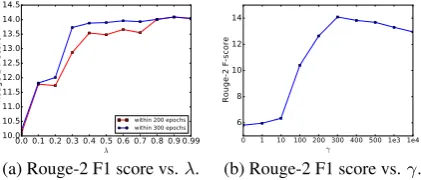
[image:8.595.306.538.61.135.2](b) Rouge-2 F1 score vs.γ. Figure 2: Results of different setting of hyper-parameters tested on 500 samples from the Dai-lyMail test set.
4.4 Model Validation
We conduct experiments to see how the model’s performance is affected by the choice of the hyper-parameters. For efficiency we test on 500 ran-dom samples from the DailyMail test set. Figure
2ashows the maximum average Rouge-2 F1-score achieved when the model is trained using different
λvalues within 200 and 300 epochs. When using
a largerλ, the performance is better and the
con-vergence is faster. Whenλ = 1.0the model fails
to train because of running into a singular matrix. Figure2b shows the results achieved when us-ing different γ values in the hierarchical
decod-ing algorithm. γ = 0is the baseline of the
tradi-tional decoding algorithm which does not refer to the original document. The poor results indicate that even the model is able to learn to identify the salient information in the original document, the performance is limited by the model’s ability of generating a long output sequence. That may be a reason why simple extensions of seq2seq mod-els fail on the abstractive document summarization task. The performance is significantly improved using a reasonable γ, and the optimal γ value is consistent with the one chosen on the validation set. When using an extremely largeγ, the
perma-nence begins to decrease, because the model will copy too much from the original document, and at this time the generated text also becomes less flu-ent. Results show that introducing the reference mechanism in the hierarchical beam search is very effective. Theγ factor significantly affects the
re-sults, but the optimal value is easy to be decided on a validation set.
We also conduct ablation experiments on the CNN dataset to verify the effectiveness of the pro-posed model. Results on the CNN test set are shown in Table 6. “w/o GraphAtt” is to replace
Framework Rouge-1 Rouge-2 Rouge-L
Our Method 30.3 9.8 20.0
w/o GraphAtt 29.2 9.0 19.0 w/o SentenceBeam 29.6 9.3 19.1 w/o BeamSearch 25.1 6.7 17.9
Table 6: Results of removing different compo-nents of our method on the CNN test set using thefull-length F1variants of Rouge. Two-tailed t-tests demonstrate the difference between Our Methodand other frameworks are all statistically significant (p <0.01).
the graph-based attention by a traditional attention function. “w/o SentenceBeam” is to remove the sentence-level beam search. “w/o BeamSearch” is to remove both the sentence-level and word-level beam search, and use a greedy decoding algorithm with the reference mechanism. As seen from Ta-ble6, the graph-based attention mechanism is sig-nificantly better than traditional attention mecha-nism for the document summarization task. Beam search helps significantly improve the generated summaries. Our proposed decoding algorithm en-ables a sentence-level beam search, which helps improve the generated summaries with multiple sentences.
4.5 Case Study
We show the case study of a sample4from the
Dai-lyMail test set in Figure3. We show the “@entity” and number here although they are removed in the evaluation. We compare our result with the output by a model using traditional attention asBaseline Attention. We also show the output generated by a Baseline Decoder, which setsγ = 0and does not
use the sentence-level beam search, to study the difficulty for a traditional decoder to generate mul-tiple sentences. Many observations can be found in Figure3. The lead three sentences mainly fo-cus on the money information and are not suffi-cient. As for the Baseline Decoder, first it usu-ally ends the generation too early. The “<eod>”
token indicates where the original output stops. When we force the decoder not to end here, the model shows the ability to continue producing the important information. However, two flaws are presented. First is the repetition of “## year
-4The original story and highlights can be found at
[image:8.595.75.286.73.163.2]Gold Summary:
@entity 2 mary day , ## , claimed over£##,### in benefits despite not being eligible .
she had£##,### savings in the bank which meant she was not entitled . day used taxpayers ’ money to go on luxury holidays to @entity 1 indian resort of @entity 1 goa .
pleaded guilty to dishonestly claiming benefits and has paid back money .
Lead3:
a benefits cheat who pocketed almost£##,### of taxpayers ’ money and spent it on a string of luxury holidays despite having£##,### in the bank has avoided jail .
@entity 2 mary day , ## , of @entity 1 swanage in @entity 1 dorset , used taxpayers ’ money to go on luxury holidays to the @entity 1 indian resort of @entity 1 goa for up to a month each time .
day fraudulently claimed£##,### of income support and disability al-lowance despite having£##,### of her own savings in the bank .
Baseline Decoder:
## - month - old @entity 2 mary day , ## , was given£##,### in money . the ## - year - old claimed£##,### in disability allowance.<eod>
the ## - year - old was given a six - month prison sentence . ## - year - old pleaded guilty to two counts of fraud .
Baseline Attention:
@entity 2 mary day , ## , used taxpayers ’ money to go on luxury holidays . claimed£##,### of income support and disability allowance despite having savings in the bank .<eod>
benefits of taxpayers£##,### in disability handouts .
Our Method:
@entity 2 mary day , ## , used taxpayers ’ money to go on luxury holidays to the @entity 1 indian resort of @entity 1 goa .
despite having£##,### of her own savings in the bank , she claimed£
##,### of income support and disability allowance .
she pleaded guilty and had given the sentence for three months in prison , but suspended the sentence for ## months .
Figure 3: Examples of generated summaries.
old”. Because the word decoder is unaware of the history generated sentences, it repeats generating the sequence as the subject all the time. Second, more importantly, is the information incorrectness. The “## - month - old” is not appropriate to de-scribe the heroine, and the “six - month prison sen-tence” is in fact “three months”. Information in-correctness occurs because, for a decoder, it aims at generating a fluent sentence according to the input representation. However, no favor of con-sistent with the original input is concerned. The proposed hierarchical decoding algorithm helps to alleviate the two problems. The awareness of all the generated sentences helps prevent from always generating some important information. The fa-vor of bigram overlapping with the original sen-tences helps generate more correct sensen-tences. For example the model is able to correctly distinguish between the “three-month sentence” and the “##-month suspend”. In conclusion, our method is able to identify the most important information in the original document, and the decoding algorithm we propose is able to generate a more discourse-fluent and information-correct abstractive summary.
The visualization of the graph-based attention when our method generates the presented example
I1 I2 I3 I4 I5 I6 I7 I8 I9 I10I11I12I13I14I15I16I17I18I19<eod>
O1
O2
O3
[image:9.595.309.524.63.136.2]<eod>
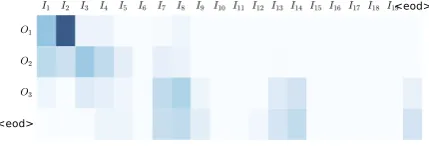
Figure 4: Attention heatmap when generating the example summary.IiandOiindicate thei-th
sen-tence of the input and output, respectively.
is shown in Figure4. It seems that the graph-based attention mechanism is able to find the important sentences in the input document, and the distrac-tion mechanism makes the decoder focus on dif-ferent sentences during decoding. Gradually the decoder attends to “<eod>” until it stops.
5 Conclusion and Future Work
In this paper we tackle the challenging task of ab-stractive document summarization, which is still less investigated to date. We study the difficulty of the abstractive document summarization task, and address the need of finding salient content from the original document, which is overlooked by previous studies. We propose a novel graph-based attention mechanism in a hierarchical encoder-decoder framework, and propose a hierarchical beam search algorithm to generate multi-sentence summary. Extensive experiments verify the effec-tiveness of the proposed method. Experimental re-sults on two large-scale datasets demonstrate our method achieves state-of-the-art abstractive docu-ment summarization performance. It is also able to achieve competitive results with state-of-the-art neural extractive summarization models.
There is lots of future work we can do. An ap-pealing direction is to investigate the neural ab-stractive method on the multi-document summa-rization task, which is more challenging and lacks training data. Further endeavor may be needed.
Acknowledgments
References
Dzmitry Bahdanau, Kyunghyun Cho, and Yoshua Ben-gio. 2014. Neural machine translation by jointly
learning to align and translate. arXiv preprint
arXiv:1409.0473.
Ziqiang Cao, Furu Wei, Li Dong, Sujian Li, and Ming Zhou. 2015a. Ranking with recursive neural net-works and its application to multi-document
summa-rization. InProceedings of the Twenty-Ninth AAAI
Conference on Artificial Intelligence, January 25-30, 2015, Austin, Texas, USA.. pages 2153–2159. Ziqiang Cao, Furu Wei, Sujian Li, Wenjie Li, Ming
Zhou, and Houfeng Wang. 2015b. Learning
sum-mary prior representation for extractive summariza-tion. InProceedings of the 53rd Annual Meeting of the Association for Computational Linguistics and the 7th International Joint Conference on Natural Language Processing (Volume 2: Short Papers). As-sociation for Computational Linguistics, pages 829– 833. https://doi.org/10.3115/v1/P15-2136.
Jaime G. Carbonell and Jade Goldstein. 1998. The use of mmr, diversity-based reranking for
reorder-ing documents and producreorder-ing summaries. InSIGIR
’98: Proceedings of the 21st Annual International ACM SIGIR Conference on Research and Develop-ment in Information Retrieval, August 24-28 1998, Melbourne, Australia. pages 335–336.
Qian Chen, Xiaodan Zhu, Zhen-Hua Ling, Si Wei, and Hui Jiang. 2016. Distraction-based neural networks
for document summarization. InProceedings of the
Twenty-Fifth International Joint Conference on Ar-tificial Intelligence (IJCAI-16). pages 2754–2760.
Jianpeng Cheng and Mirella Lapata. 2016.
Neu-ral summarization by extracting sentences and words. In Proceedings of the 54th Annual Meet-ing of the Association for Computational Lin-guistics (Volume 1: Long Papers). Association for Computational Linguistics, pages 484–494.
https://doi.org/10.18653/v1/P16-1046.
Kit Jackie Chi Cheung and Gerald Penn. 2014.
Unsupervised sentence enhancement for auto-matic summarization. In Proceedings of the 2014 Conference on Empirical Methods in Nat-ural Language Processing (EMNLP). Association for Computational Linguistics, pages 775–786.
https://doi.org/10.3115/v1/D14-1085.
Sumit Chopra, Michael Auli, and M. Alexander Rush.
2016. Abstractive sentence summarization with
attentive recurrent neural networks. In Proceed-ings of the 2016 Conference of the North Ameri-can Chapter of the Association for Computational Linguistics: Human Language Technologies. Asso-ciation for Computational Linguistics, pages 93–98.
https://doi.org/10.18653/v1/N16-1012.
Anirban Dasgupta, Ravi Kumar, and Sujith Ravi.
2013. Summarization through submodularity and
dispersion. In Proceedings of the 51st Annual
Meeting of the Association for Computational Lin-guistics (Volume 1: Long Papers). Association for Computational Linguistics, pages 1014–1022.
http://aclweb.org/anthology/P13-1100.
Harold P Edmundson. 1969. New methods in
au-tomatic extracting. Journal of the ACM (JACM)
16(2):264–285.
G¨unes Erkan and Dragomir R. Radev. 2004. Lexrank: Graph-based lexical centrality as salience in text
summarization. J. Artif. Intell. Res. (JAIR)22:457–
479.
Alex Graves. 2013. Generating sequences with
recurrent neural networks. arXiv preprint
arXiv:1308.0850.
Taher H. Haveliwala. 2002. Topic-sensitive pagerank. InProceedings of the Eleventh International World Wide Web Conference, WWW 2002, May 7-11, 2002, Honolulu, Hawaii. pages 517–526.
Karl Moritz Hermann, Tom´as Kocisk´y, Edward Grefenstette, Lasse Espeholt, Will Kay, Mustafa Su-leyman, and Phil Blunsom. 2015. Teaching
ma-chines to read and comprehend. In Advances in
Neural Information Processing Systems 28: Annual Conference on Neural Information Processing Sys-tems 2015, December 7-12, 2015, Montreal, Que-bec, Canada. pages 1693–1701.
Sepp Hochreiter and J¨urgen Schmidhuber. 1997.
Long short-term memory. Neural Computation
9(8):1735–1780.
Diederik Kingma and Jimmy Ba. 2014. Adam: A
method for stochastic optimization. arXiv preprint
arXiv:1412.6980.
Hayato Kobayashi, Masaki Noguchi, and Taichi
Yatsuka. 2015. Summarization based on
em-bedding distributions. In Proceedings of the 2015 Conference on Empirical Methods in Natural Language Processing. Association for Computational Linguistics, pages 1984–1989.
https://doi.org/10.18653/v1/D15-1232.
Chen Li, Xian Qian, and Yang Liu. 2013.
Us-ing supervised bigram-based ilp for extractive sum-marization. In Proceedings of the 51st Annual Meeting of the Association for Computational Lin-guistics (Volume 1: Long Papers). Association for Computational Linguistics, pages 1004–1013.
http://aclweb.org/anthology/P13-1099.
Jiwei Li, Thang Luong, and Dan Jurafsky. 2015. A
hierarchical neural autoencoder for paragraphs and documents. In Proceedings of the 53rd Annual Meeting of the Association for Computational Lin-guistics and the 7th International Joint Conference on Natural Language Processing (Volume 1: Long Papers). Association for Computational Linguistics,
pages 1106–1115.
Jiwei Li, Will Monroe, and Dan Jurafsky. 2016. A sim-ple, fast diverse decoding algorithm for neural
gen-eration. arXiv preprint arXiv:1611.08562.
Chin-Yew Lin. 2004. Rouge: A package for automatic
evaluation of summaries. In Text Summarization
Branches Out: Proceedings of the ACL-04
work-shop. Barcelona, Spain, volume 8.
Ryan T. McDonald. 2007. A study of global infer-ence algorithms in multi-document summarization. In Advances in Information Retrieval, 29th Euro-pean Conference on IR Research, ECIR 2007, Rome, Italy, April 2-5, 2007, Proceedings. pages 557–564. Rada Mihalcea and Paul Tarau. 2004. Textrank:
Bring-ing order into text. InProceedings of the 2004
Con-ference on Empirical Methods in Natural Language Processing. pages 404–411.
Lili Mou, Yiping Song, Rui Yan, Ge Li, Lu Zhang, and
Zhi Jin. 2016. Sequence to backward and forward
sequences: A content-introducing approach to gen-erative short-text conversation. In Proceedings of COLING 2016, the 26th International Conference on Computational Linguistics: Technical Papers. The COLING 2016 Organizing Committee, pages
3349–3358. http://aclweb.org/anthology/C16-1316.
Ramesh Nallapati, Feifei Zhai, and Bowen Zhou. 2017. Summarunner: A recurrent neural network based se-quence model for extractive summarization of
doc-uments. In Proceedings of the Thirty-First AAAI
Conference on Artificial Intelligence, February 4-9, 2017, San Francisco, California, USA.. pages 3075– 3081.
Ramesh Nallapati, Bowen Zhou, Cicero dos San-tos, Caglar Gulcehre, and Bing Xiang. 2016.
Abstractive text summarization using sequence-to-sequence rnns and beyond. In Proceedings of The 20th SIGNLL Conference on Computa-tional Natural Language Learning. Association for Computational Linguistics, pages 280–290.
https://doi.org/10.18653/v1/K16-1028.
Hitoshi Nishikawa, Kazuho Arita, Katsumi Tanaka, Tsutomu Hirao, Toshiro Makino, and Yoshihiro
Matsuo. 2014. Learning to generate coherent
summary with discriminative hidden semi-markov
model. In Proceedings of COLING 2014. Dublin
City University and Association for Computational Linguistics, pages 1648–1659.
Lawrence Page, Sergey Brin, Rajeev Motwani, and Terry Winograd. 1999. The pagerank citation rank-ing: Bringing order to the web. Technical report, Stanford InfoLab.
Jeffrey Pennington, Richard Socher, and
Christo-pher Manning. 2014. Glove: Global vectors
for word representation. In Proceedings of the 2014 Conference on Empirical Methods in Nat-ural Language Processing (EMNLP). Association for Computational Linguistics, pages 1532–1543.
https://doi.org/10.3115/v1/D14-1162.
Daniele Pighin, Marco Cornolti, Enrique Alfonseca,
and Katja Filippova. 2014. Modelling events
through memory-based, open-ie patterns for abstrac-tive summarization. In Proceedings of the 52nd Annual Meeting of the Association for Computa-tional Linguistics (Volume 1: Long Papers). Associ-ation for ComputAssoci-ational Linguistics, pages 892–901.
https://doi.org/10.3115/v1/P14-1084.
M. Alexander Rush, Sumit Chopra, and Jason
We-ston. 2015. A neural attention model for
ab-stractive sentence summarization. In Proceed-ings of the 2015 Conference on Empirical Meth-ods in Natural Language Processing. Associa-tion for ComputaAssocia-tional Linguistics, pages 379–389.
https://doi.org/10.18653/v1/D15-1044.
Rui Sun, Yue Zhang, Meishan Zhang, and Donghong
Ji. 2015. Event-driven headline generation. In
Proceedings of the 53rd Annual Meeting of the Association for Computational Linguistics and the 7th International Joint Conference on Natural Lan-guage Processing (Volume 1: Long Papers). Associ-ation for ComputAssoci-ational Linguistics, pages 462–472.
https://doi.org/10.3115/v1/P15-1045.
Kapil Thadani and Kathleen McKeown. 2013. Super-vised sentence fusion with single-stage inference. In
Proceedings of the Sixth International Joint Confer-ence on Natural Language Processing. Asian Feder-ation of Natural Language Processing, pages 1410– 1418.
Xiaojun Wan. 2010. Towards a unified approach to simultaneous single-document and multi-document
summarizations. In Proceedings of the 23rd
Inter-national Conference on Computational Linguistics (Coling 2010). Coling 2010 Organizing Committee, pages 1137–1145.
Xiaojun Wan, Jianwu Yang, and Jianguo Xiao. 2007. Manifold-ranking based topic-focused
multi-document summarization. InIJCAI 2007,
Proceed-ings of the 20th International Joint Conference on Artificial Intelligence, Hyderabad, India, January 6-12, 2007. pages 2903–2908.
Kristian Woodsend and Mirella Lapata. 2012. Multi-ple aspect summarization using integer linear
pro-gramming. In Proceedings of the 2012 Joint
Con-ference on Empirical Methods in Natural Language Processing and Computational Natural Language Learning. Association for Computational Linguis-tics, pages 233–243.
Jin-ge Yao, Xiaojun Wan, and Jianguo Xiao. 2017.
Re-cent advances in document summarization.
Knowl-edge and Information Systems.
Wenpeng Yin and Yulong Pei. 2015. Optimizing sen-tence modeling and selection for document
summa-rization. InProceedings of the Twenty-Fourth
Inter-national Joint Conference on Artificial Intelligence, IJCAI 2015, Buenos Aires, Argentina, July 25-31,