3197
Margin-based Parallel Corpus Mining
with Multilingual Sentence Embeddings
Mikel Artetxe
University of the Basque Country (UPV/EHU)∗ [email protected]
Holger Schwenk Facebook AI Research
Abstract
Machine translation is highly sensitive to the size and quality of the training data, which has led to an increasing interest in collect-ing and filtercollect-ing large parallel corpora. In this paper, we propose a new method for this task based on multilingual sentence embed-dings. In contrast to previous approaches, which rely on nearest neighbor retrieval with a hard threshold over cosine similarity, our proposed method accounts for the scale in-consistencies of this measure, considering the margin between a given sentence pair and its closest candidates instead. Our experiments show large improvements over existing meth-ods. We outperform the best published results on the BUCC mining task and the UN recon-struction task by more than 10 F1 and 30 preci-sion points, respectively. Filtering the English-German ParaCrawl corpus with our approach, we obtain 31.2 BLEU points on newstest2014, an improvement of more than one point over the best official filtered version.
1 Introduction
While Neural Machine Translation (NTM) has obtained breakthrough improvements in standard benchmarks, it is known to be particularly sen-sitive to the size and quality of the training data (Koehn and Knowles, 2017;Khayrallah and
Koehn, 2018). In this context, effective
ap-proaches to mine and filter parallel corpora are crucial to apply NMT in practical settings.
Traditional parallel corpus mining has relied on heavily engineered systems. Early approaches were mostly based on metadata information from web crawls (Resnik,1999;Shi et al.,2006). More recent methods focus on the textual content in-stead. For instance, Zipporah learns a classifier
∗
This work was performed during an internship at Face-book AI Research.
over bag-of-word features to distinguish between ground truth translations and synthetic noisy ones (Xu and Koehn,2017). STACC uses seed lexical translations induced from IBM alignments, which are combined with set expansion operations to score translation candidates through the Jaccard similarity coefficient (Etchegoyhen and Azpeitia,
2016;Azpeitia et al.,2017,2018). Many of these approaches rely on cross-lingual document re-trieval (Utiyama and Isahara,2003;Munteanu and
Marcu, 2005, 2006; Abdul-Rauf and Schwenk,
2009) or machine translation (Abdul-Rauf and Schwenk,2009;Bouamor and Sajjad,2018).
More recently, a new research line has shown promising results using multilingual sentence em-beddings alone1 (Schwenk, 2018; Guo et al.,
2018). These methods use an NMT inspired encoder-decoder to train sentence embeddings on existing parallel data, which are then directly ap-plied to retrieve and filter new parallel sentences using nearest neighbor retrieval over cosine simi-larity with a hard threshold (Espa˜na-Bonet et al.,
2017;Hassan et al.,2018;Schwenk,2018). In this paper, we argue that this retrieval method suffers from the scale of cosine similarity not be-ing globally consistent. As illustrated by the ex-ample in Table1, some sentences without any cor-rect translation have overall high cosine scores, making them rank higher than other sentences with a correct translation. This issue was also pointed out by Guo et al. (2018), who learn an encoder to score known translation pairs above synthetic negative examples and train a separate model to dynamically scale and shift the dot prod-uct on held out supervised data. In contrast, our
1Multilingual entence embeddings have also been used as
(A) Les produits agricoles sont constitu´es de th´e, de riz, de sucre, de tabac, de camphre, de fruits et de soie.
0.818 Main crops include wheat, sugar beets, potatoes, cotton, tobacco, vegetables, and fruit. 0.817 The fertile soil supports wheat, corn, barley, tobacco, sugar beet, and soybeans.
0.814 Main agricultural products include grains, cotton, oil, pigs, poultry, fruits, vegetables, and edible fungus. 0.808 The important crops grown are cotton, jowar, groundnut, rice, sunflower and cereals.
(B) Mais dans le contexte actuel, nous pourrons les ignorer sans risque.
0.737 But, in view of the current situation, we can safely ignore these. 0.499 But without the living language, it risks becoming an empty shell.
0.498 While the risk to those working in ceramics is now much reduced, it can still not be ignored. 0.488 But now they have discovered they are not free to speak their minds.
Table 1: Motivating example of the proposed method. We show the nearest neighbors of two French sentences on the BUCC training set along with their cosine similarities. Only the nearest neighbor of B is a correct translation, yet that of A has a higher cosine similarity. We argue that this is caused by the cosine similarity of different sentences being in different scales, making it a poor indicator of the confidence of the prediction. Our method tackles this issue by considering the margin between a given candidate and the rest of theknearest neighbors.
proposed method tackles this issue by considering the margin between the cosine of a given sentence pair and that of its respectiveknearest neighbors.
2 Multilingual sentence embeddings
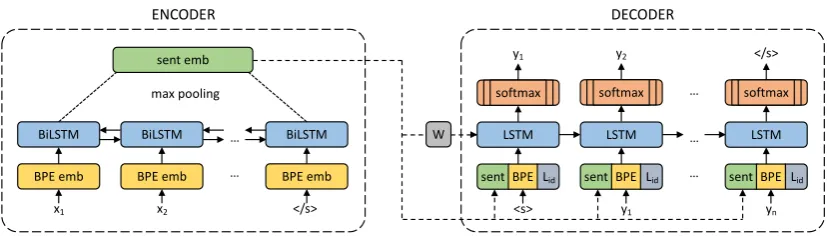
Figure1 shows our encoder-decoder architecture to learn multilingual sentence embeddings, which is based onSchwenk(2018). The encoder consists of a bidirectional LSTM, and our sentence em-beddings are obtained by applying a max-pooling operation over its output. These embeddings are fed into an LSTM decoder in two ways: 1) they are used to initialize its hidden and cell state after a linear transformation, and 2) they are concate-nated to the input embeddings at every time step. We use a shared encoder and decoder for all lan-guages with a joint 40k BPE vocabulary learned on the concatenation of all training corpora.2 The encoder is fully language agnostic, without any explicit signal of the input or output language, whereas the decoder receives an output language ID embedding at every time step. Training min-imizes the cross-entropy loss on parallel corpora, alternating over all combinations of the languages involved. We train on 4 GPUs with a total batch size of 48,000 tokens, using Adam with a learning rate of 0.001 and dropout set to 0.1. We use a sin-gle layer for both the encoder and the decoder with a hidden size of 512 and 2048, respectively, yield-ing 1024 dimensional sentence embeddyield-ings. The input embeddings size is set to 512, while the
lan-2Prior to BPE segmentation, we tokenize and lowercase
the input text using standard Moses tools. As the only ex-ception, we use Jieba (https://github.com/fxsjy/ jieba) for Chinese word segmentation.
guage ID embeddings have 32 dimensions. After training, the decoder is discarded, and the encoder is used to map a sentence to a fixed-length vector.
3 Scoring and filtering parallel sentences
The multilingual encoder can be used to mine par-allel sentences by taking the nearest neighbor of each source sentence in the target side according to cosine similarity, and filtering those below a fixed threshold. While this approach has been reported to be competitive (Schwenk,2018), we argue that it suffers from the scale of cosine similarity not be-ing globally consistent across different sentences.3 For instance, Table1shows an example where an incorrectly aligned sentence pair has a larger co-sine similarity than a correctly aligned one, thus making it impossible to filter it through a fixed threshold. In that case, all four nearest neighbors have equally high values. In contrast, for example B, there is a big gap between the nearest neigh-bor and its other candidates. As such, we argue that the margin between the similarity of a given candidate and that of itsk nearest neighbors is a better indicator of the strength of the alignment.4 We next describe our scoring method inspired by this idea in Section3.1, and discuss our candidate generation and filtering strategy in Section3.2.
3Note that, even if cosine similarity is normalized in the
(-1, 1) range, it is still susceptible to concentrate around dif-ferent values.
4As a downside, this approach will penalize sentences
DECODER
…
sent BPE Lid LSTM
<s>
sentBPE Lid LSTM
y1
sent BPE Lid LSTM
yn y1
softmax
y2
softmax
</s>
softmax …
… …
BPE emb BiLSTM
x1
BPE emb BiLSTM
x2
BPE emb BiLSTM
</s> …
sent emb
max pooling
W
[image:3.595.92.506.64.182.2]ENCODER
Figure 1: Architecture of our system to learn multilingual sentence embeddings.
3.1 Margin-based scoring
We consider the margin between the cosine of a given candidate and the average cosine of its k nearest neighbors in both directions as follows:
score(x, y) = margin(cos(x, y),
X
z∈NNk(x)
cos(x, z)
2k +
X
z∈NNk(y)
cos(y, z)
2k )
whereNNk(x)denotes theknearest neighbors of
xin the other language excluding duplicates,5and analogously forNNk(y). We explore the
follow-ing variants of this general definition:
• Absolute(margin(a, b) = a): Ignoring the
average. This is equivalent to cosine similar-ity and thus our baseline.
• Distance(margin(a, b) = a−b):
Subtract-ing the average cosine similarity from that of the given candidate. This is proportional to the CSLS score (Conneau et al.,2018), which was originally motivated to mitigate the hub-ness problem on Bilingual Lexicon Induction (BLI) over cross-lingual word embeddings.6
• Ratio (margin(a, b) = ab): The ratio
be-tween the candidate and the average cosine of its nearest neighbors in both directions.
3.2 Candidate generation and filtering
When mining parallel sentences, we explore the following strategies to generate candidates:
5Unless otherwise indicated, we usek
= 4.
6
While our work is motivated by thresholding, which is not used in BLI, this connection points out a related prob-lem that our approach also addresses: even when the source sentence is fixed, the potentially different scales of its tar-get candidates might also affect their relative ranking, which ultimately causes the hubness problem. Thanks to its bidirec-tional nature, our proposed scoring method penalizes target sentences with overall high cosine similarities, so it can learn better alignments that account for this factor.
• Forward: Each source sentence is aligned
with exactly one best scoring target sen-tence.7 Some target sentences may be aligned with multiple source sentences or with none.
• Backward: Equivalent to the forward
strat-egy, but going in the opposite direction.
• Intersectionof forward and backward
candi-dates, which discards sentences with incon-sistent alignments.
• Max. score: Combination of forward and
backward candidates that, instead of dis-carding all inconsistent alignments, it selects those with the highest score.
These candidates are then sorted according to their margin scores, and a threshold is applied. This can be either optimized on the development data, or adjusted to obtain the desired corpus size.
4 Experiments and results
We next present our results on the BUCC min-ing task, UN corpus reconstruction, and ma-chine translation over filtered ParaCrawl. All ex-periments use an English/French/Spanish/German multilingual encoder trained on Europarl v7
(Koehn, 2005) for 10 epochs. To cover all
languages in BUCC, we use a separate En-glish/French/Russian/Chinese model trained on the UN corpus (Ziemski et al.,2016) for 4 epochs.
4.1 BUCC mining task
The shared task of the workshop on Building and Using Comparable Corpora (BUCC) is a well-established evaluation framework for bitext min-ing (Zweigenbaum et al.,2017,2018). The task is 7For efficiency, only theknearest neighbors over cosine
similarity are considered, where the neighborhood sizekis
Func. Retrieval EN-DE EN-FR
P R F1 P R F1
Abs. (cos)
Forward 78.9 75.1 77.0 82.1 74.2 77.9 Backward 79.0 73.1 75.9 77.2 72.2 74.7 Intersection 84.9 80.8 82.8 83.6 78.3 80.9 Max. score 83.1 77.2 80.1 80.9 77.5 79.2
Dist.
Forward 94.8 94.1 94.4 91.1 91.8 91.4 Backward 94.8 94.1 94.4 91.5 91.4 91.4 Intersection 94.9 94.1 94.5 91.2 91.8 91.5 Max. score 94.9 94.1 94.5 91.2 91.8 91.5
Ratio
Forward 95.2 94.4 94.8 92.4 91.3 91.8 Backward 95.2 94.4 94.8 92.3 91.3 91.8 Intersection 95.3 94.4 94.8 92.4 91.3 91.9 Max. score 95.3 94.4 94.8 92.4 91.3 91.9
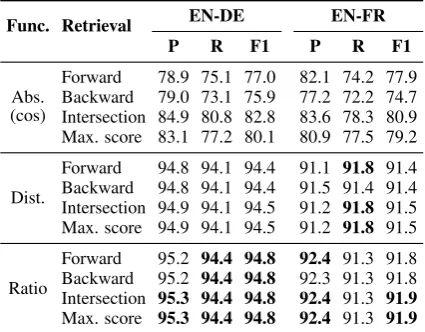
Table 2: BUCC results (precision, recall and F1) on the training set, used to optimize the filtering threshold.
to mine for parallel sentences between English and four foreign languages: German, French, Russian and Chinese. There are 150K to 1.2M sentences for each language, split into a sample, training and test set. About 2–3% of the sentences are parallel. Table 2 reports precision, recall and F1 scores on the training set.8 Our results show that multilin-gual sentence embeddings already achieve com-petitive performance using standard forward re-trieval over cosine similarity, which is in line with Schwenk (2018). Both of our bidirectional retrieval strategies achieve substantial improve-ments over this baseline while still relying on co-sine similarity, withintersectiongiving the best re-sults. Moreover, our proposed margin-based scor-ing brscor-ings large improvements when usscor-ing either the distance or the ratio functions, outperform-ing cosine similarity by more than 10 points in all cases. The best results are achieved by ratio, which outperformsdistanceby 0.3-0.5 points. In-terestingly, the retrieval strategy has a very small effect in both cases, suggesting that the proposed scoring is more robust than cosine.
Table 3 reports the results on the test set for both the Europarl and the UN model in compar-ison to previous work.9 Our proposed system out-performs all previous methods by a large margin,
8Note that the gold standard information was exclusively
used to optimize the filtering threshold for each configuration, making results comparable across different variants.
9
We use theratiomargin function withmaximum score
retrieval for our method. The filtering threshold was opti-mized to maximize the F1 score on the training set for each language pair and model. The gold-alignments of the test set are not publicly available – these scores on the test set are cal-culated by the organizers of the BUCC workshop. We have done one single submission.
en-de en-fr en-ru en-zh
Azpeitia et al.(2017) 83.7 79.5 -
-Azpeitia et al.(2018) 85.5 81.5 81.3 77.5
Bouamor and Sajjad(2018) - 76.0 -
-Schwenk(2018) 76.9 75.8 73.8 71.6 Proposed method (Europarl) 95.6 92.9 -
[image:4.595.75.288.63.229.2]-Proposed method (UN) - - 92.0 92.6
Table 3: BUCC results (F1) on the test set. We use theratiofunction withmaximum scoreretrieval and the filtering threshold optimized on the training set.
en-fr en-es
Guo et al.(2018) 48.90 54.94 Proposed method 83.27 85.78
Table 4: Results on UN corpus reconstruction (P@1)
obtaining improvements of 10-15 F1 points and showing very consistent performance across dif-ferent languages, including distant ones.
4.2 UN corpus reconstruction
So as to compare our method to the similarly moti-vated system ofGuo et al.(2018), we mimic their experiment on aligning the 11.3M sentences of the UN corpus. This task does not require any filter-ing, so we useforwardretrieval with theratio mar-gin function. As shown in Table 4, our system outperforms that of Guo et al. (2018) by a large margin despite using only a fraction of the train-ing data (2M sentences from Europarl in contrast with over 400M sentences from Google’s internal data).
4.3 Filtering ParaCrawl for NMT
Finally, we filter the English-German ParaCrawl corpus and evaluate NMT models trained on them. Our NMT models use fairseq’s implemen-tation of the big transformer model (Vaswani et al.,2017), using the same configuration asOtt et al. (2018) and training for 100 epochs. Fol-lowing common practice, we use newstest2013 and newstest2014 as our development and test sets, respectively, and report both tokenized and detokenized BLEU scores as computed by
multi-bleu.perl and sacreBLEU. We de-code with a beam size of 5 using an ensemble of the last 10 epochs. One single model is only slightly worse.
● ●
● ●
● ●
● ●
●
25.5 26.0 26.5 27.0 27.5 28.0
0 10 20 30
Sentences (millions)
[image:5.595.319.514.62.204.2]BLEU (detok)
Figure 2: English-German Dev results (newstest2013) using different thresholds to filter ParaCrawl.
#SENT BLEU
tok detok
BiCleaner v1.2 17.4M 30.05 29.37
Zipporah v1.2 40.5M 24.78 24.38
Proposed method 10.0M 31.19 30.53
Table 5: Results on English-German newstest2014 for different filtered versions of the ParaCrawl corpus.
sentences for which the fastText language identifi-cation model10predicts a different language, those with less than 3 or more than 80 tokens, or those with either an overlap of at least 50% or a ra-tio above 2 between the source and target tokens. This reduces the corpus size from 4.59 billion to 64.4 million sentence pairs, mostly due to dedu-plication. We then score each sentence pair with theratiofunction, processing the entire corpus in batches of 5 million sentences, and take the top scoring entries up to the desired size. Figure 2
shows the development BLEU scores of the result-ing system for different thresholds, which peaks at 10 million sentences. As shown in Table 5, this model clearly outperforms the two official filtered versions of ParaCrawl in the test set.
Finally, Table 6 compares our results to previ-ous works in the literature using different train-ing data. In addition to our ParaCrawl system, we include an additional one combining it with all parallel data from WMT18 except Common-Crawl. As it can be seen, our system outperforms all previous systems butEdunov et al.(2018), who use a large in-domain monolingual corpus through back-translation, making both works complemen-tary. Quite remarkably, our full system outper-formsOtt et al.(2018) by nearly 2 points despite using the same configuration and training data, so
10https://fasttext.cc/docs/en/ language-identification.html
DATA BLEU
tok detok
Wu et al.(2016) wmt 26.3
-Gehring et al.(2017) wmt 26.4
-Vaswani et al.(2017) wmt 28.4
-Ahmed et al.(2017) wmt 28.9
-Shaw et al.(2018) wmt 29.2
-Ott et al.(2018) wmt 29.3 28.6
Ott et al.(2018) wmt+pc 29.8 29.3
Edunov et al.(2018) wmt+nc 35.0 33.8
Proposed method pc 31.2 30.5
[image:5.595.93.271.62.172.2]wmt+pc 31.8 31.1
Table 6: Results on English-German newstest2014 in comparison to previous work. wmtfor WMT parallel data (excluding ParaCrawl),pcfor ParaCrawl, andnc
for monolingual News Crawl with back-translation.
our improvement can be attributed to a better fil-tering of ParaCrawl.11
5 Conclusions and future work
In this paper, we propose a new method for paral-lel corpus mining based on multilingual sentence embeddings. We use a sequence-to-sequence ar-chitecture to train a multilingual sentence encoder on an initial parallel corpus, and a novel margbased scoring method that overcomes the scale in-consistencies of cosine similarity.
Our experiments show large improvements over previous methods. Our system obtains the best published results on the BUCC mining task, out-performing previous systems by more than 10 F1 points for all the four language pairs. In addi-tion, our method obtains up to 85% precision at reconstructing the 11.3M sentence pairs from the UN corpus, improving over the similarly moti-vated method ofGuo et al.(2018) by more than 30 points. Finally, we show that our improvements also carry over to downstream machine transla-tion, as we obtain 31.2 BLEU points for English-German newstest2014 training on our filtered ver-sion of ParaCrawl, an improvement of more than one point over the best performing official release. The code of this work is freely available as part of the LASER toolkit, together with an additional single encoder which covers 93 languages.12
11To confirm this, we trained a separate model on WMT
data, obtaining 29.4 tokenized BLEU. This is on par with the results reported byOtt et al.(2018) for the same data (29.3 tokenized BLEU). This shows that the difference cannot be attributed to implementation details.
[image:5.595.86.279.223.296.2]References
Sadaf Abdul-Rauf and Holger Schwenk. 2009. On the Use of Comparable Corpora to Improve SMT per-formance. InEACL, pages 16–23.
Karim Ahmed, Nitish Shirish Keskar, and Richard Socher. 2017. Weighted Transformer Network for Machine Translation. arXiv:1711.02132.
Andoni Azpeitia, Thierry Etchegoyhen, and Eva Mart´ınez Garcia. 2017. Weighted Set-Theoretic Alignment of Comparable Sentences. In BUCC, pages 41–45.
Andoni Azpeitia, Thierry Etchegoyhen, and Eva Mart´ınez Garcia. 2018. Extracting Parallel Sen-tences from Comparable Corpora with STACC Vari-ants. InBUCC.
Houda Bouamor and Hassan Sajjad. 2018. H2@BUCC18: Parallel Sentence Extraction from Comparable Corpora Using Multilingual Sentence Embeddings. InBUCC.
Alexis Conneau, Guillaume Lample, Marc’Aurelio Ranzato, Ludovic Denoyer, and Herv´e J´egou. 2018.
Word Translation Without Parallel Data. InICLR.
Sergey Edunov, Myle Ott, Michael Auli, and David Grangier. 2018. Understanding Back-Translation at Scale. InEMNLP, pages 489–500.
Cristina Espa˜na-Bonet, ´Ad´am Csaba Varga, Alberto Barr´on-Cede˜no, and Josef van Genabith. 2017. An Empirical Analysis of NMT-Derived Interlingual Embeddings and their Use in Parallel Sentence Iden-tification. IEEE Journal of Selected Topics in Signal Processing, pages 1340–1348.
Thierry Etchegoyhen and Andoni Azpeitia. 2016. Set-Theoretic Alignment for Comparable Corpora. In
ACL, pages 2009–2018.
Jonas Gehring, Michael Auli, David Grangier, Denis Yarats, and Yann N Dauphin. 2017. Convolutional Sequence to Sequence Learning. In ICML, pages 1243–1252.
Francis Gr´egoire and Philippe Langlais. 2017. BUCC 2017 Shared Task: a First Attempt Toward a Deep Learning Framework for Identifying Parallel Sen-tences in Comparable Corpora. InBUCC, pages 46– 50.
Mandy Guo, Qinlan Shen, Yinfei Yang, Heming Ge, Daniel Cer, Gustavo Hernandez Abrego, Keith Stevens, Noah Constant, Yun-Hsuan Sung, Brian Strope, and Ray Kurzweil. 2018. Effective Paral-lel Corpus Mining using Bilingual Sentence Embed-dings. InWMT, pages 165–176.
Hany Hassan, Anthony Aue, Chang Chen, Vishal Chowdhary, Jonathan Clark, Christian Feder-mann, Xuedong Huang, Marcin Junczys-Dowmunt, William Lewis, Mu Li, Shujie Liu, Tie-Yan Liu,
Renqian Luo, Arul Menezes, Tao Qin, Frank Seide, Xu Tan, Fei Tian, Lijun Wu, Shuangzhi Wu, Yingce Xia, Dongdong Zhang, Zhirui Zhang, and Ming Zhou. 2018. Achieving Human Parity on Automatic Chinese to English News Translation.
arXiv:1803.05567.
Huda Khayrallah and Philipp Koehn. 2018.On the Im-pact of Various Types of Noise on Neural Machine Translation. InWNMT, pages 74–83.
Philipp Koehn. 2005. Europarl: A parallel corpus for statistical machine translation. InMT summit.
Philipp Koehn and Rebecca Knowles. 2017. Six Chal-lenges for Neural Machine Translation. InWNMT, pages 28–39.
Dragos Stefan Munteanu and Daniel Marcu. 2005. Im-proving Machine Translation Performance by Ex-ploiting Non-Parallel Corpora. Computational Lin-guistics, 31(4):477–504.
Dragos Stefan Munteanu and Daniel Marcu. 2006.
Extracting Parallel Sub-Sentential Fragments from Non-Parallel Corpora. InACL, pages 81–88.
Myle Ott, Sergey Edunov, David Grangier, and Michael Auli. 2018. Scaling neural machine trans-lation. InWMT, pages 1–9.
Philip Resnik. 1999. Mining the Web for Bilingual Text. InACL.
Holger Schwenk. 2018. Filtering and Mining Parallel Data in a Joint Multilingual Space. InACL, pages 228–234.
Peter Shaw, Jakob Uszkoreit, and Ashish Vaswani. 2018. Self-Attention with Relative Position Repre-sentations. InNAACL, pages 464–468.
Lei Shi, Cheng Niu, Ming Zhou, and Jianfeng Gao. 2006. A DOM Tree Alignment Model for Mining Parallel Data from the Web. In ACL, pages 489– 496.
Masao Utiyama and Hitoshi Isahara. 2003. Reliable Measures for Aligning Japanese-English News Arti-cles and Sentences. InACL.
Ashish Vaswani, Noam Shazeer, Niki Parmar, Jakob Uszkoreit, Llion Jones, Aidan N Gomez, Łukasz Kaiser, and Illia Polosukhin. 2017. Attention is all you need. InNIPS, pages 6000–6010.
Neural Machine Translation System: Bridging the Gap between Human and Machine Translation.
arXiv:1609.08144.
Hainan Xu and Philipp Koehn. 2017. Zipporah: a Fast and Scalable Data Cleaning System for Noisy Web-Crawled Parallel Corpora. InEMNLP, pages 2945– 2950.
Michał Ziemski, Marcin Junczys-Dowmunt, and Bruno Pouliquen. 2016. The United Nations Parallel Cor-pus v1.0. InLREC.
Pierre Zweigenbaum, Serge Sharoff, and Reinhard Rapp. 2017.Overview of the Second BUCC Shared Task: Spotting Parallel Sentences in Comparable Corpora. InBUCC, pages 60–67.