The Impact of Listener Gaze on Predicting Reference Resolution
Nikolina Koleva1 Mart´ın Villalba2 Maria Staudte1
1Embodied Spoken Interaction Group, Saarland University, Saarbr¨ucken, Germany 2 Department of Linguistics, University of Potsdam, Potsdam, Germany
{nikkol | masta}@coli.uni-saarland.de
{martin.villalba | alexander.koller}@uni-potsdam.de
Alexander Koller2
Abstract
We investigate the impact of listener’s gaze on predicting reference resolution in situated interactions. We extend an ex-isting model that predicts to which entity in the environment listeners will resolve a referring expression (RE). Our model makes use of features that capture which objects were looked at and for how long, reflecting listeners’ visual behavior. We improve a probabilistic model that consid-ers a basic set of features for monitoring listeners’ movements in a virtual environ-ment. Particularly, in complex referential scenes, where more objects next to the tar-get are possible referents, gaze turns out to be beneficial and helps deciphering listen-ers’ intention. We evaluate performance at several prediction times before the listener performs an action, obtaining a highly sig-nificant accuracy gain.
1 Introduction
Speakers tend to follow the listener’s behavior in order to determine whether their communicated message was received and understood. This phe-nomenon is known asgrounding, it is well estab-lished in the dialogue literature (Clark, 1996), and it plays an important role in collaborative tasks and goal–oriented conversations. Solving a col-laborative task in a shared environment is an ef-fective way of studying the alignment of commu-nication channels (Clark and Krych, 2004; Hanna and Brennan, 2007).
In situated spoken conversations ambiguous lin-guistic expressions are common, where additional modalities are available. While Gargett et al. (2010) studied instruction giving and following in virtual environments, Brennan et al. (2013) ex-amined pedestrian guidance in outdoor real envi-ronments. Both studies investigate the interaction
of human interlocutors but neither study exploits listeners’ eye movements. In contrast, Koller et al. (2012) designed a task in which a natural lan-guage generation (NLG) system gives instructions to a human player in virtual environment whose eye movements were tracked. They outperformed similar systems in both successful reference res-olution and listener confusion. Engonopoulos et al. (2013) attempted to predict the resolution of an RE, achieving good performance by combining two probabilistic log–linear models: a semantic
modelPsemthat analyzes the semantics of a given
instruction, and anobservationalmodelPobs that
inspects the player’s behavior. However, they did not include listener’s gaze. They observed that the accuracy forPobsreaches its highest point at a
rel-atively late stage in an interaction. Similar obser-vations are reported by Kennington and Schlangen (2014): they compare listener gaze and an incre-mental update model (IUM) as predictors for the resolution of an RE, noting that gaze is more ac-curate before the onset of an utterance, whereas the model itself is more accurate afterwards.
In this paper we report on the extension of the Pobs model to also consider listener’s visual
be-haviour. More precisely we implement features that encode listener’s eye movement patterns and evaluate their performance on a multi–modal data collection. We show that such a model as it takes an additional communication channel pro-vides more accurate predictions especially when dealing with complex scenes. We also expand on concepts from the IUM, by applying the conclu-sions drawn from its behaviour to a dynamic task with a naturalistic interactive scenario.
2 Problem definition
We address the research question of how to auto-matically predict an RE resolution, i.e., answer-ing the question of which entity in a virtual en-vironment has been understood by the listener
ter receiving an instruction. While the linguistic material in instructions carries a lot of informa-tion, even completely unambiguous descriptions may be misunderstood. A robust NLG system should be capable of detecting misunderstandings and preventing its users from making mistakes.
Language comprehension is mirrored by inter-locutors’ non verbal behavior, and this can help when decoding the listener’s interpretation. Pre-cise automatic estimates may be crucial when de-veloping a real–time NLG system, as such a mech-anism would be more robust and capable at avoid-ing misunderstandavoid-ings. As mentioned in section 1, Engonopoulos et al. (2013) propose two statistical models to solve that problem: a semantic model Psem based on the linguistic content, and an
ob-servation model Pobs based on listener behavior
features.
More formally, let’s assume a system generates an expressionr that aims to identify a target ob-jectotamong a setOof possible objects, i.e. those
available in the scene view. Given the state of the worldsat time pointt, and the observed listener’s behavior σ(t) of the user at time t ≥ tb (where
tbdenotes the end of an interaction), we estimated
the conditional probabilityp(op|r, s, σ(t))that
in-dicates how probable it is that the listener resolved r toop. This probability can be also expressed as
follows:
P(op|r, s, σ(t))∝ Psem(op|r, sP)(Poobs(op|σ(t)) p)
Following Engonopoulos et al. (2013) we make the simplifying assumption that the distribution of the probability among the possible targets is uni-form and obtain:
P(op|r, s, σ(t))∝Psem(op|r, s)Pobs(op|σ(t))
We expect an NLG system to compute and out-put an expression that maximizes the probability ofop. Due to the dynamic nature of our
scenar-ios, we also require the probability value to be up-dated at certain time intervals throughout an in-teraction. Tracking the probability changes over time, an NLG system could proactively react to changes in its environment. Henderson and Smith (2007) show that accounting for both fixation lo-cation and duration are key to identify a player’s focus of attention.
The technical contribution of this paper is to ex-tend thePobsmodel of Engonopoulos et al. (2013)
with gaze features to account for these variables.
3 Episodes and feature functions
The data for our experiment was obtained from the GIVE Challenge (Koller et al., 2010), an inter-active task in a 3D virtual environment in which a human player (instruction follower, IF) is navi-gated through a maze, locating and pressing but-tons in a predefined order aiming to unlock a safe. While pressing the wrong button in the sequences doesn’t always have negative effects, it can also lead to restarting or losing the game. The IF re-ceives instructions from either another player or an automated system (instruction giver, IG). The IF’s behavior was recorded every 200ms, along with the IG’s instructions and the state of the virtual world. The result is an interaction cor-pus comprising over 2500 games and spanning over 340 hours of interactions. These interactions were mainly collected during the GIVE-2 and the GIVE-2.5 challenges. A laboratory study con-ducted by Staudte et al. (2012) comprises a data collection that contains eye-tracking records for the IF. Although the corpus contains both success-ful and unsuccesssuccess-ful games, we have decided to consider only the successful ones.
We define anepisodeover this corpus as a typ-ically short sequence of recorded behavior states, beginning with a manipulation instruction gener-ated by the IG and ending with a button press by the IF (at time point tb). In order to make sure
that the recorded button press is a direct response to the IG’s instruction, an episode is defined such that it doesn’t contain further utterances after the first one. Both the target intended by the IG (ot)
[image:2.595.309.511.545.700.2]and the one selected by the IF (op) were recorded.
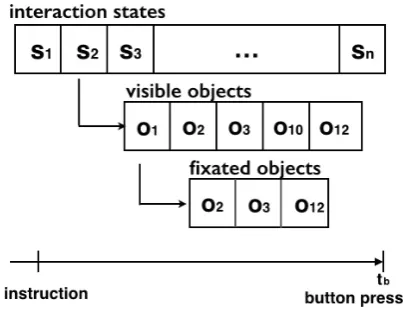
Figure 1: The structure of the interactions.
can be seen as a sequence of interaction states (s1, . . . , sn), and each state has a set of visible
objects ({o1, o2, o3, o10,o12}). We then compute the subset of fixated objects ({o2, o3, o12}). We update both sets of visible and fixated objects dy-namically in each interaction state with respect to the change in visual scene and the corresponding record of the listener’s eye movements.
We developed feature functions over these episodes. Along with the episode’s data, each function takes two parameters: an object op for
which the function is evaluated, and a parameter dseconds that defines how much of the episode’s data is the feature allowed to analyze. Each feature looks only at the behavior that happens in the time interval−dto0. Henceforth we refer to the value of a feature function over this interval as its value at time−d. The value of a feature function evalu-ated on episodes with length less thandseconds is undefined.
4 Prediction models
Given an RE uttered by an IG, thesemanticmodel Psem estimates the probability for each possible
object in the environment to have been understood as the referent, ranks all candidates and selects the most probable one in a current scene. This prob-ability represents the semantics of the utterance, and is evaluated at a single time point immediately after the instruction (e.g. “press the blue button”) has been uttered. The model takes into account features that encode the presence or absence of ad-jectives carrying information about the spatial or color properties (like the adjective “blue”), along with landmarks appearing as post modifiers of the target noun.
In contrast to the semantic model, the observa-tionalmodelPobsevaluates the changes in the
vi-sual context and player’s behavior after an instruc-tion has been received. The estimated probabil-ity is updated constantly before an action, as the listener in our task–oriented interactions is con-stantly in motion, altering the visual context. The model evaluates the distance of the listener posi-tion to a potential target, whether it is visible or not, and also how salient an object is in that par-ticular time window.
As we have seen above, eye movements pro-vide useful information indicating language com-prehension, and also how to map a semantic repre-sentation to an entity in a shared environment.
In-terlocutors constantly interact with their surround-ing and point to specific entities with gestures. Gaze behaviour is also driven by the current state of an interaction. Thus, we extend the basic set ofPobs features and implement eye–tracking
fea-tures that capture gaze information. We call this theextended observationalmodelPEobs and
con-sider the following additional features:
1. Looked at: feature counts the number of interaction states in which an object has been fixated at least once during the current episode.
2. Longest Sequence: detects the longest con-tinuous sequence of interaction states in which a particular object has been fixated.
3. Linear Distance: returns the euclidean dis-tancediston screen between the gaze cursor and the center of an object.
4. Inv-Squared Distance:returns 1+dist1 2.
5. Update Fixated Objects: expands the list of fixated objects in order to consider the IF’s focus of attention. It successively searches in 10 pixel steps and stops as soon as an object is found (the threshold is 100 pixels). This feature evaluates to 1 if the list of fixated ob-jects is been expanded and 0 otherwise.
When training our model at time −dtrain, we
generate a feature matrix. Given a training episode, each possible (located in the same room) objectop is added as a new row, where each
col-umn contains the value of a different feature func-tion forop over this episode at time−dtrain.
Fi-nally, the row based on the target selected by the IF is marked as a positive example. We then train a log-linear model, where the weights assigned to each feature function are learned via optimiza-tion with the L-BFGS algorithm. By training our model to correctly predict a target button based only on data observed up until −dtrain seconds
before the actual actiontb, we expect our model to
reliably predict which button the user will select. Analogously, we define accuracy at testing time
−dtestas the percentage of correctly predicted
tar-get objects when predicting over episodes at time
−dtest. This pair of training and test parameters is
5 Dataset
We evaluated the performance of our improved model over data collected by Staudte et al. (2012) using the GIVE Challenge platform. Both training and testing were performed over a subset of the data obtained during a collection task involving worlds created by Gargett et al. (2010), designed to provide the task with varying levels of diffi-culty. This corpus provides recorded eye-tracking data, collected with a remote faceLAB system. In contrast, the evaluation presented by Engonopou-los et al. (2013) uses only games collected for the GIVE 2 and GIVE 2.5 challenges, for which no eye-tracking data is available. Here, we do not in-vestigate the performance ofPsemand concentrate
on the direct comparison betweenPobs andPEobs
in order to find out if and when eye–tracking can improve the prediction of an RE resolution.
We further filtered our corpus in order to re-move noisy games following Koller et al. (2012), considering only interactions for which the eye-tracker calibration detected inspection of either the target or another button object in at least 75% of all referential scenes in an interaction. The resulting corpus comprises 75 games, for a combined length of 8 hours. We extracted 761 episodes from this corpus, amounting to 47m 58s of recorded interac-tions, with an average length per episode of 3.78 seconds (σ = 3.03sec.). There are 261 episodes shorter than 2 sec., 207 in the 2-4 sec. range, 139 in the 4-6 sec. range, and 154 episodes longer than 6 sec.
6 Evaluation and results
The accuracy of our probabilistic models depends on the parameters (dtrain, dtest). At different
stages of an interaction the difficulty to predict an intended target varies as the visual context changes and in particular the number of visible objects. As the weights of the features are optimized at time
−dtrain, it would be expected that testing also at
time −dtest = −dtrain yields the highest
accu-racy. However, the difficulty to make a predic-tion decreases astb −dtest approachestb, i.e. as
the player moves towards the intended target. We expect that testing at−dtrain works best, but we
need to be able to update continuously. Thus we also evaluate at other timepoints and test several combinations of the(dtrain, dtest)parameters.
Given the limited amount of eye-tracking data available in our corpus, we replaced the
cross-corpora-challenge test setting from the original Pobs study with a ten fold cross validation setup.
As training and testing were performed over in-stances of a certain minimum length according to (dtrain, dtest), we first removed all instances with
length less thanmax(dtrain, dtest), and then
per-form the cross validation split. In this way we ensure that the number of instances in the folds are not unbalanced. Moreover, each instance was classified aseasyorharddepending on the num-ber of visible objects at time tb. An instance
was consideredeasyif no more than three objects were visible at that point, orhard otherwise. For
−dtest = 0, 59.5% of all instances are considered
hard, but this proportion decreases as −dtest
in-creases. At−dtest =−6, the number of hard
in-stances amounts to 72.7%.
We evaluated both the originalPobs model and
thePEobsmodel on the same data set. We also
cal-culated accuracy values for each feature function, in order to test whether a single function could out-performPobs. We included as baselines two
ver-sions ofPobs using only the featuresInRoomand
Visual Salienceproposed by Engonopoulos et al. (2013).
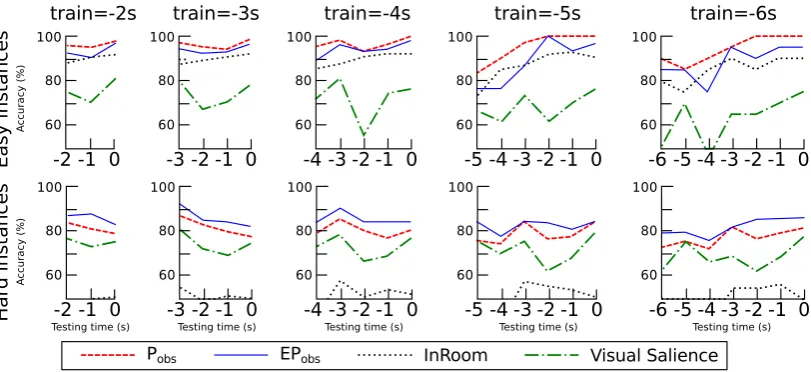
The accuracy results on Figure 2 show our ob-servations for−6≤ −dtrain ≤ −2and−dtrain ≤
−dtest≤0. The graph shows thatPEobsperforms
similarly as Pobs on the easy instances, i.e. the
eye-tracking features are not contributing in those scenarios. However,PEobsshows a consistent
im-provement on thehardinstances overPobs.
For each permutation of the training and test-ing parameters (dtrain, dtest), we obtain a set of
episodes that fulfil the length criteria for the given parameters. We applyPobs andPEobs on the
ob-tained set of instances and measure two corre-sponding accuracy values. We compared the ac-curacy values ofPobsandPEobsover all 25
differ-ent (dtrain, dtest) pairs, using a paired samples
t-test. The test indicated that thePEobsperformance
(M = 83.72,SD = 3.56) is significantly better than the Pobs performance (M = 79.33, SD =
3.89), (t(24) = 9.51, p < .001, Cohen0s d =
1.17). Thus eye-tracking features seem to be par-ticularly helpful for predicting to which entity an RE is resolved in hard scenes.
Figure 2: Accuracy as a function of training and testing time.
classified as target object or not. Data for this ta-ble was collected from all episode judgements for models trained at times in the [−6sec.,−3sec.] range and tested at -3 seconds. McNemar’s test showed that the marginal row and column frequen-cies are significantly different (p < 0.05). This peak is related to the average required time be-tween an utterance and the resulting target manip-ulation. This result shows that our model is more accurate precisely at points in time when we ex-pect fixations to a target object.
7 Conclusion
In this paper we have shown that listener’s gaze is useful by showing that accuracy improves over Pobs in the context of predicting the resolution of
an RE. In addition, we observed that our model PEobsproves to be more robust thanPobswhen the
time interval between the prediction (tb −dtest)
and the button press (tb) increases, i.e. gaze is
especially beneficial in an early stage of an in-teraction. This approach shows significant ac-curacy improvement on hard referential scenes where more objects are visible.
We have also established that gaze is particu-larly useful when combined with some other sim-ple features, as the features that capture listeners visual behaviour are not powerful enough to out-perform even the simplest baseline. Gaze only benefits the model when it is added on top of fea-tures that capture the visual context, i.e. the current scene.
The most immediate future line of research is the combination of ourPEobs model with the
se-mantic modelPsem, in order to test the impact of
the extended features in a combined model. If suc-cessful, such a model could provide reliable pre-dictions for a significant amount of time before an action takes place. This is of particular importance when it comes to designing a system that auto-matically generates and online outputs feedback to confirm correct and reject incorrect intentions.
Testing with users in real time is also an area for future research. An implementation of thePobs
model is currently in the test phase, and an exten-sion for thePEobs model would be the immediate
next step. The model could be embedded in an NLG system to improve the automatic language generation in such scenarios.
Given that our work refers only to NLG sys-tems, there’s no possible analysis of speaker’s gaze. However, it may be interesting to ask whether a human IG could benefit from the pre-dictions of PEobs. We could study whether
pre-dictions based on the gaze (mis-)match between both interlocutors are more effective than simply presenting the IF’s gaze to the IG and trusting the IG to correctly interpret this data. If such a sys-tem proved to be effective, it could point misun-derstandings to the IG before either of the partici-pants becomes aware of them.
Acknowledgements
References
Susan E. Brennan, Katharina S. Schuhmann, and Karla M. Batres. 2013. Entrainment on the move
and in the lab: The walking around corpus. In
Pro-ceedings of the 35th Annual Conference of the Cog-nitive Science Society, Berlin, Germany.
Herbert H. Clark and Meredyth A. Krych. 2004. Speaking while monitoring addressees for
under-standing. Journal of Memory and Language,
50(1):62–81, January.
Herbert H. Clark. 1996. Using Language. Cambridge
University Press, May.
Nikos Engonopoulos, Mart´ın Villalba, Ivan Titov, and Alexander Koller. 2013. Predicting the resolution
of referring expressions from user behavior. In
Pro-ceedings of the Conference on Empirical Methods in Natural Language Processing (EMNLP), Seattle. Andrew Gargett, Konstantina Garoufi, Alexander
Koller, and Kristina Striegnitz. 2010. The give-2 corpus of giving instructions in virtual
environ-ments. InProceedings of the Seventh International
Conference on Language Resources and Evaluation (LREC’10), Valletta, Malta, May. European Lan-guage Resources Association (ELRA).
Joy E. Hanna and Susan E. Brennan. 2007. Speakers’ eye gaze disambiguates referring expressions early
during face-to-face conversation. Journal of
Mem-ory and Language, 57(4):596–615, November. John M. Henderson and Tim J. Smith. 2007. How
are eye fixation durations controlled during scene viewing? further evidence from a scene onset delay
paradigm. Visual Cognition, 17(6-7):1055–1082.
Casey Kennington and David Schlangen. 2014. Com-paring listener gaze with predictions of an
incremen-tal reference resolution model. RefNet workshop on
Psychological and Computational Models of Refer-ence Comprehension and Production.
Alexander Koller, Kristina Striegnitz, Andrew Gargett, Donna Byron, Justine Cassell, Robert Dale, Johanna Moore, and Jon Oberlander. 2010. Report on the Second NLG Challenge on Generating Instructions
in Virtual Environments (GIVE-2). InProceedings
of the 6th International Natural Language Genera-tion Conference (INLG).
Alexander Koller, Maria Staudte, Konstantina Garoufi, and Matthew Crocker. 2012. Enhancing
referen-tial success by tracking hearer gaze. In
Proceed-ings of the 13th Annual Meeting of the Special In-terest Group on Discourse and Dialogue, SIGDIAL ’12, pages 30–39, Stroudsburg, PA, USA. Associa-tion for ComputaAssocia-tional Linguistics.
Maria Staudte, Alexander Koller, Konstantina Garoufi, and Matthew Crocker. 2012. Using listener gaze to augment speech generation in a virtual 3D
environ-ment. InProceedings of the 34th Annual Meeting of