155
Cross-lingual Transfer Learning and Multitask Learning for Capturing
Multiword Expressions
Shiva Taslimipoor, Omid Rohanian, Le An Ha
Research Group in Computational Linguistics University of Wolverhampton, UK
{shiva.taslimi,omid.rohanian,l.a.ha}@wlv.ac.uk
Abstract
Recent developments in deep learning have prompted a surge of interest in the applica-tion of multitask and transfer learning to NLP problems. In this study, we explore for the first time, the application of transfer learn-ing (TRL) and multitask learnlearn-ing (MTL) to the identification of Multiword Expressions (MWEs). For MTL, we exploit the shared syntactic information between MWE and de-pendency parsing models to jointly train a sin-gle model on both tasks. We specifically pre-dict two types of labels: MWE and depen-dency parse. Our neural MTL architecture utilises the supervision of dependency pars-ing in lower layers and predicts MWE tags in upper layers. In the TRL scenario, we over-come the scarcity of data by learning a model on a larger MWE dataset and transferring the knowledge to a resource-poor setting in an-other language. In both scenarios, the result-ing models achieved higher performance com-pared to standard neural approaches.
1 Introduction
Multiword Expressions (MWEs) are combina-tions of two or more lexical components that form non/semi-compositional meaning units. Due to their idiosyncratic behaviour, MWEs have been studied using various statistical and machine learning approaches including supervised classifi-cation (Diab and Bhutada,2009), tagging ( Schnei-der et al.,2014), and unsupervised prediction ( Fa-zly et al., 2009). Studies have focused on both their syntactic (Constant and Nivre,2016) and se-mantic (Van de Cruys and Moir´on,2007) features. Recently, the PARSEME project provided an extensive multilingual dataset of verbal MWEs (Ramisch et al., 2018). Datasets of certain lan-guages in this resource are rich with a huge num-ber of tagged sequences while others are consider-ably smaller. Several notable systems have been
proposed to train sequence labelling models on this dataset including neural (Taslimipoor and Ro-hanian, 2018) and non-neural systems (Moreau et al.,2018). MWE prediction for some of these languages has proved to be more challenging due to several reasons including scarcity of data, higher percentage of unseen MWE instances in the test set, and prevalence of discontinuous or vari-able MWEs.
In this paper, we focus on one of those lan-guages for which the results were collectively low (interestingly it was English) and explore two neu-ral approaches in order to address the shortcom-ings of the current neural models and enhance learning. The two approaches are: multitask learn-ing and transfer learnlearn-ing, with two different moti-vations.
Syntactic and semantic idiosyncrasies in MWEs call for special treatment, with models that take them into account from different perspectives. Syntactic and semantic information are commonly fed to the models as input features. However, we consider an alternative way to exploit this informa-tion. Specifically, in a supervised setting, we add dependency syntax information as auxiliary super-vision. Therefore we perform multitask learning between MWE and dependency parse tags.
Syntactic dependency information has been pre-viously proven to be successful in identifying MWEs (Constant and Nivre, 2016). However, neural processing methodologies are yet to be deeply explored for MWE modelling (Constant et al., 2017). In multitask learning we have sev-eral different prediction tasks over the same input. The idea is that the process of learning features for one task can be helpful for another.
In this study we build upon recent neural net-work systems that have proved to be successful in representing syntactic and semantic features of text and design novel multitask and transfer learn-ing architectures for MWE identification. The contributions of this work are: 1) we propose a neural model that improves MWE identification by jointly learning MWE and dependency parse labels; 2) We show that MWE identification mod-els, when multitasked with dependency parsing, outperform the models which naively add depen-dency parse information as additional features; 3) we propose, to the best of our knowledge for the first time, a cross-lingual transfer learning method for processing MWEs, thus making a contribution towards the study of low-resource languages.
2 Related Work
Constant and Nivre(2016) proposed joint syntac-tic and lexical analysis in which the syntacsyntac-tic di-mension of their structure is represented by a de-pendency tree, and the lexical dimension is rep-resented by a forest of trees. The two dimen-sions share token-level representations. They use a transition-based system that jointly learns both lexical and syntactic analysis resulting in an im-provement for the task of MWE identification.
The idea of multitask learning (MTL) in neu-ral networks was popularised by the work of Col-lobert et al. (2011). They improved the perfor-mance of chunking by jointly learning it with POS tagging.Søgaard and Goldberg(2016) discuss the idea further by pinpointing that supervising differ-ent tasks on differdiffer-ent layers is beneficial. Specif-ically, in their work, for an input sequence, w1:n
they have several RNN layers l for each task,
t, and their task-specific classifier is defined as:
taskt(w1:n, i) = ft(vil(t))where1≤ i≤n,viis
the output representation of RNN for word iand
ft is the tagger/classification function. This way,
different tasks might be applied to different RNN layers (i.e. there are layers shared by several tasks, and layers that are specific to some tasks). We use this idea here, by having some specific layers for final MWE prediction which are not shared with the auxiliary parsing task.
Using an LSTM-based model, Bingel and Søgaard (2017) performed a study to find bene-ficial tasks for the purpose of MTL in a sequence labelling scenario. In their work, the MWE model benefited from most auxiliary tasks such as
chunk-ing, CCG parschunk-ing, and Super-sense tagging. A similar finding is reported in Changpinyo et al.
(2018) where performance of an MWE tagger was consistently improved when jointly trained with any of the 10 different auxiliary tasks in various MTL settings.
Transfer learning (TRL) has seen a flurry of interest with the advent of pre-trained language models, transformers, and contextualised embed-dings (Howard and Ruder, 2018; Peters et al.,
2018;Devlin et al.,2018). Transfer learning is par-ticularly helpful where data scarcity can be an is-sue, and a related task with more data can be used to alleviate the issue. Liu et al.(2018) is an ex-ample of the use of task-aware language models to enhance sequence labelling using an LSTM-CRF architecture powered by a language model.
A related scenario in TRL is when tasks re-main the same but models are designed to trans-fer knowledge across languages. In NLP, cross-lingual transfer learning has been extensively ex-plored in the context of representation learning where monolingual spaces are mapped into a com-mon embedding space through methods like retro-fitting (Faruqui et al., 2015), matrix factorization (Vyas and Carpuat, 2016) or similar. Outside representation learning, there have been many at-tempts to use TRL in NLP tasks. For sequence labelling, Kim et al. (2017) trained POS tagging models cross-lingually without access to parallel resources. The model consisted of two LSTM components where one is shared between the lan-guages and the other is private (language-specific).
Yang et al. (2017) is a notable example of cross-lingual transfer learning under low-resource settings where sequence labelling models were trained to transfer knowledge between English, Spanish, and Dutch for POS tagging, chunking, and Named Entity Recognition (NER) through the use of shared and private parameters. In that work, three different architectures were explored for domain, application, and cross-lingual transfer. The core of their proposed mod-els is similar toLample et al.(2016), with minor differences including the incorporation of GRU in-stead of LSTM and a training objective based on the max-margin principle.
3 Methodology
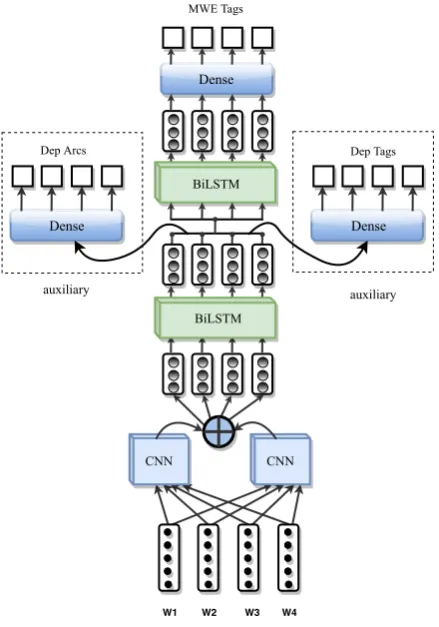
commonly employed in sequence tagging mod-els.1 We adapt the architecture to the two scenar-ios of multitask and transfer learning. The details of the layers and input representations for these models are further explained in Section4and de-picted in Figure1.
Dense
Dense Dense
Dep Arcs Dep Tags
MWE Tags
W1 W2 W3 W4
CNN CNN
BiLSTM
BiLSTM
[image:3.595.315.513.61.222.2]auxiliary auxiliary
Figure 1: Overall architecture of the model (consisting of two auxiliary tasks in case of MTL)
3.1 Multitask Learning
In the multitask learning scenario, the models are required to simultaneously predict MWE tags, de-pendency parse arcs and dede-pendency parse labels. A sample of all three-fold labels that the model should predict for a sentence is depicted in figure
2. In order to learn the main output, MWE tag, the model computes loss values for two auxiliary outputs, Dep arc and Dep tag, and add them to the main output loss.
Similar to the idea of Søgaard and Goldberg
(2016), we introduce the supervision of depen-dency parsing in lower layers and aim to boost the performance of the final MWE tagging layer. To this end, the parallel CNNs and the first BiLSTM
1Two CNN layers without pooling act like feature
extrac-tors. Their results are then concatenated and given to the next BiLSTM layer.
INPUT INPUT AUX-OUT AUX-OUT OUTPUT
Word POS Dep arc Dep tag MWE tag
Worse ADJ 10 advmod *
yet ADV 1 advmod *
, PUNCT 1 punct *
what PRON 6 nsubj *
is AUX 6 aux *
going VERB 10 csubj 2:VPC
on ADV 6 compound 2
:prt
will AUX 10 aux *
not PART 10 advmod *
let VERB 0 root 1:VID
us PRON 10 obj *
alone ADJ 10 xcomp 1
[image:3.595.72.292.158.472.2]. PUNCT 10 punct *
Figure 2: Annotation of one sample sentence containing one VPC and a verbal idiom in the English data for the Parseme shared task edition 1.1.
layer is shared between the two tasks. On top of this, two layers with independent auxiliary losses are applied to predict dependency tags. Parallel to this, we add a single BiLSTM before the main output layer for predicting MWE tags (Figure1). In this study, we simply add the main loss to the two auxiliary losses (which are all computed using categorical cross-entropy).
3.2 Transfer Learning
In transfer learning, also known as domain adap-tation, information from a source task is retained to enhance learning for another related task. In this study, we use TRL in a multilingual scenario. Since our target language is low-resource, the aim is to benefit from richer data of another language. To this end, a model which is trained on the do-main of one language is transferred to the dodo-main of another target language.
The two languages have the same sets of POS and dependency parse tags. Therefore, one-hot encoded POS and dependency inputs are shared between the trained and the transferred models. When loading pretrained contextualised embed-dings as inputs, the sentences of individual lan-guages have their own sets of weights. On the other hand, we also have a setting in which our model starts with a trainable embedding layer. In this case, the vocabularies of both languages are combined and indexed together. This way, com-mon vocabularies or proper nouns of the two lan-guages receive the same indices.
4 Experiments
We experiment with the multilingual dataset from the PARSEME project (Savary et al.,2018) which was made available for the shared task on identi-fication of verbal MWEs (Ramisch et al., 2018). Verbal MWEs in the dataset include idioms, verb particle constructions, and light verb construc-tions, among others. MWE tags in the dataset are similar to IOB labels, since there is a distinction between the beginning and other components of an MWE. We target the data for English which is surprisingly small in this dataset (with3,471 train-ing and3,965test sequences) and try to use MTL and TRL to improve MWE identification.
The inputs to our system are combinations of ELMo embeddings which are trained on our data using the implementation provided by Che et al.
(2018) and one-hot encoded POS tags. In cases where we add dependency parse information as in-puts, the representation for dependency arcs and labels are as follows. In order to represent arcs, we use adjacency matrix representation for each sentence. In the adjacency matrix, each token is assigned a row in which all cells are zero except for the one corresponding to the head of the token in dependency tree. Dependency labels, though are one-hot encoded.
We set hyperparameters based on the ones used in a similar architecture proposed byTaslimipoor and Rohanian(2018) which was implemented for a single task and mono-lingual setting. The CNN layers have 200 neurons, one with filter size 2 and the other with size 3, both with relu activation. BiLSTM layers have both 300 neurons, dropout 0.5, and recurrent dropout of 0.2. We use the
Adamoptimizer for all settings. Figure1 shows the whole architecture for MTL. The model archi-tecture for standard setting and TRL is the same excluding the auxiliary components.
4.1 Evaluation
In the MTL setting, we make comparison between the case when the model is trained only on MWE tags (single-task, STL) to when jointly trained to predict MWE and dependency parsing tags in a multitask scenario (MTL). We also compare the results of joint prediction with the case when de-pendency information is directly fed as additional input. In the TRL setting, we first train our model on the German data which has6,734training
se-quences.2 We finally compare the results from TRL with all other results.
We evaluate the models using F1-score in two settings: 1) strict matching (MWE-based) in which all components of an MWE are consid-ered as a unit that should be correctly classified; and 2) fuzzy matching (token-based) in which any correctly predicted token of the data is counted (Savary et al.,2017).
4.2 Results
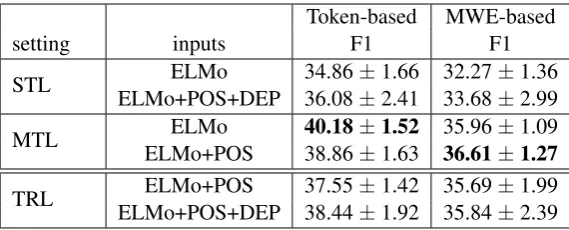
The results are reported in Table 1. We report the average F1-score over five separate runs along with standard deviation. The first two rows show the baseline results when we use the neural model in the standard setting. For the second row, we use dependency parsing tags as well as ELMo and POS tags for the input to the system.
In the third and the fourth rows (MTL), we ob-serve that the results improve when dependency parse information is predicted as auxiliary out-put. In particular, we observe these improvements when adding the dependency loss outputs at one layer before the outermost BiLSTM. We also see that the addition of POS to the input is not neces-sarily effective in the MTL setting (i.e. according to the third row, the MTL setting without POS re-sults in a better performance). Our best MTL sys-tem outperforms the syssys-tems that participated in open track of the Parseme shared task (Ramisch et al., 2018) for English data. However, it per-forms slightly worse than the neural system pro-posed byRohanian et al.(2019), which deals with discontinuous MWEs using graph convolutional network and attention mechanism.
The models are trained on google colab with GPU: 1xTesla K80, having 2496 CUDA cores, compute 3.7, and 12GB GDDR5 VRAM. While the MTL model might seem to be compli-cated, it does not add much to the time complexity of the model. Specifically it takes, on average, 45 minutes to train the MTL model compared to 43 minutes to train STL both for 100 epochs.
The performance of TRL is only slightly bet-ter than STL and lower than MTL. This is not to our surprise, because ELMo vectors, that are one of the inputs to all the models, are pre-trained on huge amount of data and bring enough knowledge to the low resource.
2The idea is to train on a Germanic language which is a
Token-based MWE-based
setting inputs F1 F1
STL ELMo 34.86±1.66 32.27±1.36
ELMo+POS+DEP 36.08±2.41 33.68±2.99
MTL ELMo 40.18±1.52 35.96±1.09
ELMo+POS 38.86±1.63 36.61±1.27
TRL ELMo+POS 37.55±1.42 35.69±1.99
ELMo+POS+DEP 38.44±1.92 35.84±2.39
Table 1: Comparing the performance of the CNN-biLSTM model (in terms of average F1 over 5 runs with standard deviation) in single (STL), multitask (MTL) and transfer learning (TRL) scenarios.
setting Token-based F1 MWE-based F1 closed STL 30.34±1.36 28.12±1.37
[image:5.595.156.441.61.176.2]TRL 33.31±0.75 30.40±0.66
Table 2: Comparing the performance of transfer learn-ing (TRL) with the standard settlearn-ing (STL).
Furthermore, in the case of TRL, we hypothe-size a scenario in which we do not have access to a huge amount of data and avoid using ELMo as the input. We perform a preliminary experiment with a randomly initialized embedding layer as the first component of the network to be trained with other layers. We report the results of this experi-ment in Table2. This way the model is not using any extensive external data (hence the name closed STL). Here we can better see the benefits of trans-ferring the model cross-lingually. More investiga-tions need to be done to discover the limits of this approach (e.g. through the application of different language models and experimentation with other architectures of the same kinds).
4.3 The Effect of Learning Rate in TRL
When transferring from the source to the target do-main, the model is prone to overfitting on the new data, losing the potentially beneficial information from the high-resource model. This problem is sometimes referred to as catastrophic forgetting. One way to mitigate this issue is to control for the hyperparameters of the source and target lan-guage, specially setting the learning rate in a way that domain adaptation occurs incrementally. On-going research explore various regularization and ensemble methods to preserve and transfer knowl-edge between tasks (Chronopoulou et al., 2019;
Lee et al., 2017;Rusu et al.,2016). These meth-ods, however, introduce varying degrees of com-putational complexities.
Even though the sensitivity of TRL to the
learn-ing rate is largely acknowledged in the literature, previous work is indecisive as to what learning rate scheduling achieves the best result.Bowman et al.
(2015) lower the starting learning rates after trans-fer, in order to preserve pre-transfer information in early training. Kocmi and Bojar(2018) however, found that, in TRL between language pairs in the task of neural machine translation, changing hy-perparameters from the parent to the child model harmed performance. Mou et al. (2016) set the best hyperparameters from the source task during the validation phase and transferred them to the target domain. They acknowledged that the hy-perparameters can potentially become biased to-wards the source domain. The conclusion was that the best hyperparameters are ready to be trans-ferred during the epoch range when the perfor-mance peaks in the source domain.
In this work we refrained from altering the learning rate, since, consistent with some of the previous work, we noticed a sharp decline in per-formance when changing this value.
5 Conclusions and Future Work
In this work we explored two neural architectures to improve identification of MWEs through learn-ing of related llearn-inguistic tasks.3 We experimented with cross-lingual transfer learning between two Germanic languages, and in a separate scenario, we designed and tested a multitask learning ap-proach to tag MWEs while concurrently training on dependency arcs and labels as auxiliary tasks. Our results show that the models prove promising and outperform the standard baseline. In future we plan to study these techniques in more detail, and make extensive comparisons between them in or-der to unor-derstand to what extent and unor-der what circumstances they help MWE identification.
3The code for the experiments is available athttps://
References
Joachim Bingel and Anders Søgaard. 2017. Identify-ing beneficial task relations for multi-task learnIdentify-ing in deep neural networks. InProceedings of the 15th Conference of the European Chapter of the Associa-tion for ComputaAssocia-tional Linguistics: Volume 2, Short Papers, pages 164–169.
Samuel R Bowman, Gabor Angeli, Christopher Potts, and Christopher D Manning. 2015. A large anno-tated corpus for learning natural language inference. In Proceedings of the 2015 Conference on Empiri-cal Methods in Natural Language Processing, pages 632–642.
Soravit Changpinyo, Hexiang Hu, and Fei Sha. 2018. Multi-task learning for sequence tagging: An em-pirical study. In Proceedings of the 27th Inter-national Conference on Computational Linguistics, pages 2965–2977.
Wanxiang Che, Yijia Liu, Yuxuan Wang, Bo Zheng, and Ting Liu. 2018. Towards better UD parsing: Deep contextualized word embeddings, ensemble, and treebank concatenation. InProceedings of the CoNLL 2018 Shared Task: Multilingual Parsing from Raw Text to Universal Dependencies, pages 55–64, Brussels, Belgium. Association for Compu-tational Linguistics.
Alexandra Chronopoulou, Christos Baziotis, and Alexandros Potamianos. 2019. An embarrass-ingly simple approach for transfer learning from pretrained language models. arXiv preprint arXiv:1902.10547.
Ronan Collobert, Jason Weston, L´eon Bottou, Michael Karlen, Koray Kavukcuoglu, and Pavel Kuksa. 2011. Natural language processing (almost) from scratch. The Journal of Machine Learning Re-search, 12:2493–2537.
Mathieu Constant, Glen Eryiit, Johanna Monti, Lon-neke van der Plas, Carlos Ramisch, Michael Rosner, and Amalia Todirascu. 2017. Multiword expression processing: A survey. Computational Linguistics, 43(4):837–892.
Matthieu Constant and Joakim Nivre. 2016. A transition-based system for joint lexical and syn-tactic analysis. In Proceedings of the 54th An-nual Meeting of the Association for Computational Linguistics (Volume 1: Long Papers), pages 161– 171, Berlin, Germany. Association for Computa-tional Linguistics.
Tim Van de Cruys and Bego˜na Villada Moir´on. 2007.
Semantics-based multiword expression extraction. In Proceedings of the Workshop on a Broader Perspective on Multiword Expressions, MWE ’07, pages 25–32, Stroudsburg, PA, USA. Association for Computational Linguistics.
Jacob Devlin, Ming-Wei Chang, Kenton Lee, and Kristina Toutanova. 2018. Bert: Pre-training of deep
bidirectional transformers for language understand-ing.arXiv preprint arXiv:1810.04805.
Mona T. Diab and Pravin Bhutada. 2009. Verb noun construction mwe token supervised classification. In
Proceedings of the Workshop on Multiword Expres-sions: Identification, Interpretation, Disambigua-tion and ApplicaDisambigua-tions, MWE ’09, pages 17–22, Stroudsburg, PA, USA. Association for Computa-tional Linguistics.
Manaal Faruqui, Jesse Dodge, Sujay Kumar Jauhar, Chris Dyer, Eduard Hovy, and Noah A Smith. 2015. Retrofitting word vectors to semantic lexicons. In
Proceedings of the 2015 Conference of the North American Chapter of the Association for Computa-tional Linguistics: Human Language Technologies, pages 1606–1615.
Afsaneh Fazly, Paul Cook, and Suzanne Stevenson. 2009. Unsupervised type and token identification of idiomatic expressions. Computational Linguistics, 35(1):61–103.
Jeremy Howard and Sebastian Ruder. 2018. Universal language model fine-tuning for text classification. In
Proceedings of the 56th Annual Meeting of the As-sociation for Computational Linguistics (Volume 1: Long Papers), pages 328–339.
Joo-Kyung Kim, Young-Bum Kim, Ruhi Sarikaya, and Eric Fosler-Lussier. 2017. Cross-lingual transfer learning for pos tagging without cross-lingual re-sources. InProceedings of the 2017 Conference on Empirical Methods in Natural Language Process-ing, pages 2832–2838.
Tom Kocmi and Ondˇrej Bojar. 2018. Trivial fer learning for low-resource neural machine trans-lation. In Proceedings of the Third Conference on Machine Translation: Research Papers, pages 244– 252.
Guillaume Lample, Miguel Ballesteros, Sandeep Sub-ramanian, Kazuya Kawakami, and Chris Dyer. 2016. Neural architectures for named entity recognition.
arXiv preprint arXiv:1603.01360.
Sang-Woo Lee, Jin-Hwa Kim, Jaehyun Jun, Jung-Woo Ha, and Byoung-Tak Zhang. 2017. Overcom-ing catastrophic forgettOvercom-ing by incremental moment matching. InAdvances in neural information pro-cessing systems, pages 4652–4662.
Liyuan Liu, Jingbo Shang, Xiang Ren, Frank Fangzheng Xu, Huan Gui, Jian Peng, and Jiawei Han. 2018. Empower sequence la-beling with task-aware neural language model. In Thirty-Second AAAI Conference on Artificial Intelligence.
In Joint Workshop on Linguistic Annotation, Mul-tiword Expressions and Constructions (LAW-MWE-CxG-2018) at the 27th International Conference on Computational Linguistics (COLING 2018), pages 241–247.
Lili Mou, Zhao Meng, Rui Yan, Ge Li, Yan Xu, Lu Zhang, and Zhi Jin. 2016. How transferable are neural networks in nlp applications? In Proceed-ings of the 2016 Conference on Empirical Methods in Natural Language Processing, pages 479–489.
Matthew E Peters, Mark Neumann, Mohit Iyyer, Matt Gardner, Christopher Clark, Kenton Lee, and Luke Zettlemoyer. 2018. Deep contextualized word rep-resentations. arXiv preprint arXiv:1802.05365.
Carlos Ramisch, Silvio Cordeiro, Agata Savary, Veronika Vincze, Verginica Mititelu, Archna Bhatia, Maja Buljan, Marie Candito, Polona Gantar, Voula Giouli, et al. 2018. Edition 1.1 of the PARSEME shared task on automatic identification of verbal multiword expressions. In the Joint Workshop on Linguistic Annotation, Multiword Expressions and Constructions (LAW-MWE-CxG-2018), pages 222– 240.
Omid Rohanian, Shiva Taslimipoor, Samaneh Kouchaki, Le An Ha, and Ruslan Mitkov. 2019.
Bridging the gap: Attending to discontinuity in identification of multiword expressions. In Pro-ceedings of the 2019 Conference of the North American Chapter of the Association for Computa-tional Linguistics: Human Language Technologies, Volume 1 (Long and Short Papers), pages 2692– 2698, Minneapolis, Minnesota. Association for Computational Linguistics.
Andrei A Rusu, Neil C Rabinowitz, Guillaume Des-jardins, Hubert Soyer, James Kirkpatrick, Koray Kavukcuoglu, Razvan Pascanu, and Raia Hadsell. 2016. Progressive neural networks. arXiv preprint arXiv:1606.04671.
Agata Savary, Marie Candito, Verginica Barbu Mi-titelu, Eduard Bejˇcek, Fabienne Cap, Slavom´ır
ˇ
C´epl¨o, Silvio Ricardo Cordeiro, G¨uls¸en Eryigit, Voula Giouli, Maarten van Gompel, Yaakov HaCohen-Kerner, Jolanta Kovalevskaite, Simon Krek, Chaya Liebes kind, Johanna Monti, Carla Parra Escart´ın, Lonneke van der Plas, Behrang QasemiZadeh, Carlos Ramisch, Federico Sangati, Ivelina Stoyanova, and Veronika Vincze. 2018. PARSEME multilingual corpus of verbal multi-word expressions. In Stella Markantonatou, Carlos Ramisch, Agata Savary, and Veronika Vincze, edi-tors, Multiword expressions at length and in depth. Extended papers from the MWE 2017 workshop. Language Science Press, Berlin, Germany.
Agata Savary, Carlos Ramisch, Silvio Cordeiro, Fed-erico Sangati, Veronika Vincze, Behrang Qasem-izadeh, Marie Candito, Fabienne Cap, Voula Giouli, Ivelina Stoyanova, et al. 2017. The PARSEME shared task on automatic identification of verbal
multiword expressions. InProceedings of the 13th Workshop on Multiword Expressions (MWE 2017), pages 31–47.
Nathan Schneider, Emily Danchik, Chris Dyer, and Noah A. Smith. 2014. Discriminative lexical se-mantic segmentation with gaps: Running the MWE gamut. TACL, 2:193–206.
Anders Søgaard and Yoav Goldberg. 2016. Deep multi-task learning with low level tasks supervised at lower layers. In Proceedings of the 54th An-nual Meeting of the Association for Computational Linguistics (Volume 2: Short Papers), pages 231– 235, Berlin, Germany. Association for Computa-tional Linguistics.
Shiva Taslimipoor and Omid Rohanian. 2018. Shoma at parseme shared task on automatic identifica-tion of vmwes: Neural multiword expression tag-ging with high generalisation. arXiv preprint arXiv:1809.03056.
Yogarshi Vyas and Marine Carpuat. 2016. Sparse bilingual word representations for cross-lingual lex-ical entailment. InProceedings of the 2016 Confer-ence of the North American Chapter of the Associ-ation for ComputAssoci-ational Linguistics: Human Lan-guage Technologies, pages 1187–1197.