565
Improving Robustness of Neural Machine Translation
with Multi-task Learning
Shuyan Zhou, Xiangkai Zeng, Yingqi Zhou Antonios Anastasopoulos,Graham Neubig
Language Technologies Institute, School of Computer Science Carnegie Mellon University
{shuyanzh,xiangkaz,yingqiz,aanastas,gneubig}@cs.cmu.edu
Abstract
While neural machine translation (NMT) achieves remarkable performance on clean, in-domain text, performance is known to degrade drastically when facing text which is full of typos, grammatical errors and other varieties of noise. In this work, we propose a multi-task learning algorithm for transformer-based MT systems that is more resilient to this noise. We describe our submission to the WMT 2019 Robustness shared task (Li et al.,2019) based on this method. Our model achieves a BLEU score of 32.8 on the shared task French to En-glish dataset, which is 7.1 BLEU points higher than the baseline vanilla transformer trained with clean text1.
1 Introduction
Real world data, especially in the realm of social media, often contains noise such as mis-spellings, grammar errors, or lexical variations. Even though humans do not have much difficulty in recognizing and translating noisy or ungrammatical sentences, neural machine translation (NMT;Bahdanau et al. (2015);Vaswani et al.(2017)) systems are known to degrade drastically when confronted with noisy data (Belinkov and Bisk, 2017; Khayrallah and Koehn,2018;Anastasopoulos et al.,2019). Thus, there is increasing need to build robust NMT sys-tems that are resilient to naturally occurring noise. In this work, we attempt to enhance the ro-bustness of the NMT system through multi-task learning. Our model is a transformer-based model (Vaswani et al., 2017) augmented with two de-coders, with each decoder bound to different learn-ing objectives. It has a cascade architecture (Niehues et al.,2016;Anastasopoulos and Chiang, 2018) where the first decoder reads in the output of the encoder and the second decoder reads in the
1The code is available at https://github.com/
shuyanzhou/multitask_transformer
output of both encoder and the first decoder. The objective of the first decoder, namely the denois-ing decoder, is to recover from the noisy sentence and generate the corresponding clean sentence. Given both the noisy and clean sentence, the ob-jective of the second decoder, namely the transla-tion decoder, is to correctly translate the sentence to the target language. This framework should be beneficial in two ways: 1) Since the model is trained with noisy text, it should inherently bet-ter generalize to noisy text. 2) The translation de-coder could potentially take advantage of the re-covered clean sentence while maintaining specific varieties of noise (e.g. emoji) by referring to the original noisy sentence. This framework requires triplets of clean and noisy source sentences, along with target translations, so we also followVaibhav et al.(2019) and design a back-translation strategy that synthesizes noisy data.
Our proposed model outperforms the baseline vanilla transformer trained with clean text by 4.6 BLEU points on the WMT 2019 Robust-ness shared task (Li et al., 2019) French to En-glish dataset. The fine-tuning process brings an additional 2.5 points improvement. According to our analysis, however, the improvements can mainly be attributed to introducing noisy data dur-ing traindur-ing rather than the multi-task learndur-ing ob-jective.
2 Multi-task Transformer
In this section, we describe in detail the architec-ture of our proposed multi-task transformer. It is a transformer-based (Vaswani et al., 2017) cascade multi-task framework (Niehues et al.,2016; Anas-tasopoulos and Chiang,2018).
2.1 Detailed Architecture
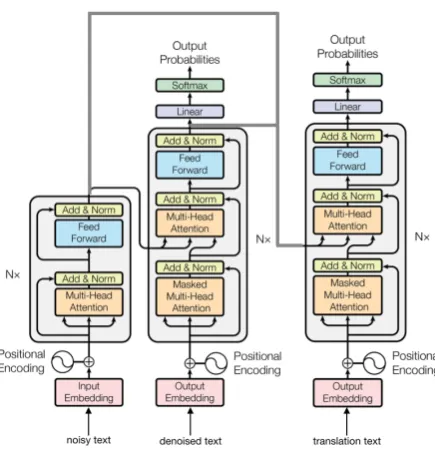
de-Figure 1: Multitask transformer architecture. Bold grey lines represent parts we add on top of the vanilla trans-former.
coders. The dataset consists of triplets: T = {tn,tc,tt}wheretnis the noisy source sentence, tc is the clean source sentence andtt is the target translation. Eachtconsists of a sequence of words [w1, w2, ..., wl], wherelis the length of the
corre-sponding text. By looking up the word and posi-tion embedding lookup tables, eachtis converted to a representation matrixx={e1, e2, ..., el}and
thus result inX={xn,xc,xt}.
The encoder reads in noisy text xn and gener-ates the encoded representation Mn. The layers of the first decoder (denoising decoder) first at-tends toxc(self-attention) and then attends toMn from the encoder. After N layers, this decoder generates another representationMcwhich repre-sents the clean rather than the noisy source text. Now, the layers of the second decoder (translation decoder) first perform self-attention as usual, and then attend to both Mn and Mc simultaneously. After repeating this processN times, the transla-tion decoder generatesMtwhich is then passed on to a position-wise feed-forward network followed by a softmax layer. The output of the model is a probability matrixP ∈ Rl×V, where V is the
vocabulary size and l is the length of translated sentence.
As the description above, the denoising decoder is exactly the same as the decoder of the vanilla transformer. The only difference is that for the translation decoder each layer needs to attend to
both encoder outputsMn and denoising decoder outputs Mc after self-attention. Therefore, the translation decoder receives two contexts, namely from the encoder attention An and the denoising decoder attentionAc. In our model, we design the final attention context as the linear transformation of the concatenation of these two attention states:
At=W[An;Ac] +b
WhereW∈Rd×2dandb∈
Rd.
FollowingTu et al.(2017);Anastasopoulos and Chiang (2018), the first objective is to maximize the log likelihood of the clean texttcand the sec-ond objective is to maximize that of the translated texttt. The importance of these two objectives are controlled by a hyper-parameterλ:
L(θ) =λlogP(tc|tn;θ) + (1)
(1−λ) logP(tt|tn,tc;θ)
2.2 Two Phase Beam Search
FollowingAnastasopoulos and Chiang(2018), we use two separate beam search processes to de-code the final translation. Let Nbeam be the size of the beam-search. The process is outlined here for clarity. Given a sentence tn, the denoising decoder produces a Nbeam outputs, each consist-ing of a denoised hypothesis ˆtc, the probability of the hypothesisP(ˆtc|xn;θ), and corresponding hidden state matrixMc. For each hypothesis fromˆ this first decoder, the second decoder also pro-duces Nbeam tuples, each including a translation hypothesis ˆtt and its probability P(ˆtt|tn,tcˆ;θ). At the end of the second phase, we will have
Nbeam×Nbeamtranslation hypotheses. We rank the these hypothesis by their scores defined in Equa-tion1.
3 Training Triple Generation
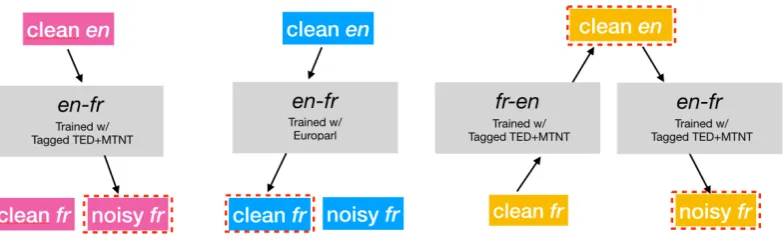
[image:2.595.75.293.67.292.2]Figure 2: Training data synthesis. Blocks rounded by dash rectangle are synthetic while others are real.
Depending on which part of triple is available, we select the proper NMT model and synthesize the missing ones. In Figure 2, we show 3 ways that we did this in this work. Note that because we focus on the translation from French to English where the French text mostly consists of MTNT-style noise (Michel and Neubig,2018), we specify the source language asfr, the target language as enand the noise style asMTNT; however, our ap-proach could be used for all other language pairs with different noise distributions.
Clean fr & Clean en: This is the most com-mon parallel corpus that could be obtained from many existing resources. The only missing text is the noisy French text. In this case, we syn-thesize the noisy text with the help of the NMT model trained with both TED and MTNT training data. During training, we add a tag showing the source of this pair at the beginning of each En-glish sentence (Kobus et al.,2017;Vaibhav et al., 2019). By adding this tag, the model could po-tentially better distinguish TED data and MTNT data. To generate the noisy French text, we add an MTNT tag at the beginning of each sentence and feed them to this NMT model. Ideally, besides the inherent noise as a result of imperfect translations, the translated French sentences could also possess a similar noise distribution as MTNT.
Noisy fr & Clean en: This kind of parallel text can be found in the MTNT training data. Note that even though the manually translated English sen-tences contain some level of “noise” (e.g. emoji), we treat them as clean English text. In this sce-nario, we leverage a pre-trained NMT system pro-vided by fairseq (Ott et al., 2019) to translate English sentences back to French. Considering its good performance over other benchmarks (e.g. WMT newstest datasets) we assume that the
trans-lated French sentences are of high quality and thus treat them as clean French text.
Clean fr: To make our back-translation strategy more generalized to settings where the above par-allel data is not enough to train the model, we also design a pipeline to utilize monolingual data which is likely to be available most of the time. In this case, we first translate these sentences to En-glish and then translate them back to French. Both NMT models are trained with TED and MTNT data as we describe above. Similarly, in both di-rections, we add the MTNT tag in the beginning of the sentences. Note that alternatively one could use an off-the-shelf NMT model to generate clean English text.2
4 Experiments
In this section, we first describe in detail our data pre-processing scheme, as well as the choice of hyperparameters. Then we compare our system with the baseline model (a vanilla transformer trained on clean French and clean English parallel data). Finally, we carry out a case study by com-paring the output of our model with the baseline model.
4.1 Data Pre-processing
Because of time limitations, we did not use all three kinds of training triples. We only used the first two triples introduced in Section3.
Clean fr & Clean en: The clean data consists of europarl-v73 and news-commentary-v10 copora.4 We filter out sentences whose length is greater
2
We did not attempt this due to time restrictions.
3
http://www.statmt.org/europarl/v7/ fr-en.tgz
4http://www.statmt.org/wmt15/
than 50. We apply a pretrained Byte Pair Encod-ing (BPE,Gage(1994)) model with 16k subword units to both source and target sentences. The pro-cess of synthesizing noisy French sentences is de-scribed in the corresponding paragraph of Section 3. We denote this set of triples asTeuroparl.
Noisy fr & Clean en: As mentioned in the cor-responding paragraph of Section 3, both noisy French and clean English come from MTNT train-ing data and we create clean French through back-translation. This set of triples is denoted asTmtnt.
4.2 Hyperparameters
We follow the transformer-base setting ofVaswani et al. (2017), using N = 6 layers for both en-coder and deen-coder,h= 8heads for self-attention, anddk,dv are both set to 64. The hidden size of the modeldmodelis set to 512 and the hidden size of the feed forward network is set to 2048. The smoothing rateis set to 0.1 and the dropout rate is set to 0.1. For our multi-task transformer specif-ically, the weightλin Equation1is set to 0.5. The implementation of the model is based on fairseq (Ott et al.,2019)5.
4.3 Results
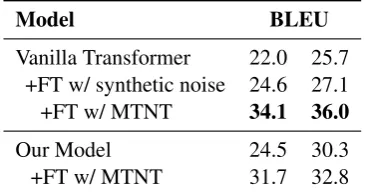
The baseline model is the vanilla transformer trained with clean French and clean English. In our experiment, it contains pairs T1 = {tc,tt} that are extracted from Xeuroparl. On the other hand, our model is the multitask transformer trained withXeuroparl. The same number of pairs and triples are used during training. We evaluate these two models on two MTNT datasets, one of them comes from the original paper (Michel and Neubig,2018) while the other one is provided by WMT Robustness shared task (Li et al., 2019). The BLEU score of these two models are shown in the first and the third column of Table1.
Compared to the vanilla transformer, our proposed multi-task transformer yields 2.5 and 4.6 BLEU points improvement on two MTNT datasets. However, the component that leads to the success of this model is unclear as there are mainly two differences: 1) our proposed model utilizes an auxiliary decoder to recover from the noisy text, it could potentially benefit the translation process with cleaner data 2) our model is further trained on
5https://github.com/pytorch/fairseq/
tree/master/fairseq
Model BLEU
Vanilla Transformer 22.0 25.7 +FT w/ synthetic noise 24.6 27.1 +FT w/ MTNT 34.1 36.0
[image:4.595.325.508.63.160.2]Our Model 24.5 30.3 +FT w/ MTNT 31.7 32.8
Table 1: BLEU score of different models. The second column shows the score in MTNT test dataset intro-duced inMichel and Neubig(2018) and the third col-umn shows the score in the MTNT test dataset provided by WMT Robustness share task (Li et al.,2019).
noisy data, presumably overcoming any domain-adaptation issues.
We investigate this issue by fine-tuning the baseline model with another set of pairs T2 =
{tn,tt}that are extracted fromTeuroparl. We load the pre-trained model and continue training for an extra epoch. With this fine-tuning process, the baseline model sees exact the same number of data as our proposed model. The fine-tuning result is shown in the second row of Table1.
The performance of the fine-tuned baseline sys-tem is very close to that of our proposed model on the original MTNT test data and is 3.2 BLEU points lower on the shared task dataset. This result suggest that while the inclusion of synthetic noisy sentences is generalizable among datasets, using the denoising decoder might be beneficial only in specific settings.
Further, to investigate model’s potential when in possession of in-domain training data, we fine tune both models with MTNT parallel training data. The data we use here is the same as the MTNT data we use to train auxiliary NMT systems to gen-erate triples (Section 3). During the fine-tuning process, hence, we do not introduce new parallel data. The performance of the fine-tuned systems are shown in the third and the last row of Table1 respectively.
pro-posed model respectively. This again shows the power of domain adaptation for building a robust NMT system.
4.4 Case Study
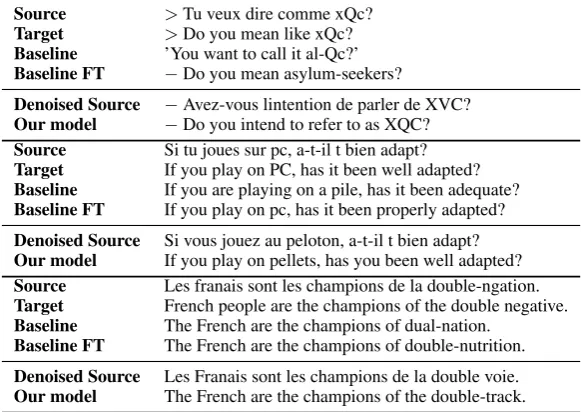
Table2shows example outputs of original MTNT test dataset from different models. The denoised source is the sentence generated by the denoising decoder in our proposed model.
The first example contains special characters ‘>’ and the word‘xQc’. All models fail to cor-rectly copy the special character>and generate a replacement. On the other hand, the word‘xQc’ confuses the two baseline models and they fail to correctly copy this word. Our model, however, correctly copies the word and generates a reason-able translation. The denoised sentence seems to not bring benefit and, in fact, it attempts to denoise ‘xQc’ to ‘XVC’. The translation decoder then seems to combine the two versions, copying the word from the source noisy sentence but upper-casing it just like the denoised version.
The second example contains the acronym ‘PC’ and our model does not produce a correct translation. It is interesting that the translated word ‘pellets’ is also not the corresponding translation of ‘peloton’ in the denoised sen-tence. Somewhat similar to the first example, this suggests that the translation decoder mostly ig-nores the context from the denoisy decoder. In terms of performance of vanilla transformer, al-though the baseline model also fails, the fine-tuned model deals with ‘PC’ correctly and procures a good translation. This indicates that explicitly having attention to both noisy and clean sentences does not always lead to better translation quality.
In the last example, the noise lies in a typo in the phrase corresponding to the phrase ‘‘double negative’’. None of the models produces a good translation of this phrase. Similar to the first case, the denoised sentence has a negative effect as it falsely “corrects” ‘‘ngation’’ to ‘‘voie’’ (“way” in English), which changes the meaning of the word and results in the bad translation‘track’. This demonstrates that all models still need to address issues regarding rare and misspelled words.
The main takeaway from a manual inspection of the outputs, is that the first (denoising) decoder does not really properly deal with noise in the de-sired way, and the translation decoder generally
ignores its output. We suspect that this issue is caused by the data synthesis process which re-sults in low quality triples. Other further improve-ments could be possibly achieved by constrain-ing the output of the denoisconstrain-ing decoder, such that it produces minimal, non-meaning-altering edits. We leave these investigations as future work.
5 Related Work
Here, we discuss how the MT community handles the noise problem. In general, there are mainly two kinds of approaches: the first attempts to de-noise text, and the second proposes training with noisy texts.
Denoising text: Sakaguchi et al. (2017) pro-poses semi-character level recurrent neural net-work (scRNN) to correct words with scrambling characters. Each word is represented as a vector with elements corresponding to the characters’ po-sition. Heigold et al. (2018) investigates the ro-bustness of character-based word embeddings in machine translation against word scrambling and random noise. The experiments show that the noise has a larger influence on character-based models than BPE-based models. To minimize the influence of word structure, Belinkov and Bisk (2017) proposes to represent word as its average character embeddings, which is invariant to these kinds of noise. The proposed method enables the MT system to be more robust to scrambling noise even training the model with clean text. Instead of handling noise at the word level, we try to recover the clean text from the noisy one at the sentence level. Besides noise like word scrambling, the sen-tence level denoising could potentially better deal with more complex noise like grammatical errors.
Source >Tu veux dire comme xQc? Target >Do you mean like xQc? Baseline ’You want to call it al-Qc?’ Baseline FT −Do you mean asylum-seekers?
Denoised Source −Avez-vous lintention de parler de XVC? Our model −Do you intend to refer to as XQC? Source Si tu joues sur pc, a-t-il t bien adapt? Target If you play on PC, has it been well adapted? Baseline If you are playing on a pile, has it been adequate? Baseline FT If you play on pc, has it been properly adapted?
Denoised Source Si vous jouez au peloton, a-t-il t bien adapt? Our model If you play on pellets, has you been well adapted? Source Les franais sont les champions de la double-ngation. Target French people are the champions of the double negative. Baseline The French are the champions of dual-nation.
Baseline FT The French are the champions of double-nutrition.
[image:6.595.153.444.64.270.2]Denoised Source Les Franais sont les champions de la double voie. Our model The French are the champions of the double-track.
Table 2: Comparison of baseline, baseline FT w/ synthetic noise and our model in MTNT fr-en.
kinds of noise. Similar findings were outlined in Anastasopoulos et al.(2019) andAnastasopoulos (2019), which evaluated MT systems on natural and natural-like grammatical noise, specifically on English produced by non-native speakers. Natural noise appears to be richer and more complex com-pared to synthetic noise, making it challenging to manually design a comprehensive set of noise to approximate real world settings. In our work, we follow (Vaibhav et al., 2019) and synthesize the noisy text through back-translation. There is no need to manually control the distribution of noise. In terms of multi-task learning for machine translation, Tu et al. (2017) proposes to add a reconstructor on top of the decoder. The aux-iliary objective is to reconstruct the source sen-tence from the hidden layers of the translation de-coder. This encourages the decoder to embed com-plete source information, which helps improve the translation performance. This approach was found to be helpful in low-resource MT scenarios also byNiu et al.(2019). Anastasopoulos and Chiang (2018) proposes a tied multitask learning model architecture to improve the speech translation task. The intuition is that, speech transcription as an in-termediate task, should improve the performance of speech translation if the speech translation is based on both the input speech and its transcrip-tion.
6 Conclusion
In this work, we propose a multi-task transformer architecture that tries to not only denoisy the noisy
source text but also translate it. We design a strat-egy for synthesizing data triplets for this architec-ture. Our model could be viewed as a combina-tion of denoising source text and domain adap-tation, both of which are popular approaches for designing robust NMT systems. Compared to the baseline vanilla transformer that is trained on clean data only, our proposed model with fine tun-ing enjoys 7.1 BLEU points improvement on the WMT Robustness shared task French to English dataset. However, this improvement is most likely attributed to the noisy text we add to the training process (hence, due to better domain adaptation), and not due to the denoising multi-task strategy.
References
Antonios Anastasopoulos. 2019. An analysis of source-side grammatical errors in nmt. In Proc. BlackboxNLP. To appear.
Antonios Anastasopoulos and David Chiang. 2018. Tied multitask learning for neural speech translation. InProceedings of the 2018 Conference of the North American Chapter of the Association for Computa-tional Linguistics: Human Language Technologies, Volume 1 (Long Papers), pages 82–91.
Antonios Anastasopoulos, Alison Lui, Toan Q. Nguyen, and David Chiang. 2019. Neural machine translation of text from non-native speakers. In Proc. NAACL-HLT.
Dzmitry Bahdanau, Kyunghyun Cho, and Yoshua Ben-gio. 2015. Neural machine translation by jointly learning to align and translate. InInternational Con-ference on Learning Representations.
Yonatan Belinkov and Yonatan Bisk. 2017. Synthetic and natural noise both break neural machine transla-tion. InInternational Conference on Learning Rep-resentations.
Philip Gage. 1994. A new algorithm for data compres-sion.The C Users Journal, 12(2):23–38.
Georg Heigold, Stalin Varanasi, G¨unter Neumann, and Josef Genabith. 2018. How robust are character-based word embeddings in tagging and mt against wrod scramlbing or randdm nouse? InProceedings of the 13th Conference of the Association for Ma-chine Translation in the Americas (Volume 1: Re-search Papers), volume 1, pages 68–80.
Huda Khayrallah and Philipp Koehn. 2018. On the impact of various types of noise on neural machine translation. InProceedings of the 2nd Workshop on Neural Machine Translation and Generation, pages 74–83.
Catherine Kobus, Josep Crego, and Jean Senellart. 2017. Domain control for neural machine transla-tion. InProceedings of the International Conference Recent Advances in Natural Language Processing, RANLP 2017, pages 372–378.
Xian Li, Paul Michel, Antonios Anastasopoulos, Yonatan Belinkov, Nadir K. Durrani, Orhan Firat, Philipp Koehn, Graham Neubig, Juan M. Pino, and Hassan Sajjad. 2019. Findings of the first shared task on machine translation robustness. In Proceed-ings of the Fourth Conference on Machine Transla-tion, Volume 2: Shared Task Papers, Florence, Italy. Association for Computational Linguistics.
Yitong Li, Trevor Cohn, and Timothy Baldwin. 2017. Robust training under linguistic adversity. In Pro-ceedings of the 15th Conference of the European Chapter of the Association for Computational Lin-guistics: Volume 2, Short Papers, volume 2, pages 21–27.
Paul Michel and Graham Neubig. 2018. Mtnt: A testbed for machine translation of noisy text. In Pro-ceedings of the 2018 Conference on Empirical Meth-ods in Natural Language Processing.
Jan Niehues, Eunah Cho, Thanh-Le Ha, and Alex Waibel. 2016. Pre-translation for neural machine translation. In Proceedings of COLING 2016, the 26th International Conference on Computational Linguistics: Technical Papers, pages 1828–1836, Osaka, Japan. The COLING 2016 Organizing Com-mittee.
Xing Niu, Weijia Xu, and Marine Carpuat. 2019. Bi-directional differentiable input reconstruction for low-resource neural machine translation. InProc. NAACL-HLT.
Myle Ott, Sergey Edunov, Alexei Baevski, Angela Fan, Sam Gross, Nathan Ng, David Grangier, and Michael Auli. 2019. fairseq: A fast, extensible toolkit for sequence modeling. In Proceedings of NAACL-HLT 2019: Demonstrations.
Keisuke Sakaguchi, Kevin Duh, Matt Post, and Ben-jamin Van Durme. 2017. Robsut wrod reocgini-ton via semi-character recurrent neural network. In Thirty-First AAAI Conference on Artificial Intelli-gence.
Matthias Sperber, Jan Niehues, and Alex Waibel. 2017. Toward robust neural machine translation for noisy input sequences. InInternational Workshop on Spo-ken Language Translation (IWSLT), Tokyo, Japan.
Zhaopeng Tu, Yang Liu, Lifeng Shang, Xiaohua Liu, and Hang Li. 2017. Neural machine translation with reconstruction. InThirty-First AAAI Conference on Artificial Intelligence.
Vaibhav, Sumeet Singh, Craig Stewart, and Graham Neubig. 2019. Improving robustness of machine translation with synthetic noise. In Meeting of the North American Chapter of the Association for Computational Linguistics (NAACL), Minneapolis, USA.