User Embedding for Scholarly Microblog Recommendation
Yang Yu, Xiaojun Wan and Xinjie Zhou
Institute of Computer Science and Technology, The MOE Key Laboratory of Computational
Linguistics, Peking University, Beijing 100871, China
{yu.yang, wanxiaojun, xinjiezhou}@pku.edu.cn
Abstract
Nowadays, many scholarly messages are posted on Chinese microblogs and more and more researchers tend to find schol-arly information on microblogs. In order to exploit microblogging to benefit scien-tific research, we propose a scholarly mi-croblog recommendation system in this study. It automatically collects and mines scholarly information from Chinese mi-croblogs, and makes personalized rec-ommendations to researchers. We pro-pose two different neural network models which learn the vector representations for both users and microblog texts. Then the recommendation is accomplished based on the similarity between a user’s vector and a microblog text’s vector. We also build a dataset for this task. The two em-bedding models are evaluated on the da-taset and show good results compared to several baselines.
1
Introduction
Online social networks such as microblogs have drawn growing attention in recent years, and more and more researchers are involved in mi-croblogging websites. Besides expressing their own emotions and exchanging their life experi-ences just like other users, these researchers also write from time to time about their latest findings or recommend useful research resources on their microblogs, which may be insightful to other researchers in the same field. We call such mi-croblog texts scholarly mimi-croblog texts. The vol-ume of scholarly microblog texts is huge, which makes it time-consuming for a researcher to browse and find the ones that he or she is inter-ested in.
In this study, we aim to build a personalized recommendation system for recommending scholarly microblogs. With such a system a
re-searcher can easily obtain the scholarly mi-croblogs he or she has interests in. The system first collects the latest scholarly microblogs by crawling from manually selected microblog users or by applying scholarly microblog classification methods, as introduced in (Yu and Wan, 2016). Second, the system models the relevance of each scholarly microblog to a researcher and make personalized recommendation. In this study, we focus on the second step of the system and aim to model the interest and preference of a researcher by embedding the researcher into a dense vector. We also embed each scholarly microblog into a dense vector, and thus the relevance of a scholar-ly microblog to a researcher can be estimated based on their vector representations.
In this paper, we propose two neural embed-ding algorithms for learning the vector represen-tations for both users (researchers) and mi-croblog texts. By extending the paragraph vector representation method proposed by (Le and Mikolov, 2014), the vector representations are jointly learned in a single framework. By model-ing the user preferences into the same vector space with the words and texts, we can obtain the similarity between them in a straightforward way, and use this relevance for microblog recommen-dation. We build a real evaluation dataset from Sina Weibo. Evaluation results on the dataset show the efficacy of our proposed methods.
2
Related Work
There have been a few previous studies focusing on microblog recommendation. Chen et al. (2012) proposed a collaborative ranking model. Their approach takes advantage of collaborative filter-ing based recommendation by collectfilter-ing prefer-ence information from many users. Their ap-proach takes into account the content of the tweet, user’s social relations and certain other explicitly defined features. Ma et al. (2011) generated rec-ommendations by adding additional social regu-larization terms in MF to constrain the user latent feature vectors to be similar to his or her friends' average latent features. Bhattacharya et al. (2014)
proposed a method benefiting from knowing the user’s topics of interest, inferring the topics of interest for an individual user. Their idea is to infer them from the topical expertise of the users whom the user follows. Khater and Elmongu (2015) proposed a dynamic personalized tweet recommendation system capturing the user’s in-terests, which change over the time. Their sys-tem shows the messages that correspond to such dynamic interests. Kuang et al. (2016) consid-ered three major aspects in their proposed tweet recommending model, including the popularity of a tweet itself, the intimacy between the user and the tweet publisher, and the interest fields of the user. They also divided the users into three types by analyzing their behaviors, using differ-ent weights for the three aspects when recom-mending tweets for different types of users. Most of the above studies make use of the re-lationships between users, while in this study, we focus on leveraging only the microblog texts for addressing the task.
3
Our Approach
3.1 Task Definition
We denote a set of users by
u
u u
1,
2,
,
u
m
, and a set of microblog texts by
1, 2, , n
d d d d . We assume that a user tweeting, retweeting or commenting on a mi-croblog text reflects that the user is interested in that microblog. Given
u
t
u
, we denote the set of microblogs thatu
t is interested in byd u
t . In our task, the entire sets of d and u are given, while given a useru
t
u
, only a subset of
td u
is known. This subset is used as the train-ing set, denoted as d u
t . Our task aims to re-trieve a subset d' of d, that d' is as similar to
t
td u d u as possible.
In this section, we introduce one baseline method and then propose two different neural network methods for user and microblog embed-ding. The baseline averages the vector represen-tation of microblog texts into a user vector repre-sentation. Our proposed two methods learn user vector representations jointly with word and text vectors, either indirectly or directly from word vectors.
3.2 Paragraph Vector
As our methods are mainly based on the Para-graph Vector model proposed by (Le and
Mikolov, 2014), we start by introducing this framework first.
Paragraph Vector is an unsupervised frame-work that learns continuous distributed vector representations for pieces of texts. In this ap-proach, every paragraph is mapped to a unique vector, represented by a column in matrix D and every word is also mapped to a unique vector, represented by a column in matrix W. This ap-proach is similar to the Word2Vec apap-proach pro-posed in (Mikolov et al., 2013), except that a paragraph token is added to the paragraph and is treated as a special word. The paragraph vector is asked to contribute to the prediction work in ad-dition to the word vectors in the context of the word to be predicted. The paragraph vector and word vectors are averaged to predict the next word in a context.
Formally speaking, given a paragraph
d
i, ,
w w
1 2,
,
w
T
withd
i as the paragraphtoken, k as the window size, the Paragraph Vec-tor model applies hierarchical softmax to maxim-ize the average log probability
1
log ( t | i, t k,..., t k)
t
p w d w w
T
3.3 Averaging Microblog Text Vectors as User Vector
An intuitive baseline approach to map a mi-croblog user into a vector space is to build such representation from the vector representations of the microblogs he or she likes.
[image:2.595.315.524.71.201.2]We treat microblog texts as paragraphs, and then apply the Paragraph Vector model intro-duced in Section 3.2 to learn vector representa-tions of the microblog texts. After learning all vector representations of microblog texts, for each user, we average all vectors of microblog
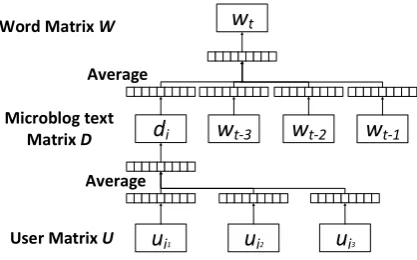
Figure 1. The proposed User2Vec#1 framework for learning user vector representation. In this frame-work, the word vectors do not directly contribute to the user vectors.
w
tw
t-3w
t-2w
t-1d
iui1 ui2
u
i3Word Matrix W
Microblog text Matrix D
User Matrix U
Average
texts he or she likes in the training set as the user vector.
3.4 Learning User Vectors Indirectly From Word Vectors
Besides the above-mentioned baseline approach we further consider to jointly learn the vectors of users and microblog texts. In this framework, every user is mapped to a vector represented in a column in matrix U , in addition to the mi-croblog text matrix D and the word matrixW. Given a microblog text
d
i, ,
w w
1 2,
,
w
T
,be-sides predicting words in the microblog texts using the microblog token
d
i and words in thesliding window, we also try to predict
d
i using the users related to it. Denoting the set of all us-ers related tod
i in the training set as1 2
( ) { , ..., }
h
i i i i
u d u u u , we maximize the
aver-age log probability
1
1
[log ( | , ,..., ) log ( | ,..., )]
h
t i t k t k i i i
t
p w d w w p d u u
T
The structure of this framework is shown in Figure 1. We name this framework User2Vec#1.
3.5 Learning User Vectors Directly From Word Vectors
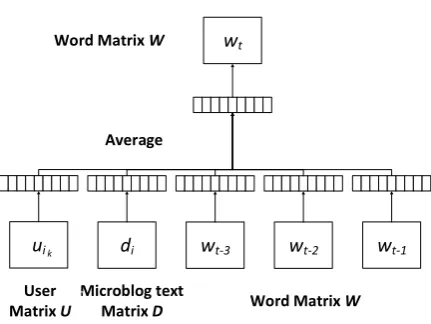
In the above framework, the user vectors are learned only from microblog text vectors, not directly from word vectors. Another framework we proposed for learning user vector representa-tion is to put user vectors and microblog vectors in the same layer. Unlike User2Vec#1, we do not use user vectors to predict microblog text vector. Instead, we directly add user vectors into the in-put layer of word vector prediction task, along with the microblog text vector.
In this framework, the average log probability we want to maximize is
1 1
( log ( | , ,..., , ,..., )
h
t i t k t k i i
t
p w d w w u u
T
In practical tasks, we modify the dataset by copying each microblog once for each user in 𝑢̃(𝑑𝑖), and make each copied microblog text only
relate to one user. All copies of the same mi-croblog text share a same vector representation.
The structure of the framework is shown in Figure 2. We name this framework User2Vec#2.
3.6 Recommending Microblogs
When recommending microblogs, given a mi-croblog djand a user
u
k , we compute the cosine distance between their vector representations, and use the cosine distance to determine whetherj
d should be recommended to
u
k or not.4
Evaluation
4.1 Data Preparation
To evaluate our proposed user embedding meth-ods in a scholarly microblog recommending sys-tem, we built a dataset by crawling from the website Machine Learning Daily1.
The Machine Learning Daily is a Chinese website which focuses on collecting and labeling scholarly microblogs related to machine learning, natural language processing, information retriev-al and data mining on Sina Weibo. These mi-croblog texts were collected by a combination of manual and automatic methods, and each mi-croblog text is annotated with multiple tags by experts, yielding an excellent dataset for our ex-periment. The microblog texts in our dataset can be written in a mixture of both Chinese and Eng-lish. We removed stop words from the raw texts, leaving 16,797 words in our corpus. The texts were then segmented with the Jieba Chinese text segmentation tool2.
[image:3.595.308.524.92.254.2]
1 http://ml.memect.com/ 2 https://github.com/fxsjy/jieba
Figure 2. The proposed User2Vec#2 framework for learning user vector representation. In this frame-work, the word vectors contribute directly to the user vectors, along with the microblog text vectors.
wt
wt-3 wt-2 wt-1
di
ui
Word Matrix W
Microblog text Matrix D
User
Matrix U Word Matrix W
Average
0.340 0.360 0.380 0.400 0.420 0.440
50 100 150 200 250 300
Average Embedding User2Vec#1
User2Vec#2
After crawling the microblogs from the Ma-chine Learning Daily, we used Sina Weibo API to retrieve the list of users who retweeted or commented on those microblogs. These retweet-ing and commentretweet-ing actions indicated that those users have interests in the microblogs they re-tweeted or commented, and such microblogs were considered the gold-standard (positive) mi-croblogs for the users in the recommendation system. Then we filtered out the users who have less than two hundred positive samples to avoid the data sparseness problem. This left us with 711 users and 10,620 microblog texts in our cor-pus. Each user was associated with 282.3 posi-tive microblogs on average.
4.2 Evaluation Setup
Because there is no API that can directly grant us the access to the follower and followee list for each user without authorization on Sina Weibo, when evaluating the effectiveness of our methods, we randomly choose one hundred positive sam-ples and another four hundred negative samsam-ples randomly selected from the crawled microblogs, to simulate the timeline of a user, and use this simulated timeline as the test dataset. The re-maining positive samples are used for training.
We adopt two additional baselines: of-Words and SVM on of-of-Words. For the Bag-of-Words baseline, we use the Bag-Bag-of-Words vector of each microblog text as the microblog text vector, and average them to obtain user vec-tors. For the SVM on Bag-of-Words baseline, we randomly choose the same amount of negative samples as that of positive samples for training. We use the Bag-of-Words vector of each mi-croblog text as the features, and run the SVM algorithm implemented in LibSVM3 once for
every user. Note that the Average Embedding
3 https://www.csie.ntu.edu.tw/~cjlin/libsvm/
method introduced in Section 3.3 is considered a strong baseline for comparison.
For each method and each user, we sort the microblog texts according to their similarity with the user and select the top k microblog texts as recommendation results, where k varies from 10 to 100.
Besides precision and recall values, we also compute mean reciprocal rank (MRR) to meas-ure the recommendation results in our experi-ments, which is the average of the multiplicative inverse of the rank of the positive samples in the output of the recommending system, and then averaged again across all users. Note that when k
is set to 100, the precision and recall value will be equal to each other.
4.3 Evaluation Results
The comparison results with respect to differ-ent k are shown in Table 1. As we can see, the two proposed joint learning methods outperform the simple average embedding method and the two other baselines, indicating the effectiveness of the proposed methods. Moreover, User2Vec#2 yields better results than User2Vec#1.We believe this is because in User2Vec#2, the word vectors have a direct contribution to the user vectors, which improves the learning effect of the user
k=10 k=20 k=50 k=100
Preci-sion Recall MRR
Preci-sion Recall MRR
Preci-sion Recall MRR
Preci-sion Recall MRR
Bag-of-Words 0.5036 0.0504 0.0153 0.4917 0.0983 0.0185 0.4461 0.2231 0.0223 0.3204 0.3204 0.0246 SVM on
BoW 0.5774 0.0577 0.0172 0.5662 0.1132 0.0212 0.5122 0.2561 0.0256 0.3675 0.3675 0.0282 Average
Embedding 0.5963 0.0596 0.0183 0.5824 0.1165 0.0219 0.5266 0.2633 0.0264 0.3793 0.3793 0.0291
User2Vec#1 0.6246 0.0625 0.0189 0.6055 0.1211 0.0228 0.5511 0.2756 0.0275 0.3953 0.3953 0.0304
[image:4.595.65.519.73.211.2]User2Vec#2 0.6652 0.0665 0.0201 0.6498 0.1300 0.0244 0.5883 0.2942 0.0295 0.4231 0.4231 0.0325
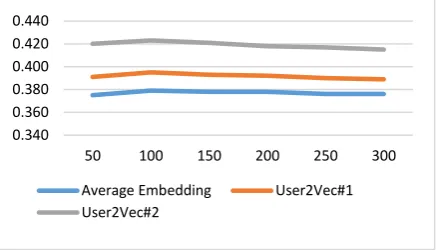
[image:4.595.305.524.250.375.2]Figure 3. Precision/Recall@k=100 w.r.t. vector di-mension.
vectors learnt in the framework. Furthermore, the precision/recall scores of the embedding methods (k=100) with respect to different vector dimen-sions are shown in Figure 3. We can see that the dimension size has little impact on the recom-mendation performance, and our proposed two methods always outperform the strong baseline.
5
Conclusion
In this paper, we proposed two neural embedding methods for learning the vector representations for both the users and the microblog texts. We tested their performance by applying them to recommending scholarly microblogs. In future work, we will investigate leveraging user rela-tionships and temporal information to further improve the recommendation performance.
Acknowledgments
The work was supported by National Natural Science Foundation of China (61331011), Na-tional Hi-Tech Research and Development Pro-gram (863 ProPro-gram) of China (2015AA015403) and IBM Global Faculty Award Program. We thank the anonymous reviewers and mentor for their helpful comments. Xiaojun Wan is the cor-responding author.
References
Michal Barla. 2011. Towards social-based user mod-eling and personalization. Information Sciences and Technologies Bulletin of the ACM Slovakia, 3(1).
Parantapa Bhattacharya, Muhammad Bilal Zafar, Ni-loy Ganguly, Saptarshi Ghosh, and Krishna P. Gummadi. 2014. Inferring user interests in the twit-ter social network. In Proceedings of the 8th ACM Conference on Recommender systems. ACM. Kailong Chen, Tianqi Chen, Guoqing Zheng, Ou Jin,
Enpeng Yao, and Yong Yu. 2012. Collaborative personalized tweet recommendation. In Proceed-ings of the 35th international ACM SIGIR confer-ence on Research and development in information retrieval. ACM.
Shaymaa Khater and Hicham G. Elmongui. 2015. Tweets You Like: Personalized Tweets Recom-mendation based on Dynamic Users Interests. In
2014 ASE Conference.
Li Kuang, Xiang Tang, Meiqi Yu, Yujian Huang and Kehua Guo. 2016. A comprehensive ranking model for tweets big data in online social network. EUR-ASIP Journal on Wireless Communications and Networking, 2016(1).
Quoc V. Le and Tomas Mikolov. 2014. Distributed representations of sentences and documents. arXiv preprint arXiv:1405.4053.
Hao Ma, Dengyong Zhou, Chao Liu, Michael R. Lyu and Irwin King. 2011. Recommender systems with social regularization. In Proceedings of the fourth ACM international conference on Web search and data mining. ACM.
Tomas Mikolov, Kai Chen, Greg Corrado, and Jeffrey Dean. 2013. Efficient estimation of word represen-tations in vector space. arXiv preprint arXiv:1301.3781.
Tomas Mikolov, Ilya Sutskever, Kai Chen, Greg S. Corrado and Jeff Dean. 2013. Distributed represen-tations of words and phrases and their composi-tionality. In Advances in neural information pro-cessing systems.
Hongzhi Yin, Bin Cui, Ling Chen, Zhiting Hu and Xiaofang Zhou. 2015. Dynamic user modeling in social media systems. ACM Transactions on In-formation Systems (TOIS), 33(3).
Jianjun Yu, Yi Shen and Zhenglu Yang. 2014. Topic-STG: Extending the session-based temporal graph approach for personalized tweet recommendation. In Proceedings of the companion publication of the 23rd international conference on World Wide Web companion. International World Wide Web Con-ferences Steering Committee.