Learning Dynamic Feature Selection for Fast Sequential Prediction
Emma Strubell Luke Vilnis Kate Silverstein Andrew McCallum College of Information and Computer Sciences
University of Massachusetts Amherst Amherst, MA, 01003, USA
{strubell, luke, ksilvers, mccallum}@cs.umass.edu
Abstract
We present paired learning and inference algorithms for significantly reducing com-putation and increasing speed of the vector dot products in the classifiers that are at the heart of many NLP components. This is accomplished by partitioning the features into a sequence of templates which are or-dered such that high confidence can of-ten be reached using only a small fraction of all features. Parameter estimation is arranged to maximize accuracy and early confidence in this sequence. Our approach is simpler and better suited to NLP than other related cascade methods. We present experiments in left-to-right part-of-speech tagging, named entity recognition, and transition-based dependency parsing. On the typical benchmarking datasets we can preserve POS tagging accuracy above 97% and parsing LAS above 88.5% both with over a five-fold reduction in run-time, and NER F1 above 88 with more than 2x in-crease in speed.
1 Introduction
Many NLP tasks such as part-of-speech tagging, parsing and named entity recognition have become sufficiently accurate that they are no longer solely an object of research, but are also widely deployed in production systems. These systems can be run on billions of documents, making the efficiency of inference a significant concern—impacting not only wall-clock running time but also computer hardware budgets and the carbon footprint of data centers.
This paper describes a paired learning and infer-ence approach for significantly reducing computa-tion and increasing speed while preserving accu-racy in the linear classifiers typically used in many
NLP tasks. The heart of the prediction computa-tion in these models is a dot-product between a dense parameter vector and a sparse feature vec-tor. The bottleneck in these models is then often a combination of feature extraction and numeri-cal operations, each of which snumeri-cale linearly in the size of the feature vector. Feature extraction can be even more expensive than the dot products, in-volving, for example, walking sub-graphs, lexicon lookup, string concatenation and string hashing. We note, however, that in many cases not all of these features are necessary for accurate predic-tion. For example, in part-of-speech tagging if we see the word “the,” there is no need to perform a large dot product or many string operations; we can accurately label the word a DETERMINER us-ing the word identity feature alone. In other cases two features are sufficient: when we see the word “hits” preceded by a CARDINAL(e.g. “two hits”) we can be confident that it is a NOUN.
We present a simple yet novel approach to im-prove processing speed by dynamically determin-ing on a per-instance basis how many features are necessary for a high-confidence prediction. Our features are divided into a set offeature templates, such ascurrent-token orprevious-tagin the case of
POS tagging. At training time, we determine an ordering on the templates such that we can approx-imate model scores at test time by incrementally calculating the dot product in template ordering. We then use a running confidence estimate for the label prediction to determine how many terms of the sum to compute for a given instance, and pre-dict once confidence reaches a certain threshold.
In similar work, cascades of increasingly com-plex and high-recall models have been used for both structured and unstructured prediction. Viola and Jones (2001) use a cascade of boosted mod-els to perform face detection. Weiss and Taskar (2010) add increasingly higher-order dependen-cies to a graphical model while filtering the
put domain to maintain tractable inference. While most traditional cascades pass instances down to layers with increasingly higher recall, we use a single model and accumulate the scores from each additional template until a label is predicted with sufficient confidence, in a stagewise approxima-tion of the full model score. Our technique applies to any linear classifier-based model over feature templates without changing the model structure or decreasing prediction speed.
Most similarly to our work, Weiss and Taskar (2013) improve performance for several structured vision tasks by dynamically selecting features at runtime. However, they use a reinforcement learn-ing approach whose computational tradeoffs are better suited to vision problems with expensive features. Obtaining a speedup on tasks with com-paratively cheap features, such as part-of-speech tagging or transition-based parsing, requires an approach with less overhead. In fact, the most at-tractive aspect of our approach is that it speeds up methods that are already among the fastest in NLP. We apply our method to left-to-right part-of-speech tagging in which we achieve accuracy above 97% on the Penn Treebank WSJ corpus while running more than five times faster than our 97.2% baseline. We also achieve a five-fold in-crease in transition-based dependency parsing on the WSJ corpus while achieving an LAS just 1.5% lower than our 90.3% baseline. Named entity recognition also shows significant speed increases. We further demonstrate that our method can be tuned for2.5 3.5x multiplicative speedups with nearly no loss in accuracy.
2 Classification and Structured Prediction
Our algorithm speeds up prediction for multiclass classification problems where the label set can be tractably enumerated and scored, and the per-class scores of input features decompose as a sum over multiple feature templates. Frequently, classifica-tion problems in NLP are solved through the use of linear classifiers, which compute scores for input-label pairs using a dot product. These meet our ad-ditive scoring criteria, and our acceleration meth-ods are directly applicable.
However, in this work we are interested in speeding up structured prediction problems, specifically part-of-speech (POS) tagging and de-pendency parsing. We apply our classification
algorithms to these problems by reducing them tosequential prediction (Daum´e III et al., 2009). For POS tagging, we describe a sentence’s part of speech annotation by the left-to-right sequence of tagging decisions for individual tokens (Gim´enez and M`arquez, 2004). Similarly, we implement our parser with a classifier that generates a sequence of shift-reduce parsing transitions (Nivre, 2009).
The use of sequential prediction to solve these problems and others has a long history in prac-tice as well as theory. Searn (Daum´e III et al., 2009) and DAgger (Ross et al., 2011) are two pop-ular principled frameworks for reducing sequen-tial prediction to classification by learning a clas-sifier on additional synthetic training data. How-ever, as we do in our experiments, practitioners of-ten see good results by training on the gold stan-dard labels with an off-the-shelf classification al-gorithm, as though classifying IID data (Bengtson and Roth, 2008; Choi and Palmer, 2012).
Classifier-based approaches to structured pre-diction are faster than dynamic programming since they consider only a subset of candidate out-put structures in a greedy manner. For exam-ple, the Stanford CoreNLP classifier-based part-of-speech tagger provides a 6.5x speed advantage over their dynamic programming-based model, with little reduction in accuracy. Because our methods are designed for the greedy sequential prediction regime, we can provide further speed increases to the fastest inference methods in NLP.
3 Linear models
Our base classifier for sequential prediction tasks will be alinear model. Given an inputx2 X, a set of labelsY, a feature map (x, y), and a weight vector w, a linear model predicts the highest-scoring label
y⇤ = arg max
y2Y w· (x, y). (1) The parameterwis usually learned by minimizing a regularized (R) sum of loss functions (`) over the training examples indexed byi
w⇤ = arg min
w
X
i
`(xi, yi,w) +R(w).
In this paper, we partition the features into a set offeature templates, so that the weights, feature function, and dot product factor as
w· (x, y) =X j
for some set offeature templates{ j(x, y)}. Our goal is to approximate the dot products in (1) sufficiently for purposes of prediction, while using as few terms of the sum in (2) as possible.
4 Method
We accomplish this goal by developing paired learning and inference procedures for feature-templated classifiers that optimize both accuracy and inference speed, using a process of dynamic feature selection. Since many decisions are easy to make in the presence of strongly predictive fea-tures, we would like our model to use fewer tem-plates when it is more confident. For a fixed, learned ordering of feature templates, we build up a vector of class scores incrementally over each prefix of the sequence of templates, which we call theprefix scores. Once we reach a stopping crite-rion based on class confidence (margin), we stop computing prefix scores, and predict the current highest scoring class. Our aim is to train each pre-fix to be as good a classifier as possible without the following templates, minimizing the number of templates needed for accurate predictions.
Given this method for performing fast inference on an ordered set of feature templates, it remains to choose the ordering. In Section 4.5, we de-velop several methods for picking template order-ings, based on ideas from group sparsity (Yuan and Lin, 2006; Swirszcz et al., 2009), and other tech-niques for feature subset-selection (Kohavi and John, 1997).
4.1 Definitions
Given a model that computes scores additively over template-specific scoring functions as in (2), parametersw, and an observationx 2X, we can define thei’thprefix scorefor labely2 Y as:
Pi,y(x,w) = i X
j=1
wj · j(x, y),
or Pi,y when the choice of observations and weights is clear from context. Abusing notation we also refer to the vector containing alli’th prefix scores for observationxassociated to each label in
YasPi(x,w), orPiwhen this is unambiguous. Given a parameter m > 0, called the margin, we define a functionhon prefix scores:
h(Pi, y) = max{0,max
y06=yPi,y0 Pi,y+m}
Algorithm 1Inference
Input:template parameters{wi}ki=1, marginm
and optional (for train time) true labely
Initialize: i= 1
whilel >0^ikdo
l= maxy0h(Pi, y0)(test) orh(Pi, y)(train)
i i+ 1
end while
return {Pj}ij=1(train) ormaxy0Pi,y0 (test)
Algorithm 2Parameter Learning
Input:examples{(xi, yi)}Ni , marginm
Initialize: parametersw0 = 0,i= 1
whileiN do
prefixes Infer(xi, yi,wi, m)
gi ComputeGradient(prefixes)
wi+1 UpdateParameters(wi, gi)
i i+ 1
end while
return wN
This is the familiar structured hinge loss func-tion as in structured support vector machines (Tsochantaridis et al., 2004), which has a mini-mum at0if and only if classyis ranked ahead of all other classes by at leastm.
Using this notation, the condition that some la-bel y be ranked first by a margin can be writ-ten as h(Pi, y) = 0, and the condition that any class be ranked first by a margin can be written as maxy0h(Pi, y0) = 0.
4.2 Inference
As described in Algorithm 1, at test time we com-pute prefixes until some label is ranked ahead of all other labels with a marginm, then predict with that label. At train time, we predict until the cor-rect label is ranked ahead with marginm, and re-turn the whole set of prefixes for use by the learn-ing algorithm. If no prefix scores have a margin, then we predict with the final prefix score involv-ing all the feature templates.
4.3 Learning
we want to learn an ordering of templates that op-timizes accuracy.
We wish to optimize several different objec-tives during learning: template parameters should have strong predictive power on their own, but also work well when combined with the scores from later templates. Additionally, we want to encour-age well-calibrated confidence scores that allow us to stop prediction early without significant reduc-tion in generalizareduc-tion ability.
4.4 Learning the parameters
To learn parameters that encourage the use of few feature templates, we look at the model as out-putting not a single prediction but a sequence of prefix predictions {Pi}. For each training ex-ample, each feature template receives a number of hinge-loss gradients equal to its distance from the index where the margin requirement is finally reached. This is equivalent to treating each prefix as its own model for which we have a hinge loss function, and learning all models simultaneously. Our high-level approach is described in Algorithm 2.
Concretely, for k feature templates we opti-mize the following structured max-margin objec-tive (with the dependence ofP’s onwwritten ex-plicitly where helpful):
w⇤ = arg min
w
X
(x,y)
`(x, y,w)
`(x, y,w) = i⇤
y
X
i=1
h(Pi(x,w), y)
i⇤y = min
i2{1..k}i s.t. h(Pi, y) = 0
The per-example gradient of this objective for weightswj corresponding to feature template j then corresponds to
@` @wj =
i⇤
y
X
i=j
j(x, yloss(Pi, y)) j(x, y).
where we define
yloss(Pi, y) = arg max
y0 Pi,y0 m·I(y
0 =y),
whereIis an indicator function of the labely, used to define loss-augmented inference.
We add an `2 regularization term to the objec-tive, and tune the marginmand the regularization
strength to tradeoff between speed and accuracy. In our experiments, we used a development set to choose a regularizer and margin that reduced test-time speed as much as possible without decreasing accuracy. We then varied the margin for that same model at test time to achieve larger speed gains at the cost of accuracy. In all experiments, the mar-gin with which the model was trained corresponds to the largest margin reported, i.e. that with the highest accuracy.
4.5 Learning the template ordering
We examine three approaches to learning the tem-plate ordering.
4.5.1 Group Lasso and Group Orthogonal Matching Pursuit
The Group Lasso regularizer (Yuan and Lin, 2006) penalizes the sum of `2-norms of weights of fea-ture templates (different from what is commonly called “`2” regularization, penalizing squared `2 norms), Picikwik2, where ci is a weight for each template. This regularizer encourages entire groups of weights to be set to0, whose templates can then be discarded from the model. By vary-ing the strength of the regularizer, we can learn an ordering of the importance of each template for a given model. The included groups for a given reg-ularization strength are nearly always subsets of one another (technical conditions for this to be true are given in Hastie et al. (2007)). The sequence of solutions for varied regularization strength is called theregularization path, and by slight abuse of terminology we use this to refer to the induced template ordering.
this method is that it fits the gradient of the training error which can rapidly overfit for sparse, high-dimensional data. Ultimately, we would prefer to use a development set for feature selection.
4.5.2 Wrapper Method
The wrapper method (Kohavi and John, 1997) is a meta-algorithm for feature selection, usually based on a validation set. We employ it in a stage-wise approach to learning a sequence of templates. Given an ordering of the initial sub-sequence and a learning procedure, we add each remaining tem-plate to our ordering and estimate parameters, se-lecting as the next template the one that gives the highest increase in development set performance. We begin the procedure with no templates, and re-peat the procedure until we have a total ordering over the set of feature templates. When learning the ordering we use the same hyperparameters as will be used during final training.
While simpler than the Lasso and Matching Pursuit approaches, we empirically found this ap-proach to outperform the others, due to the neces-sity of using a development set to select features for our high-dimensional application areas.
5 Related Work
Our work is primarily inspired by previous re-search on cascades of classifiers; however, it dif-fers significantly by approximating the score of a single linear model—scoring as few of its features as possible to obtain sufficient confidence.
We pose and address the question of whether a single, interacting set of parameters can be learned such that they efficiently both (1) provide high ac-curacy and (2) good confidence estimates through-out their use in the lengthening prefixes of the feature template sequence. (These two require-ments are both incorporated into our novel param-eter estimation algorithm.) In contrast, other work (Weiss and Taskar, 2013; He et al., 2013) learns a separate classifier to determine when to add fea-tures. Such heavier-weight approaches are unsuit-able for our setting, where the core classifier’s fea-tures and scoring are already so cheap that adding complex decision-making would cause too much computational overhead.
Other previous work on cascades uses a se-ries of increasingly complex models, such as the Viola-Jones face detection cascade of classifiers (2001), which applies boosted trees trained on
subsets of features in increasing order of complex-ity as needed, aiming to reject many sub-image windows early in processing. We allow scores from each layer to directly affect the final predic-tion, avoiding duplicate incorporation of evidence. Our work is also related to the field of learn-ing and inference under test-time budget con-straints (Grubb and Bagnell, 2012; Trapeznikov and Saligrama, 2013). However, common ap-proaches to this problem also employ auxiliary models to rank which feature to add next, and are generally suited for problems where features are expensive to compute (e.gvision) and the ex-tra computation of an auxiliary pruning-decision model is offset by substantial reduction in fea-ture computations (Weiss and Taskar, 2013). Our method uses confidence scores directly from the model, and so requires no additional computation, making it suitable for speeding up classifier-based NLP methods that are already very fast and have relatively cheap features.
Some cascaded approaches strive at each stage to prune the number of possible output structures under consideration, whereas in our case we fo-cus on pruning the input features. For example, Xu et al. (2013) learn a tree of classifiers that sub-divides the set of classes to minimize average test-time cost. Chen et al. (2012) similarly use a linear cascade instead of a tree. Weiss and Taskar (2010) prune output labels in the context of structured prediction through a cascade of increasingly com-plex models, and Rush and Petrov (2012) success-fully apply these structured prediction cascades to the task of graph-based dependency parsing.
In the context of NLP, He et al. (2013) describe a method for dynamic feature template selection at test time in graph-based dependency parsing. Their technique is particular to the parsing task— making a binary decision about whether to lock in edges in the dependency graph at each stage, and enforcing parsing-specific, hard-coded constraints on valid subsequent edges. Furthermore, as de-scribed above, they employ an auxiliary model to select features.
He and Eisner (2012) share our goal to speed test time prediction by dynamically selecting fea-tures, but they also learn an additional model on top of a fixed base model, rather than using the training objective of the model itself.
exists related work in the field of general (static) feature selection. The most relevant results come from the applications of group sparsity, such as the work of Martins et al. (2011) inGroup Lasso for NLP problems. The Group Lasso regularizer (Yuan and Lin, 2006) sparsifies groups of feature weights (e.g. feature templates), and has been used to speed up test-time prediction by remov-ing entire templates from the model. The key dif-ference between this work and ours is that we se-lect our templates based on the test-time difficulty of the inference problem, while the Group Lasso must do so at train time. In Appendix A, we com-pare against Group Lasso and show improvements in accuracy and speed.
Note that non-grouped approaches to selecting sparse feature subsets, such as boosting and`1 reg-ularization, do not achieve our goal of fast test-time prediction in NLP models, as they would not zero-out entire templates, and still require the computation of a feature for every template for ev-ery test instance.
6 Experimental Results
We present experiments on three NLP tasks for which greedy sequence labeling has been a successful solution: part-of-speech tagging, transition-based dependency parsing and named entity recognition. In all cases our method achieves multiplicative speedups at test time with little loss in accuracy.
6.1 Part-of-speech tagging
We conduct our experiments on classifier-based greedy part-of-speech tagging. Our baseline tag-ger uses the same features described in Choi and Palmer (2012). We evaluate our models on the Penn Treebank WSJ corpus (Marcus et al., 1993), employing the typical split of sections used for part-of-speech tagging: 0-18 train, 19-21 devel-opment, 22-24 test. The parameters of our mod-els are learned using AdaGrad (Duchi et al., 2011) with`2regularization via regularized dual averag-ing (Xiao, 2009), and we used random search on the development set to select hyperparameters.
This baseline model (baseline) tags at a rate of approximately 23,000 tokens per second on a 2010 2.1GHz AMD Opteron machine with ac-curacy comparable to similar taggers (Gim´enez and M`arquez, 2004; Choi and Palmer, 2012; Toutanova et al., 2003). On the same machine
Model/m Tok. Unk. Feat. Speed
Baseline 97.22 88.63 46 1x
Stagewise 96.54 83.63 9.50 2.74
Fixed 89.88 56.25 1 16.16x
Fixed 94.66 60.59 3 9.54x
Fixed 96.16 87.09 5 7.02x
Fixed 96.88 88.81 10 3.82x
Dynamic/15 96.09 83.12 1.92 10.36x
Dynamic/35 97.02 88.26 4.33 5.22x
Dynamic/45 97.16 88.84 5.87 3.97x
Dynamic/50 97.21 88.95 6.89 3.41x
Table 1: Comparison of our models using differ-ent margins m, with speeds measured relative to the baseline. We train a model as accurate as the baseline while tagging 3.4x tokens/sec, and in an-other model maintain>97%accuracy while tag-ging 5.2x, and>96%accuracy with a speedup of 10.3x.
the greedy Stanford CoreNLP left3words part-of-speech tagger also tags at approximately 23,000 tokens per second. Significantly higher absolute speeds for all methods can be attained on more modern machines.
We include additional baselines that divide the features into templates, but train the templates’ pa-rameters more simply than our algorithm. The
stagewise baseline learns the model parameters
for each of the templates in order, starting with only one template—once each template has been trained for a fixed number of iterations, that tem-plate’s parameters are fixed and we add the next one. We also create a separately-trained baseline model for each fixed prefix of the feature templates
(fixed). This shows that our speedups are not
sim-ply due to superfluous features in the later tem-plates.
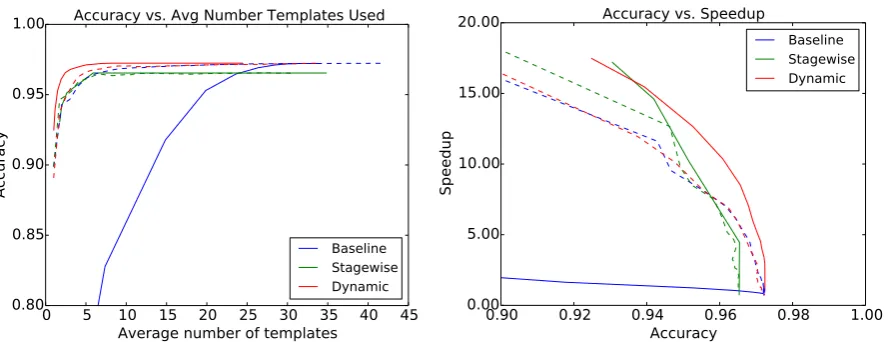
Figure 1: Left-hand plot depicts test accuracy as a function of the average number of templates used to predict. Right-hand plot shows speedup as a function of accuracy. Our model consistently achieves higher accuracy while using fewer templates resulting in the best ratio of speed to accuracy.
that we varied the margin at test time. Superior results form6= 50could likely be obtained by op-timizing hyperparameters for the desired margin.
Results show our method (dynamic) learns to dynamically select the number of templates, often using only a small fraction. The majority of test tokens can be tagged using only the first few tem-plates: just over 40% use one template, and 75% require at most four templates, while maintaining 97.17% accuracy. On average 6.71 out of 46 tem-plates are used, though a small set of complicated instances never surpass the margin and use all 46 templates. The right hand plot of Figure 1 shows speedup vs. accuracy for various settings of the confidence marginm.
The left plot in Figure 1 depicts accuracy as a function of the number of templates used at test time. We present results for both varying the number of templates directly (dashed) and margin (solid). The baseline model trained on all tem-plates performs very poorly when using margin-based inference, since its training objective does not learn to predict with only prefixes. When pre-dicting using a fixed subset of templates, we use a different baseline model for each one of the 46 to-tal template prefixes, learned with only those fea-tures; we then compare the test accuracy of our dynamic model using template prefixito the base-line model trained on the fixed prefixi. Our model performs just as well as these separately trained models, demonstrating that our objective learns weights that allow each prefix to act as its own high-quality classifier.
6.1.1 Learning the template ordering
As described in Section 4.5, we experimented on part-of-speech tagging with three different algo-rithms for learning an ordering of feature tem-plates: Group Lasso, Group Orthogonal Matching Pursuit (GOMP), and the wrapper method. For the case of Group Lasso, this corresponds to the experimental setup used when evaluating Group Lasso for NLP in Martins et al. (2011). As detailed in the part-of-speech tagging experiments of Ap-pendix A, we found the wrapper method to work best in our dynamic prediction setting. Therefore, we use it in our remaining experiments in pars-ing and named entity recognition. Essentially, the Group Lasso picks small templates too early in the ordering by penalizing template norms, and GOMP picks large templates too early by overfit-ting the train error.
6.2 Transition-based dependency parsing
We base our parsing experiments on the greedy, non-projective transition-based dependency parser described in Choi and Palmer (2011). Our model uses a total of 60 feature templates based mainly on the word form, POS tag, lemma and assigned head label of current and previous input and stack tokens, and parses about 300 sentences/second on a modest 2.1GHz AMD Opteron machine.
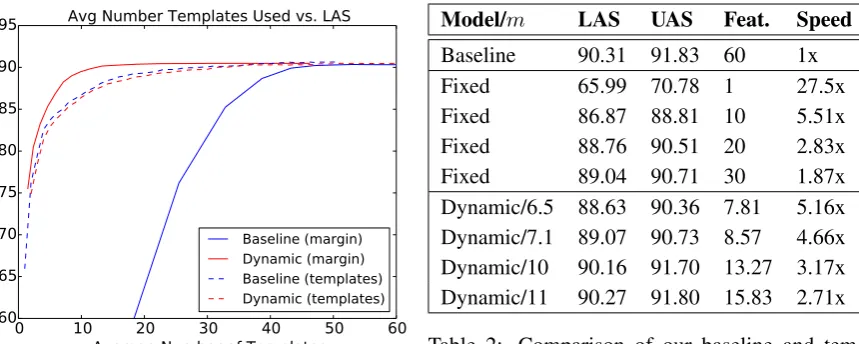
Figure 2: Parsing speedup as a function of accu-racy. Our model achieves the highest accuracy while using the fewest feature templates.
Marneffe and Manning, 2008). POS tags were au-tomatically generated via 10-way jackknifing us-ing the baseline POS model described in the pre-vious section, trained with AdaGrad using`2 reg-ularization, with parameters tuned on the develop-ment set to achieve 97.22 accuracy on WSJ sec-tions 22-24. Lemmas were automatically gener-ated using the ClearNLP morphological analyzer. We measure accuracy using labeled and unlabeled attachment scores excluding punctuation, achiev-ing a labeled score of 90.31 and unlabeled score of 91.83, which are comparable to similar greedy parsers (Choi and Palmer, 2011; Honnibal and Goldberg, 2013).
Our experimental setup is the same as for part-of-speech tagging. We compare our model (
dy-namic) to both a singlebaselinemodel trained on
all features, and a set of 60 models each trained on a prefix of feature templates. Our experiments vary the margin used during prediction (solid) as well as the number of templates used (dashed).
As in part-of-speech tagging, we observe sig-nificant test-time speedups when applying our method of dynamic feature selection to depen-dency parsing. With a loss of only 0.04 labeled at-tachment score (LAS), our model produces parses 2.7 times faster than the baseline. As listed in Ta-ble 2, with a more aggressive margin our model can parse more than 3 times faster while remain-ing above 90% LAS, and more than 5 times faster while maintaining accuracy above 88.5%.
In Figure 2 we see not only that our dynamic
model consistently achieves higher accuracy while
Model/m LAS UAS Feat. Speed
Baseline 90.31 91.83 60 1x
Fixed 65.99 70.78 1 27.5x
Fixed 86.87 88.81 10 5.51x
Fixed 88.76 90.51 20 2.83x
Fixed 89.04 90.71 30 1.87x
Dynamic/6.5 88.63 90.36 7.81 5.16x
Dynamic/7.1 89.07 90.73 8.57 4.66x
Dynamic/10 90.16 91.70 13.27 3.17x
Dynamic/11 90.27 91.80 15.83 2.71x
Table 2: Comparison of our baseline and tem-plated models using varying marginsmand num-bers of templates.
using fewer templates, but also that our model (
dy-namic, dashed) performs exactly as well as
sep-arate models trained on each prefix of templates
(baseline, dashed), demonstrating again that our
training objective is successful in learning a single model that can predict as well as possible using any prefix of feature templates while successfully selecting which of these prefixes to use on a per-example basis.
6.3 Named entity recognition
We implement a greedy left-to-right named entity recognizer based on Ratinov and Roth (2009) us-ing a total of 46 feature templates, includus-ing sur-face features such as lemma and capitalization, gazetteer look-ups, and each token’sextended pre-diction history, as described in (Ratinov and Roth, 2009). Training, tuning, and evaluation are per-formed on the CoNLL 2003 English data set with the BILOU encoding to denote label spans.
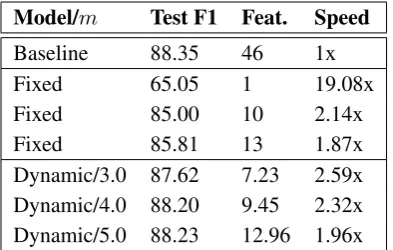
Our baseline model achieves F1 scores of88.35 and 93.37 on the test and development sets, re-spectively, and tags at a rate of approximately 5300tokens per second on the hardware described in the experiments above. We achieve a 2.3x speedup while maintaining F1 score above88 on the test set.
7 Conclusions and Future Work
[image:8.595.297.525.62.219.2]lit-Model/m Test F1 Feat. Speed
Baseline 88.35 46 1x
Fixed 65.05 1 19.08x
Fixed 85.00 10 2.14x
Fixed 85.81 13 1.87x
Dynamic/3.0 87.62 7.23 2.59x
Dynamic/4.0 88.20 9.45 2.32x
[image:9.595.84.281.62.187.2]Dynamic/5.0 88.23 12.96 1.96x
Table 3: Comparison of our baseline and tem-plated NER models using varying margin m and number of templates.
tle extra implementation cost and can easily be combined with existing state-of-the-art systems. Future work will remove the fixed ordering for feature templates, and dynamically add additional features based on the current scores of different la-bels.
8 Acknowledgements
This work was supported in part by the Center for Intelligent Information Retrieval, in part by DARPA under agreement number FA8750-13-2-0020, and in part by NSF grant #CNS-0958392. The U.S. Government is authorized to reproduce and distribute reprint for Governmental purposes notwithstanding any copyright annotation thereon. Any opinions, findings and conclusions or recom-mendations expressed in this material are those of the authors and do not necessarily reflect those of the sponsor.
References
Eric Bengtson and Dan Roth. 2008. Understanding the value of features for coreference resolution. In Pro-ceedings of the Conference on Empirical Methods in Natural Language Processing, pages 294–303. As-sociation for Computational Linguistics.
Minmin Chen, Zhixiang “Eddie” Xu, Kilian Q Wein-berger, Olivier Chappele, and Dor Kedem. 2012. Classifier cascade for minimizing feature evaluation cost. InAISTATS.
Jinho Choi and Martha Palmer. 2011. Getting the Most out of Transition-based Dependency Parsing. Asso-ciation for Computational Linguistics, pages 687– 692.
Jinho Choi and Martha Palmer. 2012. Fast and robust part-of-speech tagging using dynamic model selec-tion. InAssociation for Computational Linguistics.
Hal Daum´e III, John Langford, and Daniel Marcu. 2009. Search-based structured prediction. Machine Learning, 75(3):297–325.
Marie-Catherine de Marneffe and Christopher D. Man-ning. 2008. The stanford typed dependencies rep-resentation. InCOLING 2008 Workshop on Cross-framework and Cross-domain Parser Evaluation.
John Duchi, Elad Hazan, and Yoram Singer. 2011. Adaptive Subgradient Methods for Online Learning and Stochastic Optimization. JMLR, 12:2121–2159.
Bradley Efron, Trevor Hastie, Iain Johnstone, Robert Tibshirani, et al. 2004. Least angle regression. The Annals of Statistics, 32(2):407–499.
Jes´us Gim´enez and Llu´ıs M`arquez. 2004. Svmtool: A general pos tagger generator based on support vector machines. InProceedings of the 4th LREC, Lisbon, Portugal.
Alexander Grubb and J. Andrew Bagnell. 2012. SpeedBoost: Anytime Prediction with Uniform Near-Optimality. InAISTATS.
Trevor Hastie, Jonathan Taylor, Robert Tibshirani, and Guenther Walther. 2007. Forward stagewise regres-sion and the monotone lasso. Electronic Journal of Statistics, 1:1–29.
He He and Jason Eisner. 2012. Cost-sensitive dynamic feature selection. InICML Workshop on Inferning: Interactions between Inference and Learning.
He He, Hal Daum´e III, and Jason Eisner. 2013. Dy-namic feature selection for dependency parsing. In EMNLP.
M Honnibal and Y Goldberg. 2013. A Non-Monotonic Arc-Eager Transition System for Dependency Pars-ing.CoNLL.
Ron Kohavi and George H John. 1997. Wrappers for feature subset selection. Artificial Intelligence, 97(1):273–324.
Aur´elie C Lozano, Grzegorz Swirszcz, and Naoki Abe. 2011. Group orthogonal matching pursuit for logis-tic regression. InInternational Conference on Arti-ficial Intelligence and Statistics, pages 452–460.
Mitchell P. Marcus, Beatrice Santorini, and Mary Ann Marcinkiewicz. 1993. Building a Large Annotated Corpus of English: The Penn Treebank. Computa-tional Linguistics, 19(2):313–330.
Joakim Nivre. 2009. Non-projective dependency pars-ing in expected linear time. In Proceedings of the Joint Conference of the 47th Annual Meeting of the ACL and the 4th International Joint Conference on Natural Language Processing of the AFNLP, vol-ume 1, pages 351–359. Association for Computa-tional Linguistics.
Lev Ratinov and Dan Roth. 2009. Design challenges and misconceptions in named entity recognition. In Proceedings of the Thirteenth Conference on Com-putational Natural Language Learning, pages 147– 155. Association for Computational Linguistics. St´ephane Ross, Geoffrey J. Gordon, and Drew Bagnell.
2011. A reduction of imitation learning and struc-tured prediction to no-regret online learning. In Ge-offrey J. Gordon, David B. Dunson, and Miroslav Dud´ık, editors, AISTATS, volume 15 ofJMLR Pro-ceedings, pages 627–635.
Alexander M Rush and Slav Petrov. 2012. Vine prun-ing for efficient multi-pass dependency parsprun-ing. In Proceedings of the 2012 Conference of the North American Chapter of the Association for Computa-tional Linguistics: Human Language Technologies, pages 498–507. Association for Computational Lin-guistics.
Grzegorz Swirszcz, Naoki Abe, and Aurelie C Lozano. 2009. Grouped orthogonal matching pursuit for variable selection and prediction. In Advances in Neural Information Processing Systems, pages 1150–1158.
Kristina Toutanova, Dan Klein, Christopher D Man-ning, and Yoram Singer. 2003. Feature-rich part-of-speech tagging with a cyclic dependency network. InHLT-NAACL.
Kirill Trapeznikov and Venkatesh Saligrama. 2013. Supervised sequential classification under budget constraints. InAISTATS.
Ioannis Tsochantaridis, Thomas Hofmann, Thorsten Joachims, and Yasemin Altun. 2004. Support vector machine learning for interdependent and structured output spaces. InProceedings of the Twenty-first In-ternational Conference on Machine Learning, page 104.
Paul Viola and Michael Jones. 2001. Rapid object de-tection using a boosted cascade of simple features. InProceedings of the 2001 IEEE Computer Society Conference on Computer Vision and Pattern Recog-nition, volume 1, pages I–511. IEEE.
David Weiss and Ben Taskar. 2010. Structured predic-tion cascades. InAISTATS.
David Weiss and Ben Taskar. 2013. Learning adaptive value of information for structured prediction. In NIPS.
Lin Xiao. 2009. Dual Averaging Method for Regular-ized Stochastic Learning and Online Optimization. InNIPS.
Zhixiang “Eddie” Xu, Matt J Kusner, Kilian Q Wein-berger, and Minmin Chen. 2013. Cost-sensitive tree of classifiers. InICML.