Determinants of financial performance of
financial sectors (An assessment through
economic value added)
Khan, Muhammad Kamran and Nouman, Mohammad and
TENG, JIAN-ZHOU and Khan, Muhammad Imran and
Jadoon, Arshad Ullah
1-Institute of Business and Management Sciences, The University of
Agriculture Peshawar, Pakistan, 2-School of Economics, Northeast
Normal University, Changchun Jilin, China
26 October 2017
Online at
https://mpra.ub.uni-muenchen.de/82386/
www.euacademic.org DRJI Value: 5.9 (B+)
Determinants of Financial Performance of
Financial Sectors
(An Assessment through Economic Value Added)
MUHAMMAD KAMRAN KHAN1
Institute of Business and Management Sciences The University of Agriculture Peshawar, Pakistan School of Economics, Northeast Normal University Changchun Jilin, China
MOHAMMAD NOUMAN
Institute of Business and Management Sciences The University of Agriculture Peshawar, Pakistan
JIAN-ZHOU TENG
MUHAMMAD IMRAN KHAN ARSHAD ULLAH JADOON
School of Economics, Northeast Normal University Changchun Jilin, China
Abstract:
This study investigated determinants of financial performance of listed financial sectors in Karachi Stock Exchange from 2008 to 2012. The objective of this study was to investigate the factors of financial performance of financial sectors in Pakistan. Descriptive statistics, Correlation matrix, Chow test, Hausman Test for Fixed Effect Model and Random Effect Model and Breusch-Pagan Lagrange multiplier for Random Effect were used in this study. Estimated results revealed that determinants of financial sectors such as leverage, liquidity, size, risk and tangibility have significant effect on financial performance of financial sectors. It is recommended that financial sectors should consider EVA as an important factor for financial
performance. It is suggested that increased number of independent variables will further enhanced the scope of the future studies.
Key words: Leverage, Liquidity, Size, Risk, Tangibility, EVA (Economic Value Added)
I. INTRODUCTION
1.1 Background of the Study
Financial performance management is a part of total performance management of an organization. Weldeghiorgis (2004) investigated that organization managers have started to understand that both financial and non-financial elements of performance must be measured in calculating performance. Weldeghiorgis (2004) revealed that calculations of financial performance are the means of support of Firms. Financial performance is the major factors of assessment of Firms. Al-Enizi et al. (2006) reported that the identification of the restrictions of conventional financial performance calculations has facilitated to numerous research programs which promoted the utilization of non-financial performance calculations. El-Enizi et al. (2006) observed consumer consent, transport and
other “significant accomplishment aspects” as pattern of non -financial performance measurements (NFPMs). Le Roux (2004) revealed that efficient administration of firms provide sound base that marks procedure which helps estimation of development of firms, activities such as transaction, client facilitation, expenditure, and supervision of workers. This may facilitate an organization to achieve financial performance There are many events that require to be useful and which must facilitate attainment of goals such as redistribution of a turnover (assuming that the company is doing well) by means
Business and manufacturing sector are the foundation of a nation financial system. The company day to day affairs are carried out by different types of trade venture. Individual ownership, ownership through share, companies are the main types of business. Business and manufacturing sector are the two main types of business organization. Commerce is the activities that are carried out for buy and auction of merchandise and services. Commerce is sub divided in wholesalers, retailers, financial services (banks, insurance etc.). Industry is financial activities taken for the production of furnished goods from unprocessed inputs. This comprises manufacturing plants and natural deposits. Production is a practical knowledge which includes procedure and techniques of efficient operation of an organization. The topic of our interest in this area of investigation is financial performance of financial sectors. Company is the absolute shape of trade due to its legal identity. The samples of investigation were collected from financial firms mainly because of its legal character. The emphasis of this study is financial performance of financial sector of Karachi Stock Exchange.
The emphasis of this study was on management of financial performance due to facts that it is the focal point and final product of all actions carried out in particular time period. Financial performance shows an image of the sustaining performance of firms. Sustainable performance guarantee retaining human resources, business performance, and profit shares of the investors. Strong financial position of business is an important aspect for everyone such as workers, shareholders, financial firms and state institutions (Lin and Piesse, 2004).
1.2 Performance
„Performance‟ is used to indicate the hard work to attain a
human, financial and natural resources. The performance is an activity applied to a part or all of performance of an actions in a time period, often with connection to previous or proposed
expenditure efficiency, management responsibility or
accountability. According to Nirmal (2004) Performance‟ not
only indicates demonstration of something but it also indicates the satisfactory output of an organization.
1.3 Financial Performance
Financial performance of an organization not just plays the function to raise the market value of that particular organization but also direct development of the financial sector which finally leads to success of market specifically for property business and its function as an engine of financial development.
Several research workers have presented affirmative
relationship for financial improvement and economic
participate significant unction in development of financial performance (Tarawneh, 2006).
Financial performances represent the operation to carry out monetary actions. Generally, financial performance indicates measures to which economic goals being or has been achieved. Economic activities are course of action of measuring the outcome of an organization's guidelines and action in financial shape. It is used to calculate organization's overall economic fitness over particular time period. The financial performance of the organizations can be calculated by its economic outcome and by its size of earnings. Risk and profitability are two main components which together decide the significance of organization. Financial conclusion which enlarges uncertainty will reduce the value of organization and on the other hand financial conclusions which boost up the profitability will enlarge value of the organization. Risk and
profitability are two essential elements of business
organization.
1.4 Significance of Research Study
The importance of this study come from information that financial organization plays an important role in enhancing the nation economy and providing significant services for peoples of Pakistan. This research has practically put into operation complete systematic structure of financial performance in case of financial organization of Pakistan. The research study has
observed the impact of key elements of organization‟s financial
tangibility, and other non-identified variables of financial sectors of Pakistan.
1.5 Problem of Research Study
The financial performance has received more importance from academic community of different disciplines. Financial performance got great attention from experts of trade activities because financial performance has impacts on quality of firms and its sustainability. The current study has discovered the following research question.
1. What factors are significantly affecting the economic
value added (financial performance) of financial sectors of Karachi Stock Exchange (KSE)?
1.6 Justification of Research Study
1.7 Objectives of Research
The aim of research is to examine factors that affect financial performance of financial sector of Pakistan. The aim was achieved by following objective:
1. To identify the determinants of Financial
Performance for financial sector of Karachi Stock Exchange (KSE).
II. LITERATURE REVIEW
Several studies related to organization‟s financial performance
have recognized different elements which has influenced performance of organizations. Limited numbers of findings
are available regarding companies‟ performance in Pakistan compared with large number of studies conducted by foreign researchers. Some of these studies are presented as under.
William (1988) concluded that choice of maximum leverage reduces disagreement among managers and investors. Previous research work generally differentiates among two kinds of organizational performance such as financial performance and innovative performance.
Molyneux and Thornton (1992) studied factors of
financial sector‟s profitability in eighteen European states from
1986 to 1989. Their research results indicated positive impacts on ROA and range of interest with government control.
Avkiran (1995) reported that financial performance of financial sector was determined by mix of financial ratios, benchmarking and calculating performance against budget or a mix of these techniques.
Berger et al. (1995) reported that essentials foundation
of the operational performance of financial services
a task of efficiency of contractual instrument in focusing, maintaining and controlling administrative capacity in ways
that capitalize investor‟s capital.
Krishnan and Moyer (1997) revealed negative and
important connection among leverage and company‟s
performance though additional elements significantly
impacting company‟s performance such as size, growth, tax and risk.
Krishnan and Moyer (1997) revealed negative and
important connection among leverage and company‟s
performance though additional elements significantly
impacting company‟s performance such as size, growth, tax and risk.
Damanpour and Evan (1998) reported that previous research work has frequently utilized performance as separate
idea. Financial performance was frequently used in
environment of development of sales, high dividend on investment, high share prices in market.
Bashir (2000) examined factors of Islamic bank‟s
performance from 1993 to 1998. Internal and external elements were used to forecast productivity and effectiveness. Managing macroeconomic situation, economic marketplace position and tax duty, the outcomes confirm that large amount of leverage and high loans to asset ratios guide to high profitability. Foreign-owned banks are more money-making compare to local banks.
Guru et al. (2002) investigated performance of seventeen Malaysian customer banks from1986 to 1999 to determine profitability performance of Malaysian banks. There were two forms of output, inside elements (liquidity, capital capability and expense administration) and outside elements (shareholder Equity, organization size and outside financial environment). Based on their research results they found low profit performance of Banks.
Chowdhury (2002) reveled that banking sector of Bangladesh include a mix single include state-owned, and overseas customer banks. It is becoming very important for banks to suffer the stress occurring from both inside and outside elements and show to be beneficial.
Neceur (2003) studied Tunisian banks for period 1980 to 2000. He stated affirmative effect of owner investment to return on assets.
Spathis and Doumpos (2002 ) examined the efficiency of Greek banks based on their property size. They applied multiple methods to categorize Greek banks according to the profit and operation elements, and to demonstrate the dissimilarity of banks productivity and competence among small and large banks.
Muhammet Mercan et al (2003) investigated economic performance index of Turkish commercial banks from 1989 to 1999. They revealed effects of range and means of shareholder possession of banks with financial performance of banks.
Adams and Buckle (2003) conducted research on factors of organization day to day performance in Bermudian insurance marketplace. They suggested that firms with high leverage, low liquidity and reinsurers have better operational performance.
Goddard et al. (2004) studied performance of European financial institutions. They observed comparatively feeble correlation among size and profitability calculated by return on equity. The British financial institutions present optimistic correlation among off-balance-sheet trade and profitability.
Shiu (2004) investigated the factors of performance of the UK universal Insurance Corporation, for the period 1986 to 1999 using panel data, using three key indicators: investment
yield, fraction alteration in shareholder‟s money and profit on shareholder‟s investments based on the results of panel data.
He empirically tested 12 descriptive variables and showed that performance of insurers have best relationship.
Ho and Zhu (2004) observed that estimation of
organization‟s performance has been pointing the day to day organization efficiency and competence, which exert pressure
the organization‟s endurance straightforwardly.
Chien and Song Zhu (2004) reported that several earlier research programmes about firm performance estimation have paying attention just on day to day organization effectiveness and day to day efficiency which may straight-line pressure the endurance of a firm. By applying an original two-stage data envelopment examination framework in their research, the outcome of this research revealed that firm with improved capability does not forever signify that it has gained efficiency.
Elizabeth and Elliott (2004) reported economic
performance procedures as interest rate profit on uses of organization assets. Investment was significantly related with
consumer‟s satisfaction.
Millar (2005) revealed comparison of economic value
explanation of economic value added. He reported that normal, the United Kingdom financial sectors include rate more than time, which is due to low profit for 10 year govt. securities and time of comparatively improve financial development in the United Kingdom which has accelerated banks earnings.
Tarawneh (2006) showed assessment of economic performance in the financial segment with some proof from Omani customer banks. It revealed that banks with advanced sum equity, deposit, loan or total assets does not always mean of improved productivity.
Knoben and Oerlemans (2006) reported that literature often used both financial and innovative performance as separate concepts. Firm performance is the capacity which has been accomplished by firm. There are variety of procedures of economic performance i.e. profit on sales show how much an organization make profit in connection to its sales, profit on
assets find out firm‟s capability.
Fiordelsi (2007) developed investor value efficiency frontier using economic value added. He concluded that it is improved to moreover comparative cost or turnover competence in calculation of performance.
Lee (2008) investigated the impact of shareholder capital composition on company economic performance in South Korea. It pointed on the function of two key scope of the share holder rights composition: Ownership application (i.e. the division of shares owned by common owners) and point the shareholders (specially, overseas shareholder and organizational financier). He indicated that organization performance calculated by bookkeeping price of return on assets normally enhanced as shareholder share attention enhance, but possessions of overseas investor and organization share are irrelevant.
Liargovas and Skandalis (2008) studied the effect of
company performance. The study showed that leverage, export movement, site, size and the index for organization capability considerably influence company performance in Greece. The research outcome showed that gainful companies in Greece are
big, immature, sell abroad companies with brave
administration players, which have a best debt-equity ratio and employ their liquidity to sponsor their funds.
Prasetyantoko and Parmono (2008) reported the
elements shaping business performance of scheduled
businesses in Indonesia particularly due to 1997 economic disaster. The investigation also pointed that shareholders shares element matter on company performance by the proof that companies with popular overseas investment have much superior performance in both dimensions.
Xiaochi Lin (2009) reported the effects of bank ownership on performance for 60 banks. He used the ROE, ROA, damaged (non-performancing) assets to total credit, Costs to working profits to calculate the performance of all the banks.
Sufian (2009) reported that high credit uncertainty in business and high loan attentiveness in Malaysian banks has observed low profitability in business. On the opposite side, Malaysian banks with high rank of investment, high profits from non-interest resource, and high level of day to day expenses practiced high profitability points in business.
Al-Tamimi (2009) reported that liquidity and
attentiveness were the most important elements of professional national banks. On the other hand, number of branches and
cost was the mainly important elements of Islamic banks‟
performance.
Nepal (NRB) has applied CAMEL model for performance estimation of the banks and other financial organizations.
Memon et al. (2010) studied funds arrangement and
company‟s performance on textile industry. They revealed that performance of business in this segment is lower finest stage of funds composition and corporations are unsuccessful to attain the economies of level.
Nosa and Ose (2010) reported requirement of successful financing for expansion and advancement of the business in Nigeria. They recommended improving the management
structure for growing the company‟s performance by stressing on risk administration and commercial control.
Onaolapo and Kajola (2010) observed important and
unenthusiastic connection among debt ratio and company‟s
financial performance.
Marcia Millon Cornett et al (2010) examined the effects of govt. share possession in the banking organization during the Asian crisis. By using the regression they reported that govt. banks generally operated low profitable and have lower ability
to take credit risks than investor‟s banks earlier to 2001.
Curak et al. (2011) conducted research on determinants
of the financial performance of the Croatian composite insurers for the period 2004 to 2009. The determinant of profitability selected was explanatory variables which included both internal factors specific to insurance companies and external factors specific to economic environment. By applying panel data technique he investigated that company size, underwriting risk, inflation and return on equity have significant influence on profitability.
Ahmad (2011) concluded that there is a strong unenthusiastic connection among return on asset and bank size and with day to day competence. He observed significant relationship among return on asset and asset administration relation.
Malik (2011) revealed significant profitability of insurers, while leverage and loss ratio have non significant effect on the insurers. The last variable tested, company age, have no affect on profitability of insurance companies.
Charumathi (2012) conducted research on financial performance of the Indian life insurers using six variables for
analysis. In India, life insurer‟s profitability was significantly
and positively influenced by company size and liquidity, while leverage, growth of gross written premiums and volume of equity have negative and significant influence. Moreover, it was noticed that there was no linkage between underwriting risk and profitability. In order to improve performance of insurance companies, the author proposed several recommendations regarding supervisory authority and competition in the insurance market, capital market participation, strengthening connections with banks and increasing foreign direct investment.
Mehari and Aemiro (2013) investigated the impact of the
Ethiopian insurance companies‟ characteristics on their
performance. The study includes 9 insurance companies which were analyzed through panel data technique for the period 2005 to 2010. According to final results of research, they concluded that company size, tangibility and leverage represent
important elements of insurers‟ performance, while growth of
gross written premiums, age and liquidity have an insignificant statistical impact.
Several research studies conducted by various
researchers have studied different aspects of financial sector. However sufficient studies were not conducted on this subject. The overall aspects of financial sector were not studied in greater detail in previous studies. In some research programmes, if it was examined, the time of research has been of limited time. In addition to that large number of previous research studies have emphasized only on small number of independent variables. This study has emphasized the function
of some independent variables on development and
performance of financial sector in Pakistan from 2008-2012.
III. RESEARCH METHODOLOGY
Firm‟s financial performance of financial sector was calculated by several methods, due to type of analysis and requirement of
user. Different procedures were employed for calculating firm‟s
financial performance and interpretations of financial
3.1 Sample Design of Research Study
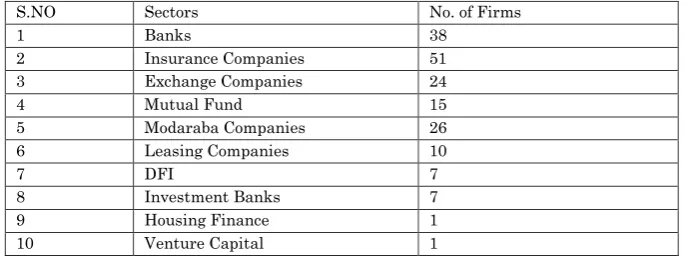
[image:17.439.49.394.279.409.2]The financial sectors were purposively selected based on availability of the data during 2008 to 2012. In purposive sampling the desired information was obtained from specific sectors. This study has covered 145 financial firms from ten areas namely Banks, Development Financial Institutions, Leasing Companies, Investment Banks, Mutual Funds, Modarabas, Exchange Companies, Insurance Companies, Housing Finance and Venture Capital. The data were compiled from financial statements of financial sectors of Karachi Stock Exchange.
Table 3.1 Sector Wise Distributions of Financial Sectors S.NO Sectors No. of Firms
1 Banks 38
2 Insurance Companies 51 3 Exchange Companies 24
4 Mutual Fund 15
5 Modaraba Companies 26 6 Leasing Companies 10
7 DFI 7
8 Investment Banks 7
9 Housing Finance 1
10 Venture Capital 1
3.2 Sources of Data
3.3. VARIABLES OF RESEARCH STUDY
(A) INDEPENDENT VARIABLES
3.4.1 Leverage
Leverage was calculated by debt/equity ratio. This indicates the extent of the amount of loans in investment. Firms with more leveraged amount may face collapse of business due to its inability to arrange timely payment of loans. These firms may lose credibility in business environment and may face hardship in future loans. Leverage is sometimes useful because, it will improve profit of investors on share of their capital and can put together proper utilization of tax benefits related to loans (Amal et al. 2012).
Leverage = (Total debt / Equity ratio)
3.4.2 Liquidity
Liquidity = (Current assets / Current liabilities)
3.4.3 Size
Company size will influence financial achievement in the market. Big companies may explore economies of scale. They are highly resourceful and capable than companies with little capacity and resources. Companies with little capacity and resources will carry less influence than big companies in business environment. Small companies will not be able to participate actively in market environment compared with big companies. However, performance improvement is a hard task for big companies which some time can lead to low performance in the market. Theoretically it is equivocal on the precise
relationship in size and performance (Majumdar, 1997).
Size = Natural Log of Total Assets
3.4.4 Risks
Risk intensity is the basic element of a company‟s financial achievement (Kale et al.1991). Company with maximum uncertainty and high agency costs may have more chances of financial collapse compared with company more business profits. According to Johnson (1997) companies of volatile earnings may face environment of low available cash hardly sufficient to recover loans. Esperanca et al. (2003) observed hopeful connection among risk of company and both long duration and short duration debt.
Risks = (EBIT / Earning after interest and Tax)
3.4.5 Tangibility of Assets
Tangibility of Assets = (Fixed Asset / Total Assets)
(B) DEPENDENT VARIABLE
3.5 Economic Value Added
In light of Weaver‟s (2001) reports and to make sure
comparison with return on average assets and return on average equity, we used the LBS-First Consulting (1992) bank value added formula together with modifications endorsed by Uyemura et al. (1996).
EVA i,t= (operating profits after tax i,t - capital charge i,t)/factor inputs
i,t
Where:
Capital charge i,t = capital i,t * cost of capital i,t
Factor inputs i,t = operating costs i,t + interest costs i,t
EVA is normalized by factor inputs to minimize possible heteroskedasticity and scale effects in the model.
3.6 Statistical Analysis
The fixed effect and random effects was processed through Hausman specification test (1978). Keeping in view more number of companies and short time duration of study, we processed short panel data type according to Baltagi (2005).
3.7 Panel Data
information and collinearity among variables is minimum and generalized.
3.8 Fixed Effect Model
One of the types of panel data is fixed effect model. Wooldridge (2001) reported that in regression model, fixed effect model give partiality because of excluded variables. In fixed effect model, intercept are unlike for individuals while the slope of coefficients are constant (Gujrati, 2003; Baltagi, 2008). This model is used for robustness in the result. This test was carried out with robust standard errors where Heteroskedasticity was investigated in data.
3.9 Random Effect Model
Random effect model was used which is the type of panel data analysis. In random effect model, the value of intercept is the mean of overall intercepts of the cross sectional units whereas fixed effect model gives fixed value to the intercept of the cross sectional unit (Gujrati, 2003). This model is used for robust errors, where Heteroskedasticity is found in data.
3.10 Hausman Specification Test
The Hausman specification test match up fixed and random effects with null hypothesis. Individual effects are not related with other regressors in the model (Hausman 1978). If correlated (H0 is rejected), random effect model will create unfair estimators and will abuse one of Gauss-Markov assumptions. In this situation fixed effect model is favorite
choice. Hausman‟s essential result is that covariance of an
3.11 Chow Test
Chow test is employed for selection of fixed effect model and Pooled OLS Model which give details if model is according to nature of data. The hypothesis of the chow test is:
H0: The pooled OLS model is adequate, in favor of the fixed
effects alternative.
H1: The pooled OLS model is not adequate, in favor of the fixed
effects alternative.
3.12 Breusch and Pagan Lagrangian Multiplier Test
The Breusch-Pagan Lagrange multiplier test decides between random effect model and pooled OLS regression. It gives details of major existing variation among units. In case of no variability across units, OLS regression is employed than random effect model. In case of major variation in units then panel data models (fixed effect model, random effect model or between effect model) is used.
H0: The pooled OLS model is adequate, in favor of the random
effects model.
H1: The pooled OLS model is not adequate, in favor of the
random effects model.
3.13 Regression Model
The following regression model for the estimation of current study was employed.
Where:
i is for company
t is for year
FP: financial performance through EVA= Economic Value Added LV = leverage
TN= tangibility
In addition, α: constant β1, β2, β3, β4 and β5are called the regression
coefficients, and
are the random error term.IV. RESULTS AND DISCUSSION
[image:23.439.50.390.285.376.2]The results of different diagnostic tests such as Descriptive Statistics, Correlation Matrix, Fixed Effect Model, Breusch and Pagan Lagrange Multiplier (LM) Test for Random Effect Model, Hausman Test for comparison of Fixed and Random Effect Model, Chow Test for pooled OLS Model are presented as under:
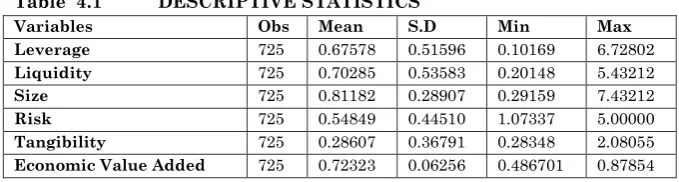
Table 4.1 DESCRIPTIVE STATISTICS
Variables Obs Mean S.D Min Max Leverage 725 0.67578 0.51596 0.10169 6.72802
Liquidity 725 0.70285 0.53583 0.20148 5.43212
Size 725 0.81182 0.28907 0.29159 7.43212
Risk 725 0.54849 0.44510 1.07337 5.00000
Tangibility 725 0.28607 0.36791 0.28348 2.08055
Economic Value Added 725 0.72323 0.06256 0.486701 0.87854
Based on secondary data obtained from financial statement Table 4.1 reveals descriptive statistics such as mean, standard
deviation, minimum and maximum of firm‟s performance
respectively. The maximum of leverage, liquidity, size, risk, tangibility and economic value added is 6.72802, 5.43212, 7.43212, 5.00, 2.08055 and .87854 respectively. Burca et al. (2014) revealed that parameters of financial performance of Romanian insurance market were financial leverage, size, risk and risk retention ratio. Abbas et al. (2013) reported that performance of textile companies in Pakistan was drastically influenced due to short term leverage, size and risks.
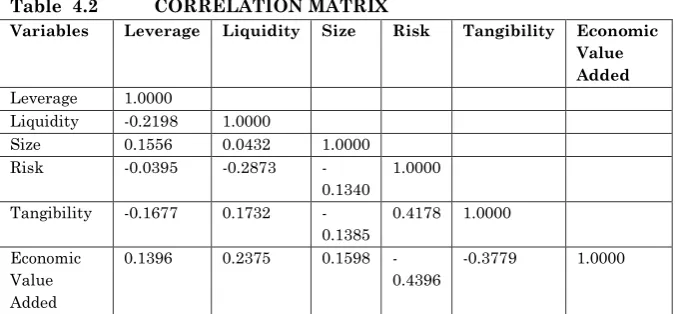
Table 4.2 CORRELATION MATRIX
Variables Leverage Liquidity Size Risk Tangibility Economic Value Added
Leverage 1.0000
Liquidity -0.2198 1.0000
Size 0.1556 0.0432 1.0000 Risk -0.0395 -0.2873
-0.1340
1.0000
Tangibility -0.1677 0.1732 -0.1385
0.4178 1.0000
Economic Value Added
0.1396 0.2375 0.1598 -0.4396
-0.3779 1.0000
margin and liquidity, but have negative correlation with inflation. Abbas et al. (2013) indicated that leverage including
tax and tangibility have negative correlation with firm‟s
[image:25.439.56.388.240.354.2]performance while growth, size, risk, liquidity have positive correlation with firm‟s performance. Burca et al.(2014) revealed that company size and equity have positive correlation with performance.
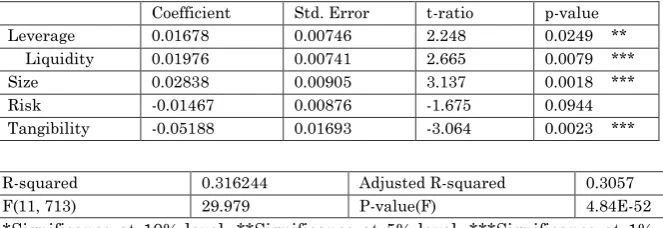
Table 4.3 AUGMENTED REGRESSIONS FOR CHOW TEST OLS, using 725 observations
Dependent variable: EVA
Coefficient Std. Error t-ratio p-value Leverage 0.01678 0.00746 2.248 0.0249 ** Liquidity 0.01976 0.00741 2.665 0.0079 *** Size 0.02838 0.00905 3.137 0.0018 *** Risk -0.01467 0.00876 -1.675 0.0944 Tangibility -0.05188 0.01693 -3.064 0.0023 ***
R-squared 0.316244 Adjusted R-squared 0.3057 F(11, 713) 29.979 P-value(F) 4.84E-52 *Significance at 10% level. **Significance at 5% level. ***Significance at 1% level.
Chow test for structural break at observation 29:5 F(6, 713) = 2.98773 with p-value 0.0069
Table 4.4 BREUSCH AND PAGAN LAGRANGIAN MULTIPLIER TEST
Var SD = sqrt (Var)
EVA 0.003914 0.0625622
Var(u) = 0 Chibar2 (01) = 166.58
Prob> Chibar2 = 0.0000
[image:26.439.51.392.48.169.2]Table 4.4 shows variation and standard deviation of Economic Value Added. The variation and SD of Economic value added (EVA) is 0.00391 and 0.06256 respectively. On the basis of p-value we reject null hypothesis which indicates that pooled OLS model is better than random effects model. We conclude that random effect model is suitable. Shamsudin et al. (2013) revealed that random effect model is suitable for panel data analysis.
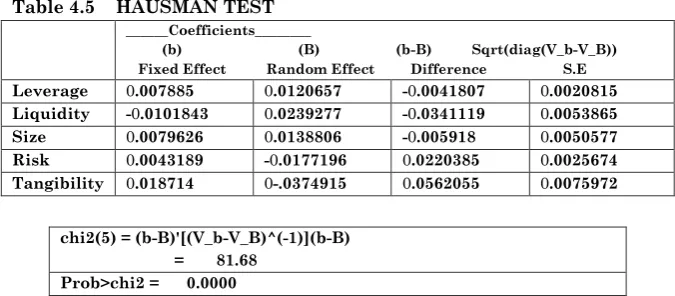
Table 4.5 HAUSMAN TEST ______Coefficients________
(b) (B) (b-B) Sqrt(diag(V_b-V_B)) Fixed Effect Random Effect Difference S.E
Leverage 0.007885 0.0120657 -0.0041807 0.0020815 Liquidity -0.0101843 0.0239277 -0.0341119 0.0053865 Size 0.0079626 0.0138806 -0.005918 0.0050577 Risk 0.0043189 -0.0177196 0.0220385 0.0025674 Tangibility 0.018714 0-.0374915 0.0562055 0.0075972
chi2(5) = (b-B)'[(V_b-V_B)^(-1)](b-B) = 81.68
Prob>chi2 = 0.0000
Table 4.5 explains the results of the Hausman specification test. This test was used for the purpose of selecting whether to use fixed effect model or random effect model, which can provide efficient results. The p-value of chi2 is .0000 which is
[image:26.439.51.389.322.470.2]conducted research on company operated in Romanian insurance market and revealed on the basis of their results that fixed effect model is suitable.
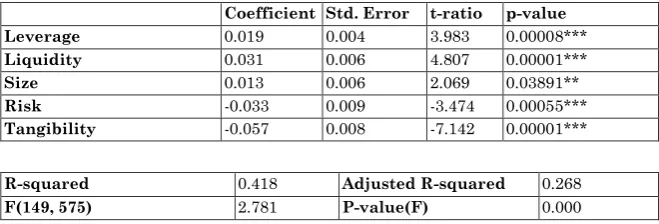
Table 4.6 FIXED EFFECT MODEL
Fixed-effects, No. of observations 725
Dependent variable: Economic Value Added with Robust (HAC) standard errors
Coefficient Std. Error t-ratio p-value Leverage 0.019 0.004 3.983 0.00008***
Liquidity 0.031 0.006 4.807 0.00001***
Size 0.013 0.006 2.069 0.03891**
Risk -0.033 0.009 -3.474 0.00055***
Tangibility -0.057 0.008 -7.142 0.00001***
R-squared 0.418 Adjusted R-squared 0.268
F(149, 575) 2.781 P-value(F) 0.000
*Significance at 10% level. **Significance at 5% level. ***Significance at 1% level.
The results of Fixed Effects Model are revealed in Table 4.6. It can be observed from data that variables such as leverage, liquidity, risk, size and tangibility were statistically significant. The P value of Leverage, Liquidity, Size, Risk and Tangibility
are 0.00008, 0.00001, 0.03891, 0.00055 and 0.00001
respectively. The P values of all variables are less than 0.05 which means that Leverage, Liquidity, Size, Risk and Tangibility are highly significant. The value of R-squared shows
that independent variable explains 42% of the entire panel‟s
variation. The coefficient of fixed effect model shows that Leverage, Liquidity, and Size have positive effect on Economic Value Added while Risk and Tangibility have negative effect on Economic Value Added.
[image:27.439.55.385.194.306.2]due to added management benefits and leads to more investment. In case of companies with maximum leverage may face antagonistic approaches from low leveraged competitors and may be unable to get market share in an oligopoly product market.
Liquidity has major influence on financial performance of financial sectors in Pakistan. Chen and Wong (2004) indicated that liquidity have positive impact on financial performance. Adams and Buckle (2000) revealed that liquidity having non-significant impact on financial performance.
Size is statistically significant which have affected financial performance of financial sector of Pakistan. Liargavas and Skandalis, 2008;Tarawneh, 2006; Kakani et al. 2005; Chen and Wong, 2004) reported that major firms are more gainful because of more investment opportunities, sufficient human resources and advanced computer system which lead to more performance and output. In addition to that financial experts are more interested in big companies due to publication and availability of regular financial reports along with bright financial opportunities.
Risk is significant at 5% level probability (p ≤ 0.05) of financial sectors of Pakistan. This negative relationship
between risks and firm‟s performance is not consistent with
findings of (Abbas et al. 2010; Krishnan and Moyer, 1997). They
reported same relationship between risks and firm‟s
performance. They indicated that more risky firms tend to perform well in financial sector of Pakistan.
Tangibility is statistically significant at 5% level of
probability (p ≤ 0.05) in financial sectors of Pakistan. It means
that tangibility have played significant role for firm‟s financial
Pakistan. It means that tangibility has not played significant
role for firm‟s performance.
4.7 HETEROSKEDASTICITY
Distribution free Wald test for Heteroskedasticity.
Null hypothesis: The units have a common error variance Asymptotic test statistics: Chi-square (145) = 3300.98 With p-value = 0.0000
According to results of Wald test, the p-value is 0.0000 which is less than 0.05. In this situation we do not accept Ho and conclude the problem of Heteroskedasticity in model. To address this in order to solve the difficulty of heteroskedasticity robust regression was employed (El-Melegy and Moumen, 2014).
V. CONCLUSION & RECOMMENDATIONS
The study entitled “Determinants of financial performance for
Funds, Modarabas, Exchange Companies, Insurance Companies, Housing Finance and Venture Capital. The correlation of liquidity with Size and economic value added was positive but have negative correlation with risk and tangibility. The correlation between size and risk is positive with EVA but negative with tangibility.
Based on results of this research study and overall situation of stock market, the determinants of financial sectors such as leverage, liquidity, risk, size and tangibility have significant effect on EVA (financial performance). Greater attention should be paid to leverage, liquidity, risk and tangibility. Companies of maximum leverage may face financial collapse in case of no payments on their debt. These companies may also face problems of future lending. Leverage may enhance shareholders profits on their invested capital and can properly utilize tax benefits related to borrowing. It is proposed that financial sectors should consider EVA as an important factor for financial performance measurement. The companies must not depend on short time debt, which create greater portion of its leverage. Companies must emphasize on planning of inside policy which should facilitate additional enhancement of its performance in term of accounting because of low accounting performance for the period under study. In future
research firm‟s financial performance may be conducted on
primary data through market value measures like Tobin‟s Q
REFERENCES
1. Abbas, Ali, Zahid Bashir, Shahid Manzoor, and
Muhammad Nadeem Akram. "Determinants of firm's financial performance: an empirical study on textile
sector of Pakistan." Business and Economic Research 3,
no. 2 (2013): 76.
2. Adams, Mike, and Mike Buckle. "The determinants of
corporate financial performance in the Bermuda
insurance market." Applied Financial Economics 13, no.
2 (2003): 133-143.
3. Ahmad, Usman, Shujaat Farooq, and Hafiz Hanzla Jalil.
"Efficiency dynamics and financial reforms: Case study of Pakistani banks." (2009): 172-182.
4. Al-Enizi, Faisal MN, John Innes, Reza Kouhy, and Awad
M. Al-Zufairi. "Non-financial performance measurement in the banking sector: four grounded theory case
studies." International Journal of Accounting, Auditing
and Performance Evaluation 3, no. 3 (2006): 362-385.
5. Almajali, Amal Yassin, Sameer Ahmed Alamro, and
Yahya Zakarea Al-Soub. "Factors affecting the financial performance of Jordanian insurance companies listed at
Amman Stock Exchange." Journal of Management
Research 4, no. 2 (2012): 266.
6. Almazari, Ahmed Arif. "Financial performance
evaluation of some selected Jordanian commercial
banks." International Research Journal of Finance and
Economics 68, no. 8 (2011): 50-63.
7. Ana-Maria Burca and Ghiorghe Batrînc 2014. "The
Determinants of Financial Performance in the
Romanian Insurance Market.” International Journal of
Academic Research in Accounting, Finance and
8. Bakar, Nor Mazlina Abu, and Izah Mohd Tahir. "Applying multiple linear regression and neural network
to predict bank performance." International Business
Research 2, no. 4 (2009): 176.
9. Baltagi, B. H. "Econometric Analysis of Panel Data 3rd
Edition England JW &Sons." (2005).
10.Baral, Keshar J. "Health check-up of commercial banks
in the framework of CAMEL: A case study of joint
venture banks in Nepal." Journal of Nepalese Business
Studies 2, no. 1 (2007): 41-55.
11.Bashir, Abdel-Hameed M. "Assessing the performance of
Islamic banks: Some evidence from the Middle
East." Topics in Middle Eastern and North African
Economies 3 (2001).
12.Batra, Geeta. "Job reallocation, the export market, and
firm performance: Microeconomic evidence." World Bank
Policy and Research (1999): 683-26.
13.Berger, Philip G., and Eli Ofek. "Diversification's effect on firm value." Journal of financial economics 37, no. 1 (1995): 39-65.
14.Bradley, Michael, Gregg A. Jarrell, and E. Kim. "On the
existence of an optimal capital structure: Theory and evidence." The journal of Finance 39, no. 3 (1984): 857-878.
15.Caprio, Gerard, Luc Laeven, and Ross Levine.
"Governance and bank valuation." Journal of Financial Intermediation 16, no. 4 (2007): 584-617.
16.Chaplinsky, Susan, and Greg Niehaus. "Do inside
ownership and leverage share common
determinants?." Quarterly Journal of Business and
Economics (1993): 51-65.
17.Charumathi, B. "On the Determinants of Profitability of
of the World Congress on Engineering, vol. 1, no. 2, pp. 4-6. 2012.
18.Chein, T., and S. Z. Danw. "Performance measurement
of Taiwan Commercial bank." International Journal of
productivity and Performance management (2004). 19.Chowdhury, Anis. "Politics, society and financial sector
reform in Bangladesh." International Journal of Social
Economics 29, no. 12 (2002): 963-988.
20.Claessens, Stijn, Aslι Demirgüç-Kunt, and Harry Huizinga. "How does foreign entry affect domestic banking markets?." Journal of Banking & Finance 25, no. 5 (2001): 891-911.
21.Cornett, Marcia Millon, Lin Guo, Shahriar Khaksari,
and Hassan Tehranian. "The impact of state ownership on performance differences in privately-owned versus
state-owned banks: An international
comparison." Journal of Financial Intermediation 19, no.
1 (2010): 74-94.
22.Ćurak, Marijana, Sandra Pepur, and Klime Poposki. "Firm and economic factors and performance: Croatian
composite insurers." The Business Review,
Cambridge (2011).
23.Damanpour, Fariborz, and William M. Evan.
"Organizational innovation and performance: the problem of" organizational lag"." Administrative science quarterly (1984): 392-409.
24.DeAngelo, Harry, and Ronald W. Masulis. "Optimal
capital structure under corporate and personal
taxation." Journal of financial economics 8, no. 1 (1980):
3-29.
25.Drobetz, Wolfgang, and Roger Fix. "What are the
determinants of the capital structure? Some evidence for
Switzerland." University of Basel. WWZ/Department of
26.Duncan, Elizabeth, and Greg Elliott. "Efficiency, customer service and financial performance among
Australian financial institutions." International Journal
of bank marketing 22, no. 5 (2004): 319-342.
27.Elyor, Saidov. "Factors affecting the performance of
foreign banks in Malaysia." PhD diss., Universiti Utara Malaysia, 2009.
28.Fiordelisi, Franco. "Shareholder value efficiency in
European banking." Journal of Banking & Finance 31, no. 7 (2007): 2151-2171.
29.Goddard, John, Phil Molyneux, and John OS Wilson.
"The profitability of European banks: a cross‐sectional
and dynamic panel analysis." The Manchester School 72,
no. 3 (2004): 363-381.
30.Guru, Balachandher K., John Staunton, and B.
Balashanmugam. "Determinants of commercial bank
profitability in Malaysia." Journal of Money, Credit, and
Banking 17 (2002): 69-82.
31.Hausman, Jerry A., and William E. Taylor. "Panel data
and unobservable individual effects." Econometrica:
Journal of the Econometric Society (1981): 1377-1398.
32.Ho, Chien-Ta, and Dauw-Song Zhu. "Performance
measurement of Taiwan's commercial
banks." International Journal of Productivity and
Performance Management 53, no. 5 (2004): 425-434.
33.Islam, Mazhar M. "Development and performance of
domestic and foreign banks in GCC
countries." Managerial Finance 29, no. 2/3 (2003): 42-72.
34.Iswati, Sri, and Muslich Anshori. "The influence of
intellectual capital to financial performance at insurance
companies in Jakarta Stock Exchange (JSE)."
35.Jahangir, Nadim, Shubhankar Shill, and Md Amlan Jahid Haque. "Examination of Profitability in the
Context of Bangladesh Banking Industry." ABAC
Journal 27, no. 2 (2007).
36.Johnson, Shane A. "An empirical analysis of the
determinants of corporate debt ownership
structure." Journal of Financial and Quantitative
Analysis 32, no. 1 (1997): 47-69.
37.Kakani, Ram Kumar, Biswatosh Saha, and V. N. Reddy.
"Determinants of financial performance of Indian corporate sector in the post-liberalization era: an exploratory study." (2001). 5:12-30
38.Kale, Jayant R., Thomas H. Noe, and Gabriel G.
Ramirez. "The effect of business risk on corporate capital
structure: Theory and evidence." The Journal of
Finance 46, no. 5 (1991): 1693-1715.
39.Kemal Avkiran, Necmi. "Developing an instrument to
measure customer service quality in branch
banking." international journal of bank marketing 12,
no. 6 (1994): 10-18.
40.Khizer, A. A. Muhammad and A.Hafiz. "Bank-Specific
and Macroeconomic Indicators of Profitability - Empirical Evidence from the Commercial Banks of
Pakistan." International Journal of Business and Social
Science. 2 no, (2011)
41.Knoben, Joris, and Leon Oerlemans. "The effects of firm
relocation on firm performance-A literature review." (2005).
42.Krishnan, V. Sivarama, and R. Charles Moyer.
"Performance, capital structure and home country: An
analysis of Asian corporations." Global Finance
43.Le Roux, Daniel Servaas. "Best practice in corporate performance management." PhD diss., University of Johannesburg, 2004.
44.Lee, Sanghoon. "Ownership structure and financial
performance: Evidence from panel data of South Korea." (2008).
45.Liargovas and Skandalis, "Capital Structure and
Corporate Performance in Malaysian Construction Sector." International Journal of Humanities and Social Sciences. 1(2), (2008) 28-36.
46.Liargovas, Panagiotis, and Konstantinos
Skandalis. Factors affecting firms’ financial
performance: The Case of Greece. No. 0012. 2008.
47.Lin, Lin, and Jenifer Piesse. "Identification of corporate
distress in UK industrials: a conditional probability
analysis approach." Applied Financial Economics 14, no.
2 (2004): 73-82.
48.Lin, Xiaochi, and Yi Zhang. "Bank ownership reform and
bank performance in China." Journal of Banking &
Finance 33, no. 1 (2009): 20-29.
49.Lin, Xiaochi, and Yi Zhang. "Bank ownership reform and
bank performance in China." Journal of Banking &
Finance 33, no. 1 (2009): 20-29.
50.Lumpkin, G. Thomas, and Gregory G. Dess. "Linking
two dimensions of entrepreneurial orientation to firm performance: The moderating role of environment and
industry life cycle." Journal of business venturing 16, no.
5 (2001): 429-451.
51.MacKie‐Mason, Jeffrey K. "Do taxes affect corporate
financing decisions?." The journal of finance 45, no. 5 (1990): 1471-1493.
52.Majumdar, Sumit K. "The impact of size and age on
India." Review of industrial organization 12, no. 2 (1997): 231-241.
53.Malik, Hifza. "Determinants of insurance companies
profitability: an analysis of insurance sector of
Pakistan." Academic Research International 1, no. 3
(2011): 315.
54.Mehari, Daniel, and Tilahun Aemiro. "Firm Specific
Factors that Determine Insurance Companies‟
performance in Ethiopia." European Scientific Journal,
ESJ 9, no. 10 (2013).
55.Memon, Fozia, Niaz Ahmed Bhutto, and Ghulam Abbas.
"Capital structure and firm performance: A case of
textile sector of Pakistan." Asian Journal of Business
and Management Sciences1, no. 9 (2012): 9-15.
56.Mercan, Muhammet, Arnold Reisman, Reha Yolalan,
and Ahmet Burak Emel. "The effect of scale and mode of ownership on the financial performance of the Turkish banking sector: results of a DEA-based analysis." Socio-Economic Planning Sciences 37, no. 3 (2003): 185-202.
57.Millar, L. "The measurement and determinants of UK
banks‟ performance."Cass Business School Past Dissertation, available from the Cyril Kleinwort Learning Resource Centre, Cass Business School (2005). 58.Modigliani, Franco, and Merton H. Miller. "The cost of
capital, corporation finance and the theory of
investment." The American economic review 48, no. 3
(1958): 261-297.
59.Molyneux, Philip, and John Thornton. "Determinants of
European bank profitability: A note." Journal of banking
& Finance 16, no. 6 (1992): 1173-1178.
60.Naceur, Samy Ben. "The determinants of the Tunisian
banking industry profitability: panel
evidence." Universite Libre de Tunis working
61.Nathwani, Nirmal. "The Study of Financial Performance of Banking Sector of India." PhD diss., Saurashtra University, 2004.
62.Onaolapo, Adekunle A., and Sunday O. Kajola. "Capital
structure and firm performance: evidence from
Nigeria." European Journal of Economics, Finance and
Administrative Sciences 25 (2010): 70-82.
63.Park, Hun Myoung. "Practical Guides To Panel Data
Analysis, 2011." URL: http://www. iuj. ac.
jp/faculty/kucc625/writing/panel_guidelines. pdf (2010).
64.Paulo Esperança, José, Ana Paula Matias Gama, and
Mohamed Azzim Gulamhussen. "Corporate debt policy of small firms: an empirical (re) examination." Journal of Small Business and Enterprise Development 10, no. 1 (2003): 62-80.
65.Pervan, Maja, M. Curak, and I. Mariajnovic. "Dynamic
panel analysis of B&H insurance companies‟
profitability." Recent Researches in Business and
Economics (2012): 158-163.
66.Prasetyantoko, Agustinus, and Rachmadi Parmono.
"Determinants of corporate performance of listed
companies in Indonesia." MPRA Pap 6777 (2008).
67.Rizvi, Syed Fawad Ali, and Ashfaque H. Khan.
"Post-liberalisation Efficiency and Productivity of the Banking
Sector in Pakistan [with Comments]." The Pakistan
Development Review (2001): 605-632.
68.Shamsudin, Norazidah, Wan Mansor Wan Mahmood,
and Fathiyah Ismail. "The performance of stock and the
indicators." International Journal of Trade, Economics
and Finance 4, no. 6 (2013): 409.
69.Shiu, Y. "Determinants of United Kingdom general
insurance company performance." British Actuarial
70.Shoaib, Adnan. "Measuring performance through capital structure: Evidence from banking sector of Pakistan." (2010).
71.Sørensen, Jesper B., and Toby E. Stuart. "Aging,
obsolescence, and organizational
innovation." Administrative science quarterly45, no. 1
(2000): 81-112.
72.Sufian, Fadzlan. "Factors influencing bank profitability
in a developing economy: Empirical evidence from
Malaysia." Global Business Review 10, no. 2 (2009):
225-241.
73.Tangen, Stefan. "An overview of frequently used
performance measures." Work study 52, no. 7 (2003):
347-354.
74.Tarawneh, Medhat. "A comparison of financial
performance in the banking sector: Some evidence from
Omani commercial banks." International Research
Journal of Finance and Economics 3, no. 3 (2006): 101-112.
75.Uyemura, Dennis G., Charles C. Kantor, and Justin M.
Pettit. "EVA® for banks: Value creation, risk
management, and profitability measurement." Journal
of applied corporate finance 9, no. 2 (1996): 94-109.
76.Uzhegova, O. "The relative importance of bank-specific
factors for bank profitability in developing economies." (2010).
77.Victor, Shih, Qi Zhang, and Liu Mingxing. "Comparing
the performance of Chinese banks: a principal
component approach." China Economic Review 18, no. 1
(2007): 15-34.
78.Wald, John K. "How firm characteristics affect capital
structure: an international comparison." Journal of
79.Weaver, Samuel C. "Measuring economic value added: A
survey of the practices of EVA® proponents." Journal of
Applied Finance11, no. 1 (2001): 50-60.
80.Weldeghiorgis, Kidusan Yohannes. "Performance
measurement practices in selected Eritrean
manufacturing enterprises." (2004).
81.Williamson, Oliver E. "Corporate finance and corporate
governance." The journal of finance 43, no. 3 (1988):
567-591.
82.Zeitun, Rami, and Gary Gang Tian. "Capital structure