Munich Personal RePEc Archive
Procurement of Advanced Technology
and Welfare-Reducing Vertical
Integration
Lee, Sang-Ho and Matsumura, Toshihiro and Park, Chul-Hi
Chonnam National University, Institute of Social Science, The
University of Tokyo, Chonnam National University
5 May 2017
1
Procurement of Advanced Technology and Welfare-Reducing Vertical Integration
Sang-Ho Leea,Toshihiro Matsumurab, and Chul-Hi Parka
a Graduate School of Economics, Chonnam National University, Gwangju, Korea
b Institute of Social Science, The University of Tokyo, Tokyo, Japan
This article presents a model in which two downstream firms compete in a differentiated product market and choose whether to adopt new advanced inputs supplied by the mo-nopolist, while standard inputs are competitively supplied. When the monopoly supplier is independent, from the welfare viewpoint, the incentive to adopt the new inputs is in-sufficient (can be excessive) given that the rival does not adopt (adopts). When the mo-nopoly supplier and one downstream firm merge, such integration increases the unin-tegrated downstream firm’s incentive to adopt the new input supplied by the rival and thus helps the spread of new inputs in the industry. However, because of the collusive effect of increasing the prices of the final products, vertical integration can be harmful for welfare despite the reduction in the welfare loss due to double marginalization and the increase in product quality.
JEL Classification Codes: D43, L13, L41
Keywords: demand-enhancing inputs; commitment to procure; make-or-buy decision; CSR procurement
* We would like to thank Hiroshi Kitamura, Noriaki Matsushima, and the participants at Industrial Organ-ization and Competition Policy Workshop at Kyoto Sangyo University. All remaining errors are ours. This work was supported by the National Research Foundation of Korea grant funded by the Korean Govern-ment (NRF—2014S1A2A2028188), JSPS KAKENHI (15K03347), and Zengin Foundation for Studies on Economics and Finance.
2 I. Introduction
Adopting new advanced inputs and announcing this fact broadly improves consumers’ awareness of final products, allowing firms to expand their demand. However, such new inputs are often provided by a limited number of input suppliers or even by monopolists, which supply them at less competitive prices. Considering the hold-up problem in
which suppliers may name high prices in the future, committing to the adoption of a new input is thus risky for manufacturing firms. Therefore, they may hesitate to adopt such an input unless its demand-enhancing effect is sufficiently large.
The following example highlights the type of situation on which this study focuses. In the early stage of development, Sharp was the only supplier of liquid crystal display panels made with IGZO (indium-gallium-zinc-oxide) and TFT (thin film transistor) that
provided high energy-saving performance. Introducing such displays substantially
im-proves the quality of mobile phones, tablets, and laptops, and downstream producers can advertise their product quality by announcing the introduction of this new advanced input. However, the commitment to procure this input may be risky because no other input suppliers can supply this product, and thus Sharp may require a higher input price in the future. In fact, major downstream firms such as Apple have recognized the ad-vantage of this input but not adopted it. We also observe a similar situation for the adop-tion of organic electroluminescent displays for TV sets, where LG Electronics is the on-ly supplier of large panels at a reasonable cost.
In this study, we investigate the adoption of new inputs embodying advanced tech-nology and analyze firms’ incentives to adopt a specific input that enhances their de-mand. In the presented vertical model, downstream firms first choose whether they pur-chase the high quality input that enhances demand from the monopolist or the standard input from the competitive market1 and then the input suppliers name their prices. We
next examine the role of the demand-enhancing effect and provide the conditions under
which firms adopt specific inputs.
1 Instead, we can interpret our model as one with a make-or-buy decision. Each firm chooses whether it
3
We compare two cases. The first is the non-integration case in which the specific
in-puts are produced by an independent supplier. The second is the integration case under which one of the two downstream firms produces the specific inputs in house and the other downstream firm chooses whether to purchase these inputs from its rival or from the competitive market.
In the first case (non-integration case), we analyze the equilibria in three subgames
(i.e., no firm adopts the specific input, only one firm adopts it, and both firms adopt it). We show that if no firm adopts the specific input, the private incentive to adopt the spe-cific input by a firm is insufficient from the welfare viewpoint, while if only one firm has adopted it already, the private incentive for the additional adoption of the new input by another firm may be insufficient or excessive. Thus, the private incentive to adopt the high quality input as a pioneer is always insufficient for social welfare, but that of the second adopter can be excessive.
In the second case (integration case), we analyze the equilibria in two subgames (i.e., only the integrated firm adopts the specific input and both firms adopt it). We show that the decision to adopt by the rival firm depends on the size of the demand-enhancing
ef-fect. Only when the market-enhancing effect is strong does the rival firm also adopt it;
however, this might be harmful for welfare.
Finally, we compare the results in the non-integration case with those in the
integra-tion case. Counterintuitively, integraintegra-tion stimulates the unintegrated downstream firm to adopt the specific input. In other words, a downstream firm has a stronger incentive to adopt the new input when the rival firm supplies it than when the independent firm sup-plies it. Moreover, we show that integration can be harmful for welfare, although it par-tially eliminates the distortion from double marginalization, which by itself improves welfare. This is because it induces the unintegrated downstream firm to adopt the input supplied by the integrated rival. The adoption of the new input by the rival induces weaker pricing by the integrated downstream firm. That is, there exists an implicit col-lusion effect in deciding higher prices. Thus, procuring new inputs from the rival in-creases downstream firms’ profits and reduces welfare. Our analysis therefore highlights a new aspect of the possible anti-competitive effect of new technology adoption and
4
Our analysis may also highlight the welfare implications of Yahoo’s search engine strategy that invokes intensive discussions in the anti-trust context (Harbour and
Koslov , 2010). Yahoo tried to introduce Google’s advanced search engine technology to improve its search quality and save the investment and maintenance costs of its own search engine. The anti-trust departments of the United States and EU were against this
strategy because it stagnates innovation in the search engine market, and finally Yahoo gave up introducing it. Our results suggest that Yahoo’s search engine strategy has more direct anti-competitive effects, which supports the judgment of the anti-trust
depart-ments of the United States and EU. Our results also imply that the adoption of the ri-val’s input may have a direct price-raising effect in downstream markets such as
adver-tising markets, although a firm has an incentive to introduce the rival’s technology of the input.
Our analysis can apply to other broad contexts such as Corporate Social Responsibil-ity (CSR) procurement and biological inputs in the food industry. For example, firms often commit to purchase CSR-oriented inputs (e.g., child labor-free, CO2-free, fair
trade products). Announcing the adoption of these inputs as CSR is appealing for con-sumers and may enhance demand.2 However, few suppliers of these specialized inputs
exist and firms adopting such CSR-oriented inputs may face a similar hold-up problem
in our analysis. In particular, once firms obtain certification, it is difficult for them to switch from a CSR-oriented input to a non-CSR-oriented input even when the input
price of the former rises
Adopting non-genetically modified (GM) agricultural inputs is another example.
Products made from non-GM soybeans are highly evaluated and can be sold at higher
prices than standard products. However, non-GM soybeans are not popular globally, and
few suppliers provide this input. Once a downstream firm advertises its products as GM bean-free, it is difficult to switch from the monopolistic supplier to competitive
suppli-ers that do not offer non-GM soybeans. Our result can thus apply to these situations.
2 Manasakis et al. (2013, 2014) and Liu et al. (2015) explicitly considered the market-expanding effect of
5
Finally, we discuss the difference between our analysis and the literature on vertical foreclosure. As the seminal papers of Salinger (1988) and Ordover et al. (1990) demon-strated, the possible anti-competitive effect of vertical integrationenables the integrated
firm to raise its rival’s costs. In their model, the input market is competitive in the sense that vertically unintegrated firms have the option to purchase inputs from outsiders. In our model, however, downstream firms first choose whether to abandon the outside op-tion and commit to purchase the input from a specific firm.3 In the short run, this may
be unrealistic because downstream firms will choose the supplier after observing the prices of other suppliers. However, it is difficult to pre-commit to a future price level in
the long run, while firms often commit to a specific quality of the final product, which makes it difficult for firms to switch suppliers flexibly. Under such circumstances, it is risky to commit to the monopoly supplier. Surprisingly, in such a situation, vertical inte-gration with the monopoly supplier of advanced technology enhances the adoption of the new technology by the unintegrated downstream firm. Moreover, we incorporate the demand-enhancing effect of the adoption of the high quality input that is not discussed
in these works. Thus, we can emphasize that the adoption of the high quality input may be motivated by improving product quality. Nevertheless, under vertical integration, this may reduce welfare because of the collusion effect.4
In addition to vertical foreclosure, this study is different from the discussion in the literature on entry deterrence by using exclusive contracts.5 In our model, each
down-stream firm has the option to deal with competitive input suppliers; if a downdown-stream firm expects to be excluded, it never commits to adopt the input supplied by the mo-nopolistic supplier in equilibrium. Instead, its reliance upon input procurement provides
3 For the same reason, our model formulation is different from those in the standard works on licensing
such as Kamien and Tauman (1986) and Katz and Shapiro (1986), in which a royalty or fixed fee payment is determined before firms become licensees.
4 Allain et al. (2016) suggested that vertical integration creates a hold-up problem. Our discussion is
dif-ferent from theirs because in our analysis a hold-up problem exists with and without integration and
verti-cal integration mitigates, rather than accelerates, this problem.
5 See Rasmusen et al. (1991). For recent developments of exclusion by adopting exclusive contracts, see
Wright (2009), Kitamura (2010), and Kitamura et al. (2017). For other discussions of anti-competitive
6
a cost-increasing effect, which might push up the price of competitive products. Thus,
the entry deterrence effect does not matter in our analysis.
The remainder of this paper is organized as follows. Section 2 constructs the duopoly model of a vertical structure. We analyze the non-integration case and integration case
in Sections 3 and 4, respectively. Section 5 compares these two cases and examines the welfare consequences. Section 6 concludes the paper.
2. The Model
We consider a vertical model in which two downstream firms compete in a differentiat-ed product market. Each downstream firm chooses whether to purchase advancdifferentiat-ed inputs from specific input suppliers or standard products from the competitive market.6 We
normalize the standard (non-advanced) input price to zero. Let 𝑟 be the price of the
advanced input. For tractability, we assume that the advanced input is supplied by the monopolist, firm U.
Two downstream firms choose whether to commit to purchase advanced inputs. We assume that these advanced inputs increase the value of the final product. Therefore, consumers’ willingness to pay for firm i’s product depends on whether firm i adopts the advanced input. The utility function of the representative consumer is
𝑈(𝑞𝑖, 𝑞𝑗) = 𝐴𝑖𝑞𝑖+ 𝐴𝑗𝑞𝑗−12(𝑞𝑖2+ 2𝛽𝑞𝑖𝑞𝑗 + 𝑞𝑗2) (1)
where 𝛽 ∈ (0,1) represents the degree of product differentiation and 𝑞𝑖 and 𝑃𝑖 are
the output and price of downstream firm i (i = 1,2), respectively. We assume that 𝐴𝑖 = 𝐴∗ (𝐴
𝑖 = 𝐴) if firm i adopts (does not adopt) the advanced input and 𝐴 < 𝐴∗ < 𝐴̅ = 𝐴 (2−𝛽𝛽2) in order to ensure all the games discussed below have interior solutions.
The inverse demand function and demand function of each firm i (𝑖 = 1,2. 𝑖 ≠ 𝑗)
are, respectively,
𝑃𝑖 = 𝐴𝑖 − 𝑞𝑖− 𝛽𝑞𝑗, 𝑞𝑖 =𝐴𝑖−𝛽𝐴1−𝛽𝑗−𝑃2𝑖+𝛽𝑃𝑗 (2)
The profit of firm i (𝑖 = 1,2. 𝑖 ≠ 𝑗) is
7
𝜋𝑖 = (𝑃𝑖−𝑐𝑖)𝑞𝑖 (3)
where 𝑐𝑖 is zero if firm i adopts the standard input and r otherwise. We assume that the
marginal costs of all upstream firms are constant, which are normalized to zero.7
The game runs as follows. In the first stage, each downstream firm simultaneously chooses whether to commit to adopt the high quality input. In the second stage, after observing downstream firms’ decisions in the first stage, firm U sets r. In the third stage, downstream firms choose their prices simultaneously.
3. The Equilibrium without Integration
3-1 Third-stage competition
We discuss the third stage in which each downstream firm faces price competition. From the first-order condition of each firm i (𝑖 = 1,2. 𝑖 ≠ 𝑗), we obtain the following
equilibrium price:
𝑃𝑖 = (2−𝛽
2)𝐴
𝑖−𝛽𝐴𝑗+2𝑐𝑖−𝛽𝑐𝑗
4−𝛽2 (4)
3-2 Second-stage choice
We discuss the second stage in which firm U chooses input price r. We now discuss the following three subgames.
3-2-1. The subgame in which both firms adopt the standard input
Suppose that both downstream firms adopt the standard input. In this subgame, the up-stream monopolist, firm U, does nothing. By substituting 𝐴𝑖 = 𝐴𝑗 = 𝐴 and 𝑐𝑖 = 𝑐𝑗 = 0 into (4), we obtain the second-stage equilibrium outcomes shown in Table 1.8
7 It may be natural to assume that the production cost for the advanced input is higher than that for the
standard one. Suppose that the cost difference between them is c. All of our lemmas and propositions hold if we replace A* with A** =A* - c. In other words, we can interpret A* as the net benefit (i.e., the
de-mand-expanding effect minus the additional production cost of the input) of adopting the high quality
input.
8 The first digit in the bracket indicates the decision of firm 𝑖 on high quality procurement and the
sec-ond digit indicates the decision of firm 𝑗 on high quality procurement. For example, 𝜋𝑖(0,0) denotes
8
Table 1. Equilibrium outcomes without integration when no firm adopts
𝑃𝑖(0,0) =𝐴(1 − 𝛽)2 − 𝛽 𝑞𝑖(0,0) =2 + 𝛽 − 𝛽𝐴 2
𝜋𝑖(0,0) = 𝐴
2(1 − 𝛽)
(2 − 𝛽)2(1 + 𝛽) 𝐶𝑆(0,0) =
𝐴2
(2 − 𝛽)2(1 + 𝛽)
𝑊(0,0) =(2 − 𝛽)𝐴2(3 − 2𝛽)2(1 + 𝛽)
3-2-2 The subgame in which only one firm adopts the high quality input
Suppose that only firm i adopts the high quality input. By substituting 𝐴𝑖 = 𝐴∗, 𝐴𝑗 = 𝐴, 𝑐𝑖 = 𝑟 and 𝑐𝑗 = 0 into (4), we obtain the following profit of firm U:
𝜋𝑈 = 𝑟𝑞𝑖 =𝑟((2−𝛽
2)𝐴∗−𝐴𝛽−𝑟(2−𝛽2))
4−5𝛽2+𝛽4 (5)
The first-order condition provides the equilibrium outcomes shown in Table 2.
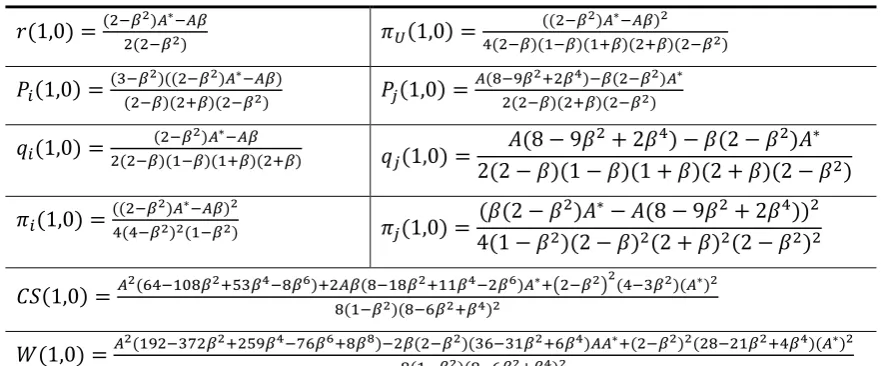
Table 2. Equilibrium outcomes without integration when only one firm adopts
𝑟(1,0) =(2−𝛽2(2−𝛽2)𝐴∗2−𝐴𝛽) 𝜋𝑈(1,0) =
((2−𝛽2)𝐴∗−𝐴𝛽)2
4(2−𝛽)(1−𝛽)(1+𝛽)(2+𝛽)(2−𝛽2)
𝑃𝑖(1,0) =(3−𝛽
2)((2−𝛽2)𝐴∗−𝐴𝛽)
(2−𝛽)(2+𝛽)(2−𝛽2) 𝑃𝑗(1,0) =
𝐴(8−9𝛽2+2𝛽4)−𝛽(2−𝛽2)𝐴∗
2(2−𝛽)(2+𝛽)(2−𝛽2)
𝑞𝑖(1,0) = (2−𝛽
2)𝐴∗−𝐴𝛽
2(2−𝛽)(1−𝛽)(1+𝛽)(2+𝛽) 𝑞𝑗(1,0) = 𝐴(8 − 9𝛽
2+ 2𝛽4) − 𝛽(2 − 𝛽2)𝐴∗
2(2 − 𝛽)(1 − 𝛽)(1 + 𝛽)(2 + 𝛽)(2 − 𝛽2)
𝜋𝑖(1,0) =((2−𝛽
2)𝐴∗−𝐴𝛽)2
4(4−𝛽2)2(1−𝛽2) 𝜋𝑗(1,0) = (𝛽(2 − 𝛽
2)𝐴∗− 𝐴(8 − 9𝛽2+ 2𝛽4))2
4(1 − 𝛽2)(2 − 𝛽)2(2 + 𝛽)2(2 − 𝛽2)2
𝐶𝑆(1,0) =𝐴2(64−108𝛽2+53𝛽4−8𝛽6)+2𝐴𝛽(8−18𝛽8(1−𝛽2)(8−6𝛽2+11𝛽2+𝛽4−2𝛽4)2 6)𝐴∗+(2−𝛽2)2(4−3𝛽2)(𝐴∗)2
𝑊(1,0) =𝐴2(192−372𝛽2+259𝛽4−76𝛽6+8𝛽8)−2𝛽(2−𝛽8(1−𝛽22)(8−6𝛽)(36−31𝛽2+𝛽2+6𝛽4)2 4)𝐴𝐴∗+(2−𝛽2)2(28−21𝛽2+4𝛽4)(𝐴∗)2
3-2-3 The subgame in which both firms adopt the high quality input
Suppose that both firms adopt the high quality input. By substituting 𝐴𝑖 = 𝐴𝑗 = 𝐴∗ and 𝑐
𝑖 = 𝑐𝑗 = 𝑟 into (4), we obtain the following profit of firm U:
𝜋𝑈 = 𝑟(𝑞𝑖 + 𝑞𝑗) = 2𝑟(𝐴
∗−𝑟)
[image:9.595.77.521.398.581.2]9
The first-order condition provides the equilibrium input price. We obtain the
[image:10.595.82.518.157.303.2]equilibri-um outcomes shown in Table 3.
Table 3. Equilibrium outcomes without integration when both firms adopt
𝑟(1,1) =𝐴2∗ 𝜋𝑈(1,1) = (𝐴
∗)2
2(2 − 𝛽)(1 + 𝛽)
𝑃𝑖(1,1) =(3 − 2𝛽)𝐴 ∗
2(2 − 𝛽) 𝑞𝑖(1,1) =
𝐴∗
2(2 − 𝛽)(1 + 𝛽)
𝜋𝑖(1,1) = (1 − 𝛽)(𝐴 ∗)2
4(2 − 𝛽)2(1 + 𝛽) 𝐶𝑆(1,1) =
(𝐴∗)2
4(2 − 𝛽)2(1 + 𝛽)
𝑊(1,1) =4(2 − 𝛽)(7 − 4𝛽)(𝐴2(1 + 𝛽)∗)2
3-3 First-stage choice
We discuss the first stage in which downstream firms simultaneously choose whether to commit to adopt the high quality input. We have the following lemma.
Lemma 1. Define 𝐴𝜋(1,0) =𝐴(4−𝛽−2𝛽
2)
2−𝛽2 and 𝐴𝜋(1,1) =
𝐴(8−9𝛽2+2𝛽4)
(2−𝛽2)2 . Then,
𝐴𝜋(1,0) < 𝐴𝜋(1,1). In equilibrium, (i) no firm adopts the high quality input if 𝐴∗ ≦ 𝐴𝜋(1,0), (ii) only one firm adopts the high quality input if 𝐴𝜋(1,0) ≦ 𝐴∗ ≦ 𝐴𝜋(1,1),
and (iii) both firms adopt the high quality input if 𝐴𝜋(1,1) ≦ 𝐴∗.
Proof. Suppose that firm 𝑗 does not adopt the high quality input.
𝜋𝑖(1,0) − 𝜋𝑖(0,0) =((2−𝛽
2)𝐴∗−𝐴(4−𝛽−2𝛽2))(𝐴(4−𝛽(3+2𝛽))+(2−𝛽2)𝐴∗)
4(4−𝛽2)2(1−𝛽2) > 0 if and only if
𝐴∗ > 𝐴
𝜋(1,0) =𝐴(4−𝛽−2𝛽
2)
2−𝛽2 . This implies (i).
Suppose that firm 𝑗 adopts the high quality input.
𝜋𝑖(1,1) − 𝜋𝑖(0,1) =(2−𝛽
2)3(2−𝛽(2+𝛽))(𝐴∗)2+2𝛽(2−𝛽2)(8−9𝛽2+2𝛽4)𝐴𝐴∗−(8−9𝛽2+2𝛽4)2𝐴2
4(1−𝛽2)(8−6𝛽2+𝛽4)2 > 0
if and only if 𝐴∗ > 𝐴
𝜋(1,1) =𝐴(8−9𝛽
2+2𝛽4)
(2−𝛽2)2 . This implies (iii).
10
Lemma 1 is intuitive. If the demand-enhancing effect is sufficiently large, both firms
adopt the high quality input. If it is sufficiently small, no firm chooses the high quality input. If it is intermediate, only one firm adopts the high quality input.
Next, we compare the profit of each downstream firm when only one firm adopts the high quality input.
Lemma 2. 𝜋𝑖(1,0) > 𝜋𝑗(1,0) if 𝐴∗ > 𝐴𝜋(1,0).
Proof. 𝜋𝑖(1,0) − 𝜋𝑗(1,0) =(2−𝛽
2)2(𝐴∗)2+2𝛽(2−𝛽2)𝐴𝐴∗−(4+𝛽−2𝛽2)(4−𝛽−2𝛽2)𝐴2
4(4−𝛽2)(2−𝛽2)2 > 0 if and
only if 𝐴∗ > 𝐴(4−𝛽−2𝛽2)
2−𝛽2 = 𝐴𝜋(1,0). Q.E.D.
Lemma 2 states that if only one firm adopts the high quality input in equilibrium, the firm adopting it obtains greater profits than its rival. The adoption of the high quality input increases the firm’s profit directly by expanding demand. The change in the de-mand parameter directly reduces the rival’s dede-mand and thus reduces its profit. However, the adoption of the high quality input raises the price of the firm and this increases the profit of its rival indirectly. The former direct effect dominates the latter effect and the adoption of the high quality input thus reduces the rival’s profit. This leads to Lemma 2. Note that given that the rival does not adopt the high quality input, a firm adopts the high quality input only if it increases its own profit.
This result has another implication. Instead of simultaneous choice in the model, if firms sequentially choose whether to adopt the high quality input, the leader chooses the high quality input when 𝐴𝜋(1,0) ≦ 𝐴∗ ≦ 𝐴𝜋(1,1). Thus, there is a first-mover
ad-vantage in adopting the high quality input.
We now discuss welfare. The welfare gain of the high quality input is caused by the increase in consumer value. However, because the market of the high quality input is less competitive than the perfectively competitive standard input market, adopting the high quality input raises the price. This yields a welfare loss.
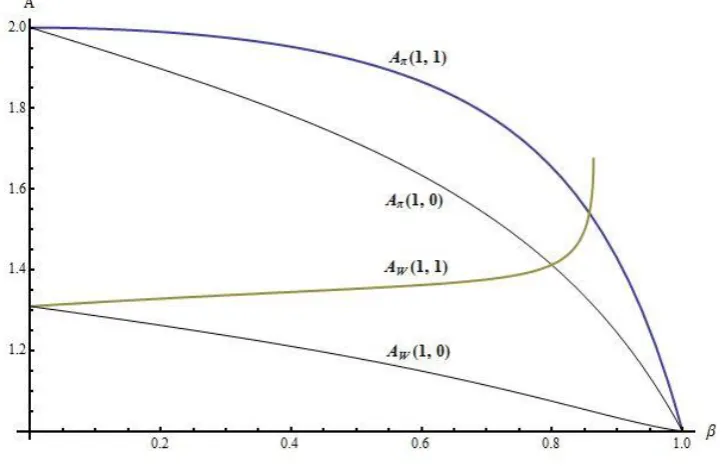
11 𝐴𝑊(1,0) = 𝐴𝛽(36−31𝛽
2+6𝛽4)+2(1−𝛽)(2+𝛽)√(2+𝛽)(2−𝛽2)(84−𝛽(70+𝛽(62−𝛽(53+8(1−𝛽)𝛽))))
(2−𝛽2)(28−21𝛽2+4𝛽4) and 𝐴𝑊(1,1) =
𝐴(2+𝛽)√2(1−𝛽)(672−𝛽(768+𝛽(1140−𝛽(1320+𝛽(653−2𝛽(398+𝛽(69−𝛽(97+4𝛽−8𝛽(2−𝛽2)(28−𝛽(32+𝛽(21−2𝛽(5+2𝛽)))) 2))))))))−𝛽(36−31𝛽2+6𝛽4)
Then, 𝐴𝑊(1,0) < 𝐴𝑊(1,1). We obtain the following lemma.
Lemma 3. ) 1 , 1 ( if ) 1 , 1 ( ) 0 , 1 ( if ) 0 , 1 ( if ) 1 , 1 ( ) 0 , 1 ( ) 0 , 0 ( )} 1 , 1 ( ), 0 , 1 ( ), 0 , 0 ( max{ * * * A A A A A A A W W W W W W W W W W .
Proof. 𝑊(1,0)><𝑊(0,0) ⟺ 𝐴∗ >
<𝐴𝑊(1,0) and 𝑊(1,1) >
<𝑊(1,0) ⟺ 𝐴∗ ><𝐴𝑊(1,1).
These yield 𝐴 < 𝐴𝑊(1,0) < 𝐴𝑊(1,1). Q.E.D.
Lemma 3 is intuitive. When the value-added effect of the high quality input is
suffi-ciently small (large), adopting the high quality input is harmful (beneficial) for social welfare because the higher prices (quality) induced by the less competitive (more valua-ble) procurement reduces (increases) the consumer surplus. If this effect is intermediate, the welfare-enhancing effect of the high quality input exists but it is weak. Therefore,
one firm’s adoption of the high quality input improves (reduces) welfare given that the rival does not (does) adopt the high quality input.
We now discuss whether the private incentive to adopt the high quality input is exces-sive or insufficient from the welfare viewpoint.
Proposition 1. (i) 𝐴𝑊(1,0) < 𝐴𝜋(1,0). (ii) Both 𝐴𝑊(1,1) > 𝐴𝜋(1,1) and 𝐴𝑊(1,1) < 𝐴𝜋(1,1) are possible.
Proof
(i) 𝐴𝜋(1,0) − 𝐴𝑊(1,0) =(2−𝛽2)2(28−21𝛽2𝐴 2+4𝛽4)(𝐵 − √𝐶), where 𝐵 = (7 − 11𝛽 + 4𝛽2)(4 + 2𝛽 − 2𝛽2 − 𝛽3)2 > 0 and
𝐶 = (1 − 𝛽)2(4 + 2𝛽 − 2𝛽2− 𝛽3)3(84 − 70𝛽 − 62𝛽2+ 53𝛽3+ 8𝛽4− 8𝛽5) > 0. Because
𝐵2− 𝐶 = 2(1 − 𝛽)2(2 + 𝛽)3(2 − 𝛽2)3((2 − 𝛽)(28 − 21𝛽2+ 4𝛽4)) > 0, we obtain (i).
12
Fig. 1. Comparisons of the thresholds without integration
Q.E.D.
Lemmas 1–3 and Proposition 1(i) imply that, starting from the situation in which no firm adopts the high quality input, the private incentive to adopt the high quality input by a downstream firm is insufficient from the welfare viewpoint. Adopting the high quality input increases product value, which raises the consumer surplus as well as the profit of the upstream firm. However, a downstream firm does not take account of these effects when it chooses the high quality input. This yields the insufficient adoption of the high quality input.
Lemmas 1–3 and Proposition 1(ii) imply that, starting from the situation in which on-ly one firm adopts the high quality input, the private incentive for the additional adop-tion of the high quality input by another firm may be insufficient or excessive from the welfare viewpoint. The adoption of the high quality input by firm 2 reduces firm 1’s profit. Because of this business-stealing effect, the incentive can be excessive.9
We have thus far examined the case in which the superior input is supplied by the in-dependent firm. However, such an input may be produced in house by downstream firms. In the next section, we discuss the case in which one downstream firm produces
13
such an input and the other downstream firm chooses whether to purchase the input from the rival.
4. The Equilibrium with Integration
In this section, we consider the case in which one of the downstream firms, rather than an independent input supplier, produces the high quality input in house. This corre-sponds to the situation in which firm 1 merges with firm U.
The game runs as follows. In the first stage, firm 1 chooses whether it sells the high quality input to firm 2. In the second stage, firm 2 chooses whether to adopt the high quality input. In the third stage, firm 1 chooses the price of high quality input r. In the fourth stage, firms face price competition.
It is obvious that firm 1 adopts the high quality input because 𝐴∗ > 𝐴. It is also
obvi-ous that in the first stage, firm 1 offers the high quality input to firm 2.10 Thus, it is
suf-ficient to discuss the following two situations. One is the case in which firm 2 does not adopt the high quality input (and thus only firm 1 adopts the high quality input) and the other is the case in which firm 2 adopts the high quality input (and thus both firms adopt the high quality input). Let the superscript M represent the integration case (i.e., firms U and 1 merge).
4-1 The subgame in which only firm 1 adopts the high quality input
By substituting 𝐴1 = 𝐴∗, 𝐴2 = 𝐴, 𝑐1 = 𝑐2 = 0 into (4), we obtain the equilibrium
[image:14.595.78.523.564.624.2]prices and quantities including profits and social welfare shown in Table 4.11
Table 4. Equilibrium outcomes with integration when only firm 1 adopts
𝑃1𝑀(1,0) =(2−𝛽
2)𝐴∗−𝐴𝛽
4−𝛽2 𝑃2𝑀(1,0) =
𝐴(2−𝛽2)−𝛽𝐴∗
4−𝛽2
𝑞1𝑀(1,0) = (2−𝛽
2)𝐴∗−𝐴𝛽
(2−𝛽)(1−𝛽)(1+𝛽)(2+𝛽) 𝑞2𝑀(1,0) =
𝐴(2−𝛽2)−𝛽𝐴∗ (2−𝛽)(1−𝛽)(1+𝛽)(2+𝛽)
10 This is because firm 1 can offer a sufficiently high price in the third stage. If firm 2 expects firm 1 to
set such a high price, it never chooses to adopt the high quality input.
11 The first digit in the bracket indicates the decision of firm 1 on the adoption of the high quality input
and the second digit indicates the decision of firm 2 on the adoption of the high quality input. That is,
14
𝜋1𝑀(1,0) =((2−𝛽
2)𝐴∗−𝐴𝛽)2
(4−𝛽2)2(1−𝛽2) 𝜋2𝑀(1,0) =
(𝐴(2−𝛽2)−𝛽𝐴∗)2
(4−𝛽2)2(1−𝛽2)
𝐶𝑆𝑀(1,0) =𝐴2(4−3𝛽2)−2𝐴𝛽3𝐴∗+(4−3𝛽2)(𝐴∗)2 2(4−𝛽2)2(1−𝛽2)
𝑊𝑀(1,0) =(12−9𝛽2+2𝛽4)(𝐴∗)2−2𝛽(8−3𝛽2)𝐴𝐴∗+(12−9𝛽2+2𝛽4)𝐴2 2(4−𝛽2)2(1−𝛽2)
4-2. The subgame in which both firms adopt the high quality input
In this case, 𝐴1 = 𝐴2 = 𝐴∗. The profit functions of both firms are as follows:
𝜋1𝑀 = 𝑃1𝑞1+ 𝑟𝑞2 =𝑟((1−𝛽)𝐴
∗−𝑃2)+𝑃1(𝑟𝛽+𝛽𝑃2+𝐴∗(1−𝛽))−𝑃 12
1−𝛽2 (7)
𝜋2𝑀 = (𝑃2− 𝑟)𝑞2 = (𝑃2−𝑟)(𝛽𝑃1−𝑃2+𝐴
∗(1−𝛽))
1−𝛽2 (8)
The first-order conditions provide the following equilibrium outcomes in the fourth
stage:
𝑃1𝑀(1,1) =(1−𝛽)(2+𝛽)𝐴
∗+3𝑟𝛽
4−𝛽2 (9)
𝑃2𝑀(1,1) =(1−𝛽)(2+𝛽)𝐴
∗+𝑟(2+𝛽2)
4−𝛽2 (10)
𝑞1𝑀(1,1) =(2+𝛽)𝐴
∗−𝑟𝛽(1+𝛽)
(1+𝛽)(4−𝛽2) (11)
𝑞2𝑀(1,1) =(2+𝛽)𝐴
∗−2𝑟(1+𝛽)
(1+𝛽)(4−𝛽2) (12)
In the third stage, firm 1 chooses the high quality input price r. Its profit is
𝜋1 =(1−𝛽)(2+𝛽)
2(𝐴∗)2−𝑟2(1+𝛽)(8+𝛽2)+𝑟(1+𝛽)(2+𝛽)(4−2𝛽+𝛽2)𝐴∗
(1+𝛽)(4−𝛽2)2 (13)
The first-order condition provides the equilibrium input price. Thus, we obtain the
[image:15.595.77.526.667.731.2]equi-librium outcomes in the third stage shown in Table 5.
Table 5. Equilibrium outcomes with integration when both firms adopt
𝑟𝑀(1,1) =(8+𝛽3)𝐴∗ 2(8+𝛽2)
𝑃1𝑀(1,1) =(4−𝛽)(2+𝛽)𝐴
∗
2(8+𝛽2) 𝑃2𝑀(1,1) =
(12−𝛽(4−(2−𝛽)𝛽))𝐴∗
15
𝑞1𝑀(1,1) =(8+𝛽(2+𝛽+𝛽
2))𝐴∗
2(1+𝛽)(8+𝛽2) 𝑞2𝑀(1,1) =
(2+𝛽2)𝐴∗
(1+𝛽)(8+𝛽2)
𝜋1𝑀(1,1) =(12+𝛽(4+𝛽+𝛽
2))(𝐴∗)2
4(1+𝛽)(8+𝛽2) 𝜋2𝑀(1,1) =
(1−𝛽)(2+𝛽2)2(𝐴∗)2
(1+𝛽)(8+𝛽2)2
𝐶𝑆𝑀(1,1) =(80+16𝛽+36𝛽2+24𝛽3+𝛽4+5𝛽5)(𝐴∗)2 8(1+𝛽)(8+𝛽2)2
𝑊𝑀(1,1) =(304+𝛽(48+𝛽(108+𝛽(16+(11−𝛽)𝛽))))(𝐴∗)2 8(1+𝛽)(8+𝛽2)2
4-3 Firm 2’s decisions on the adoption of the high quality input
We now discuss whether firm 2 adopts the high quality input in the second stage. We obtain the following lemma.
Lemma 4. Firm 2 adopts the high quality input if and only if 𝐴∗ > 𝐴
𝜋𝑀(1,1), where
𝐴𝜋𝑀(1,1) = 𝐴(2−𝛽
2)(8+𝛽2)
8+𝛽2(2−𝛽(1+(1−𝛽)𝛽)).
Proof. We obtain 𝜋2𝑀(1,1) − 𝜋2𝑀(1,0) =(1−𝛽2)(32−4𝛽𝐷𝐸 2−𝛽4)2
where 𝐷 = (8 + 𝛽2(2 − 𝛽(1 + (1 − 𝛽)𝛽)))𝐴∗− 𝐴(2 − 𝛽2)(8 + 𝛽2) and 𝐸 = 𝐴(2 − 𝛽2)(8 + 𝛽2) − (𝛽(16 + (2 − 𝛽)𝛽(𝛽 + 𝛽2− 1)) − 8)𝐴∗. 𝐷 > 0 if and only if 𝐴∗ > 𝐴(2−𝛽2)(8+𝛽2)
8+𝛽2(2−𝛽(1+(1−𝛽)𝛽))= 𝐴𝜋𝑀(1,1) and 𝐸 > 0 if and only if
𝐴∗ < 𝐴(2−𝛽2)(8+𝛽2)
𝛽(16+(2−𝛽)𝛽(𝛽+𝛽2−1))−8. Note that 𝐴̅ <
𝐴(2−𝛽2)(8+𝛽2)
𝛽(16+(2−𝛽)𝛽(𝛽+𝛽2−1))−8, which is sufficient to prove the result. Q.E.D.
Lemma 4 is again intuitive. When the market expansion effect of the high quality in-put is strong, firm 2 also adopts the high quality inin-put.
We obtain a similar result on the welfare consequences of firm 2’s adoption of the high quality input under integration. This is beneficial (harmful) for welfare if 𝐴∗ is
sufficiently large (small).
Lemma 5. There exists 𝐴𝑊𝑀(1,0) > 𝐴𝑊𝑀(0,0) > 0 such that (i) if 𝐴∗ ><𝐴𝑊𝑀(0,0),
then 𝑊𝑀(1,1)>
<𝑊(0,0) and (ii) if 𝐴∗ ><𝐴𝑊
𝑀(1,0), then 𝑊𝑀(1,1)>
16
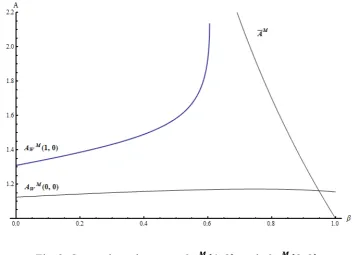
Proof. Fig. 2 shows that 𝐴𝑊𝑀(1,0) > 𝐴𝑊𝑀(0,0) > 0 for 𝛽 ∈ (0,1), in which 𝐴𝑊𝑀(1,0) denotes the threshold between 𝑊𝑀(1,1) and 𝑊𝑀(1,0) and 𝐴𝑊𝑀(0,0)
[image:17.595.117.470.165.420.2]denotes the threshold between 𝑊𝑀(1,1) and 𝑊(0,0).
Fig. 2. Comparisons between 𝑨𝑾𝑴(𝟏, 𝟎) and 𝑨𝑾𝑴(𝟎, 𝟎)
Q.E.D.
5. Comparisons
We now discuss whether vertical integration enhances the unintegrated firm’s adoption of the high quality input. Counterintuitively, Proposition 2 states that integration accel-erates the rival’s adoption of the high quality input.
Proposition 2. 𝐴𝜋(1,1) > 𝐴𝜋𝑀(1,1).
Proof. 𝐴𝜋(1,1) − 𝐴𝜋𝑀(1,1) =𝛽
2(1−𝛽)(1+𝛽)(2+𝛽)(16−12𝛽−𝛽2+5𝛽3−2𝛽4)
(2−𝛽2)2(8+2𝛽2−𝛽3−𝛽4+𝛽5) > 0. Q.E.D. Proposition 2 implies that if both firms adopt the high quality input in the non
17
downstream firm has a stronger incentive to adopt the high quality input under integra-tion may thus be counterintuitive. We therefore explain the intuiintegra-tion behind this result.
Under integration, when firm 2 adopts the high quality input, firm 1 obtains the reve-nue from firm 2 that is proportional to firm 2’s output given r. A higher final product price set by firm 1 raises the output of firm 2, resulting in an increase in firm 1’s reve-nue from inputs. Therefore, firm 1 has a stronger incentive to raise its final product price when firm 2 adopts the high quality input. In other words, the adoption of the high quality input by firm 2 mitigates competition in the downstream market. Thus, the weaker competition caused by firm 2’s adoption of the high quality input increases its profit. Therefore, firm 2 has a stronger incentive to adopt the high quality input under integration.
However, this does not imply that vertical integration is beneficial for firm 2. Integra-tion reduces the marginal cost of firm 1 because it eliminates the double marginalizaIntegra-tion problem between firms U and 1. This induces stronger pricing by firm 1, which reduces firm 2’s profit. Proposition 3 states that firm 2 obtains smaller profits under integration.
Proposition 3. Firm 2 always obtains smaller profits under integration compared with non-integration.
Proof. We have to consider the eight adoption combinations between the integration and non-integration cases.
(i) Suppose that both firms adopt the high quality input without integration. Then, from Proposition 2, both adopt the high quality input with integration, too. Therefore, we ob-tain
𝜋2(1,1) − 𝜋2𝑀(1,1) = (1−𝛽)𝛽(4−3𝛽+2𝛽
2)(16−4𝛽+5𝛽2−2𝛽3)(𝐴∗)2
4(2−𝛽)2(1+𝛽)(8+𝛽2)2 > 0
(ii) Suppose that only firm 1 adopts the high quality input with and without integration. This happens only when 𝐴∗ < 𝐴
𝜋𝑀(1,1). Then, we have 𝜋2𝑀(1,0) > 𝜋2(1,0) if
and only if 𝐴∗ >𝐴(16−17𝛽2+4𝛽4)
6𝛽−3𝛽3 . Because
𝐴(16−17𝛽2+4𝛽4)
18
(iii) Suppose that only firm 1 adopts the high quality input with integration and both adopt the high quality input without integration. This contradicts Proposition 2 and thus it never takes place.
(iv) Suppose that both firms adopt the high quality input with integration but only firm 1 adopts the high quality input without integration. This happens only when 𝐴∗ >
𝐴𝜋(1,1). We obtain 𝜋2𝑀(1,1) > 𝜋2(1,0) if and only if 𝐴∗ > 𝐴(8+𝛽2)(8−9𝛽2+2𝛽4)
(2−𝛽2)(16−𝛽(8−𝛽(4−𝛽(3+2(1−𝛽)𝛽)))). Because
𝐴(8+𝛽2)(8−9𝛽2+2𝛽4)
(2−𝛽2)(16−𝛽(8−𝛽(4−𝛽(3+2(1−𝛽)𝛽))))>
𝐴𝜋(1,1), 𝜋2𝑀(1,1) > 𝜋2(1,0) never holds in this case.
(v) Suppose that only firm 2 adopts the high quality input without integration and only firm 1 adopts the high quality input with integration. As we showed in Lemma 2, in the non-integration case, the firm that does not adopt the high quality input obtains smaller
profits. In addition, firm 1’s marginal cost is lower under integration. Both effects re-duce firm 2’s profit, while there is no effect of increasing firm 2’s profit. Therefore, firm 2’s profit is smaller with integration.
(vi) Suppose that only firm 2 adopts the high quality input without integration and both firms adopt the high quality input with integration. Then, firm 2 earns a larger profit than that when only firm 1 adopts the high quality input without integration from Lem-ma 2. We also showed in (iv) that integration reduces firm 2’s profit even when only firm 1 adopts the high quality input without integration. These two facts imply that inte-gration reduces firm 2’s profit in this case, too.
(vii) Suppose that no firm adopts the high quality input without integration and only firm 1 adopts the high quality input with integration. The adoption of the high quality input by firm 1 reduces firm 2’s profit and vertical integration reduces firm 1’s cost, which makes firm 1 stronger. Both effects reduce firm 2’s profit, while there is no effect of increasing firm 2’s profit. Therefore, firm 2’s profit is smaller with integration.
(viii) Suppose that no firm adopts the high quality input without integration and both firms adopt the high quality input with integration. This happens only when 𝐴∗ <
𝐴𝜋(1,0). 𝜋2𝑀(1,1) > 𝜋2(0,0) if and only if 𝐴∗ > 𝐴(8+𝛽
2)
4−2𝛽+2𝛽2−𝛽3. Because
𝐴(8+𝛽2)
19
Integration increases the joint profits of firms U and 1. The merged firm’s profit can increase through two channels. First, the merged firm internalizes the problem of double marginalization between the upstream and downstream firms (firm U and firm 1). Sec-ond, as shown in Proposition 2, vertical integration induces the rival to adopt the new inputs, and integration induces weaker price competition when both firms adopt the new inputs. This collusive effect increases the profit of firm 1.12
Because this collusive effect harms consumer welfare, integration involves a trade-off
in welfare. On one hand, it mitigates the double marginalization problem between firm U and 1. On the other hand, it enhances the adoption of the new input by firm 2 and this makes the market less competitive. It is ambiguous whether the former welfare
-enhancing effect dominates the latter welfare-reducing effect.
Proposition 4 (i) Suppose that the pattern of the high quality input adoption does not change with and without integration; then, integration always improves welfare. (ii) When integration encourages firm 2’s adoption of the high quality input, integration may harm welfare.
Proof (i) First, suppose that both firms adopt the high quality input with and without integration. Then, we obtain
𝑊𝑀(1,1) − 𝑊(1,1)
=(1 − 𝛽)(320 − 192𝛽 + 128𝛽8(2 − 𝛽)22(1 + 𝛽)(8 + 𝛽− 64𝛽3+ 10𝛽2)42− 14𝛽5+ 𝛽6)(𝐴∗)2
> 0
Second, suppose that only firm 1 adopts the high quality input with and without integra-tion. This happens only when 𝐴𝜋(1,0) ≦ 𝐴∗. Then, we have 𝑊𝑀(1,0) > 𝑊(1,0) if
and only if 𝐴∗ > 𝐴𝛽(36−35𝛽2+8𝛽4)
(2−𝛽2)(20−15𝛽2+4𝛽4). Because 𝐴𝜋(1,0) >
𝐴𝛽(36−35𝛽2+8𝛽4)
(2−𝛽2)(20−15𝛽2+4𝛽4), we can show that this always holds.
12 This anti
-competitive effect appears even under passive vertical integration in which downstream
20
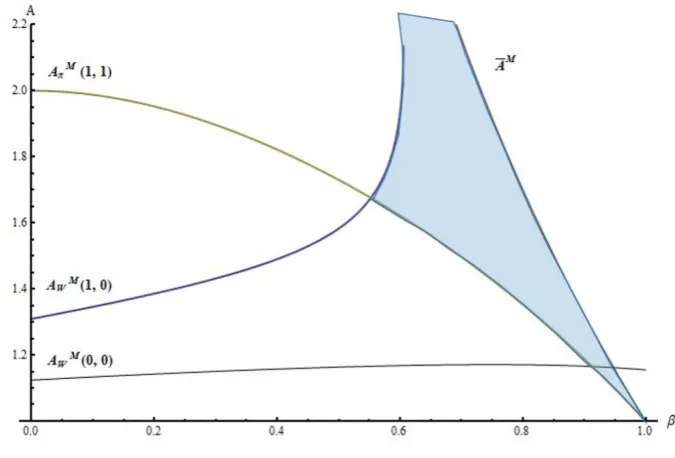
(ii) Fig. 3 shows that 𝐴𝑊𝑀(1,0) > 𝐴𝜋𝑀(1,0)(= 𝐴) and 𝐴𝑊𝑀(0,0) > 𝐴𝜋𝑀(1,1) are
[image:21.595.124.462.140.369.2]possible.
Fig. 3. Comparisons of the thresholds with integration
Q.E.D.
Proposition 4(i) states that under the same pattern of the high quality input adoption, the welfare-improving effect (from eliminating double marginalization) dominates the
welfare-reducing effect (inducing implicit collusion). Thus, although both firms’
adop-tion of the high quality input induces weaker price competiadop-tion, it is socially desirable. However, Proposition 4(ii) states that if integration changes the pattern of the high quality input adoption, this might reduce welfare. In particular, Fig. 3 shows that if ver-tical integration induces firm 2 to newly adopt the high quality input, it will be harmful to welfare when both A and 𝛽 are high (the shaded area in Fig. 3).
6. Conclusion
21
quality input is ambiguous. These results suggest that the first adopter of a new high quality input should be promoted, whereas the second adopter might not be.
Next, we investigate the case in which one downstream firm and the high quality in-put supplier merge. We find that integration enhances the adoption of the high quality input by the rival. This is because a firm’s adoption of the inputs produced by the rival firm induces the rival’s higher price in the downstream market, which increases its prof-it. Although integration enhances the adoption of the high quality input, it may be harm-ful for welfare because of the weaker competition in the final product market.
Finally, we discuss future research directions. A simplified model with a monopolistic high quality input provider and duopolistic competition in the downstream market should be further examined. For example, incorporating the competition effect into the input market with different production technologies would be an interesting topic for future research. We also assumed that the high quality input increases product value in a perfectly asymmetric way. If another channel can induce consumers’ preferences to change, however, this imperfection of asymmetric effectsamong firms may yield differ-ent implications. Finally, we need to generalize the hold-up problem with high quality
procurement into a multi-period or dynamic model. Nevertheless, this study provides a
22 References
Allain, M.-L., Chambolle, C., and Rey, P. 2016. Vertical integration as a source of hold
-up. Review of Economic Studies 83(1), 1–25.
Flath, D. 1989. Vertical integration by means of shareholding interlocks. International Journal of Industrial Organization 7(3), 369–380.
Greenlee, P., Raskovich, A. 2006. Partial vertical ownership. European Economic Re-view 50(4), 1017–1041.
Harbour, P. J. and Koslov, T. I. 2010. Section 2 in a Web2.0 World: An Expanded vision of relevant product markets. Antitrust Law Journal 76(3), 769-797.
Hunold, M., Stahl, K. 2016. Passive vertical integration and strategic delegation. RAND Journal of Economics 47(4), 891-913.
Kamien, M., Tauman, Y. 1986. Fees versus royalties and the private value of a patent.
Quarterly Journal of Economics, 101, 471-491.
Katz, M., Shapiro, C. 1986. How to license intangible property. Quarterly Journal of Economics 101, 567-590.
Kitamura, H., 2010. Exclusionary vertical contracts with multiple entrants. Internation-al JournInternation-al of IndustriInternation-al Organization 28(3), 213–219.
Kitamura, H., Matsushima, N. and Sato, M., 2017. Exclusive contracts and bargaining power. Economics Letters 151, 1-3.
Kitzmueller, M. and Shimshack, J. 2012. Economic perspectives on corporate social responsibility. Journal of Economic Literature 50(1), 51-84.
Liu, C.C., Wang, L.F.S. and Lee, S.H. 2015. Strategic environmental corporate social responsibility in a differentiated duopoly market. Economics Letters 129, 108-111. Mankiw, N. G. and Whinston, M. D. 1986. Free entry and social inefficiency. RAND
Journal of Economics 17(1), 48-58.
Manasakis, C., Mitrokostas, E., and Petrakis, E. 2013. Certification of Corporate Social
Responsibility Activities in Oligopolistic Markets, Canadian Journal of Economics
46(1), 282-309.
Manasakis, C., Mitrokostas, E., and Petrakis, E. 2014. Strategic corporate social
respon-sibility activities and corporate governance in imperfectly competitive markets,
23
Matsushima, N. and Pan, C. 2016. Strategic perils of outsourcing: sourcing strategy and
product positioning. ISER Discussion Paper No. 983
Ordover, A.J., Saloner, G., and Salop, S. C. 1990. Equilibrium vertical foreclosure.
American Economic Review 80(1), 127-142.
Rasmusen, E.B., Ramseyer, J. M. and Wiley, J. S. Jr., 1991. Naked exclusion. American
Economic Review 81(5), 1137-1145.
Sappington, D.E.M. 2005. On the irrelevance of input prices for make-or-buy decisions.
American Economic Review 95(5), 1631-1638.
Salinger, M.A. 1988. Vertical mergers and market foreclosure. Quarterly Journal of
Economics103(2), 345-356.
Schreck, P. 2011. Reviewing the business case for corporate social responsibility: new
evidence and analysis. Journal of Business Ethics 103(2), 167-188.