Implicit Role Linking on Chinese Discourse:
Exploiting Explicit Roles and Frame-to-Frame Relations
Ru Li1,2, Juan Wu1, Zhiqiang Wang1 and Qinghua Chai3 1School of Computer and Information Technology
2Key Laboratory of Ministry of Education for Computation Intelligence and Chinese Information Processing 3School of Foreign Languages, Shanxi University, Taiyuan, China
{liru,charles}@sxu.edu.cn, {wujuan_0922,zhiq.wang}@163.com
Abstract
There is a growing interest in research-ing null instantiations, which are those implicit semantic arguments. Many of these implicit arguments can be linked to referents in context, and their discoveries are of great benefits to semantic process-ing. We address the issue of automat-ically identifying and resolving implicit arguments in Chinese discourse. For their resolutions, we present an approach that combines the information about overtly la-beled arguments and frame-to-frame rela-tions defined by FrameNet. Experimental results on our created corpus demonstrate the effectiveness of our approach.
1 Introduction
In natural discourse, only a small proportion of the theoretically possible semantic arguments of predicates tend to be locally instantiated. Other locally unrealized semantic roles are called null instantiations(NIs). Nevertheless, many of these implicit roles, while linguistically unexpressed, can often be bound to antecedent referents in the discourse context. What’s more, capturing such implicit semantic roles and linking them to their antecedents can dramatically help text understanding.
Example (1) shows an analyzed result (Li, 2012) by employing Chinese FrameNet (Liu, 2011), which is a lexical semantic knowledge base based on the frame semantics of Fillmore (1982) and takes Berkeley’s FrameNet Project (Baker et al., 1998) as the reference. In Chinese FrameNet, the predicates, called lexical units (LU), evoke frames which roughly correspond to different events or scenarios. Each frame defines a set of arguments called Frame Elements (FE). The set of FEs is further split into core FEs and non-core
FEs. Particularly, the core FEs are the essential components of a frame and can be defined by themselves. However, not all core FEs of a frame can be realized simultaneously in a sentence. These non-instantiated FEs are considered asnull instantiations of the frame elements. Depending on the interpretation type of the omission, Chinese FrameNet divides the NIs into two categories: 1) Indefinite Null Instantiations (INIs), the missing element which can be understood given interpre-tational conventions and do not need resolution, and 2) Definite Null Instantiations (DNIs), the missing element which is something that can be understood in the linguistic or discourse context, and the fillers need to be inferred from the context through resolutions.
(1) [U:¥(]Entity•´´´áááuuu,,,aaa[<E¥(]Category,Ú ¥(!Ï&¥(!í–¥( Óá˜a" [The celestial burial satellite]EntityisBeing_in_category [artificial satellite]Category, and belongs to the same category with reconnaissance, communications and meteorological satellite.
ØÓ ´^åˆÉ§´;€^5•˜ •Ý ¶pÝ
½ØÓ§˜„uuu ¦¦¦ £££[ å/¥L¡3000õúp? ‚¥; þ]Goal"[ThemeDNI] [AgentINI]
The purpose is different, specially used for storing the urn; due to the different heights, generally
launchedCause_motion into [the orbit over 3000 kilo-meters away from the surface of earth]Goal. [Theme DNI] [AgentINI]
Particularly, in example (1), lexical unit (or target) launched/u evokes the semantic frame Cause_motion, which has nine core FEs, namely Agent, Theme, Source, Path, Goal, Area,
Cause,Result,Initial_State, but only one of them is instantiated, i.e. Goal, whose filler is [the orbit over 3000 kilometers away from the surface of earth/ å/¥L¡3000õúp? ‚¥; þ]. For another core FE Theme, it is filled by [The celestial burial satellite/U:¥(] that occurs in
the previous sentence.
Clearly, human beings have no problem to infer these uninstantiated roles and find the cor-responding fillers based on the relevant context information, but this is beyond the capacity of state-of-the-art semantic role labeling systems.
Next, we formalize the problem as follows: given a discourse D = {S1, S2, ..., Sn}, where
Sk(k∈[1, n]) is the k-th sentence in D. The
lexical unit set inSkisTk = {Tk1, Tk2, ..., Tkp},
and Fk = {Fk1, Fk2, ..., Fkp} is relevant frame
set. For a particular frameFki(i∈[1, p]), its core
FE set isEki ={e1, e2, ..., em}, but it is possible
that only part of core FEs Cki appears in Sk,
i.e. Cki ⊆ Eki. Apparently the set Eki −Cki
includes the uninstantiated core FEs. Thus, we need to determine which elements in Eki −Cki
are null instantiations. Ifem(em∈Eki−Cki) has
been identified as a null instantiated FE, we should determine whetherem is a DNI. If so, we need to
find the corresponding antecedentdmin context.
The major contributions of this paper can be summarized as follows:
(i) We have created a null instantiation (NI) annotations corpus, consisting of 164 Chinese discourses across different fields.
(ii) We use frame-to-frame relations to find antecedents from those explicit semantic roles.
2 Related Work
Among the researches of null instantiation on English, the most representative work is the task “Linking Events and Their Participants in Discourse” shared by the SemEval-2010 (Ruppen-hofer et al., 2010). The two systems participated in the NI resolution task, VENSES++ and SE-MAFOR, took very different approaches.
Tonelli and Delmonte (2010) develop a knowledge-based system called VENSES++, and describe two strategies depending on the predicate class (either nominal or verbal). For verbal predicates, they try to map the predicate argument structure extracted by VENSES with the valence patterns generated from FrameNet data, to identify missing arguments. And NIs are resolved by reasoning about the semantic similarity between an NI and a potential filler using WordNet. For nominal predicates, they resolve NIs by utilizing a common sense reasoning module that builds on ConceptNet (Liu and Singh, 2004). The final Precision and Recall are 4.62%
and 0.86% respectively.
Later on, Tonelli and Delmonte (2011) propose a simpler role linking strategy that based on computing a relevancy score for the nominal head of each potential antecedent. The intuition is that heads which often serve as role fillers and occur close to the target NI are more likely to function as antecedents for the NI. Finally they reported an F-score of 8% for role linking. However, being strongly lexicalized, their trained model seems heavily dependent on the training data.
The second system (Chen et al., 2010) is statistical based and extends an existing semantic role labeler (Das et al., 2010). Resolving DNIs is modeled in the same way as labeling overt arguments, with the search space being extended to nouns, pronouns, and noun phrases from the previous three sentences. When evaluating a potential filler, the syntactic features used in argument labeling of overt arguments are replaced by two semantic features: firstly the system checks whether a potential filler fills the null instantiated role overtly in at least one of the FrameNet sen-tences and train data, if not, the system calculates the distributional similarity between filler and role. While this system achieved 5% in F-score, data sparseness is a potential limiting factor.
Also closely related studies are as follows. Silberer and Frank (2012) cast NI resolution as a coreference resolution (CR) task, and employ an entity-mention model. They experiment with features of SRL and CR, and automatically expand the training set with examples generated from coreference corpus to avoid data sparseness, ulti-mately achieving F-score of 7.1%.
Gorinski et al. (2013) present a weakly su-pervised approach that investigates and combines a number of linguistically motivated strategies, which consist of four basic NI resolvers that exploit different types of linguistic knowledge, and achieve F-score of 12%.
Wang et al. (2013) conduct DNI resolution on SemEval2010 task10 data. They considered the task as a classified problem, by adding new features such as the information of head word and frame to traditional features, proposed a rule to choose the best candidate words set and combination of features, achieving F-score of 14.65% finally.
used to model anaphora and coreference resolu-tion tasks to implicit argument resoluresolu-tion, and got the best results: F-score of 18%.
For nominal predicates, Gerber and Chai (2010) investigate the linking of implicit arguments using the PropBank role labeling scheme. In contrast to the SemEval task, which focuses on a verbs and nouns, their system is only applied to nouns and is restricted to 10 predicates with 120 annotated instances per predicate on average. They propose a discriminative model that selects an antecedent for an implicit role from an extended context window. The approach incorporates some aspects relating to CR that go beyond the SRL oriented SemEval systems: A candidate representation includes information about all the candidates’ coreferent mentions (determined by automatic CR), in particular their semantic roles (provid-ed by gold annotations) and WordNet synsets. Patterns of semantic associations between filler candidates and implicit roles are learned for all mentions contained in the candidate’s entity chain. They achieve an F-score of 42.3%, which is noticeably higher than those obtained on the SemEval data.
And Gerber (2011) presents an extended model that incorporates strategies suggested in Burchardt et al. (2005): using frame relations as well as coreference patterns acquired from large corpora. This model achieves an F-score of 50.3%.
Lei et al. (2013) conduct DNI identification on SemEval2010 task10 data. They adopt the method of combining rules and machine learning. Differ-ent from them, we conduct two-level idDiffer-entifying for NI detection and use more features on Chinese data. Wang et al. (2013) take noun phrases and pronoun as candidate words for DNI filler. We use several similar features with them. The differences are that 1) we take the fillers of overt instantiated FE as candidate words and 2) we use Frame-to-Frame relations. And Gerber (2011) also used frame relations. Different from them, we limit relation paths to 2.
3 Null Instantiation Detection
Now, we are ready to address the first subtask, i.e. null instantiation detection.
3.1 Frame element relations
Not all core arguments of all frames can be realized simultaneously. Some frames involve
core FEs that are mutually exclusive. In example (2), in the Amalgamation frame, there are four core FEs, namely Part_1, Part_2, Parts and
Whole, in which the first two FEs are mutually exclusive with Parts, thus formed an Excludes
relation (relation 1). At the same time, Part_1
and Part_2 are in a Requires relation (relation 2), which means that if one of these two core FEs is present, then the other must occur as well. FE Whole, the result of the Amalgamation, is only existentially bound within the discourse, annotated as NI.
CoreSet (relation 3) specifies that at least one of the set must be instantiated overtly, though more of them can also be instantiated. As shown in example (3), in the Awareness frame, the two FEs Content and Topic are in one CoreSet. AsContentis overtly realized, we considerTopic
is not annotated as NI. The frame owning this relation is complicated. Sometimes, if one FE of this set is explicit, the absence of the other FEs in the set is not annotated as NI, but sometimes it is not true.
(2) [ÎN›]P art_1 Ú[#N›]P art_2 (((ÜÜÜ(((ÜÜÜ3˜å" [WholeINI]
[The old system]P art_1and [the new system]P art_2 arecombinedAmalgamationtogether.[WholeINI] (3) [\P†]Cognizer••• ••• [\ ?Ö]Content"
[Your boss]Cognizer isawareAwareness[of your com-mitment ]Content.
3.2 Modeling Null Instantiation detection
As shown in example (1), given a frame Fki
(e.g. Cause_motion evoked by launched/u ), NI detector needs to determine whether core FEs in EFki −subEFki are missing, relying on
information about the three types of the relations among core FEs: CoreSetFki, ExcludesFki,
RequiresFki (as discussed in Section 3.1). In
Cause_motion, the core FEs Initial_State,
Goal, Path, Source and Result belong to the same CoreSet, and Goal is instantiated, thus
Initial_State, Path, Source and Result are not annotated as NIs. Meanwhile core FEsGoaland
by Lei et al. (2013) to detect NIs. As forCoreSet
relation, in particular, as long as one of the FEs in this set is expressed overtly, NIs are not annotated for the absence of the other FEs in the set. If none of CoreSet is expressed, the contextually most relevant one should be annotated as a NI. However, this is difficult for automatic detector, which inevitably introduces some false detected NIs.
Thus, we conduct a second-level identifying. To be specific, for the current lexical unit, i.e. the target word, we collect its frame element patterns from the training dataset. Frame element patterns are annotated semantic roles, which include the roles annotated as NIs. Taking lexical unit
launched/u as an example, Table 1 shows its frame element patterns in our data. Depending on this kind of patterns, we are able to filter out some false NIs effectively.
Patte1 Time AgentINI Theme GoalINI
Patte2 Agent Theme GoalINI
Table 1:Frame element patterns for the target u /launchedin our data
4 Definite Null Instantiation Identification
In this section, we focus on our second task of definite null instantiation (DNI) identification.
Before performing the implicit argument reso-lution in discourse, we have to decide which null instantiated frame elements should be selected, i.e. which null instantiations are definite. As shown in example (1) above, assuming one detected null instantiated FE in the previous step is em (e.g. Theme), we should determine whether em needs
to be filled or not, that is, we should determineem
as DNI or INI.
Num Feature names Feature Descriptions T1 Target Target predicate T2 Pos The part of speech of target T3 Frame The frame that target evokes T4 FENI NI of frame elements
[image:4.595.323.507.560.719.2]T5 FE Overtly expressed FEs
Table 2:Features description in DNI Identification We treat this issue as a classification problem, and build a binary maximum entropy model to predict the null instantiation type of em. Table
2 lists all features used for training our models. In addition, we employ some similar features that were used in Lei et al. (2013). Meanwhile, we choose to learn a SVM classifier for comparison purpose.
5 Definite Null Instantiation Resolution
In this section, we tackle the last subtask, namely definite null instantiation resolution.
5.1 Frame-to-Frame Relations
The relations of Frame-to-Frame and FE-to-FE in FrameNet, serve as important information sources, to be leveraged for DNI resolutions.
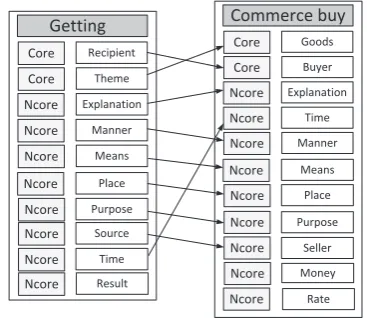
FrameNet arranges frames into a net by defining frame-to-frame relations, including Inheritance, Inchoative Of, Subframe, Causative Of, Precedes, Using, See_also and Perspective On. In the case of Inheritance relation, it defines two frames, i.e. one more general frame and the other more specific frame. The specific frame Commerce buy, for example, is inherited from the general frameGetting.
As Figure 1 shows, the inheritance relation allows a general frame (e.g., Getting) to be specialized with a particular semantic interpreta-tion (e.g.,Commerce buy). Also the inheritance relation exists between theframe elementsof two related frames. Each of the inheriting FEs contains all semantic properties of the inherited general frame elements and also owns its additional pri-vate properties.
Getting
Core Recipient
Core Theme
Ncore Explanation
Ncore Manner
Ncore Means
Ncore Place
Ncore Purpose
Ncore Source
Ncore Time
Commerce buy
Core Goods
Core Buyer
Ncore Explanation
Ncore Time
Ncore Manner
Ncore Means
Ncore Place
Ncore Purpose
Ncore Seller
[image:4.595.75.286.605.699.2]Ncore Result Ncore Money Rate Ncore
Number Features Name Features Description
F1 DistCT The number of sentences between candidate FE content and target T1 F2 CanFEcon Candidate frame element content
F3 CanFEpt The phrase type or POS of candidate frame element content F4 Frame The frame that target predicate evokes
T2 F5 FEDNI DNI frame element F6 Target Target predicate
[image:5.595.119.482.63.183.2]F7 TargetPOS The part of speech of target
Table 3:Features description in Overt Frame Elements Based Resolver
5.2 Modeling Definite Null Instantiation Resolution
After accomplishing the previous processes, we can perform DNI resolutions. If the uninstantiated FE em (e.g., Theme in example (1)) has been
identified as DNI previously, we need to find the corresponding antecedent mentiondm (e.g., [The celestial burial satellite/U:¥(] in example
(1)). Due to having fine-grained frame semantic role labeled for each sentence, we think the filler of DNI maybe also instantiates the FE of other annotated frames in the context. Therefore, we collect the overt FE content set ϕinstantiated in the discourse, and this set forms the overall set of candidates for DNI linking. Then, for DNIem, a
subset of candidatesϕm (ϕm ⊆ ϕ) is chosen as
candidate search space for resolvingem.
We implement two semantic resolvers based on different methods. For either of these two resolvers, if two or more candidates score equally well, the one closest to the target predicate is chosen.
OvertFE is based on machine learning, and FFR is an inference method. As the inherent difficulty of task, it’s difficult to find all fillers for DNIs only using one of them. Thus finally we simultaneously employ OvertFE and FFR to find as many fillers for DNIs as possible.
Overt Frame Elements Based Resolver (OvertFE)
This resolver is based on the assumption that the filler of DNI can be found among the overt FE content set in context. Given a DNI em , DNI
linking can be treated as a classification problem to judge whether a candidate overt FE content d (d ∈ ϕm) could be taken as filler of a DNI.
Therefore, we employ a classification method to solve the problem. Clearly, the performance of classifiers largely depends on constructed features. Since corresponding antecedent of DNI is not
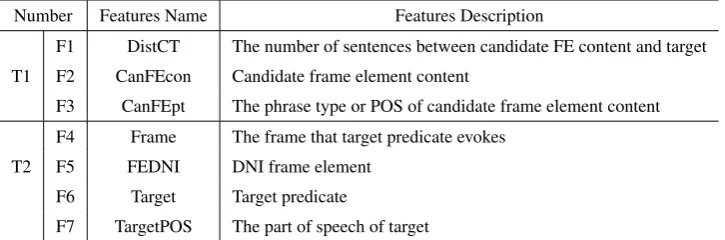
overtly expressed, it is difficult to get some information from context to describe them. What we take as features is the information of candidate frame element contents and frame information. Table 3 lists all features used for training our models. Some similar features were employed by Wang et al. (2013) where they also considered DNI linking as a classification problem.
Then maximum entropy models, widely used in natural language processing (such as Chinese word segmentation and machine translation), are employed to predict whether a candidate FE content is the filler of DNI.
Frame-to-Frame Relations Based Resolver (F-FR)
Another way of finding the correct filler is through searching Frame-to-Frame relations in a given context window. This is because Frame-to-Frame relations and FE-to-FE relations can provide rel-evant information for finding DNI filler among candidate frame element contents. Specifically, for one frame f1 that contains a DNI, firstly we
need to find related framef2with it from context.
Then, if DNI frame element inf1has relation with
the frame element (marked with fe2) of f2, the
filler offe2is the corresponding filler of this DNI.
The detailed steps are reported in Algorithm 1. If frame names are the same, we think they are related, and Figure 2 illustrates this case. As the frames evoked in two sentences are both Arriving, we link the antecedent of Goal in the second sentence to [Tiananmen Square/US €2|], which is the content of Goalin the first sentence.
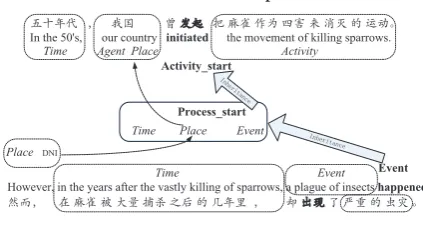
in which the two frame elements (Agent,Place) is expressed in a single constituent [our country/· I], i.e. the phenomenon of frame element fusion arises. Frame Event is evoked by the target happened/Ñy in the second sentence, where Time and Event FEs are expressed overt-ly, except the core FE Place. In the net of FrameNet, frame Activity_start inherits from the frameProcess_startwhich further inherits from theEventframe. These inheritance relationships also hold between the frame ele-ments of the related frames. According to the FE-to-FE relations, the content of FEPlacein the first sentence, [our country/·I], is the corresponding filler of implicit FEPlacein the second sentence.
Algorithm 1 : Frame-to-Frame Relations Based Resolver
Input: The frame set in discourse is F = {f1, f2, ..., fn}; overt core frame element set
for framefi isEi ={e1, e2, ..., em}, its
corre-sponding filler set isAi ={a1, a2, ..., am}; one
frame that contains DNIe∗isf∗, targettevokes the framef∗;dis(ai, t)is the distance between DNI filleraiand targett;relationpath(fi, f∗)
are the relation paths from fi to f∗; Atemp is
temporary DNI filler set
Output: the fillera∗of DNIe∗ Atemp=φ
foreachfi ∈F do
if fi has frame relation with f∗ AND
relationpath(fi, f∗)≤2then
foreachei ∈Ei,ai ∈Aido
ifeihas relation withe∗then
ai ∈Atemp
end if end for
else iffi =f∗then
ai∈Atemp
end if end for
ifAtemp6=φthen
forai ∈Atemp do
ifdis(ai, t)is minimumthen
a∗ =a
i
end if end for end if
returna∗;
䐜㧞㹆䐴䐏㚻᷍㬏゙㦬䄜⤜㩺㦌⭞㑬᱄
:LWKLQRQO\WKUHHWRILYHPLQXWHVDGR]HQSHRSOHDOODUULYHG 䊣㦶䎃㳍᷍㸳㗨➕䊝Ⰹ㬒ヅ㎕⭞㑬㳍➓㗦⺄⧂᱄
2Q2FWREHUUGZHFDPHWR7LDQDQPHQ6TXDUHDWWKHDSSRLQWHGWLPH
Time Thm Goal
Arriving
Time Thm
[image:6.595.312.523.64.139.2]Goal DNI Arriving
Figure 2:Two consecutive sentences owning the same frame. Bold fonts represent lexical units or
frames. Dashed boxes represent FEs.
Event
Time Agent Place
㹆㬏㛋⫛᷍㸳⺛䋙ⳃ㡑➲㕊㦙䔘㸋㯥⼇㎕㼜㘑⭥䊬Ⱀ᱄ In the 50's, our country initiated the movement of killing sparrows.
However, in the years after the vastly killing of sparrows, a plague of insectshappened. 㦜ⱙ᷍䊻㕊㦙⡜⫔㑠⤗㩒䐏⽔⭥゙㛋㏐᷍㦕⨗㻷㑬䁰䐹⭥⨇䊷᱄
Time Event
Activity
Activity_start
Process_start
,QKH ULWDQ
FH
Time Place Event
Place DNI
,QKH ULWDQFH
Figure 3:Two consecutive sentences owing related frames. Bold fonts represent lexical units or frames.
Dashed boxes represent FEs.
6 Experiments
6.1 Experimental Settings
Data: Experimental data set comes from Semantic Computing and Chinese FrameNet Research Cen-tor of Shanxi University1. Because of the current low performance of CFN automatic semantic anal-ysis systems, all discourses are labeled semantic roles manually, and the process is similar with the FrameNet annotation.
First, the ICTCLAS are used for part-of-speech tagging (omitted in examples), and we treat verbs, adjectives and nouns in each sentence as potential targets. As not all potential targets can be annotated, it is necessary to identify those targets which can evoke frames.
Then, we choose corresponding frames for those targets. For one verb target launched/u in example (1), we find its evoked frame Cause_motion.
Then annotate semantic roles for those con-stituents which share syntactical relations with this target, so the span [the orbit over 3000 kilometers away from the surface of earth/ å/¥L¡3000 õúp? ‚¥; þ] is annotated as roleGoal, which is, however, the only one instantiated, out of nine Cause_motion’s core frame elements. So according to the context and frame element relations, we need to determine whether each
[image:6.595.308.520.190.303.2]missing frame element should be annotated as DNI or INI.
Next, we generate the XML format for our annotated corpus, which is similar to the data format in SemEval-10 Task 10.
Our 164 discourses had been annotated by one person (to make it consistent), and they consist of 57 discourses from People’s Daily and 107 discourses from Chinese reading comprehension, which cover technology, health care, social, geog-raphy and other fields. Each discourse contains 10 sentences in average. The data set contains about 37526 words in 1618 sentences; it has 175 frame types, including 2283 annotated frame instances. Table 4 shows the detailed statistics of our data set. we’ll share our data in the website(http://sccfn.sxu.edu.cn/).
discourses sentences frame inst.
frame
types INIs DNIs
164 1618 2283 175 213 212
Table 4:Corpus Statistics
Definite Null Instantiation identification and resolution model: Our maximum entropy classi-fication model uses the toolkit from Zhang (2005) with the default parameter values. The SVM classifier for comparison was trained via SVM toolkit LIBSVM with the default parameter values too.
6.2 Experimental Results
Based on the experimental methods described in the previous section, we have systematically evaluated our approach on the constructed Chinese null instantiation corpus. Note all the perfor-mances are achieved using 5-fold cross validation. Null Instantiation Detection
Table 5 gives the performance of NI detection, which achieves 72.71%, 86.12% and 78.84% in precision, recall and F-score, respectively. Here, the relatively lower precision is mainly due to the heuristic rules used to detect NIs. However, it is worth to point out that lower precision and higher recall is highly beneficial, as higher recall means less filtering of true NIs.
P% R% F%
Ours 72.71 86.12 78.84
Lei et al. 56.18 90.57 69.34
Table 5:Performance of NI Detection
To illustrate the effectiveness of our method, we compare it with the Lei et al.’s method on our data, as shown in the Table 5. The F-score of our method is 78.84%, which is 9% higher than that of Lei et al.’s method. Clearly, these experimental results further prove that our second-level identification is very effective.
Definite Null Instantiation Identification
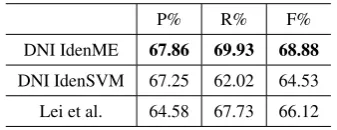
Table 6 provides the performance of DNI iden-tification on our automatic NI detection results. It shows that DNI identification based on max-imum entropy model achieves the performance of 67.86%, 69.93% and 68.88% in terms of precision, recall and F-score respectively, which are better than the results using SVM classifier, as well as the results employing Lei et al.’s method on our data.
We observe, from Table 6, that the performance of DNI identification is not high, possibly due to the poorer results of NI detection in the previous step. Moreover, because of the diversity of NI distribution, the difference of frames, and target words or missing core frame elements, the interpretation of NI types may be quite different. Thus it is difficult to build a suitable and accurate uniform classification model.
P% R% F%
DNI IdenME 67.86 69.93 68.88
[image:7.595.332.501.427.492.2]DNI IdenSVM 67.25 62.02 64.53 Lei et al. 64.58 67.73 66.12
Table 6:Performance of DNI Identification Resolution on golden Definite Null Instantiation In order to select the most effective features for OvertFE resolver and choose the best search space, we assume perfect results for the first two steps, that is, we perform DNI resolution experiment just with the correct DNIs in discourse. After extensive experiments employing different sets of features in different window sizes, we conclude that combining all features can achieve the best performance. Table 7 shows the results on correct DNIs using the best feature set in the window of 2, 3 and 4 sentences containing and before the target predicate (Win2, Win3, Win4 for short).
Win2 Win3 Win4
P% R% F% P% R% F% P% R% F%
[image:8.595.119.479.61.140.2]OvertFE 45.22 18.20 25.95 43.04 17.64 25.02 38.63 15.23 21.84 FFR 65.56 16.29 26.11 63.50 16.81 26.58 58.53 17.32 26.72 OvertFE+FFR 51.17 31.59 39.06 52.41 32.02 39.75 45.88 31.10 37.07
Table 7:Results on golden DNI
OvertFE classifier to find right fillers.
For FFR resolver, it needs to find related frames, and we find that its resolved DNIs are less than that by OvertFE resolver, thereby resulting in the lower precision of OvertFE than FFR.
Though performances of OvertFE and FFR both are relatively low, FFR can resolve several DNIs that OvertFE can not. Figures 2 and 3 both are such cases. So when combining the two resolvers, the final result of OvertFE+FFR outper-forms that of each individual resolver. Meanwhile, as shown in Table 7, for the combined resolver OvertFE+FFR, the F-score is the highest when the window size is 3 (i.e. Win3).
[image:8.595.99.263.540.618.2]Overall: Null Instantiation Resolution
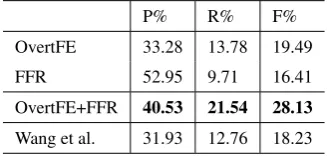
Table 8 gives the performance of overall null instantiations resolution with automatic NI detec-tion and automatic DNI determinadetec-tion. It shows that our resolver OvertFE+FFR achieves 40.53%, 21.54% and 28.13% in terms of precision, recall and F-score. In comparison with the results (52.41%, 32.02% and 39.75% in P, R and F) in Win3 of Table 7, it shows that the errors caused by automatic NI detection and automatic DNI determination decrease the performance of overall NI resolution by about 11% in terms of F-score.
P% R% F%
OvertFE 33.28 13.78 19.49
FFR 52.95 9.71 16.41
OvertFE+FFR 40.53 21.54 28.13
Wang et al. 31.93 12.76 18.23
Table 8:Performance of NI resolution for our models and comparative systems
For comparison, we also conduct DNI reso-lution on our constructed corpus employing the method proposed by Wang et al. (2013). Since our corpus does not contain annotation of head words, the results are obtained by using their features without head word information. As the last line of Table 8 shows, the performance behaves similarly with our OvertFE resolver. In addition, we
notice current state-of-the-art approach of Laparra and Rigau (2013) employs coreference models, although our corpus does not contain coreference annotation information. As such, we are not able to conduct experiments on our dataset using their method for comparison purpose.
Overall, the relatively low performance of res-olution reflects the inherent difficulty of this task, also reveals that further research is needed.
7 Conclusion and Future Work
Apparently, linking implicit participants of a pred-icate is a challenging problem. We have presented a study for identifying implicit arguments and finding their antecedents in Chinese discourse.
As shown in this paper, we split the difficult task into three subtasks: null instantiation detec-tion, definite null instantiation identification and definite null instantiation resolution. Among the three subtasks, the third is our major focus. For the third subtask, we build two different resolvers: 1) OvertFE resolver, which represents that the filler of a DNI can be found among those overt FE content set in context, by employing classification methods; 2) FFR resolver, which is the related search, leverages rich network of frame-frame relations to find antecedents. We have proved that these two resolvers are very useful for the third subtask, and a combination of two resolvers produced the best results.
potentially further improve the performance of our proposed method.
Acknowledgments
We would like to thank anonymous reviewers and the mentor Jacob Eisenstein for their valuable comments and suggestions, and Xiaoli Li for help-ing us polish the paper. This work was supported by the National Natural Science Foundation of China (No.61373082, 61432011, U1435212), Na-tional 863 Project of China(No.2015AA015407), Shanxi Platform Project(2014091004-0103) and Scholarship Council(2013-015), and Open Project Foundation of Information Security Evaluation Center of Civil Aviation, Civil Aviation University of China(No.CAAC-ISECCA-201402).
References
Collin F. Baker, Charles J. Fillmore, and John B. Lowe. 1998. The berkeley framenet project. In Proceedings of COLING/ACL.
Aljoscha Burchardt, Anette Frank, and Manfred Pinkal. 2005. Building text meaning representa-tions from contextually related frames–a case study. Proceedings of the 6th International Workshop on Computational Semantics (IWCS-6), pages 66–77. Desai Chen, Nathan Schneider, Dipanjan Das, and
Noah A Smith. 2010. Semafor: Frame argument resolution with log-linear models. In Proceedings of the 5th international workshop on semantic evaluation, pages 264–267.
Dipanjan Das, Nathan Schneider, Desai Chen, and Noah A Smith. 2010. Probabilistic frame-semantic parsing. In Human language technologies: The 2010 annual conference of the North American chapter of the association for computational linguis-tics, pages 948–956.
Charles J. Fillmore. 1982. Frame semantics. Linguistics in the morning calm, pages 111–137. Matthew Gerber and Joyce Y. Chai. 2010. Beyond
nombank: a study of implicit arguments for nominal predicates. In Proceedings of the 48th Annual Meeting of the Association for Computational Linguistics, pages 1583–1592.
Matthew Steven Gerber. 2011. Semantic Role Label-ing of Implicit Arguments for Nominal Predicates. Ph.D. thesis, Michigan State University.
Philip Gorinski, Josef Ruppenhofer, and Caroline Sporleder. 2013. Towards weakly supervised resolution of null instantiations. In Proceedings of the 10th International Conference on Computational Semantics (IWCS 2013)–Long Papers, pages 119– 130.
Egoitz Laparra and German Rigau. 2013. Sources of evidence for implicit argument resolution. In Proceedings of the 10th International Conference on Computational Semantics (IWCS 2013)–Long Papers, pages 155–166.
Zhangzhang Lei, Ning Wang, Ru Li, and Zhiqiang Wang. 2013. Definite null instantiation recognizing in framenet. Journal of Chinese Information, 27(3):107–112.
Ru Li. 2012. Research on Frame Semantic Structure Analysis Technology for Chinese Sentences. Ph.D. thesis, ShanXi university.
Hugo Liu and Push Singh. 2004. Conceptnet: a practical commonsense reasoning tool-kit. BT technology journal, 22(4):211–226.
Kaiying Liu. 2011. Research on chinese framenet construction and application technologies. Journal of Chinese Information Processing, 6:006.
Josef Ruppenhofer, Caroline Sporleder, Roser Morante, Collin Baker, and Martha Palmer. 2010. Semeval-2010 task 10: Linking events and their participants in discourse. InProceedings of the 5th International Workshop on Semantic Evaluation, pages 45–50.
Carina Silberer and Anette Frank. 2012. Casting implicit role linking as an anaphora resolution task. In Proceedings of the First Joint Conference on Lexical and Computational Semantics-Volume 1: Proceedings of the main conference and the shared task, and Volume 2: Proceedings of the Sixth International Workshop on Semantic Evaluation, pages 1–10.
Sara Tonelli and Rodolfo Delmonte. 2010. Venses++: Adapting a deep semantic processing system to the identification of null instantiations. InProceedings of the 5th international workshop on semantic evaluation, pages 296–299.
Sara Tonelli and Rodolfo Delmonte. 2011. Desperate-ly seeking implicit arguments in text. In Proceed-ings of the ACL 2011 workshop on relational models of semantics, pages 54–62.
Ning Wang, Ru Li, Zhangzhang Lei, Zhiqiang Wang, and Jingpan Jin. 2013. Document oriented gap filling of definite null instantiation in framenet. In Chinese Computational Linguistics and Natural Language Processing Based on Naturally Annotated Big Data, pages 85–96.