Parse Imputation for Dependency Annotations
Jason Mielens1 Liang Sun2
1Department of Linguistics 2Department of Mechanical Engineering The University of Texas at Austin The University of Texas at Austin
{jmielens,jbaldrid}@utexas.edu [email protected]
Jason Baldridge1
Abstract
Syntactic annotation is a hard task, but it can be made easier by allowing annotators flexibility to leave aspects of a sentence underspecified. Unfortunately, partial an-notations are not typically directly usable for training parsers. We describe a method for imputing missing dependencies from sentences that have been partially anno-tated using the Graph Fragment Language, such that a standard dependency parser can then be trained on all annotations. We show that this strategy improves perfor-mance over not using partial annotations for English, Chinese, Portuguese and Kin-yarwanda, and that performance competi-tive with state-of-the-art unsupervised and weakly-supervised parsers can be reached with just a few hours of annotation.
1 Introduction
Linguistically annotated data is produced for many purposes in many contexts. It typically requires considerable effort, particularly for lan-guage documentation efforts in which tooling, data, and expertise in the language are scarce. The challenge presented by this scarcity is com-pounded when doing deeper analysis, such as syn-tactic structure, which typically requires greater expertise and existing tooling. In such scenar-ios, unsupervised approaches are a tempting strat-egy. While the performance of unsupervised dependency parsing has improved greatly since Klein and Manning’s (2004) Dependency Model with Valence (DMV), state-of-the-art unsuper-vised parsers still perform well below superunsuper-vised approaches (Martins et al., 2010; Spitkovsky et al., 2012; Blunsom and Cohn, 2010). Additionally, they typically require large amounts of raw data. While this is not a problem for some languages,
many of the world’s languages do not have a clean, digitized corpus available.1 For instance, the ap-proach of Naseem et al. (2010) is unsupervised in the sense that it requires no dependency annota-tions, but it still makes use of the raw version of the full Penn Treebank. The approach of Mare-cek et al. (2013) requires extra unlabeled texts to estimate parameters.
Another strategy is to exploit small amounts of supervision or knowledge. Naseem et al. (2010) use a set of universal dependency rules and obtain substantial gains over unsupervised methods in many languages. Spitkovsky et al. (2010b; 2011) use web mark-up and punctuation as additional an-notations. Alternatively, one could try to obtain actual dependency annotations cheaply. We use the Graph Fragment Language (GFL), which was created with the goal of making annotations eas-ier for experts and possible for novices (Schneider et al., 2013; Mordowanec et al., 2014). GFL sup-ports partial annotations, so annotators can omit obvious dependencies or skip difficult construc-tions. The ability to focus on portions of a sen-tence frees the annotator to target constituents and dependencies that maximize information that will be most useful for machine-learned parsers. For example, Hwa (1999) found higher-level sentence constituents to be more informative for learning parsers than lower-level ones.
To support this style of annotation while getting the benefit from partial annotations, we develop a two-stage parser learning strategy. The first stage completes the partial GFL annotations by adapting a Gibbs tree sampler (Johnson et al., 2007; Sun et al., 2014). The GFL annotations constrain the tree sampling space by using both dependencies and the constituent boundaries they express. The sys-tem performs missing dependency arc imputation using Gibbs sampling – we refer to this approach 1In fact, standardized writing systems have yet to be
adopted for some languages.
as the Gibbs Parse Completer2 (GPC). The sec-ond stage uses the full dependencies output by the GPC to train Turbo Parser (Martins et al., 2010), and evaluation is done with this trained model on unseen sentences. In simulation experiments for English, Chinese and Portuguese, we show that the method gracefully degrades when applied to training corpora with increasing percentages of the gold training dependencies removed. We also do actual GFL annotations for those languages plus Kinyarwanda, and show that using the GPC to fill in the missing dependencies after two hours of annotation enables Turbo Parser to obtain 2-6% better absolute performance than when it has to throw incomplete annotations out. Furthermore, the gains are even greater with less annotation time and it never hurts to use the GPC—so an annota-tion project can pursue a partial annotaannota-tion strat-egy without undermining the utility of the work for parser training.
This strategy has the further benefit of needing only a small number of sentences—in our case, under 100 sentences annotated in a 2-4 hour win-dow. Furthermore, it relies on no outside tools or corpora other than a part-of-speech tagger; a re-source that can be built with two hours of annota-tion time (Garrette and Baldridge, 2013).
2 Data
Data sources We use four languages from three language families in an effort to both verify the cross-linguistic applicability of our approach, ac-counting for variations in linguistic properties, as well as to attempt to realistically simulate a real-world, low-resource environment. Our data comes from English (ENG), Chinese (CHI), Portuguese (POR), and Kinyarwanda (KIN).
For ENG we use the Penn Treebank (Marcus et al., 1993), converted into dependencies by the standard process. Section 23 was used as a test set, and a random sample of sentences from sec-tions 02-21 were selected for annotation with GFL as described below and subsequently used as the minimal training set. For CHI we use the Chi-nese Treebank (CTB5) (Xue et al., 2005), also converted to dependencies. The testing set con-sisted of files 1-40/900-931, and the sentences pre-sented for GFL annotation were randomly sam-pled from files 81-899. The POR data is from
2The software, instructions, and data are available at
[image:2.595.335.494.54.227.2]http://www.github.com/jmielens/gpc-acl-2015
Figure 1: GFL example for Mr. Conlon was ex-ecutive vice president and director of the equity division.
the CoNLL-X Shared Task on Multilingual De-pendency Parsing and is derived from the Bosque portion of the Floresta sint´a(c)tica corpus (Afonso et al., 2002), using the standard provided splits for training and testing. TheKINdata is a corpus con-sisting of transcripts of testimonies by survivors of the Rwandan genocide, provided by the Kigali Genocide Memorial Center – this data is described by Garrette and Baldridge (2013).
GFL annotation We use a small number of sen-tences annotated using the Graph Fragment Lan-guage (GFL), a simple ASCII markup lanLan-guage for dependency grammar (Schneider et al., 2013). Unlike traditional syntactic annotation strategies requiring trained annotators and great effort, rapid GFL annotations can be collected from annotators who have minimal training. Kong et al. (2014) demonstrate the feasibility of training a depen-dency parser based on a GFL-annotated corpus of English tweets.
An example of GFL is shown in Figure 1: (a) is the GFL markup itself and (b) is a graphical repre-sentation of the dependencies it encodes. Figure 1 specifies several dependencies: ofis a dependent ofdirector, executive vice presidentanddirector
are conjuncts andandis the coordinator. However, the complete internal structure of the phrase the equity divisionremains unspecified, other than di-visionbeing marked as the head (via an asterisk).3 Finally,Mr. Conlonin square brackets indicates it is a multiword expression.
3The graphical representation shows both of these as FE
CFG Rule EVG distribution Description
S→YH P(root=H) The head of the sentence isH
YH→LHRH - Split-head representation
LH →HL P(ST OP|dir=L, head=H, val= 0) Hhas no left children
LH →L1H P(CONT|dir=L, head=H, val= 0) Hhas at least one left child
L0
H →HL P(ST OP|dir=L, head=H, val= 1) Hhas no more left children
L0
H →L1H P(CONT|dir=L, head=H, val= 1) Hhas other left children
L1
[image:3.595.104.493.62.148.2]H →YAL0H P(ArgA|dir=L, head=H, val= 1) Ais a left child ofH
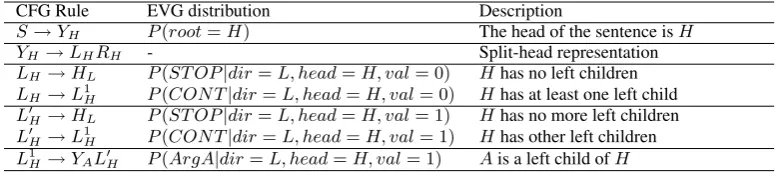
Table 1: The CFG-DMV grammar schema from Klein and Manning (2004). Note that in these rules H and A are parts-of-speech. For brevity, we omit the portion of the grammar that handles the right-hand arguments since they are symmetric to the left. Valency (val) can take the value1(we have made attachments in the direction (dir) d) or0(not).
[image:3.595.74.285.230.273.2]CHI ENG KIN POR Sentences Annotated 24 34 69 63 Tokens Annotated 820 798 988 1067 Fully Specified Sentences 4 15 31 20
Table 2: Two Hour GFL Annotation Statistics
Kong et al. (2014) stipulate that the GFL an-notations in their corpus must be fully-specified. They are thus unable to take advantage of such un-derspecified sentences, and we address that limita-tion in this paper. From the GFL annotalimita-tions we can extract and deduce dependency arcs and con-straints (see Section 3.2 for full details) in order to guide the Gibbs sampling process.
Time-bounded annotation As described in Section 1, a primary goal of this work was to con-sider the time in which a useful number of depen-dency tree annotations might be collected, such as might be required during the initial phase of a language documentation project or corpus build. To this end our annotators were operating under a strict two hour time limit. We also collected two further hours for English.
The annotators were instructed to annotate as many sentences as possible in the two hours, and that they should liberally use underspecification, especially for particularly difficult sequences in a given sentence. This was done to facilitate the availability of partial annotations for experimenta-tion. All of the annotators had some previous ex-perience providing GFL annotations, so no train-ing period was needed. Annotation was done in 30-minute blocks, to provide short breaks for the annotators and so that learning curves could be generated. Each language was annotated by a single annotator. The ENG and CHI annotators were native speakers of their annotation language, while thePORandKINannotators were non-native
though proficient speakers.
The annotators achieved rates of 400-500 kens/hr, whereas we find rates of 150-200 to-kens/hr more typical when annotators are asked to fully specify. Requiring full specification also in-troduces more errors in cases of annotator uncer-tainty.
Table 2 shows the size of the GFL corpora that were created. Typically, over 50% of the sentences were not fully specified—the partial annotations provided in these are useless to Turbo Parser un-less the missing dependencies are imputed.
3 Gibbs Parse Completer (GPC)
3.1 Gibbs sampler for CFG-DMV Model CFG-DMV model The GPC is based on the DMV model, a generative model for the unsu-pervised learning of dependency structures (Klein and Manning, 2004). We denote the input cor-pus as ω = (ω1,· · ·,ωN), where each ωs is a
sentence consisting of words and in a sentenceω, word ωi has an corresponding part-of-speech tag τi. We denote the set of all words asVω and the
set of all parts-of-speech asVτ. We use the part-of-speech sequence as our terminal strings, result-ing in an unlexicalized grammar. Dependencies can be formulated as split head bilexical context free grammars (CFGs) (Eisner and Satta, 1999) and these bilexical CFGs require that each termi-nalτi in sentenceωis represented in a split form by two terminals, with labels marking the left and right heads (τi,L, τi,R). Henceforth, we denote
w = w0,n as our terminals in the split-form of
sentence ω(e.g., the terminals for the dog walks
areDTLDTRNNLNNRVLVR). Table 1 shows
Require: Ais parent node of binary rule; wi,kis a valid
span of terminals andi+ 1< k functionTREESAMPLER(A, i, k)
fori < j < kand pair of child nodes ofA:B, C do P(j, B, C)=θAw→BCc(i,j)c(j,k)·pB,i,j·pC,j,k
pA,i,k
end forSamplej∗, B∗, C∗from multinomial distri-bution for(j, B, C)with probabilities calculated above
returnj∗, B∗, C∗
end function
Algorithm 1: Sampling split position and rule to expand parent node.
Gibbs sampler The split-head representation encodes dependencies as a CFG. This enables the use of a Gibbs sampler algorithm for estimating PCFGs (Johnson et al., 2007; Sun et al., 2014), and it is straightforward to incorporate constraints from partial annotations into this sampler. To do this, we modified the tree-sampling step to incor-porate constraints derived from GFL annotations and thereby impute the missing dependencies.
Given a string w = (w1,· · ·wn), we define
a span of w as wi,k = (wi+1,· · ·, wk), so that
w =w0,n. As introduced in Pereira and Schabes
(1992), a bracketingBofwis a finite set of spans onwsatisfying the requirement that no two spans in a bracketing may overlap unless one span con-tains the other. For each sentencew = w0,n we
define the auxiliary function for each span wi,j,
0≤i < j ≤n:
c(i, j) =
(
1 if spanwi,j is valid forB;
0 otherwise.
Here one span is valid for B if it doesn’t cross any brackets. Section 3.2 describes how to de-rive bracketing information from GFL annotations and how to determine if a spanwi,jis valid or not.
Note that for parsing a corpus without any annota-tions and constraints,c(i, j) = 1for any span, and the algorithm is equivalent to the Gibbs sampler in Sun et al. (2014).
There are two parts to the tree-sampling. The first constructs an inside table as in the Inside-Outside algorithm for PCFGs and the second se-lects the tree by recursively sampling productions from top to bottom. Consider a sentencew, with sub-spans wi,k = (wi+1,· · · , wk). Given θw (modified rule probabilitiesθgiven constraints of sentencew, see Section 3.2), we construct the in-side table with entriespA,i,kfor each nonterminal and each spanwi,k:0≤i < k≤n. We introduce
Require: Arcsis the set of all directed arcs extracted from annotation for sentencew
functionRULEPROB-SENT(w, θ, Arcs)
θw=θ
for each directed arcwi< wjdo
ifi < jthen
for nonterminal A6=Lτjdo
θw
A→β= 0ifβcontainsYτi
end for else
for nonterminal A6=Rτjdo
θw
A→β= 0ifβcontainsYτi
end for end if end for returnθw
end function
Algorithm 2: Modifying Rule Probabilities forw
to ensure parse tree contains all directed arcs.
c(i, j)into the calculation of inside probabilities:
pA,i,k=c(i, k)· X
A→BC∈R X
i<j<k
θAw→BC·pB,i,j·pC,j,k (1)
Here,pA,i,k = PGA(wi,k | θw)is the probability
that terminals i through k were produced by the non-terminalA,A→ BC ∈Rare possible rules to expandA. The inside table is computed recur-sively using Equation 1.
The resulting inside probabilities are then used to generate trees from the distribution of all valid trees of the sentence. The tree is generated from top to bottom recursively with the function
T reeSampler defined in Algorithm 1, which in-troduces c(i, j) into the sampling function from Sun et al. (2014).
3.2 Constraints derived from GFL
We exploit one dependency constraint and two constituency constraints from partial GFL anno-tations.
Dependency rule Directed arcs are indicated with angle brackets pointing from the dependent to its head, e.g. black>cat. Once we have a di-rected arc annotation, sayωi > ωj, ifi < j, which
means wordj has a left child, we must have rule
L1
τj →YτiL0τj in our parse tree (similarly ifi > j,
we haveR1
τj → R0τjYτi in our parse tree), where
τi, τj are parts-of-speech for ωi and ωj. We
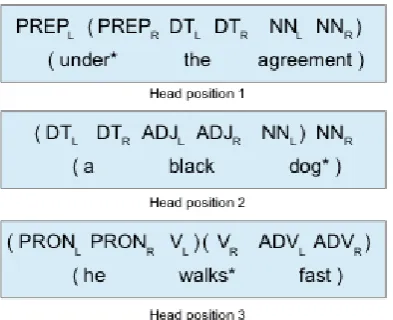
Figure 2: Generating brackets for known head
Figure 3: Generating half brackets
[image:5.595.307.527.60.225.2]Brackets GFL allows annotators to group words with parenthesis, which provides an explicit indi-cator of constituent brackets. Even when the inter-nal structure is left underspecified (e.g. (the eq-uity division*) in Figure 1 (a), the head is usu-ally marked with *, and we can use this to infer sub-constituents. Given such a set of parentheses and the words inside them, we generate brackets over the split-head representations of their parts-of-speech, based on possible positions of the head. Figure 2 shows how to generate brackets for three situations: the head is the leftmost word, right-most word, or is in a medial position. For exam-ple, the first annotation indicates thatunderis the head ofunder the agreement, and the rest of words are right descendants ofunder. This leads to the bracketing shown over the split-heads.
Half brackets We can also derive one-sided half brackets from dependency arcs by assuming that dependencies are projective. For example, in Fig-ure 3, the annotation a > dog specifies that dog
has a left childa, so we know that there is a right bracket before the right-head ofdog. Thus, we can detect invalid spans using the half brackets; if a span starts afteraand ends afterdog, this span is invalid because it would result in crossing brack-ets. This half bracketing is a unique advantage provided by the split-head representation. The de-tails of this algorithm are shown in Algorithm 3.
Require: Arcsis the set of all directed arcs extracted for sentence,wa,bis a span to detect
functionDETECTINVALIDSPAN(a, b, Arcs)
for each directed arcωi< ωjdo
ifi < jthen
ifa <2i−1< b <2jthen c(a, b) = 0
end if else
if2j−2< a <2i−1< bthen c(i, j) = 0
end if end if end for returnc(a, b)
end function
[image:5.595.87.280.257.314.2]Algorithm 3: Detect whether one span is invalid given all directed arcs.
Figure 4: Process of generating brackets and de-tecting invalid spans.
We use both half bracket and full bracket infor-mation, B, to determine whether a span is valid. We setc(i, j) = 0 for all spans overw detected by Algorithm 3 and violatingB. Then, in the sam-pling scheme, we’ll only sample parse trees that satisfy these underlying constraints.
Figure 4 shows the resulting blocked out spans in the chart based on both types of brackets for the given partial annotation, which is Step 1 of the process. The black dogis a constituent with dog
marked as its head, so we generate a full bracket over the terminal string in Step 2. Also,barkshas a right childloudly; this generates a half bracket beforeVR. In Step 3, the chart in Figure 4 repre-sents all spans over terminal symbols. The cells in black are invalid spans based on the full bracket, and the hatched cells are invalid spans based on the half bracket.
4 Results
[image:5.595.313.528.274.395.2]ap-Figure 5: English oracle and degradation results
proach. The first is the effectiveness of the GPC in imputing missing dependencies and the second is the effectiveness of the GFL annotations them-selves. Of particular note with respect to the latter is the reasonable likelihood of divergence between the annotator and the corpus used for evaluation— for example, how coordination is handled and whether subordinate verbs are dependents or heads of auxiliary verbs. To this end, we perform simu-lation experiments that remove increasing portions of gold dependencies from a training corpus to un-derstand imputation performance and annotation experiments to evaluate the entire pipeline in a re-alistically constrained annotation effort.
In that regard, one thing to consider are the part-of-speech tags used by the unlexicalized GPC. These do not come for free, so rather than ask annotators to provide them, the raw sentences to be annotated were tagged automatically. For En-glish and Kinyarwanda, we used taggers trained with resources built in under two hours (Garrette and Baldridge, 2013), so these results are actually constrained to the GFL annotation time plus two hours. Such taggers were not available for Chinese or Portuguese, so the Stanford tagger (Toutanova et al., 2003) was used instead.
After imputing missing dependencies, the GPC outputs fully sentences that are used to train Tur-boParser (Martins et al., 2010). In all cases, we compare to a right-branching baseline (RB). Although comparing to a random baseline is more typical of imputation experiments, a right-branching baseline provides a stronger initial com-parison. For the GFL annotation experiments, we use two additional baselines. The first is simply to use the sentences with full annotations and drop any incomplete ones (GFL-DROP). The second is
[image:6.595.76.296.62.222.2]Language ENG CHI POR RB 25.0 11.6 27.0 GFL-GPC-25 58.7 33.5 60.2 GFL-GPC-50 75.0 46.1 71.4 GFL-GPC-75 77.8 50.1 73.7 Full 81.6 56.2 78.1
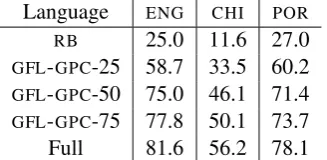
Table 3: Results with simulated partial annota-tions, GFL-GPC-X indicates X percent of depen-dencies were retained.
to make any partial annotations usable by assum-ing a right-branchassum-ing completion (GFL-RBC).
Simulated partial annotations Figure 5 shows the learning curve with respect to number of an-notated tokens when retaining 100%, 75%, 50% and 25% of gold-standard training dependencies and using the GPC to impute the removed ones. With both 75% and 50% retained, performance degrades gracefully. It is substantially lower for 25%, but the curve is steeper than the others, indi-cating it is on track to catch up. Nonetheless, one recommendation from these results is that it prob-ably makes sense to start with a small number of fully annotated sentences and then start mixing in partially annotated ones.
Table 3 shows the attachment scores obtained for English, Chinese, and Portuguese with varying proportions of dependencies removed for the GPC to impute.4 English and Portuguese hold up well with 75% and 50% retained, while Chinese drops more precipitously, and 25% leads to substantial reductions in performance for all.
Note that these simulations indicate that, given an equivalent number of total annotated arcs, using the GPC is more beneficial than requiring annota-tors to fully specify annotations. Imputing fifty percent of the dependency arcs from sentences containing 1000 tokens is typically more effective by a few points than using the full gold-standard arcs from sentences containing 500 tokens. Ac-tually, this simulation is too generous to complete annotations in that it leaves out consideration of the time and effort required to obtain those 100% full gold-standard arcs: it is often a small part of a sentence that consumes the most effort when full annotation is required. Additionally, these simula-tion experiments randomly removed dependencies while humans tend to annotate higher-level con-4These are based on the same sentences used in the next
[image:6.595.336.500.63.143.2]Eval Length <10 <20 all GFL-DROP(4hr) 54.5 55.0 52.6
GFL-GPC(4hr) 60.1 61.8 55.1 Blunsom and Cohn, 2010 67.7 – 55.7
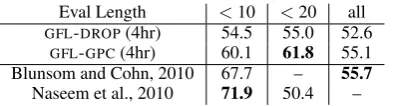
[image:7.595.85.282.61.114.2]Naseem et al., 2010 71.9 50.4 – Table 4: English results compared to previous un-supervised and weakly-un-supervised methods.
stituents and leave internal structure (e.g. of noun phrases) underspecified. Given Hwa’s (1999) find-ings, we expect non-random partial annotations to better serve as a basis for imputation.
GFL annotations We conducted three sets of experiments with GFL annotations, evaluating on sentences of all lengths, less than 10 words, and less than 20 words. This was done to determine the types of sentences that our method works best on and to compare to previous work that evaluates on sentences of different lengths.
Table 4 shows how our results on ENG com-pare to others. Blunsom and Cohn (2010) rep-resent state-of-the-art unsupervised results for all lengths, while Naseem et al. (2010) was chosen as a previous weakly-supervised approach.GFL-GPC achieves similar results on the ‘all lengths’ crite-rion as Blunsom and Cohn and substantially out-performs Naseem et al. on sentences less than 20 words. Our poor performance on short sentences is slightly surprising, and may result from an un-even length distribution in the sentences selected for annotation—we have only 3 training sentences less than 10 words—as discussed by Spitkovsky et al. (2010a). To correct this problem, both long and short sentences should be included to construct a more representative sample for annotation.
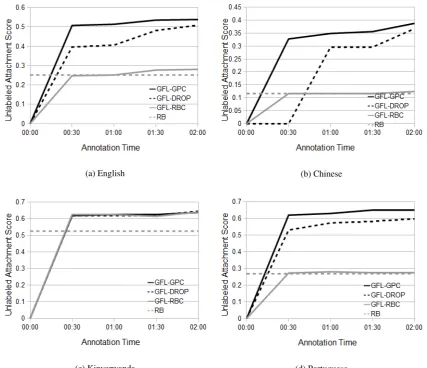
We did not expectGFL-RBCto perform so sim-ilarly toRB. It is possible that the relatively large number of under-specified sentences led to the right-branching quality of GFL-RBC dominating, rather than the more informative GFL annotations. The results of the ENG annotation session can be seen in Figure 6a. GFL-GPCis quite strong even at thirty minutes, with only seven sentences anno-tated.GFL-DROPpicks up substantially at the end; this may be in part explained by the fact that the last block contained many short sentences, which provide greater marginal benefit toGFL-DROPthan toGFL-GPC.
The learning curves for the other languages can be seen in Figures 6b-6d, with a summary avail-able in Tavail-able 5. Like ENG, CHI and POR both
Language KIN CHI POR RB 52.6 11.6 27.0 GFL-DROP(2hr) 64.4 36.7 59.8 GFL-GPC(2hr) 64.5 38.8 65.0
Table 5: Non-English results summary
show clear wins for the GPC strategy. Of particu-lar note is that theCHIannotations contained many fewer fully-completed sentences (4) than theENG annotations (15). This somewhat addresses the question raised by the 25% retention simulation experiments—the GPC method improves results over dropping partial annotations. ThePORresults show a consistent strong win for GPC throughout. The KIN results in Figure 6c exhibit a pattern unlike the other languages; specifically, the KIN data has a very high right-branching baseline (RB in figures) and responds nearly identically for all of the more informed methods. Upon investi-gation, this appears to be an artifact of the data used inKINevaluation plus domain adaptation is-sues. The gold data consists of transcribed natural speech, whereas the training data consists of sen-tences extracted from the Kinyarwanda Wikipedia. All of the learning curves display a large ini-tial jump after the first round of annotations. This is encouraging for approaches that use annotated sentences: just a small number of examples pro-vide tremendous benefit, regardless of the strategy employed.
Error analysis The primary errors seen on an analysis of the GPC-completed sentences varies somewhat between languages. TheENGdata con-tains many short sentences, consisting often of a few words and a punctuation mark. Part of the GFL convention is that the annotator is free to an-notate punctuation as part of the sentence or in-stead view it as extra-linguistic and drop the punc-tuation from the annotation. Often the puncpunc-tuation in theENGdata went unannotated, with the result being that the final parse model is not particularly good at handling these types of sentences when encountered in the test set.
[image:7.595.341.494.62.104.2]anno-(a) English (b) Chinese
[image:8.595.85.513.77.445.2](c) Kinyarwanda (d) Portuguese
Figure 6: GPC results by annotation time for eval sentences of all lengths.
tation, although were this a real annotation project, there would be no existing corpus to compare to at first. This brings up a more basic question of eval-uation - one of usability versus representational norm matching. It is likely that the GFL anno-tations (and thus the models trained on them) di-verge from the gold standard in what amount to annotation conventions rather than substantive lin-guistic divergences. To evaluate more fully or fairly, we would need test sets produced by the same set of annotators or an external, task-based evaluation that uses the dependencies as in input.
5 Conclusions
We have described a modeling strategy that takes advantage of a Gibbs sampling algorithm for CFG parsing plus constraints obtained from partial an-notations to build dependency parsers. This strat-egy’s performance improves on that of a parser
built only on the available complete annotations. In doing so, our approach supports annotation ef-forts that use GFL to obtain guidance from non-expert human annotators and allow any annotator to put in less effort than they would to do complete annotations.
take much longer to assemble if there is no ex-isting corpus. This also means our method would be useful for getting in-domain training data for domain adaptation for parsers.
Finally, our method has the ability to encode both universal grammar and test-language gram-mar as a prior. This would be done by replacing the uniform prior used in this paper with a prior favoring those grammar rules during the updating-rule-probabilities phase of the GPC, and would es-sentially have the effect of weighting those gram-mar rules.
Acknowledgments
This work was supported in part by the U. S. Army Research Laboratory and the U. S. Army Research Office under contract/grant number W911NF-10-1-0533
References
S. Afonso, E. Bick, R. Haber, and D. Santos. 2002. “Floresta sint´a(c)tica”: a Treebank for Portuguese. InProceedings of the 3rd International Conference on Language Resources and Evaluation (LREC), pages 1698–1703. LREC.
Phil Blunsom and Trevor Cohn. 2010. Unsupervised induction of tree substitution grammars for depen-dency parsing. In Proceedings of the 2010 Con-ference on Empirical Methods in Natural Language Processing, pages 1204–1213. Association for Com-putational Linguistics.
Jason Eisner and Giorgio Satta. 1999. Efficient pars-ing for bilexical context-free grammars and head au-tomaton grammars. InProceedings of the 37th an-nual meeting of the Association for Computational Linguistics on Computational Linguistics, pages 457–464. Association for Computational Linguis-tics.
Dan Garrette and Jason Baldridge. 2013. Learning a part-of-speech tagger from two hours of annotation. InHLT-NAACL, pages 138–147. Citeseer.
Rebecca Hwa. 1999. Supervised grammar induction using training data with limited constituent infor-mation. In Proceedings of the 37th annual meet-ing of the Association for Computational Lmeet-inguistics on Computational Linguistics, pages 73–79. Associ-ation for ComputAssoci-ational Linguistics.
Mark Johnson, Thomas L Griffiths, and Sharon Gold-water. 2007. Bayesian inference for PCFGs via Markov chain Monte Carlo. In Human Language Technologies 2007: The Conference of the North American Chapter of the Association for Computa-tional Linguistics, pages 139–146.
Dan Klein and Christopher D Manning. 2004. Corpus-based induction of syntactic structure: Models of de-pendency and constituency. In Proceedings of the 42nd Annual Meeting on Association for Computa-tional Linguistics, page 478. Association for Com-putational Linguistics.
Lingpeng Kong, Nathan Schneider, Swabha Swayamdipta, Archna Bhatia, Chris Dyer, and Noah A Smith. 2014. A dependency parser for tweets. InProceedings of the Conference on Em-pirical Methods in Natural Language Processing, Doha, Qatar, to appear.
Mitchell P Marcus, Mary Ann Marcinkiewicz, and Beatrice Santorini. 1993. Building a large anno-tated corpus of English: The Penn Treebank. Com-putational linguistics, 19(2):313–330.
David Marecek and Milan Straka. 2013. Stop-probability estimates computed on a large corpus improve unsupervised dependency parsing. InACL (1), pages 281–290.
Andr´e FT Martins, Noah A Smith, Eric P Xing, Pe-dro MQ Aguiar, and M´ario AT Figueiredo. 2010. Turbo parsers: Dependency parsing by approxi-mate variational inference. In Proceedings of the 2010 Conference on Empirical Methods in Natural Language Processing, pages 34–44. Association for Computational Linguistics.
Michael T. Mordowanec, Nathan Schneider, Chris Dyer, and Noah A Smith. 2014. Simplified depen-dency annotations with GFL-Web. ACL 2014, page 121.
Tahira Naseem, Harr Chen, Regina Barzilay, and Mark Johnson. 2010. Using universal linguistic knowl-edge to guide grammar induction. InProceedings of the 2010 Conference on Empirical Methods in Nat-ural Language Processing, pages 1234–1244. Asso-ciation for Computational Linguistics.
Fernando Pereira and Yves Schabes. 1992. Inside-outside reestimation from partially bracketed cor-pora. In Proceedings of the 30th annual meeting on Association for Computational Linguistics, pages 128–135. Association for Computational Linguis-tics.
Nathan Schneider, Brendan OConnor, Naomi Saphra, David Bamman, Manaal Faruqui, Noah A Smith, Chris Dyer, and Jason Baldridge. 2013. A framework for (under) specifying dependency syn-tax without overloading annotators. LAW VII & ID, page 51.
Valentin I Spitkovsky, Hiyan Alshawi, and Daniel Ju-rafsky. 2010a. From baby steps to leapfrog: How less is more in unsupervised dependency parsing. In
Valentin I Spitkovsky, Daniel Jurafsky, and Hiyan Al-shawi. 2010b. Profiting from mark-up: Hyper-text annotations for guided parsing. In Proceedings of the 48th Annual Meeting of the Association for Com-putational Linguistics, pages 1278–1287. Associa-tion for ComputaAssocia-tional Linguistics.
Valentin I Spitkovsky, Hiyan Alshawi, and Daniel Ju-rafsky. 2011. Punctuation: Making a point in un-supervised dependency parsing. In Proceedings of the Fifteenth Conference on Computational Natural Language Learning, pages 19–28. Association for Computational Linguistics.
Valentin I Spitkovsky, Hiyan Alshawi, and Daniel Ju-rafsky. 2012. Three dependency-and-boundary models for grammar induction. In Proceedings of the 2012 Joint Conference on Empirical Methods in Natural Language Processing and Computational Natural Language Learning, pages 688–698. Asso-ciation for Computational Linguistics.
Liang Sun, Jason Mielens, and Jason Baldridge. 2014. Parsing low-resource languages using Gibbs sam-pling for PCFGs with latent annotations. In Pro-ceedings of the 2014 Conference on Empirical Meth-ods in Natural Language Processing. Association for Computational Linguistics.
Kristina Toutanova, Dan Klein, Christopher D Man-ning, and Yoram Singer. 2003. Feature-rich part-of-speech tagging with a cyclic dependency network. InProceedings of the 2003 Conference of the North American Chapter of the Association for Computa-tional Linguistics on Human Language Technology-Volume 1, pages 173–180. Association for Compu-tational Linguistics.