Proceedings of the 55th Annual Meeting of the Association for Computational Linguistics (Short Papers), pages 305–310 Vancouver, Canada, July 30 - August 4, 2017. c2017 Association for Computational Linguistics
Proceedings of the 55th Annual Meeting of the Association for Computational Linguistics (Short Papers), pages 305–310 Vancouver, Canada, July 30 - August 4, 2017. c2017 Association for Computational Linguistics
Pocket Knowledge Base Population
Travis Wolfe Mark Dredze Benjamin Van Durme
Human Language Technology Center of Excellence Johns Hopkins University
Abstract
Existing Knowledge Base Population methods extract relations from a closed relational schema with limited coverage, leading to sparse KBs. We proposePocket Knowledge Base Population (PKBP), the task of dynamically constructing a KB of entities related to a query and find-ing the best characterization of relation-ships between entities. We describe novel Open Information Extraction meth-ods which leverage the PKB to find infor-mative trigger words. We evaluate using existing KBP shared-task data as well as new annotations collected for this work. Our methods produce high quality KBs from just text with many more entities and relationships than existing KBP systems.
1 Introduction
Much of human knowledge is contained in text in books, encyclopedias, the internet, and writ-ten communications. Building knowledge bases to store, search, and reason over this information is an important problem in natural language un-derstanding. A lot of work in knowledge base population (KBP) has focused on the NIST Text Analysis Conference track of the same name, and specifically the slot filling task. Slot Filling (SF) defines a relational schema similar to Wikipedia infoboxes. SF KBP systems extract facts from text corresponding to an entity called the query.
This work addresses two issues concerning SF KBP. First, the SF schema has strict semantics for the relations which can be extracted, and thus no SF relation can be extracted for most related enti-ties, leading to sparse KBs. Second, because SF has a small static schema, most research has fo-cused on batch processing for a single schema,
limiting downstream usefulness. This means KBs built by slot filling have limited applicability in some real world settings of interest.
We address these issues by proposing Pocket Knowledge Base Population. Pocket KBs (PKBs) are dense entity-centric KBs dynamically con-structed for a query. In both SF and pocket KBP, a query is an entity of interest and a document mentioning that entity. However, in PKB the pri-mary goal is to populate the KB with nodes for all entities related to the query, irrespective of any prior beliefs about relations. PKB edges store rep-resentations of mentions referring to the entities connected by that edge, and thus may better serve downstream tasks which don’t perfectly align to a particular schema.
We describe a PKBP system which builds KBs from text corpora. This includes unsupervised methods for finding related entities and mentions of them and the query with accuracies of 89.5 and 93.1 respectively when evaluated on SF queries. We also propose novel entity-centric Open IE (Banko et al., 2007) methods for characterizing the relationship between entities which perform twice as well as a syntactically-informed baseline. Our contributions also include a comparison between pocket and SF KBs constructed on SF queries, showing our KBs are multiple times larger while remaining high quality. We make our system pub-licly available.1
2 Pocket Knowledge Base Population The defining characteristic of pocket KBs is they are small, entity-centric, and dynamically gener-ated according to a query. Most work in KBP is centered around batch processing with a relation extractor, whereas PKBP is based on entity
men-1 https://hub.docker.com/r/hltcoe/pocket-knowledge-base-population
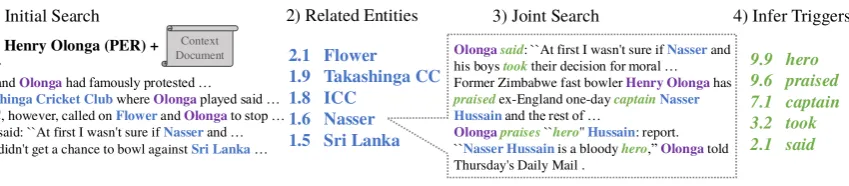
Figure 1: High level steps of the PKB construction process. Example PKBs can be found in Table 3. The first two steps of initial search and related entities are described in§3.1, the third step of joint searching in§3.2, and finally extracting triggers in§3.3.
tion search and ad-hoc trigger extraction. PKBs resemble a hub and spoke graph where the hub is the query and nodes on the outside are related en-tities. The spokes represent mentions proving that an entity is related to the query. Traversing this graph by crossing a spoke is akin to building a new PKB with that related entity as the new hub.
PKBs are aids for “knowledge-based” search over a document collection. KBs are useful for question answering (Yao, 2014) and PKBs serve this goal because related entities are good answer candidates for questions about a query. SF KBs are specialized to the case where you know the questions ahead of time, like “Where does Mary
work?” and “Who isACME’sparent company?”. PKBs offer a set of answers for queries with clues as to their relationship, like Marc Bolland and
Stuart Rose are related because of events de-scribed using the word replaced. KBs are also useful information retrieval (IR) tools (Dietz and Schuhmacher, 2015) for human guided corpus ex-ploration. PKBs serve this goal by providing ranked lists of related entities and over the men-tions describing their relamen-tionship to the query.
We describe a system which achieves the goals of PKBP using low-resource and unsupervised methods. We discuss how PKBs are built in §3 and evaluate their quality in§4 on SF queries.
3 Construction
There are three steps to PKB construction: §3.1 discovering related entities,§3.2 finding men-tions of the query and related entities, and§3.3 ex-tracting trigger word explanations.
3.1 Discovering Related Entities
Candidate related entities are collected by search-ing for mentions of the query and taksearch-ing other mentions which appear in the results. This process is similar to cross document entity coreference and
we adopt the vector space model (Bagga and Bald-win, 1998). First, triage featuresare used to lo-cate sentences in an inverted index, including the mention headword and all word unigrams and bi-grams (case sensitive and insensitive).
Next, we use context features: a word uni-gram tf-idf vector. We implement a compromise between Cucerzan (2007) (used sentences before, after, and containing a mention) and Bagga and Baldwin (1998) (used any sentence in a corefer-ence chain). Instead of running a corefercorefer-ence re-solver, we use the high-precision heuristic of link-ing mentions with the same headword and NER type. Terms are weighted as 2
1+d where dis the distance in sentences to the nearest mention.
Our attribute features are a generalization of Mann and Yarowsky (2003). They train a few ad-hoc relation extractors likebirth year and occupationfrom seed facts. Their extractions provide high-precision signal for merging entity mentions. We found extracting allNNP*or capi-talizedJJ*words within 4 edges in a dependency tree was less sparse, requires no seeds, and pro-duced similar quality attributes. We union these attributes across mentions found by the headword and NER type coreference heuristic to build a fine-grain tf-idf vector. We use the same 2
1+d re-weighting for attributes, except wheredis the
distance in dependency edges to the entity men-tion head. The closest attributes are descriptors within a noun phrase likeHEAD-nn-Dr.. We in-clude the NER type of the headword to distinguish between attributes likePERSON-nn-American andORGANIZATION-nn-American.
Given the triage featurest(m), context features
c(m), and attribute featuresa(m), we search for
mentionsmwhich maximize
(1 +αtcosθt)(1 +αccosθc)(1 +αaθa)
t(mquery) andt(m). We only consider the sub-set of mentions that havecosθt>0, which can be efficiently retrieved via an inverted index.
Any mention with a score higher thanτ is
con-sidered coreferent with the query. We extract men-tions in the same sentences as the query as candi-date related entities if they have an NER type of PER, ORG, or LOC. We link candidate mentions against entities in the PKB using the same coref-erence score used to retrieve query mentions. If a candidate’s best link has a score s < τ, we
pro-mote it to an entity and add it to the PKB with probability1−sτ.2
3.2 Joint Linking of Related Entities
At this point there are on the order of 100 mentions of the query and 20 to 50 related entities.3 For each entity, we perform a joint search for it and the query. These entity co-occurrences will form the spokes in the PKB and be used to characterize the relationship between and relatedness to the query. Joint entity searches are similar to single-mention searches in §3.1 with two differences. First, instead of having a single mention to com-pute feature vectors from, there are multiple. Fea-ture vectors for entities are built up from men-tions, where the weight of a mentionw(m) = ρb
forρ ∈ (0,1)andbis how many mentions were
linked beforem. Second, we are scoring mention
pairs (with both mentions in the same sentence) as the geometric mean of the coreference scores of both links. The coreference score function does not need to change, but the triage step does: we only consider sentences which havecosθt>0for both the query and the related entity and use the sameτ. Entity relatedness is a function of how
of-ten entities are mentioned together. We modeled it as the sum of the joint entity linking probabilities, where the probability of a link is logit−1(s
τ). 3.3 Trigger Word Analysis
At this stage we have found on the order of 2 to 20 sentences which mention the query and a related entity which will be used to determine the rela-tion between them. There is work on rule-based (Banko et al., 2007; Fader et al., 2011; Angeli et al., 2015), supervised (Mausam et al., 2012), 2Mentions with a score nearτ may be coreferent, so we prefer low scoring mentions to avoid over-splitting entities.
3These values depend on the query (which are more or less rare in a corpus) and pruning thresholds (for our experi-ments we stop at 100 query mentions)
and distantly-supervised (Mintz et al., 2009) meth-ods for characterizing relations in text. Our method is similar to distant supervision, where a KB of known facts is used to infer how relations are expressed, but we use supervision from the KB being constructed. We cast the problem of charac-terizing a relation as a search for trigger words. We state our priors on trigger words and condition on the data to find likely triggers.
Predicate (triggers) and arguments are syntac-tically close together. Assuming the related en-tity mention heads are arguments, we compute the probability that these two random walks in a de-pendency tree end up at the same token. This serves as a weak syntactically informed prior.
Information is conveyed as a surprisal under a background distribution (codebook).We compute a unigram distribution over words which are likely under our syntactic prior for triggers (conditioned on the NER type of the two arguments). We use this marginal distribution as a codebook. We di-vide out this codebook probability in every pair of related entity mentions in the PKB giving a cost in bits (log probability ratio) of each trigger word.
Repetition indicates importance. We sum the costs for each trigger across sentences. We weaken this assumption by averaging the max and the sum for each trigger for the final score.
This process yields a score for every trigger word, and we use the topktriggers to characterize
the relationship between entities. For each trigger we keep, we also maintain provenance informa-tion for meninforma-tions using a given trigger.
4 Experiments
We use the TAC SF13 query entities to evaluate our methods; 50 person and 50 organization en-tities are used as queries to construct 100 PKBs. 70 of the 100 query entities were NIL (26/60 PER and 44/50 ORG), meaning that they do not appear in the TAC KB, though our methods aren’t in prin-ciple sensitive to this because they create entities on the fly. We use annotated versions of Giga-word 5 (Parker et al., 2011; Ferraro et al., 2014) and English Wikipedia (February 24, 2016 dump) to construct our PKBs.4We use Amazon Mechan-ical Turk workers as annotators. We generated our PKBs withτ = 15,ρ = 0.5,αt = 40,αc = 20, andαa= 10. These constants were tuned by hand
and are not sensitive to small changes. We take a subset of the PKB which covers the 15 most re-lated entities and the one-best trigger for each. We call these “explanations” where each is a sentence with three labels: a) a mention of the query mq,
b) a mention of the a related entity mr, and c) a
trigger wordt.
Entity Linking and Relatedness For each ex-planation, we ask: COREF: Does the query men-tion refer to the same entity asmq? RELATED: Is the query entity meaningfully related to the ref-erent of mr? These annotations are not done by
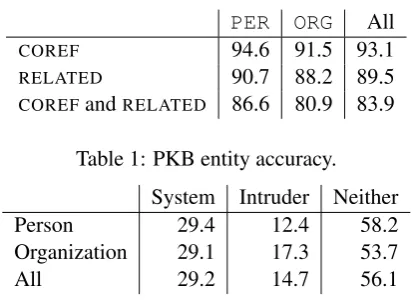
the same annotators to avoid confirmation bias. Worried annotators might be lulled into thinking all COREF instances were true, we made the task ternary by adding an intruder entity (randomly drawn from SF13 queries). Annotators were shownmq and could choose coreference with the query, the intruder, or neither.5 We drop annota-tions from annotators who chose an intruder6 be-cause we know these to be incorrect, and compute accuracy as proportion of the remaining annota-tions which chose the query.
RELATEDwas posed as a binary task of whether
mr is more related to the query or the intruder (without highlighting mq). In positive cases, the
annotator should observe that sentence shown con-tains a mention of the query entity and explains why they are related. The results are in Table 1.
Our system retrieves coreferent and related mentions with high accuracy. For coreference, mistakes usually happen when there is signifi-cant lexical overlap but some distinguishing fea-ture that proves too subtle for our system to doubt the match, likeMidwest High Speed Rail Asso-ciationvsU.S. High Speed Rail Associationor
[English] Nationwide Building SocietyvsIrish Nationwide Building Society.
For relatedness, the biggest source of errors are news organizations listed as related entities be-cause it is common to see sentences like “
Mo-hammed Sobeih, Moussa’s deputy, told The
As-sociated Press on Monday that...”. Future work might address this problem by using normalized measures of statistical relatedness like PMI rather than raw co-occurrence counts.
Trigger Words To evaluate the informativeness of chosen triggers, we present annotators withmq,
5The order of the intruder and the query were randomized. 6This affected 6.1% ofCOREFannotations.
PER ORG All
COREF 94.6 91.5 93.1
RELATED 90.7 88.2 89.5
[image:4.595.313.519.58.209.2]COREFandRELATED 86.6 80.9 83.9
Table 1: PKB entity accuracy. System Intruder Neither
Person 29.4 12.4 58.2
Organization 29.1 17.3 53.7
All 29.2 14.7 56.1
Table 2: Related entity trigger identification.
mr, and two potential trigger words highlighted.
One trigger is chosen according to §3.3 and the other is anNN*|VB*|JJ*|RB*word in the pro-jection of the dependency node dominating both entities.7 The annotator may choose either trigger as a good characterization of the situation involv-ingmqandmr, or label neither as sufficient. Note that this baseline is strong: it shares the entity link-ing (§3.2), trigger sentence selection (§3.3), and dependency parse tree as our system. We report the results in Table 2.
Our method is chosen about twice as often as a syntactically informed baseline, but fails to find a high quality trigger word more than half of the time. Some mistakes are caused by rare but oft-repeated words like “50” in: “Bolland,50, ... will replace Briton Stuart Rose”. “50” has nothing to do with the relationship between Bolland and Rose, but it’s repeated in 4 sentences about both of them, a stylistic coincidence our system can-not ignore. In other cases there is no word in situ which can explain entities’ relatedness, like “... the day after Wimbledon concludes, Montcourt
must serve a five-week ban and ...”. The author and the reader can likely infer that Montcourt com-petedat Wimbledon, but this fact is not explicitly committed to, limiting our systems ability to ex-tract a trigger.
Related Entities vs Slot Fillers There is no fair way to evaluate systems without a com-mon schema, but we offer some extraction statis-tics. On SF13 queries our system generated 17.6 relevant entities/query,8 each having 4.6 trigger words/pair, 2.1 mentions/trigger word, and 9.8
7If no nodes match this, we walk up the tree until we find a node which has at least one allowed descendant.
Query Entity Related Entity Triggers
Marc Bolland PER Dalton Philips PER appointed, departure, following, move
Marc Bolland PER Stuart Rose PER replace, 50, Briton
Marc Bolland PER Marks & Spencer ORG departure, CEO, become, following
Henry Olonga PER Givemore Makoni PER club, president, done, played
Henry Olonga PER England LOC cricketer, asylum, hiding, quit
Henry Olonga PER Harare LOC hiding, armbands, wore
Mohammad Oudeh PER Munich LOC massacre, briefed, defended
Mohammad Oudeh PER Fatah Revolutionary Council ORG faction, belonged, return
Mohammad Oudeh PER Gaza Strip LOC allows, asked, host
A123 Systems LLC ORG Fisker ORG supplier, struck, recall, owns
A123 Systems LLC ORG Watertown, Massachusetts LOC produces, batteries, company
A123 Systems LLC ORG Obama PER plant, opening, Granholm
United Steelworkers of America ORG Curt Brown PER spokesman, rejected, contracts
United Steelworkers of America ORG Wayne Fraser PER negotiator, spokesman, union
United Steelworkers of America ORG Jerry Fallos PER boss, broke, shut, local
BNSF ORG Santa Fe LOC asked, vote
BNSF ORG Chapman ORG venture, help, transition, joint
[image:5.595.74.520.62.271.2]BNSF ORG Robert Krebs PER Burlington, chairman
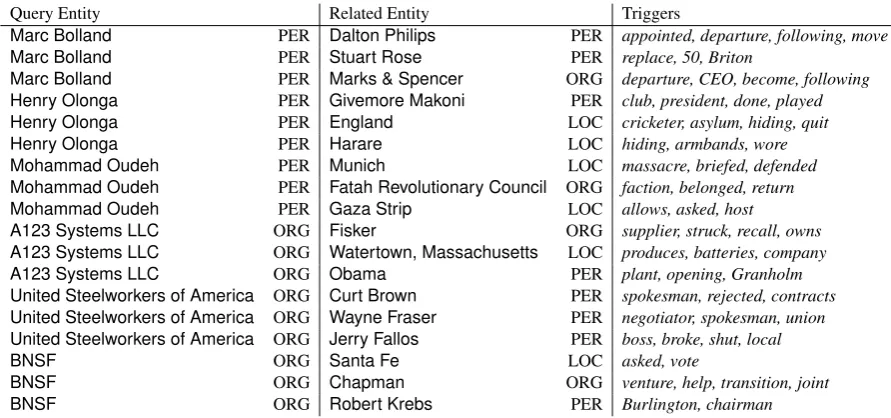
Table 3: Examples of slices of PKBs for the three most related entities for six queries and the best triggers for each pair. Supporting sentences for related entities and trigger words are not shown.
mentions/pair. In extractions fromall systems in the SF13 evaluation (pooling answers, filtering out incorrect), they filled 6.0 slots/query with 14.2 fillers/query and 38.3 mentions/query as prove-nance. Some slots have string-valued fillers, but many could be related entities in the PKB sense. In these cases, we found 2.2 entities/query over-lapping, 1.7 fillers not in their corresponding PKB and 10.8 related entities which weren’t fillers.
5 Related Work
Blanco and Zaragoza (2010) study the informa-tion retrieval problem of findingsupport sentences which explain the relationship between a query and an entity, which is similar to this work. Our work addresses two new aspects of this problem: 1) how to automatically find related entities, which are assumed given in that work and 2) how to find the salient parts of support sentences (trigger words) by aggregating evidence across sentences.
This work shares goals with Dalton and Di-etz (2013) and DiDi-etz and Schuhmacher (2015), who create “knowledge sketches”: distributions over documents, entities, and relations related to a query. The primary difference is that our work creates a KB instead of returning results from an existing one. They use Freebase for relations and Wikipedia for anchor text and links. Our approach uses parsed and NER tagged text.
Open vocabulary characterization of entities was investigated by Raghavan et al. (2004). They found intersecting entity language models yields
common descriptors. Their notion of similarity (e.g. Ronald Reagan and Richard Nixon are bothpresidents) is different from our notion of re-latedness (e.g. Alexander Haig andPrinceton, NJare related viaMeredith– Haig’s sister).
Finally other work has used Open IE for SF KBP. Soderland et al. (2013) and Finin et al. (2015) manually created a mapping between the Ollie (Mausam et al., 2012) and SF schemas. An-geli et al. (2015) perform OpenIE and then map between their schema and SF with PMI2.
6 Conclusion
We propose Pocket Knowledge Base Popula-tionfor dynamically building dense entity-centric KBs. We evaluate our methods on SF queries and find high accuracies of related entity discovery and coreference. We propose novel Open Informa-tion ExtracInforma-tion methods which leverage the PKB to identify trigger words and show they are effec-tive at explaining related entities. In future work we hope to use PKBs for tasks like QA and IR.
Acknowledgments
References
Gabor Angeli, Melvin Jose Johnson Premkumar, and Christopher D. Manning. 2015. Leverag-ing lLeverag-inguistic structure for open domain informa-tion extracinforma-tion. In Proceedings of the 53rd An-nual Meeting of the Association for Computa-tional Linguistics and the 7th InternaComputa-tional Joint Conference on Natural Language Processing (Vol-ume 1: Long Papers). Association for Computa-tional Linguistics, Beijing, China, pages 344–354. http://www.aclweb.org/anthology/P15-1034.
Amit Bagga and Breck Baldwin. 1998. Entity-based cross-document coreferencing using the vec-tor space model. In Proceedings of the 36th Annual Meeting of the Association for Compu-tational Linguistics and 17th International Con-ference on Computational Linguistics - Volume 1. Association for Computational Linguistics, Stroudsburg, PA, USA, ACL ’98, pages 79–85. https://doi.org/10.3115/980845.980859.
Michele Banko, Michael J. Cafarella, Stephen Soderland, Matt Broadhead, and Oren Et-zioni. 2007. Open information extraction from the web. In Proceedings of the 20th Interna-tional Joint Conference on Artifical Intelligence. Morgan Kaufmann Publishers Inc., San Fran-cisco, CA, USA, IJCAI’07, pages 2670–2676. http://dl.acm.org/citation.cfm?id=1625275.1625705.
Roi Blanco and Hugo Zaragoza. 2010. Finding sup-port sentences for entities. In Proceedings of the 33rd International ACM SIGIR Conference on Re-search and Development in Information Retrieval. ACM, New York, NY, USA, SIGIR ’10, pages 339– 346. https://doi.org/10.1145/1835449.1835507.
Silviu Cucerzan. 2007. Large-scale named entity dis-ambiguation based on Wikipedia data. In Pro-ceedings of the 2007 Joint Conference on Em-pirical Methods in Natural Language Processing and Computational Natural Language Learning (EMNLP-CoNLL). Association for Computational Linguistics, Prague, Czech Republic, pages 708– 716. http://www.aclweb.org/anthology/D/D07/D07-1074.
Jeffrey Dalton and Laura Dietz. 2013. Con-structing query-specific knowledge bases. In Proceedings of the 2013 Workshop on Auto-mated Knowledge Base Construction. ACM, New York, NY, USA, AKBC ’13, pages 55–60. https://doi.org/10.1145/2509558.2509568.
Laura Dietz and Michael Schuhmacher. 2015. An in-terface sketch for queripidia: Query-driven knowl-edge portfolios from the web. In Krisztian Ba-log, Jeffrey Dalton, Antoine Doucet, and Yusra Ibrahim, editors, Proceedings of the Eighth Work-shop on Exploiting Semantic Annotations in Infor-mation Retrieval, ESAIR 2015, Melbourne, Aus-tralia, October 23, 2015. ACM, pages 43–46. https://doi.org/10.1145/2810133.2810145.
Anthony Fader, Stephen Soderland, and Oren Etzioni. 2011. Identifying relations for open information extraction. InProceedings of the Conference on Em-pirical Methods in Natural Language Processing. Association for Computational Linguistics, Strouds-burg, PA, USA, EMNLP ’11, pages 1535–1545. http://dl.acm.org/citation.cfm?id=2145432.2145596.
Francis Ferraro, Max Thomas, Matthew R. Gorm-ley, Travis Wolfe, Craig Harman, and Benjamin Van Durme. 2014. Concretely annotated corpora. InThe NIPS 2014 AKBC Workshop.
Tim Finin, Dawn Lawrie, Paul McNamee, James May-field, Douglas Oard, Nanyun Peng, Ning Gao, Yiu-Chang Lin, Josh MacLin, and Tim Dowd. 2015. Hlt-coe participation in tac kbp 2015: Cold start and tedl. InText Analytics Conference (TAC).
Gideon S. Mann and David Yarowsky. 2003. Unsu-pervised personal name disambiguation. In Pro-ceedings of the Seventh Conference on Natural Language Learning at HLT-NAACL 2003 - Vol-ume 4. Association for Computational Linguistics, Stroudsburg, PA, USA, CONLL ’03, pages 33–40. https://doi.org/10.3115/1119176.1119181.
Mausam, Michael Schmitz, Robert Bart, Stephen Soderland, and Oren Etzioni. 2012. Open language learning for information extraction. In Proceed-ings of the 2012 Joint Conference on Empirical Methods in Natural Language Processing and Computational Natural Language Learning. Asso-ciation for Computational Linguistics, Stroudsburg, PA, USA, EMNLP-CoNLL ’12, pages 523–534. http://dl.acm.org/citation.cfm?id=2390948.2391009.
Mike Mintz, Steven Bills, Rion Snow, and Dan Ju-rafsky. 2009. Distant supervision for relation ex-traction without labeled data. In Proceedings of the Joint Conference of the 47th Annual Meeting of the ACL and the 4th International Joint Conference on Natural Language Processing of the AFNLP: Volume 2-Volume 2. Association for Computational Linguistics, pages 1003–1011.
Robert Parker, David Graff, Junbo Kong, Ke Chen, and Kazuaki Maeda. 2011. English gigaword fifth edi-tion, linguistic data consortium. Technical report, Technical report, Technical Report. Linguistic Data Consortium, Philadelphia.
Hema Raghavan, James Allan, and Andrew McCallum. 2004. An exploration of entity models, collective classification and relation description .
Stephen Soderland, John Gilmer, Robert Bart, Oren Et-zioni, and Daniel S Weld. 2013. Open information extraction to kbp relations in 3 hours. InTAC.