Effective and inclusive practices in family
literacy, language and numeracy: a review
of programmes and practice in the UK
and internationally
Welcome to CfBT Education Trust
The National Research and Development Centre for Adult Literacy and Numeracy (NRDC) was founded in 2002 as a cornerstone of the Government’s Skills for Life strategy in England.
The Centre’s work is supported financially by DIUS and a range of other organisations.
Our remit is to provide underpinning evidence and practical guidance for teacher educators, teachers and other professionals. We are working to help improve the quality of teaching and learning so that young people and adults can progress, achieve and develop the skills and knowledge they need to succeed in life and work and for policy development.
NRDC is a consortium, led by the Institute of Education, University of London. It brings together the best United Kingdom researchers in the field, together with expert and
experienced development professionals and a wide range of talented practitioners.
The partners are:
• Institute of Education, University of London • Literacy Research Centre, Lancaster
University
• School of Continuing Education, University of Nottingham
• School of Education, University of Sheffield • East London Pathfinder
• Liverpool Lifelong Learning Partnership CfBT Education Trust is a leading charity
providing education services for public benefit in the UK and internationally. Established 40 years ago, CfBT Education Trust now has an annual turnover exceeding £100 million and employs more than 2,000 staff worldwide who support educational reform, teach, advise, research and train.
Since we were founded, we have worked in more than 40 countries around the world. Our work involves teacher and leadership training, curriculum design and school improvement services. The majority of staff provide services direct to learners in schools or through projects for excluded pupils, in young offender institutions and in advice and guidance for young people.
We have worked successfully to implement reform programmes for governments throughout the world. Current examples
include the UK Department for Children, Schools and Families (DCSF) Programme for Gifted and Talented Education and a nationwide teacher training programme for the Malaysian Ministry of Education.
Other government clients include the Brunei Ministry of Education, the Abu Dhabi Education Council, aid donors such as the European Union (EU), the Department for International Development (DfID), the World Bank, national agencies such as the Office for Standards in Education (Ofsted), and local authorities.
Surpluses generated by our operations are reinvested in educational research and development. Our new research programme – Evidence for Education – will improve educational practice on the ground and widen access to research in the UK and overseas.
Visit www.cfbt.com for more information.
The views and opinions expressed in this publication are those of the authors and do not necessarily represent the views of CfBT Education Trust.
• Basic Skills Agency at NIACE • Learning and Skills Network
• LLU+, London South Bank University • National Institute of Adult Continuing
Education, including the Basic Skills Agency • King’s College London
• University of Leeds
Information about NRDC’s research and development programmes and projects can
be found on www.nrdc.org.uk
© The University of Sheffield is a member of the NRDC consortium, and its School of Education is one of Britain’s leading centres of research on family literacy, language and numeracy, and on literacy more generally. In addition to Greg Brooks and Kate Pahl, researchers in these areas currently or recently based there include Prof. Peter Hannon, Prof. Jackie Marsh, Prof. Cathy Nutbrown, Dr Maxine Burton, Dr Julia Davies, Dr Kath Hirst, Dr Anne Morgan
(née Kirkpatrick, now at Sheffield Hallam University), Dr Andrey Rosowsky and Dr Jo Weinberger. Particularly influential has been Peter Hannon and Cathy Nutbrown’s ORIM model, analysing family literacy in terms of parents providing Opportunities for their children’s literacy development, Recognition of their children’s literacy practices, Interaction with children to develop their literacy, and
This review is dedicated to the memory of Sheila Wolfendale.
Rosa
Why I didn’t do the homework Because the phone is ringing The door is noking
The kid is yumping The food is burning Time runs fast.
Rosa (Auerbach 1989)
Lem
Way far Now
It a Church bell Ringin’ Dey singin’ You hear it? I hear it Far Now
Contents
List of Figures 7
List of Tables 7
Project team 8
Acknowledgements 8
Independent peer review 8
Executive summary 9
Greg Brooks
1 Origins, aims and scope of the review 11
Greg Brooks and Kate Pahl
1.1 Origins of the review 11
1.2 Aims 11
1.3 Scope 11
2 Values, history, definitions, typologies and rationales 12 Kate Pahl
2.1 Values of the study 12
2.2 Family literacy, language and numeracy programmes: a brief history 12
2.2.1 Family literacy 12
2.2.2 Family numeracy 15
2.2.3 Family language (English for speakers of other languages, ESOL) 15
2.3 Definitions, typologies and rationales for family literacy, language and 16
numeracy programmes
2.3.1 ‘Family literacy’ 16
2.3.2 What is literacy? Literacy and literacies 16
2.3.3 What is numeracy? 17
2.3.4 Questions and challenges over definitions 17
2.3.5 Typologies of family literacy programmes 17
2.3.6 Rationale for programmes 18
3 Analysis of the quantitative evidence 20
Greg Brooks with Felicity Rees and Alison Pollard
3.1 What is a meta-study? 20
3.2 This meta-study 20
3.3 The projects covered 20
3.4 The analyses 21
3.5 Findings 24
3.6 Benefits for parents 28
3.7 Benefits for children 28
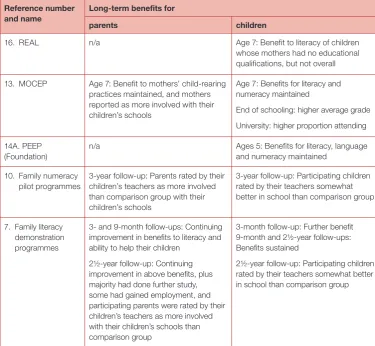
3.8 Long-term benefits 29
4 Qualitative analysis of the international projects 32 Kate Pahl
4.1 Introduction 32
4.2 Canada 32
4.3 Europe 33
4.3.1 Parent Empowerment through Family Literacy: a European initiative 33
4.3.2 QualiFLY: a European project on family literacy 34
4.4 Nepal 36
4.5 New Zealand 37
4.6 South Africa 38
4.7 Uganda 41
4.8 USA 41
4.8.1 The Verizon OPTIONS Initiative, Santa Barbara, California 41
4.8.2 Project FLAME, Chicago 43
4.8.3 MAPPS Math And Parent Partnerships, South Western States 44
4.9 Conclusion to qualitative international survey: drawing the threads together 45
5 Family literacy, language and numeracy provision in
England and Wales: an overview 47
Kate Pahl
5.1 Introduction 47
5.2 Skills for Families 47
5.3 Keeping Up with the Children 49
5.4 Early Start 50
5.5 Family literacy and language programmes within Sure Start 50
5.6 Family numeracy 52
5.7 IMPACT 53
5.8 Bookstart and Books for Babies 54
5.9 Reading is Fundamental, UK 55
5.10 The REAL Project, Sheffield 55
5.11 PEEP (Peers Early Education Partnership), Oxford 56
5.12 Fathers’ projects 57
5.13 Drawing together some threads: the picture in England and Wales 58
5.13.1 The Basic Skills Agency 58
5.13.2 Family literacy, language and numeracy as delivered by local authorities 59
5.13.3 Initiatives funded through the private sector, charities and voluntary sector 60
5.13.4 Sure Start 60
5.13.5 Literacy and literacies 60
5.13.6 Some future directions 61
6 Conclusions and implications 62
Greg Brooks
Appendices 71
Appendix A: The detailed quantitative analyses 72
Greg Brooks with Felicity Rees and Alison Pollard
Appendix B: Outline details of the programmes analysed qualitatively in chapter 4 137
Kate Pahl
Appendix C: Continuing debates and some emerging principles 143
Kate Pahl
Debate number 1: Family literacy: rhetoric or research? 143
Debate number 2: The causal possibilities of FLLN programmes 143
Debate number 3: Do family literacy programmes perpetuate a 144
normative, middle-class version of schooling?
Debate number 4: Whose literacies are being supported by 145
family literacy programmes?
Debate number 5: Whose numeracies are being supported by 147
family numeracy programmes?
Debate number 6: Whose languages are being supported by 148
family language programmes?
Debate number 7: What kinds of families are being supported by 149
FLLN programmes?
Debate number 8: Whose cultures are being supported by 150
FLLN programmes?
Productive pedagogies and principles of family literacy, language and 151
numeracy programmes
Table 1 The projects analysed quantitatively, and basic information about them 22
Table 2 Summary of findings from the quantitative analyses 25
Table 3 Summary of follow-up findings from the quantitative analyses 30
Table 4 Overview of approved FLLN courses in England, 2005/06 48
List of Tables
Figure 1 Development of family literacy practice in England 13
Figure 2 The ORIM framework 14
[image:7.595.174.554.141.433.2]Project team for this meta-study
Acknowledgements
Independent peer review
Prof. Greg Brooks, project director Dr Kate Pahl (February–November 2006) Alison Pollard (March–July 2005) Felicity Rees (March–July 2005)
The report was read and independently peer-reviewed by: This report, and the handbook based on the
research project, were supported by a number of key people and organisations. We would like to thank the members of the FLLN Advisory Group, chaired by Carol Taylor of the Basic Skills Agency, who gave us substantial and rigorous feedback on our research. This report could not have been prepared without the substantial support of the following:
Musseret Anwar, CETS Croydon Beryl Bateson, Birmingham LA
Dave Baker, Institute of Education, University of London
Viv Bird, National Literacy Trust
Snoeks Desmond, Family Literacy Project, KwaZulu-Natal
Peter Hannon, University of Sheffield Rachel Hodge, Lancaster University Nan Jackson, Rochdale LA
Wendy Leak, Rotherham Central Sure Start Desiree Lopez, NRDC, Institute of Education, University of London
Yvonne Spare, University of Sheffield Carol Taylor, Basic Skills Agency at NIACE We particularly thank the Research and Development team at CfBT for supporting us and working with us throughout the project.
Elaine McCann Bernadette Lawlor Jeanne Haggart Jeff Evans John Vorhaus Andrea Mearing
Executive summary
Context
This study – a meta-study – was commissioned by CfBT Education Trust, and funded by CfBT and the National Research and Development Centre for Adult Literacy and Numeracy (NRDC).
The aims of the meta-study were to
• conduct a UK-wide and international review of family literacy, language and numeracy (FLLN) programmes and practice
• develop an international perspective on effective practices in FLLN, looking both at how literacy, language and numeracy are enhanced by programmes, and also at how families’ wider outcomes are enabled • identify criteria for promising practice and
models of inclusive and diverse FLLN delivery for wide dissemination.
A ‘meta-study’ was taken to include a quantitative and qualitative review, based on studies exhibiting a wider range of research designs than would contribute to a systematic review. This study is based on evidence not only from Britain but also from Canada, Germany, Nepal, New Zealand, South Africa, Turkey, Uganda, the USA, and from a six-nation initiative led by Malta which also involved Belgium, England, Italy, Lithuania and Romania.
Scope of the study
An inclusive stance was taken towards what should be counted as a family, and to the range of practices to be classed as literacy, oracy and numeracy. Holistic and community approaches, and formal and informal learning, were all considered. In multilingual situations a key value of providers and learners is respect for, and building on, learners’ first language.
When first introduced into Britain in the mid-1990s, two-generation FLLN programmes went through a period of fairly detailed central prescription, but since about 2000 the range of programmes has diversified. This review covers not only two-generational approaches but any that acknowledge participants as members of a family. A widespread
assumption of two-generation FLLN
programmes is that they not only benefit both parents and children but benefit them more than stand-alone programmes.
Findings: quantitative evidence
Most family programmes aim to improve the ability of parents to help their children’s education. Eight studies report these benefits: • Family numeracy pilot programmes
• Bookstart in Birmingham
• Family literacy demonstration programmes • Early Start
• Family literacy for new groups
• Family literacy and numeracy in prisons • FLAME
• Ħilti clubs
Parents also benefit in their ability to help their children in wider ways, including:
• mothers’ child-rearing practices • parents’ employment
• parents’ self-confidence
• parents being more involved with their children’s schools.
There is good evidence of benefits to children’s skills, as compared with parents’:
• literacy: 12 studies reported benefits from test data
• language: eight studies reported benefits from test data
• numeracy: six studies reported benefits from test data.
For all three skills the evidence is mixed, and firmer evidence is desirable.
Impressive results are quoted where programmes worked with mothers in a ‘traditional’ family setting. Programmes such as FLAME in Chicago and MOCEP in Turkey may involve literacy and numeracy, but are part of a broader vision of the role of the parent – community integration and involvement in FLAME, health and child-rearing in MOCEP. Similar insights are found in Nepal and South Africa.
No quantitative study has yet been carried out into whether:
• two-generation FLLN programmes benefit both parents and children
• parents in FLLN programmes make better progress than they would in stand-alone adult basic education programmes • some approaches to family literacy or
language or numeracy are more successful than others.
Findings: qualitative evidence
The FLLN field in England and Wales is vibrant, and more varied than ever before. It has also: • provided inspiration for some of the
increasing number of interesting and effective programmes elsewhere in the world
• contributed at home to parents’, especially mothers’, empowerment through learning, and improved children’s educational prospects.
Research and development was led by the Basic Skills Agency in the field in both England and Wales in the mid and late 1990s, and it has continued to do so in Wales. In England its role has now diminished and has not been taken up in full by any other organisation; leadership for the field remains a pressing issue.
Provision in England through local authorities and the private, charitable and voluntary sectors is excellent in some places and patchy in others.
The role of local authorities remains critical in shaping and delivering policy and practice. Flagship authorities can lead the way in listening to families, taking account of their linguistic and cultural resources, and developing a framework for delivery.
The strength of many UK programmes lies in the complex, community-focused partnerships they encouraged.
• Initiatives such as Shared Beginnings worked at grassroots level to encourage book sharing with young children.
• Local Sure Start initiatives reached across different agencies to work together.
Relatively new international programmes (such as Hamburg, part of the QualiFLY project) are actively working in a multimodal way, drawing on a multiple range of modes to deliver their work.
• Digital storytelling features as a theme in programmes such as the Verizon OPTIONS programme, and has also been described as a key feature of family literacy programmes in Toronto.
• There is some evidence that this is
happening in Britain too, and this opens up possibilities for attractive new programmes. • At the same time, evaluation strategies in
rural South Africa and Nepal also rely heavily on visual methods and oral storytelling.
In multilingual situations a key value of providers and learners is respect for and building on learners’ first languages.
1.1 Origins of the review
This whole project was commissioned by CfBT Education Trust, and funded mainly by CfBT, with a contribution of about one third of the overall cost from the National Research and Development Centre for Adult Literacy and Numeracy (NRDC), which also carried it out. The project began in April 2005 and ran until December 2006. It was a collaboration between researchers at the Institute of Education, University of London, at Lancaster University and at the University of Sheffield. There were also strategic and crucial contributions from partners in Birmingham, Croydon, Derbyshire (Read On – Write Away!), Rochdale and Staffordshire local authorities – see the accompanying report on the case studies and self-reporting sites. This section of the project, the review of which has taken the form of a meta-study with both quantitative and qualitative aspects, was carried out entirely by researchers at the University of Sheffield.
1.2 Aims
The primary aim of this project as a whole was to identify and support effective and inclusive family literacy, language and numeracy practices.
The aims of this section of the project were to • conduct a UK-wide and international review
of family literacy, language and numeracy (FLLN) programmes and practice
• develop an international perspective on effective practices in FLLN, looking both at how literacy, language and numeracy are enhanced by programmes, and also at how families’ wider outcomes are enabled • identify criteria for promising practice and
models of inclusive and diverse FLLN delivery for wide dissemination.
It was hoped that an international comparative approach would advance understanding of promising practice, both in the UK and elsewhere, and contribute to an understanding of increasingly diverse conceptions of families and their literacy, language and numeracy learning. The review was also intended to contribute to an understanding of the historical development of FLLN, and the political context for learning practices in each country included in the review.
1.3 Scope
Chapter 2 addresses the history of family literacy provision in the UK and the USA, incorporates a discussion of definitions of FLLN, and includes sections on values, typologies and rationales for the field. The next three chapters present the findings of
• quantitative analyses of FLLN programmes from the UK and elsewhere (chapter 3); this chapter also presents our definition of a meta-study
• qualitative analyses of FLLN programmes from the rest of the world (chapter 4), and • qualitative analyses of FLLN programmes
from the UK (chapter 5).
Some conclusions and implications for policy and practice are presented in chapter 6, and a number of continuing debates and emerging principles in the field are discussed in Appendix C.
Chapter 1: Origins, aims and scope
of the review
Greg Brooks and
Kate Pahl
This section
of the project, the
review which has
taken the form of
a meta-study with
both quantitative
and qualitative
aspects, was
carried out entirely
by researchers
at the University
of Sheffield.
‘‘
2.1 Values of the study
The research team took an inclusive approach to the family, in respect of age, gender, size and diversity of culture and ways of living and working. Since the 1990s, there has been a great amount of provision which has explored with families what they do with literacy, language and numeracy (LLN) in supportive and diverse ways, best exemplified by a number of surveys the National Literacy Trust conducted during that period that revealed these initiatives (Hannon and Bird 2004).
It is essential to understand and value family learning and informal learning as ways of participating in and practising LLN and learning. At present, family learning and informal learning are poorly understood, and the informal and creative ways in which families learn literacy, language and numeracy remain under-explored. A primary feature of the context for this work is the growing migration and displacement of peoples, and the changing structures, circumstances and ways of living for families in the early 21st century. For example, we have to understand the needs and circumstances of refugees and other vulnerable communities in order to make a positive and practical response to their literacy, language and numeracy needs and also engage with the LLN practices of families, and to understand what learning they want and need.
Citizenship is a further central dimension: families are part of communities and essential to community development and vibrant social capital. The starting point of good practice in FLLN is to appreciate and to build on the richness and variety of literacy and language activity at home.
2.2 Family literacy, language and
numeracy programmes: a
brief history
This section offers a brief overview of the history of FLLN programmes. As the report
shows, the history of these has then to be set in context, in relation to values, definitions and perceptions of the field. This is an introduction for those interested in the broad history of the programmes in the USA and UK.
2.2.1 Family literacy
Hannon and Weinberger (2003) suggested that the concept of family literacy originated in the United States. The phrase itself was first used as a term of description by Taylor (1983). When programmes to support and develop family literacy were developed in the USA, they were specifically organised through the Even Start programmes, which were funded through the US Department of Education. Nickse (1993) estimated that there were then already more than 500 family literacy projects in operation in the USA, funded federally.
A model that was developed in the USA, but imported to the UK, was the Kenan model of family literacy, which originated in Louisville, Kentucky and was promoted by the National Center for Family Literacy. This model was intensive (three or four days a week), and long term (over a school year), and focused on low-literacy parents and their preschool children. It included Adult Basic Education for parents, quality ‘High/Scope’ preschool education for children, parent education, and time for parents and children to engage in shared activities (Hannon and Weinberger 2003).
In a survey of family literacy carried out by Hannon and Bird (2004), three studies were described that referred to activity in the USA, namely Morrow (1995), Purcell-Gates (2000) and Wasik, Dobbins and Herrmann (2001). Hannon and Bird also referred to reviews by Hannon (1995) and Wolfendale and Topping (1996) in Britain, as well as Cairney (2002) who looked at family literacy programmes in Australia. Hannon and Bird also reported on activity in Canada, France, Spain, Greece, New Zealand, Brazil, Mexico, and South Africa.
Chapter 2: Values, history, definitions,
typologies and rationales
Kate Pahl
At present,
family learning and
informal learning are
poorly understood,
and the informal
and creative ways
in which families
learn literacy,
language and
numeracy remain
under-explored.
‘‘
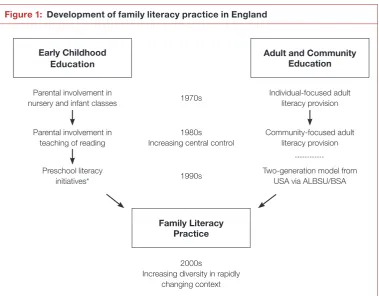
Hannon and Bird argued that the development of family literacy programmes in England can best be understood in terms of bringing together two strands – early childhood
education and adult and community education. This can be represented in a visual model (Figure 1), which is taken from the updated chapter by Hannon, Brooks and Bird (2007).
Hannon and Bird admitted that the initial focus for family literacy, and the rationale adopted by government agencies, was improving children’s literacy. This was tied to a focus on children’s literacy standards in the early 1990s, which culminated in the National Literacy Strategy, rolled out in schools from 1998. Throughout the 1990s family literacy was also growing, after the Adult Literacy and Basic Skills Unit (ALBSU) imported the Kenan model of family literacy from the United States. Following a fact-finding research tour of the USA in 1992–93, ALBSU instituted four demonstration programmes in different ‘areas of deprivation’ in England and Wales
in 1994. They were based in or near primary schools. Details of the programme content and implementation have been reported in an evaluation by NFER (Brooks et al. 1996). This study claimed that the programmes produced changes in reported home literacy activities and significant gains in the literacy achievement of both children and parents. The children began from a very low starting point in terms of measures of vocabulary and reading, with average standardised scores around 85. Gains were of the order of 5 points. Twenty to 34 months later, a follow-up study of families found that children had retained their gains, and that parents reported benefits in finding or retaining employment (Brooks et al. 1997).
[image:13.595.174.554.429.725.2]The effect of the ALBSU initiative and its associated research was to establish a national prominence for family literacy (Hannon and Bird 2004:19). Family literacy programmes began to recognise the importance of studies of emergent literacy, as well as of family literacy practices involving both children and
Figure 1: Development of family literacy practice in England
Early Childhood
Education Adult and Community Education
Parental involvement in nursery and infant classes
Parental involvement in teaching of reading
Preschool literacy initiatives*
1970s
1980s Increasing central control
1990s
Family Literacy Practice
2000s
Increasing diversity in rapidly changing context
Individual-focused adult literacy provision
Community-focused adult literacy provision
Two-generation model from USA via ALBSU/BSA
parents. Such activities as parent literacy support groups and family reading groups followed this pattern (Beverton et al. 1993). Many initiatives evolved which were valued for their diversity and for the way in which a number of communities and groups within the community, particularly women, were empowered and developed their skills further. For example, Read On – Write Away! in Derbyshire developed initiatives to support women in their family literacy programme and develop progression opportunities (Davies
et al. 2002).
As part of this development of family literacy programmes in the UK, in the years 1994–96 a co-funding scheme of grants to support some 400 smaller programmes was instituted by ALBSU. Poulson et al. (1997) studied 18 smaller family literacy programmes, but the conclusions were unclear.
In 1995 ALBSU’s remit was extended to include supporting the development of effective programmes in basic skills for children and young people and changed its name to the Basic Skills Agency (BSA). As the remit for the BSA widened, the field was also developing to understand family literacy in a wider concept. Emerging thinking on such provision was also focused on literacy, language and numeracy activity in the home. As a result of their work with families in Sheffield, Hannon and Nutbrown (1997) sought to develop a conceptual framework for family literacy activity in the home, especially that directed at children. Hannon and Nutbrown developed the ORIM framework (see Figure 2), which identified ways of working with parents and children together within the home. Hannon
and Nutbrown argued that it was possible for parents to provide the circumstances shown.
In 1993 the National Literacy Trust (NLT) was set up with the aim of working with others to enhance literacy standards; to encourage more reading and writing for pleasure by children, young people and adults; and to raise the profile of the importance of literacy in the context of social and technological change. The NLT initiated a series of surveys in order to determine the scale and scope of family literacy provision in the UK. These found that 400 initiatives could be described as family literacy initiatives out of a total of 1300 returns from their survey of literacy initiatives. The picture revealed by the surveys was of provision in a range of settings, including baby clinics, family centres, day nurseries, libraries, after-school clubs, travellers’ sites, playgroups, churches and housing schemes. Many agencies were involved, including schools, adult community colleges, further education colleges, voluntary organisations and educational business organisations, newspapers, community associations, ex-offender organisations, social services and healthcare organisations. Activities were very broad, including the making of books, puppets or story sacks, and some provided resources for parents to use at home. Accreditation was often offered through ‘Open College’ systems (Hannon and Bird 2004). These activities reflect the powerful pull of family literacy activity for parents and children and reflect the excitement many practitioners felt about working in this way with families.
The incoming Labour government in 1997 encouraged further literacy activity. As a result
Figure 2: The ORIM framework
Opportunities for their children’s literacy development (trips, visits, shopping, materials for writing, drawing, books, opportunities for play)
Recognition of their literacy practices (explicitly valuing what children do, and listening to them talking playing and writing)
Interaction with children to develop their literacy (such as spelling out words children want to write, looking at letter/sound names, helping children spell a word)
Modelling of their own literacy practices (reading signs, directions, instructions, packaging, print in the environment, writing notes, letters, shopping lists, reading newspapers)
of a new enthusiasm for government-sponsored literacy initiatives, a National Year of Reading was run by the NLT in 1998/99, and this also encouraged a wide range of provision. After the Moser report of 1999, Skills for Life was set up as a major government initiative, with the aim of tackling adult literacy and numeracy, and the result was a focus on parents’ skills in adult education.
Since the Hannon and Bird study, and as described in chapter 5, the development of Sure Start was a major government initiative in the UK. Rolling out from 1999 onwards, it has encouraged a plethora of initiatives aimed at encouraging literacy practices within families, and the REAL project in Sheffield has continued to work using the ORIM framework, with teachers and parents in homes
(Nutbrown, Hannon and Morgan 2006).
The position today is one of very diverse provision, with very different epistemological models of family literacy. Many local projects, such as the Rochdale family literacy
programmes, incorporate a focus on creativity, including art and music activities as well as digital literacies. This is partly to do with the focus on innovation instituted by Skills for Families, an initiative developed by the Basic Skills Agency to encourage innovation and training in the field of FLLN. Sure Start has also encouraged local groups to ‘take hold’ of different models of FLLN and adapt them to local contexts (Weinberger, Pickstone and Hannon 2005). This kind of approach mirrors similar work in developing countries such as Bangladesh (Rogers with Uddin 2005) which focuses on the local and vernacular as a starting point for family literacy programmes (Street 2005). In chapter 5 a further analysis of family literacy programmes within Sure Start provides the context for current policy initiatives.
2.2.2 Family numeracy
Family numeracy developed sometimes in tandem with, and sometimes independently of, family literacy. One early account of a group by Jean Milloy (1994) from Walk in Numeracy, a purpose-built centre on the White City Estate in London focusing on numeracy, described working with students to link everyday maths with ‘school maths’, and she described the content of the sessions as being focused
on how maths is taught in primary schools. Family numeracy was an add-on to the initial concept of family literacy, but focused on everyday maths. Merttens (1993) also addressed the issue of the impact of a family numeracy programme with a focus on school mathematics, showing positive results for the intervention.
Family numeracy programmes to support parents in their numeracy and to help them help their children in their numeracy development were piloted by the Basic Skills Agency between April 1997 and March 1998. The programmes were evaluated in-house in 1998, with statistical analyses by Greg Brooks and Dougal Hutchison (Basic Skills Agency 1998). The model adhered to for the programme made sure that there was a weekly joint session between parents and children, as well as separate sessions for children and parents of between one and a half and two hours. Over 500 families took part in the pilot programme. A new television series, ‘Count on Me’, was broadcast on the BBC to address this issue.
As with literacy, the Standards Fund allocated funding for family courses such as ‘Keeping Up with the Children’ as part of schools’ remit to raise numeracy standards in the late 1990s.
2.2.3 Family language (English for speakers of other languages, ESOL)
The original model of family literacy established by the Basic Skills Agency in 1994, and evaluated by NFER in 1994–5 (Brooks et al. 1996), was also aimed at multilingual families but the local programme designed to do this collapsed after a few months and provided no data. In 1997 the Agency therefore implemented a further set of family literacy pilot programmes which included adapting the model to include working with linguistic minority families where the parents had basic skills needs and the children were aged 3 to 6. The Basic Skills Agency commissioned NFER to evaluate these alternative models (Brooks
et al. 1999), and the resulting study concluded
the children made substantial progress in writing and in early literacy generally.
The same study also showed that the basic model could be successfully adapted for children in Year 4 (age 8) and their parents, but a parallel attempt to adapt it for children in Year 7 (age 11, in England the first year of secondary school) was a failure.
As family literacy programmes expanded and diversified in the late 1990s, many more programmes arose in response to local needs and were developed to enhance linguistic competences. Many of the family literacy courses described by the National Literacy Trust’s surveys of family literacy provision were aimed at multilingual parents. These included programmes in areas of linguistic diversity such as Rochdale, Birmingham, Islington, Coventry and Blackburn. Parent literacy programmes in urban areas such as Southwark built upon the linguistic capacities of the communities they served (Pahl 2000). Community-focused approaches often succeeded in supporting family language programmes (Hannon et al. 2003). The Skills for Families programme also attracted new learners in new settings, and family language programmes in areas where there was a high concentration of multilingual families were particularly successful, for example in Croydon (Pahl 2002a). Part 2 describes initiatives which were aimed at multilingual parents, in particular the programmes based in the USA aimed at Spanish-speaking parents, such as FLAME and MAPPS. The case studies, in particular the studies set in Croydon, Rochdale and Blackburn, further describe family
language programmes.
2.3 Definitions, typologies and
rationales for family literacy,
language and numeracy
programmes
2.3.1 ‘Family literacy’
It is thought that Denny Taylor coined the phrase ‘family literacy’ in 1983, and the phrase built on her understanding and recognising of diverse literacy practices within families. This is distinct from the concept of family literacy programmes. The definition of these from the
Basic Skills Agency, when they first began funding family literacy programmes in 1993, was as follows:
Family literacy programmes work with parents and their children to improve the literacy skills of both. On occasions other family members, such as grandparents, brothers and sisters, may be involved, but this is relatively rare in the more intensive programmes.
(ALBSU 1993:9)
The definition from the National Literacy Trust, which supported the development of family literacy programmes in a more diffuse way, was:
…any initiative which aims to work through parents to improve the reading and writing of their children, as well as those which have the improvement of the parents’ literacy as an aim.
‘Family literacy’ can also convey the ideas that there is pre-existing literacy activity in families, that older family members may be engaging children in those activities (and vice versa), and that in practice most programmes often do not deal with isolated individuals but with members of a family (Hannon 1999:122).
2.3.2 What is literacy? Literacy and literacies
There has been considerable debate over whether there can be a ‘settled’ definition of literacy in the context of changes in communicational practices (Kress 2003). However, there have also been clear indications that a focus on language and literacy can be tied to an alphabetic construction of literacy, and Kress and Street (2006) have agreed that to go too far into non-verbal areas where literacy is concerned is not constructive. Therefore, in this study the term ‘literacy’ relates to language and literacy practices tied to alphabetic literacy and to linguistic repertoires.
is therefore retained. It is also recognised that literacy practices within families are linked to a wide range of communicative practices including the use of narrative, and practices such as drawing and model-making. Sometimes these links are very close and ethnographies of communicative practices within families have found this to be the case (Pahl 2002a).
2.3.3 What is numeracy?
Within the numeracy field, the debate has been more about the relationship between everyday maths and numeracy. In this study, the concept of numeracy as a social practice is used, in order to draw attention to the way numeracy is used on an everyday basis within families (Street, Baker and Tomlin 2005). However, it has been argued by Street and Baker (2006) that a multimodal dimension to numeracy aids an understanding of numeracy learning in classrooms. This added dimension to numeracy is one which is of use in considering links between home numeracy practices and a multimodal understanding of learning; that is, an understanding of numeracy as being both linguistic and visual in its properties.
2.3.4 Questions and challenges over definitions
Hannon and Weinberger (2003) argued that there were some problems with the way the term ‘family literacy’ was still acquiring meanings and the way the construct ‘family literacy’ is conceived. Hannon (1999) was concerned that there was a theoretical vacuum at the heart of the definitions of family literacy and that there needed to be a reconsideration of ways of conceptualising family literacy programmes. He argued that there was no distinction currently being made between a ‘family literacy’ programme and a much broader notion of family literacy. He argued that there needed to be distinction between the concept of ‘rhetoric’ in family literacy, and the reality (1999). In some cases, the rhetoric was at odds with the reality, but was being used to drive funding for programmes. He argued that the assumptions underpinning programmes were often at odds with research findings. For example, he argued that according to family literacy research, very few, if any, families could be said totally to lack
literacy or concern for children’s development and education, yet some programmes appeared to be premised on such beliefs.
Auerbach (1989:167) had likewise noted a gap between research and implementation: existing models for family literacy programmes seemed not to be informed by ethnographic research. Both Hannon and Auerbach pointed to an urgent need for ethnographic research into family literacy practices to inform practice within family literacy programmes. By recognising that the definitions of FLLN programmes are contested, this study also opens out the scope to include a focus on research on FLLN practices, which underpins the way FLLN programmes are delivered.
2.3.5 Typologies of family literacy programmes
There appear to be no typologies of family language or numeracy programmes. Therefore, in order to clarify the way in which FLLN programmes are conceptualised, this section on typology examines different models of family literacy, drawing on work by Auerbach (1989) and Nickse (1993) in the USA.
Elsa Auerbach (1989) developed the following typology of family literacy work.
1. Parents working independently from their children on reading and writing.
2. Using literacy to address family and community problems, increasing the social significance of literacy in their lives.
3. Parents addressing child-rearing concerns through family literacy classes.
4. Supporting the development of home language and culture.
5. Interacting with the school system.
Ruth Nickse (1993) described the following different models in the USA.
2. Programmes focusing on reading, e.g. Beginning with Books, Take Up Reading Now, Mothers’ Reading Program (New York), Family Reading.
3. Programmes supporting women’s re-entry into the workplace, such as Wider Opportunities for Women.
Nickse acknowledged the complexity of programmes, and the complexity of families. She produced this typology to help clarify the position:
Type 1: Parent/child (family literacy) Type 2: Adult/child (intergenerational) Type 3: Adult alone
Type 4: Child alone.
From this, different family literacy programmes can be identified and sorted. The Basic Skills Agency has always been very clear that their model has to include a session with the children on their own, a session with the parents working on their literacy skills on their own, and then a joint session with parents and children. In that, they draw on the Kenan model of family literacy, and perpetuate it.
Parallel typologies for family language and numeracy could be based on this approach, and indeed, when the Basic Skills Agency developed its family numeracy pilot programmes, it used a three-part model very similar to its family literacy approach (Basic Skills Agency 1998).
2.3.6 Rationale for programmes
FLLN programmes were built on an
assumption that the programmes encourage home literacy, language and numeracy activity, and benefit both parents and children. In particular, the research into parental involvement in reading activity in the home, which then looked at cause and effect between reading behaviour in the home and children’s reading scores, encouraged programmes to develop.
Many commentators have pointed to the link between parents’ involvement in their children’s literacy and their children’s
improvements in literacy learning. These include the findings from the Haringey reading project (Tizard, Schofield and Hewison 1982) which involved the following initiative: Children took school-reading books home and parents were encouraged to help their children by talking about stories, listening to children’s oral reading with minimal intervention and ensuring that the shared reading experiences remained enjoyable. Tizard et al. found that the programme produced significant reading test gains. They found that children who read to their parents on a regular basis made significant gains, in fact greater gains than children receiving an equivalent amount of extra reading instruction by reading specialists at school. The research design included two follow-ups, one year and three years on; both showed the children’s gains had been maintained. (However, for a failure to replicate the Haringey effect in a different context, see Hannon 1987, Hannon and Jackson 1987.)
The rationale for family literacy started by drawing on longitudinal data sets. ALBSU (1993) commissioned research into the links between parents’ literacy difficulties and their children’s literacy achievements drawing on the National Child Development Study. The study found that children of parents who reported having literacy difficulties were around twice as likely as others to be in the lowest quartile nationally on reading test scores.
Hannon, however, argued that ‘correlation is one thing, identification quite another’ (Hannon 1999:128). He contended that:
There is an overlap between families where parents have literacy difficulties and families where children have low literacy achievement but it is an extremely small overlap.
(Hannon 1999:128)
He urged caution in over-readily drawing conclusions about a direct correlation between an increase in literacy levels in parents’ skills and a consequent increase in children’s literacy. He argued, with Auerbach, that
The context provided by parents and their consistent support may be more important than any transfer of skills.
More recently, Bynner and Parsons (2006) reported findings from the age 34 sweep of the British Cohort Study 1970, a lifetime cohort study following (originally) all the people born in Britain in one week in April 1970. In 2004, the cohort members were re-contacted and both their own and their children’s literacy was tested. Correlating the two sets of scores showed that children whose parents had the poorest grasp of literacy were much more likely to have poor literacy themselves than children whose parents had good literacy skills. However, the logic of this finding is reversed: what needs to be shown is what proportion of low-scoring children had parents with low literacy scores. This analysis was done by Hannon (1999) for the ALBSU (1993) data and showed that the great majority of children with poor literacy did not have parents with poor literacy. The data reported by Bynner and Parsons (2006) is in a form which does not permit a similar analysis. However, until it can be shown that selecting families on the basis that the parents have poor literacy, also selects a high proportion of the children who are at risk of literacy failure, research appears to provide no firm support for the theory of intergenerational transfer and for intergenerational programmes.
However, Hannon did admit that it is probably safe to conclude that the parental involvement form of family literacy benefits children’s literacy (Hannon 1999). He defined what he called the ‘restricted’ model as being that provision whose availability is restricted to those families where parents are interested, willing, and able to participate as learners themselves. He drew on the two Brooks et al. studies (1996,
1997), to conclude that there was evidence from evaluations in Britain and the USA to support claims that such programmes have positive educational effects for parents and children, but added, ‘There is none to show that they have greater effects, or are more cost-effective, than separate child-focused or adult-focused programmes’ (Hannon 1999:133); this point is addressed further in chapter 3. For that reason, Hannon argued that the rhetoric about ‘restricted’ programmes lacked research support. Hannon therefore warned against the rhetoric implicit within these studies, which asserts that parents with literacy difficulties will have low-achieving children, and that low-achieving children will have parents with literacy difficulties.
Family literacy, language and numeracy practices can be understood as being multiple, in that they involve many generations; and multiple languages are involved when families make meaning (Pahl 2006). Families bring creativity to these multiple practices. They tell stories, create texts and artefacts, and give children space when they listen to them and support their meaning making with words and numbers. By building on families’ strengths, as Zentella has suggested, families’ cultural resources can grow (Zentella 2005). Many practitioners already do this, and this should be celebrated.
3.1 What is a meta-study?
As we conceptualised it, a meta-study includes but goes well beyond a narrative review, and is somewhere between a ‘best-evidence synthesis’ and a systematic review.
1. A narrative review does not usually gather, tabulate and compare the quantitative evidence for impact from separate studies; nor does it judge some categories of evidence as deserving more weight than others. It may judge studies with large samples as more important, and/or report findings with statistical significances attached, but on the whole it is a continuous text devoid of numerical tables.
2. A best-evidence synthesis goes beyond this by explicitly asking what the strongest evidence is for various sub-questions within the field being analysed. For example, if the question being addressed is ‘What methods are effective in boosting adult learners’ literacy and numeracy skills?’, the various forms of evidence would be arranged in a hierarchy like this: – randomised controlled trials (RCTs) – other controlled trials
– matched-groups pre-test/post-test quasi-experiments
– unmatched-groups pre-test/post-test studies
– one-group pre-test/post-test studies – correlational studies
– other quantitative evidence, e.g. adults’ views on their own progress
– case studies
– judgements of experts on factors thought to correlate with better progress
– other qualitative studies.
3. A systematic review goes beyond a best-evidence synthesis by taking account of all and only the most rigorous evidence available on the question posed. A systematic review addressing a question about effective teaching does not proceed down the hierarchy beyond other controlled trials, since less rigorous designs fail to control possible unknown confounding factors.
3.2 This meta-study
This meta-study went beyond a best-evidence synthesis by analysing the quantitative evidence from a range of evaluations conducted around the world (this chapter), and by providing a complementary qualitative commentary on a overlapping set of studies (chapters 4 and 5), but not as far as a
systematic review in rejecting all but controlled trials. This is because we already knew that there are very few controlled trials in the FLLN field: the REAL (Raising Early Achievement in Literacy) project conducted by Peter Hannon and colleagues in Sheffield, Anne Morgan’s Dialogic Reading study, also in Sheffield, and the In-Depth Study within the evaluation of Even Start in the United States seem to be the only genuine RCTs (though the PEFaL project in Malta could be considered a ‘naturally-occurring RCT’). We discovered no non-randomised controlled trials, and most of the evidence consists of data from matched-group and one-group pre-test/post-test studies.
We also discovered no previous review attempting a quantitative analysis of the type presented in this chapter. The most comprehensive recent survey of the field is the volume edited by Wasik (2004), and that is noticeably lacking in quantitative information (though the little which is given on FLAME has been used in this report).
3.3 The projects covered
Relevant projects were identified from the research team members’ prior knowledge and from following reference trails. Table 1 lists the 16 projects identified and analysed alphabetically, and gives some basic information about them. They yielded 19 studies in all, since three projects were the subject of two studies each. Two studies provided data only on parents (one of these only because its data on children could not be accessed at the time of writing), five only on children, and 12 on both.
Some well-known studies have not been included, in particular the Perry Preschool
Chapter 3: Analysis of the quantitative evidence
Greg Brooks with
Felicity Rees and
Alison Pollard
From their
inception in the
mid-1980s, family
programmes were
intended for families
in particular need,
both economically
and in terms of
being thought to
require a boost
to their literacy,
language or
numeracy skills.
‘‘
Project in Ypsilanti, Michigan, better known as High/Scope, plus several other US programmes analysed in detail in Karoly
et al. (1998). This is because none of those
studies gathered quantitative literacy, language or numeracy data on either parents or children. Two British studies were excluded for the same reason (Keeping Up with the Children (Brooks et al. 2003), and the PEEP Enabling Parents study (Sylva
et al., forthcoming)).
Table 1 shows that most of the projects with quantitative evidence were still from the English-speaking world, especially England, but there was also some evidence from non-English-speaking countries (Malta, Turkey, and a Zulu-speaking area of KwaZulu-Natal in South Africa), and two of the programmes investigated were bilingual (PEFaL in Malta, FLAME in Chicago). The MOCEP programme in Turkey has one of the longest-running research projects in the field – it began in 1986, and was based on a programme which had begun in 1982. PEFaL in Malta collected data on progress in both Maltese and English. As the full name of FLAME implies, it was designed for Spanish-speakers, and it was intended to benefit the skills of parents and children in both Spanish and English. Part of the Family Literacy for New Groups initiative in England was concerned with linguistic minority families; most of the parents who participated in that aspect were from Mirpuri Punjabi- and Urdu-speaking backgrounds.
From their inception in the mid-1980s, family programmes were intended for families in particular need, both economically and in terms of being thought to require a boost to their literacy, language or numeracy skills. This was true of all the programmes studied for this review. For example, FLAME served a poor Latino neighbourhood in Chicago, MOCEP very deprived communities in several parts of Turkey, PEFaL several such communities in Malta. And although Bookstart had expanded to cover potentially every baby in Britain by about 2003, the two local evaluations analysed here were based in disadvantaged areas of Birmingham and Sheffield.
3.4 The analyses
The detailed quantitative analyses are provided in Appendix A. The point of going into the level of detail shown in the analyses was to tease out exactly which findings can be supported by quantitative evidence, and the strength of that evidence.
The following are methodological observations arising from the analyses.
• The information provided was sometimes patchy, even in funded and well-regarded evaluations.
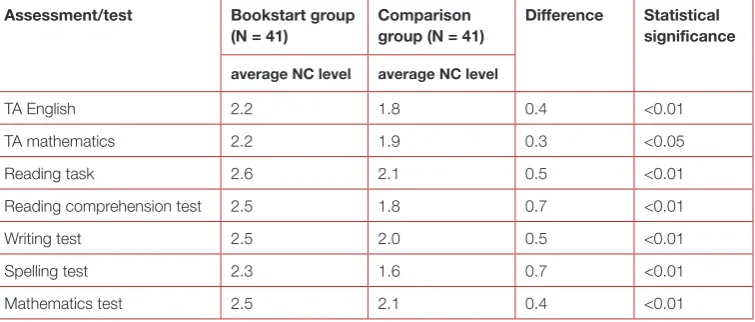
• Some studies for which great importance is claimed had sample sizes too small to bear that weight, e.g. Bookstart in Birmingham. • Exactly half the studies provided data only
or mainly from an intervention group, with no or few comparison group data.
• Even within the other eight studies, none of the programmes had been compared with an alternative intervention, only with ‘no treatment’.
• Most of the evidence arises from test data or, in the case of such aspects as self-confidence, validly from self-report questionnaires, but for some aspects less direct measures were used, e.g. teachers’ reports about parents and children. Reliance on indirect measures of impact was more frequent with regard to parents than children, and there were fewer test data on parents than on children.
Refer
ence number
and name 1. Bookstart – 2 studies 2. Boots Books for Babies 3. Child-to-child pr
ogramme
4.
Dialogic r
eading
5.
Early Start (Basic Skills Agency)
6.
Even Start – 2 studies
7.
Family literacy demonstration pr
ogrammes (Basic Skills
Agency)
8.
Family literacy for new gr
oups
(Basic Skills Agency)
9.
Family literacy and numeracy in prisons (Basic Skills Agency)
literacy
, with some
language and numeracy data literacy literacy
, language and
numeracy literacy and language language literacy and language literacy literacy and language literacy and numeracy
England (1A Birmingham) England (1B Shef
field)
England (Nottingham City and County) South Africa (Mpumalanga district, KwaZulu-Natal) England (Shef
field)
England USA (6A – In-Depth Study) USA (6B – National Study) England and W
ales
(Car
dif
f, Liverpool,
Norfolk, North T
yneside)
England and W
ales England Age 2-3: 28 + 29
Ages 5 and 7: n/a n/a n/a n/a n/a 2001/02: 592 2003: 435, of whom 213 retur
ned qr es 101 + 98 reducing to 84 + 75
? 361 349 43
Age 2–3: 28 + 29 Ages 5 and 7: 41 + 41 23 + 23 c.1700 + c.600 20 + 12 20 + 20 reducing to 14–17 + 14–17
(2001/02: n/a) 2003: not stated but presumably 435 101
+ 98 reducing to 84 + 75
? 392 316 44
Matched gr
oups,
post-test only Matched gr
oups,
post-test only Unmatched gr
oups,
‘post-test’ only One gr
oup pr
e/post
study
, with opportunistic
comparison gr
oup at
post-test Matched gr
oups RCT
One gr
oup pr
e/post
study RCT One gr
oup pr
e/post
study One gr
oup pr
e/post
study
, with comparison
gr
oup only at 3-year
follow-up One gr
oup pr
e/post
study One gr
oup pr e/post study Ta b le 1 : T h e p ro je c ts a n al ys ed q u an ti ta ti ve ly , a n d b as ic i n fo rm at io n a b o u t t h em 1 o f 2 Literacy , language or numeracy
Country (and ar
ea*)
Numbers ** of
Resear ch design par ents childr en re as a re n am ed o nl y w he n v er y s p ec ifi c. W he re t w o n um b er s a re s ho w n, t he s ec on d i s f or t he c on tr ol /c om pa ris on g ro up . C
T = r
an d om is ed c on tr ol le d t ria l
a = n
ot av
ai
la
b
Refer
ence number
and name 10. Family numeracy pilot pr
ogrammes (Basic Skills
Agency)
11.
FLAME – Family Literacy – Apr
endiendo, Mejorando, Educando (Lear ning, Impr oving, Educating) 12. Ħ ilti clubs 13. MOCEP (Mother -Child Education Pr ogram) 14.
PEEP (Peers Early Education Partnership) – 2 studies
15.
PEFaL (Par
ent Empowerment
thr
ough Family Literacy)
16.
REAL (Raising Early Achievement in Literacy)
numeracy literacy and language literacy and language literacy
, language and
numeracy literacy
, language and
numeracy literacy literacy
, language
England USA (Chicago) Malta Turkey England (Oxfor
d) (1
4A –
Foundation PEEP) England (Oxfor
d) (14B –
Birth T
o School Study)
Malta England (Shef
field)
517 189 257 102
+ 115 n/a 294 +297 reducing to 210 + 225 46 + 21 88 + 88 215 overall; 148 + 144
in matched gr
oups
120 365 102
+ 115 64 + 83 301 + 303 reducing to 215 + 230 54 + 40 88 + 88
Mainly one gr
oup pr e/post study , with matched gr oup
sub-samples of childr
en
One gr
oup pr
e/post
study One gr
oup,
post-test-only study Matched-gr
oups
pr
e-test/post-test
quasi-experimental studies Matched-gr
oups,
pr
e-test/post-test
quasi-experimental studies Quasi-RCT RCT
Ta b le 1 : T h e p ro je c ts a n al ys ed q u an ti ta ti ve ly , a n d b as ic i n fo rm at io n a b o u t t h em 2 o f 2 Literacy , language or numeracy
Country (and ar
ea*)
Numbers ** of
Resear ch design par ents childr en
* A
re as a re n am ed o nl y w he n v er y s p ec ifi c. ** W he re t w o n um b er s a re s ho w n, t he s ec on d i s f or t he c on tr ol /c om pa ris on g ro up . R C
T = r
• Though we talk throughout this report of ‘parents’, very few fathers took part in any of these studies – typically under 5%, and none at all in the Turkish programme, which was after all intended only for mothers – but this is a general pattern, as documented extensively by Goldman (2005).
• There is more evidence for literacy (17 studies) and language (15 studies) than for numeracy (8 studies); only one of the latter had numeracy as its sole focus, and in several others it was a subsidiary focus. • The fact that rather few null or negative
results appear in the findings suggests that there may be publication bias in this field as in others – for evidence and arguments on publication bias see Torgerson (2003, 2005; Torgerson et al. 2004). That is, positive findings are more likely to be reported (some researchers are reluctant to report negative or null findings) and academic journals and other outlets are also less likely to accept reports of negative or null findings. This is a further reason to take the findings summarised below with some caution.
3.5 Findings
The findings are presented in full in Appendix A; a summary is provided in Table 2. In the ‘Benefits for parents’ column the ages shown are not of course the parents’ but those of their children when the data were gathered. Also, absence of mention of a form of benefit does not mean that there was no benefit, only that no evidence was gathered on it.
In Table 2 the studies are listed in decreasing order of the strength of their research designs, with randomised controlled trials (RCTs) at the top and a one-group post-test-only study at the bottom. The numbers of parents and children are shown as further guidance on the strength of the evidence; in general, less weight should be attached to very small studies (the Child-to-Child programme, Dialogic Reading, both Bookstart studies) though at the opposite end of the scale diminishing returns operate – the numbers in the Boots Books for Babies study are impressive but smaller numbers would have made the same point.
The description ‘Matched pairs RCT’ for REAL and Dialogic reading means that in those studies the experimenters first identified closely similar pairs of, respectively, families and children, then allocated one member of each pair randomly to their experimental group, and the other to the control group. This is an even stronger design than an RCT where random allocation is carried out without knowing any of the characteristics of the participants.
The reason for placing the Birth To School Study of PEEP in Oxford immediately after the RCTs is this. The data in this study were analysed using a relatively new statistical technique called Propensity Score Matching (PSM) which was developed precisely for designs where random assignment to
experimental and control groups is not possible, for example where an intervention is already established, or must be allocated to a particular area or sample. (In this case, PEEP was already established in four deprived areas of south Oxford.) In place of matching individuals or groups beforehand, PSM matches them after the event. Using background and other data gathered at the beginning of a study, for each member of the experimental group PSM identifies the member of the comparison group who is most like that member of the experimental group; when as many such pairs as possible have been identified statistical analysis proceeds on the basis of the groups so constituted. PSM is said by its advocates to go some way towards allowing for the differences between groups that random allocation attempts to eliminate and non-random allocation cannot, and therefore to sustain more robust and reliable statistical comparisons than conventional methods of comparing non-randomised groups.
Refer
ence number
and name 16.
REAL
4.
Dialogic r
eading
6.
Even Start – In-Depth Study
114B.
PEEP (BTSS)
13.
MOCEP
14A.
PEEP (Foundation)
10.
Family numeracy pilot pr
ogrammes
Matched pairs RCT Matched pairs RCT RCT Matched-gr
oups,
pr
e-test/post-test
quasi-experimental study Matched-gr
oups
pr
e-test/post-test
quasi-experimental study Matched-gr
oups,
pr
e-test/post-test
quasi-experimental study Matched-gr
oups,
pr
e/post
n/a n/a Benefit to general educational qualifications but not to literacy Some benefit to mothers’ car
egiving
Age 6: Benefits to mothers’ child- rearing practices and self-esteem Age 7 follow-up: Benefit to mothers’ child-r
earing practices maintained,
and mothers r
eported as mor
e
involved with their childr
en’
s schools
n/a Age 5: Benefits to mothers’ self- conf
id en ce a nd in vo lv em en t w ith th ei r ch ild re n’ s sc ho ol s; a ls o, tu to rs re po rt ed be ne fit s to m ot he rs ’ n um er ac y an d ab ilit y to h el p th ei r c hi ld re n
3-year follow-up: Par
ents rated by
their childr
en’
s teachers as mor
e
involved than comparison gr
oup with
their childr
en’
s schools
Age 5: Benefit to literacy but not vocabulary Age 7: Benefit to literacy of childr
en
whose mothers had no educational qualifications, but not overall Probably no benefit, and very small if it existed No advantage over contr
ols
Mixed r
esults, no overall benefit
Ages 3, 4 and 5: Benefits for literacy and language, but possibly negative for numeracy Age 6: Benefits for literacy
, language
and numeracy Age 7 follow-up: Benefits for literacy and numeracy maintained End of schooling: higher average grade University: higher pr
oportion attending
Ages 4 and 5: Benefits for literacy
,
language and numeracy Age 5: Benefit to early numeracy 3-year follow-up: Participating childr
en
rated by their teachers somewhat better in school than comparison group
Ta b le 2 : S u m m ar y o f f in d in g s f ro m t h e q u an ti ta ti ve a n al ys es 1 o f 3 Resear ch design 88 + 88 n/a 101 + 98 reducing to 84 + 75 294 +297 reducing to 210 + 225 102 + 115
n/a 517
88 + 88 20 + 20 reducing to 14–17 + 14–17 101 + 98 reducing to 84 + 75 15. PEFaL Quasi-RCT Mixed r
esults, no overall benefit
46 + 21 54 + 40 301 + 303 reducing to 215 + 230 102 + 115 64 + 83
215 overall; 148 + 144
in
matched
gr
oups
Numbers of par
ents
childr
en
Benefits for par
ents
childr
Refer
ence number
and name 1A
. B oo ks ta rt – B irm in gha m 1B . B oo ks ta rt – S he ffi el d 2. B oo ts B oo ks f or B ab ie s 3. C hi ld -t o-ch ild pr ogr amm e 5. E ar ly S ta rt 6. E ve n S ta
rt – N
E IS M at ch ed g ro up s, p os t-te st o nl y M at ch ed g ro up s, po st -t es t o nl y U nm at ch ed g ro up s, ‘p os t-te st ’ o nl y O ne g ro up pr e/ po st s tu d y, w ith o pp or tu ni st ic co m pa ris on g ro up a t po st -t es t O ne g ro up p re /p os t stu d y O ne g ro up p re /p os t stu d y A ge 2 ½ –3 : B en ef it t o a b ili ty t o h el p th ei r c hi ld re n
n/a n/a n/a Sel
f-re po rt ed b en ef its t o s el f-co nf id en ce , l an gu ag e, a b ili ty t o he lp t he ir c hi ld re n, e du ca tio n a nd empl oy m en t N o b en ef it A ge 2 ½ –3 : B en ef it t o e ng ag em en t w ith b oo ks A ge
s 5 a
nd 7 : B en ef its t o l ite ra cy an d n um er ac y B en ef its t o l ite ra cy a nd n um er ac y B en ef it t o u se o f l ib ra rie s B en ef its f or l ite ra cy , l an gu ag e a nd nu m er ac y, b ut v er y s m al l B en ef its f or c hi ld re n’ s l an gu ag e re po rt ed b y t he p ar en ts (e vi d en ce n ot a cc es se d ) Ta b le 2 : S u m m ar y o f f in d in g s f ro m t h e q u an ti ta ti ve a n al ys es 2 o f 3 Resear ch design A ge 2 –3 : 2 8 + 2 9 A ge
s 5 a
nd 7
: n
/a
n/a n/a n/a 2001
/0 2: 5 92 20 03 : 4 35 , o f w ho m 2 13 r et ur ne d qr es ? A ge 2 –3 : 2 8 + 2 9 A ge
s 5 a
nd 7 : 41 + 4 1 23 + 2 3 c. 17 00 + c .6 00 20 + 1 2 7. F am ily l ite ra cy d em on st ra tio n pr ogr amm es O ne g ro up p re /p os t st ud y, w ith c om pa ris on gr ou p o nl y a t 2 ½ -y ea r fol lo w -up B en ef its