Enabling features of
Psychologically Informed Planned
Environments
Caroline Turley, Colin Payne and Stephen Webster
NatCen Social Research
The NOMS Directorate of Commissioning and Commercial supports
effective policy development and operational delivery within the National
Offender Management Service and Ministry of Justice by conducting and
commissioning high-quality social research and statistical analysis. We
aim to publish information to add to the evidence-base and assist with
informed debate.
Disclaimer
The views expressed are those of the authors and are not necessarily shared by the Ministry of Justice (nor do they represent Government policy).
First published 2013
© Crown copyright 2013
You may re-use this information (excluding logos) free of charge in any format or medium, under the terms of the Open Government Licence. To view this licence, visit
http://www.nationalarchives.gov.uk/doc/open-government-licence/ or email: [email protected]
Where we have identified any third party copyright material you will need to obtain permission from the copyright holders concerned.
Any enquiries regarding this publication should be sent to us at [email protected]
This publication is available for download at
Acknowledgements
We would like to thank Sarah Bridgland, Kirk Turner and Jess Haskins at NOMS for their support and guidance throughout the study. Thanks also to those at NOMS who provided comments and guidance on early findings and report outputs.
At NatCen Social Research, we would like to thank Tom Kenny and Helen Ranns for their assistance with fieldwork and data analysis, and Sara Scott for her support during analysis and reporting.
Contents
Key findings 1
Research summary 2
1. Introduction 6
1.1 Policy context and background 6
1.2 Aims and objectives 8
1.3 Research design 9
2. Adopting a PIPE approach 12
2.1 Selection of pilot sites 12
2.2 Staffing the PIPE 12
2.3 PIPE location 16
2.4 Populating the PIPE 16
2.5 Guidance on set-up and implementation 17
3. PIPE delivery 19
3.1 Offender induction 19
3.2 Key features of PIPEs 20
3.3 Behavioural monitoring and management 26
3.4 Linking with wider establishment/probation area 27
3.5 Exiting the PIPE 28
4. Emerging impacts 29
4.1 Perceived impact on offenders 29
4.2 Perceived impact on PIPE staff 32
4.3 Perceived impact on establishment/wider probation area 32
5. Key learning and implications 34
5.1 Adopting a PIPE approach 34
5.2 PIPE delivery 34
5.3 Implications for measuring outcomes 35
References 36
Key findings
This study was designed to explore the enabling features of Psychologically Informed Planned Environments (PIPEs) through qualitative research in three case study pilot sites.
There are a number of lessons from the case study PIPEs about the key enabling features of the PIPE model. Establishing and maintaining safe and supportiverelationships between staff and prisoners/residents of Approved Premises (APs) were seen as key, with offenders highlighting the importance of staff availability and
respectful day-to-day interaction. Other key features included taking a more
collaborative approach to PIPE management and organisation, as well as providing formal support mechanisms for offenders through regular personal officer/key worker sessions, structured groups, creative sessions and informal activities.
PIPE staff need to have an understanding of, and comply with, the PIPE way of working. This can be facilitated by a clearly defined team who receive training and clinical supervision together. A key lesson from the case study sites is that inconsistent approaches and variable commitment by staff can undermine helpful interaction with prisoners/AP residents. To this end the Clinical Lead has a key role in supporting and developing staff. Recruiting appropriately skilled staff to these roles is also central to effective PIPE delivery.
Communication about PIPEs needs to filter through all levels of operation so that there is appropriate strategic leadership within establishments as well as a comprehensive understanding across frontline staff. This helps ensure that the PIPE is supported both by those working within it and throughout the wider establishment/probation area. This is particularly important when non-PIPE staff have the potential to undermine the PIPE ethos or pursue goals in conflict with it. Communication also needs to extend topotential residents so they are clear about the purpose and parameters of the PIPE.
Research summary
Background
Psychologically Informed Planned Environments (PIPEs) form a key part of the offender Personality Disorder (PD) strategy (Department of Health (DH) & National Offender
Management Service (NOMS) 2011). At the time of the research, NOMS and the NHS were supporting six pilot PIPE sites; two in male prisons, two in female prisons and two probation Approved Premises (APs). A further site in a male prison came on board during the project.
PIPEs are specifically designed, contained environments where staff members have additional training to develop an increased psychological understanding of their work. This understanding enables them to create an enhanced safe and supportive environment, which can facilitate the development of those who live there. PIPEs are designed to have a
particular focus on the environment in which they operate, and actively recognise the importance and quality of relationships and interactions. They aim to maximise ordinary situations and to approach these in a psychologically informed way, paying attention to interpersonal difficulties, including issues that might be linked to PD (NOMS & DH, 2012).
PIPEs are not a treatment intervention, instead they are designed to enable offenders to progress through a pathway of intervention, maintaining developments that have previously been achieved, and supporting transition and personal development at significant stages of their pathway (NOMS & DH, 2012). Within the prison setting, the field test of the PIPEs model is applied in the delivery of progression units for offenders who have recently
completed high intensity offending behaviour and treatment programmes. For the field test in the community, the PIPE approach is applied to existing offender populations in APs.
Research design
NatCen Social Research conducted qualitative research to examine the key enabling features of PIPEs. The aim was not to evaluate pilot PIPEs, but to provide an objective articulation of PIPEs activity and identify its key ingredients. The research also identified lessons learnt from the pilots which are discussed here to help inform future delivery.
Three pilot sites were purposively selected to be case studies: a sexual offenders’ wing in a male prison; an AP accommodating men convicted of violent offences (though not
exclusively); and a unit in a female prison. Fieldwork involved in-depth interviews and
and AP residents, and video observations of key PIPE activities. A workshop was then held and attended by NOMS and NHS stakeholders as well as representatives from all seven pilot sites. As this is a qualitative study, the prevalence of particular views and experiences cannot be estimated.
Key findings
PIPE delivery
The PIPE approach draws on a number of theoretical models, with a core focus throughout on the importance and quality of relating and relationships (NOMS & DH, 2012). Staff and prisoners/AP residents identified the following as key elements of the PIPE model:
Establishing and maintaining improved relationships and interaction
Staff actions and behaviours: Examples included: staff looking to understand offenders’ challenging behaviour and address underlying meaning and issues; an emphasis on respectful communication and interaction; staff spending time with prisoners/AP residents informally and getting involved in PIPE activities; and accommodating their ideas and suggestions where possible.
PIPE staff need to have an understanding of, and comply with, the PIPE way of working. This can be facilitated by a full, consistent and clearly defined team who receive training and clinical supervision together. A key lesson from the case study sites is that inconsistent approaches and variable commitment by staff can undermine the quality of interaction with prisoners/AP residents. To this end the Clinical Lead has a key role in supporting and developing staff. Recruiting appropriately skilled staff to these roles is also central to effective PIPE delivery.
The physical environment was also an important enabling factor. The housing of the PIPE unit in a distinct and self-contained area was felt to encourage positive
communication and helped prisoners to form a more cohesive group. Informal places for interaction were seen as playing a key role in normalising interaction and enabling responsible and co-operative behaviours.
Staff were very mindful of the destabilising impact some prisoners/AP residents could have, and some were felt unsuitable for the PIPE in terms of their motivation or attitude towards the PIPE approach. Prison PIPEs sometimes housed ‘lodgers’ alongside PIPE prisoners, as capacity issues in the wider establishment meant they were not permitted to have empty cells. At this initial stage of PIPE development it was inevitable that this mix of prisoners diluted the PIPE experience and was not in keeping with NOMS and DH guidance (2012).
Formalised support for offenders
This centred on a personal officer/key worker meeting regularly with their prisoner/AP resident to discuss: their experience of the PIPE; instances of positive or negative behaviour and factors underpinning them; their history in terms of personal life, offending behaviour and any treatment experiences, and plans for the future. PIPE prisoners and AP residents were generally positive about these relationships, and particularly where staff were open, honest, non-judgmental and shared their own experiences. Challenges identified included: shift patterns or other commitments limiting staff availability; inconsistent approaches and variable commitment between different staff; and balancing support with a monitoring role – this needed to be managed carefully with prisoners/AP residents to maintain trust. In the AP there was the additional need to maintain consistency between the personal officer/key worker and Offender Manager.
Behavioural monitoring and management
aspects of PIPE delivery, having a consistent approach across staff was considered important, and not without its challenges.
Emerging impacts
Staff felt that the intended outcomes of PIPEs had not been clearly communicated. In the case study prison sites this may have been exacerbated by the Clinical Lead not being in post at the start of implementation to explain the aims and intended outcomes of PIPEs as outlined in the Service Specification documents (NOMS, 2010a; NOMS, 2010b). However, both staff and prisoners/AP residents suggested a range of emerging impacts arising from PIPEs. It is important to highlight that the research took place shortly after implementation and while the PIPEs were still developing. Therefore all possible impacts, and specified outcomes, will not have been fully realised or understood at this stage.
Greater opportunity to communicate in formal and informal settings was felt to have led to improved relationships between prisoners/AP residents. This was demonstrated by offenders recognising when others were in need of support. Staff also reported that there was less bullying on PIPE units than on other prison wings.
Enhanced contact through personal officer/key worker sessions, structured groups, creative sessions, and informal interaction were felt to have led to better quality relationships between staff and prisoners/AP residents. Staff reported that these opportunities had helped to build rapport with offenders, which in turn enabled staff to be better able to challenge them about their behaviour. It was also noted that more positive relationships with PIPE staff provided a model for offenders of how to interact with staff from other settings, as well as services on release.
PIPE prisoners/AP residents were felt to have taken more responsibility for their actions and behaviours. Within the AP, staff felt that there had been a decline in the number of recalls and that compliance with licence conditions had improved.
However, some staff queried whether these reductions were actually more a result of changes to staff behaviour, in terms of staff reporting fewer incidents rather than fewer incidents taking place.
1.
Introduction
1.1
Policy context and background
Awareness of the high levels of mental health need amongst offenders has increased considerably during the last decade (Singleton et al, 1998). Of particular concern has been the treatment of offenders with personality disorder (PD), and in 2009 the Bradley Report recommended that an interdepartmental strategy should be developed for the management of all levels of PD, through custody and into the community (Department of Health (DH), 2009). It was recognised that offenders who completed treatment were moved to an ordinary location in mainstream prison, only to find that they were not psychologically equipped to deal with change. These offenders required more support to help integrate and reflect on what they had learnt. Consideration was therefore given to provision of a new pathway of care that would provide offenders with an opportunity to put their new skills into practice (Bolger & Turner, 2013). Part of the Government’s response was the development of Psychologically Informed Planned Environments (PIPEs), which now form a key part of the offender PD strategy (National Offender Management Service (NOMS) & DH, 2012).
At the time of the research, NOMS and NHS were supporting six pilot PIPE sites; two in male prisons, two in female prisons and two probation Approved Premises (APs). A further site in a male prison was introduced during the pilot. Within the prison setting, PIPEs are
progression units for offenders who have recently completed offending behaviour and treatment programmes, primarily those of high intensity such as the Dangerous and Severe Personality Disorder programme (DSPD), Democratic Therapeutic Communities (DTCs), and other accredited programmes such as the Healthy Relationships Programme (HRP). In the community the PIPE approach is applied to existing offender populations in APs. PIPEs are not a treatment, instead they are designed to enable offenders to progress through a
pathway of intervention, maintaining developments that have previously been achieved, and supporting transition and personal development at significant stages of their pathway (NOMS & DH, 2012).
environment,1 which emphasises the importance and quality of relationships and interactions. They aim to maximise ordinary situations and to approach these in a psychologically informed way, paying attention to interpersonal difficulties and avoiding reinforcement of asocial or emotionally destructive behaviours. While it is not a requiremen that offenders have a diagnosis of PD, the aim is to provide a pathway option for those wh are likely to have a PD and meet the eligibility criteria for the PD pathway.
t o ed 2012):
2 The intend
service outcomes for PIPEs are as follows (NOMS & DH,
Reduced sexual or violent re-offending as part of the wider PD strategy;
A workforce that is confident working with complex needs such as PD;
Improved (or sustained) levels of institutional behaviour;
Improved psychological health of offenders;
Effective movement through a clear pathway of intervention;
Improved staff/offender relationships; and
Sustained benefits gained through treatment programmes or a period in custody.The PIPE model offers additional structures and planned components to support its
functioning and to provide opportunities for psychologically informed practice to take place:
Structured groups designed to address criminogenic need. These aim to help offenders consolidate and integrate what they have learned earlier in their sentence. In APs, where residents might not have addressed their offending behaviour, these groups have a pro-social focus to support resettlement needs.
Creative sessions that help offenders work towards their goals, developed using a ‘Good Lives’ approach (discussed below). These sessions enable prisoners/AP residents to have social interaction whilst retaining focus on a task, and provide staff with an opportunity to observe and monitor their interactions in a less formal or structured environment. Activities might include promoting competitionbetween offenders and opportunities to explore and reflect on creative talents. Any activity needs to comply with standards for acceptable activity within NOMS and will focus on supporting and monitoring relational activity.
1 Enabling environments are defined as places where: positive relationships promote well-being for all
participants; people experience a sense of belonging; people can learn new ways of relating; contributions of all parties are recognised and respected; and where it is recognised that carers also need to be cared for (NOMS & DH, 2012). The Enabling Environment Award can be obtained by environments that meet required standards set out by the Royal College of Psychiatrists Centre for Quality Improvement (CCQI).
2 Men assessed as presenting a high likelihood of violent or sexual offence repetition and a high/very high risk
Regular personal officer/key worker sessions to help enhance existing relationships between offenders and staff, as well as an opportunity to focus on achievements and any concerns arising.
Group supervision for staff, led by the Clinical Lead, to enable staff to reflect on reasons behind offenders’ behaviour and manage them in a more mindful way.Underpinning the development of the PIPE concept is the application of the Good Lives model. Ward et al (2007) describe the Good Lives model as based on the belief that all humans strive for the same goals (good life goals) and our sense of well-being is intrinsically linked to achieving these. A major aim of introducing the Good Lives model into forensic services is to equip offenders with skills, values, attitudes and resources necessary to lead a different life: personally meaningful and satisfying which does not involve inflicting harm on others.
At the time of the research, the PIPE model in prison was delivered as a post-treatment model. Following further development work on the PIPE approach in criminal justice settings, two additional operating models have been developed; a pre-treatment and an in-treatment PIPE. The PIPE model in APs continues to be applied in line with the approach in the field test.
1.2
Aims and objectives
NatCen Social Research conducted qualitative research to examine the key enabling features of PIPEs. The aim was not to evaluate pilot PIPEs, but to provide an objective articulation of PIPEs activity and identify its key ingredients. The research also identified lessons learnt from the pilots which are discussed here to help inform future delivery.
The specific research objectives were to:
Understand what is being delivered on the PIPE units, and when and how delivery takes place;
Examine how staff and managers engage offenders with different activities;
Describe how governance is operationalised and conflict managed;
Observe relationships between staff and prisoners/AP residents, their key ingredients and the setting and maintenance of boundaries; andThe qualitative case studies were carried out between February and June 2012, shortly after the PIPEs were implemented. The focus of the research was therefore on implementation and early experiences of delivery. Practice had developed since the research was
conducted, and this was highlighted in the national workshop held in December 2012 (see below).
1.3
Research design
Qualitative case studies
Three pilot sites were purposively selected3 to be case studies, to ensure exposure to the broad range of issues that may influence how PIPEs operate in practice. Case study sites were sampled according to criminal justice setting, gender of offenders, and offence type. They comprised the following:
A sexual offenders’ wing in a male prison;
An AP accommodating men convicted of violent offences (though not exclusively); and
A unit in a female prison.Fieldwork took place over three consecutive days in each site and involved in-depth
interviews and mini-group discussions with strategic and operational staff, in-depth interviews with offenders, and video observations of key PIPE activities. Each is discussed below, with further detail about sampling, recruitment and analysis provided in Appendix A.
Strategic staff
Individual in-depth interviews were conducted with the Governor/Manager, Operational Lead and Clinical Lead at each site. These individuals had overall responsibility for the PIPE and so interviews focused on set-up and implementation, facilitators and challenges to delivery, early outcomes, and lessons for wider roll-out. Interviews lasted between 60 and 80 minutes.
Operational staff
The following encounters took place:
A mini-group discussion with between two and four PIPE prison officers/hostel workers, lasting between 90 minutes and two hours, at each site. These
3 Sampling in this way involves selection based on dimensions that reflect key differences in the study
discussions comprised staff with different lengths of service and experiences of treatment delivery to ensure range and diversity of perspectives.
Individual in-depth interviews with the PIPEs Coordinator4 at two of the sites, lasting between 60 and 70 minutes.
A member of prison or probation area staff external to the PIPE who had contact with PIPE prisoners/AP residents at each site. Interviews lasted 30 minutes.Encounters with operational staff focused on PIPE implementation, the training and support available to staff, PIPE delivery, and early outcomes.
Prisoners and AP residents
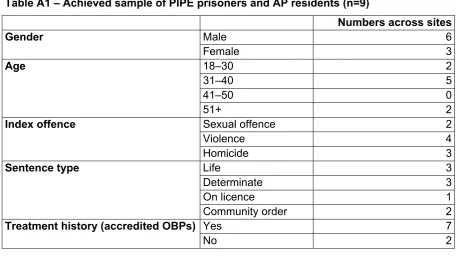
Gathering offenders’ views was critical to understanding the enabling features of PIPEs, and so in-depth interviews were undertaken with three offenders in each site. Participants were purposively selected as far as possible from those who were willing to take part in the research, and sampled according to their age, the nature of their index offence, sentence type, treatment history, and formal diagnosis or indication of PD or other mental health problems. Interviews lasted between 30 and 60 minutes.
Interview conduct and analysis
All research encounters were based on topic guides (see Appendix A), recorded on encrypted digital devices and transcribed verbatim. Transcripts were analysed using the Framework approach (Ritchie & Lewis, 2003). Verbatim interview quotations are provided in this report to highlight themes and findings where appropriate.5
The findings in this report show the range and diversity of views and experiences among those interviewed. However, as this is a qualitative study, the prevalence of particular views and experiences cannot be estimated.
Observations
Observations were invaluable in providing a detailed understanding of each PIPE and prompting specific areas of questioning during the subsequent interviews and discussions, as well as providing primary data. With permission, the observations were filmed in two of the
4 This was not a prescribed role, but was in place at two of the case study sites.
5 Throughout the report, ‘strategic staff’ refers to the Governor/Manager, Operational Lead or Clinical Lead role,
three sites in order to record, analyse and disseminate key practice. Offenders in one of the sites did not consent to filming, so handwritten notes were taken instead. Observations took place over the three days spent at each site and focused on structured groups, creative sessions, personal officer/key worker sessions and staff group supervision, as well as more informal interaction on the PIPEs during association time.
National workshop
This was the final phase of the research. It was attended by 23 participants, including NOMS and DH strategic stakeholders, and representatives from all seven PIPE pilot sites.
Preliminary findings and video observations were presented for feedback and discussion, and followed by three breakout group discussions which focused on key issues arising from the qualitative case studies: populating the PIPE; measuring PIPE outcomes; and
recruitment, training and management of staff. The data collected at this event were used to develop, refine and update the findings from the case studies. The workshop took place in December 2012 and lasted approximately four hours.
Wider evaluation
This research is one strand of a wider PIPEs evaluation, which comprises:
A quantitative, longitudinal study of changes in the social climate following the introduction of the PIPE model, using the EssenCES questionnaire.6
An evaluation of the impact of a specialist training package in enhancing PIPE staff confidence and ability.
A qualitative exploration of staff and prisoner/AP resident experiences of the PIPE.
An investigation of behavioural and risk changes and maintenance of change amongst PIPE prisoners and AP residents.
These strands of research are being undertaken by Her Majesty’s Prison Service (HMPS) and researchers in an NHS Medium Secure PD Service. Once the wider evaluation is complete, NOMS and DH will explore the wider implementation of the PIPEs model across criminal justice settings.
6 The English Essen Climate Evaluation Schema (EssenCES) Social Climate Questionnaire measures three
aspects of social climate in forensic settings (Freestone et al, in press). The Therapeutic Hold scale measures the extent to which the unit is perceived as supportive of patients’/prisoners’ therapeutic needs. The
2.
Adopting a PIPE approach
This chapter describes how case study PIPEs were set up from the perspective of strategic and operational staff. It explores how sites were selected for the pilot; issues around staffing; the location of the PIPE and its physical environment; populating the PIPE; and guidance received on set-up and implementation. This insight will be useful as NOMS and DH consider the wider implementation of the PIPEs model across criminal justice settings.
2.1
Selection of pilot sites
At the time of the research, NOMS and DH were supporting seven pilot PIPEs sites. The following factors were identified by the three case study sites that participated in this research as underpinning selection of their establishments as pilots and can be viewed as useful foundations for setting up a PIPE.
Strategic support: The motivating and momentum-building role of strategic staff when a new service or policy is implemented is well documented (Turley & Tompkins, 2012; McNaughton Nicholls et al, 2010). In one of the prisons, staff identified the leadership approach of their previous Governor as a significant factor in their selection for the pilot. He had kept the prison at the forefront of new initiatives and encouraged a ‘can-do approach’ amongst staff.
Experience of piloting and innovation: Following on from this, staff across the sites felt their establishment had a reputation for piloting new programmes and initiatives, which had made them ‘an obvious choice’ to pilot the PIPE. However, there was a sense in one prison that their involvement in the pilot had been assumed by NOMS and DH on the back of this, and so initial implementation and delivery of the PIPE had been hindered by a lack of both strategic leadership and operational ownership.
An existing psychological approach: AP staff saw PIPEs as ‘a natural extension’
of the work they were already doing and felt they had a strong foundation to build on due to their experience of running the Living Here, Moving On (LHMO) offending behaviour programme (OBP). They saw the pilot as an opportunity to imbed a psychologically informed approach into offender management.
2.2
Staffing the PIPE
providing positive social experiences, challenging inappropriate behaviour, and ensuring their PIPE runs effectively. This section explores the PIPE staff structure, process of recruitment, training provided to staff, and ongoing supervision received.
Staff structure
NOMS and DH guidance (2012) prescribes key roles for all PIPEs. First, it is essential that the PIPE is led by a Clinical Lead, usually a chartered Psychologist. Both case study prison sites faced delays in recruiting a Clinical Lead. This was felt to have had a considerable impact on staff and offender understanding of and engagement with the PIPEs model. In terms of wider implementation, it is crucial that strategic staff are briefed and in post before the PIPE is rolled out.
Clinical Leads worked in partnership with a nominated Operational Lead from the
establishment (often a Principal Officer or Senior Probation Officer). It was the responsibility of the Operational Lead to create and maintain a psychosocial environment and ensure that it adhered to the theoretical principles of the PIPE model. The establishment’s Residential Governor or Assistant Chief Officer should aim to promote and protect the PIPE unit within the wider prison or probation system (NOMS & DH, 2012).
PIPE staff (prison officers, or hostel workers in the AP) were responsible for delivering the PIPE on a day-to-day basis. However, staff shortages in one prison meant that while they had received funding for two full-time PIPE officers, these hours had to be shared between six members of staff. This was supported by some, as it was felt that staff were less stressed due to sharing responsibilities and that any staff absences had less of an impact on PIPE delivery. However, part-time roles were felt to have implications for consistency of approach with offenders (discussed further in section 3.2). This was also a concern where wing staff from outside the PIPE worked on the unit, which was the case in both prison sites. Echoing the PIPEs model, staff and offenders were of the view that ideally PIPEs needed to be self-contained to ensure that dynamics were managed consistently.
Recruitment
Doubts were expressed across the sites about the suitability of some of the officers working on the PIPE, with some said to be uncomfortable with the increased level of interaction with prisoners/AP residents, the requirement to participate in creative sessions, and the use of forenames rather than surnames7 (see Chapter 3). This perceived lack of engagement was felt to have an impact on PIPE delivery and indicates a need for targeted training and/or communication at the operational level.
'I think there's some people who need to move on, either metaphorically in their thinking, or physically by going somewhere else.' (Operational staff)
Training
Comprehensive training is crucial to ensuring ethical, effective, and consistent programme delivery (McNaughton Nicholls et al, 2010), and to support staff in their role. It is vital that PIPEs staff understand what being psychologically informed means, both in theory and practice. Most staff across the case study sites had received the PD Knowledge and Understanding Framework (KUF) and how to develop an Enabling Environment (EE) training. The KUF comprised six online modules and three days of training delivered by an external provider. Some positive feedback was given, such as the training being informative and the online modules enjoyable. However, it faced a number of criticisms across the case study sites, including:
A lack of understanding about criminal justice settings, particularly prisons;
The content being ‘common sense’, ‘pitched too low’, and insufficient in preparing staff for working with PD offenders;
The 12 hours of homework being too time consuming; and
Logistical problems including difficulties organising training around shift patterns, cancellations and IT issues.NOMS and DH have since piloted two new versions of the KUF training: one adapted to take into account the prison context, and another aimed at women with PD (W-KUF).
The one day EE training was viewed far more positively. Staff suggested revising the
sequencing of the training, so that EE was followed by KUF. This was because EE was felt to offer an introduction to the PIPE model that underpinned the KUF training.
NOMS and DH guidance (2012) highlights group work skills as a key component of the training delivered to PIPEs staff. However, it had not been undertaken by all staff at the time of the research. Instead, Clinical Leads provided aspects of the training informally. Staff also identified further training needs around PD, child protection issues, and women’s mental health (some of these issues might have been addressed by the W-KUF pilot).
Supervision
Support for staff is fundamental to effective service implementation and ongoing delivery as it helps staff maintain high standards of delivery as well as stay resilient (McNaughton Nicholls et al, 2010). Supervision on a PIPE involves understanding events that take place in the unit and acting upon them. Supervised practice preserves the culture and safety of the PIPE and incorporates learning opportunities for PIPE staff. While regular staff team meetings are the main vehicle for supervised practice to be implemented, all aspects of working within a PIPE should reflect a supervised practice model (Bolger & Turner, 2013). Group supervision was provided by Clinical Leads across the case study sites. Whilst a new experience for many PIPE staff, it was very positively received and felt to have four key functions:
Encourage a consistent approach to managing offenders, particularly in relation to improved interaction and maintaining boundaries;
Enable staff to reflect on reasons behind offenders’ behaviour;
Assist preparation for personal officer/key worker sessions; and
Share problems or difficulties staff were facing with offenders, such as attempts at manipulation. This was particularly noteworthy, as it was considered unusual for prison and probation staff to be encouraged to discuss suchchallenges with peers and seek their support and feedback.
‘I think it [supervision] is positive because… you didn’t understand before that residents... will encourage splitting and all that… It was good to recognise that and… to stand together really and have consistency. I think that’s really important. So you’re able to back up your colleagues and challenge the resident in a positive manner… because you’ll always get, ‘Oh so and so… allows me to do that, and you don’t.’ (Operational staff)
expertise and how approachable they were. The Clinical Leads themselves also had monthly group supervision and bimonthly individual supervision.
2.3
PIPE location
NOMS and DH guidance (2012) describes how prison PIPEs should be housed on a discrete unit, where influences from non-PIPE prisoners and contact with non-PIPE trained/supported staff are minimised. In both the prison case studies, the PIPE was housed on one wing, but wing staff from outside the PIPE worked on the unit. AP PIPEs are expected to operate as a ‘whole unit’, and this was true of the case study AP in this research.
Enabling environments are defined as places where people experience a sense of belonging. As such, staff highlighted the importance of the appearance of the PIPE. Both prison PIPEs were housed on older wings and it was suggested that they might have been more suitably located in newer wings or buildings which were described as ‘lighter’ and considered better suited to modern prison requirements. Despite this, some staff and prisoners thought attempts to improve the physical environment with plastic plants and pictures had been successful, while others thought them of little consequence. Prisoners and AP residents interviewed were largely unable to articulate the rationale for this focus on the physical environment. In the AP, opportunities for refurbishment had been limited by a lack of
dedicated budget as well as concerns around health and safety when it was suggested that residents could assist with decorating. At the time of the research there were plans to pay for decorating out of the AP’s own budget.
Beyond aesthetics, it was felt that offenders should feel a sense of ownership towards their environment. Shortly before taking part in the research, one prison PIPE had relocated to a new wing. It was felt that staff and prisoners had been able to shape their new environment to meet the needs of the PIPE approach.
2.4
Populating the PIPE
had been diagnosed by their previous establishment. That one of the case study PIPEs was originally known as the ‘PD unit’ within the prison8 suggests that awareness-raising among operational staff, PIPE prisoners and AP residents, and the wider establishment is important.
The profile of offenders in the case study sites was as follows:
Offenders who had completed OBPs, primarily those of high intensity, such as DSPD, the Sex Offender Treatment Programme (SOTP), and DTCs;
Offenders with a range of clinical and criminogenic needs; and
In the case of the AP, the existing offender population, who were mixed in terms of treatment received to address their offending behaviour.Staff were very mindful of the destabilising impact some offenders could have on others and on the PIPE as a whole. It was suggested that some offenders were unsuitable for the PIPE and were there to ‘make up the numbers’, and staff had sought to remove these individuals. In addition, prison PIPEs sometimes housed ‘lodgers’alongside PIPE prisoners, where capacity issues in the wider establishment meant they were not permitted to leave cells empty. Staff tried to select lodgers who were not disruptive, or were soon to leave the prison, but did always have any input in decisions. Whilst lodgers had to adhere to certain rules, such as no prisoner visitors from other wings, it was inevitable that this mix of prisoners diluted the PIPE experience, and was not in keeping with NOMS and DH guidance (2012).
2.5
Guidance on set-up and implementation
Guidance and support from the centre is fundamental to effective programme
implementation. However, strategic staff felt there had been a lack of guidance from NOMS and DH around setting up the PIPE. For example, while the Service Level Agreement did state the requirement for an Operational Lead and provide detail around funding and budgeting, it was criticised by some staff who felt that it failed to specify what input was required from strategic staff – particularly the Operational Lead, or provide sufficient
guidance on budgeting and what PIPEs funding was intended to cover. There was also felt to be a lack of consideration given to how a PIPE should operate in an AP context. It was suggested that involvement of strategic AP staff during the pilot planning stage would have corrected some inaccurate assumptions and facilitated set-up.
8 This changed when the Clinical Lead took up post and was able to clarify the position of the PIPE within the
Doubts were also expressed about the ‘organic approach’ taken by the centre and there was felt to be a lack of clarity about the degree of freedom sites had to develop their PIPE. However, while some case study staff felt not having a prescribed model to follow had been a barrier to effective implementation, others were more positive about the freedom given, even though it felt 'chaotic' at the time. If PIPEs are to be implemented more widely, a
balance between providing clear guidance and allowing sites autonomy to develop their PIPE according to the needs of their establishment and offender population was strongly
recommended by strategic staff.
There was also agreement across the case study sites that initial guidance from NOMS and DH about what a PIPE was, or should be, had been overly complicated and technical. As such, some strategic staff had struggled to communicate clearly the key aims of the PIPE to operational staff, who recalled some confusion about what would be involved. Once the pilot began, the sites’ Clinical Leads played an important role in clarifying the aims of the PIPE for operational staff. However, they first had to overcome their own initial confusion about what was required (particularly as some had just joined the PIPE) and as such felt that more strategic guidance would have been useful before starting in the role. There was clearly a balance to be struck between staff needing to develop their PIPE during the field test phase while also being provided with sufficient guidance.
‘It was difficult because I was still kind of getting my head around what this PIPE was about… I didn't really know what it would look like and [the PIPE officers] were all kind of waiting… On the first day they were saying, “Brilliant, the psychologist has arrived, now we'll get a PIPE”, as if I could hand it to them.’
(Strategic staff)
3.
PIPE delivery
This chapter describes how the key elements and enabling features of the PIPE model are delivered in criminal justice settings, and how key challenges are addressed. It also looks at day-to-day governance within the PIPE and how conflict and discipline are managed.
3.1
Offender induction
At the time of the research, most of the prisoners had been on the case study prison PIPEs from inception and there had been few new arrivals. The AP PIPE continued to operate with its existing offender population. Therefore, induction processes were still developing.
However, alongside formal meetings or interviews that took place with offenders as part of ‘recruitment’ or transfer processes, sites were beginning to use a range of approaches:
One-to-one meetingswhere a personal officer/key worker introduced the PIPE model and answered any questions from the offender. These meetingssometimes involved Clinical Leads too;
‘Newcomer meetings’ where all new offenders were brought together to discuss key aspects of the PIPE;
Signing a PIPE ‘contract’ which summarised expected behaviours;
Induction packsranging from pamphlets to more extensive information packages; and
Formal and informal ‘buddy’ systems.Operational staff and offenders felt inductions needed to convey three key messages. First, that PIPEs are not treatment, but rather progression units (in prison) that aim to consolidate treatment gains, as well as supporting transition and personal development. Some prisoners and AP residents were disappointed when their expectations had not been met here. It was also felt necessary to stress that support would be less intensive than on many of the OBPs. Second, Clinical Leads highlighted the need for transparency about the role of observation and monitoring on PIPEs (see section 3.3). Finally, how boundaries are set and maintained, although staff felt that doing this at induction posed a number of challenges:
At the time of the research PIPEs were still in the early stages of delivery. Therefore boundaries had not always been fully defined;
Offenders sometimes had a role in identifying boundaries themselves (with the Clinical Lead ultimately responsible for setting them), and so it was not possible to raise these at induction;
The AP faced the additional challenge of setting boundaries that fit with individual licence conditions.3.2
Key features of PIPEs
Staff and prisoners/AP residents identified the key elements of the PIPE model as being:
Establishing and maintaining safe and supportiverelationships and interaction;
A more collaborative approach to PIPE management and organisation; and
Formal mechanisms of support for offenders.This section describes how each of these elements were delivered in the case study sites.
Safe and supportive relationships and interaction
PIPEs are designed to focus on developing a safe and supportive environment and
emphasise the importance and quality of relationships and interactions (NOMS & DH, 2012). This emphasis is in part derived from the knowledge that people with personality related needs are likely to have had disrupted early lives, and that this will have impacted on how they connect with others.
Staff actions and behaviours
A range of positive staff actions and behaviours were identified and described as a departure from ‘business as usual’ in the case study sites.
‘Respectful’ day-to-day interaction: Such as offering a friendly greeting when unlocking prisoners or when residents returned to the AP.
Personalisation: Using offenders’ forenames rather than surnames when addressing them. Being recognised as an individual in this way was valued by the women prisoners interviewed in particular.
Staff availability: Beyond formalised support mechanisms (discussed below), both staff and prisoners/AP residents highlighted the importance of PIPE officers being available to talk to offenders on an ad hoc, informal basis. This might involve discussing a specific issue in the offender’s cell or room, or having a cup of tea or game of cards in one of the recreational areas, with such interaction intended to encourage healthy interaction through more informal means.
Involvement in PIPE activities: This included staff organising and facilitating planned components, as well as getting directly involved in creative sessions. It also extended to more informal, day-to-day activities, such as helping to serve at mealtimes, or playing cards with offenders. These activities were intended to encourage improved interaction through more informal means, such as turn-taking and offering encouragement to peers. Such involvement was valued by prisoners and AP residents and some staff.
Working collaboratively with offenders: Where offenders were given the opportunity to suggest changes to their environment or ideas for creative sessions, staff would try to accommodate these as far as possible. When these were unworkable, staff did not dismiss them out of hand, but would explain the barriers to implementing them and work with the offender to suggest alternatives.Whilst examples of improved interaction between staff and offenders were observed across the case study sites, this was seen as a ‘big change’ for staff and two challenges were identified. The first was inconsistent approaches to offenders’ behaviour across members of staff. In terms of maintaining safety and security, staff who were seen as too lenient could
‘get grief’ from other staff whilst, conversely, these staff could become frustrated with those they saw as too strict. Lack of consistency could also confuse and frustrate offenders, and undermine some of the wider work on the PIPE.
‘[It’s] the simple things, like when you unlock in the morning, you see them [some PIPE staff], they're like lightening, they just open the [cell] doors, come back down and sit in the office. No. We should be opening the door, “good morning, how are you today?” A “good morning” shouldn't cost you anything. So interacting immediately… staying up there [on the landing], talking to them, mixing, you know.’ (Operational staff)
APs had the additional challenge of working with Offender Managers who have the power of recall, as well as licence conditions meaning that rules had to vary between residents. In addition, some PIPE officers did not always engage with or participate in PIPE activities.
‘I like the staff… It depends who’s on [duty] like. Some are like “do this, do that”, you know, they do me head in… These staff’s alright today, who’s on, but different staff, they might be in a mood or something like that… It [the atmosphere] changes if they’re on, we just sit quiet and that’s it.’ (Offender)
Previous research has shown the importance of a consistent approach to managing offenders and improving outcomes (Turley et al, 2011), and so an important lesson arising from this research is that this issue is addressed with PIPE staff. This might be best achieved in group supervision, given how much PIPE officers valued and engaged with this aspect of the PIPE model.
Prison staff reported that opportunities for enhanced contact with prisoners were sometimes limited by the wider prison regime and prisoners’ engagement with purposeful activity. For example, prisoners attending workshops were not always available for personal officer/key worker sessions. Similarly, opportunities to receive training to support staff in carrying out their PIPE roles were sometimes limited by difficulties in identifying time for whole staff training sessions.
The second challenge related to maintenance of personal boundaries. Both staff and offenders spoke of instances where boundaries had been overstepped, such as offenders asking staff overly personal questions. Although staff generally felt equipped to deal with such situations, it had made some wary of engaging with offenders in case they disclosed personal information. Some staff also described being cautious about getting involved with planned activities, particularly ones that involved discussing life histories or feelings in front of offenders, for the same reason. It was felt that by increasing familiarity between staff and offenders in this way, offenders might inadvertently ‘forget themselves’; intentionally overstep boundaries; or try to manipulate staff.
‘At the end of the day, we are still officers. As much as we try and play it on an equal par… it’s not about them thinking that they’ve got one over us… Otherwise they’re going to think “what can we do next?”’ (Operational staff)
Interaction between offenders
PIPEs offered a range of planned components to facilitate improved interaction between offenders. These included:
Structured groups, facilitated by a personal officer/key worker, which focused on the discussion of personal histories. These encouraged offenders to better understand and support each other.
Creative sessions that required team work and collaboration, such as painting a mural or sporting activities. They could also focus on developing communication skills, through discussion of a topic that had featured in the news recently for example, and reinforcing the message that offenders should respect other’s contributions. As well as testing specific behaviours, such tasks also enabled staff to identify more dominant or reserved prisoners/AP residents, and work with them around achieving more balanced involvement.The physical environment was also an important enabling factor for offender interaction. The housing of the PIPE unit in a distinct and self-contained area was felt to encourage positive communication and helped offenders to form a more cohesive group. Informal places for interaction such as the kitchen and dining area were seen as playing an important role in normalising interaction and enabling responsible, relaxed and co-operative behaviours.
A related challenge was the presence of ‘lodgers’ who could upset the balance of the PIPE, particularly if they were disruptive. The counter to this was that some staff felt it beneficial to have some non-PIPE prisoners as their presence could ‘test residents out’. The final
challenge concerned instances of prisoners and AP residents exerting too much control over some aspects of the PIPE, for example two offenders in one PIPE overtly ‘taking control’ of the unit’s sandwich toaster during lunchtimes and excluding others. Whilst such instances need careful management, they can also be useful in identifying and addressing problematic behaviour.
The AP PIPE faced particular challenges in attempting to create a cohesive culture, largely due to their more transient population (residents are typically there for a few months before moving on), and the fact that residents have freedom to spend time off the PIPE. There were also suggestions that there is greater scope for inappropriate behaviour in APs, such as consumption of alcohol or drugs, and that this could be divisive, particularly if residents felt under pressure to get involved with using substances.
Collaboration and involvement
Offender involvement in decision making was highlighted by some staff and prisoners/AP residents as an important aspect of the PIPEs model. This took a variety of forms, including:
Committees or resident groups being given the opportunity to generate ideas for changes to the environment, or activities for creative sessions. In one site prisoners drew up a detailed ‘vision’ of what the PIPE should be, distilling the discussion to a single page which was displayed on the PIPE.
Resident meetings or newsletters for information sharing. A key part of this involved explaining to prisoners and AP residents why things had happened, or why particular decisions may have been taken so they had a greater sense of ownership over what happens on the PIPE.Support mechanisms for offenders
Research has highlighted one-to-one work as being central to supporting offenders (Burnett, 1996). A key component of the PIPEs model was regular personal officer/key worker
sessions. In APs these sometimes extended to three-way meetings and involved the offender’s Offender Manager. Sessions involved:
Discussing the offender’s experience of the PIPE, and how this could be improved or developed.
Reflecting on instances of positive or negative behaviour, and exploring the reasons behind these. This was considered a departure from how negative behaviour was historically dealt with (issuing warnings or formal discipline).
Exploring the offender’s history in terms of their personal life, offending behaviour and treatment experience. However, the findings workshop revealed the some PIPE officers required clarity about what to do if an offender raised an issue which was beyond the remit of a personal officer/key worker session, which the officer did not feel equipped to manage, such as historic child abuse. There was a concern that signposting or referring the offender elsewhere might damage their trust in their personal officer/key worker going forward.
Discussing goals and plans for the future (including release, whereappropriate). This was a particular focus in the AP with sessions ideally tying in with resettlement work being done with the resident’s Offender Manager.
Prisoners and AP residents across the sites were generally positive about relationships with their personal officer/key worker, and valued staff being open and honest. This in turn was felt to help build trust. This is important, as research on offender management models suggests that trust is the foundation to effective relationships between offenders and Offender Managers (Turley et al, 2011). Offenders also appreciated staff sharing their own experiences with them; accommodating their schedules (particularly in the AP); being
non-judgmental in response to information shared by the offender; and their availability for ad hoc support outside formal sessions.
Despite the generally positive experiences of both staff and offenders, some issues were identified that undermined this enabling feature:
Shift patterns or other commitments which limited the availability of personal officers/key workers and meant that some sessions could not be held.
The time commitment for staff, including documenting what was discussed in the session.
Inconsistent approaches and variable commitment between differentpersonal officers/key workers. This was due to the role being new to staff, as well as a lack of engagement among some, as discussed in section 2.2.
Challenges balancing support and monitoring roles. This required careful handling and transparency with offenders to ensure trust was maintained.
In the AP there was the additional challenge of coordinating approaches with Offender Managers.3.3
Behavioural monitoring and management
There is a concern that some offenders who complete high intensity programmes may not have applied this learning to practice. The PIPE is designed to ‘test out’ offenders by monitoring how they function in a supportive environment, both day-to-day and in planned activities. The idea is that reflecting upon interactions as they take place within the PIPE should make it easier for staff to identify progress (or lack of it) and this in turn should make documentation of risk easier (NOMS & DH, 2012).
A variety of systems were in place to support monitoring across the case study sites, and included:
Documenting PIPE activities;
Clinical supervision for staff (as discussed in section 2.2);
Personal officers/key workers preparing progress or ‘end of term’ reports about the offenders they support, for the Clinical Lead;
In some instances, receiving feedback from non-PIPE staff to provide an indication of how offenders were behaving off the unit;
In the case of APs, information and observations would be passed to Offender Managers.discussion. There was also a feeling among prisoners/AP residents and staff that some offenders ‘fake good’ in an attempt to present themselves in the most favourable light.
In PIPEs the focus is on challenging unacceptable behaviour and engaging with the underlying reasons for it rather than necessarily taking a more disciplinary approach. The observation and monitoring that occurs on PIPEs can allow early intervention if negative behaviour is identified and issues can be dealt with before they escalate. In these instances the offender’s behaviour will usually be discussed in a personal officer/key worker session. Women prisoners in particular recognised this less punitive approach as a departure from
‘business as usual’, and described how it had helped them to respect PIPE rules and staff.
‘We’ve still got rules, you know, and we abide by the rules. Well, I know I do and a lot of the others do. We know that we have to abide by them… ‘Cause like where they [staff] respect us, we’ve got a lot of respect for them too.’ (Offender)
Notwithstanding this, PIPEs had strict protocols for escalating disciplinary measures to remove offenders off the PIPE, or recall them to prison, but there were few instances of this having happened at the time of the research.
3.4
Linking with wider establishment/probation area
Offenders from both prison and AP PIPEs are expected to engage in purposeful activity in an external environment, such as workshops (NOMS & DH, 2012). While established
relationships with the wider establishment or probation area facilitated support for the PIPE model in some instances, challenges were also faced. For prison PIPEs these centred on them fitting in with the wider prison regime, as PIPE activities could clash with non-PIPE commitments. PIPE staff and prisoners tended to take the view that PIPEs should be given more autonomy, but non-PIPE staff interviewed felt that the PIPE model needed to fit with the wider prison regime, and that the PIPE and its residents should see themselves as part of a wider community. In particular, the policy shift towards ‘working prisons’9 with structured days would make greater autonomy an unrealistic aim for PIPEs. APs faced the additional challenge of coordinating approaches with Offender Managers and interacting with residents who sometimes spent a considerable amount of time off the PIPE.
Non-PIPE staff felt it was important that PIPE prisoners were not treated any differently to other prisoners when they were off the PIPE. As such, the lack of awareness and
understanding of the PIPE model among non-PIPE staff generally did not cause problems, and personal officers/key workers felt they received adequate feedback from non-PIPE staff about prisoners’ behaviour. The only time when this lack of understanding was problematic was when personal officers/key workers needed to coordinate approaches with Offender Managers. It was suggested that guidance should be issued to Offender Managers to help raise their awareness of PIPEs and what they were trying to achieve.
‘It would have been helpful just to have had some briefing or something before it all came about, to explain what it is, why it’s happening, how it would impact on things, and how we can work together.’ (Non-PIPE staff)
3.5
Exiting the PIPE
At the time of the research there were few instances of prisoners having exited the prison PIPEs, while in the case study AP these were more common. Exits were ultimately led by Clinical Leads working in conjunction with personal officers/key workers, and Offender Managers in APs. Interviews with staff and the findings workshop emphasised how exits needed to be carefully handled, as it was important that the PIPE did not become ‘just another cliff to fall off’ for those being released. To this end, release planning and joining up with external agencies was important in order to smooth the transition out of PIPEs. This was most clearly expressed in the AP where supporting resettlement was a key objective, but it was not always possible to plan exits due to the transient nature of the population.
Staff identified some further challenges around PIPE exits, relating to the impact on the remaining PIPE prisoners and AP residents. Where offenders were recalled or removed for disciplinary reasons this could cause some tension, particularly if offenders perceived it to be unfair. Where offenders progressed from the PIPE two considerations were noted. First, the need to manage any sadness that the prisoners/AP residents felt. The second was
4.
Emerging impacts
This chapter explores some of the emerging impacts arising from PIPEs, on prisoners/AP residents, staff and the wider prison establishment/probation area. The research took place shortly after implementation while the PIPEs were still developing, and so all possible impacts will not have been fully realised at this stage. It was beyond the remit of this research to assess the overall effectiveness of the pilots.
While NOMS and DH stated the intended service outcomes10 for PIPEs in their Service Specification documents (NOMS, 2010a; NOMS, 2010b), staff were not always aware of them at the time of the research. Where they were, there was sometimes a lack of clarity about how to interpret these outcomes at the local level. Due to their confusion, staff
suggested that NOMS and DH identify national aims and intended outcomes, and that sites tailor these to fit with their specific establishments and offender populations.
4.1
Perceived impact on offenders
Findings from the case study sites suggest that prisoners and AP residents experience a range of impacts from living on the PIPE, which centre on changes in relationships as well as aspects of their behaviour.
Relationships
Being on a PIPE was felt to have an impact on offenders’ relationships with other offenders and staff, and also with significant others such as partners or family members outside the prison or AP. Each of these is discussed in turn.
Relationships with other offenders on the PIPE
PIPEs were felt to facilitate improved relationships between offenders. This was
demonstrated by offenders ‘looking out’ for each other and recognising when another person needed support, rather than the traditional attitude of ‘every man for himself’. There were instances where more established prisoners/AP residents had taken newer ones ‘under their wing’, and of support being extended to PIPE ‘lodgers’. Staff also reported that offenders were taking part in more activities together and had become more sociable, when typically they might have avoided association time and stayed in their cell or room. For example,
10 Reduced sexual or violent re-offending; a workforce that is confident and capable of working with complex
offenders in one unit took part in group activities, such as playing competitive games and purposeful association. While in another, offenders had collectively celebrated the Diamond Jubilee. The improvement in relationships between prisoners was such that staff reported that there was less bullying on PIPE units than on other prison wings (though as a qualitative study, there was no quantitative evidence to support this). Prison PIPEs were also felt to be calmer, less hierarchical and more cohesive as a group.
However, improved relationships were not universal. Some prisoners and AP residents preferred to spend association time in their cells or rooms due to not wanting to associate with others or feeling ‘outside’ of an established group. Within the AP specifically,
establishing and maintaining relationships between residents was hindered by its relatively short-term population and the fact that residents spent more time off the PIPE. However, this should not necessarily be seen as problematic, given the role of APs in supporting
resettlement.
In addition, relationships between offenders were not always safe and supportive. There were reports of offenders threatening violence or being violent towards others, and not engaging with the PIPE model and groups or activities available. Such behaviour was given as a reason for ‘keeping yourself to yourself’ on a PIPE; offenders did not want to be
associated with it for fear it would reflect negatively on them. However, it was noted that offenders sometimes had a role to play in challenging disruptive behaviour themselves, rather than relying on staff to do this. Staff reflected that this could be more effective coming from peers than from staff. Barriers to establishing positive relationships were also noted where PIPEs were not exclusively occupied by PIPE prisoners.
Relationships with PIPE staff
As described in Chapter 3, staff had enhanced contact with offenders through personal officer/key worker sessions, as well as structured groups, creative sessions and more informally too. Staff reported that these opportunities had helped to build rapport with offenders which in turn had helped facilitate more positive relationships. It was hoped that such relationships provided offenders with a model of how to interact with staff in other settings or services in the community, such as Jobcentres and Housing Associations.
Relationships with significant others
Changes in behaviour
PIPEs are not a treatment intervention, but in the prison progression model aim to consolidate treatment gains and support prisoners as they move through intervention pathway(s). However, staff did report that being on the PIPE had the potential to change offenders’ behaviour, although the extent to which such impacts can be directly attributed to the PIPE is unclear at this stage in their operation.
Pro-social behaviour
Some offenders reported that they felt more equipped to deal with their impulsive behaviours and would use strategies to manage more challenging interactions. For example, one
prisoner described how he would ‘stop and think’ before acting out if something upset him on the PIPE. This prisoner described how he planned to use this technique on release to help him avoid re-offending.
Within the AP, staff felt that there had been a decline in the number of recalls and that compliance with licence conditions had improved. However, some staff suggested that these reductions could be due to changes in staff behaviour, in terms of staff reporting fewer incidents, rather than fewer incidents taking place.
Prisoners/AP residents and staff reported that offenders’ awareness of being under
observation on the PIPE was a factor influencing positive behaviour. However, progress was not universal and staff reported that offenders could be quick to regress if criticised for their behaviour, particularly if they felt that they had responded well to treatment before coming onto the PIPE and did not require any additional support from staff.
Consolidating treatment gains
Some offenders reported that receiving positive reinforcement from PIPE staff was a factor in helping them to consolidate and maintain treatment gains,11 as well as from other staff such as their Offender Manager. Feeling valued and having their self-worth promoted through a supportive environment was felt to have resulted in offenders successfully changing their behaviour, and reflect on their past and the underlying issues which had contributed to their current situation. This was particularly the case for women prisoners. However, staff also acknowledged the limitations of PIPE units in addressing very complex and problematic behaviours, but noted that offenders could receive one-to-one support from a Psychologist or their Offender Manager in such instances.
4.2
Perceived impact on PIPE staff
As discussed in section 2.2, PIPE staff received group supervision from their Clinical Lead. This was felt to have given them a better working knowledge of the PIPE and more skills in interacting with offenders, and enabled them to develop a deeper understanding of why people behave in the way they do. These changes in attitudes among some staff were reinforced by seeing the positive impact of the PIPE on offenders. However, staff who were less engaged with the PIPE model could undermine and cause problems. For example, some expressed reluctance at having to deliver personal officer/key worker sessions on top of their other responsibilities. Some of this reluctance was believed to stem from a lack of confidence in their abilities to deliver the PIPEs model.
It was noted that non-PIPE staff sometimes referred to PIPE staff as ‘fluffy’ or as having a
‘cushy number’ because of the time spent informally with offenders. Staff reported that when this happened they had to ignore it and not let it change their practices.
4.3