American Journal
of
Computational
Linguistics
Microfiche 36 : 5 2DAVID BRILL AND
B E A T R I C E
T. OSHIKAS p e e c h C o m m u n i c a t i o n s R e s e a r c h L a b o r a t o r y , I n c . 8 0 0 A Mirarnonte D r i v e
S a n t a B a r b a r a , C a l i f o r n i a 9 3 1 0 9
ABSTRACT
A set of SAIL programs has been implemented for analyzing
large bodies of natural language data in which associations
exist between strings and sets of strings. These programs
include facilities for compiling information such as
frequency of occurrence of strings (e.g. word frequencies)
or substrings (e.g. consonant cluster frequencies), and
describing relationships among strings (e.g. various phono-
logical realizations af a word). Also, an associative data
base may be interactively accessed on the basis of keys
corresponding to different types of data elements, and a
pattern matcher allows retrieval of incompletely specified
elements. Applications Of this natural language processing
package include analysis of phonological variation for speci-
fying and testing phonological rules, and comparison across
f ,
NATURAL LANGUAGE PROCESSING PACKAGEA. General characteristics
The natural language processing package implemented at
the Speech Communications Research Laboratoqy (SCIU;) is
currently w e d in the analysis of associated lists @f string
data such as discourse transcriptions or pronouncing diction-
aries. The package consists of
a) a set of "batchw programs which provide frequency
and context information on the lexical and phonological forms
appearing in the input; and
b) a system for interactively accessing the data dn the
basis
of
orthographic and phonological patterns.All of the programs in this package are written in SAIL,
an ALGOL-based language offering extended string and set
manipulation operations and an associative data base. The
programs run on a DEC PDP-10 at Carnegie-Mellon University
via the Advanced Research Projects Agency (ARPA) computer
network (ARPANET). The ARPANET is accessed by the ELI? oper-
ating system developed by SCRL, which runs on a local PDP-11 [I].
While the processing package is applicable to various
types of natural language data, it has been used most exten-
sively at SCRL in the analysis of discourse transcriptions.
The discourses consist of conversational speech gathered in
interviews with adult speakers of various dialects of American
English. More than twenty-five discourses, transcribed ortho-
detailed information on over 28,000 utterances representing
about 3,500 distinct lexical- items. All examples in this
section are taken from a typical discburse.
B. "Batchw Facility
Discourse processing usually begins with the generation
of a transcription reference file in which orthographic and
phonological representations are listed in discourse order,
as illustrated in Figure 1.
WELL
LET
'
STRY
CLASSIFYING
THEM
ACCORDING=
TO
THE
EXCUSES
0 8 6 TRAY
887 KLAES$CFAYIHNS
888 DHAXM
88s //AXK$ORDIHN/TUW//
F i g u r e 1
In this example, the phonological realization of TRY
is /tray/ (coded TRAY). The phonological code shown is a
basic ARPA phonemic alphabet augmented by special symbols
indicatim some phonetic detail, such as vowel height. The
realization of THE, for example, is coded DH$I, indicating
that the vowel fell between /i/ and / I / .
Reference number's assigned to each utterance serve as an
index to the discourse context in which utterances occur, and
are used to interpret the output of other programs in the
the orthographic and phonological forms
in
the reference files,since there may not be a one-to-one correspondence between
these forms, as in the case of phonological merging whl-eh
obscures word boundaries, In Figure 1, for example, the two
orthographic items WELL and LET'S are realized as a single
phonological item /wl E ts/ (coded WELEHTS)
The core of the "batch! processing facility is a set of
three programs: PROCON, ENVIRN and CLUSTR. PROCON provides
frequency and context information on the lexical level, while
the other two provide similaf information on the phonological
level,
PROCON output contains an alphabetically sorted list of
the utterance types occurring in the input discourse trans-
cription file as illustrated in Figure 2. Frequency of oc-
currence
of
each typeis
given, along with the various phono-logical realizations. For each phonological realization,
frequency count and reference numbers are provided.
8 HAVE 3 AXV 11,337,703
3 HHAEI 354,828,1397
1 HHAXh 710
1 HH$GV 1067
Figure 2
In Figure 2, for example, HAVE occurred eight times, and
was pronounced (/av/) three times and HHAEV v three
times. Using the reference numbers associated with these pro-
One would f i n d that the tbree AXV pronunciations (i.e.
utterances 11, 337 and 703) a l l involved the auxiliary
construction in ",.,may have felt,,,seemed to have been
which have since been.
..
IIENVIRN tallies occurrences of phonological segments and
environments in the discourse transcriptions. The output of
this program lists frequencies of all phonemes appearing in
&he input file, as illustrated in Figure 3.
Figure 3
Glottal stop, coded Q, occurred a total of thirty times
in the discourse, The immediate environments of Q are l i s t e d
alphabetically by left context, with word boundaries indicated
by slash
/,
and a frequency count and reference numbers aregiven for each environment. For example, Q appeared eight
times in the context EH--EN ( E - n , and a check of the
reference list shows that all these occurrences were in the
ENVIRN output also provides a frequency ordered l i S t of
phonemes, w i t h frequency totals brokerr down according t o
occurrence in word i n i t i a l , medial and final position.
CLUSTR, the third of the "batch" programs,is used i n t h e
analysis of phoneme c l u s t e r distribution i n the discourse data.
A l l c l u s t e r s are indexed by each of their component phonemes,
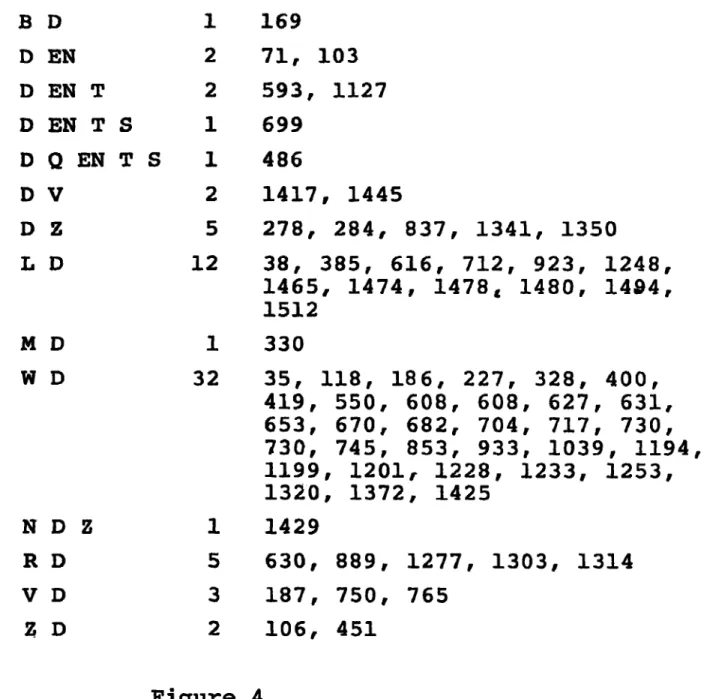
s o t h a t the cluster NDZ (fndz)') which i s listed under D i n
Figure 4 also appears under N a d 2 i n t h e full output.
D E N T S 1 6 9 9
D Q E N T S 1 4 8 6
D V 2 1 4 1 7 , 1445
D Z 5 278, 284, 8 3 7 , 1 3 4 1 , 1 3 5 0
N D Z 1 1429
Separate output may be generated for clusters occurring within
woxds or across word boundaries- Currently, consonant and
vawel clusters are tallied, but the program can be easily
modified to handle sequences of phonemes belonging to arbi-
trary user-defined classes (e.g. voiced sounds,, nasals, un-
voiced stops, etc. )
.
For each phoneme belonging to a selected class, CLUSTR
provides a count of the number of times that the phoneme appears
in clusters, an alphabetically sorted list of those clusters,
and a frequency count and reference numbers for each cluster.
Figure 4, a sample of CLUSTR output for within-word consonant
clusters, shows that D appeared in clusters a total of 70 times,
with 32 of these being ND clusters. Reference numbers may be
used to establish the discourse context of any cluster. For
example, the cluster D Q EN T S (/di?nts/) appears in utterance
486 which is the word students. Like ENVIRN, CLUSTR provides
a frequency ordered list of cluster types in addition ts the
alphabetic list.
C - Interactive Retrieval Facility
The set of "batch" programs is complemented by a language
data retrieval system which allows the user to interactively
retrieve data items conforming to various orthographic, phono-
logical and syntactic patterns.
Linguistic data is inte~nally stored in the system as a
network of associations between items of various types. These
associations are implemented in SAIL as LEAP triples [2J and
ing to the
-
particular application. For example, in analysisof the discourse data described above, triples contain ortho-
graphic, phonological and syntactic elements. For study of
phonetic-to-phonemic mapping, triples might be orthographic,
phonemic and phonetic elements. In comparative linguistic
research, triples might consist of an orthographic element
and two phonological elements corresponding to two languages
or dialects
Data can be accessed on the basis of patterns directed to
any one (or any combination) of these elements. For example,
if the data base contains associations between orthographic,
phonological and syntactic elements, then the query
P/ 0: THE
retrieves the phonological items associated with the .spelling
THE, and might return D H A X ( / B a / ) and DHIY i ) . The query
O/ P: TUW
would retprn the orthographic items pronounced T m (/tu/), e.g
two, too, t o r
- - -
Patterns such as THE and TUW completely specify the
element to which they are directed, but various special forms
allow partial. specifications to be expressed also. The symbol
$ matches any single segment (in a phonological pattern) or
character (in an orthographic pattern), and the symbol =
matches any number, llncluding zero, of contiguous segments
(or characters). Thus, if N is the syntactic code for Nounr
the query
searches for all two-phoneme nouns which begin with the letter
D, and might return dye, day,
-
doe, dough.Each phonological element is defined in terms of a set of
features such
as
UV (unvoiced) and ST (stop), and thesefeatures may
be used
to specify segments in phonologicalpawerns. To search for phonological realizations containing
/i/ between unvoiced stops, one could
use
the queryP/ P: =(UV
+
ST)IY(UV+
ST)=to find /kip/ (keep)
,
/ p i k ~ ? / (peeking),
and/r
pit d/ (repeated) Boolean operators are also available for specifyingpattern segments. For example, the query
0
6:
(C OR K)=, P: (NOT K)=returns arthographic ikems which begin
with
C orK
and are notpronounced with initial k , e.g. cite, change, know.
Several capabilities lacking in the
current
interactivesystem will be available in the near future. The user will be
able to (1) specify optional segments and sequences of segments
in phonological patterns; (2) create and name sets containing
items of interest, e.g. monosyllabic function words, and use
set operations
such
as union and intersection; (3) interactive-ly modify feature definitions of phonological symbols: (4) re-
trieve several elements, e.g. orthographic and phonological
forms, simultaneously; (5) display the discourse context of any
given item, and (6) write retrieval queries and responses
to
a11. APPLICATIONS
The processing package can be used in t h e analysis of
various kihds of natural language data, as illustrated in the
following examples.
A. Phonological variation
The programs can be used to efficiently index and sort
natural language data so that systematic phonological varia-
tion can be easily examined. For example, inspection of a
PROCON output for a ten minute interview consisting of over
2,000 utterance tokeno yields general observations such as
--
final /t/ alternates with final glottal stop /?/ under certain conditions;--
alveolar flapping occurs under several stress conditions whidh appear to be related to noun affixes.These preliminary observations can be systematically
investigated using t h e interactive query system.
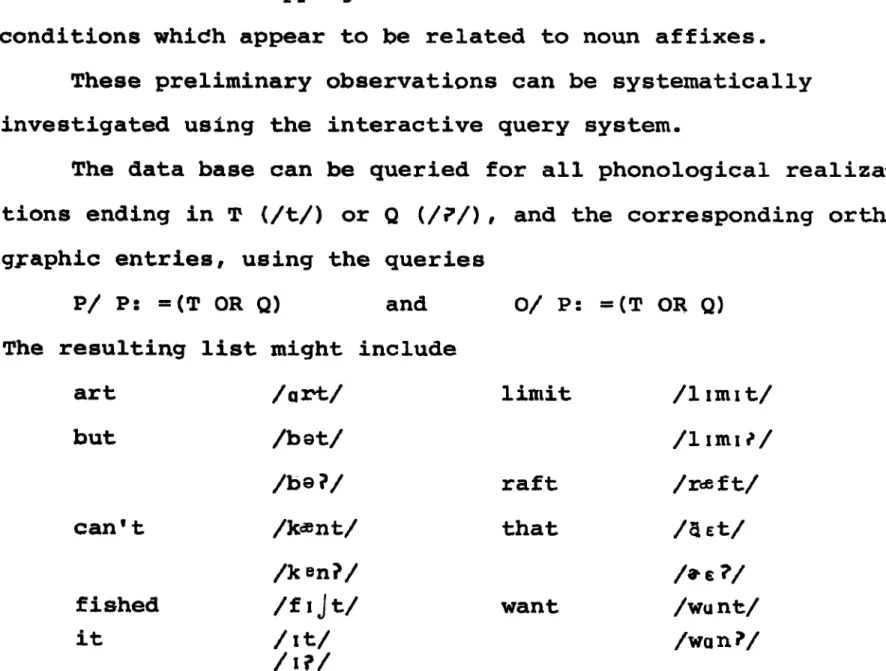
T h e data base can be queried for all phonological realiza-
tions ending in T (/t/) or Q ( / ? / ) , and the corresponding ortho-
graphic entries, using t h e queries
P/ P: =(T OR Q ) and O/ P: =(T OR 9 )
The resulting list might include
a r t /a*/
but / b a t /
can' t /k=nt/
/k en?/ fished /f 1 J t /
limit
raft
that
That is, final /t/ appears to vary with final / ? / following
vowels arid following nasals, but not elgewhere. This hy-
pothesis, represented as a context-sensitive phonological
rule, could then be tested against additional data using any
of several computer rule testers [3-51.
Forthcoming modifications will allow queries with set
operations, such that the intersection of orthographic entries-
having final /t/ alternating with /?/ can be requested directly by the query
01
P: =Tn
P: =Q.
That is, only entrieq with /t/ and /?/ alternation would be
retrieved, and the entties art, fished and raft would not be
returned,
In order to determine the conditions under which alveolar
flapping occurs, the queries
O/ P: =DX= and P/ P: =DX=
can be used to retrieve phonological items which contain DX
( ) and correspondihg orthographic items. Such a list might
include
ability l a b il xfi/
city /s
ifid/
facility /f as il
IF^/
letter /l ;fa/
petty /p ;pi/
responsibility / r ~ s p a n s ~ b i l ~ ~ i /
Flapping occprs in
a
descending stress pattern, e.g. cityletter, petty, wrdting in which a stressed vowel precedes
the flap and an unstressed vowel follows. In addition, trhe
flap appears to occur between unstressed vowels when the
sequence rppresents the noun asfix -ity, as in ability. To
check this, the query
P/ 0: =ITY, S: N
could be used to
retrieve
a81 nouns ending in -ity, and thesubset involving affixed forms ( i . e . excluding city,
p i t y )
could be examined for occurrences of flapping.
B. Word Error Recognition testing
The interactive facility can be used to examine the kinds
of word recognition errors which might occur
in
a speech under-standing system due to indeterminacies in segment labelling.
If a string is completely specified as /likrg/(coded LIYKIHNX),
then it matches a single word, leaking. However, if labelling
is less precise, then alternative (and incorrect)word matches
might occur. Using the i n t e ~ c t i v e retrieval system, alter-
native labels and resulting word matches can be examined for
any given lexicon.
In the example above, the labelled string might be
L (VOC HIGH ANT) K I H NX
with the stressed vowel represented as a set of features:
vocalic, high, anterior. Resulting word matches might include
leaking and licking.
If the initial consonant
is
also specified as a set of(CON SON CONT) {VOC H I G H ANT) K IH NX
then the resulting word matches might be leaking, l i c k i n q ,
reeking. If the K
is
specified less precisely as $ voice-less stop, word matches might include leakinq, licking,
reeking, leaping, rippinq.
The interactive facility allows the system designer to
easily determine the nature of possible incorrect matches
due to phonological indeterminacy, especially as the size of
the lexison increases.
C. Comparative Linguistic Relationships
If the data base is represented as an orthographic list
with two associated phonological lists representing two
languages or dialects, the interactive system can be used to
discover systematic sound correspondences, and to aid
in
thestudy
of
dialect relationships and historical reconstruction.A sample'data base might be:
Gloss
a fish
to have
no, not
brother
bamboo
Lanquaqe A Lanquage B
plaa Pa
mi i mia
plaaw Paw
phii fia
phaay fay
The query
would retrieve those items in language B which correspond to
items in language A with initial /pl-/ clusters, e.g. and
paw, indicating that consonant cluster simplification may have
B/ A: =IYIY
would retrieve those items in language B which correspond to
items in language A with final /-ii/, e.g. the drphthongized
mia and f ia.
- -
A large data base could be accessed in this way to dis-
cover systematic correspondences between languages A and B,
such as the correspondences /pl-/:/p-/, m : m , /ph-/:/f/,
i i : i a a a : a , etc.
The flexibility of the interactive system, combined with
the linguistic intuition of the user, can be used.to specify
and retrieve any set of correspondences, without the need to
format
the
data according to initial consonants or clusters,vowel nuclei,
finals,
etc. Information such as tonal cnntoursand stress can also be represented and accessed.
REFERENCES
[I]
Retz, D. L a , 3. R. Miller, J. L. McClurg, B. W. Schafer,Elf Kernel Programmer's Guide, Speech Comunications
Research Laboratory, Santa Barbara, California. April, 1975.
[ 2 ] Feldman, J. A. and P. Rovner
,
"An ALGOL-based Associative Language," Comm. ACM, Volume 12, August, 1969, 439-449.[ 3 ] Barnett, J. A,, A Phonological Rules System, TM-5478/000/00,
System beveiopment Corporation, Santa Monica, California,
1975.
[ 4 ] Bobrow, D. G. and J. B. Fraser, "A Phonological Rule
T e ~ t e r , ~ Comm. ACM, Volume 11, November, 1968, 766-772.
Description, Natural
Language Studies No. 9,Phonetics
Laboratory,
The University of
Michigan,
1971.
ACKNOWLEDGEMENT
This research was supported in
part by the AdvancedResearch
Projects Agency of the Department df Defensethrough
Contract N00014-73-C-0221