Original Article
Levocarnitine and torasemide combination improved
ventricular remodeling in patients with acute
exacerbation of chronic heart failure
Guangchong Liao*, Zulibiya AISA*, Jing Ma, Xunhui Long, Jian Chen
Department of Intensive Care Unit, Traditional Chinese Medicine Hospital of The Xinjiang Uygur Autonomous Region, Xinjiang, China. *Equal contributors.
Received October 6, 2018; Accepted November 8, 2018; Epub May 15, 2019; Published May 30, 2019
Abstract: Objective: The goal of this study was to investigate the effect of the combination of torasemide and le-vocarnitine for the treatment of acute exacerbation of chronic heart failure. Methods: A total of 128 patients with acute exacerbation of chronic heart failure were randomly divided into two groups. The control group (n = 63) was treated with levocarnitine and the observation group (n = 65) was treated with torasemide and levocarnitine and
the clinical efficacy, ventricular remodeling, and quality of life were compared with the control group. Results: The total effective rate (92.3%) in the observation group was significantly higher than that in the control group (P =
0.004). After treatment, the ventricular remodeling indicators NT-proBNP, plasma renin (PRA), angiotensin II (Ang
II), aldosterone (ALD), endothelin (ET) in the observation group were significantly lower than in the control group (P<0.0011). After treatment, the Living With Heart Failure questionnaire (MLWHF), and left ventricular end-diastolic volume (LVEDV) and Left ventricular end- systolic volume (LVESV) of the observation group were significantly lower than those of the control group. SF-36 left ventricular ejection fraction scores were significantly higher than those in the control group. After treatment, metalloproteinase 2 (MMP-2), 9 (MMP-9), tumor necrosis factor-α (TNF-α), and interleukin-6 (IL-6) in the observation group were significantly lower than in the control group. Metalloproteinase inhibitor 1 (TIMP-1) and 2 (TIMP-2) were significantly higher than in the control group (all P<0.001). Significantly
fewer patients experienced adverse reactions in the observation than in the control group (P<0.05). Conclusion: In the treatment of patients with acute exacerbation of chronic heart failure, the combination of torasemide and levo-carnitine had a stronger therapeutic effect on the improvement of ventricular remodeling symptoms, and enhanced
the quality of life of patients.
Keywords: Torasemide, acute exacerbation of chronic heart failure, ventricular remodeling, quality of life
Introduction
Chronic heart failure is a common clinical disor-der [1], often related to myocardial infarction and cardiomyopathy. Chronic heart failure is a complication of hemodialysis of patients with chronic renal failure [2]. Owing to patient ar- rhythmia and severe myocardial injury, patients are often in a state of acute exacerbation [3]. Excessively high left ventricular end-diastolic pressure and overloaded hemodynamics may lead to decompensation of heart function,
impaired ventricular filling, and impaired ejec -tion func-tion [4, 5].
Clinical statistics show that the incidence of chronic heart failure in cardiovascular disease
is extremely high, up to 40%, and most patients have acute exacerbation of chronic heart fail-ure. Therefore, clinical treatment has received particular attention. Patients with heart failure suffer repeated attacks and the success rate of cure is low. Therefore, the purpose of the
clini-cal treatment is mainly to improve the quality of
life of patients and to reduce the mortality rate [6, 7].
At present, drugs for the treatment of chronic heart failure are mostly diuretics, renin-angio-tensin-aldosterone system inhibitors, and ino-tropic agents, which improve patients’ clinical
symptoms, increase the quality of life, and
such as nausea, vomiting, or rashes [8, 9]. The drug levocarnitine facilitates metabolism. It can increase cardiomyocyte oxidation and pro-mote cardiomyocyte metabolism, which may
subsequently reduce the accumulation of drug
metabolites in the myocardium and prevent damage to cardiac muscle cells [10]. Torase- mide, a new type of long-acting diuretic with a
strong diuretic effect, can significantly reduce
the common symptoms of electrolyte imbal-ance resulting from the use of diuretics, and is used widely in clinical applications [11]. There are currently few established clinical applica-tions for the combination of two drugs in patients with chronic heart failure. Therefore, this study used a combination of drugs to
investigate the clinical efficacy of torasemide
plus levocarnitine in patients with acute acer-bation of chronic heart failure.
A total of 128 patients with chronic heart fail-ure in our hospital were selected and treated with levocarnitine or the combination of torase-mide combined with levocarnitine. The clinical effect of the combined treatment in patients with acute exacerbation of chronic heart fai- lure on the improvement of patients’ ventricular
remodeling and quality of life was investigated.
Material and methods
General information
A total of 128 patients with chronic heart fail-ure in Traditional Chinese Medicine Hospital of the Xinjiang Uygur Autonomous Region were selected and randomly divided into two groups with a Random Number Table. There were 63 patients in the control group and 65 cases patients in the observation group. There were
no significant differences in general clinical
data, such as age, gender, and disease course between the two groups. All patients were aware of the clinical protocol before the trial and provided informed consent. This study was approved by the Hospital Ethics Committee. Inclusion criteria: patients met the diagnostic criteria of the Guidance on Chronic Heart Fai- lure in China of the Cardiovascular Branch of the Chinese Medical Association [12]; patients had clinical symptoms visible on a chest X-ray, such as respiratory distress and pulmonary edema; patients were NYHA Class III to IV; patient compliance was good; and patients
could actively cooperate with the diagnosis and treatment of medical staff.
Exclusion criteria: patients with other cardio-vascular diseases; patients with malignant tu- mors; patients with systemic immune system diseases; patients with allergies to treatment drugs; patients in pregnancy or lactation; and patients with mental illness.
Methods
Both groups of patients were treated with the conventional treatment. The control group was treated with an intravenous infusion of levocar-nitine injection (Sigma Chemical Company, St Louis, Missouri, USA and prepared in 100 ml of physiological saline or glucose;). The applied treatment dose was 2 grams once per day for 2 days consecutively. The observation group was treated with an intravenous injection of torasemide in the control group (Taishotoyama Pharmaceutical Co. Ltd. Toshima-Ku, Tokyo, Japan; 20 mg, once per day). The course of treatment for both groups was 1 week. Sampl- es of venous blood were collected from both groups of patients before and after treatment for the in evaluation of clinical indicators.
Observation indicators and efficacy evaluation
Clinical efficacy evaluation criteria: If the treat-ed patient’s clinical symptoms were relievtreat-ed, and their cardiac function was be improved a minimum of two levels (cardiac function is grade I), the treatment was considered mark-edly effective. If the patient’s clinical symptoms were relieved and their cardiac function was improved by at least 1 level (cardiac function is not grade I), it was deemed effective. If the patient’s clinical symptoms were not improved or deteriorated, the treatment was invalid. To-
tal efficiency = (markedly effective + effective)/
total number of cases [13]. Determination of NT-proBNP
immunosorbent assay (NanJing SenBeiJia Bio- technology Co. Ltd, Najing, Jiangsu, China). Determination of ET: A radioimmunoassay was conducted in strict accordance with the kit instructions (Shanghai Xinfan Biological Tech- nology Co. Ltd. Shanghai, China). LVEDV, LVESV, and LVEF: Color Doppler ultrasound was used for the detection of these parameters.
Determination of MMP-2, MMP-9, TIMP-1,
TIMP-2, TNF-α, and IL-6: Venous blood was cen -trifuged at the supernatant plasma was col-lected and used for the determination of the serum content of the indicated proteins. An enzyme-linked immunoassay was performed in accordance with the manufacturer’s instruc- tions.
Quality of Life Assessment: Health Survey
Profile and Minnesota Living with Heart Failure
Questionnaire (MLWHF) were used for assess-ment. SF-36 scores of the patient’s physiologi-cal function, vitality, general health, emotional function, mental health, social function, and physical pain were rated based on physical and psychological aspects in eight dimensions and
36 items, respectively. MLWHF questionnaires
were used to assess the effect on the degree of heart failure in patients within 1 month. In total,
there were 21 questions and a total of 0-5
points. A higher score indicated a greater on the impact of heart failure on patients [14]. Adverse reactions of note recorded during the treatment were nausea, electrolyte imbalance,
surements are expressed as the mean ± stan-dard deviation (_x ± s). The t-test was used for comparison between groups. The enumeration
data are expressed as a percentage (%) and χ2 was used as the test statistic. Values of P<0.05
were considered to be statistically significant.
Results
Comparison of general clinical data
There were no significant differences between
the two groups in terms of age, gender, left ventricular ejection fraction, left ventricular dia-stolic end-diadia-stolic diameter, serum creatinine, serum sodium, serum potassium, and other general data (P>0.05) (Table 1).
Comparison of clinical efficacy
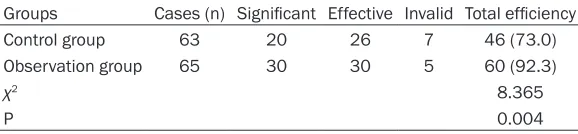
The total effective rate of the control group and the observation group was 73.0% and 92.3%, respectively. The total effective rate of the
observation group was significantly higher than
that of the control group (P = 0.004) (Table 2). Comparison of NT-proBNP, PRA, angII, ALD, and ET levels before and after treatment
There were no significant differences in
NT-proBNP, PRA, AngII, ALD, and ET before treat-ment between the two groups (P>0.05). After
treatment, these parameters were significantly
lower in the observation group than in the
control group with significant differences (P<
[image:3.612.93.524.89.195.2]0.0011) (Table 3). Table 1. Comparison of general clinical data in two groups of patients (_x ± s)
Index Control group Observation group T/χ2 P
Age (year) 58.23±6.65 60.56±6.87 -1.949 0.054
Gender (M/F) 31/32 34/31
Left ventricular ejection fraction (%) 34.81±4.32 34.66±3.97 0.205 0.838 Left ventricular end diastolic phase (mm) 64.21±6.43 63.98±7.09 0.192 0.848
Creatinine (μmol/l) 79.23±9.86 79.23±8.87 0.000 1.000
Blood sodium (mmol/l) 139.23±14.32 139.23±17.43 0.000 1.000
Blood potassium (mmol/l) 3.89±0.43 3.79±0.56 1.131 0.260
Table 2. Comparison of clinical data in two groups of patients [n (%)] Groups Cases (n) Significant Effective Invalid Total efficiency
Control group 63 20 26 7 46 (73.0)
Observation group 65 30 30 5 60 (92.3)
χ2 8.365
P 0.004
hypokalemia, and skin rash; other symptoms were recor- ded during treatment. Statistical methods
[image:3.612.91.380.227.294.2]mea-Comparison of SF-36 and MLWHF scores
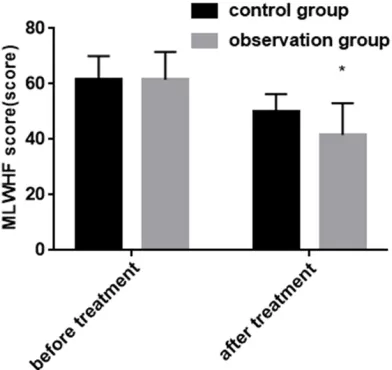
There were no differences in SF-36 and MLW- HF scores before treatment between the two groups; after tre atment, the scores of SF-36
in the observation group were significantly high -er than those in the control group (P<0.001) and the scores of MLWHF in the observation
group were significantly lower than those in the
control group (P<0.01) (Figures 1 and 2). Comparison of cardiac function indicators
Before treatment, there were no significant dif -ferences in cardiac function parameters, such as LVEDV, LVESV, and LVEF, between the two groups. After treatment, LVEDV and LVESV were
significantly higher in the control group than
those in the observation group (P<0.001). LVEF
was significantly higher in the observation
group than that in the control group (Table 4). Comparison of HR and blood pressure before and after treatment
Before treatment, there were no significant dif -ferences in HR and blood pressure indicators (SBP and DBP) between the two groups. After
treatment, these parameters were significantly
lower in the observation group than in the con-trol group (P<0.001) (Table 5).
Comparison of inflammatory factors before
and after treatment
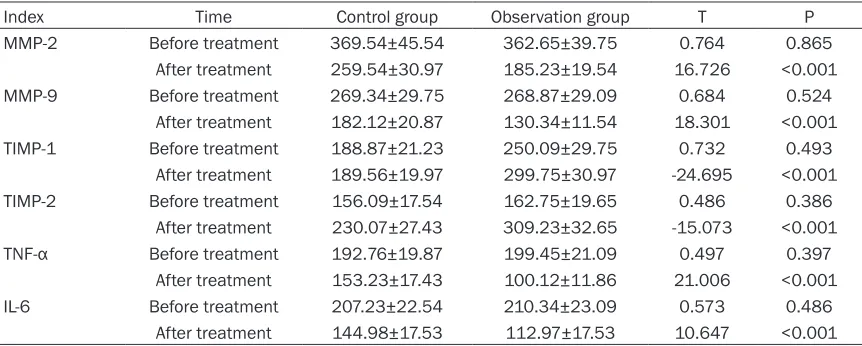
Before treatment, there were no significant dif
-ferences in inflammatory factors, such as MMP-2, MMP-9, TIMP-1, TIMP-MMP-2, TNF-α, and IL-6,
between the two groups. After treatment,
MMP-2, MMP-9, TNF-α, and IL-6 were significantly
[image:4.612.95.523.88.235.2]lower in the observation than in the control Table 3. Comparison of NT-proBNP, PRA, Ang II, ALD and ET levels in two groups of patients (_x ± s)
Index Time Control group Observation group T P
NT-proBNP (pg/ml) Before treatment 669.32±66.75 673.62±77.54 -0.336 0.738 After treatment 523.44±50.76 419.76±44.75 12.268 <0.001
PRA (ng/ml) Before treatment 2.25±0.32 2.24±0.27 0.191 0.849
After treatment 1.89±0.19 1.60±0.23 7.764 0.000
Ang II (pg/ml) Before treatment 185.44±20.97 183.34±19.87 0.708 0.480 After treatment 161.27±18.54 131.76±17.53 6.294 <0.001 ALD (pg/ml) Before treatment 237.09±28.64 236.23±27.43 0.779 0.492
After treatment 194.83±21.54 170.23±19.97 6.784 <0.001
ET (pg/ml) Before treatment 86.54±9.87 80.98±8.87 0.829 0.528
[image:4.612.91.285.246.439.2]After treatment 87.12±8.89 42.23±8.54 31.816 <0.001
Figure 1. Comparison of SF-36 scores in the two groups of patients. *P<0.01 compared with control group after treatment.
[image:4.612.91.287.505.690.2]group. Conversely, TIMP-1 and TIMP-2 were
sig-nificantly higher in the control group (P<0.001)
(Table 6).
Comparison of adverse reactions
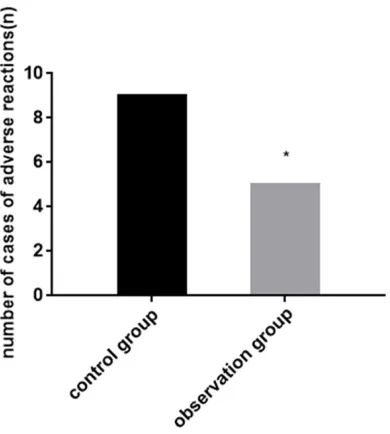
In the observation group, five patients
report-ed adverse reactions. The incidence was 7.7%. In the control group, nine patients reported adverse reactions and the incidence was 14.3%. The number of patients experiencing adverse reactions in the observation group was
significantly lower than that in the control
gr-oup (P<0.05) (Figure 3).
Discussion
Clinical treatment of heart failure is to enhance myocardial contractility and reduce the heart load, thereby improving the hemodynamics of patients with heart failure [15]. The clinical medication for the disease mainly comprises diuretics or inotropic agents. These can alle-
viate the condition and improve the quality of
life [16]. In this study, the effects of torasemide combined levocarnitine was investigated on
ventricular remodeling and quality of life in
[image:5.612.91.523.88.181.2]patients with acute exacerbation of chronic heart failure. After treatment, improved ven- Table 4. Comparison of cardiac function in two groups of patients (_x ± s)
Index Time Control group Observation group T P
LVEDV (ml) Before treatment 152.33±17.64 154.98±11.86 0.432 0.498 After treatment 145.65±15.86 126.43±13.54 7.665 <0.001
LVESV (ml) Before treatment 74.54±8.09 73.83±7.99 0.292 0.621
After treatment 62.32±6.54 50.92±5.87 12.308 <0.001
LVEF (%) Before treatment 42.31±4.56 41.90±4.97 0.923 0.459
[image:5.612.90.523.226.318.2]After treatment 51.87±6.54 59.53±6.87 -7.542 <0.001
Table 5. Comparison of heart rate and blood pressure before and after treatment in two groups of patients (_x ± s)
Index Time Control group Observation group T P
HR (t/min) Before treatment 92.37±10.98 91.95±9.54 0.623 0.739
After treatment 89.93±9.99 72.54±6.87 11.950 <0.001 SBP (mmHg) Before treatment 138.54±17.43 136.86±17.54 0.592 0.621
After treatment 119.09±12.45 101.21±11.21 9.693 <0.001
DBP (mmHg) Before treatment 83.45±9.09 84.56±9.98 0.502 0.498
After treatment 85.54±8.99 60.63±7.09 20.042 <0.001
Table 6. Comparison of inflammatory factors before and after treatment in the two groups of patients
(pg/ml, (_x ± s))
Index Time Control group Observation group T P
MMP-2 Before treatment 369.54±45.54 362.65±39.75 0.764 0.865
After treatment 259.54±30.97 185.23±19.54 16.726 <0.001
MMP-9 Before treatment 269.34±29.75 268.87±29.09 0.684 0.524
After treatment 182.12±20.87 130.34±11.54 18.301 <0.001
TIMP-1 Before treatment 188.87±21.23 250.09±29.75 0.732 0.493
After treatment 189.56±19.97 299.75±30.97 -24.695 <0.001
TIMP-2 Before treatment 156.09±17.54 162.75±19.65 0.486 0.386
After treatment 230.07±27.43 309.23±32.65 -15.073 <0.001
TNF-α Before treatment 192.76±19.87 199.45±21.09 0.497 0.397 After treatment 153.23±17.43 100.12±11.86 21.006 <0.001
IL-6 Before treatment 207.23±22.54 210.34±23.09 0.573 0.486
[image:5.612.91.522.361.534.2]tricular remodeling was observed along with increased heart and lung function, reduced
levels of inflammatory factors, and enhanced patient quality of life. These results suggest
a more effective clinical treatment and have
provided a scientific basis for further clinical
research.
Levocarnitine is involved in the lipid
metabo-lism process. Significant reductions in the level
of levocarnitine in the body are found in cases of heart failure. After in vitro levocarnitine ad- ministration, acyl-CoA is produced in myocardi-al cells from the mitochondria of patients with heart failure, which inhibits destruction of met-abolic enzymes, protects the cell membrane, and ensures normal function of myocardial
cells [17], which is confirmed by our study as
both LVEDV and LVESV levels improved. Torasemide is a new type of diuretic and play a role in the retention of sodium and the remov-al of potassium, which can promote urination and reduce the cardiac load [11]. This is also
consistent with our findings. In the observation group, the level LVEDV and LVESV were signifi -cantly lower than in the control group, which indicates better cardiac functions. The improve-ment of heart rate and blood pressure in the
observation group was also significantly better
than that in the control group, which indicated that the combination therapy improved heart
function and enhanced treatment. Pharmaco- logical studies also found that potassium re- moval by torasemide mainly occurs in the liver, so there is less damage to renal function, and a lower incidence of hypokalemia following long-term use [18]. Related studies have es- tablished the diuretic effect of torasemide, which has a long duration in the body and a higher bioavailability than conventional diuret-ics. Therefore, the drug has been used widely in clinical practice and has become a major representative diuretic.
It has been reported that the treatment of torasemide in mice with chronic heart failure can improve the symptoms of ventricular re- modeling and have a good therapeutic effect on myocarditis[21]. Pharmacological studies have shown that ET has a strong vasoconstric-tor effect, so the level of ET in patients with
heart failure is significantly increased. ET syn -thesis and secretion are promoted through va- rious mechanisms. Therefore, this indicator is also considered to be the main factor in the determination of heart failure function. The
main indicator in the determination of the effi -cacy of heart failure treatment is NT-proBNP, which is released from the ventricle. When the myocardial wall is damaged, the content of released NT-proBNP is increased; thus, the more serious the heart failure, the higher the
content in the body, making it a specific, sensi -tive indicator of heart failure [19].
When heart failure occurs, MMPs (MMP-2 and MMP-9) are activated, resulting in damage to the myocardial cells through the destruction of the collagen network structure. During this process, the MMP/TIMP balance system is
destroyed, TIMP is significantly reduced, and
left ventricle remodeling occurs in response to continuous wall pressure. In addition, MMPs
are related to the inflammatory cytokines TNF-α and IL-6. Prolonged overexpression of TNF-α
and IL-6 in patients with heart failure inhibits myocardial contractile function. Through the regulation of MMP expression, this type of
inflammatory factor causes ventricular remod -eling, myocardial damage, and aggravated he- art failure [20]. In this study, it was found that the improvement of the ventricular remodeling indicator in the observation group was better than that in the control group, which indicated that the combination therapy protected cardio-myocytes and reduced damage to the myocar-Figure 3. Comparison of adverse reactions in the two
[image:6.612.93.288.70.287.2]dial wall. A significant reduction of inflammatory cytokines TNF-α and IL-6 was also observed,
which inhibited MMP activation and prevented myocardial damage. Combination therapy can therefore improve the symptoms arising from the overactivation of multiple systems in the body and restore the balance of various fac- tors and hormones in the body, to return multi-ple indicators to normal levels, reduce the inci-dence of heart failure, and decrease ventricular remodeling.
Quality of life indicators were assessed by using the SF-36 and MLWHF scales. The SF-36 scale determines the patient’s physical and mental health, whereas the MLWHF scale determines the severity of the patients’ heart failure symptoms; thus, the combination of bo- th scales produces a more accurate
assess-ment of the patient’s quality of life. The improve
-ment of the quality of life scale MLWHF in the observation group was also significantly better
than that in the control group, which demon-strated that the combination therapy could
sig-nificantly relieve the patients’ clinical symp -toms and improve their health. The results of this study are similar to previous studies. It
has been reported that levocarnitine signifi -cantly improved cardiac function in patients with chronic heart failure and the six-minute
walking distance test was also significantly bet -ter than that of a placebo group, which
demon-strated a clear improvement in the quality of
life of patients. The use of torasemide in patients with chronic heart failure improved the symptoms of myocardial remodeling. The
improved quality of life was significantly greater
than that in the control group furosemide [10, 22].
There are some limitations to this study. The clinical effects of L-carnitine alone and the combination of the two drugs were discussed separately. The therapeutic effect of torsemide alone was not analyzed. Therefore, the next step of this topic can be further studied in this aspect. In addition, the therapeutic effect of combination therapy in patients with chronic heart failure and other disorders can be stud-ied to provide more medical treatment for the disease.
In summary, the combination of torasemide and levocarnitine in patients with chronic heart
failure significantly improved the symptoms of ventricular remodeling, enhanced the quality of
life and had a high clinical value. Therefore, it is worth investigating the drug combination and developing it for clinical practice.
Disclosure of conflict of interest
None.
Address correspondences to: Jian Chen, Depart- ment of Intensive Care Unit, Traditional Chinese Medicine Hospital of the Xinjiang Uygur Autonomous
Region, No. 116 Huanghe Road, Urumqi 830000, Xinjiang, China. Tel: +86-0991-5588957; E-mail: [email protected]
References
[1] Jacob J, Tost J, Miró Ò, Herrero P, Martín-Sánchez FJ and Llorens P. Impact of chronic obstructive pulmonary disease on clinical course after an episode of acute heart failure. EAHFE–COPD study. Int J Cardiol 2017; 227: 450-456.
[2] Kitamura K, Fujii H, Nakai K, Kono K, Goto S, Nishii T, Kono A and Nishi S. Relationship
be-tween cardiac calcification and left ventricular
hypertrophy in patients with chronic kidney dis-ease at hemodialysis initiation. Heart Vessels 2017; 32: 1109-1116.
[3] Soriano JB, Lamprecht B, Ramírez AS, Martinez-Camblor P, Kaiser B, Alfageme I, Almagro P, Casanova C, Esteban C and Soler-Cataluña JJ, de-Torres JP, Miravitlles M, Celli BR, Marin JM, Puhan MA, Sobradillo P, Lange P, Sternberg AL, Garcia-Aymerich J, Turner AM, Han MK, Langhammer A, Leivseth L, Bakke P, Johannessen A, Roche N, Sin DD. Mortality prediction in chronic obstructive pulmonary disease comparing the GOLD 2007 and 2011 staging systems: a pooled analysis of individu-al patient data. Lancet Respir Med 2015; 3: 443-450.
[4] Miro O, Gil VI, Martin-Sanchez FJ, Jacob J,
Herrero P, Alquezar A, Llauger L, Aguilo S,
Martinez G, Rios J, Dominguez-Rodriguez A, Harjola VP, Muller C, Parissis J, Peacock WF, Llorens P; Research Group on Acute Heart Failure of the Spanish Society of Emergency Medicine (ICA-SEMES Research Group) Re- searchers. Short-term outcomes of heart fail-ure patients with reduced and preserved ejec-tion fracejec-tion after acute decompensaejec-tion
[5] Hohendanner F, Bode D, Primessnig U, Guthof T, Doerr R, Jeuthe S, Reimers S, Zhang K, Bach D, Wakula P, Pieske BM and Heinzel FR. Cellular mechanisms of metabolic syndrome-related atrial decompensation in a rat model of HFpEF. J Mol Cell Cardiol 2018; 115: 10-19. [6] Imiela T and Budaj A. Acetazolamide as add-on
diuretic therapy in exacerbations of chronic heart failure: a pilot study. Clin Drug Investig 2017; 37: 1175-1181.
[7] Taniguchi A, Miyahara N, Oda N, Morichika D, Ichihara E, Oze I, Tanimoto Y, Ichikawa H, Fujii U, Tanimoto M, Kanehiro A and Kiura K. Protective effects of bisoprolol against acute exacerbation in moderate-to-severe chronic obstructive pulmonary disease. Acta Med Okayama 2017; 71: 453-457.
[8] Damman K, Kjekshus J, Wikstrand J, Cleland JG, Komajda M, Wedel H, Waagstein F and McMurray JJ. Loop diuretics, renal function and clinical outcome in patients with heart fail-ure and reduced ejection fraction. Eur J Heart Fail 2016; 18: 328-336.
[9] Kapelios CJ, Malliaras K and Nanas JN. Dosing of loop diuretics in chronic heart failure: it’s time for evidence. Eur J Heart Fail 2016; 18: 1298.
[10] Jing ZC, Wu BX, Peng JQ, Li XL, Pan L, Zhao SP, Li DY, Yu ZX, Gong JB and Zhao QY. Effect of intravenous l-carnitine in Chinese patients with chronic heart failure. Eur Heart J Suppl 2016; 18: A27-A36.
[11] Prieto-Ramos J, McNaught K and French AT. The novel use of intravenous pimobendan and oral torasemide in a cat with congestive heart failure secondary to end-stage hypertro-phic cardiomyopathy. Veterinary Record Case Reports 2016; 4: e000273.
[12] Mant J, Al-Mohammad A, Swain S, Laramee P and Guideline Development G. Management of chronic heart failure in adults: synopsis of the national institute for health and clinical ex-cellence guideline. Ann Intern Med 2011; 155: 252-259.
[13] Demissei BG, Postmus D, Liu LC, Cleland JG, O’Connor CM, Metra M, Ponikowski P, Teerlink JR, Cotter G, Davison BA, Edwards C, Givertz
MM, Bloomfield DM, Dittrich HC, Voors AA and Hillege HL. Risk-based evaluation of efficacy of
rolofylline in patients hospitalized with acute heart failure-Post-hoc analysis of the PROTECT trial. Int J Cardiol 2016; 223: 967-975. [14] Jacobsen EL, Bye A, Aass N, Fossa SD, Grotmol
KS, Kaasa S, Loge JH, Moum T and Hjermstad MJ. Norwegian reference values for the short-form health survey 36: development over time. Qual Life Res 2018; 27: 1201-1212.
[15] Zittermann A, Ernst JB, Prokop S, Fuchs U, Dreier J, Kuhn J, Knabbe C, Birschmann I, Schulz U, Berthold HK, Pilz S, Gouni-Berthold I, Gummert JF, Dittrich M and Borgermann J. Effect of vitamin D on all-cause mortality in heart failure (EVITA): a 3-year randomized clini-cal trial with 4000 IU vitamin D daily. Eur Heart J 2017; 38: 2279-2286.
[16] Packer M. Absence of an Ideal Observer II: the
agonizing search for experts without a conflict
of interest. Circulation 2017; 136: 2400-2402. [17] Meng Q, Sun S, Sun Y, Li J, Wu D, Shan A, Shi B
and Cheng B. Effects of dietary lecithin and l-carnitine on fatty acid composition and lipid-metabolic genes expression in subcutaneous
fat and longissimus thoracis of growing-finish -ing pigs. Meat Sci 2018; 136: 68-78.
[18] Mills KT, Chen J, Yang W, Appel LJ, Kusek JW, Alper A, Delafontaine P, Keane MG, Mohler E, Ojo A, Rahman M, Ricardo AC, Soliman EZ, Steigerwalt S, Townsend R, He J; Chronic Renal
Insufficiency Cohort (CRIC) Study Investigators.
Sodium excretion and the risk of cardiovascu-lar disease in patients with chronic kidney dis-ease. JAMA 2016; 315: 2200-2210.
[19] Cheng H, Fan WZ, Wang SC, Geng J, Zang HL, Shen XH, Liu ZH and Wang LZ. Prognostic utili-ty of combination of NT-proBNP with high sen-sitive cTn I in patients with heart failure: re-sults from retrospective study in an emergency department. Scand J Clin Lab Invest 2016; 76: 361-367.
[20] Aiqi X. GW27-e0005 change in levels of HMGB1, TNF-α, H-FABP in elderly anemic pa -tients with congestive heart failure and its ef-fect on ventricular remodeling. Journal of the American College of Cardiology 2016; 68: C144.
[21] Arumugam S, Sreedhar R, Karuppagounder V, Harima M, Nakamura M, Suzuki H, Sone H and Watanabe K. Comparative evaluation of to-rasemide and spironolactone on adverse diac remodeling in a rat model of dilated car-diomyopathy. Cardiovasc Ther 2017; 35. [22] Trippel TD, Van Linthout S, Westermann D,