. Exp. Biol. (1961), 38, 391-401 3 9 I
With 19 text-figures Printed in Great Britain
THE RESPONSES OF CERTAIN MYSIDS TO CHANGES
IN HYDROSTATIC PRESSURE
BY A. L. RICE
Marine Biological Station, Port Erin, Isle of Man
{Received 7 December i960)
INTRODUCTION
Hardy & Paton (1947) obtained results from experiments in the sea on Calanus finmarchicus (Gunn.) which suggested that the vertical migration of this species might
be affected by the change of pressure with depth. This prompted research on pressure effects and, since then, responses to changes of pressure by various animals have been observed in the laboratory by Hardy & Bainbridge (1951), Knight-Jones & Qasim (1955) and Baylor & Smith (1957). The present work is the first account of the pressure responses of mysids. It also appears to contain the first published demon-stration that the behaviour of an animal may be affected by the pressure changes due to tidal rise and fall, although different responses recorded by Prof. E. W. Knight-Jones (personal communication) for the pycnogonid Nymphon may well have a tidal significance in nature.
MATERIAL AND METHODS
The mysids used were adult and immature specimens of Schistomysis spiritus (G. O. Sars) and Siriella armata (Mime Edwards) and adults of Praunus flexuosus (Miiller) and P. neglectus (G. O. Sars), all collected by D-net in Port Erin bay. Recently hatched specimens of Schistomysis spiritus, released from the parents in the laboratory, were also used.
In the experiments a transparent Perspex observation tank 24 in. long and with a 2 in. square cross-section was used. An adjustable mercury column in transparent P.V.C. tubing communicated with the tank through an inlet in one side, and one of the end-plates could be removed to introduce sea water and animals. The tank could be held either vertically or horizontally and could be illuminated from above, below or from the side, the light always passing along the long axis of the tank. The light source used was either a projector lamp, giving a parallel beam slightly wider than the tank and an intensity of about 1000 lux, or a microscope lamp giving a nar-rower beam of about 850 lux. The same behaviour was exhibited whichever of these two light sources was used.
Usually between ten and thirty animals were used in each experiment and the numbers in each quarter of the tank were recorded at intervals; but occasionally the track of a single animal was observed.
Observations were made both on normal animals and on others without statocysts. The latter were obtained by first narcotizing with propylene phenoxetol and then
392
In the experiments conducted in darkness, observations were made by silhouetting the animals against a red light which was switched on only for the few seconds re-quired to record the distribution in the tank.
In all the experiments the animals had been adapted to the lighting conditions of the experiment for at least 10 min. before recording was started.
Pressures referred to in the results are all in excess of atmospheric pressure and are recorded in millibars. One millibar equals the pressure produced by approximately i cm. of sea water.
£1333 ~10001000 666 333 0
: "£14
3 2 12 '-a 6
J2 o
10 20 30 40 50 60 70 80 90 100 Thne (min )
Fig. I
20 30 40 Time (min )
Fig. a
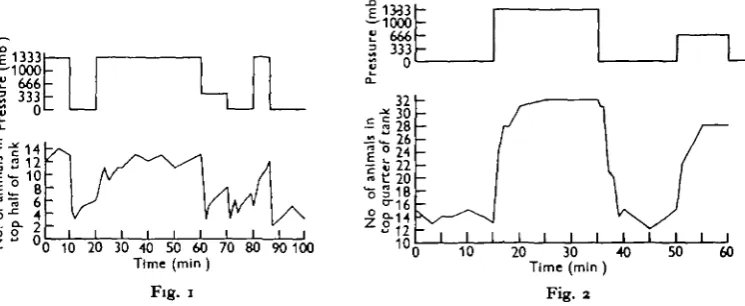
Fig. i. Distribution during pressure changes of fifteen specimens of SchUtomysit tpiritut in darkness.
Fig. 2. Distribution during pressure changes of thirty-two specimens of SchUtomytis spiritus in overhead light.
FslfrLr-
1
"
E-S
5 S *o 2
21
10 20 30 40 50 60 70 80 90 100 110120130140I I I I I I I I I I I I 1 1 Time (min )—I—I I I I I I I 0 10 20 30 40 50 60 70 80 90
Time (min )
Fig. 3 Fig. 4 Fig. 3. Distribution during pressure changes of fourteen specimens of Schutomytis sptritus in horizontal light.
Fig. 4. Distribution during pressure changes of twelve specimens of ScHstomyrit spiritus in light from below.
RESULTS
Schistomysis spiritus
[image:2.451.42.415.164.317.2] [image:2.451.38.416.377.499.2]Responses of tnysids to changes in hydrostatic pressure 393
In horizontal light the animals also exhibited a pressure response, moving towards the light with increased pressure and away from the light when the pressure was decreased (Fig. 3). Movement was with the head foremost in both cases.
With the observation tank vertical and the light coming from below (Fig. 4), the mysids again swam upwards with increased pressure and downwards with decreased pressure, as they did in darkness or when illuminated from above. Considered in relation to the incidence of the light, however, these movements are the reverse of those shown both in overhead and in lateral illumination.
.1000
666
333
c 16 2 15
1}}
g-10 - 9 E 8
M
* \
J I I I l l
[image:3.451.119.331.167.362.2]20 40 60 80 100120140160180 200 220 240260280 Time (mln )
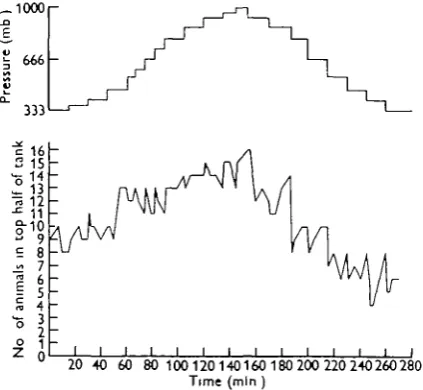
Fig. 5. Distribution of sixteen specimens of Sckittomynt sptritui under constant overhead illumination, with cyclical change of pressure by frequent small increments and decrements
The result of an experiment in overhead light in which the pressure was gradually increased and then decreased by frequent small changes is given in Fig. 5. A repro-duction of the tidal pressure change was not attempted and the whole cycle in the experiment took only 4^ hr., but the rate of change of pressure is of the same order as that which might be experienced in Port Erin bay due to the tides. It can be seen that responses were shown to each small pressure change and that there was also an over-all tendency for the animals to move upwards as the pressure increased and downwards as it decreased. The smallest changes of pressure in this experiment, at 15 and 30 min., were each equivalent to about 30 cm. of water and both produced definite responses. In another experiment responses were obtained to pressure changes as low as 15 mb. (i.e. 15 cm. of water).
The results given above refer to adult animals, but younger specimens were found to show the same responses to changes of pressure, and this was true even for those which had been released from the brood pouch only a few hours before.
Animals without statocysts. After removal of the statocysts the animals behaved in a similar manner to normal animals in light from above, moving upwards with increased pressure and downwards with decreased pressure (Fig. 6).
In darkness the same type of behaviour was again clearly shown (Fig. 7), and it
was very noticeable that when the pressure was increased the animals tended to swim actively right at the surface of the tank, whereas after a decrease in pressure they were never observed in this position.
In horizontal light (Fig. 8) the result was again similar to that with normal animals. As noted by Foxon (1940) for Hemimysis lamornae (Couch), the movements towards or away from the light would sometimes be executed while the animal showed a dorsal light reflex all the time, i.e. with either the dorsal or ventral surface foremost. Quite often, however, the excursion would be made head first, with the dorsal light reflex
1333 1000
% 666 a 333,
v 0
20 30 Time (min )
Fig. 6
S—1000 S-g 666 t> 3- 333 £ 0
1 - 5
• « - = 1
9-0 I I I I I I 1 1
o j " o 10 20 30 40 50 60 70 80 "^ Time (mln )
Fig. 7
Fig. 6. Distribution during pressure changes of fourteen specimens of Sc/mtomyiis tprritus without statocysts in overhead light.
Fig. 7. Distribution during pressure changes of five specimens of Schiitomysit spiritus with-out statocysts in darkness.
£~1000r 2-9 66b[
= C 6
J£ > 4 c O 2
•= 0, I I I I j I J L
10 20 30 40
Time (mln )
50 60 70
Fig. 8. Distribution during pressure changes of fourteen specimens of Schutomysit tpiritus without statocysts in horizontal light.
only becoming apparent at the end of the movement. An interesting variant was also often seen in which the animal's first response to an increase of pressure would be to exhibit a dorsal light reflex facing upwards. It would then move slowly towards the light, dorsal surface foremost, and lean over backwards until it would be lying on its back facing the light source. Once in this position it would swim rapidly towards the light upside down or sometimes on its side. Having reached the end of the tank it would press its dorsal surface against the end plate and remain there until the pressure was decreased, when it would swim towards the other end of the tank with the ventral surface facing downwards.
Responses of mysids to changes in hydrostatic pressure 395
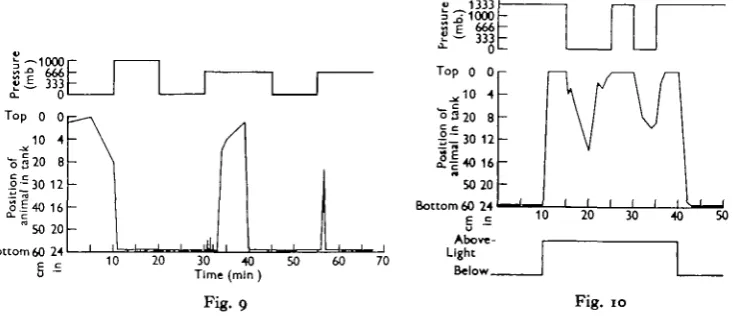
caused any change in this behaviour. Occasionally an animal was found swimming higher in the tank and in this case increased pressure almost invariably caused rapid swimming downwards towards the light, as is illustrated in the first part of Fig. 9, which is the track of a single individual. The interesting behaviour shown by this specimen in the later part of the same experiment was not seen in any other individuaL After reaching the bottom in response to the initial increase in pressure, the animal remained there exhibiting the dorsal light reflex throughout the high-pressure period and the sub-sequent period of lowered pressure. Shortly after the second pressure increase, how-ever, it made a succession of abortive attempts to leave the bottom. These attempts consisted of an upward movement of about 5 cm. executed head first, after which the animal turned over on to its back and swam obliquely to the bottom. Eventually, as recorded in the graph, it left the bottom and remained swimming for several minutes
30 40 Time (mln )
Fig. 9
g 1333 2 2" 1000
Top 0 0 _*10 4
[image:5.451.41.408.218.377.2]~° 3 20 8
| f 30 12
i l l 40 16
50 20 Bottom 60 24 Above -Light Below -_
-n /
\ r
\
V
i i 10 20or
—\ r\
\ \
i i i | 30 40 51
Fig. 10
Fig. 9. Track during pressure changes of a single specimen of Sckistomysis spiritus without 8tatocysts in light from below. The animal's abortive attempts to leave the bottom (see text) are indicated by short vertical lines.
Fig. 10. Track of a single specimen of Sckiitomysis tptritus without statocygts in an experiment m which the pressure and light direction were changed as indicated.
high up in the tank, orientated dorsal side up, and then, suddenly turning over, it exhibited a dorsal light reflex for a few seconds before swimming rapidly to the bottom. It remained on its back on the bottom throughout the following low-pressure period and more or less repeated the above procedure after the next pressure increase, but this time spent only a few seconds swimming high in the tank.
A further illustration of the importance of light as an orientating factor in animals lacking statocysts is furnished by Fig. 10, which shows the track of a single individual in an experiment during which the direction of the light was changed twice, in addition to the pressure changes. The animal maintained its dorsal surface towards the light throughout this experiment.
Siriella armata
In vertical light, either from above (Fig. 11) or below (Fig. 12), adults of this species behaved in a similar manner to Schistomysis spiritus, except that a smaller proportion B F them moved upwards in response to increased pressure with the light from below.
In horizontal light the majority of the animals used made no migration at all, and only a few showed the same response as S. spiritus, swimming towards the source of light when the pressure was increased and away when it was decreased (Fig. 13). Under atmospheric pressure in horizontal light the animak remained more or less stationary on the bottom of the tank facing directly away from the light, and about half of them did not move from this position despite the pressure changes. However, about one-third of the specimens tested showed a change in their orientation when the pressure altered. After an increase of pressure they took up a position facing vertically upwards with their dorsal surfaces towards the light. Several animals maintained this orienta-tion for as long as 30 min., until the pressure was again decreased, when they once more became horizontal, facing away from the light.
0 10 20 30 40 50 60 70 80 90100110120130140 Time (min)
Fig. I I
10 20 30 40 50 60 70 80 90100110120 Time (min )
Fig. ia
Fig. 11. Distribution during pressure changes of twenty-four specimens of Siriella armata in overhead light.
Fig. ia. Distribution during pressure changes of twenty-four specimens of Siriella armata in light from below.
10 2030405060708090 100110120130 I I I I I
Time (min.) 10 20 30 40 50 60 70 80 90100110120130140150Time (min )
Fig. 13 Fig. 14
Fig. 13. Distribution during pressure changes of fourteen specimens of Siriella armata in horizontal light.
Fig. 14. Distribution during pressure changes of sixteen specimens of Sniella armata under 16 mm. in length in darkness.
These results refer only to large individuals between 20 and 30 mm. in length. Smaller animals, less than about 15 mm. in length, gave very inconclusive results, as in the example illustrated in Fig. 14. This is markedly different from the situation in S. spiritus, in which all stages, including newly hatched specimens, reacted strongly to pressure changes.
Responses of mysids to changes in hydrostatic pressure 397
cysts were removed this tendency was even more marked; Foxon (1940) noted this effect of the removal of the statocysts in Hemimysis lamornae. In the present species it was found that if the animals were shaken free from the sides they exhibited a dorsal reflex only until they once more came into contact with a solid surface, when this clinging position was usually resumed. No obvious pressure response was ob-tained from these animals when the statocysts had been removed.
o Z
.8 u
[image:7.451.123.337.144.253.2]0 10 20 30 40 50 60 70 80 90 100 110 Time (mln )
Fig. 15. Distribution during pressure changes of a mixed population of eight Praumu neglectus and six P. flexuosus in overhead light.
-g-3 8
SB 4
[image:7.451.63.397.296.432.2]0 10 20 30 40 Time (mln.)
Fig. 16
50 60
£1000
§ 333
£ - 1 2 -=2 10
J ^ 8 S*= 6
n
^ 2 o0 10 20 30 HO Time (mln.)
50 60
Fig. 17
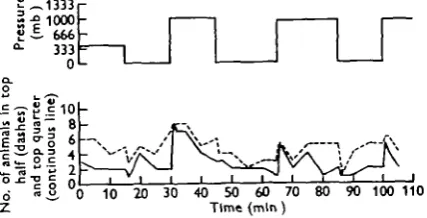
Fig. 16. Distribution during pressure changes of a mixed population of twelve Praunus neg-lectus and two P. flexuosus in overhead light.
Fig. 17. Distribution during pressure changes of a mixed population of twelve Praunus neglectus and two P. flexuosus in light from below.
Praunus flexuosus and P. neglectus
These two species were grouped together because of the difficulty of separating them before they were used in the experiments. The numbers of each species were determined after the experiments, and are given in the legends to the figures.
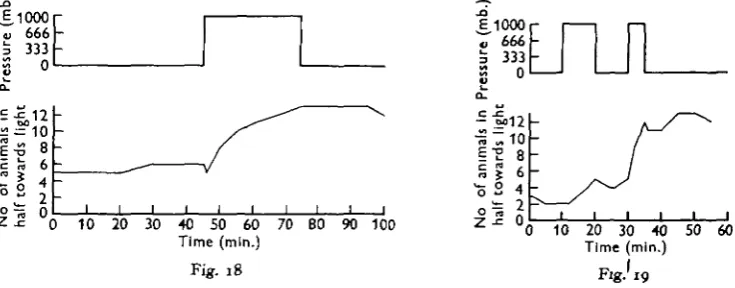
In horizontal light the pressure response was again orientated to the direction of the incident light, but the results were slightly different from those obtained with either Sckistomyiis or SirieUa. Figs. 18 and 19 show that increased pressure induced movement towards the light source, but no movement away fromthe light was recorded in response to decreased pressure. The animals showed a marked tendency to orientate so that they were facing the light, and did not show the dorsal light reflex.
.§.1000 a> 666 = 333
5 0
L
333
LRJ1
[image:8.451.40.408.152.296.2]"0 10 20 30 40 50 60 70 80 90 100 Time (mln.)
Fig. 18
§"2
O 15
Z J= 0 10 20 30 40 50 60
Time (min.)
Fig.'19
Fig. 18. Distribution during pressure changes of a mixed population of twelve Praunus neg-lectut and two P. Jlexuotus in horizontal light.
Fig. 19. Distribution during pressure changes of a mixed population of twelve Praunus neg-lectus and two P. flexuoiut in horizontal light.
A few experiments were conducted with these animals after the removal of the statocysts, and the same marked clinging tendency was shown as with SirieUa. How-ever, orientation to light was apparent even while the animals were dinging to a sur-face, since if they were illuminated laterally they would lean over so that the dorsal surface tended to be turned towards the light, and if they were facing the light the anterior end was lowered and the posterior end was raised so that again the dorsal surface was partly turned towards the light. Occasionally an increase of pressure produced a definite response in an animal, and this invariably consisted of swimming towards the light whether it involved upward, downward or horizontal movement.
DISCUSSION
Delage first demonstrated the balancing function of the statocysts in 1887 and since then various authors have been concerned with the problems of orientation and movement in mysids.
Responses of mysids to changes in hydrostatic pressure 399
Foxon (1940), working mainly on Hetmmysis lamornae, confirmed the importance of orientation to gravity in normal mysids, and found that when the animals were dark-adapted the effect of light was to produce a positive geotaxis, presumably via the statocysts. The direction of the light was found to have no influence on the orientation of the response in normal animals, but once the statocysts had been removed the light direction did become important for orientation. Franz (1911) and Fraenkel (1931) had described the phototelotaxis of light-adapted H. lamornae, in which the animals swam alternately towards and away from the light source. Foxon (1940) stated that in his experience this behaviour only occurred in horizontal light, and that in vertical light from above the animals made horizontal excursions near the bottom.Certain conclusions can be drawn from these observations. First, it seems that in normal mysids orientation to gravity is of major importance; vertical light apparently has little effect on the animals' orientation, but when it is directed horizontally it does become important in this respect. On the other hand, after removal of the statocysts the direction of incident light has more influence on the orientation than gravity, although in the absence of light, orientation to gravity is still possible.
In the present work, by observing the responses of the mysids to pressure which itself has no directional component, these conclusions have been further substantiated. The dominant effect of gravity over light in the orientation of normal mysids is shown by the fact that their pressure response is orientated to gravity even when they are illuminated from below. However, in Siriella armata with the light coming from below appreciably fewer animals moved upwards in response to increased pressure than did so in overhead light. This may indicate an influence of the light direction in this species at least.
In the experiments with horizontal light the orientating function of the light is well shown by the pressure responses of all the species tested, even in those cases in which no migration occurred.
Experiments in vertical light with animals lacking statocysts show that after the operation the importance of light for orientation is increased, but the behaviour exhibited by these animals in darkness (Fig. 7) shows that, even when the balancing organs have been removed, orientation to gravity is still possible (presumably via the general position reflex of von Buddenbrock).
Orientation of the body in mysids seems to be under the control of at least three different systems. The most important is the orientation to gravity by means of the statocysts. Secondly, there is the dorsal light reflex via the eyes, which in nature would normally reinforce the orientation to gravity. In the laboratory, by making the two factors operate in opposite directions, it can be shown that control by the statocysts is normally the stronger, and that the dorsal light reflex only becomes dominant when the statocysts are removed. The third mechanism is the general position reflex and this is obviously the least dominant of the three, since only in animals without stato-cysts and in total darkness does it become apparent.
occur, and this could apply to mysids at night when many are found in the plankton. However, these animals spend most of their time close to the bottom, and in this posi-tion would not experience these vertical displacements, but they would be subjected to the slow pressure changes associated with the rise and fall of the tides. The experi-ments on Schistomysis spiritus with frequent small changes of pressure (Fig. 5) indicate that at any rate this species can respond to these slow changes.
Liao (1951), working on Schistomysis spiritus in Port Erin bay, studied the aggrega-tion of the animals at the water's edge at different times of the day and at different states of the tide. He found that young forms were common at the water's edge near the time of high water, irrespective of the time of day, but only at night were large concentrations of older individuals found in this region. When low water occurred at night the population at the water's edge was very small. His results indicate that the animals have a tendency to move to the water's edge each night and with each rising tide, and the reverse tendency during the day and at low tide. Liao also noted that dull weather during the day increased the numbers found at the water's edge.
Elmhirst (1931, 1932) observed Schistomysis spiritus and Praunus flexuosus to move into the intertidal region with the incoming tide at night and he called these species ' tidal migrants' accordingly. He also observed that on nights with bright moonlight this shoreward migration did not occur, and this agrees with Liao's findings that light intensity is important in these movements.
Laboratory observations (Foxon, 1940, and personal observations) have confirmed that several species of shallow-water mysids tend to leave the bottom more readily in darkness or very low light intensities. It appears, therefore, that both pressure and light intensity are important factors in controlling the activity and distribution of these species. Laboratory observations that upward migration in these animals may be induced both by low light intensities and by increased pressures are completely in accord with field observations that the greatest numbers near the water's edge occur at night and near the time of high water.
SUMMARY
1. Four mysid species have been found to exhibit responses to changes in hydro-static pressure.
2. The orientation of these responses has been observed in normal animals, and also in ones from which the statocysts had been removed. The results have helped to confirm earlier work on mysids, and indicate that at least three mechanisms are involved in orientation in this group. These mechanisms are (a) orientation to gravity via the statocysts, (b) the dorsal light reflex and (c) the general position reflex.
3. One of the species used has been shown to respond to slow pressure changes of the same order as those due to tidal rise and fall, and it is suggested that the pressure responses may be important in the tidal migrations of shallow-water mysids.
Responses of mysids to changes in hydrostatic pressure 401
REFERENCES
BAYLOR, E. R. & SMITH, F. E. (1957). Diurnal migration in plankton crustaceans, in B.T. Scheer (Ed). Recent Advances in Invertebrate Phytiology, pp. 21—35. University of Oregon Publications.
BUDDENBROCK, W. VON (1914). Uber die Orientierung der Krebse im Raum. Zool. Jb., Abt. allg. Zool. Physiol. 34, 479-514.
DELAGE, T. (1887). Sur une fonction nouvelle des Otocystes commes organes d'orientation locomotnce. Arch. Zool. Exper. Gin., Ser. 2, 5, 1-36.
ELMHIRST, R. (1931). Studies in the Scottish marine fauna. Proc. Roy. Soc. Edm. 51, 169-75. ELMHIRST, R. (1932). Quantitative studies between tide marks. Glasg. Nat. 10, 56-62.
FOXON, G. E. H. (1940). The reactions of certain mysids to stimulation by light and gravity. J. Mar. Biol Ass U.K. 33, 89-97.
FRAENKKL, G. (1931). Die Mechanik der Orientierung der Tiere im Raum. Biol. Rev. 17, 377-93. FRANZ, V. (1911). Weitere Phototaxistudien. 1. Zur Phototaris bei Fischen. 2. Phototaxis beimannen
Crustaceen. 3. Phototaktische lokomotionsperioden bei Hemimysis. Int. Rev. Hydrobiol., Biol. Suppl., Bd. 3, Dritte Ser. 1-23.
HARDY, A. C. & BAINBRIDGE, R. (1951). Effect of pressure on the behaviour of decapod larvae. Nature, Lond., 167, 354.
HARDY, A. C. & PATON, N. (1947). Experiments on the vertical migration of plankton nni'main J. Mar. Biol. Ass. UK 26, 467-526.
KNIGHT-JONES, E. W. & QASIM, S. Z. (1955). Responses of some marine plankton animals to changes in hydrostatic pressure. Nature, Lond., 175, 941.