Election Sentimental Analysis using Swift
Sudip Kandel
Department of Information Science Engineering, New Horizon College of Engineering Outer Ring Road, Marathalli, Bengaluru-
560 103
Abstract: The process of identifying and distributing opinions and views which are expressed in a piece of text, especially in
order to decide whether the attitude of the user toward particular idea, product is positive, negative, or neutral is known as
sentiment analysis. During election days , it’s really necessary to determine the mindset of the people towards particular tweets or
sentiment. In this project we used twitter API to fetch the data using the unique key provided by the twitter. An user interface is
constructed in iOS platform which can be used to search tweet related to the election . These tweets are later classified using a
machine learning model(text classifier) provided by CoreML2 which calculates the points with respect to the number of tweets
according to its sentiment (Positive, Negative or Neutral). These points are used to determine the actual sentiment of the people
towards that particular search. Later , this classified points are displayed in user’s screen. Users also can make multiple searches
as per their requirement.
Keywords: election sentiment in ios , CreateML , text classifier for election using swift.
I.
INTRODUCTION
Sentiment Analysis is widely used to analyze the sentiments, attitudes, reactions, evaluation of the content of the text. Most of the
time we will be analyzing the opinions, reactions ,sentiments, evaluations of the various entities which can be services, products,
organizations, events , issues or other topics . Sentiment Analysis where we try to find the opinion of people or text provided is also
known as Opinion Mining . Among the giant platform of social media Twitter is a microblogging media which in real time
expresses the persuasion of a person or group about a particular topic which can appear in Timeline. All the messages displayed in
the wall of the Twitter is known as Tweets . The user are connected to each other by various tweets and followers while their
timeline are key components of Twitter. The timeline is chronologically sorted and are expressed in the form of text, image or links.
Because of popularity of Twitter as an information source, it led to development of applications and research in many spheres.
Twitter is used in predicting the happenings of earthquakes and identifying relevant users to follow to obtain disaster relevant
information. In the various prediction we are interested in the sentiments to the people towards the election. By using these
sentiments we are trying to predict the most possible result to the election in a mobile Platform.
Fig 1: This is an image of Swifter API which helps us to connect and retrieve tweets from twitter.
[image:1.612.144.462.593.713.2]Swifter is a greater Framework which is written in Swift to provide a swiftly experience to parse the data from the twitter API . This
Framework make the task easier by making it simpler and more developer friendly. As it has a great documentation it makes the
developers a lot easier to use this framework.
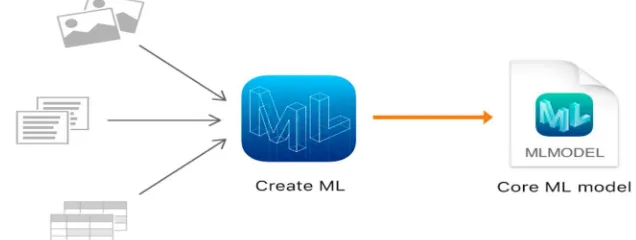
Machine Learning in a mobile device is a great wish but was not possible previously. Using the Playground in Xcode by using
MacOS platform we can use CreateML to produce great machine learning models. Machine learning models can be produced very
effectively and can be used in mobile application with the help of createML module. All the machine learning model created can be
usable when it is in .mlmodel format. A model can process various data types like structure or semi structured datasets.
II.
LITERATURE SURVEY
S l No.
Title of the Paper
Authors
Month & Year
Observations
1
Twitter Sentiment Analysis
Aliza Sarlan , Chayanit Nadam,
Shuib Basri
November 18 –
20, 2014
Application Programming
Interface(API)
, Natural Language Processing
(NLP)
2
Sentiment Analysis on Twitter
Akshi Kumar and Teeja Mary
Sebastian
July 2012
Tweet Sentiment Scoring ,
Scoring Module
3
A Study on Sentiment Analysis
Techniques of Twitter Data
Abdullah Alsaeedi1 , Mohammad
Zubair Khan2
2019
Document-Level Sentiment
Analysis Approaches
4
Sentiment Analysis of Twitter Data
Apoorv Agarwal Boyi Xie Ilia
Vovsha Owen Rambow Rebecca
Passonneau
Prior polarity scoring, Feature
Analysis
5
Sentiment Analysis of Twitter Data
Kiruthika M.,Sanjana Woonna,
Priyanka Giri
Data Collection using Twitter
API
6
Social Network and Sentiment Analysis
on Twitter: Towards a Combined
Approach
Paolo Fornacciari, Monica
Mordonini , Michele Tomauiolo
Social Network Analysis: data
selection, sequence of cleaning
the tweet
7
Twitter Sentiment Analysis of Movie
Reviews using Machine Learning
Techniques.
Akshay Amolik, Niketan Jivane,
Mahavir Bhandari, Dr.M.Venkatesan
January 2016
Modelling of Feature Vector ,
Naïve Bayes Classifier , Support
Vector Machine
8
Sentiment Analysis on Twitter Data
Varsha Sahayak Vijaya Shete
Apashabi Pathan
January 2015
Filtering, Tokenization, Removal
of Stop words
9
Semi Supervised and Active Learning in
video Scene Classification from
Statistical Features
Tomas Sabata, Petr Pulc, Martin
Holena
Video data, scene classification,
semi- supervised learning , color
statistics, feedforward neural
networks
10
Sentiment Analysis On Twitter Data
Onam Bharti Mrs. Monika Malhotra
June 2016
Naive Bayes (NB), Modified
approach K-mean algorithm.
11
Implementation Of Sentiment Analysis
On Twitter Data
Thirupathi Rao Komati, Sai
Balakrishna Allamsetty , Chaitanya
Varma Pinnamaraju
2017
Search twitter feeds,
Load Twitter API
12
Review Paper on Sentiment Analysis of
Twitter Data Using Text Mining and
Hybrid Classification Approach
Shubham Goyal
2017
binary task of classifying
sentiment
13
Twitter Data Analysis on Natural
Disaster Management System
Pichao wang, wanqing Li,Philip
Ogunbona,Jun Wan,Sergio Escalera
2017
Human motion recognition ,
RGB-D data, Deep learning
14
Empirical Study of Twitter and Tumblr
for Sentiment Analysis using Soft
Computing Techniques
Akshi Kumar
October, 2017
Multilayer Perceptron (MLP) ,
Decision Tree (DT)
15
Sentiment Analysis Based On Twitter
Data On Violence
Nihal Jumhare, Raja Rajeswari G,
Balaji Jayakrishnan
February 2017
Maximum Entropy
16
Stress Detection And Sentiment
Prediction: A Survey
Dr. G V Garje
, Apoorva Inamdar, Harsha Mahajan,
Apeksha Bhansali, Saif Ali Khan
January 2016
17
Sentiment Analysis of Twitter Data
through Big Data
Anusha.N , Divya.G,
Ramya.B
1)
Problem Statement:
The main objective of the research is to provide effective prediction of election by studying the sentiments
of people by applying the machine learning algorithm provided by the Swift’s CoreML. In this project we are majorly focused
to construct the ML model that provides an effective and accurate data to the user. The ultimate goal is to ascertain data that
are fetched properly from twitter successfully to classify the tweets according to sentiments to provide promising accuracy.
III.
METHODOLOGY
1)
API Call: Swifter can be used with the 3 different kinds of authentication protocols Twitter allows. You can specify which
protocol to use as shown below. By studying the Twitter Authentication Protocol (OAuth) we can access the twitter API in
following ways
A.
Application-Only Authentication: Oauth2 (Bearer Token)
1)
Application-only authentication is a form of authentication where an application makes API requests on its own behalf, without
the user context. This method is for developers that just need read-only to access public information.
B.
Application-User Authentication: Oauth 1a (Access Token For User Context)
1)
The user authentication method of authentication allows an authorized app to act on behalf of the user, as the user.
C.
Classification Using Ml Model: Steps Required For Classifying The Twitter Data Are Given Below
Converting JSON/CSV to a MLDataTable
1)
First and foremost, we'll need to tell Create ML where it can find our JSON file.
D.
Splitting the Data
1)
80% of your dataset should be used for training, and you should save the other 20% to make sure everything is working as it
should.
E.
Training and Testing
1)
Now that your data is all set up and ready, it's time to finally train it and test your resulting model.
F.
Code
Code For creating the model
import Cocoa
import CreateML
//can be converted either from JSON or CSV data format
let data = try MLDataTable(contentsOf: URL(fileURLWithPath:
"/Users/sudip/Desktop/8TH-SEM/FYP/TWITTER-CSV/twitterf.csv"))
let(trainingData, testingData) = data.randomSplit(by: 0.8, seed: 5)
let sentimentClassifier = try MLTextClassifier(trainingData: trainingData, textColumn: "text", labelColumn: "class")
let evaluationMetrics = sentimentClassifier.evaluation(on: testingData)
let evaluationAccuracy = (1.0 - evaluationMetrics.classificationError) * 100
let metadata = MLModelMetadata(author: "Sudip Kandel", shortDescription: "A set of data used to classify sentiments", version:
"1.0")
try sentimentClassifier.write(to: URL(fileURLWithPath:
"/Users/sudip/Desktop/8TH-SEM/FYP/TWITTER-CSV/twitterSentiment.mlmodel"))
try sentimentClassifier.prediction(from: "he is really good person")
try sentimentClassifier.prediction(from: "he is bad person")
try sentimentClassifier.prediction(from: "bjp")
Code for fetching the tweet using Swifter Framework
func fetchTweet(){
// let prediction = try! sentimentClassifier.prediction(text : "@BJP is great and best")
// print(prediction.label)
swifter.searchTweet(using: searchText, lang : "en" , count: tweetCount ,tweetMode : .extended ,success: { (results,
metadata) in
//tweets is a object of the twitterSentimentInput.mlmodel which is kept inside a array which holds the input value from the
twitter ie each tweet which is stored inside the array.
var tweets = [twitterSentimentInput]()
//a for loop that iterates from 0 to 100 so total 100 tweet
for i in 0..<self.tweetCount{
//"full_text" is the json value from the twitter which is converted into string
//tweetForClassification classifies each tweet
if let tweet = results[i]["full_text"].string{
let tweetForClassification = twitterSentimentInput(text: tweet)
//those hundred tweets are stored inside the tweets array object
//and append each tweet inside it
tweets.append(tweetForClassification)
}
}
//if successfully tweets are fetched and inserted inside the array of strings inside the variable called tweets send the tweets
to makePrediction function
self.makePrediction(with: tweets)
//if error produce error
}) { (error) in
print("There was an error with Twitter API request , \(error)")
self.sentimentLabel.text = "Sorry we are not able to fetch the tweets. Try Again"
self.errorToRecieve()
}
}
}
[image:4.612.185.443.497.719.2]G.
Structure and Data Flow Diagram
Fig 4: Data Flow Daigram
The above diagram shows us how the Features are taken extracted and managed by the CoreML where data are classified
accordingly and later fed to the model with respect to the tweet searched.
IV.
RESULT AND CONCLUSION
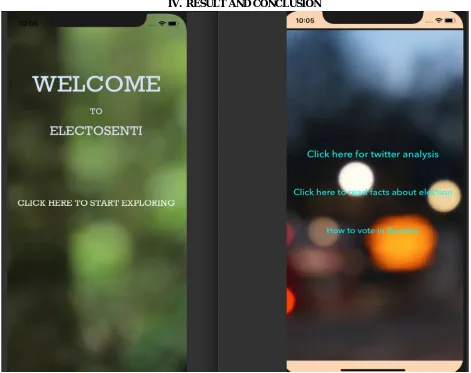
[image:5.612.71.542.341.714.2]Fig 6 : Representation of Prediction Page and Result Page which shows a result of sample tweet searched in iOS Simulator (iPhone
XS).
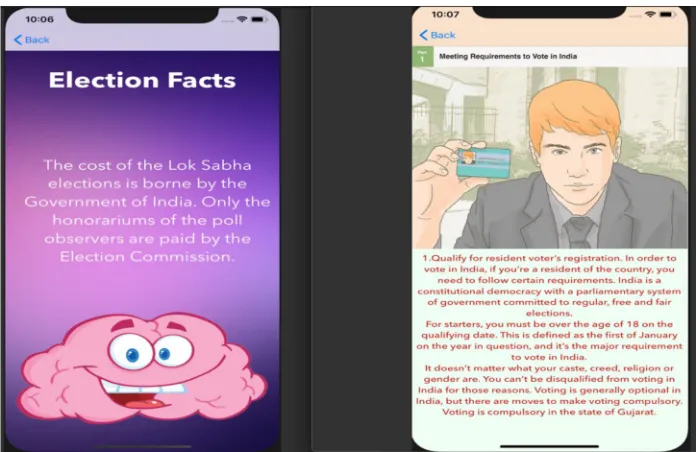
Fig 7 : Representation of Election Fact Page and Voting Instruction Page in iOS Simulator (iPhone XS).
V.
CONCLUSIONS
[image:6.612.132.481.380.606.2]REFERENCES
[1] Kavitha, S & J. Anandhi, R. (2014). A survey of image compression methods for low depth-of-field images and image sequences. Multimedia Tools and Applications. 74. 10.1007/s11042-014-2032-0.
[2] J. Anandhi, R & Subramanyam, Natarajan. (2014). Privacy Protected Mining Using Heuristic Based Inherent Voting Spatial Cluster Ensembles. 10.1007/978-81-322-1602-5_124.
[3] J. Anandhi, R & Subramanyam, Natarajan & Abburu, Sunita. (2010). An enhanced clusterer aggregation using nebulous pool. Proceedings of the 1st Amrita ACM-W Celebration of Women in Computing in India, A2CWiC'10. 61. 10.1145/1858378.1858439.
[4] R J, Anandhi & Subramanyam, Natarajan. (2010). A Robust -knowledge guided fusion of clustering Ensembles. International Journal of Computer Science and Information Security.
[5] Abburu, Sunitha & J. Anandhi, R. (2010). Concept ontology construction for sports video. Proceedings of the 1st Amrita ACM-W Celebration of Women in Computing in India, A2CWiC'10. 50. 10.1145/1858378.1858428.
[6] Dr. Mohan Kumar S & Dr. Balakrishnan, Classification Of Breast Mass Classification – CAD System And Performance Evaluation Using SSNE, IJISET – International Journal of Innovative Science, Engineering & Technology, Vol. 2, Issue 9, 417-425, ISSN 2348 – 7968
[7] Dr. Mohan Kumar S, Dr. Balakrishnan, Classification Of Breast Mass Classification – CAD System With Performance Evaluation, International Journal of Engineering And Computer Science, Volume 4, Issue 09, 14187-14193, ISSN 2319-7242, September, 2015
[8] Dr. Mohan Kumar S, Dr. Balakrishnan, Classification Of Breast Microcalcification- CAD System And Performance Evaluation Using SSNE, International Journal of Advanced Research in Computer Science and S
[9] oftware Engineering, Volume 5 , Issue 9, 824-830, ISSN: 2277 128X, Sep- 2015
[10] Dr. Mohan Kumar S, Karthikayini, Essential Best Practices And Processes In Higher Educational Technical Institutions, International Journal Of Engineering Research And General Science, Volume 3, Issue 6, 231-236, ISSN 2091-2730 231, December, 2015
[11] Dr. Mohan Kumar S, Karthikayini, LNW-A System Model For A High Quality Effective E-Learning Using Cloud Environs, International Journal of Current Research and Review, Volume 7, Issue 23, 21-25, ISSN: 0975-5241, December, 2015
[12] Dr. Mohan Kumar S, Ayurveda Medicine Roles In Healthcare Medicine, And Ayurveda Towards Ayurinformatics, International Journal of Computer Science and Mobile Computing, Volume 4, Issue 12, 35-43, ISSN 2320-088X, December, 2015
[13] Dr. Mohan Kumar S, Muralidhara, Importance Of Accreditation And Autonomous Status In HEI – An Assessment With Special Orientation To Karnataka State, International Journal of Engineering Sciences & Research Technology, Volume 5, , Issue 1, 472-479, ISSN : 2277-9655, January, 2016
[14] Dr. Mohan Kumar S , Interrelated Research Works And Importance Of Object Oriented Analysis And Modeling, International Journal of Engineering Sciences & Research Technology, Volume 5, Issue 1, Page Numbers:59-62, ISSN : 2277-9655, January, 2016
[15] Dr.S Mohan Kumar, R.Jaya, A Survey On Medical Data Mining – Health Care Related Research And Challenges, International Journal of Current Research, Volume 8, Issue 01, Page Numbers; 25170-25173, ISSN:0975-833X, January, 2016
[16] R.Jaya, Dr S Mohan Kumar, A Study On Data Mining Techniques, Methods, Tools And Applications In Various Industries, International Journal of Current Research & Review, Volume 8, Issue 04, Page Numbers:35-43, ISSN:0975-5241, January, 2016
[17] Clara K, Dr S Mohan Kumar, Cyber Crime Varient Activities And Network Forensic Investigation, International Journal of Emerging Technology and Advanced Engineering, Volume 6, Issue 04, Page Numbers: April 2016, ISSN:2250-2459, March, 2016,
[18] Clara.K, Dr S Mohan Kumar,Exploratory Study Of Cyber Crimes, Digital Forensics And Its Tools, International Journal of Emerging Technology and Advanced Engineering, Volume 6, Issue 04, Page Numbers: April 2016, ISSN:2250-2459, March, 2016
[19] Revathi Y, Dr S Mohan Kumar, Efficient Implementation Using RM Method For Detecting Sensitive Data Leakage In Public Network International Journal of Modern Trends in Engineering and Research, Volume 3, Issue 04, Page Numbers: 515-518, ISSN (Online):2349–9745 ISSN (Print):2393-8161 , April, 2016
[20] Revathi Y , Dr S Mohan Kumar, Review On Importance And Advancement In Detecting Sensitive Data Leakage In Public Network, International Journal Of Engineering Research And General Science, Volume 4, Issue 02, Page Numbers:263-265, ISSN:2091-2730, April, 2016
[21] Revathi Y, Dr S Mohan Kumar, A Survey On Detecting The Leakage Of Sensitive Data In Public Network International Journal of Emerging Technology and Advanced Engineering, Volume 6, Issue 03, Page Numbers:234-236, January, 2016
[22] Vandana CP, "Security improvement in IoT based on Software Defined Networking (SDN)",International Journal of Science, Engineering and Technology Research (IJSETR)
[23] Volume 5, Issue 1 ,Pages 291-295
[24] Vandana cp,"Internet of Things and Security",International Journal of Computer Science and Mobile Computing ,Volume 5 ,Issue 1 [25] Pages 133-139 ,IJCSMC, Vol. 5, Issue. 1, January 2016
[26] Vandana cp,Study of Resource Discovery trends in Internet of Things (IoT) ,Journal Int. J. Advanced Networking and Applications ,Volume 8,Issue 3 [27] Pages 3084-3089
[28] Vandana cp,IOT future in edge computing ,Journal International Journal of Advanced Engineering Research and Science [29] Volume 3 ,Issue 12 , AI Publications
[30] Sujithra ks,Baswaraju Swathi, sonia singh,Inclusive analysis of incomplete data sets using IkNN search, International Journal of Innovative Research in Computer and Communication Engineering,
[31] Subathra Muthuraman, Mrs Swathi Baswaraju, Mrs B Mounica, LARGE SCALE IMAGE RETRIEVAL USING DESCRIPTORS AND DISTANCE MEASURE, International Journal of Computer Science and Mobile Computing, Vol.4 Issue.5
[32] Swathi Baswaraju, Balani Somesh, Shrestha Niza Barun-SURVEY ON HOME SECURITY SURVEILLANCE SYSTEM BASED ON WI-FI CONNECTIVITY USING RASPBERRY PI AND IOT MODULE, International Journal of Advanced Research in Computer Science . Mar/Apr2018, Vol. 9 Issue 2.
[34] Mr.Dilish Babu.J, Dr.S Mohan Kumar, Survey On Routing Algorithms During Emergency Crisis Based On MANET, IJETAE, International Journal of Emerging Technology and Advanced Engineering, Volume 6, Issue 3, Page Numbers: 278-281, ISSN: 2250–2459, Mar-16
[35] Mr.Dilish Babu.J, Dr.S Mohan Kumar, Emergency Communication Sysytem For Natural Disaster Using MANET, IJRDO, International Journal of Research and Development Organization, Volume 2, Issue 5, Page Numbers:01 to 10, ISSN:2456-1843, May, 2016
[36] Ms.Sulochana Panigrahi, Dr S Mohan Kumar, Social Data Analysis Using Big-Data Analytic Technologies- Apache Flume, HDFS, HIVE, IJRDO, International Journal of Research and Development Organization, Volume 2, Issue 5, Page Numbers:16 to 21, ISSN:2456-1843, May, 2016
[37] Ms.Sulochana Panigrahi, Dr S Mohan Kumar, Social Media Analysis Using Apache Flume, Hdfs, Hive, International Journal of Current Trends in Engineering & Technology, Volume 2, , Issue 2, Page Numbers:282 to 285, ISSN:2395-3152, March, 2016
[38] Dr. V. ILANGO and Dr. S. Mohan Kumar, Factors For Improving The Research Publicatons And Quality Metrics International Journal of Civil Engineering & Technology (IJCIET) ISSN 0976-6308 and 0976-6316(Print&Online) Volume 8, Issue 4, 04-17,
[39] Naga Raju Hari Manikyam and Dr. S .Mohan Kumar, Methods And Techniques To Deal With Big Data Analytics And Challenges In Cloud Computing Environment, International Journal of Civil Engineering & Technology (IJCIET), ISSN 0976-6308 and 0976-6316(Print&Online), Volume 8, Issue 4, 04-17, [40] V Karthik, Dr.S . Mohan Kumar and Ms. Karthikayini, A Novel Survey On Location Based Node Detection And Identifying The Malicious Activity Of
Nodes In Sensor Networks International Journal of Civil Engineering & Technology, (IJCIET), ISSN 0976-6367 and 0976-6375(Print & Online), Volume 8, [41] Karthik V, Ms.Karthikayini, Dr S Mohan Kumar, Ms Gayathri T, Geocentric Based Node Detection And Revoking Malicious Node In WSN, International
Journal for Science and Advance Research in Technology (IJSART), ISSN 2395-1052 (Print&Online), Volume 3, Issue 4, 04-17
[42] Dr.S. Mohan Kumar and Dr G. Balakrishnan, Wavelet And Symmetric Stochastic Neighbor Embedding Based Computer Aided Analysis For Breast Cancer, Indian Journal of Science and Technology ISSN 0974-6846 and 0974-5645(Print&Online), Volume 9, Issue 47, 12-16
[43] Sruthi Hiremath, Sheba Pari N and Dr.S. Mohan Kumar, Booster in High Dimensional Data Classification, (DOI: 10.15680/IJIRCCE.2017. 0503349), International Journal of Innovative Research in Computer and Communication Engineering, Vol. 5, Issue 3, March 2017, 5984-5989.
[44] Dr S. Mohan Kumar & Dr.T.Kumanan, Skin Lesion Classification System and Dermoscopic Feature Analysis for Melanoma Recognition and Prevention, IJETAE, International Journal of Emerging Technology and Advanced Engineering, ISSN: 2250–2459 and Volume 7, Issue 7, July 2017,
[45] Dr S. Mohan Kumar & DrJitendranathMungara, J. Karthikayini, Design and implementation of CNN for detecting Melanoma through image processing, International Journal for Research in Applied Science and Engineering Technology, ISSN : 2321 – 9653, Volume 6, Issue - 3, March – 2018 in (DOI : 10.22214) pp. No.: 2249-2253
[46] Dr S. Mohan Kumar & J. Karthikayini, Surveys on Detection of Melanoma through image processing Techniques, International Journal for Research in applied science and Engineering Technology (IJRASET), ISSN : 2321 – 9653, volume 6, Issue III, March 2018 in IJRASET, DOI: 10.22214, pp. no.: 1699-1704
[47] Dr S. Mohan Kumar, Automated Segmentation of retinal images, International Journal of Engineering and Technology, UAE, July 2018, International Journal of Engineering and Technology, UAE
[48] Dr. S. Mohan Kumar & Anisha Rebinth, Automated detection of Retinal Defects using image mining, A review, European Journal of Biomedical and Pharmatical Sciences, European ISSN : 2349 – 8870, Volume 5 , Issue : 01 year : 2018, pp No.: 189 – 194
[49] Dr. S. Mohan Kumar& Dr.T.Kumanan, Analysis on skin Lesion classification systems and Dermoscopic Feature Analysis for Melanoma International Journal for Research in Applied Science and Engineering Technology (IJRASET), ISSN : 2321 – 9653, Volume 6, Issue - 3, March – 2018 in (DOI : 10.22214), pp. no.:1971-78
[50] Dr. S. Mohan Kumar & Dr.T.Kumanan, Study on skin Lesion Classifications system and Dermoscopic Feature Analysis for Melanoma, International journal of Creative Research Thoughts (IJCRT), IJCRT1802680, ISSN : 2320 – 2882, Volume 6, issue-1, March 2018, Page No . 1863 – 1873
[51] Dr. S. Mohan Kumar & Dr.T.Kumanan, Classification System and Dermoscopic Features Analysis for Melanoma recognition and Prevention, International journal of Creative Research Thoughts (IJCRT), IJCRT1802680, ISSN : 2250 – 2459 , Volume 7 , Issue 8, August 2017 , pp no: 351 – 357
[52] Dr. S. Mohan Kumar& Darpan Majumder, Healthcare Solution based on Machine Learning Applications in IOT and Edge Computing, International Journal of Pure and Applied Mathematics, ISSN: 1311-8080 (printed version) ISSN: 1314-3395 (on-line version) Jul 2018 issue.
[53] Dr. S. Mohan Kumar, Ashika.A, A Survey on Big Data Analysis, Approaches and its Applications in the real World, Journal of Emerging Technologies and Innovative Research, ISSN: 2349-5162, May 2018 , Volume 5, Issue 5, pp. no.: 93-100
[54] Shreya R, Sri Lakshmi Chandru, Vivek Kumar, Shwetha M, Dr. S. Mohan Kumar, Classification of Skin Cancer through image processing and implementating CAD System International journal of Creative Research Thoughts (IJCRT)IJCRT1802680m, ISSN : 2320 – 2882, Volume 6, issue-2 , April 2018 Page No . 1863 – 1873
[55] S Mohan Kumar & Dr. Balakrishnan, Statistical Features Based Classification of Micro calcification in Digital Mammogram using Stocastic Neighbour Embedding, International Journal of Advanced Information Science and Technology, 2012, ISSN:2319-2682 Volume 07, Issue 07 , November 2012, Page Numbers: 20-26
[56] S Mohan Kumar & Dr. Balakrishnan ,Breast Cancer Diagnostic system based on Discrete Wavelet Transformation and stochastic neighbour Embedding, European Journal of Scientific Research, 2012, ISSN:1450-216X ,Volume 87, Issue 03 , October 2012, Page Numbers: 301-310
[57] S Mohan Kumar & Dr. Balakrishnan, Classification of Microclacification in digital mammogram using SNE and KNN classifier, International Journal of Computer Applications - Conference Proceedings published in IJCA, 2013 ISBN: 973-93-80872-00-6, ICETT proceedings with IJCA on January 03,2013, Page Numbers: 05-09
[58] S Mohan Kumar & Dr. Balakrishnan, Mutiresolution analysis for mass classification in Digital Mammogram using SNE, IEEE international Conference- ICCSP-13 organized by Athiparasakthi Engineering College, Chennai , 2013, ISBN:978-1-4673-4864-5, Page Numbers: 2041-2045.
[59] S Mohan Kumar & Dr. Balakrishnan, Categorization of Benign And Malignant Digital Mammograms Using Mass Classification – SNE and DWT, Karpagam Journal of Computer Science, 2013, ISSN No: 0973-2926, Volume-07, Issue-04, June-July-2013, Numbers: 237-243.