A Corpus-Based Study
Florian Wolf
∗University of Cambridge
Edward Gibson
∗∗Massachusetts Institute of Technology
This article aims to present a set of discourse structure relations that are easy to code and to develop criteria for an appropriate data structure for representing these relations. Discourse structure here refers to informational relations that hold between sentences in a discourse. The set of discourse relations introduced here is based on Hobbs (1985).
We present a method for annotating discourse coherence structures that we used to manually annotate a database of 135 texts from theWall Street Journaland theAP Newswire. All texts were independently annotated by two annotators. Kappa values of greater than 0.8 indicated good interannotator agreement.
We furthermore present evidence that trees are not a descriptively adequate data structure for representing discourse structure: In coherence structures of naturally occurring texts, we found many different kinds of crossed dependencies, as well as many nodes with multiple parents. The claims are supported by statistical results from our hand-annotated database of 135 texts.
1. Introduction
An important component of natural language discourse understanding and production is having a representation of discourse structure. A coherently structured discourse here is assumed to be a collection of sentences that are in some relation to each other. This article aims to present a set of discourse structure relations that are easy to code and to develop criteria for an appropriate data structure for representing these relations.
There have been two kinds of approaches to defining and representing discourse structure and coherence relations. These approaches differ with respect to what kinds of discourse structure they are intended to represent. Some accounts aim to represent the intentional-level structure of a discourse; in these accounts, coherence relations reflect how the role played by one discourse segment with respect to the interlocu-tors’ intentions relates to the role played by another segment (e.g., Grosz and Sidner 1986). Other accounts aim to represent the informational structure of a discourse; in these accounts, coherence relations reflect how the meaning conveyed by one discourse segment relates to the meaning conveyed by another discourse segment (e.g., Hobbs 1985; Marcu 2000; Webber et al. 1999). Furthermore, accounts of discourse structure vary greatly with respect to how many discourse relations they assume, ranging from 2 (Grosz and Sidner 1986) to over 400 different coherence relations (reported in Hovy and
∗Computer Laboratory and Genetics Department, Cambridge, CB3 0FD, U.K. E-mail: [email protected]
∗∗Department of Brain and Cognitive Sciences, Cambridge, MA 02139. E-mail: [email protected].
Maier [1995]). However, Hovy and Maier (1995) argue that, at least for informational-level accounts, taxonomies with more relations represent subtypes of taxonomies with fewer relations. This means that different informational-level-based taxonomies can be compatible with each other; they differ with respect to how detailed or fine-grained a manner they represent informational structures of texts. Going beyond the question of how different informational-level accounts can be compatible with each other, Moser and Moore (1996) discuss the compatibility of rhetorical structure theory (RST) (Mann and Thompson 1988) with the theory of Grosz and Sidner (1986). However, note that Moser and Moore (1996) focus on the question of how compatible the claims are that Mann and Thompson (1988) and Grosz and Sidner (1986) make about intentional-level discourse structure.
In this article, we aim to develop an easy-to-code representation of informational relations that hold between sentences or other nonoverlapping segments in a dis-course monologue. We describe an account with a small number of relations in order to achieve more generalizable representations of discourse structures; however, the number is not so small that informational structures that we are interested in are obscured. The goal of the research presented is not to encode intentional relations in texts. We consider annotating intentional relations too difficult to implement in practice at this time. Note that we do not claim that intentional-level structure of discourse is not relevant to a full account of discourse coherence; it just is not the focus of this article.
The next section describes in detail the set of coherence relations we use, which are mostly based on Hobbs (1985). We try to make as few a priori theoretical assumptions about representational data structures as possible. These assumptions are outlined in the next section. Importantly, however, we do not assume a tree data structure to represent discourse coherence structures. In fact, a major result of this article is that trees do not seem adequate to represent discourse structures.
This article is organized as follows. Section 2 describes the procedure we used to collect a database of 135 texts annotated with coherence relations. Section 3 describes in detail the descriptional inadequacy of tree structures for representing discourse coherence, and Section 4 provides statistical evidence from our database that supports this claim. Section 5 offers some concluding remarks.
2. Collecting a Database of Texts Annotated with Coherence Relations
This section describes (1) how we defined discourse segments, (2) which coherence relations we used to connect discourse segments, and (3) how the annotation procedure worked.
2.1 Discourse Segments
There is agreement that discourse segments should be nonoverlapping spans of text. However, there is disagreement in the literature about how to define discourse segments (cf. the discussion in Marcu [2000]). Whereas some argue that discourse segments should be prosodic units (Hirschberg and Nakatani 1996), others argue for intentional units (Grosz and Sidner 1986), phrasal units (Lascarides and Asher 1993; Longacre 1983; Webber et al. 1999), or sentences (Hobbs 1985).
Table 1
Contentful conjunctions used to illustrate coherence relations.
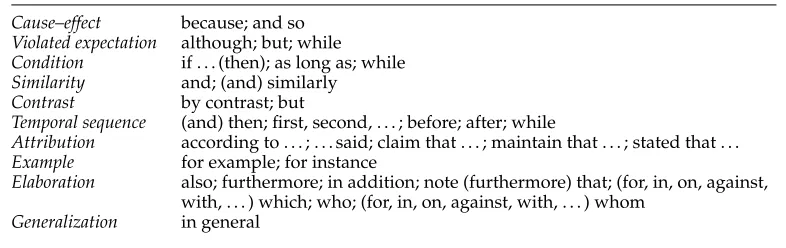
Cause–effect because; and so Violated expectation although; but; while Condition if . . . (then); as long as; while Similarity and; (and) similarly
Contrast by contrast; but
Temporal sequence (and) then; first, second, . . . ; before; after; while
Attribution according to . . . ; . . . said; claim that . . . ; maintain that . . . ; stated that . . . Example for example; for instance
Elaboration also; furthermore; in addition; note (furthermore) that; (for, in, on, against, with, . . . ) which; who; (for, in, on, against, with, . . . ) whom
Generalization in general
However, we also assumed that contentful coordinating and subordinating conjunc-tions (cf. Table 1) can delimit discourse segments.
Note that we did not classifyand as delimiting discourse segments if it was used to conjoin nouns in a conjoined noun phrase, likedairy plants and dealersin example (1) (from wsj 0306; Wall Street Journal 1989 corpus [Harman and Liberman 1993]) or if it was used to conjoin verbs in a conjoined verb phrase, likesnowed and rainedin example (2) (constructed):
(1) Milk sold to the nation’s dairy plants and dealers averaged $14.50 for each hundred pounds.
(2) It snowed and rained all day long.
We classified periods, semicolons, and commas as delimiting discourse segments. How-ever, in cases like example (3) (constructed), in which they conjoin a complex noun phrase, commas were not classified as delimiting discourse segments.
(3) John bought bananas, apples, and strawberries.
We furthermore treated attributions (John said that . . .) as discourse segments. This was empirically motivated. The texts used here were taken from news corpora, and there, attributions can be important carriers of coherence structures. For instance, consider a case in which some source Aand some source Bboth comment on some eventX. It should be possible to distinguish between a situation in which sourceAand sourceB make basically the same statement about eventXand a situation in which sourceAand source Bmake contrasting comments about event X. Note, however, that we treated cases like example (4) (constructed) as one discourse segment and not as two separate ones (. . . citedandtransaction costs . . .). We separated attributions only if the attributed material was a complementizer phrase, a sentence, or a group of sentences. This is not the case in example (4): The attributed material is a complex NP (transaction costs from its 1988 recapitalization).
2.2 Discourse Segment Groupings
Adjacent discourse segments could, in our approach, be grouped together. For example, discourse segments were grouped if they all stated something that could be attributed to the same source (cf. section 2.3 for a definition of attribution coherence relations). Furthermore, discourse segments were grouped if they were topically related. For example, if a text discussed inventions in information technology, there could be groups of a few discourse segments each talking about inventions by specific companies. There might also be subgroups, consisting of several discourse segments each, talking about specific inventions at specific companies. Thus, marking groups could determine a partially hierarchical structure for the text.
Other examples of discourse segment groupings included cases in which several discourse segments described an event or a group of events that all occurred before another event or another group of events described by another (group of) discourse segments. In those cases, what was described by a group of discourse segments was in a temporal sequence relation with what was described by another (group of) discourse segments (cf. section 2.3 for a definition of temporal-sequence coherence relations). Note furthermore that in cases in which one topic required one grouping and a following topic required a grouping that was different from the first grouping, both groupings were annotated.
Unlike approaches such as the TextTiling algorithm (Hearst 1997), ours allowed partially overlapping groups of discourse segments. The idea behind this option was to allow groupings of discourse segments in which a transition discourse segment belonged to the previous as well as the following group. However, the option was not used by the annotators (i.e., in our database of 135 hand-annotated texts, there were no instances of partially overlapping discourse segment groups).
2.3 Coherence Relations
As pointed out in section 1, we aim to develop a representation of informational relations between discourse segments. Note one difference between schema-based approaches (McKeown 1985) and coherence relations as we used them: Whereas schemas are instantiated from information contained in a knowledge base, coherence relations as we used them do not make (direct) reference to a knowledge base.
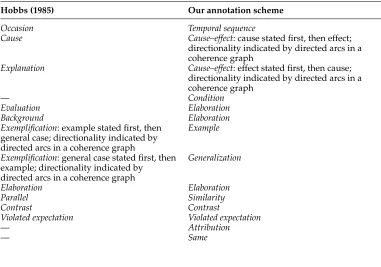
There are a number of different informational coherence relations, dating back, in their basic definitions, to Hume, Plato, and Aristotle (cf. Hobbs 1985; Hobbs et al. 1993; Kehler 2002). The coherence relations we used are mostly based on Hobbs (1985); below we describe each coherence relation we used and note any differences between ours and Hobbs’s (1985) set of coherence relations (cf. Table 2 for an overview of how our set of coherence relations relates to the set of coherence relations in Hobbs [1985]).
The kinds of coherence relations we used include cause–effect relations, as in example (5) (constructed), in which discourse segment 1 states the cause for the effect that is stated in discourse segment 2:
(5) Cause–effect
1. There was bad weather at the airport 2. and so our flight got delayed.
before a discourse segment stating an effect; anexplanationrelation holds if a discourse segment stating an effect occurs before a discourse segment stating a cause. We encoded this difference by adding a direction to thecause–effectrelation. In a graph, this can be represented by a directed arc going from cause to effect.
Another kind of causal relation iscondition. Hobbs (1985) does not distinguish con-ditionrelations from eithercauseorexplanationrelations. However, we felt that it might be important to distinguish between a causal relation describing an actual causal event (cause–effect, cf. above), on the one hand, and a causal relation describing a possible causal event (condition, cf. below), on the other hand. In example (6) (constructed), discourse segment 2 states an event that will take place if the event described by discourse segment 1 also takes place:
(6) Condition
1. If the new software works, 2. everyone should be happy.
In a third type of causal relation, the violated expectation relation (also violated expectation in Hobbs [1985]), a causal relation between two discourse segments that normally would be present is absent. In example (7) (constructed), discourse segment 1 normally would be a cause for everyone’s being happy; this expectation is violated by what is stated by discourse segment 2:
(7) Violated expectation
1. The new software worked great, 2. but nobody was happy.
Other possible coherence relations includesimilarity(parallelin Hobbs [1985]) or
contrast(alsocontrastin Hobbs [1985]) relations, in which similarities or contrasts are
determined between corresponding sets of entities or events, such as between discourse segments 1 and 2 in example (8) (constructed) and discourse segments 1 and 2 in example (9) (constructed), respectively:
(8) Similarity
1. The first flight to Frankfurt this morning was delayed. 2. The second flight arrived late as well.
(9) Contrast
1. The first flight to Frankfurt this morning was delayed. 2. The second flight arrived on time.
Discourse segments might also elaborate (also elaboration in Hobbs [1985]) on other sentences, as in example (10) (constructed), in which discourse segment 2 elaborates on discourse segment 1:
(10) Elaboration
1. A probe to Mars was launched from the Ukraine this week. 2. The European-built “Mars Express” is scheduled to reach Mars by
late December.
(exemplificationin Hobbs [1985]) for what is stated in discourse segment 1:
(11) Example
1. There have been many previous missions to Mars. 2. A famous example is the Pathfinder mission.
Hobbs (1985) also includes anevaluationrelation, as in example (12) (from Hobbs [1985]), in which discourse segment 2 states an evaluation of what is stated in discourse segment 1. We decided to call such relationselaborations, since we found it too difficult in practice to reliably distinguishelaborationsfromevaluations(according to our annota-tion scheme, in example (12), what is stated in discourse segment 2 elaborates on what is stated in discourse segment 1):
(12) Elaboration (labeled as evaluation in Hobbs [1985]) 1. (A story.)
2. It was funny at the time.
Unlike Hobbs (1985), we did not have a separatebackgroundrelation as in exam-ple (13) (modified from Hobbs [1985]), in which what is stated in discourse segment 1 provides the background for what is stated in discourse segment 2. As with the evaluationrelation, we found thebackgroundrelation too difficult to reliably distinguish fromelaborationrelations (according to our annotation scheme, in example (13), what is stated in discourse segment 1 elaborates on what is stated in discourse segment 2):
(13) Elaboration (labeled as background in Hobbs [1985]) 1. T is the pointer to the root of a binary tree. 2. Initialize T.
In a generalization relation, as in example (14) (constructed), one discourse
seg-ment (here discourse segseg-ment 2) states a generalization for what is stated by another discourse segment (here discourse segment 1):
(14) Generalization
1. Two missions to Mars in 1999 failed.
2. There are many missions to Mars that have failed.
Furthermore, discourse segments can be in anattribution relation, as in example (15) (constructed), in which discourse segment 1 states the source of what is stated in discourse segment 2 (cf. [Bergler 1991] for a more detailed semantic analysis of attributionrelations):
(15) Attribution 1. John said that
2. the weather would be nice tomorrow.
In a temporal sequence relation, as in example (16) (constructed), one discourse segment (here discourse segment 1) states an event that takes place before another event stated by the other discourse segment (here discourse segment 2):
(16) Temporal Sequence
1. First, John went grocery shopping. 2. Then he disappeared in a liquor store.
In contrast to cause–effectrelations, there is no causal relation between the events described by the two discourse segments. Thetemporal sequencerelation is equivalent to theoccasionrelation in Hobbs (1985).
Thesamerelation, illustrated by example (17) (constructed), is an epiphenomenon of assuming contiguous distinct elements of text (Hobbs [1985] does not include asame relation). A samerelation holds if a subject NP is separated from its predicate by an intervening discourse segment. For instance, in example (17), discourse segment 1 is the subject NP of a predicate in discourse segment 3, and so there is asamerelation between discourse segments 1 and 3; discourse segment 1 is the first and discourse segment 3 is the second segment of what is actually one single discourse segment, separated by the intervening discourse segment 2, which is in anattributionrelation with discourse segment 1 (and therefore also with discourse segment 3, since discourse segments 1 and 3 are actually one single discourse segment):
(17) Same
1. The economy,
2. according to some analysts,
3. is expected to improve by early next year.
Table 2 provides an overview of how our set of coherence relations relates to the set of coherence relations in Hobbs (1985).
We distinguish between asymmetrical or directed relations, on the one hand, and symmetrical or undirected relations, on the other hand (Mann and Thompson 1988; Marcu 2000). Cause–effect,condition,violated expectation, elaboration, example, generaliza-tion,attribution, and temporal sequenceare asymmetrical or directed relations, whereas similarity,contrast, andsameare symmetrical or undirected relations. In asymmetrical or directed relations, the directions of relations are as follows:
r
Cause–effect: from the discourse segment stating the cause to the discourse segment stating the effectr
Condition: from the discourse segment stating the condition to the discourse segment stating the consequencer
Violated expectation: from the discourse segment stating the cause to the discourse segment describing the absent effectr
Elaboration: from the elaborating discourse segment to the elaborated discourse segmentr
Example: from the discourse segment stating the example to the discourse segment stating the exemplifiedTable 2
Correspondence between the set of coherence relations in Hobbs (1985) and our set of coherence relations.
Hobbs (1985) Our annotation scheme
Occasion Temporal sequence
Cause Cause–effect: cause stated first, then effect; directionality indicated by directed arcs in a coherence graph
Explanation Cause–effect: effect stated first, then cause; directionality indicated by directed arcs in a coherence graph
— Condition
Evaluation Elaboration
Background Elaboration
Exemplification: example stated first, then Example general case; directionality indicated by
directed arcs in a coherence graph
Exemplification: general case stated first, then Generalization example; directionality indicated by
directed arcs in a coherence graph
Elaboration Elaboration
Parallel Similarity
Contrast Contrast
Violated expectation Violated expectation
— Attribution
— Same
r
Attribution: from the discourse segment stating the source to the attributed statementr
Temporal sequence: from the discourse segment stating the event that happened first to the discourse segment stating the event that happened secondThis definition of directionality is related to Mann and Thompson’s (1988) notion of nucleus and satellite nodes (where the nodes can represent [groups of] discourse segments): For asymmetrical or directed relations, the directionality is from satellite to nucleus node; by contrast, symmetrical or undirected relations hold between two nucleus nodes.
Note also that in our annotation project, we decided to annotate a coherence relation either if there was a coherence relation between the complete content of two discourse segments, or if there was a relation between parts of the content of two discourse segments. Consider the following example (from ap890104-0003; AP Newswire corpus; [Harman and Liberman 1993]):
(18) 1.a[ Difficulties have arisen ]b[ in enacting the accord for the
independence of Namibia ]
2. for which SWAPO has fought many years,
mentioned in discourse segment 1), although the relation actually only holds between discourse segment 2 and the second part of discourse segment 1, indicated by brackets. Although it is beyond the scope of the current project, future research should investigate annotations with discourse segmentations that allow annotating rela-tions only between parts of discourse segments that are responsible for a coherence relation. For example, consider example (19) (from ap890104-0003; AP Newswire corpus [Harman and Liberman 1993]), in which brackets indicate how more-fine-grained discourse segments might be marked:
(19) 1.a[ for which ]b[ SWAPO ]c[ has fought many years, ]
2. referring to the acronym of the South-West African Peoples Organization nationalist movement.
In our current project, we annotated anelaborationrelation from discourse segment 2 to discourse segment 1 (discourse segment 2 provides additional details, the full name, for SWAPO, which is mentioned in discourse segment 1). A future, more detailed, annotation of coherence relations could then annotate this elaborationrelation to hold only between discourse segment 2 and the wordSWAPOin discourse segment 1.
2.4 Coding Procedure
To code the coherence relations of a text, we used a procedure consisting of three steps. In the first step, a text was segmented into discourse segments (cf. section 2.1).
In the second step, adjacent discourse segments that were topically related were grouped together. The criteria for this step are described in section 2.2.
In the third step, coherence relations (cf. section 2.3) were determined between discourse segments and groups of discourse segments. Each previously unconnected (group of) discourse segment(s) was tested to see whether it connected to any of the (groups of) discourse segments that had already been connected to the already existing representation of discourse structure.
In order to help determine the coherence relation between (groups of) discourse segments, the annotators judged which, if any, of the contentful coordinating conjunc-tions in Table 1 resulted, when used, in the most acceptable passage (cf. Hobbs 1985; Kehler 2002). If using a contentful conjunction to connect (groups of) discourse seg-ments resulted in an acceptable passage, this was used as evidence that the coherence relation corresponding to the mentally inserted contentful conjunction held between the (groups of) discourse segments under consideration. This mental exercise was done only if there was not already a contentful coordinating conjunction that disambiguated the coherence relation.
The following list (which was also used by the annotators to guide them in their task) shows in more detail how the annotations were carried out:
1. Segment the text into discourse segments:
(a) Insert segment boundaries at every period that marks a sentence boundary (i.e., not at periods such as those inMrs.orDr.).
(b) Insert segment boundaries at every semicolon and colon that marks a sentence or clause boundary.
(d) Insert segment boundaries at every quotation mark, if there is not already a segment boundary based on steps (a)–(c).
(e) Insert segment boundaries at the contentful coordinating conjunctions listed in Table 1, if there is not already a segment boundary based on steps (a)–(d). Forand, do not insert a segment boundary if it is used to conjoin verbs or nouns in a conjoined verb or noun phrase.
2. Generate groupings of related discourse segments:
(a) Group contiguous discourse segments that are enclosed by pairs of quotation marks.
(b) Group contiguous discourse segments that are attributed to the same source.
(c) Group contiguous discourse segments that belong to the same sentence (marked by periods, commas, semicolons, or
colons).
(d) Group contiguous discourse segments that are topically centered on the same entities or events.
3. Determine coherence relations between discourse segments and groups of discourse segments. For each previously unconnected (group of) discourse segment(s), test whether it connects to any of the (groups of) discourse segments that have already been connected to the already existing representation of discourse structure. Use the following steps for each decision:
(a) Use pairs of quotation marks as a signal forattribution. (b) For pairs of (groups of) discourse segments that are already
connected with one of the contentful coordinating conjunctions from Table 1, choose the coherence relation that corresponds to the coordinating conjunction.
(c) For pairs of (groups of) discourse segments that are not connected with one of the contentful coordinating conjunctions from
Table 1:
i. Mentally connect the (groups of) discourse segments with one of the coordinating conjunctions from Table 1
and judge whether the resultant passage sounds acceptable.
ii. If the passage sounds acceptable, choose the coherence relation that corresponds to the coordinating conjunction selected in step (c.i).
iii. If the passage does not sound acceptable, repeat step (c.i) until an acceptable coordinating conjunction is found. iv. If the passage does not sound acceptable with any of the
coordinating conjunctions from Table 1, assume that the (groups of) discourse segments under consideration are not related by a coherence relation.
(d) Iterative procedure for steps (a) and (b):
i. Start with any of the unambiguous coordinating
Table 3
Statistics for texts in our database.
Number of words Number of discourse segments
Mean 545 61
Minimum 161 6
Maximum 1,409 143
Median 529 60
ii. If none of the unambiguous coordinating conjunctions results in an acceptable passage, use the more ambiguous
coordinating conjunctions (and,but,while,also, etc.). (e) Important distinctions for steps (2) and (3) (this is based on
practical issues that came up during the annotation project): i. Exampleversuselaboration: Anexamplerelation sets up an
additional entity or event (the example), whereas an elaborationrelation provides more details about an already introduced entity or event (the one on which one elaborates). ii. Cause–effectversustemporal sequence: Bothcause–effectand
temporal sequencedescribe a temporal order of events (in cause–effect, the cause has to precede the effect). However, onlycause–effectrelations have a causal relation between what is stated by the (groups of) discourse segments under consideration. Thus, if there is a causal relation between the (groups of) discourse segments under consideration, assume cause–effectrather thantemporal sequence(cf. Lascarides and Asher 1993).
2.5 Annotators
The annotators for the database were MIT undergraduate students who worked in our lab as research students. For training, the annotators received a manual that described the background of the project, discourse segmentation, coherence relations and how to recognize them, and how to use the annotation tools that we developed in our lab (Wolf et al. 2003). The first author of this article provided training for the annotators. Training consisted of explaining the background of the project and the annotation method and of annotating example texts (these texts are not included in our database). Training took 8–10 hours in total, distributed over five days of a week. After completing the training, annotators worked independently.
2.6 Statistics on Annotated Database
Steps 2 (discourse segment grouping) and 3 (coherence relation annotation) of the coding procedure described in section 2.4 were performed independently by two annotators. For step 1 (discourse segmentation), a pilot study on 10 texts showed that agreement on this step, as determined bynumber of common segments/(number of common segments+number of differing segments), was never below 90%. Therefore, all 135 texts were segmented by two annotators together, resulting in segmentations that both annotators could agree on.
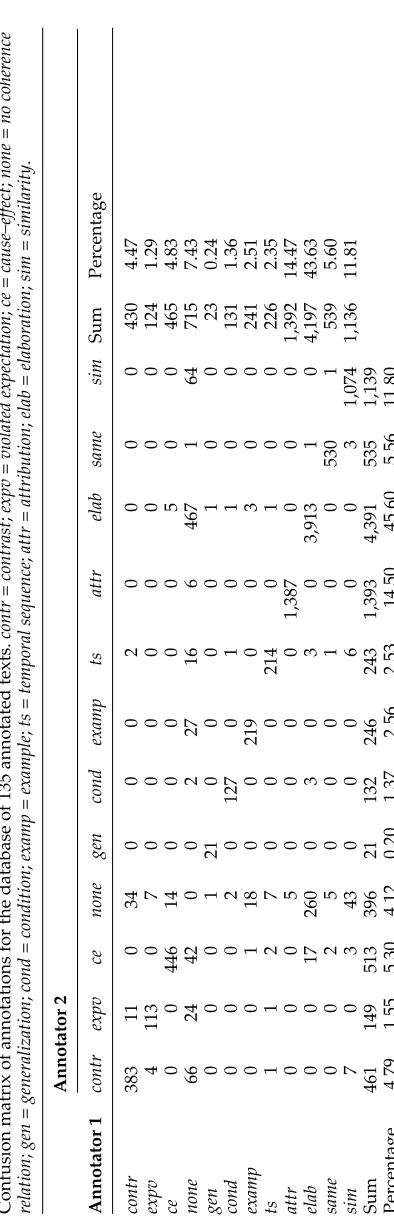
In order to determine interannotator agreement for step 2 of the coding procedure for the database of annotated texts, we calculated kappa statistics (Carletta 1996). We used the following procedure to construct a confusion matrix: First, all groups marked by either annotator were extracted. Annotator 1 had marked 2,616 groups, and an-notator 2 had marked 3,021 groups in the whole database. The groups marked by the annotators consisted of 536 different discourse segment group types (for example, groups that included the first two discourse segments of each text were marked 31 times by both annotators; groups that included the first three discourse segments of each text were marked 6 times by both annotators). Therefore, the confusion matrix had 536 rows and columns. For all annotations of the 135 texts, the agreement was 0.8449, per chance agreement was 0.0161, and kappa was 0.8424. Annotator agreement did not differ as a function of text length, arc length, or kind of coherence relation (allχ2values<1).
We also calculated kappa statistics to determine interannotator agreement for step 3 of the coding procedure.1For all annotations of the 135 texts, the agreement was 0.8761, per chance agreement was 0.2466, and kappa was 0.8355. Annotator agreement did not differ as a function of text length (χ2=1.27,p <0.75), arc length (χ2 <1), or kind of coherence relation (χ2 < 1). Table 4 shows the confusion matrix for the database of 135 annotated texts that was used to compute the kappa statistics. The table shows, for example, that much of the interannotator disagreement seems to have been driven by disagreement over how to annotate elaboration relations (in the whole database, annotator 1 marked 260 elaboration relations where annotator 2 marked no relation; annotator 2 marked 467 elaboration relations where annotator 1 marked no relation).
The only other comparable discourse annotation project that we are currently aware of is that of Carlson, Marcu, and Okurowski (2002).2 Since they use trees and split the annotation process into different substeps than those in our procedure, their annotator agreement figures are not directly comparable to ours. Furthermore, note that Carlson and her colleagues do not report annotator agreement figures for their database as a whole, but for different subsets of four to seven documents that were each annotated by different pairs of annotators. For discourse segmentation, they report kappa values ranging from 0.951 to 1.00; for annotation of discourse tree spans, their kappa values ranged from 0.778 to 0.929; for annotation of coherence relation nuclearity (whether a node in a discourse tree is a nucleus or a satellite, cf. section 2.3 for the definition of these terms), kappa values ranged from 0.695 to 0.882; for assigning types of coherence relations, they reported kappa values ranging from 0.624 to 0.823.
1 Note that interannotator agreement for step 3 was influenced by interannotator agreement for step 2. For example, one annotator might mark a group of discourse segments 2 and 3, whereas the second annotator might not mark that group of discourse segments. If the first annotator then marks, for example, acause–effectcoherence relation between discourse segment 4 and the group of discourse segments 2 and 3, whereas the second annotator marks acause–effectcoherence relation between discourse segment 4 and discourse segment 3, this would count as a disagreement. Thus, our measure of interannotator agreement for step 3 is conservative.
3. Data Structures for Representing Coherence Relations
In order to represent the coherence relations between discourse segments in a text, most accounts of discourse coherence assume tree structures (Britton 1994; Carlson, Marcu, and Okurowski 2002; Corston-Oliver 1998; Longacre 1983; Grosz and Sidner 1986; Mann and Thompson 1988; Marcu 2000; Polanyi and Scha 1984; Polanyi 1996; Polanyi et al. 2004; van Dijk and Kintsch 1983; Walker 1998); some accounts do not allow crossed dependencies but appear to allow nodes with multiple parents (Lascarides and Asher 1991).3Other accounts assume less constrained graphs that allow crossed dependencies as well as nodes with multiple parents (e.g., Bergler 1991; Birnbaum 1982; Danlos 2004; Hobbs 1985; McKeown 1985; Reichman 1985; Zukerman and McConachy 1995; for dialogue structure, Penstein Rose et al. 1995).
Some proponents of tree structures assume that trees are easier to formalize and to derive than less constrained graphs (Marcu 2000; Webber et al. 2003). We demonstrate that in fact many coherence structures in naturally occurring texts cannot be adequately represented by trees. Therefore we argue for less constrained graphs in which nodes represent discourse segments and labeled directed arcs represent the coherence rela-tions that hold between these discourse segments as an appropriate data structure for representing coherence.
Some proponents of more general graphs argue that trees cannot account for a full discourse structure that represents informational, intentional, and attentional discourse relations. For example, Moore and Pollack (1992) point out that rhetorical structure theory (Mann and Thompson 1988) has both informational and intentional coherence relations but then forces annotators to decide on only one coherence relation between any two discourse segments. Moore and Pollack argue that often there is an informa-tional as well as an inteninforma-tional coherence relation between two discourse segments, which then presents a problem for RST, since only one of the relations can be annotated. Instead, Moore and Pollack propose allowing more than one coherence relation between two discourse segments, which violates the tree constraint of not having nodes with multiple parents.
Reichman (1985) argues that tree-based story grammars are not sufficient to account for discourse structure. Instead, she argues that in order to account for the intentional structure of discourse, more general data structures are needed. We argue that the same is true for the informational structure of discourse.
Moore and Pollack (1992), Moser and Moore (1996), and Reichman (1985) argue that trees are insufficient for representing informational, intentional, and attentional discourse structure. Note, however, that the focus of our work is on informational coherence relations, not on intentional relations. That does not mean that we think that attentional or intentional structure should not be part of a full account of discourse structure. Rather, we would like to argue that whereas the above accounts argue against trees for representing informational, intentional, and attentional discourse structure together, we argue that trees are not even descriptively adequate to describe just in-formational discourse structure by itself.
Some accounts of informational discourse structure do not assume tree structures (e.g., Bergler [1991] and Hobbs [1985] for monologue and Penstein Rose et al. [1995] for dialogue structure). However, none of these accounts provides systematic empir-ical support for using more general graphs rather than trees. Providing a systematic empirical study of whether trees are descriptively adequate for representing discourse coherence is the goal of this article.
There are also accounts of informational discourse structure that argue for trees as a “backbone” for discourse structure but allow certain violations of tree constraints (crossed dependencies or nodes with multiple parents). Examples of such accounts include Webber et al. (1999) and Knott (1996). Similarly to our approach, Webber et al. (1999) investigated informational coherence relations. The kinds of coherence relations they used are basically the same as those that we used (cf. also Hobbs 1985). However, they argue for a tree structure as a backbone for discourse structure but have also addressed violations of tree structure constraints. In order to accommodate violations of tree structure constraints (in particular, crossed dependencies), Webber et al. (1999) argue for a distinction between “structural” discourse relations, on the one hand, and “nonstructural” or “anaphoric” discourse relations on the other hand. Structural discourse relations are represented within a lexicalized tree-adjoining gram-mar framework, and the resultant structural discourse structure is represented by a tree. However, more recently, Webber et al. (2003) have argued that structural discourse structure should allow nodes with multiple parents, but no crossed dependencies. It is unclear, however, why Webber et al. (2003) allow one kind of tree constraint violation (nodes with multiple parents) but not another (crossed dependencies).
Note that there seems to be a problem with the definition of “structural” versus “nonstructural” discourse structure in Webber et al. (1999): According to Webber et al. (1999), nonstructural discourse relations are licensed by anaphoric relations and can be involved in crossed dependencies. However, Webber et al. (1999) also argue that one criterion for nonstructural coherence relations is that they can cross (non)structural coherence relations. Since this definition of “nonstructural” appears to be circular, it is necessary to find an independent way to validate the difference between structural and nonstructural coherence relations. Knott (1996) might provide a way to empirically formalize the claims in Webber et al. (1999), or at least claims that seem to be very similar to those in Webber et al. (1999): Based on the observation that he cannot identify characteristic cue phrases forelaborationrelations (e.g.,becausewould be a characteristic cue phrase for cause–effect), Knott argues thatelaborationrelations are more permissive than other types of coherence relations (e.g.,cause–effect,similarity,contrast). As a conse-quence, Knott argues,elaborationrelations would be better described in terms of focus structures (cf. Grosz and Sidner 1986), which Knott argues are less constrained, than in terms of rhetorical relations (cf. Hobbs 1985; Mann and Thompson 1988), which Knott argues are more constrained. This hypothesis makes testable empirical claims: Elabora-tionrelations should in some way pattern differently from other coherence relations. We come back to this issue in sections 4.1 and 4.2.
do not seem to be the right kinds of constraints. This appears to be a crucial difference between approaches like Knott’s (1996), Marcu’s (2000), or Webber et al.’s (2003), on the one hand, and our approach, on the other hand. The goal of the former approaches seems to be to first specify a set of constraints on possible discourse annotations and then to annotate texts with these constraints in mind.
The following two sections illustrate problems with trees as a representation of discourse coherence structures. Section 3.1 shows that the discourse structures of nat-urally occurring texts contain crossed dependencies, which cannot be represented in trees. Another problem for trees, in addition to crossed dependencies, is that many nodes in coherence graphs of naturally occurring texts have multiple parents. This is shown in section 3.2. Because of these problems for trees, we argue for a representation such as chain graphs (cf. Frydenberg 1989; Lauritzen and Wermuth 1989), in which directed arcs represent asymmetrical or directed coherence relations and undirected arcs represent symmetrical or undirected coherence relations (this is equivalent to arguing for directed graphs with cycles). For all the examples in sections 3.1 and 3.2, chain-graph-based analyses are given. RST analyses are given only for those examples that are also annotated by Carlson, Marcu, and Okurowski (2002) (in those cases, the RST analyses are those provided by Carlson, Marcu, and Okurowski).
3.1 Crossed Dependencies
Consider the text passage in example (20) (modified from SAT practice materials):
(20) 1. Schools tried to teach students history of science.
2. At the same time they tried to teach them how to think logically and inductively.
3. Some success has been reached in the first of these aims. 4. However, none at all has been reached in the second.
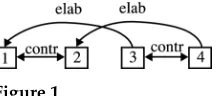
Figure 1 shows the coherence graph for example (20). Note that the arrowheads of the arcs represent directionality for asymmetrical relations (elaboration) and bidirectionality for symmetrical relations (similarity,contrast).
The coherence structure for example (20) can be derived as follows:
r
Contrastrelation between discourse segments 1 and 2: Discourse segments 1 and 2 describe teaching different things to students.r
Contrastrelation between discourse segments 3 and 4: Discourse segments 3 and 4 describe varying degrees of success (some vs. none).r
Elaborationrelation between discourse segments 3 and 1: Discourse [image:16.486.53.162.598.646.2]segment 3 provides more details (the degree of success) about the teaching described in discourse segment 1.
Figure 1
r
Elaborationrelation between discourse segments 4 and 2: Discoursesegment 4 provides more details (the degree of success) about the teaching described in discourse segment 2.
In the resultant coherence structure for (20), there is a crossed dependency between
{3, 1}and{4, 2}.
In order to be able to represent a structure like the one for (20) in a tree without violating validity assumptions about tree structures (Diestel 2000), one might consider augmenting a tree either with feature propagation (Shieber 1986) or with a coindex-ation mechanism (Chomsky 1973). There is a problem, however, with both feature propagation and coindexation mechanisms: Both the tree structure itself and the fea-tures and coindexations as well represent the same kind of information (coherence relations). It is unclear how a dividing line could be drawn between tree structures and their augmentation. That is, it is unclear how one could decide which part of a text coherence structure should be represented by the tree structure and which part should be represented by the augmentation. Other areas of linguistics have faced this issue as well. Researchers investigating data structures for representing intrasentential structure, for instance, generally fall into two groups. One group tries to formulate principles that allow representation of some aspects of structure in the tree itself and other aspects in some augmentation formalism (e.g., Chomsky 1973; Marcus et al. 1994). Another group argues that it is more parsimonious to assume a unified dependency-based representation that drops the tree constraints of allowing no crossed dependencies (e.g., Brants et al. 2002; Skut et al. 1997; K ¨onig and Lezius 2000). Our approach falls into the latter group. As we point out, there does not seem to be a well-defined set of constraints on crossed dependencies in discourse structures. Without such constraints, it does not seem viable to represent discourse structures as augmented tree structures.
An important question is how many different kinds of crossed dependencies occur in naturally occurring discourse. If there are only a very limited number of different structures with crossed dependencies in natural texts, one could make special provisions to account for these structures and otherwise assume tree structures. Example (20), for instance, has a listlike structure. It is possible that listlike examples are exceptional in natural texts. However, there are many other naturally occurring nonlistlike structures that contain crossed dependencies. As an example of a nonlistlike structure with a crossed dependency (between{4, 2}and{3, 1–2}), consider example (21) (constructed):
(21) 1. Susan wanted to buy some tomatoes 2. and she also tried to find some basil
3. because her recipe asked for these ingredients.
4. The basil would probably be quite expensive at this time of the year.
The coherence structure for (21), shown in Figure 2, can be derived as follows:
r
Similarityrelation between 1 and 2: 1 and 2 both describe shopping for grocery items.Figure 2
Coherence graph for example (21).sim=similarity;ce=cause–effect;elab=elaboration.
r
Elaborationrelation between 4 and 2: 4 provides details about the basil in 2.Example (22), (from ap890109-0012; AP Newswire 1989 corpus [Harman and Liberman 1993]) has a similar structure:
(22) 1. The flight Sunday took off from Heathrow Airport at 7:52pm 2. and its engine caught fire 10 minutes later,
3. the Department of Transport said.
4. The pilot told the control tower he had the engine fire under control.
The coherence structure for example (22) can be derived as follows:
r
Temporal sequencerelation between 1 and 2: 1 describes the takeoff that happens before the engine fire described by 2 occurs.r
Attributionrelation between 3 and 1–2: 3 mentions the source of what is said in 1–2.r
Elaborationrelation between 4 and 2: 4 provides more detail about the engine fire in 2.The resulting coherence structure, shown in Figure 3, contains a crossed dependency between{4, 2}and{3, 1–2}.
Consider example (23) (from wsj 0655; Wall Street Journal 1989 corpus [Harman and Liberman 1993]):
(23) 1.1a[ Mr. Baker’s assistant for inter-American affairs, ]1b[ Bernard
Aronson, ]
2. while maintaining
3. that the Sandinistas had also broken the cease-fire, 4. acknowledged:
5. “It’s never very clear who starts what.”
Figure 3
Figure 4
Coherence graph for example (23).expv=violated expectation;elab=elaboration;attr=attribution.
Figure 5
Coherence graph for example (23) with discourse segment 1 split into two segments.expv= violated expectation;elab=elaboration;attr=attribution.
Figure 6
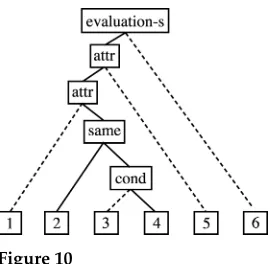
Tree-based RST annotation for example (23) from Carlson, Marcu, and Okurowski (2002). Broken lines represent the start of asymmetric coherence relations; continuous lines represent the end of asymmetric coherence relations; symmetric coherence relations have two continuous lines (cf. section 2.3).attr=attribution;elab=elaboration.
The annotations based on our annotation scheme with the discourse segmentation based on the segmentation guidelines in Carlson, Marcu, and Okurowski (2002) are presented in Figure 4, and those with the discourse segmentation based on our segmentation guidelines from section 2.1 are presented in Figure 5. Figure 6 shows a tree-based RST annotation for example (23) from Carlson, Marcu, and Okurowski (2002). The only difference between our approach and that of Carlson, Marcu, and Okurowski with respect to how example (23) is segmented is that Carlson and her colleagues assume discourse segment 1 to be one single segment. By contrast, based on our segmentation guidelines, discourse segment 1 would be segmented into two segments (because of the comma that does not separate a complex NP or VP), 1a and 1b, as indicated by the brackets in example (24):4
(24) 1a[ Mr. Baker’s assistant for inter-American affairs, ]1b[ Bernard Aronson, ]
The coherence structure for example (23) can be derived as follows:
r
If discourse segment 1 is segmented into 1a and 1b (following our discourse segmentation guidelines),elaborationrelation between 1a and 1b: 1b provides additional detail (a name) about what is stated in 1a (Mr. Baker’s assistant).r
Samerelation between 1 (or 1a) and 4: The subject NP in 1 (Mr. Baker’sassistant) is separated from its predicate in 4 (acknowledged) by intervening discoure segments 2 and 3 (and 1b in our discourse segmentation).
r
Attributionrelation between 2 and 3: 2 states the source (the elided Mr. Baker) of what is stated in 3.r
Elaborationrelation between the group of discourse segments 2 and 3 and discourse segment 1 (or the group of discourse segments 1a and 1b in our discourse segmentation): 2 and 3 state additional detail (a statement about a political process) about what is stated in 1 (or 1a and 1b) (Mr. Baker’s assistant).r
Attributionrelation between 4 (and by virtue of thesamerelation, also 1 or 1a) and 5: 4 states the source (Mr. Baker’s assistant) of what is stated in 5.r
Violated expectationrelation between the group of discourse segments 2 and 3 and the group of discourse segments 4 and 5: Although Mr. Baker’s assistant acknowledges cease-fire violations by one side (discourse segments 2 and 3), he acknowledges that it is in fact difficult to clearly blame one side for cease-fire violations (discourse segments4 and 5).
The resulting coherence structure, shown in Figure 5 (discourse segmentation from Carlson, Marcu, and Okurowski [2002]) and Figure 6 (our discourse segmentation), contains a crossed dependency: Thesamerelation between discourse segment 1 and dis-course segment 4 crosses theviolated expectationrelation between the group of discourse segments 2 and 3 and the group of discourse segments 4 and 5.
Table 5
Comparison for example (23) of tree-based RST structure from Carlson, Marcu, and Okurowski (2002) and our chain-graph-based structure.
Tree-based RST structure Our chain-graph-based structure
(1a and 1b are one discourse segment) Elaborationbetween 1a and 1b Samebetween 1–2 and 4 Samebetween 1 (or 1a) and 4 Attributionbetween 1 and 2 Attributionbetween 1 and 2
Elaborationbetween 2–3 and 1 Elaborationbetween 2–3 and 1 (or 1a and 1b) Attributionbetween 1–4 and 5 Attributionbetween 4 and 5
(no relation) Violated expectationbetween 2–3 and 4–5
Figure 7
Coherence graph for example (25).cond=condition;attr=attribution;elab= elaboration.
3.2 Nodes with Multiple Parents
In addition to including crossed dependencies, many coherence structures of natural texts include nodes with multiple parents. Such nodes cannot be represented in tree structures. Consider example (25) (from ap890103 = 0014; AP Newswire 1989 corpus [Harman and Liberman 1993]).
(25) 1. “Sure I’ll be polite,” 2. promised one BMW driver
3. who gave his name only as Rudolf.
4. “As long as the trucks and the timid stay out of the left lane.”
The coherence structure for example (25) can be derived as follows:
r
Attributionrelation between 2 and 1 and 2 and 4: 2 states the source of what is stated in 1 and 4, respectively.r
Elaborationrelation between 3 and 2: 3 provides additional detail (the name) about the BMW driver in 2.r
Conditionrelation between 4 and 1: 4 states the BMW driver’s condition for being polite, stated in 1.5Thisconditionrelation is also indicated by the phrase “as long as.”In the resultant coherence structure for example (25), node 1 has two parents—one attributionand oneconditioningoing arc (cf. Figure 7).
Figure 8
Coherence graph for example (26). Additional coherence relation used (from Carlson, Marcu, and Okurowski [2002]):evaluation-s= the situation presented in the satellite assesses the situation presented in the nucleus (evaluation-swould beelaborationin our annotation scheme). attr=attribution;cond=condition.
Figure 9
Coherence graph for example (26) with discourse segments 1 and 2 merged into one single discourse segment. Additional coherence relation used (from Carlson, Marcu, and Okurowski [2002]):evaluation-s= the situation presented in the satellite assesses the situation presented in the nucleus (evaluation-swould beelaborationin our annotation scheme).attr=attribution; cond=condition.
As another example of a discourse structure that contains nodes with multiple parents, consider the structure of example (26) (from wsj 0655; Wall Street Journal 1989 corpus [Harman and Liberman 1993]):
(26) (they in 4 and 6 = Contra supporters; this is clear from the whole text wsj 0655)
1. “The administration should now state
2. that
3. if the February election is voided by the Sandinistas 4. they should call for military aid,”
5. said former Assistant Secretary of State Elliott Abrams. 6. “In these circumstances, I think they’d win.”
Our annotations are shown in Figures 8 (discourse segmentation from Carlson, Marcu, and Okurowski [2002]) and 9 (our discourse segmentation); Carlson et al.’s (2002) tree-based RST annotation is shown in Figure 10. The only difference between our annotation and that of Carlson, Marcu, and Okurowski is that we do not assume two separate discourse segments for 1 and 2; 1 and 2 are one discourse segment in our annotation (represented by the node 1+2 in Figure 9). Note also that in discourse segment 3 of example (23) “that” is not in a separate discourse segment; it is unclear why in example (26), “that” is in a separate discourse segment (discourse segment 2) and not part of discourse segment 3. The discourse structure for example (26) can be derived as follows:
Figure 10
Tree-based RST annotation for example (26) from Carlson, Marcu, and Okurowski (2002). Broken lines represent the start of asymmetric coherence relations; continuous lines represent the end of asymmetric coherence relations; symmetric coherence relations have two continuous lines (cf. section 2.3). Additional coherence relation used (from Carlson, Marcu, and Okurowski [2002]): evaluation-s= the situation presented in the satellite assesses the situation presented in the nucleus (evaluation-swould beelaborationin our annotation scheme).attr=attribution; cond=condition.
2. Attributionrelation between 1 or 1+2 and 3–4: 1 or 1+2 state the source (the administration) of what is stated in 3–4.
3. Conditionrelation between 3 and 4: 3 states the condition for what is stated in 4 (theconditionrelation is also signaled by the cue phraseif in 3).
4. Attributionrelation between 5 and 1–4: 5 states the source of what is stated in 1–4.
5. Attributionrelation between 5 and 6: 5 states the source of what is stated in 6.
6. Evaluation-s6relation between 6 and 3–4: 3–4 state what is evaluated by 6—the Contra supporters should call for military aid, and if the February election is voided (group of discourse segments 3–4), the Contra
supporters might win (discourse segment 6). Note that in our annotation scheme, theevaluation-srelation would be anelaborationrelation (6 provides additional detail about 3–4: Elliott Abrams’s opinion on the Contras’ chances of winning).
In the resultant coherence structure for example (26), node 3–4 has multiple parents or ingoing arcs: oneattributioningoing arc and oneevaluation-singoing arc (cf. Figures 8 and 9).
Table 6 presents a comparison of the RST annotation and our chain-graph-based annotation for (26). Note in particular that theattributionrelation between 5 and 6 cannot be represented in the RST tree structure. Note furthermore that the RST tree contains an evaluation-srelation between 6 and 1–5. However, thisevaluation-srelation seems to hold rather between 6 and 3–4: What is being evaluated is a chance for the Contras to win
6 The relationevaluation-sis part of the annotation scheme in Carlson, Marcu, and Okurowski (2002) but not part of our annotation scheme. In anevaluation-srelation, the situation presented in the satellite assesses the situation presented in the nucleus (Carlson, Marcu, and Okurowski 2002). Anevaluation-s
Table 6
Comparison for (26) of tree-based RST structure (from Carlson, Marcu, and Okurowski (2002) and our chain-graph-based structure.
Tree-based RST structure Our chain-graph-based structure
Samebetween 2 and 3–4 Samebetween 1 and 2, or merging of 1 and 2 to 1+2 Attributionbetween 1 and 2–4 Attributionbetween 1 or 1+2 and 3–4
Conditionbetween 3 and 4 Conditionbetween 3 and 4 Attributionbetween 5 and 1–4 Attributionbetween 5 and 1–4 (no relation) Attributionbetween 5 and 6 Evaluation-sbetween 6 and 1–5 Evaluation-sbetween 6 and 3–4
a military conflict under certain circumstances. But a coherence relation between 6 and 3–4 could not have been annotated in a tree structure.
4. Statistics
We performed a number of statistical analyses on our annotated database to test our hypotheses. Each set of statistics was calculated for both annotators separately. How-ever, since the statistics for both annotators were never different from each other (as confirmed by significantR2s>0.9 or byχ2s>1), we report only the statistics for one annotator in the following sections.
An important question is how frequent the phenomena discussed in the previous sections are. The more frequent they are, the more urgent the need for a data structure that can adequately represent them. The following sections report statistical results on crossed dependencies (section 4.1) and nodes with multiple parents (section 4.2).
4.1 Crossed Dependencies
The following sections report counts on crossed dependencies in the annotated database of 135 texts (cf. section 1). Section 4.1.1 reports results on the frequency of crossed dependencies, section 4.1.2 reports results concerning the question of what types of coherence relations tend to be involved in crossed dependencies, and section 4.1.3 reports results on the arc lengths of coherence relations involved in crossed depen-dencies. Section 4.1.4 provides a short summary of the statistical results on crossed dependencies.
4.1.1 Frequency of Crossed Dependencies.In order to track the frequency of crossed
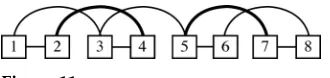
dependencies for the coherence structure graph of each text, we counted the minimum number of arcs that would have to be deleted in order to eliminate crossed dependen-cies in the coherence structure. Figure 11 illustrates this process. The example graph depicted in the figure contains the following crossed dependencies:{1, 3}crosses with
{2, 4}, {3, 5} with {2, 4}, and {5, 7} with {6, 8}. By deleting {2, 4}, two crossed dependencies can be eliminated: the crossing of{1, 3}with{2, 4}and the crossing of
Figure 11
Example graph with crossed dependencies.
Figure 12
Correlation between number of arcs and number of crossed dependencies.
Table 7
Percentages of arcs to be deleted in order to eliminate crossed dependencies in the database texts.
Mean 12.5
Minimum 0
Maximum 44.4 Median 10.9
Table 7 shows the results of the counts. On average for the 135 annotated texts, 12.5% of arcs in a coherence graph have to be deleted in order to make the graph free of crossed dependencies. Seven texts out of the 135 had no crossed dependencies. The mean number of arcs for the coherence graphs of these texts was 36.9 (minimum: 8, maximum: 69, median: 35). The mean number of arcs for the other 128 coherence graphs (those with crossed dependencies) was 125.7 (minimum: 20, maximum: 293, median: 115.5). Thus, the graphs with no crossed dependencies had significantly fewer arcs than the graphs that had crossed dependencies (χ2(1) = 15,330.35 (Yates’s correction for continuity applied),p<10−6). This is a likely explanation for why these seven texts had no crossed dependencies.
More generally, linear regressions show a correlation between the number of arcs in a coherence graph and the number of crossed dependencies. The more arcs a graph has, the higher the number of crossed dependencies (R2= 0.39,p<10−4; cf. Figure 12). The same linear correlation holds between text length and number of crossed dependencies: The longer a text, the more crossed dependencies are in its coherence structure graph (for text length in discourse segments: R2 = .29, p <10−4; for text length in words: R2= .24,p<10−4).
4.1.2 Types of Coherence Relations Involved in Crossed Dependencies.In addition
[image:25.486.53.373.130.281.2]Table 8
Percentages of arcs to be deleted in order to eliminate crossed dependencies.
Coherence relation Percentage of coherence Percentage of overall Factor
relations participating in coherence relations (= overall/crossed
crossed dependencies dependencies)
Same 1.13 17.21 15.23
Condition 0.05 0.28 5.59
Attribution 1.93 6.31 3.27
Temporal sequence 0.94 1.56 1.66
Generalization 0.24 0.34 1.40
Contrast 5.84 7.93 1.36
Cause–effect 1.13 1.53 1.35
Violated expectation 0.61 0.82 1.40
Elaboration 50.52 37.97 0.71
Example 4.43 3.15 1.34
Similarity 33.18 22.91 0.69
there are certain types of coherence relations that participate more or less frequently in crossed dependencies than other types of coherence relations. For an arc to participate in a crossed dependency, it must be in the set of arcs that would have to be deleted from a coherence graph in order to make that graph free of crossed dependencies (cf. the procedure outlined in section 4.1.1). In other words, the question is whether the fre-quency distribution over types of coherence relations is different for arcs participating in crossed dependencies compared to the overall frequency distribution over types of coherence relations in the whole database.
Figure 13 shows that the overall distribution over types of coherence relations participating in crossed dependencies is not different from the distribution over types of coherence relations overall. This is confirmed by the results of a linear regression, which show a significant correlation between the two distributions of percentages (R2 = 0.84, p<.0001). Note that the overall distribution includes only arcs with length greater than one, since arcs of length one cannot participate in crossed dependencies.
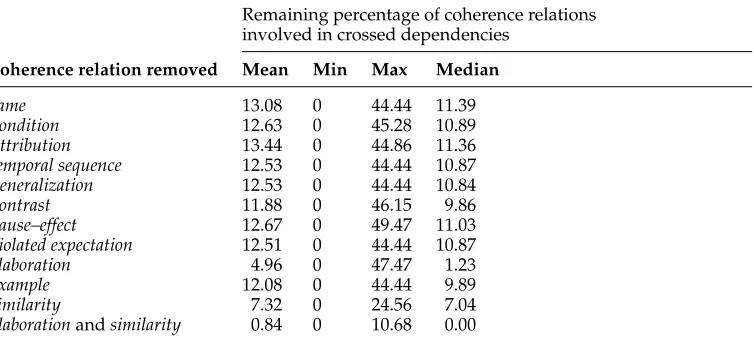
However, there are some differences for individual coherence relations. Some types of coherence relations occur considerably less frequently in crossed dependencies than overall in the database. Table 8 shows the data from Figure 13 ranked by the factor of “percentage of overall coherence relations” by “percentage of coherence relations participating in crossed dependencies.” The proportion ofsamerelations, for instance, is 15.23 times greater, and the percentage ofconditionrelations is 5.59 times greater, overall in the database than in crossed dependencies. We do not yet understand the reason for these differences and plan to address this question in future research.
Table 9
Effect of removing different types of coherence relations on the percentage of coherence relations involved in crossed dependencies.
Remaining percentage of coherence relations involved in crossed dependencies
Coherence relation removed Mean Min Max Median
Same 13.08 0 44.44 11.39
Condition 12.63 0 45.28 10.89
Attribution 13.44 0 44.86 11.36
Temporal sequence 12.53 0 44.44 10.87 Generalization 12.53 0 44.44 10.84
Contrast 11.88 0 46.15 9.86
Cause–effect 12.67 0 49.47 11.03
Violated expectation 12.51 0 44.44 10.87
Elaboration 4.96 0 47.47 1.23
Example 12.08 0 44.44 9.89
Similarity 7.32 0 24.56 7.04
Elaborationandsimilarity 0.84 0 10.68 0.00
constrained than other types of coherence relations (cf. the discussion of Knott [1996] in section 3).
However, there is a possible alternative hypothesis to Knott’s (1996). In particular, elaborationrelations are very frequent (37.97% of all coherence relations; cf. Table 8). It is possible that removingelaborationrelations from the database reduces the number of crossed dependencies only because a large number of coherence relations are removed when elaborations are removed. In other words, an alternative hypothesis to that of Knott (1996) is that the lower number of crossed dependencies is just due to less-dense coherence graphs (i.e., the less less-dense coherence graphs are, the lower the chance for crossed dependencies). We tested this hypothesis by correlating the percentage of coherence relations removed with the percentage of crossed dependencies that remain after removing a certain type of coherence relation.7 Figure 14 shows that the higher the percentage of removed coherence relations, the lower the percentage of coherence relations becomes that are involved in crossed dependencies. This correlation is con-firmed by a linear regression (R2= 0.7697,p<.0005; after removing theelaborationdata point:R2= 0.4504,p<.05; these linear regressions do not include the data point elabora-tion+similarity). Thus, although removing certain types of coherence relations reduces the number of crossed dependencies, it results in a very impoverished representation of coherence structure (i.e., after removing allelaborationand allsimilarityrelations, only 39.12% of all coherence relations would still be represented [cf. Table 8]; the figure is 52.13% based on the distribution over coherence relations including those with absolute arc length one [cf. Table 11]).
With respect to Knott’s (1996) hypothesis, note that leaving outelaborationrelations still leaves the proportion of remaining crossed dependencies at 4.96% (cf. Table 9).
Figure 14
Correlation between removed percentage of overall coherence relations and remaining percentage of crossed dependencies. Note that the data point forelaboration+similarityis not included in the figure.R2= 0.7699,p<.0005.
In order to further reduce the proportion of remaining crossed dependencies, it is necessary to remove similarity relations in addition to removing elaborationrelations (cf. Table 9). This is a pattern of results that is not predicted by any literature that we are aware of (including Knott [1996], among others, although he predicts these results partially). We believe this issue should be addressed in future research.
4.1.3 Arc Lengths of Coherence Relations Involved in Crossed Dependencies.
An-other question is how great the distance typically is between discourse segments that participate in crossed dependencies, or how great the arc length is for coherence relations that participate in crossed dependencies.8 It is possible, for instance, that crossed dependencies primarily involve long-distance arcs and that more local crossed dependencies are disfavored. However, Figure 15 shows that the distribution over arc lengths is practically identical for the overall database and for coherence relations par-ticipating in crossed dependencies (linear regression:R2= 0.937,p<10−4), suggesting a strong locality bias for coherence relations overall as well as for those participating in crossed dependencies.9The arc lengths are normalized in order to take into account the varying length of texts. Normalized arc length is calculated by dividing the absolute length of an arc by the maximum length that that arc could have, given its position in its text. For example, if there is a coherence relation between discourse segment 1 and discourse segment 4 in a text, the raw distance between them would be three. If these discourse segments are part of a text that has five discourse segments total (i.e., 1 to 5),
8 The distance between two discourse segments is not measured in terms of how many coherence links one has to follow from any discourse segmentxto any discourse segmentyto which discourse segmentxis related via a coherence relation. Instead, distance is measured in terms of the number of intervening discourse segments. Thus, distance between nodes reflects linear distance between two discourse segments in a text. For example, the distance between a discourse segment 1 and a discourse segment 4 would be three.