Robert Malouf
∗San Diego State University
Default unification operations combine strict information with information from one or more defeasible feature structures. Many such operations require finding the maximal subsets of a set of atomic constraints that are consistent with each other and with the strict feature structure, where a subset is maximally consistent with respect to the subsumption ordering if no constraint can be added to it without creating an inconsistency. Although this problem is NP-complete, there are a number of heuristic optimizations that can be used to substantially reduce the size of the search space. In this article, we propose a novel optimization,leaf pruning,which in some cases yields an improvement in running time of several orders of magnitude over previously described algorithms. This makes default unification efficient enough to be practical for a wide range of problems and applications.
1. Introduction
In unification-based grammatical frameworks, it often desirable to combine information from possibly inconsistent sources. Over the years, a number of default unification operations have been proposed1, which combine a strict feature structure with one or more defeasible feature structures. These operations preserve all information in the strict feature structure, while bringing in as much information as possible from the defeasible structures. Default unification has been used to address a wide variety of linguistic knowledge representation problems, including lexical inheritance hierarchies (Copestake 1993; Ginzburg and Sag 2001), lexical semantics (Lascarides and Copestake 1998), grammar induction (Briscoe 1999; Villavicencio 2002; Petersen 2004), anaphora resolution (Grover et al. 1994; Pr ¨ust, Scha, and van den Berg 1994), and discourse processing (Gurevych et al. 2003; Alexandersson, Becker, and Pfleger 2004), among many others.
Although the various default unification operators differ in their particulars, most involve something like Carpenter (1992)’s credulous default unification as one step. The result of credulously adding the default information inGto the strict information inFis:
cred-unify(F,G)≡ {unify(F,G), whereGsubsumesGand
Gis maximal such that unify(F,G)is defined}
∗Department of Linguistics and Asian/Middle Eastern Languages, San Diego State University, 5500 Campanile Drive, San Diego, CA 92182-7727 USA, E-mail: [email protected].
In other words,cred-unify(F,G)is the result of unifyingFwith the maximal consistent subset(s) of the atomic constraints inG. A subset of constraints is maximally consistent with respect to the subsumption ordering if no constraint can be added to it without cre-ating an inconsistency. In general, there may be more than one subset of the constraints inGthat is consistent withFand maximal, so the result of credulous default unification is a set of feature structures.
One example of the use of credulous default unification for the resolution of dis-course anaphora comes from Grover et al. (1994). Consider the mini-disdis-course:Jessy likes her brother. So does Hannah.To resolve the anaphoric predicate in the second sentence, we can set up meaning representations for the source and the target:
Source: REL like AGENT 1jessy
PATIENT REL brother THEME 1
Target: AGENThannah
and credulously unify the source with the strict information in the target.
To proceed, we first decompose the source feature structure into the following five atomic ground constraints:
RELlike, AGENTjessy, PATIENT|RELbrother,
PATIENT|THEMEjessy,
AGENT 1
PATIENT|THEME 1
Then, we find the maximal subsets of the remaining constraints which are mutually consistent with the target. This yields two solutions:
REL like AGENT 1hannah
PATIENT REL brother THEME 1 REL like AGENT hannah PATIENT REL brother THEMEjessy
corresponding to the sloppy identity and the strict identity readings of the anaphoric expression.
2. Algorithm
A key step for applying most default unification operators is finding the maximal con-sistent subsets of a set of constraintsC. Unfortunately, finding these maximal consistent subsets is an expensive operation, and, in fact, is NP-complete. LetT={T1, . . . ,Tm}be
the set ofconflictsinC, where a conflict is a minimal set of constraints that are mutually inconsistent with the target. For this example,Tconsists of the two conflicts:
PATIENT|THEMEjessy,
AGENT 1
PATIENT|THEME 1
, AGENTjessy
mutually consistent with the target information. Finding the maximal consistent subsets ofCthen is equivalent to finding the minimal subsetC ⊂Csuch that eachTicontains at least one member of C. This is the hitting subset problem,a classic NP-complete problem (Karp 1972).
An algorithm to find the maximal consistent subsets ofCmust check each subset of
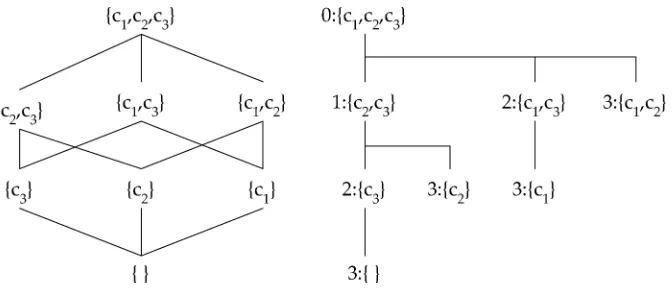
Cfor consistency. One way to proceed is to construct aspanning treeof the boolean lattice of subsets of C. This takes the form of a binomial tree, as in Figure 1 (Bird and Hinze 2003). At each node, we keep track of k, the index of the constraint that was removed from the parent set to create that subset. For example, subset {c1,c3} was formed by removingc2from{c1,c2,c3}, so k=2. The descendants of a node are constructed by successively dropping each of the constraintsciwherek<i≤ |C|. This
ensures that we will visit every subset ofCexactly once.
The algorithm described by Grover et al. (1994) performs a breadth-first search of the subset lattice, with one important optimization. Because the cardinality of the subsets at each level is one greater than those on the level below it, a breadth-first search of this tree will consider all larger sets before considering any smaller ones. Furthermore, because each subset is produced by removing constraints from its parent set, every node in a subtree is a subset of its root. This means that once a consistent set is found, no descendants of that set can be maximal, and that subtree can be pruned from the search space. However, consistent subsets that are maximal in their branch of the tree may turn out not to be globally maximal. For example, in Figure 1, if{c1,c2}
is consistent and{c1,c3}is not, a breadth-first search would identify both{c1,c2}and
{c1}as consistent and (locally) maximal. A final post-check for set inclusion can remove pseudo-maximal results like{c1}.
In addition to pruning branches rooted by a consistent subset (call thisroot prun-ing), the organization of the search space into a binomial tree allows another valuable optimization. The deepest leaf node in any subtree is the set formed from the root by removing all constraints ck<i≤|C|, and every set in the subset is a superset of that deepest
[image:3.486.56.392.491.635.2]leaf. Because no superset of an inconsistent set of constraints can be consistent, if the foot of a subtree is inconsistent then clearly no node in the tree can be consistent, and the entire tree can be skipped (call this leaf pruning). Taking both root pruning and leaf pruning together, the only subtrees that need to be explored are those whose root is
Figure 1
inconsistent but whose deepest leaf is consistent. No other subtrees can possibly contain a solution.
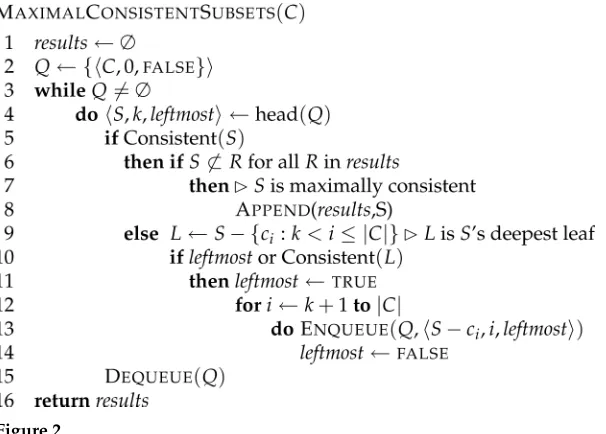
Figure 2 gives a breadth-first search algorithm that implements these optimiza-tions. Like Grover et al. (1994), this algorithm requires a post-check to remove pseudo-maximal subsets fromresults. A queue is used to keep track of subsetsSthat are yet to be checked for consistency, along with the indexkof the constraint that was last dropped, and a flagleftmostthat indicates whether that subset is the leftmost child. Because the deepest leaf node of the leftmost child is the same as the deepest leaf node of the parent, we are guaranteed that the deepest leaf of a leftmost child is consistent. Keeping track of leftmost children allows us to avoid a substantial number of redundant consistency checks.
3. Evaluation
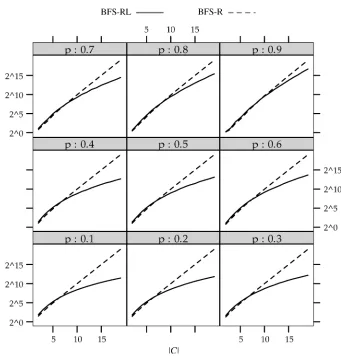
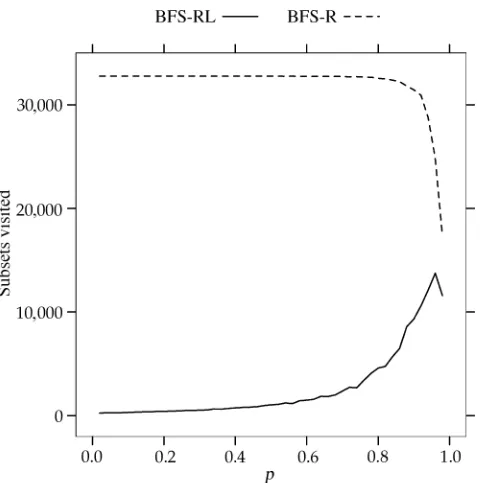
The graphs in Figure 3 and Figure 4 show an empirical comparison between a breadth-first search with root pruning (BFS-R) and a breadth-breadth-first search with root and leaf pruning (BFS-RL) on randomly generated problems. The graphs show the number of subsets that were checked for consistency, as it relates to|C|, the number of constraints, andp, the probability that two members ofCare consistent. Larger values forpgenerally lead to fewer but larger maximal consistent subsets. All counts are averaged across 100 randomly generated sets of ground constraints. In generating random problems, we make the simplifying assumptions that all constraints are consistent with any inde-feasible information, and that a subset of constraints that are pairwise consistent is a consistent subset.
[image:4.486.52.355.419.636.2]The first thing to note in these graphs is that root pruning by itself provides very little benefit. For most values of p, the number of subsets checked by BFS-R is very close to the worst case maximum 2|C|. A possible reason for this is that root pruning
Figure 2
Figure 3
Comparison of breadth-first search using root pruning alone (BFS-R) and in combination with leaf pruning (BFS-RL).|C|is the number of ground constraints,pis the fraction of the ground constraints which are pairwise consistent, and “Subsets visited” is the number of subsets ofC which were checked for consistency (on a logarithmic scale). All counts are based on the average of 100 randomly generated problems.
will have the greatest effect when consistent subsets are found in the interior nodes of the binomial search tree. However, the configuration of the search space is such that most nodes are either leaves or very close to leaves, and only a few nodes have a large number of descendants. Therefore, root pruning mostly removes very small subtrees and has only a small effect on the overall cost of the algorithm.
Figure 4
Comparison of subsets visited by BFS-R and BFS-RL as a function ofpfor|C|=15. All counts are based on the average of 100 randomly generated problems.
from leaf pruning can still be dramatic: at |C|=19 and p= 0.9, leaf pruning yields a nearly five-fold improvement in speed.
Values of |C| and p that can be realistically expected will vary widely from ap-plication to apap-plication. An anonymous reviewer reports that in one apap-plication, the resolution of non-monotonic lexical inheritance for constraint-based grammars, p is generally greater than 0.7. This may be due in part to the fact that most constraint-based grammar development platforms do not support defaults (Copestake’s [2002] LKB is a notable exception), and so grammar engineers tend to avoid the use of default overriding. Ginzburg and Sag (2001) propose a more comprehensive use of defaults, and grammars written following these principles would likely have a much lower value of
p. To my knowledge, however, these ideas have not yet made their way into any large-scale grammar implementations.
and leaf pruning can be used to eliminate regions of the search space that contain only consistent or inconsistent subsets.
4. Conclusions
Finding the maximal consistent subsets of a set of ground constraints is an impor-tant sub-problem for many natural language processing and knowledge representa-tion tasks. Unfortunately, the problem is NP-complete, and in the worst case requires checking all 2|C| subsets of C for consistency. Previously proposed algorithms have produced approximate solutions (Boppana and Halld ´orsson 1992), or have weakened the requirements to make finding a solution easier (Ninomiya, Miyao, and Tsujii 2002).
By using deepest leaf pruning, the algorithm described in the previous sections improves on the method of Grover et al. (1994) and is able to achieve substantial gains over the worst case running time for a large class of problems. An efficient method for finding maximal consistent subsets can make default unification practical for problems such as large-scale lexical representation, on-line discourse processing, or ontology construction.
References
Alexandersson, Jan and Tilman Becker. 2001. Overlay as the basic operation for
discourse processing in a multimodal dialogue system. InProceedings of the IJCAI Workshop “Knowledge and Reasoning in Practical Dialogue Systems,” pages 8–14, Seattle, WA.
Alexandersson, Jan, Tilman Becker, and Norbert Pfleger. 2004. Scoring for overlay based on informational distance. In Proceedings of KONVENS 2004, pages 1–4, Vienna, Austria.
Bird, Richard and Ralf Hinze. 2003.
Functional pearl: Trouble shared is trouble halved. InProceedings of the 2003 ACM SIGPLAN Workshop on Haskell, pages 1–6, Uppsala, Sweden.
Boppana, Ravi and Magn ´us M. Halld ´orsson. 1992. Approximating maximum
independent sets by excluding subgraphs. BIT Numerical Mathematics, 32(2):180–196. Bouma, Gosse. 1992. Feature structures and
nonmonotonicity.Computational Linguistics, 18(2):183–204.
Bouma, Gosse. 2006. Unification: Classical and default. In Keith Brown, editor, Encyclopedia of Language and Linguistics. Elsevier, New York.
Briscoe, E. J. 1999. The acquisition of grammar in an evolving population of language agents.Electronic Transactions in Artificial Intelligence. Special Issue: Machine Intelligence, 3(035):47–77.
Calder, Jonathan. 1993. Feature-value logics: Some limits on the role of defaults. In C. J.
Rupp, Mike Rosner, and Rod Johnson, editors,Constraints, Language and Computation. Academic Press, London, pages 20–32.
Carpenter, Bob. 1992. Skeptical and creduluous default unification with applications to templates and inheritance. In Ted Briscoe, Anne Copestake, and Valerie de Paiva, editors,Default Inheritance within Unification-Based Approaches to the Lexicon. Cambridge University Press, Cambridge, UK, pages 13–37.
Copestake, Ann. 1993. Defaults in lexical representation. In E. J. Briscoe, A. Copestake, and V. de Paiva, editors, Inheritance, Defaults and the Lexicon. Cambridge University Press, Cambridge, UK, pages 223–245.
Copestake, Ann. 2002.Implementing Typed Feature Structure Grammars. CSLI Publications, Stanford, CA.
Ginzburg, Jonathan and Ivan A. Sag. 2001. Interrogative Investigations. CSLI
Publications, Stanford, CA.
Grover, Claire, Chris Brew, Marc Moens, and Suresh Manandhar. 1994. Priority union and generalisation in discourse grammar. InProceedings of the 32nd Annual Meeting of the Association for Computational Linguistics, pages 17–24, Las Cruces, New Mexico.
in dialog systems. InProceedings of the HLT-NAACL 2003 Workshop on Text Meaning, pages 14–21, Edmonton, Alberta. Karp, Richard. 1972. Reducibility among
combinatorial problems. In R. E. Miller and J. W. Thatcher, editors,Complexity of Computer Computations. Plenum Press, New York, pages 85–103.
Lascarides, Alex and Ann Copestake. 1998. Pragmatics and word meaning.Journal of Linguistics, 34:387–414.
Lascarides, Alex and Ann Copestake. 1999. Default representation in constraint-based frameworks.Computational Linguistics, 25:55–105.
Ninomiya, Takashi, Yusuke Miyao, and Jun’ichi Tsujii. 2002. Lenient default unification for robust processing within unification based grammar formalisms. InProceedings of the 19th International Conference on Computational Linguistics (COLING), pages 1–7, Taipei, Taiwan.
Petersen, Wiebke. 2004. A set-theoretic approach for the induction of inheritance hierarchies.Electronic Notes in Theoretical Computer Science, 53:296–308.
Pr ¨ust, Hub. 1992.On Discourse Structuring, VP Anaphora and Gapping. Ph.D. thesis, University of Amsterdam.
Pr ¨ust, Hub, Remko Scha, and Martin van den Berg. 1994. Discourse grammar and verb phrase anaphora.Linguistics and Philosophy, 17(3):261–327.
Tateisi, Yuka, Kentaro Torisawa, Yusuke Miyao, and Jun’ichi Tsujii. 1998. Translating the XTAG English grammar to HPSG. InProceedings of the Fourth International Workshop on Tree Adjoining Grammars and Related Frameworks (TAG+4), pages 172–175, Philadelphia, PA.