Performance Analysis of Two Extension of Stable
Election Protocol regarding Energy Consumption
in Wireless Sensor Networks
Achyut Srivastava1, A. K. Shankhwar2, Ashutosh Singh3 1
M.Tech student, 2,3Associate Professor Electronics Engg. Deptt. Harcourt Butler Technical University Kanpur U.P-India
Abstract: Wireless Sensor Network (WSNs) is one of the inclining innovation having different applications in wireless communications. Energy consumption is an extensive thing in WSN. Subsequently a large portion of routing protocol is centered on Energy Conservation. Clustering is one of the well-known WSN routing techniques. In this paper we'll examine about Stable Election Protocol (SEP), a two level heterogeneous Protocol and its two expansions, S-SEP and MS-SEP; which uses Clustering technique for information transmission. In S-SEP a few hubs transmits information straightforwardly to the base station and a few uses clustering technique. MS-SEP is a three-level heterogeneous routing protocol, where cluster individuals transmit information to their head of the cluster just when detected information surpasses some limit. We at that point think about their comparison dependent on network energy dissipation having constant Throughput
Keywords: WSN, Clustering, SEP, MS-SEP, Throughput.
I. INTRODUCTION
Wireless Sensor Networks comprise of a generous measure of conservative, less power consumable and multi-operational recognizing devices known as sensor hubs. Each sensor hub is furnished with distinguishing, information preparing and transmitting accomplishments [1-4]. The recently talked about little recognizing contraptions are known as hubs. They include transceiver (for sending and getting signal or data beginning with one centre point then onto the following), CPU (with the true objective of data taking care of), battery (for imperativeness) and memory (for securing data). According to the applications, size of every sensor centre point changes as needs be. In certain military or even in some surveillance applications it might be imperceptibly little. Parameters, for instance, battery, memory size and handling speed are the integral variables for its expense. In past, different conventions are advanced, where created hubs have extra sum vitality than typical hubs [4-9]. These higher energy hubs are placed in to construct throughput. In this proposed article, we attempted with respect to the scattering of the sensor hubs in such way to increase the throughput; it may be improved alone of making increment in cutting edge of advanced hubs energy. Right off the bat, we present two as of late advanced conventions to be specific S-SEP and MS-SEP, which set out the essentials of energy levels.
II. RELATED WORK
A. Cluster Formation
Clustering depends on disseminated algorithm [1], [2]. The objective here is to limit the energy utilization and correspondence cost, and boosts the system lifetime. In this method, the system is isolated into a few clusters and in each group; one of the hub is chosen as head of the cluster with deference for the energy level. Every hub transmits the detected information to its head of the cluster and that head of the cluster performs information aggregation and transmits it to the base station.
B. Protocol
The protocols that will be examined about in this paper are: SEPs two expansions S-SEP and MS-SEP.
C. Stable Election Protocol (SEP)
centre points and the additional energy interestingly with advance centres and extra measure of energy factor in the middle of advance and normal node points is implied by (α). Accept that there are (n) quantities of sensor centre points in the framework and (m) be the bit of advance node points, which are outfitted with more energy than the ordinary normal node points. Let E0 be the
fundamental energy of each normal sensor centre point. By then energy of each advance sensor centre point will be E0(1+a).
[{n×Eo×(1-m)} + {n×Eo×m×(1+α)} = {n×Eo×(1 + α)×m)}] (1)
SEP delegate a weighted likelihood to each centre point reliant on its underlying energy. It improves the cluster course of action by decreasing the head of the group between times of advance centre points, i.e., advance centres get logically chance to transform into a head of the group. The discrete likelihood for ordinary and advance centre points independently, are:
p( ).=
( .)
(2)
Anticipate an ideal number of clusters (k) in each round. From the outset each centre point can transform into a head of the cluster with a probability p(opt.).Every centre point will move toward getting to be Head of the cluster once every
( ) cycle, ( ) is
implied as epoch.
P( .) = [
( )
( ) ] (3)
Besides, every centre point must push toward getting to be head of the cluster once every
( ) round. If there are (n) centres in the
framework, by then there are [n×.p(opt.)] speaks to the quantity of cluster and head of the cluster round. Each centre point in the
cluster picks a self-assertive number 0 and 1 complete and is appear differently in relation to the Threshold T(n) is as,
T(nrm) =
( )
( ) ×
( )
; if n∈G
0 ; elsewhere
(4)
Where, (r) represents to the current round and (G) represents to the course of action of normal node centres that have not pushed toward getting to be header of the cluster inside the last
( ) rounds of the epoch. In case the unpredictable number of a center is
lower than T(nrm), by then that centre is picked as head of the cluster.
The below given equation defines the chance for advance nodes to become as a head of the cluster.
P( .) = [
( )
( ) × (1 +α)] (5)
According to threshold for advance nodes is
T(adv. ) =
( )
( ) ×
( )
; if adv∈G
0 ; otherwise
(6) In this course of action of advance node centers that are not being picked as head of the cluster in on-going
( ) rounds. After we
have the development of head of the cluster, the head of the cluster imparts information to the center points. This information is gotten by the center points and they pick the choice to which head of the cluster and it will proceed to the current round. This is called cluster advancement stage. As indicated by the idea of sign got, center points offer reaction to head of the cluster and are as a piece of it. Head of the cluster right as of now select a TDMA position for the center points at the time in which center points can exchange data to head of the cluster.
Subsequent to finishing the headway of cluster information of every center point, transmission of the information to the head of the cluster inside the time made undeniable to the center by the head of the cluster.. By and by, data originated from center points, Head of the cluster need to accumulate all data and after gathering if essential lastly transmits data to the BS. This named is referred to as transmission stage as showed up by.
D. Sector Based Stable Election Protocol (S-SEP)
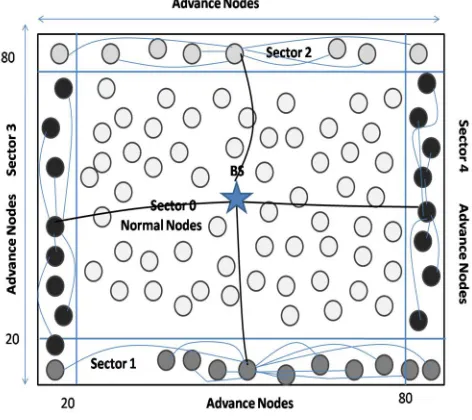
To take care of inconsistent separation issue beforehand it was advanced that to isolate the all-out territory in four areas as introduced in figure-1 [10]. Each Sector can be named,
1) Sector-1: 0<x< X and 0<y<y1
2) Sector-2: 0<x< X and y2<y<Y
3) Sector-3: 0<x< x1 and 0<y<Y
[image:3.612.188.423.170.354.2]4) Sector-4:x2<x< X and 0<y<Y
Fig. 1 Network Architecture with Sectors
[image:3.612.189.425.416.626.2]If there should arise an occurrence of hub arrangement, hubs is in altered structure, sent of ordinary hubs are in the area of (x1 < x < x2) and (y1 < y < y2), and in the rest of the locale, sending of advance node hubs is made, in sectors clarified overhead and portrayed in figure-2.
Fig. 2: Four sector based network architecture.
a) The essential advantages of S-SEP are:
i) Improved legitimate sending of created hubs.
ii) A less number of cutting edge hubs are utilized to cover remote areas from BS.
iii) Less good ways from BS to most remote hub.
iv) Enhanced throughput and steadiness period with least beginning vitality.
The fundamental confinement of both S-SEP and MS-SEP is that an enormous zone of the field is secured with normal hubs; along these lines for separation hub will cease to exist soon, and thusly will diminish stable period and throughput.
E. Modified Sector Based Stable Election Protocol (MS-SEP):
b) In this work further alteration was occurred in S-SEP and characterizes as MS-SEP. the recommended changes are as under:
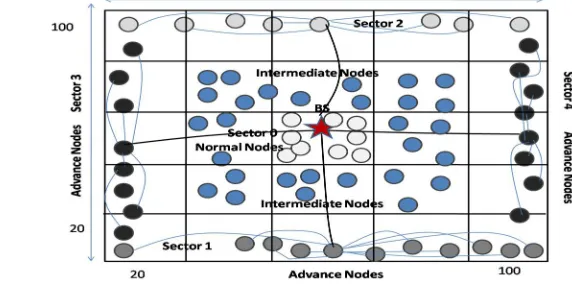
a) Divide the field into five zones.
b) Inclusion of Intermediate hubs in relationship with Normal and advance hubs.
Fig. 3: Network architecture with put forward protocol
In the most extreme introductory test, the whole number of considered hubs are 100, out of them, 20 are advance hubs, 16 are Intermediate hubs and remaining 64 hubs are normal hubs. The energy of normal hubs is viewed as E0. The energy of Intermediate
hub is [E0(1+β)] and the energy of advance hub is [E0(1+α)]. Here it is noticed that, β<α. The irregular organizations of hubs under
different conventions are exhibited in Figure 3. Be that as it may, the situation of base station is kept at fixed position of (50. 50). MS-SEP, which is an augmentation of SEP, it is a three-level heterogeneous system protocol. It is a responsive routing protocol. As transmission devours more energy than detecting, here there are three sorts of hubs: Normal hubs, Intermediate hubs and Advance hubs. The energy of intermediate hubs lies between development hubs and normal hub. These hubs have β times more energy than
that of ordinary hubs, where (β= α/2). These hubs are picked by a factor (b), a small amount of hubs which are Intermediate hubs. On the off chance that E0 is the underlying energy of every normal sensor hub, at that point energy of each advanced sensor hub will
be E0' (1+α) and energy of each intermediate hub will be E0(1+β).
The total (initial) energy of the network is equal to:
[{n×Eo×(1-m- (b×n))} + {n×m×Eo×(1+α)} + {n×b×Eo×(1 + β)} = {n×Eo×(1+(m×α)+(b×β)}] (7) The weighed probabilities for normal, intermediate and advanced nodes are, respectively:
P( .) = [
( )
( ) ] (8)
P( .)= [
( )( )
( ) ] (9)
P( .)= [
( )( )
( ) ] (10)
And threshold value calculation for normal, intermediate and advanced nodes are, respectively:
T(nrm. ) =
( )
( ) ×
( )
; if n∈G
0 ; elsewhere
(11)
T(int. ) =
( )
( ) ×
( )
; if n∈ G′
0 ; elsewhere
(12) The distribution of nodes is as follows:
Advanced Nodes Sector-1: 0<x<100 and 0<y<20 Sector-2: 0<x<100 and 80<y<100 Sector-3: 0<x<20 and 20<y<80 Sector-4: 80<x<100 and 20<y<80 Intermediate Nodes
Sector-5: 20<x<80 and 20<y<40 Sector-6: 20<x<80 and 60<y<80 Sector-7: 20<x<40 and 40<y<60 Sector-8: 60<x<80 and 40<y<60 Normal Nodes
[image:4.612.220.506.225.370.2]T( . ) =
( )
( ) ×
( )
; if n∈ G′′
0 ; elsewhere
(13)
where (r) speaks the current round, G, G' and G'', are the arrangement of normal hubs, intermediate hubs and advance hubs that have not progressed toward becoming leader of the group inside the last
( ) , ( ), and ( ) rounds of the age.
[image:5.612.180.434.192.290.2]Parameters that are utilized in the computation and for the simulation are listed in Table-1. Table-1: List of parameters and their values Parameters Value Initial Energy (E0). 0.25J, 0.50 J
Energy for data aggregation EDA 5 nJ/bit/signal
Transmission and Receiving energy 5 nJ/bit Amplification energy for short distance εfs 10 pJ/bit/m2
Amplification energy for long distance εmp 0.013 pJ/bit/m4
Probability Popt 0.2
Stability period, Network lifetime and Throughput are used to evaluate the performance of the protocols, and these are as,
c) Stability Period: Stability period is described when between times since the start of a network of the dead of unquestionably the one sensor hub. It is appealing that the estimation of this factor is should be as greatest as could sensibly be normal.
d) Network Lifetime: This is the time between time gone from the most punctual beginning stage of the system to the dead of the rearmost working hub. This is additionally should in like manner be as most extreme as could be permitted.
e) Throughput: High throughput is in like manner an appealing component of WSN. It tends to be characterizing as, the data sent from the hubs to the base station as far as packets.
[image:5.612.106.505.437.622.2]An incredible number of conventions were introduced already with the goal of accomplishing high stability period, long length of network and to accomplish high throughput. These three parameters boost is a versatile errand, since, according to the system necessities wanted parameter/parameters is/are attempt to amplify.
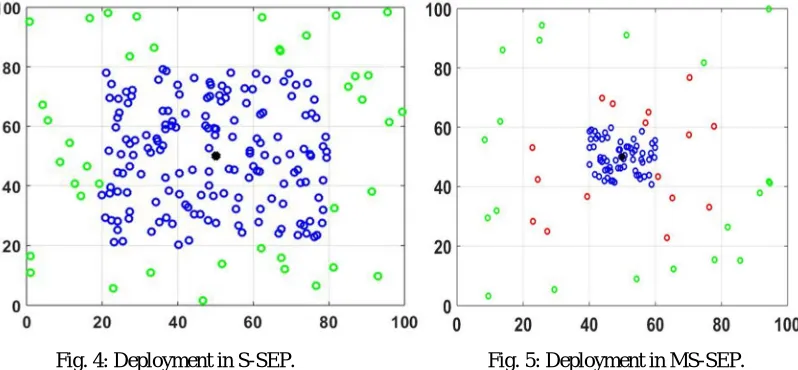
Fig. 4: Deployment in S-SEP. Fig. 5: Deployment in MS-SEP.
Fig. 4, (100×100) m2 field is utilized for simulation of S-SEP. The blue 'o' image are utilized as a portrayal of Normal hubs and that are conveyed in square 20<X<80 and 20<Y<80. For quite a while green 'o' images are utilized as a portrayal of advance node hub and that are sent in the locale stays left, and, the imprint with '×' is speaks to the situation of the BS'. The situation of BS is at mean worth (50, 50). The E0 is portrayal of vitality of the typical hubs and [E0(1+α)] is for the vitality of cutting edge hubs. MATLAB is
utilized for reenactment, and reproduction performs 2000 rounds.
III. COMPARISON OF S-SEP AND MS-SEP (SAME THROUGHPUT)
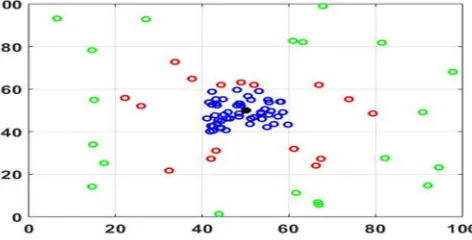
[image:6.612.188.424.146.266.2]In WSN applications, throughput is an important parameter; in this section we have made comparison of both S-SEP and MS-SEP under same throughput conditions. We have carried out multiple of experiments and figured out that for S-SEP, 80 normal nodes and 20 advanced nodes performance is same as for MS-SEP for some time considering 52 normal nodes, 16 intermediate nodes and 20 advanced nodes. Thus, a total of 88 nodes are deployed.
[image:6.612.57.559.299.444.2]Fig. 6: Deployment of nodes in MS-SEP protocol (88 nodes)
Fig. 7: Active nodes vs. rounds. Fig. 8: Dead nodes vs. rounds. Fig. 9: Packet transfer to BS vs. rounds Fig. 7, S-SEP and MS-SEP protocol is demonstrating active hubs versus rounds plot, for quite a while in fig. 8, dead hubs versus rounds is appeared. If there should arise an occurrence of S-SEP convention, the most extreme introductory hub going to be dead after 1806 rounds and rearmost hub after 3851 rounds. For quite a while at MS-SEP the most extreme starting hub going to be dead after 2203 rounds and rearmost hub bites of the dust 3752 rounds. The Packet move to BS versus round is appeared in Fig. 9. Presently, number of Packets will be transmitted to BS is 2.286×10⁵ for S-SEP convention for quite a while the quantity of packets will be transmitted to BS is 2.326×10⁵ for MS-SEP.
IV. COMPARISON OF ENERGY
A. Energy Calculations
Total energy in S-SEP protocol is ETS = (n-q)E0 +qE0(1+a)
Where, q represents the number of advanced nodes. Similarly, total energy in MS-SEP protocol is, ETMS = (n-q-r)E0 + qE0(1+α) + rE0(1+β).
Where, r represents the number of intermediate nodes. Considering n=100, q=20, r=16, α=1, β=0.5.
Total energy in S-SEP protocol is, ETS = (n-q)E0 + qE0(1+α) =120E0.
Total energy in MS-SEP protocol is,
ETMS = (n-q-r)E0 + qE0(1+α) + rE0(1+β) =128E0
B. Energy Calculations
Total energy in S-SEP protocol is, ETS = (n-q)E0 + qE0(1+α),
Where, q represents the number of advanced nodes. Similarly, total energy in MS-SEP protocol is, ETMS = (n-q-r)E0 + qE0(1+α) + rE0(1+β),
Where, r represents the number of intermediate nodes. Considering n=100, q=20, r=16, α=1, β=0.5.
Total energy in S-SEP protocol is, ETS = (n-q)E0 + qE0(1+α) =120E0.
Total energy in MS-SEP protocol with n=88, is ETMS = (n-q-r)E0 + qE0(1+α) + rE0(1+β) =116E0
Therefore, energy saving is 4 E0 units.
V. CONCLUSIONS
Here we have discussed about execution investigation of two expansions of Stable Election Protocol, S-SEP and MS-SEP, which are heterogeneous conventions and subsequently they don't require worldwide learning of energy at each election round and are adaptable as they doesn't require any information of the accurate position of every hub in the field. They utilizes clustering technique for accomplish longer system lifetime. Reenactment results have demonstrated that stability period of MS-SEP is expanded by roughly 19.95% and throughput by practically consistent, by simply fluctuating the system engineering. The network lifetime of MS-SEP is expanded 2.44% than S-SEP.
REFRENCES
[1] Smaragdakis, G., Matta, I. and Bestavros, A., SEP: A stable election protocol for clustered heterogeneous wireless sensor networks. Boston University Computer Science Department., 2004.
[2] Femi A. Aderohunmu, Jeremiah D. Deng, "An Enhanced Stable Election Protocol (SEP) for Clustered Heterogeneous WSN", Department of Information Science, University of Otago Dunedin, New Zealand.
[3] Akyildiz, I.F., Su, W., Sankarasubramaniam, Y. and Cayirci, E., Wireless sensor networks: a survey. Computer networks, 38(4), pp.393-422., 2002.
[4] Dr. Firas Ali AI-Jubooril, Sura F. Ismail, "Performance Analysis of Variable Energy Levels of Clustering Protocols for Wireless Sensor Network", LICSI International Journal of Computer Science Issues, 2013.
[5] Abbasi, A.A. and Younis, M., A survey on clustering algorithms for wireless sensor networks. Computer communications, 30(14-15), pp.2826-2841., 2007. [6] Al-Karaki, J.N. and Kamal, A.E., Routing techniques in wireless sensor networks: a survey. IEEE wireless communications, 11(6), pp.6-28., 2004. [7] Akkaya, K. and Younis, M., A survey on routing protocols for wireless sensor networks. Ad hoc networks, 3(3), pp.325-349, 2005.
[8] Anastasi, G., Conti, M., Di Francesco, M. and Passarella, A., Energy conservation in wireless sensor networks: A survey. Ad hoc networks, 7(3), pp.537-568., 2009.
[9] Tanwar, S., Kumar, N. and Rodrigues, J.J., A systematic review on heterogeneous routing protocols for wireless sensor network. Journal of network and computer applications, 53, pp.39-56., 2015.
[10] S. Misra et al. (eds.), Guide to Wireless Sensor Networks, Computer Communications and Networks, DOI: 10.1007/978-1-84882-218-4 4, Springer-Verlag London Limited, 2009.
[11] E. Callaway, “Wireless sensor networks: architectures” and protocols, Chapter 1 – 7, Auerbach Publications, 2004.