Coverage vs. Efficiency
Carlos G ´omez-Rodr´ıguez
∗Universidade da Coru ˜na
In the last decade, various restricted classes of non-projective dependency trees have been pro-posed with the goal of achieving a good tradeoff between parsing efficiency and coverage of the syntactic structures found in natural languages. We perform an extensive study measuring the coverage of a wide range of such classes on corpora of 30 languages under two different syntactic annotation criteria. The results show that, among the currently known relaxations of projectivity, the best tradeoff between coverage and computational complexity of exact parsing is achieved by either 1-endpoint-crossing trees or MHk trees, depending on the level of coverage desired. We
also present some properties of the relation of MHktrees to other relevant classes of trees.
1. Introduction
A syntactic dependency tree is projective if the yield of each node is a substring of the sentence—or equivalently, if no dependencies cross when drawn above the words.1
Projectivity is advantageous for efficient parsing: Exact inference for parsing models restricted to projective trees can be achieved in cubic time (Eisner 1996), and shift-reduce parsers can process them with very simple transitions in linear time (Nivre 2006). For this reason, and because crossing dependencies have traditionally been rare in corpora of languages like English, Chinese, or Japanese, many implementations of dependency parsers assume projectivity (Nivre 2006).
However, crossing dependencies are needed to represent some linguistic phenom-ena like topicalization, scrambling,wh-movement, or extraposition, so it is necessary for natural language parsers to support non-projectivity, especially when working with languages with flexible word order. Unfortunately, exact inference is intractable for models that support arbitrary non-projective trees, except under strong independence assumptions (McDonald and Satta 2007). For this reason, researchers have proposed various classes ofmildly non-projectivetrees: restricted classes of trees that allow a limited degree of non-projectivity, permitting crossing dependencies only under certain
∗Research Group on Language and Information Society (LyS), Departamento de Computaci ´on,
Universidade da Coru ˜na, Campus de A Coru ˜na, 15071, A Coru ˜na, Spain. E-mail:[email protected]. 1 We will assume the conventional representation of syntactic dependency analyses as trees rooted at a
dummy node. Its presence and location (Ballesteros and Nivre 2013) has no effect on the coverage of the considered classes of trees, except for 1-endpoint-crossing trees and crossing-interval trees. In these cases, we assume that the dummy root is located on the left, as in the papers in which they were defined.
Submission received: 4 February 2016; accepted for publication: 25 April 2016.
conditions. The goal of these classes is to combine a high coverage of the syntactic phenomena found in real sentences with efficient parsing.2
In this article, we perform a comparison of a wide range of these relaxations of pro-jectivity, with the goal of evaluating them in terms of the tradeoff between coverage and efficiency. For this purpose, we measure their coverage on a set of syntactic treebanks of 30 languages, analyzed under two different annotation criteria.
Thus, the main contribution of this work is that we provide homogeneous measure-ments of the coverage of a wide range of mildly non-projective classes of trees on a large collection of treebanks, relating them to their computational properties for parsing. To our knowledge, this is the first study providing an extensive comparison of such classes: Although Havelka (2007) also measured the coverage of several restrictions on non-projectivity, little was known at the time about which restrictions could be exploited for efficient parsing, so only a few of the classes discussed there are relevant for parsing. Furthermore, existing coverage data in the literature (both in that study and in the papers describing subsequently discovered classes of trees, cited herein) refer to small sets of treebanks that vary across reports, when reported at all.
Additionally, we present some results relating MHktrees, one of the sets with the best coverage–efficiency tradeoff, with other classes of mildly non-projective trees.
2. Classes of Mildly Non-Projective Trees
We now list the classes of trees considered in this study, outlining them very briefly. A full description of each class, with all the required definitions, is outside the scope of this article. We refer the reader to the provided references for further information.
Projective.Projective dependency trees can be parsed inO(n3) (see Section 1). We will denote the set of projective trees byPr.
Well-nested with Bounded Gap Degree.Well-nested trees (Bodirsky, Kuhlmann, and M ¨ohl 2005) are those that do not contain disjoint subtrees whose yields interleave (those that do are called ill-nested). Well-nested trees whose gap degree (the number of discontinuities—orgaps—in a node’s yield) does not exceed a constantkcan be parsed in timeO(n5+2k) (G ´omez-Rodr´ıguez, Weir, and Carroll 2009; G ´omez-Rodr´ıguez, Carroll, and Weir 2011); and we will call them WGk trees. WGk trees have connections to constituent grammar formalisms, as tree-adjoining grammars induce WG1 trees and
coupled context-free grammars induce WGktrees (Kuhlmann 2010).
Mild+1-Inherit and Gap-Minding.Gap inheritance (Pitler, Kannan, and Marcus 2012) is a restriction on the number of children of a node that can have arcs that cross a gap in its yield. Imposing gap inheritance bounds as additional restrictions onWG1trees, two
relevant classes of trees are obtained: Mild+1-Inherit (M1I) trees can be parsed inO(n6),
and Mild+0-Inherit (M0I) trees, or gap-minding trees, inO(n5).
Head-Split.The head-split property is a restriction that forbids trees where a node’s yield has a gap that includes its head, but not the gap in its head’s yield. This allows dynamic programming parsers to split subtrees into two at the position of their heads, reducing the complexity of parsing several subclasses of WG1trees: Satta and Kuhlmann (2013)
show how WG1 trees with the head-split property (WG1S) can be parsed inO(n6),
whereas for M1I trees with the head-split property (M1IS) the complexity isO(n5).
Mildly Ill-nested.A superset of WGk trees, mildly ill-nested trees of gap degree up to
k(MGk) include all the dependency trees that have at least one binarization of gap degreek. They can be parsed in timeO(n4+3k) (G ´omez-Rodr´ıguez, Carroll, and Weir 2011). Note that this is the same complexity as for WGkfork=1, but larger fork>1.
Attardi Degree 2.The set of trees that can be parsed with the transitions of degree up to 2 in the transition system of Attardi (2006) is also amenable to dynamic programming parsing, in timeO(n7) (Cohen, G ´omez-Rodr´ıguez, and Satta 2011). This set, which we will callAD2, includes ill-nested trees and trees with unbounded gap degree.
MHk trees.G ´omez-Rodr´ıguez, Carroll, and Weir (2011) define a generalization of the tabular algorithm obtained from the shift-reduce parser of Yamada and Matsumoto (2003), or from the arc-hybrid transition system (G ´omez-Rodr´ıguez, Carroll, and Weir 2008; Kuhlmann, G ´omez-Rodr´ıguez, and Satta 2011). This parser, called MHk, has items representing a span dominated by several head nodes (hence the acronym, for “multi-headed”). It has complexityO(nk) and is projective fork=3, but covers increasingly large sets of non-projective trees for values ofk>3, which we will callMHktrees.
1-Endpoint-Crossing.Pitler, Kannan, and Marcus (2013) define 1-Endpoint-Crossing trees (1EC trees) as dependency trees such that all the arcs that cross a given arc have a common vertex. This set of trees includes trees that are ill-nested and have unbounded gap degree, and can be parsed inO(n4) (Pitler, Kannan, and Marcus 2013; Pitler 2014).
k-Planar. k-Planar trees (k-P, equivalent tok-page book embeddings in graph theory) are those whose non-dummy arcs can be partitioned intoksets (calledplanes), in such a way that arcs belonging to the same plane do not cross (Yli-Jyr¨a 2003). No globally optimal parser is known for these trees, but they can be handled by a linear-time transition-based parser withkstacks (G ´omez-Rodr´ıguez and Nivre 2010, 2013).
k-Crossing Interval. k-Crossing Interval trees (k-C) are defined by Pitler and McDonald (2015) with a restriction on intervals formed by crossing arcs. 2-C trees can be parsed ac-curately with a linear-time shift-reduce parser with two registers (Pitler and McDonald 2015). 2-C trees are a subset of 1EC trees, which in turn are a subset of 2-P trees.
3. Materials and Methods
Corpora.We evaluate the coverage of each class described in Section 2 on HamleDT 2.0 (Rosa et al. 2014), a collection of harmonized versions of existing treebanks of 30 diverse languages, under two different annotations: Prague and Universal Stanford dependencies. Both annotation styles are interesting for parsing: The former tends to be easier to learn for monolingual parsers, but the latter is advantageous in multilingual settings (see Rosa [2015] and references therein). Thus, apart from spanning a variety of languages, these data sets allow us to see the influence of annotation criteria on the coverage of different restrictions on non-projectivity.
and Satta (2012) for the Attardi parser restricted to degree 2, which has been shown to recognize exactly the trees of AD2 and its implementation checked against the
dynamic programming algorithm of Cohen, G ´omez-Rodr´ıguez, and Satta (2011). Finally, in the case of MHk, we run a dynamic programming implementation of the parser itself.
All programs to measure coverage have been extensively tested with examples from the literature, custom-built sets of cases, known relations between classes (MH3=Pr, 2-C⊆1EPC⊆2-P, WGk⊆MGk, etc.), runs on other treebanks to compare with previously reported coverages, and in some cases, comparison of more than one implementation.
4. Results
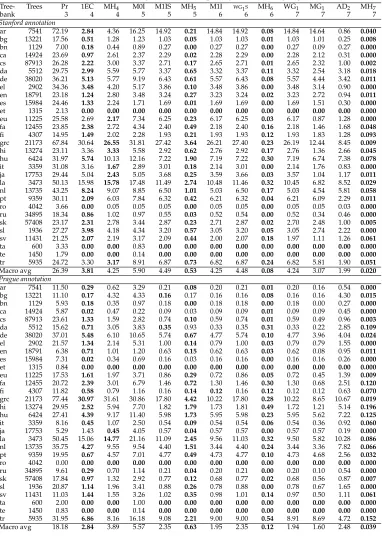
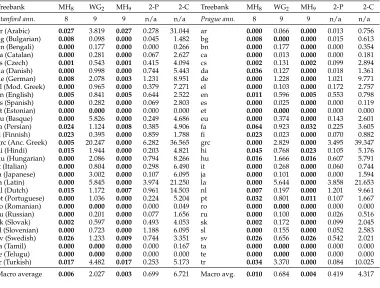
The results of the coverage analysis are shown in Tables 1 and 2. For space reasons, we omit some of the classes with less direct practical interest: 1-P (a very mild relax-ation of projectivity, of limited interest for expanding coverage), k-C and k-P fork>2 (transition systems for them are possible in theory, but likely impractical due to the extra transitions needed), and those whose best known parser is slower thanO(n9), like WGk fork>2.
The results provide interesting insights into the coverage of the different classes on a diverse set of corpora with varying amounts of non-projectivity, ranging from the total projectivity of the Prague-style Romanian treebank to the very high non-projectivity in the corpora of classical languages—probably influenced by the presence of poetic texts in them—or in the Stanford-annotated Arabic data set.
Annotation criteria have a large influence on the adequacy of the different restric-tions on projectivity. The Stanford treebanks not only tend to contain more non-projectivity than the Prague ones, but also more ill-nested trees and trees with higher gap degree. For example, the average proportion of trees that are not in WG1 is more
than double on Stanford than on Prague treebanks, with huge differences in some cases (e.g., 14.84% vs. 0.20% on the Arabic corpora). The same trend appears in the other classes requiring well-nestedness and bounded gap degree. The finding that WG1
covers almost all phenomena found in treebanks, reported in smaller data sets in the past (Kuhlmann 2010; G ´omez-Rodr´ıguez, Carroll, and Weir 2011), is questionable for Stanford treebanks, as it excludes more than 5% of the trees in nine languages.
However, this does not mean that Stanford dependencies are less amenable to mildly non-projective parsing in general, as the Attardi parser and the MHk parsers fork>4 have better coverage for the Stanford than for the Prague-annotated treebanks. Thus, the lower coverage of the well-nested parsers on the Stanford treebanks does not exclusively owe to them having more non-projectivity in a general sense, but rather different kinds of non-projectivity that are better captured with different restrictions.
Overall, the class with the best coverage among those with known globally optimal parsers running in timeO(n4) is 1EC, which even surpasses WG
1 (O(n7)) on average
on the Stanford treebanks. But if we are willing to accept larger complexities, the best tradeoff is achieved with the MHkparsers. The average coverage is close to 99.5% for MH5, and practically full for MH7, only excluding 177 trees out of the more than 800, 000
analyzed overall. MH12(not shown in the tables) has full coverage of the 60 treebanks.
Table 1
Loss of coverage for each of the classes of restricted non-projective trees that have exact parsing algorithms running inO(nk) fork<=7. The value ofkis shown below the name of the class.
For each treebank and class, we report thepercentageof trees thatdo notbelong to the class (i.e., lower is better). The best coverage for each complexity bound is highlighted inboldface.
Tree- Trees Pr 1EC MH4 M0I M1IS MH5 M1I WG1S MH6 WG1 MG1 AD2 MH7
bank 3 4 4 5 5 5 6 6 6 7 7 7 7
Stanford annotation
ar 7541 72.19 2.84 4.36 16.25 14.92 0.21 14.84 14.92 0.08 14.84 14.64 0.86 0.040 bg 13221 17.56 0.51 1.28 1.23 1.03 0.05 1.03 1.03 0.01 1.03 1.01 0.25 0.008 bn 1129 7.00 0.18 0.44 0.89 0.27 0.00 0.27 0.27 0.00 0.27 0.09 0.27 0.000 ca 14924 23.69 0.97 2.61 2.37 2.29 0.02 2.28 2.29 0.00 2.28 2.12 0.31 0.000 cs 87913 26.28 2.22 3.00 3.37 2.71 0.17 2.65 2.71 0.01 2.65 2.32 1.00 0.002 da 5512 29.75 2.99 5.59 5.77 3.37 0.65 3.32 3.37 0.11 3.32 2.54 3.18 0.018 de 38020 36.21 5.13 5.77 9.19 6.43 0.61 5.57 6.43 0.08 5.57 4.44 3.42 0.011 el 2902 34.36 3.48 4.20 5.17 3.86 0.10 3.48 3.86 0.00 3.48 3.14 0.90 0.000 en 18791 23.18 1.24 2.80 3.48 3.24 0.27 3.23 3.24 0.02 3.23 2.72 0.94 0.011 es 15984 24.46 1.33 2.24 1.71 1.69 0.01 1.69 1.69 0.00 1.69 1.51 0.30 0.000 et 1315 2.13 0.00 0.00 0.00 0.00 0.00 0.00 0.00 0.00 0.00 0.00 0.00 0.000 eu 11225 25.58 2.69 2.17 7.34 6.25 0.23 6.17 6.25 0.03 6.17 0.87 1.28 0.000 fa 12455 23.85 2.38 2.72 4.34 2.40 0.49 2.18 2.40 0.16 2.18 1.46 1.68 0.048 fi 4307 14.95 1.49 2.02 2.28 1.93 0.21 1.93 1.93 0.12 1.93 1.83 1.28 0.093 grc 21173 67.84 30.64 26.55 31.81 27.42 3.64 26.21 27.40 0.23 26.19 12.44 8.45 0.009 hi 13274 23.11 3.36 3.33 5.58 2.92 0.62 2.76 2.92 0.17 2.76 1.36 2.66 0.045 hu 6424 31.97 5.74 10.13 12.16 7.22 1.90 7.19 7.22 0.30 7.19 6.74 7.38 0.078 it 3359 31.08 3.16 1.67 2.89 3.01 0.18 2.14 3.01 0.00 2.14 1.76 0.83 0.000 ja 17753 29.44 5.04 2.43 5.05 3.68 0.25 3.59 3.66 0.03 3.57 1.04 1.17 0.011 la 3473 50.13 15.98 15.78 17.48 11.49 2.74 10.48 11.46 0.32 10.45 6.82 8.52 0.029 nl 13735 43.25 8.24 9.07 8.85 6.50 1.01 5.03 6.50 0.17 5.03 4.54 5.81 0.058 pt 9359 30.11 2.09 6.03 7.84 6.32 0.42 6.21 6.32 0.04 6.21 6.09 2.29 0.011 ro 4042 3.66 0.00 0.05 0.05 0.05 0.00 0.05 0.05 0.00 0.05 0.05 0.03 0.000 ru 34895 18.34 0.86 1.02 0.97 0.55 0.03 0.52 0.54 0.00 0.52 0.34 0.46 0.000 sk 57408 23.17 2.31 2.78 3.44 2.87 0.23 2.71 2.87 0.02 2.70 2.48 1.00 0.005 sl 1936 27.27 3.98 4.18 4.34 3.20 0.57 3.05 3.20 0.05 3.05 2.74 2.22 0.000 sv 11431 21.25 2.07 2.19 3.17 2.09 0.44 2.00 2.07 0.18 1.97 1.11 1.26 0.061 ta 600 3.33 0.00 0.00 0.83 0.00 0.00 0.00 0.00 0.00 0.00 0.00 0.00 0.000 te 1450 1.79 0.00 0.00 0.14 0.00 0.00 0.00 0.00 0.00 0.00 0.00 0.00 0.000 tr 5935 24.72 3.30 3.17 8.91 6.87 0.73 6.82 6.87 0.24 6.82 5.81 1.90 0.051 Macro avg 26.39 3.81 4.25 5.90 4.49 0.53 4.25 4.48 0.08 4.24 3.07 1.99 0.020
Prague annotation
Table 2
Loss of coverage for classes of restricted non-projective trees not shown in Table 1. For classes that have exact parsing algorithms running inO(nk), the value ofkis shown below the name of
the class. For each treebank and class, we report thepercentageof trees thatdo notbelong to the class (i.e., lower is better). The best coverage for each complexity bound is shown inboldface.
Treebank MH8 WG2 MH9 2-P 2-C Treebank MH8 WG2 MH9 2-P 2-C
Stanford ann. 8 9 9 n/a n/a Prague ann. 8 9 9 n/a n/a
ar (Arabic) 0.027 3.819 0.027 0.278 31.044 ar 0.000 0.066 0.000 0.013 0.756 bg (Bulgarian) 0.008 0.098 0.000 0.045 1.482 bg 0.008 0.000 0.000 0.015 0.613 bn (Bengali) 0.000 0.177 0.000 0.000 0.266 bn 0.000 0.177 0.000 0.000 0.354 ca (Catalan) 0.000 0.281 0.000 0.067 2.627 ca 0.000 0.013 0.000 0.000 0.181 cs (Czech) 0.001 0.543 0.001 0.415 4.094 cs 0.002 0.131 0.002 0.099 2.894 da (Danish) 0.000 0.998 0.000 0.744 5.443 da 0.036 0.127 0.000 0.018 1.361 de (German) 0.008 2.078 0.003 1.231 8.951 de 0.000 1.228 0.000 1.021 9.771 el (Mod. Greek) 0.000 0.965 0.000 0.379 7.271 el 0.000 0.103 0.000 0.172 2.757 en (English) 0.005 0.841 0.005 0.644 2.522 en 0.011 0.596 0.005 0.553 0.798 es (Spanish) 0.000 0.282 0.000 0.069 2.803 es 0.000 0.025 0.000 0.000 0.119 et (Estonian) 0.000 0.000 0.000 0.000 0.000 et 0.000 0.000 0.000 0.000 0.000 eu (Basque) 0.000 5.826 0.000 0.249 4.686 eu 0.000 0.374 0.000 0.143 2.601 fa (Persian) 0.024 1.124 0.008 0.385 4.906 fa 0.064 0.923 0.032 0.225 3.605 fi (Finnish) 0.023 0.395 0.000 0.859 1.788 fi 0.023 0.023 0.000 0.070 0.882 grc (Anc. Greek) 0.005 20.247 0.000 6.282 36.565 grc 0.000 2.829 0.000 3.495 39.347 hi (Hindi) 0.015 1.944 0.000 0.203 4.821 hi 0.045 0.768 0.023 0.105 5.176 hu (Hungarian) 0.000 2.086 0.000 0.794 8.266 hu 0.016 1.666 0.016 0.607 5.791 it (Italian) 0.000 0.804 0.000 0.298 6.490 it 0.000 0.268 0.000 0.060 0.744 ja (Japanese) 0.000 3.002 0.000 0.107 6.095 ja 0.000 0.101 0.000 0.000 1.594 la (Latin) 0.000 5.845 0.000 3.974 21.250 la 0.000 5.644 0.000 3.858 21.653 nl (Dutch) 0.015 1.172 0.007 0.961 14.503 nl 0.007 0.197 0.000 1.201 9.661 pt (Portuguese) 0.000 1.036 0.000 0.224 5.204 pt 0.032 0.801 0.011 0.107 1.667 ro (Romanian) 0.000 0.000 0.000 0.000 0.049 ro 0.000 0.000 0.000 0.000 0.000 ru (Russian) 0.000 0.201 0.000 0.077 1.656 ru 0.000 0.100 0.000 0.026 0.516 sk (Slovak) 0.002 0.597 0.000 0.493 4.053 sk 0.002 0.172 0.000 0.099 2.045 sl (Slovenian) 0.000 0.723 0.000 1.188 6.095 sl 0.000 0.155 0.000 0.052 2.583 sv (Swedish) 0.026 1.233 0.009 0.744 3.351 sv 0.026 0.656 0.026 0.542 2.021 ta (Tamil) 0.000 0.000 0.000 0.000 0.167 ta 0.000 0.000 0.000 0.000 0.000 te (Telugu) 0.000 0.000 0.000 0.000 0.000 te 0.000 0.000 0.000 0.000 0.000 tr (Turkish) 0.017 4.482 0.017 0.253 5.173 tr 0.034 3.370 0.000 0.084 10.025
Macro average 0.006 2.027 0.003 0.699 6.721 Macro avg. 0.010 0.684 0.004 0.419 4.317
shown to have very good empirical accuracy, probably because it is an easier to learn model.
5. Discussion
We have measured the coverage of a wide range of classes of mildly non-projective dependency trees on a large collection of treebanks with two different annotation styles, providing valuable data to compare said classes in terms of balance between coverage and efficiency. The relative coverage of the different classes varies across languages and annotation criteria. Explaining the concrete factors affecting it for each individual language is outside the scope of this work, and an interesting subject for studies focused on particular languages and corpora. However, despite this variability, there are very clear trends in the results. A relevant one is that the best general tradeoff is achieved by 1-Endpoint-Crossing trees (for complexityO(n4)) and MHktrees (for larger polynomial complexities).
a0 b0 a1 b1 a b
g g
...
...
Figure 1
An ill-nested dependency tree with gap degreegthat is in MH4. It can be parsed by the MH4
parser starting by building the item [bg−1,ag,bg,bg+1] and then proceeding from right to left.
(Pitler and McDonald 2015). In this sense, it is worth noting that no characterization independent of the parsing algorithm itself is known for the MHkclasses, fork>3, just as happens with Attardi trees. In fact, MHktrees have been very little studied, and their empirical coverage was unknown prior to this work. Because it is notably high, finding a simple characterization of MHk trees is an interesting open problem, which may be solvable as MHk trees have some desirable formal properties that AD2 trees lack, like
left-right symmetry (reversing the order of the words of an MHktree produces an MHk tree).
Two novel observations about the relation of MHktrees to other classes of trees are that: (1) MH4 contains ill-nested trees with unbounded gap degree (and therefore, the
same can be said of MHkfork>4, as MHk−1⊆MHkfor allk); and (2) MH4⊆2-P.
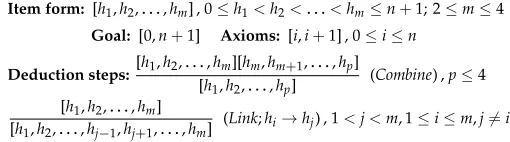
Observation (1) can be shown by example, with the tree in Figure 1, and an outline of the proof for (2) follows: given the MH4parser (shown in Figure 2), we build a variant
MH2P
4 that associates each arc with a plane∈ {P0,P1}, satisfying the 2-P constraint. To
do so, we annotate each index (node) on items with a forbidden plane, such that steps creating an arch→dalways do so on a plane not forbidden forhord. If both planes are allowed, then if the item has a nodexbetweenhanddwith a forbidden plane, the arc is created on that plane (to avoid forbidding both planes onx at the same time), otherwise an arbitrary plane is chosen. Initial items do not have any restrictions, but when we create a right arcA=h1 →h3 with a Linkstep [h1,h2,h3,h4]`[h1,h2,h4] on
planePi, we forbidPion nodeh2 (located betweenh1andh3), which prevents arcs that
crossAfrom being created on the same plane asA, and the symmetric is done for left arcs. Annotations are propagated across deductions together with their nodes.
Parsing a tree T with MH24P always produces a valid partition of T into planes, that is, it never reaches a situation where an arc cannot be created without violating 2-planarity because both planes are forbidden by the restrictions. This is shown by proving that each item has at most one node with a forbidden plane. To see this, note that the first and last nodes of an item cannot have any forbidden plane: by construction, restrictions always originate on the central node of a 3-node item, and no steps in the parser can move a node in the middle to the first or last position. Restrictions can
Item form: [h1,h2,. . .,hm] , 0≤h1<h2< . . . <hm≤n+1; 2≤m≤4 Goal:[0,n+1] Axioms:[i,i+1] , 0≤i≤n
Deduction steps:[h1,h2,. . .,hm][hm,hm+1,. . .,hp]
[h1,h2,. . .,hp] (Combine) ,p≤4
[h1,h2,. . .,hm]
[h1,h2,. . .,hj−1,hj+1,. . .,hm] (Link;hi
[image:7.486.51.306.562.633.2]→hj) , 1<j<m, 1≤i≤m,j6=i
Figure 2
propagate to 4-node items, but these always come from applying a Combine step on a 3- and a 2-node item, so again at most one node (the central one in the 3-node item) can have a forbidden plane. Thus, we can always associate a plane to an arc without violating restrictions, as there can be only one restriction per item and therefore at least one plane is allowed.
Note that this proof implicitly relies on the fact that, when the MH4parser creates an
arcA, any subsequently built arcs crossingAmust share an endpoint: for example, after the arcA=h→dis created by a deduction step [h,x,d,y]`[h,x,y], the only endpoint located between h andd remaining available isx, so any subsequent arcs crossingA
must be incident to x. This restriction is interestingly similar to the definition of 1EC trees, although weaker because it only affects arcs created afterA.
The relation of MH4with the 2-P class, as well as its indirect relation with 1EC, may
help obtain a characterization for the set of MHktrees. Their good balance between cov-erage and parsing efficiency makes this class, together with 1EC trees, very interesting for modeling the non-projectivity found in natural languages.
Acknowledgments
The author is partially funded by the TELEPARES-UDC project from MINECO (FFI2014-51978-C2-2-R) and an Oportunius program grant from Xunta de Galicia.
References
Attardi, Giuseppe. 2006. Experiments with a multilanguage non-projective dependency parser. InProceedings of CoNLL,
pages 166–170, New York.
Ballesteros, Miguel and Joakim Nivre. 2013. Going to the roots of dependency parsing.Computational Linguistics, 39(1):5–13.
Bodirsky, Manuel, Marco Kuhlmann, and Mathias M ¨ohl. 2005. Well-nested drawings as models of syntactic structure. In
Proceedings of FG-MoL, pages 195–203, Edinburgh.
Cohen, Shay B., Carlos G ´omez-Rodr´ıguez, and Giorgio Satta. 2011. Exact inference for generative probabilistic non-projective dependency parsing. InProceedings of EMNLP, pages 1234–1245, Edinburgh. Cohen, Shay B., Carlos G ´omez-Rodr´ıguez,
and Giorgio Satta. 2012. Elimination of spurious ambiguity in transition-based dependency parsing. CoRR,abs/
1206.6735.
Eisner, Jason. 1996. Three new probabilistic models for dependency parsing: An exploration. InProceedings of COLING, pages 340–345, San Francisco, CA. G ´omez-Rodr´ıguez, Carlos, John Carroll, and
David Weir. 2008. A deductive approach to dependency parsing. InProceedings of ACL-HLT, pages 968–976, Columbus, OH.
G ´omez-Rodr´ıguez, Carlos, John A. Carroll, and David J. Weir. 2011. Dependency parsing schemata and mildly non-projective dependency parsing.
Computational Linguistics, 37(3):541–586. G ´omez-Rodr´ıguez, Carlos and Joakim Nivre.
2010. A transition-based parser for 2-planar dependency structures. In
Proceedings of ACL, pages 1492–1501, Uppsala.
G ´omez-Rodr´ıguez, Carlos and Joakim Nivre. 2013. Divisible transition systems and multiplanar dependency parsing.
Computational Linguistics, 39(4):799–845. G ´omez-Rodr´ıguez, Carlos, David Weir, and
John Carroll. 2009. Parsing mildly non-projective dependency structures. In
Proceedings of EACL, pages 291–299, Athens.
Havelka, Jiˇr´ı. 2007. Beyond projectivity: Multilingual evaluation of constraints and measures on non-projective structures. In
Proceedings of ACL, pages 608–615, Prague. Kuhlmann, Marco. 2010.Dependency
Structures and Lexicalized Grammars. An Algebraic Approach, volume 6270 ofLecture Notes in Computer Science. Springer. Kuhlmann, Marco, Carlos G ´omez-Rodr´ıguez,
and Giorgio Satta. 2011. Dynamic programming algorithms for
transition-based dependency parsers. In
Proceedings of ACL, pages 673–682, Portland, OR.
McDonald, Ryan and Giorgio Satta. 2007. On the complexity of non-projective data-driven dependency parsing. InProceedings of IWPT, pages 121–132, Prague.
Nivre, Joakim. 2008. Algorithms for Deterministic Incremental Dependency Parsing.Computational Linguistics, 34(4):513–553.
Nivre, Joakim. 2009. Non-projective dependency parsing in expected linear time. InProceedings of ACL, pages 351–359, Singapore.
Pitler, Emily. 2014. A crossing-sensitive third-order factorization for dependency parsing.Transactions of the Association for Computational Linguistics,
2:41–54.
Pitler, Emily, Sampath Kannan, and Mitchell Marcus. 2012. Dynamic programming for higher order parsing of gap-minding trees. InProceedings of EMNLP-CoNLL,
pages 478–488, Jeju Island.
Pitler, Emily, Sampath Kannan, and Mitchell Marcus. 2013. Finding optimal
1-endpoint-crossing trees.Transactions of the ACL, 1:13–24.
Pitler, Emily and Ryan McDonald. 2015. A linear-time transition system for crossing
interval trees. InProceedings of
NAACL-HLT, pages 662–671, Denver, CO. Rosa, Rudolf. 2015. Multi-source
cross-lingual delexicalized parser transfer: Prague or Stanford? InProceedings of DepLing, pages 281–290, Uppsala. Rosa, Rudolf, Jan Maˇsek, David Mareˇcek,
Martin Popel, Daniel Zeman, and Zdenˇek ˇZabokrtsk ´y. 2014. HamleDT 2.0: Thirty dependency treebanks stanfordized. InProceedings of LREC, pages 2334–2341, Reykjavik.
Satta, Giorgio and Marco Kuhlmann. 2013. Efficient parsing for head-split
dependency trees.Transactions of the ACL, 1:267–278.
Yamada, Hiroyasu and Yuji Matsumoto. 2003. Statistical dependency analysis with support vector machines. InProceedings of IWPT, pages 195–206, Nara.
Yli-Jyr¨a, Anssi Mikael. 2003.