1367
©IJRASET: All Rights are Reserved
Comparative Study of Seismic Analysis of Building
with Light Weight and Conventional Material
Sumit S. Khandare1
, Ritesh J. Raut
2, Gulshan V. Patil
3, Vibha P. Borade
4, Mayuri R. Kalmore
51, 3, 4, 5UG Scholar, 2Assistant Professor, Dept. Of CE, Jagadambha College of Engineering and Technology, Yavatmal,
Maharashtra, India
Abstract: In recent decades, the lightweight materials are used in construction instead of conventional material. Lightweight construction is considered to be favourable due to the saving in construction cost and materials. AAC block is a lightweight structural material with excellent acoustic and thermal insulation properties. Due to the use of lightweight material in construction in seismic zone reduce the percentage of damages. In this paper the attempt has been made to carry out the project comparative study of seismic analysis of building with lightweight and conventional material. Structural model of multi storey building (G+3) andanalysis is carried out in STAAD-Pro by RSM (Response Spectrum Method). Building using infill AAC (Autoclaved aerated concrete) block and conventional clay brick masonry are designed for the same seismic hazard in accordance with the applicable provisions given in Indian codes. The analytical results of the buildings will be compared. The project is also aimed at getting familiarity with STAAD-Pro.2008.
Keywords: Autoclaved aerated concrete, conventional brick replacement, lightweight construction, light weight material
I. INTRODUCTION
A building can be defined as an enclosed structure intended for human occupancy. A building includes the structure and non-structural components (e.g. roofing, cladding, interior and partition walls, and ceiling). Sometimes it is required to reduce the weight of structure instead of increasing in the strength, especially in heavy structures such as tall buildings and bridges where the weight of structure is more dominating part in designing of that structure. Nowadays, designers are facing more problems related to the heavy weight of the structure due to advanced and modern architectural requirement.
Nowadays, light weight structure system is also use to resist lateral load due to earthquake, wind, etc. The light weight material reduced the self -weight of the structure as compare to conventional material. Autoclaved Aerated Concrete technology was invented by a Swedish scientist Mr. John Axel Ericson during 1920s. However, it took a long time for the invention to be commercially viable and to be in wide use in a developing Economy like INDIA. However, AAC blocks are widely used in Europe, Middle East, South East Asia, China and USA. AAC block is a light weight structural material with excellent acoustic and thermal insulation properties. The main purpose of using autoclaved aerated concrete blocks in construction is to make a light weight structure by reducing the dead load of infill walls and to increase the quality of structure, at the same time reduce the cost of construction and material. As the impact of the earthquake is directly proportional to the weight of the building, the building constructed using AAC blocks are more reliable and safer.
II. EFFECTOFINFILL
A. The stresses, in the infill wall, however, were found to increase with the increase in Young’s Modulus of elasticity due to the increase in stiffness of the system, attracting more forces to the infill.
B. The infill wall enhances the lateral stiffness of the framed structures; however, the presence of openings within the infill wall would reduce the lateral stiffness.
C. The fundamental period only slightly increases as the infill wall thickness increases, since the increase in thickness only increases the mass of the structure rather than its stiffness.
D. The infill was assumed to crack once the stress in the infill exceeded the ultimate compressive stress of the infill material.
III. ROLEOFINFILL
1368
©IJRASET: All Rights are Reserved
according to level of loading. Conventional half-brick wall infilling is noted to affect nearly all of the dynamic parameters of reinforced concrete frames. Infill influence on the kinetic and kinematic coefficients related to lateral excitation is found to depend on frame features such as number of stories and number of bays as well as infill amount and position. Lower location yields the higher strength, stiffness, and frequency of the system. Nonlinearity of the behaviour is basically due to stiffness degradation, which consequently results in frequency attenuation during the loading regime.
IV. METHOD OF ANALYSIS OF BUILDING AS PER IS 1893 (PART I): 2002
Seismic codes are unique to a particular region or country. In India, Indian standard criteria for Earthquake Resistant Design of Structures IS 1893 (Part I): 2002 is the main code that provides outline for calculating seismic design force. This force depends on the mass and seismic coefficient of the structure and the latter in turn depends on properties like seismic zone in which structure lies, importance of the structure, its stiffness, the soil on which it rests, and its ductility. The code recommends following method of analysis:
1) Equivalent static analysis
2) Dynamic Analysis.
V. MATERIALS
The autoclaved aerated concrete consists of
1) Sand, or pulverized fuel ash
2) Lime
3) Cement
4) Water
5) Aluminum powder or gas former
A. Autoclave Aerated Light Weight Concrete Blocks
1) Very light weight concrete blocks (550 600 kg/m3), 1/4th weight of normal bricks/blocks.
2) Numerous advantages especially for high rise buildings, -Reduction in dead weight.
3) Saving in steel / concrete (>10% Steel and Concrete Combined) °Increase in floor area due to reduction in size of columns. °Better Thermal /Sound Insulation.
4) Easy to transport on upper floors.
5) Time saving in construction.
6) Technology obtained from M/s HESS of Netherland who are considered to be the best in the field.
7) Works: Hyderabad and Mumbai.
B. Advantages Of AAC Block As Lightweight Material
1) Easy workable.
2) Resistant to Pest and moisture.
3) It is durable.
4) Being lightweight it reduces the dead load of the structure, resulting in to reduction in reinforcement and concrete on foundation structure work and hence allows construction of taller buildings.
5) AAC’s lightweight saves on labour cost.
6) Lightweight construction is more economical, easier and faster than conventional.
7) Reduction in waste at site.
8) Minimum deterioration over prolong use.
9) It requires minimum repair and retrofitting work due to resistance to weathering.
10) Broken blocks of AAC are also usable
C. Disadvantages Of AAC Block As Lightweight Material 1) The production cost is very high compare to red burnt bricks.
2) Number of manufacturer is limited. So, cost will drastically in places far from the manufacturer and need to travel a long distance.
1369
©IJRASET: All Rights are Reserved
Properties Normal clay brick
AAC block
Size 230x115x75 mm
600x200x100-300mm Variation in
dimensions
+/-5mm +/-1mm
Compressive strength
25-30kg/cm2 30-40kg/cm2
Dry density 1950kg/m3 550-700kg/m3
Wet density 2400 kg/m3 800-850 kg/m3(approx)
Fire resistance 2 hour 4-6 hour depending on thickness Sound
reduction index(db)
50 for 230mm thick wall
45 for 200mm thick wall
Energy saving No saving 32%(approx) Thermal
conductivity
0.81(approx) 0.16-0.17(approx) Mortar 0.01/m3 with
1.35 bag of cement
0.018/m3 with 0.5 bag of cement
VI. RESULTS
A. Response Spectrum Analysis
The method involves the calculation of only the maximum values of the displacements and member forces in each mode using smooth design spectra that are the average of several earthquake motions. Response spectrum analyses allow the users to analyse the structure for seismic loading.
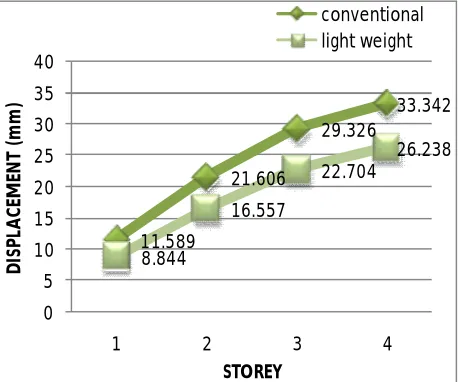
1) Storey Displacement: The storey displacement for (G+3) has been evaluated for conventional and lightweight structure. The storey displacement has been shown in Figure below. The below graph show that displacement are varies with increase in height. The displacement of conventional structure is greater than the lightweight structure.
11.589
21.606
29.326
33.342
8.844
16.557
22.704
26.238
0 5 10 15 20 25 30 35 40
1 2 3 4
D
IS
P
LA
C
EM
EN
T
(m
m
)
STOREY
[image:3.595.184.413.530.721.2]conventional light weight
1370
©IJRASET: All Rights are Reserved
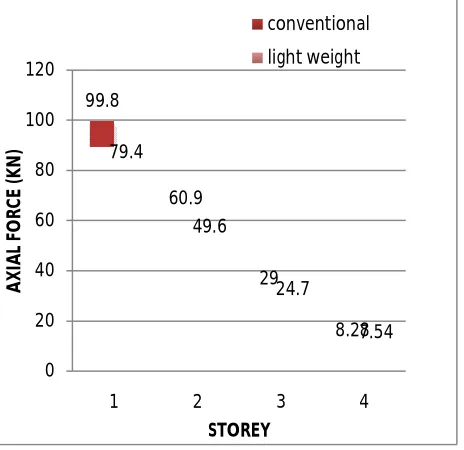
B. Comparison Of Maximum Axial ForceThe maximum axial force has been evaluated for different numbers of stories of conventional and lightweight building. The below Figure suggest that the maximum axial force in column of conventional structure is more than light weight structure.
99.8
60.9
29
8.28 79.4
49.6
24.7
7.54
0 20 40 60 80 100 120
1 2 3 4
A
X
IA
L
FO
R
C
E
(KN
)
STOREY
conventional
[image:4.595.184.416.154.379.2]light weight
Fig 1.2 Maximum axial force
C. Comparison Of Maximum Shear Force
The maximum shear force has been evaluated for different numbers of stories of conventional and lightweight building. The below Figure suggest that the maximum shear force in column of conventional structure is more than light weight structure.
31.7
20.6
17.8
6.61 24.2
15.8
14
6.5
0 5 10 15 20 25 30 35
1 2 3 4
SH
EA
R
F
O
RC
E
(K
N
)
STOREY
conventional light weight
[image:4.595.162.441.448.725.2]1371
©IJRASET: All Rights are Reserved
D. Comparison Of Maximum Bending MomentThe maximum bending moment has been evaluated for different numbers of stories of conventional and lightweight building. The below Figure suggest that the maximum bending moment in column of conventional structure is more than light weight structure.
47.5
38.3
35
16.6 36.1
29.1
27
15.1
0 5 10 15 20 25 30 35 40 45 50
1 2 3 4
B
EN
D
IN
G
M
O
M
EN
T
(KN
-M
)
STOREY
conventional
[image:5.595.184.415.155.379.2]light weight
Fig 1.4 Maximum bending moment
E. Comparison Of Total Base Shear
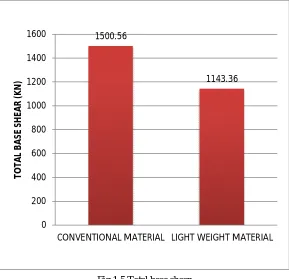
The total base shear has been evaluated for conventional and lightweight building. The below Figure suggest that the total base shear of conventional structure is more than light weight structure by 20% to 25%.
1500.56
1143.36
0 200 400 600 800 1000 1200 1400 1600
CONVENTIONAL MATERIAL LIGHT WEIGHT MATERIAL
T
O
TA
L
B
A
SE
S
H
EA
R
(
K
N
)
[image:5.595.154.443.449.728.2]1372
©IJRASET: All Rights are Reserved
VII. CONCLUSION
This comparative study presented an assessment of seismic load effect on multi storey building using conventional bricks and light weight infill blocks. By observing the overall analysis result, graphs and bar charts of conventional and light weight building structure and comparing parameters, following conclusion can be made:
A. The dead weight of lightweight building structure is found to be 30% to 40% less than conventional building structure.
B. It is observed that for lightweight building structure the base shear are reduced from 20% to 25% than the conventional building structure in response spectrum analysis.
C. The axial force in light weight structure is found to be 15% to 20% less than conventional structure in linear dynamic analysis.
D. The shear force in response spectrum analysis is also found to be less by 15% to 25% in lightweight structure than the conventional structure.
E. The maximum negative bending moment in lightweight structure is found to be reduced by 20% to 25% than conventional building structure.
According to this project the use of lightweight material in construction in seismic zone reduce the percentage of damages as well as reduce the economy of construction.
REFERENCES
[1] Agarwal P. and shrikande M, Dehli 2006 “Seismic Analysis and Design of Multi-storey RC Building ”, Earthquake resistance design of structure, PHI learning publication, (Pg. 292-326)
[2] Shah Riyaz Sameer, “Comparative Design of AAC Block and Conventional Brick by using STAAD-PRO and Manual Calculation”, Journal of innovative and engineering research in engineering volume 3, special issue1, ICSISD 2018.
[3] Shukla Radhika, “Burnt Clay Bricks Versus Autoclaved Aerated Concrete Block”, Journal of Engineering Research and Technology (IJERT) ISSN:2278-0181,Volume 3 ISSUE 11, November 2014.
[4] Zohair Mohd and Reddy Mounika R, “Analysis and Design of Multi-storey Building G+4”,Journal of advance research ideas and innovations in technology ISSN 2454-132X (Volume 4, ISSUE 1).
[5] Basavaraj M. Malagimani1, Swapnil B. Cholekar2, Hemant L. Sonawadekar3 “Comparative Study of RC Structures with Different Types of Infill Walls with