Abstract— This paper deals with door breaching using special explosive charge. Among parameters that have impact on breaching it was taken regard to propulsion velocity of the water jets. There were passed in review the existent relations of the propulsion velocity and the theoretically values obtained with these relations were compared with experimental values. When loading density of explosive is different from those the Gurney velocity was experimentally calculated, then the differences between results of propulsion velocity obtained with density dependent relations and experimentally data are up to 15%. In order to decrease these differences it was proposed a relationship for the propulsion velocity of the water jets that depends only on heat of detonation and ratio of the mass of water to the mass of explosive.
Index Terms—water propulsion, explosive energy, Gurney equations, push charges
I. INTRODUCTION
There are crisis situations whose solution involves rapid access through the walls of buildings, through windows or doors. Most often this is not possible using mechanical means, even if there are special devices for breaking doors, windows or other structures in inhomogeneous materials. Thus, it reaches variant for using, in a short time, of a special explosive charges that can help to save lives or to mitigate the risks of intervention forces.
The specific interventions where explosive charges might be used to create breaches are:
- the intervention of emergency services in a disaster situation, in order to save the people trapped in buildings with the entrance blocked or covered; - firemen intervention to get quick access to potential
victims or fire fighting;
- counter intervention to capture or annihilate the terrorists who taken an objective.
Manuscript received March 11, 2011.
M. Lupoae is with the Mechatronics Department, Military Technical Academy, No. 81-83, Avenue George Cosbuc, 050141 Bucharest, Romania, phone: +40742731069, fax: +40213355763, e-mail: [email protected].
D. Goga is with the Mechatronics Department, Military Technical Academy, No. 81-83, Avenue George Cosbuc, 050141 Bucharest, Romania, e-mail: [email protected].
.D. Constantin is with the Mechatronics Department, Military Technical Academy, No. 81-83, Avenue George Cosbuc, 050141 Bucharest, Romania, e-mail: [email protected].
C. Baciu is with the Mechatronics Department, Military Technical Academy, No. 81-83, Avenue George Cosbuc, 050141 Bucharest, Romania, e-mail: [email protected]
M. Moldovan is with the Mechatronics Department, Military Technical Academy, No. 81-83, Avenue George Cosbuc, 050141 Bucharest, Romania, e-mail: [email protected]
Such a special charge consists of a secondary explosive or buster, an initiation device and a propulsion mass, which in this case is water. In consequence of explosive detonation it results a significant amount of energy that is used to break the shell where the explosive is placed and propel the fragments, shrapnel and jets, with applications in military and civilian domain.
By analyzing the few existing data in the literature, three main types of explosive charges used to create breaches resulted:
- push charge; - cut charge; - blast charge.
Among these types of charges, the most used for door breaching is the push one because of small quantity of explosive and the reduced destructive effects.
Chosen method or technique for door breaching depends on the particular construction of the obstacle, the type of tactical situation, the time available and, not least, the level of protection to be provided for people involved or other elements placed in close proximity. Regardless of the nature, type or size of breaches, it is imperative that secondary effects of the explosive system have to be reduced. In other words, it must be safe to both the breachers and the room occupants.
For a system that operates by propelling of a water jet as a result of detonation of explosives, the following features should be considered:
- the mass, the loading density and the type of the explosive used for propulsion (by the detonation characteristics);
- the weight and type of projectile / jet propelled (by the shock characteristics);
- the ratio of the mass of water to the mass of explosive. It should provide a sufficient propulsion velocity of the water jets to only deform and open the door, without cutting or destroying it;
- a specific geometrical and dimensional configuration in order to provide the largest possible area of application of loads, but at the same time to be light enough to be manipulated and fixed quickly.
The purpose of this paper is the presentation of the research regarding the use of explosives detonation to propel water jets to create breaches in light obstacles such as metal doors. It was accentuated the propulsion velocity of the water jets as one of the most important parameters in this process.
Aspects regarding the Water Jet Propulsion
using Explosive Energy for Door Breaching
II. THEORETICAL ASPECTS
In order to calculate the propulsion velocity of water jets it is used the Gurney model. Developed by Gurney during 1940 [1] the model was devised to correlate fragment velocity from explosive / metal systems of widely varying sizes and proportions
The problem of water jets propulsion using explosive detonation is based on mass, momentum and energy balances between initial and final states of materials involved in process.
If it is assumed that the propulsion system is isolated, then the global energy balance can be written, respectively, as:
c g i
ch E E E
E = + + (1) where: Echis the chemical energy of the explosive; Eiis the internal energy; Ec is the kinetic energy of the driven
inert material and Eg is the kinetic energy of the detonation gaseous products, defined by the relation:
C dm V u V C dm u E C p p C
g ∫ ⎟⎟
⎠ ⎞ ⎜ ⎜ ⎝ ⎛ = ∫ = 0 2 2 0 2 2 1 2
1 (2)
where u is the velocity of the mass element dm, Vp is the
driven velocity of mass Mp and C is the explosive mass. All
the energies in (1) represent specific quantities (per unit mass).
Taking into account the definitions of these energies, relation (1) may be written:
(
)
⎟⎟⎠ ⎞ ⎜⎜ ⎝ ⎛ +Λ = + Λ = − µ µ 1 2 1 2 c p i
ch E V E
E (3)
where e m p m dm V u e ∫ ⎟⎟ ⎠ ⎞ ⎜ ⎜ ⎝ ⎛ = Λ 0 2
, and
µ
is the ratio of the mass of water to the mass of explosive.Equation (3) shows that the kinetic energy transferred by the explosive to the propelled mass is a functionof the chemical energy of the explosive and the ratio µ. Also this energy depends on geometrical configuration of the explosive system through the integral Λ and the residual internal energy Ei where the propulsion can be considered finished.
This model has been taken by several researchers who have provided various analytical relationships for the propulsion velocity Vp of the inert material, the loading
parameters (represented by the ratio of loading µ) and the geometric configuration of the system (symmetric, asymmetric, closed, open etc.).
If it is assumed that:
p p r V r u =
and taking into the consideration the limiting conditions, the integral Λ is:
∫ ∫ ⎟⎟ ⋅ ⋅ = + ⎠ ⎞ ⎜ ⎜ ⎝ ⎛ = ⎟ ⎟ ⎠ ⎞ ⎜ ⎜ ⎝ ⎛ =
Λ me rp −
n p n p e p n n r dr r n r r m dm V u
m0 0
1 2 2
2 (4)
where r is the current radius,
r
p is the radius of the explosive system and n is a coefficient depending on thesymmetry of the system (n = 1 plan of symmetry, n = 2 axis of symmetry, n = 3 point of symmetry).
Thus, the Gurney relationship for closed symmetrical systems can be written, [2]:
2 2 + + = n n E V p G
µ
, (5)
and for asymmetrical and open systems: 1
5 4
6 2+ +
=
µ µ
G
E
V p (6) where EG is the Gurney energy.
The Gurney’s velocity
2
E
G is calculated from data carefully conducted on cylinder tests [3] and it is used with loading density of the explosive to compute the propulsion velocity of the contact material.On principle, the relations (5) and (6) have many deficiencies of reasons on gaseous and driven masses.
In terms of gaseous mass, the uniformity assumption made that the relationships are valid for high values of µ. For low values of µ, the results of direct integration of the fundamental equations of fluid mechanics shows that values of propulsion velocity Vp are underestimated.
In terms of inert material, if the assumption of incompressible material can be done - due to its rapid return to initial pressure, the fact that it was neglected the energy which the material absorbs through the plastic deformation (in the case n = 2 or n = 3), is similar to assimilate the material with a perfect fluid. If the inert material is water, a part of explosive energy is consumed for heating and vaporizing of a quantity of water, which reduces the explosive energy transferred in the form of kinetic energy.
Finally, the assumption of instantaneous dispersion of the water layer when the radius
r
p of the explosive charge is reached, independent of µ, followed by a sudden drop in residual pressure of detonation gases, is far from reflecting reality.Relations (5) or (6) can be difficult to apply in cases where the loading density is different than the one for the Gurney velocity was computed or for the explosive mixtures for what this constant was not determined. To counter these inconveniences, various authors have developed relationships where Gurney's energy is expressed in terms of heat of detonation and loading density.
Thus, Hoskin [3] introduced the efficiency ε as the ratio of the kinetic energy of plate Mpto the chemical energy in
the explosive: d G p G p H E C M E V ∆ ⎥ ⎥ ⎦ ⎤ ⎢ ⎢ ⎣ ⎡ ⋅ ⎟ ⎟ ⎠ ⎞ ⎜ ⎜ ⎝ ⎛ = 2 2
ε (7)
where first term is the fraction of the Gurney energy which winds up in the form of kinetic energy of plate Mp, end this
term is solely a function of C
Mp . The second term is the
efficiency value. By comparison, the efficiency of propellants is typically in the range of 0.2 – 0.3. These differences between the Gurney energy and heat of detonation occur as a result of gases leakage through material fragments or lateral relaxation.
Hardesty and Kennedy [4] have included in Gurney energy relation the characteristic φ quantity, used by Kamlet and Jacobs to determine detonation pressures and velocities:
Q M
N ⋅
=
ϕ
(8) where N is the number of moles of gaseous detonation products per gram of explosive, M is the average molecular weight of the gases in gram per moles and Q is the heat of detonation in calories per gram [5].Using this characteristic φ quantity, Hardesty and Kennedy obtain the following equation for Gurney velocity:
0
44 . 1 54 . 0 6 . 0
2EG = + ⋅
ϕ
⋅ρ
, (9) whereρ
0is the loading density of explosive.Kamlet and Finger [6] obtained, following different path, another relation to compute Gurney velocity:
0
887 . 0
2EG =
ϕ
⋅ρ
. (10) More, Keshavarz and Semnani [7] expressed Gurney velocity as a function of the above mentioned parameters:5 . 0 0 0
051 . 0 61 . 37 03 . 29 427 . 4 620 . 6
220 . 0 ) / ( 2
ρ ⎟ ⎟ ⎠ ⎞ ⎜
⎜ ⎝
⎛ + + + − ⋅∆
+
+ = ⋅
FM
H d
c b a
s km E
f G
(11)
where a, b, c, d, are the stoichiometric coefficients for an explosive of general formula CaHbNcOd, ∆H0f and FM are
the molecular weight and the heat of formation of explosive. III. EXPERIMENTAL TESTS
In the first phase of the experimental tests were determined the propulsion velocities of water jets for explosive systems with axis of symmetry and different loading ratio. Propulsion velocities were determined [8] by high-speed shooting the detonation and propulsion of water jets with a high-speed camera, Xtream model and by imagine processing. In fig. 1 it can be shown images of water jets propulsion at different moments in time. By measuring the water jet length on consecutive images, fig.2c, and knowing the frame rate of the movie it was determined the propulsion velocity of water jet for different loading ratio, Table I.
Experimental tests regarding the water jets action against obstacle showed that the water jet velocity is changed at the contact with the door. In this case, the velocity is changed even if the material of the door is punched or not.
Thus, for a sandwich explosive system with a ratio of the mass of water to the mass of explosive of 300 (17 g of PETN and 5100 g of water) it was determined a propulsion velocity of water jet of only 65 m / s. The sheet metal of the door was not perforated because of a Kevlar fabrics applied on the door, fig. 2a.
When the obstacle is perforated the water jets velocities are changed. After the explosive detonation the water is propelled in all directions. For our purposes only the water propulsion on explosive charge – target direction is important. There are considered two water jets: one that penetrates the target and one that is propelled in opposite direction. In the first milliseconds the target is not perforated yet and only the water jet in opposite direction (left water jet) regarding the target is propelled. After the target is perforated the second water jet is propelled on this direction (right water jet). The velocities of these two jets are different as it can be shown in fig.3. It was used a panel of glass withthickness of 0.3 mm and an explosive system
a) explosive charge b) deformation of the metallic door
c) two consecutive frames
Fig. 2 Water jet effect on metalic door and measuring the length of jet TABLEI PROPULSION VELOCITY FOR THE WATER JET FOR DIFFERENT
WATER – EXPLOSIVE CONFIGURATIONS Explosive charge = AIX-1 (A-3) in PVC in PVC pipe
Water volume of the container = 2,0 l
Explosive mass [g] 16.5 17.0 26.3 26.5 31.3 Jet velocity [m/s] 224.0 227.0 282.0 283.0 307.0
Explosive charge = AIX-1 (A-3) in PVC pipe Water volume of the container = 1,5 l
Explosive mass [g] 16.2 16.7 17.8 29.7 31.3 Jet velocity [m/s] 255.0 259.0 268.0 346.0 347.0
Explosive charge = detonating cord P20 Water volume of the container = 1,5 l
Explosive mass [g] 7.0 14.0 21.0 28.0 3.5 Jet velocity [m/s] 168.0 238.0 291.0 336.0 375.0
Explosive charge = detonating cord P20 Water volume of the container = 0,5 l
Explosive mass [g] 4.8 9.6 14.4 19.2 24.0 Jet velocity [m/s] 241.0 340.0 402.0 480.0 534.0
t=0 s t=0.0005s t=0.001s
composed of 25 g of PETN and 500 ml water, in cylindrical configuration.
The left water jet velocity is much higher in the first phase (the obstacle prevents the relaxation of the water jet) and drops sharply when the glass is perforated (velocity is below 50 m / s). After that the values of both water jets velocities stabilize at around 70 m / s.
IV. DISCUSSIONS AND INTERPRETATIONS
The estimation of the propulsion velocity of the water jet without using Gurney's constant is important when the
loading density of the explosive is different from that it was determined the Gurney velocity.
An alternative for determining the propulsion velocity of water jet is to use the heat of detonation, Q, decreased by a coefficient that takes into account the rate of the advancement of chemical reaction, φ, which is in the range of 0.1 – 1.0. The propulsion velocity of water jet relation is:
2 2
+ +
⋅ ⋅ =
n n Q V p
µ
φ (12)
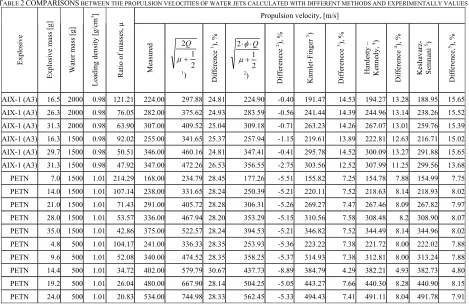
It appears that for
φ
= 0.57, the difference between the propulsion velocity of water jet calculated with (12) and that experimentally determined is less than 9% and sometimes less than 1%. If it is used only the heat of detonation, without taking into account the rate of advancement of reaction, the theoretically velocity obtained is maximum 28% higher than the experimental value, as it can be seen from Table II.It can be noted that the value considered forφ is close to the minimum of 0.6 considered by Zukas in [3] for the ratio of Gurney energy to heat of detonation. In this coefficient are considered as integrated the gas losses due to the lateral relaxation and those due to heating and water vaporization.
Applying relations (9), (10) and (11) which takes into account both heat of detonation and loading density, leads to lower values of propulsion velocity than the experimental ones, as can be seen in Table II.
For A3 (AIX-1) explosive mixture, differences between 0
50 100 150 200 250 300 350 400 450 500
10 30 50 70 90
Distance, [cm]
P
ro
pul
si
on v
el
oc
ity,
[
m
/s
]
Left water jet
[image:4.612.84.280.93.237.2]Right water jet
Fig. 3 Distribution of propulsion velocities for penetrating water jet (right water jet) and reflected jet (left water jet) for a cylindrical
configuration (0.5 l water and 25 g PETN)
TABLE 2COMPARISONS BETWEEN THE PROPULSION VELOCITIES OF WATER JETS CALCULATED WITH DIFFERENT METHODS AND EXPERIMENTALLY VALUES Propulsion velocity, [m/s]
E
xplosive
Explosi
ve m
ass [g]
W
at
er ma
ss
[
g]
L
oa
ding densit
y [g/c
m
3]
Rat
io of ma
sse
s, µ
Me
as
ur
ed
2 1 2
+
µ
Q
1)
Di
ff
er
enc
e
1), %
2 1 2
+ ⋅ ⋅
µ φ Q
2)
Di
ff
er
en
ece
2), %
Ka
m
le
t-F
inger
3)
Di
ff
er
en
ece
3), %
Ha
rd
es
ty
–
Ke
nnedy,
4)
Di
ff
er
enc
e
4), %
Kes
ha
var
z-Se
m
nani
5)
Di
ff
er
enc
e,
5), %
AIX-1 (A3) 16.5 2000 0.98 121.21 224.00 297.88 24.81 224.90 -0.40 191.47 14.53 194.27 13.28 188.95 15.65 AIX-1 (A3) 26.3 2000 0.98 76.05 282.00 375.62 24.93 283.59 -0.56 241.44 14.39 244.96 13.14 238.26 15.52 AIX-1 (A3) 31.3 2000 0.98 63.90 307.00 409.52 25.04 309.18 -0.71 263.23 14.26 267.07 13.01 259.76 15.39 AIX-1 (A3) 16.3 1500 0.98 92.02 255.00 341.65 25.37 257.94 -1.15 219.61 13.89 222.81 12.63 216.71 15.02 AIX-1 (A3) 29.7 1500 0.98 50.51 346.00 460.16 24.81 347.41 -0.41 295.78 14.52 300.09 13.27 291.88 15.65 AIX-1 (A3) 31.3 1500 0.98 47.92 347.00 472.26 26.53 356.55 -2.75 303.56 12.52 307.99 11.25 299.56 13.68 PETN 7.0 1500 1.01 214.29 168.00 234.79 28.45 177.26 -5.51 155.82 7.25 154.78 7.88 154.99 7.75 PETN 14.0 1500 1.01 107.14 238.00 331.65 28.24 250.39 -5.21 220.11 7.52 218.63 8.14 218.93 8.02 PETN 21.0 1500 1.01 71.43 291.00 405.72 28.28 306.31 -5.26 269.27 7.47 267.46 8.09 267.82 7.97 PETN 28.0 1500 1.01 53.57 336.00 467.94 28.20 353.29 -5.15 310.56 7.58 308.48 8.2 308.90 8.07 PETN 35.0 1500 1.01 42.86 375.00 522.57 28.24 394.53 -5.21 346.82 7.52 344.49 8.14 344.96 8.02 PETN 4.8 500 1.01 104.17 241.00 336.33 28.35 253.93 -5.36 223.22 7.38 221.72 8.00 222.02 7.88 PETN 9.6 500 1.01 52.08 340.00 474.52 28.35 358.25 -5.37 314.93 7.38 312.81 8.00 313.24 7.88 PETN 14.4 500 1.01 34.72 402.00 579.79 30.67 437.73 -8.89 384.79 4.29 382.21 4.93 382.73 4.80 PETN 19.2 500 1.01 26.04 480.00 667.90 28.14 504.25 -5.05 443.27 7.66 440.30 8.28 440.90 8.15 PETN 24.0 500 1.01 20.83 534.00 744.98 28.33 562.45 -5.33 494.43 7.41 491.11 8.04 491.78 7.91
1)– Q – the heat of detonation calculated al constant volume, kJ/kg; 2) -
φ
- rate of the advancement of chemical reaction,φ
= 0.57; 3) propulsionvelocity determined using Gurney energy computed with (10); 4) propulsion velocity determined using Gurney energy computed with (9); 5)
[image:4.612.71.540.395.700.2]experimental and calculated values range from 14.37% for Kamlet and Finger's relationship to 13.07% for Hardesty and Kennedy’s relationship and 15.45% for Keshavarz and Semnan’s relationship.
For PETN, differences range from 7.46% for Kamlet and Finger's relationship to 8.09% for Hardesty and Kennedy’s relationship and 7.96% for Keshavarz and Semnan’s relationship.
IIICONCLUSION
In the door breaching process using the detonation of explosives as energy source for water jets propulsion, one of the most important parameters is the propulsion velocity. Depending on the value of this velocity, the metallic shell of the door can be deformed enough so that the breach is performed or can be cut, which can lead to the metallic fragments occurrence.
The theoretical estimation of the propulsion velocity of the water jets is difficult to make for explosive mixtures that have different loading density in regard to conditions for Gurney velocity determination. It raises the need to consider the loading density term in relations of Gurney's velocity calculation. Also, in these relationships appears the term the heat of detonation.
The application of existing relationships in the literature for computing propulsion velocity of water jets using explosive energy, that take into consideration the loading density of the explosive leads to differences of up to 15% compared to the values experimentally determined and presented in this paper.
By considering the heat of detonation instead of Gurney energy in the relationship of propusion velocity, reduced by a coefficient that takes into account the rate of advancement of the chemical reaction, the differences between theoretical and experimental values for water jet velocity are about 5%.
REFERENCES
[1] R.W. Gurney, “The Initial Velocities of Fragments from Bombs, Shells and Grenades”, Report BRL 405, 1943, Army Ballistic Research Laboratories, Aberdeen Proving Ground, MD, USA [2] J. F. Danel and L. Kazandjian, “A Few Remarks about the Gurney
Energy of Condensed Explosives”, Propelants, Explosives, Pyrotechnics, pp 314-316, May 2004
[3] J. A. Zukas and W. P. Walters, ”Explosive Effects and Applications”, Springer, 1997, pp 221-255
[4] D. R. Hardesty and J.E. Kennedy, ”Thermochemical Estimation of Explosive Energy Output”, Combustion and Flame 1977, 28, 45 [5] M. J. Kamlet, S.J. Jacobs, ”A Simple Method for Calculating
Detonation Properties of CH-N-O Explosives”, Journal of Chemical. Physics. 1968, 48, 23.
[6] M. J. Kamlet, M. Finger, An Alternative Method for Calculating Gurney Velocities”, Combustion and Flame, 34, 1979.
[7] M. H. Keshavarz and A. Semnani, “The Simplest Method for Calculating Energy Output and Gurney Velocity of Explosives”, Journal of Hazardous Materials A 131, pp 1-5, 2006