INTERDEPENDENCY BETWEEN MIGRATION AND URBANIZATION
Univ. Prof. PhD. Mariana BĂLAN∗, PhD. Student Adriana STURZOIU∗∗
Abstract. During the last decades, migration is an intensively debated phenomenon both at international and national level, but most concerns, including here this period are dedicated to international migrant flows and to the root causes of their migration. The urban environment provides to high skilled but especially to low-skilled migrants higher employment opportunities.
The increase of migrants in the urban area is triggered also by population ageing, by the unequal development between the regions of a country or between states, by environmental and climate instability, etc. In most cities migration turned into a more important factor for population growth and for its age structures, than fertility and mortality. To this is added also the fact that the social networks to which migrants resort either for integration, survival, or economic opportunities, are placed within the cities. Cities are also the areas that provide higher education opportunities.
The paper proposes an analysis of the interdependencies between the trends and structure of migration flows and the urbanization degree in the main countries of destination at European and national level.
Keywords: migration, urban migration, economic and social effect, urban, metropolitan cities.
1. Introduction
During the last decades, the urbanization degree of the countries has registered increases. Thus, 54% from the world population lived in the urban area already by 2014 [1], and the forecasts of the United Nations Department of Economic and Social Affairs indicates an increase in urban population from 3.9 billion in the respective year to 6.4 billion up to the year 2050.
Among the determinant factors of urban population growth are counted globalization, migration and population ageing (in many cities
∗ SR I, Institute for Economic Forecasting – NIER, Romanian Academy, Bucharest – Romania, and “Hyperion” University – Bucharest, e-mail: [email protected].
∗∗ Institute for Economic Forecasting – NIER, Romanian Academy, Bucharest –
migration turns into a more important factor of population growth and of its age structures than fertility and mortality [2]). Immigration and its impact on the urban environment, in continuing change, are important elements of the globalization process. However, estimating the impact of migration on urban population growth is difficult because of lacking standardized institutional data regarding immigration to cities all over the world.
International or internal migration to ‘global cities’ – the ones which are advanced services’ producers, having high economies, and are international gateways and political and cultural centers of international relevance – is on continuous increase. Thus, in cities like Sydney, London and New York migrants represent one third of the population, while in Brussels or Dubai they are over 50% of the population, and in Seoul, the number of foreign residents doubled over the last ten years. The characteristic feature for Asia and Africa is the swift increase of the small- town population.
Cities meet the immediate needs of the migrants and a series of challenges on integration, as well, but they are also the areas providing for higher opportunities regarding education. The urban area provides migrants with higher employment chances, both for those with higher skills, but especially to those with low skills levels.
In large world cities is recorded the concentration of international specialized labor force within transnational corporations. The studies of Beaverstock (1994) [3], Friedmann (1986) [4] and Castells (1996) [5] have highlighted the fact that high-skilled migrants are a vital ingredient for these cities, and that the flows of skilled migrants to world cities might be regarded as having as outcome “the world city”.
On one hand, cities take advantage of the highest benefits due to brain and talent migration, and on the other, they face significant challenges triggered by migrants’ integration and services’ provision. Consequently, cities have the option of either putting to good use the skills of migrants and thus increase their competitiveness, or to increase the total costs of their social protection and unemployment system. The strong increase in urban population means also high pressure on the infrastructure, environment, and on the social structure of the city, as well.
Just as well, the social, economic, political and cultural activities in a city are playing a crucial role in fighting against anxiety and fears related to migration. Urban migration is managed soundly when it might induce economic and social dynamics that lead to increasing the capacity of migrants from the urban environment to face various shocks and pressures.
In contrary situations, migrants are faced with legal, cultural, and social barriers but also with obstacles in the way of accessing a complete range of resources, services, and opportunities that cities can provide: formal housing, labour force employment, medical assistance, education, and social support systems. Therefore, they are often forced to live under conditions of exclusion, segregation, and vulnerability.
The experience of many cities receiving migrants shows that the proper management of this phenomenon might represent an advantage for economies and societies, especially on long-term.
Migrants bring significant economic and social contributions in their countries of origin as well by remittances sent to the families left at home.
The statistics of the World Bank indicate that over 585 billion USD were transferred by migrants to their countries of origin in 2015 [6]. As result, immigrants contribute to increasing the living standards in their countries of origin, to creating links between cities and other localities of the world, and to creating new socio-economic networks.
2. Brief presentation of the migration phenomenon evolution for the last two decades
Human migration is an old phenomenon that has changed historically as structure, dimension, purpose, and needs. In the globalization era, emigration and immigration continue to provide several opportunities for states, societies, and migrants.
In the year 2015, at world level, were registered 244 million migrants [7], representing 3.3% of the world population on increase by 0.5 pp against the year 2000. The largest part of migrants (about 85%) headed to developed regions: 76 million persons to Europe, 75 million persons to Asia, 54 million migrants to North America. According to the statistics of the United Nations [7], in the 1990-2015 period, the number of migrants at world level increased by over 91 million persons.
Leaving aside external migration, at world level, a considerable volume was recorded regarding internal migration, international statistics estimating that in the year 2015, 740 million persons have left the locality/region in which they were born.
The migration phenomenon evolved determined largely by the digital revolution, by progresses in the field of transportation, information, and communication technology during the last decades, and by the decreasing transportation costs. Otherwise said, it developed due the globalization phenomenon that, according to Held et al. (1999) [8], might be defined as
the “expansion, deepening and speed-up of world level interlinks in all aspects of contemporary social and economic life”. Thus, technological changes of the last decades have led to a free flow of information, communication improvements at world level that are swifter and with less transportation costs. However, these factors are favoring factors of the migration phenomenon, and not its direct causes. They allowed to migrants to remain in contact with family and friends, to send money to families remaining in the countries of origin, and to move more easily between destination and origin countries.
In origin and destination countries alike, there are factors supporting (favorable), hindering (negative) or neutral regarding migration. Both push and pull factors might act simultaneously both in the country of origin and in the country of destination.
The factors that are the grounds for migration are multiple, complex and are owed largely to the economic prosperity, inequality, demographics, violence and conflicts, and to environmental changes etc.
Largely, in the category of economic factors are included those regarding the general state of the economy, the labor force market (state of labour force employment, high unemployment, etc.), the poverty level, etc.
The perspective of high wages, better employment opportunities, and professional achievement might attract migrants to destination with developed economies. In this context, as push factors might be regarded unemployment and job opportunities/lack thereof, poverty (especially in the rural area), the lack of sustainable living means, and as pull factors the employment opportunities, higher incomes and better perspectives of professional achievement, technical know-how for a new industry, the opportunity of pursuing courses of specialized education.
If for the vast majority of individuals migrating at international level the main reasons are related to work and studies, for others the reasons are of socio-political nature: conflicts; ethnic, religious, racial, and cultural persecution; war or threatening conflicts. Hence, political instability, the concerns related to safety and security (ethnic, religious, racial or cultural persecution), conflicts or threats of conflict, slavery; bonded labor, unfit or limited services and urban infrastructure (including health care, education, utilities, transportation, and water) are some of the pull factors, as well.
Among the socio-political pull factors might be reminded: family reunion; freedom and independence; food safety; accessible urban services for reasonable prices (including medical assistance, education, utilities, and transportation).
Climate changes and the availability of natural resources, the so- called environmental factors are those determining individuals to migrate searching for better ecologic conditions. The push factors are in this context: extreme meteorological phenomena because of climate change;
the diminishment of agricultural cultures and food deficit, and as pull factors the favorable climate to living conditions, abundant natural and mineral resources.
Regarding age, international migrants tend to be young or of working-age. Almost 75% out of the international migrants have ages between 20 and 64 years, 15% are under the age of 20, and almost 30 million persons are aged 65 years or over. In general, among those planning or preparing to migrate there are young, single individuals living in urban areas and who, quite possibly, have graduated at least secondary education.
In 2015, the second largest regional migration corridor of the world (after Latin America and Caribbean up to North America) was the European one (intra-European interregional migration).
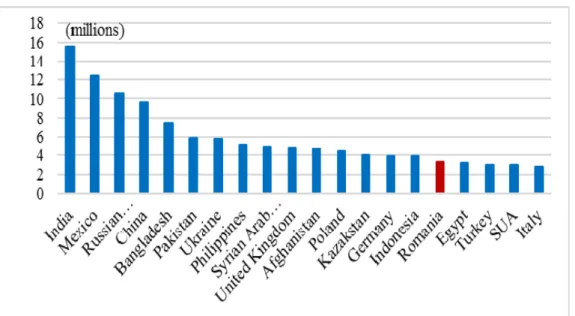
The highest sources of migrants are countries from Asia, along with Mexico and a series of European countries. From the Eastern-European countries, Ukraine, Poland, and Romania, together with the Russian Federation have the highest emigrating populations of the region (Figure 1).
Figure 1. The 20 countries of origin of the international migrants in 2015 (millions).
Source: World Migration Report 2018, International Organization for Migration, The UN migration Agency.
The characteristic feature for Europe is that intraregional migration shows particular dynamics. Thus, as of 1 January 2016, 16 million individuals with the citizenship of another member-state [9] lived in one of the European Union member-states as this is facilitated by the free movement agreements allowing to citizens crossing internal borders without being subjected to border controls. Romania with its about 3 million individuals living abroad in other European Union countries and in the European Free Trade Association (EFTA) had the highest number of migrants abroad in 2016, followed by Italy, Portugal, and the United Kingdom. However, free movement in Europe is faced with a series of challenges: i) temporary resuming of border controls as of the second half of 2015 in some of the Schengen member-states; ii) the outcomes of the future meetings on the topic of migration generated by the ‘Brexit’
negotiations.
Migrant workers in the structure of migration flows take a particular position. One statistic about the evolution and dimension of the migrant workers’ flows is difficult to develop, as the data regarding this phenomenon are not available, but also because of the differences in defining the process, of changes in the methodology and in the data sources. Therefore, global estimates of migrant workers available before 2013 (36-42 million in 1995, 86.2 million in 2000, and 105.5 million in 2010) cannot be compared with the values of 2013.
Estimates for the global stock of migrant workers in the year 2013 (the last available ones) indicate that they represent about two-thirds from the global stock of international migrants (150.3 million migrant workers out of the 232 million migrants), but the International Labor Organization considers that these global figures could be underestimated [10].
Regarding the destination towards the migrant workers were headed in 2013, existing statistics indicate that 75% of them went to high-income countries, and 23% to average-income countries (Figure 2).
Regarding the structure of migrant flows for labor, for the same year, the number of men migrant workers exceeded women migrant workers by almost 17 million (83.7 million of men and 66.6 million women) and this under the conditions in which men represented a higher number of working age international migrants (52%) (Figure 2).
Figure 2. Migrant workers, by sex and income level of destination countries, 2013.
Source: World Migration Report 2018, International Organization for Migration, The UN migration Agency.
With respect to the distribution of migrant workers at world level on sectors of the economy in the year 2013, 106.8 million individuals (from the total of 150.3 million migrant workers) were employed in services; 26.7 million in industry (manufacturing and constructions) and 16.7 million in agriculture (Figure 3).
Figure 3. Global distribution of migrant workers, by broad branch of economic activity and by sex, 2013.
Source: ILO global estimates on migrant workers. Results and methodology. Special focus on migrant domestic workers. International Labor Organization 2015.
The differences men-women are noticeable regarding the distribution of migrant workers on sectors of activity (Figure 3). It can be observed that
in agriculture the weight of employed men (11.2%) is about the same with the one of women (11.1%); in industry are employed more men than women (19.8% against 15.3%), and in the services’ sector the weight of employed women is higher than the one of men (73.7% against 69.1%).
¾ Internal migration
Internal migration is a phenomenon with a much higher breadth than the international one with economic and social implications for many individuals but to which much less attention is paid. Internal migrants are faced with many of the challenges and needs of those deciding to leave abroad. Information about internal migration, in general, are limited or outdated and this due to conceptual differences of the ‘internal migrant’. In this context, the data in comparative internal migration analyses must be examined with caution. Largely, internal migration is considered any movement inside a country (save for the European Union [11]).
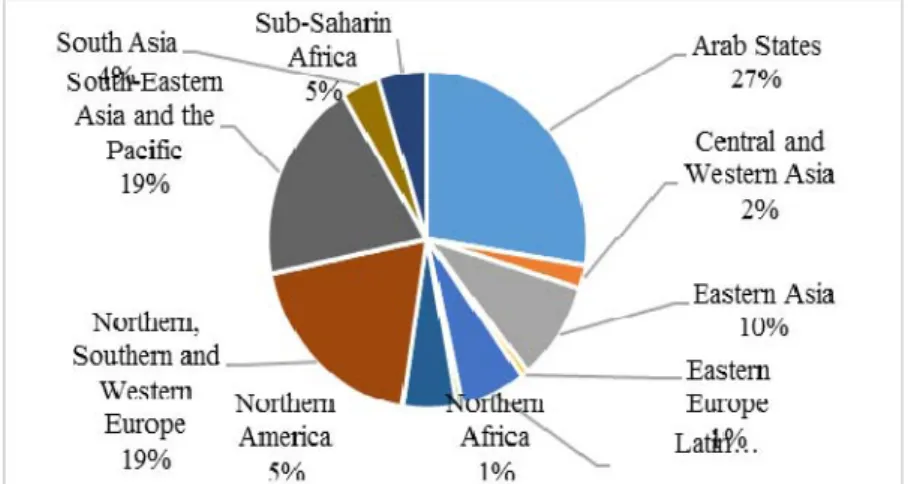
Regarding internal migration of workers, it has a weight between 17% and 20% for migrant workers in four regions of the world: East Asia, South-East Asia and Pacific, the Arab countries and Latin America, and the Caribbean (Figure 4). In North America, Sub-Saharan Africa, South- Asia and the North, South and West of Europe the weight of these workers ranges from 5% to 10%.
Figure 4. Distribution of migrant domestic workers, by broad sub-region, 2013.
Source: ILO global estimates on migrant workers. Results and methodology. Special focus on migrant domestic workers. International Labor Organization 2015.
A characteristic of this type of migration is that the highest weight of internal migrant workers is held by women, save for South-Asia where the ratio is reversed.
3. The interdependence migration – city expansion
During the last years, an increasingly higher number of events occurred within the international community that included on their agenda activities related to the interdependence between migration and dimension/issues of the cities. Thus, the International Organization for Migration organized a conference on this topic in 2015 and called on mayors and other officials to find solutions to the issues involving the increasing number of migrants in some cities of the world.
At the Third Global Forum of Mayors that took place in Quezon, Philippines, in September 2016, issues were debated related to the way in which local authorities might benefit from and provide support for migrants. At the same time, on the fifth World Summit of Local and Regional Leaders (October 2016 in Bogota, Columbia) were introduced on the agenda of the event for the first time the issues related to migration and by the adopted Declaration (the Bogota Commitment and Action Agenda) were demanded local actions in view of achieving sustainable urbanization [12]. The Habitat III Conference [13] (October 2016 in Quito, Ecuador), in its New Urban Agenda, granted a high importance degree to migration, by stipulating that in all cities of the world migrants should benefit of same rights, irrespective of their legal status, and be able to lead decent, dignified, and full of satisfaction lives for attaining their full human potential.
In the two agreements of the New York Declaration for Refugees and Migrants [14] adopted by the United Nations (2017) was included also the recognition of efficacy and accountability of the cities regarding migration and integration.
An ample analysis of the global situation of migration and of the challenges that this phenomenon generates was realized in the Report of the Special Representative of the General Secretary on migration1, Peter Sutherland (2017). Among the recommendations contained in this report regarding the ways of managing this challenge, stands out Recommendation 14 in which references are made to new elements for empowering cities and local administrations that would allow for solving issues generated by urban migration.
The urban environment meets the immediate needs of the migrants.
Cities provide for several opportunities of employment (both for those with
1 Report presented to the General Assembly of the United Nations in February 2017.
The Report highlights five fields: migration related to crisis; labor force migration; orderly,
high-skills but, especially, for those with low qualification skills) and better incomes, for education and a wider customer base for migrant entrepreneurs to trade their products and services. Cities are where social networks develop which then are used by migrants either for integration, survival, or economic opportunities.
The effects of migration on the labor force markets depend both on the skills of migrants and of existing workers, but also on the characteristics of cities’ economies.
At the same time, in many cities migration became a more important factor of population increase and of the population’s age structures than fertility and mortality [15].
Migrants, due to their ambition and enthusiasm for improving their living means bring significant and essential contributions in the economic and social field, and to the cultural development in the new communities they arrive to, as well. Thus, in the year 2015, 9.4% of the gross domestic product represented the contribution of the migrants [16].
In the urban environment, usually, migrants find other members of the family or of their ethnic or cultural group. The studies performed by various international bodies highlight a marked trend of the new migrants to live for a time in the already existing enclaves in the cities in which they arrive. These provide for community and social support, higher availability of ethnic products and food, worship centers and other community institutions.
Migrants, because of their way of life, music, ideas, and innovations might play on one hand an important role for social cohesion, culture and traditions and, to a certain extent, for the safety and security of the inhabitants.
The strong increase of the urban population represents, nevertheless, a high pressure regarding infrastructure, environment, but also on the social structure of the city.
Whenever urban migration is well managed, it might induce economic and social dynamics leading to increasing the capacity of migrants from the urban environment to meet shocks and pressures. To the contrary, migrants are faced with legal, cultural, and social barriers, but also with obstacles in the way of accessing a complete range of resources, services, and opportunities that cities can provide: formal housing, labor force employment, health care, education and social support systems.
Consequently, they are often forced to live in conditions of exclusion, segregation, and vulnerability.
As result, it might be said that cities represent determinant factors of the structure and size of migration flows, as they are “the highest reward of the migrant’s human capital” [17].
For large cities of the world, the challenges increase together with the expansion of their slums and, last but not least, of the peri-urban settlements (especially in South Asia, Africa and Latin America).
The difficulties in estimating the impact of migration on urban population increase consist in the lack of institutional standardized data regarding immigration in cities all over the world. These are points of destination for an increasingly higher number of migrants either international, or internal ones. Thus, in cities like Sydney, London, and New York, migrants represent over one-third of the population, and in Brussels and Dubai they are over 50% of the population, and in Seoul the number of foreign residents doubled during the last ten years. At the same time, in Asia and Africa is recorded a swift increase of the small-town population.
In Europe, the most affected cities by the migration phenomenon are Berlin, Athens, Paris, Amsterdam, and Rotterdam.
In Romania, during the current period, the urban system is undergoing a restructuring process, the urban phenomenon gaining new dimensions and characteristics. The industrial town – as representative type of urban settlement – was replaced gradually by the poly-functional city and services; these changes correspond to the major economic and social- political development objectives of the country at the beginning of the third millennium, and are compatible with the exigencies of integrating into the European urban system.
Romania’s urban network consisted from 320 towns in 2016, so that related to the surface of the country is obvious an excessively high polarization surface of a town, in relation to other countries of Western and Central Europe.
At the level of the year 2016, the urban population was of 10584266 inhabitants, which represents an urbanization degree of 53.7% of the total resident population. If, in the period 2008-2015, the average balance of residence changes in the urban area was of 33766 persons (Figure 5), while in 2016 this number decreased to 8303 persons (as result, also, of external final or temporary migration of a high number of persons).
Figure 5. Balance of residence changes in the urban area (persons).
Data source: TEMPO-online databank of the National Institute of Statistics, www.insse.ro.
Only one very large city (Bucharest) is able to develop a metropolitan area in agreement with international and national legislation in the field.
The remaining 17 large towns (Iasi, Constanta, Oradea, Cluj-Napoca, Timisoara, Brasov, Craiova, Galati, Braila, Baia Mare, Suceava, Targu Mures, Sibiu, Bacau, Pitesti, Ploiesti, Satu Mare), and 4 average towns (Simeria, Hunedoara, Deva and Ramnicu Valcea) have initiated projects in view of developing metropolitan areas.
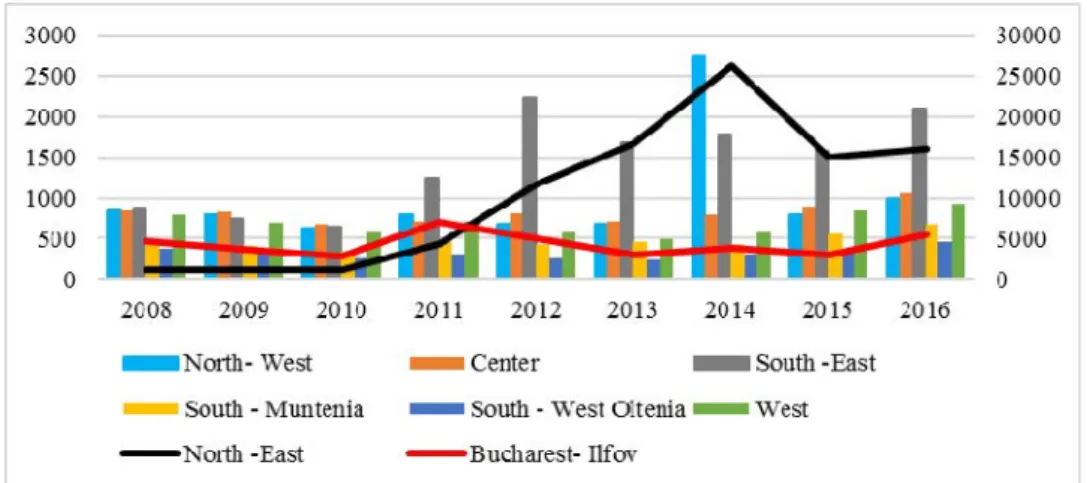
The phenomenon of immigration is still rather modest in Romania (Figure 6), as only 27863 were recorded with the statutes of definitive immigrants in 2016.
Figure 6. Evolution of the number of definitive immigrants on regions of development in Romania (persons).
The current issues faced by the urban system are related to a more marked hypertrophy of the capital, the consolidation of the basis of the urban system hierarchy, and the conditions under which the competition between cities takes place.
4. Conclusions
Over the last years, the migration phenomenon became a topic of economic debate and analysis. At world level, migration is on increase and the vast majority of migrants are headed towards urban areas of the countries of destination.
The urban environment provides to international or national migrants higher employment chances, socialization networks to which they can resort for integrating into the new community, higher economic and social opportunities. In cities, international migrants interact with the existing communities and society and thus, indirectly, with the host country.
The effects of migration on cities may be of economic, social, and psychological nature, migration affecting both migrants and natives. From the viewpoint of challenges and opportunities generated by migration flows, but also from the perspective of city leaders, the integration of migrants in urban planning is fundamental for developing urban areas in the entire world.
The main reason why people migrate at international level is labor, and migrant workers represent the majority of international and national migrants at world level. Over the last years, intensified migration for labor of the human capital was registered, along with the migration of youths with outstanding performances and higher skills, brain drain remaining an area of interest for transnational companies or for international scientific research. The analysis of the labor migration flows’ structure highlighted that the number of men exceeds the one of women.
In many areas of the world, internal migration is a phenomenon with much higher amplitude than international migration, with economic and social implications for very many individuals.
The expansion of cities and migration represent two of the most dynamic, interdependent contemporary world processes, but each has its specific dynamics.
Urbanization might be considered as a strong potential facilitator of international or internal migration: the urban area provides higher employment chances for migrants, irrespective of their skills’ level, better education opportunities etc. However, the considerable increase of the
urban population represents a high pressure regarding infrastructure, environment, but also on the social structure of the city.
Romania ranks among the first 20 countries of the world regarding external migration, with a high weight of migrants for labor and of high- skilled youths.
The analysis of statistical data regarding the evolution of large towns from Romania and of the number of immigrants, or of internal migrants to the urban area highlights that interdependence cannot be established between cities’ expansion and migration.
In Romania, the ascending evolution of the urban population was realized based on the natural population growth, the inflow of rural population in the towns, and the transition of some villages to the town status and the inclusion of some villages within the administrative limits of some towns.
REFERENCES
[1] World Urbanization Prospects, the 2014 Revision: Highlights. United Nations Department of Economic and Social Affairs (UN DESA), http://esa.un.org.
[2] Skeldon R. (2013), Global Migration: Demographic Aspects and Its Relevance for Development. UN DESA Technical paper 2013/6. www.un.org/esa.
[3] Beaverstock J. (1994), Re-thinking skilled international labour migration: World cities and banking organisations, in Geoforum, Volume 25, Issue 3, August 1994, pp. 323-338, Elsevier, www.sciencedirect.com.
[4] Friedmann J. (1986), The World City Hypothesis, in Development and Change – International Institute of Social Sciences, Volume 17, Isuue 1, pp. 69-83, onlinelibrary.wiley.com.
[5] Castells M. (1996), The Rise of the Network Society, Oxford: Blackwells, http://www.citi.columbia.edu.
[6] Migration and Remittances Data – World Bank, www.worldbank.org.
[7] United Nations, Trends in International Migrant Stock: the 2015 Revision (United Nations database, POP/DB/MIG/Stock/Rev.2015). Available from www.un migration. org.
[8] Held D., McGrew A., Goldblatt D. and Perraton J. (1999), Global Transformations: Politics, Economics and Culture. Stanford. Universitu Press, https://www.geog. mcgill.ca.
[9] Migrant integration, 2017 edition, Statistical Book, Eurostat, http://ec.europa.eu.
[10] ILO global estimates on migrant workers. Results and methodology, International Labour Organization 2015, http://www.ilo.org.
[11] Rights Of Migrant Domestic Workers In Europe, United Nations Human Rights.
Europe Regional Office, (2010). http://www.europe.ohchr.org.
[12] The Bogota Commitment and Action Agenda, 5th UCLG Congress World Summit of Local and Regional Leaders, https://www.uclg.org.
[13] The New Urban Agenda was adopted at the United Nations Conference on Housing and Sustainable Urban Development (Habitat III) in Quito, Ecuador, on
[14] The New York Declaration for Refugees and Migrants and the Global Compact for Safe, Orderly and Regular Migration, 2017, https://www.iom.int.
[15] Skeldon R. (2013), Global Migration: Demographic Aspects and Its Relevance for Development. UN DESA Technical paper 2013/6. www.un.org/esa.
[16] People on the Move: Global Migration’s Impact and Opportunity (2016), McKinsey Global Institute, www.mckinsey.com.
[17] Price M. and Benton-Short L. (2007), Immigrants and world cities: from the hyper- diverse to the bypassed, GeoJournal (2007) 68:103-117, www.wqxr.org.