Servitization, digitization and supply chain interdependency
Ferran Vendrell-Herrero
a,⁎
, Oscar F. Bustinza
b, Glenn Parry
c, Nikos Georgantzis
d,e aBirmingham Business School, University of Birmingham, United Kingdom b
Department of Management, University of Granada, Granada, Spain c
Department of Strategy, University of the West of England, United Kingdom dUniversity of Reading, United Kingdom
eLEE & Economics Dept., Universitat Jaume I-Castellon, Spain
a b s t r a c t
a r t i c l e i n f o
Article history: Received 27 January 2015
Received in revised form 21 May 2016 Accepted 17 June 2016
Available online xxxx
This study draws on literature at the intersection of servitization, digital business models and supply chain man-agement. Work empirically explores how digital disruption has affected Business-to-Business (B2B) interdepen-dencies. Dematerialization of physical products is transforming the wayfirms are positioned in the supply chain due to a reduction in production and transport costs and the different ways business engage with customers. Spe-cifically, we propose that these new market conditions can empower downstreamfirms. We further propose that upstreamfirms can still capture additional value through digital service if their servitized offer includes difficult to imitate elements. The context of the analysis is the publishing industry. The Payment Card method employed is used to test UK and US consumer's perceptions of digital formats (eBooks) and assess their willingness to pay in relation to printed formats. The method undertaken enables us to elicit aggregated consumer demand for eBooks which in turn identifies optimal pricing strategies for the digital services. Analysis demonstrates that during dig-ital servitization upstreamfirms should seek to deploy unique resources to ensure their strategic position in the supply chain is not diminished.
© 2016 The Author(s). Published by Elsevier Inc. This is an open access article under the CC BY-NC-ND license (http://creativecommons.org/licenses/by-nc-nd/4.0/). Keywords:
Servitization Digitization Interdependences Publishing industry Payment card
1. Introduction
Product firms are gradually adopting service business models (Cusumano, Kahl, & Suarez, 2015). Approximately two thirds of product
firms in developed countries have already adopted a servitization strat-egy (Neely, 2008). In addition, on average service revenue of product
firms accounts for 30% of their total revenue (Fang, Palmatier, &
Steenkamp, 2008). Through servitization,firms are able to differentiate
their offering and enhance customer engagement (Vandermerwe & Rada, 1988). Nevertheless, recent studies have shown that capturing value through servitization is complex infirms selling manufactured (Benedetti, Neely, & Swink, 2015; Kohtamäki, Partanen, Parida, & Wincent, 2013) and digitalized products (Suarez, Cusumano, & Kahl, 2013). This article seeks to unpack some of the complexities of servitization by examining the role of digital technologies andfirm interdependencies, two underexplored elements in servitization literature.
Through digital technologies productfirms are able to adopt, design and deliver new smart and connected products that change the way they compete (Porter & Heppelmann, 2014), and provide services
(Porter & Heppelmann, 2015). The dematerialisation of physical prod-ucts is merging the trends in digitization and servitization of the offer in productfirms (Lerch & Gotsch, 2015). An incipient but growing liter-ature is analysing the role of digital technologies in servitized product
firms under the heading digital servitization (Vendrell-Herrero & Wilson, 2016), which is formally described as the provision of digital services embedded in a physical product (Holmström & Partanen, 2014). This stream of literature examines how digital technologies are both a driver and enabler of servitization. In terms of establishing mech-anisms of value capture, digital servitization introduces two important obstacles. First, digital services often substitute (or cannibalize) tradi-tional products (Greenstein, 2010), which is challenging in terms of business model implementation (Cusumano et al., 2015). Second, once digital services are created the marginal cost of producing new units is practically zero, which reduces the customers' perception of the value created by the offering (Rifkin, 2014). An important contribu-tion of this study is an analysis of how productfirms can overcome these obstacles.
Digital disruption in combination with electronic commerce has af-fectedfirm interdependencies and power relationships in a number of different sectors. In the music, taxi and hotel sectors new digital services such as Spotify, Uber and AirBnB have entered the market as down-stream retailers and have established competitive offerings by Industrial Marketing Management xxx (2016) xxx–xxx
⁎ Corresponding author.
E-mail address:[email protected](F. Vendrell-Herrero).
http://dx.doi.org/10.1016/j.indmarman.2016.06.013
0019-8501/© 2016 The Author(s). Published by Elsevier Inc. This is an open access article under the CC BY-NC-ND license (http://creativecommons.org/licenses/by-nc-nd/4.0/). Contents lists available atScienceDirect
controlling consumer interaction and making upstream resource owners dependent suppliers. There are examples of upstreamfirms having main-tained a dominant position in the supply chain. For example in the travel industry Airlines have been able to create reliable digital service platforms for retail and retain control over production, service provision and infra-structure operation despite many new digital intermediaries entering the market (Preiss & Murray, 2005). The present article examines how the appearance and growth of digital retailers impacts on the power re-lationships in the entire supply chain (Cox, 1999). Literature analysing the role of electronic retailers in supply chains has implicitly or explicitly explored the unidirectional dependence of upstream or downstream parties. Analysis of the music industry shows that music producers have increased their dependence on digital retailers (Bustinza, Parry, &
Vendrell-Herrero, 2013).Ritala, Golnam, & Wegmann (2014)analyse
digital servitization in book sales andfind that Amazon uses its scale to dominate the relationship with its suppliers and competitors. These pa-pers examine a particular context from only one pa-perspective and to the best of our knowledge, literature is silent on the analysis of bidirectional, upstream–downstream interdependencies in those contexts. Conse-quently, a second important contribution of the present research is the analysis of the dynamics of upstream–downstream interdependencies in sectors where digital servitization has occurred.
The book publishing industry is a suitable context for study for a number of reasons. First, product firms in this industry have experimented with digital servitization through the development of digital products, eBooks, and the launch of specific hardware, eReaders (Anand, Olson, & Tripsas, 2009; Gilbert, 2015). Second, the industry has received widespread coverage in the popular press due to disagreements over product pricing between upstream organizations (publishers) and downstream electronic retailers (Baye, De los Santos, & Wildenbeest, 2013). Third, we argue that there is a difference in the market prices sought between a productfirm and an electronic retailer as they control, and therefore seek to monetize, different resources. All these factors are features of the publishing industry and underpin the research design based on the comparison between publishers' desired prices and actual market prices of digital services. Therefore, a third important contribu-tion of this study is the method implemented that robustly estimates a productfirms' preferred prices. Previous studies analysing the pricing disagreement between productfirms and electronic retailers in the pub-lishing industry have used parametric (De los Santos & Wildenbeest, 2015; Reimers & Waldfogel, 2014) or game-theoretic approaches (Gaudin & White, 2014; Li, Lin, Xu, & Swain, 2015). The empirical analy-sis in this paper exploits survey data for 8000 consumers residing in the UK and USA and elicits the consumers' willingness to pay specific prices using the payment card method (Camacho-Cuenca, García-Gallego, Georgantzís, & Sabater-Grande, 2004; Ryan & Watson, 2009). This exer-cise informsfirms' decision-making and can be used to estimate the price that maximises publishers' profit.
The paper proceeds as follows. The next section develops the theo-retical underpinning, positioning the paper as a study that examines how digital servitization affects the vertical interdependencies in supply chains. Insights allow the development of two testable theoretical prop-ositions.Section 3builds upon the particular case of the publishing in-dustry and presents arguments as to why this is a suitable context to test theoretical propositions.Section 4explains the data gathering pro-cess, describes methodology, and shows results.Section 5presents a discussion of the results in relation to the current debates in the publish-ing industry.Section 6closes the work with relevant theoretical and managerial implications and future research.
2. Theoretical underpinning
2.1. Structure of power in upstream–downstream relationships
Supply chain management (SCM) encompasses the efforts involved in delivering and producing products and services in the value chain
(Sherer, 2005). SCM links the processes across supplier–user companies and functions that enable the value chain to make products and provide services to the customer (Cox, Blackstone, & Spencer, 1995). The para-digm moves beyond the individual organization to a broader perspec-tive examining the value-creating network formed by the keyfirms (Kothandaraman & Wilson, 2001). Firms work together in supply chains, but seek to maximize their individual power to capture greater value for themselves (Peppard & Rylander, 2006). The linkages between the systems of interdependent activities that compose a product's sup-ply chain create the structures of power and therefore the resolution of the trade-offs created within these linkages provides a source offirm competitive advantage (Porter, 1985).
The research presented here builds upon theory of organizational power within the supply chain and followsCox (1999), who describes power as an unbalanced relationship in which either upstream or downstream parties in the supply chain have the capacity to appropri-ate most of the value creappropri-ated within exchanges. Power can be examined from a single perspective, studying the dependence of the focal or part-ner company, where dependence is the unidirectional reliance of a party on its counterpart (Scheer, Miao, & Palmatier, 2014). Dependence plays a critical role in industrial marketing relationships and impacts on strategic behaviour and economic outcomes with widely divergent results (Lusch & Brown, 1996). An alternative and more integrative ap-proach looks at power from a bidirectional perspective (Kumar, Scheer, & Steenkamp, 1995), studying the magnitude of interdependence be-tween parties (e.g. level of dependency of the focal and partner parties) and the dyadic structure of power in terms of interdependencies (e.g. asymmetric or symmetric interdependencies). In a meta-analysis of the literature on interdependencies,Scheer et al. (2014)conclude that the impact of Business-to-Business (B2B) interdependencies differs from those of Business-to-Consumer (B2C) and product-based ex-change relationships differ from service-based relationships.
Asymmetries of power in the supply chain can result from afirm having market dominance in terms of size and market share. In addition other strategic factors influence power imbalances between upstream and downstream companies. For instance, Palmer, Simmons,
Robinson, and Fearne (2015)describe how downstream suppliers can
produce power imbalances through institutionalizing industrial work-shops, a venue based mechanism where the dominant partner enhances their standing in B2B exchanges by enacting presentations, discussions and award ceremonies. The approach ensures that institutional logics of a dominant buyer are persistent in the face of any potential supplier disruption and supplier dependence is increased through the genera-tion of collective identities and the enhancement of supplier docility. Another way of exercising power is to increase switching costs through the enforcement of specific technology adoption.Hart and Saunders
(1997)provide an example of the implementation offirm specific
Elec-tronic Data Interchange (EDI) technology. Non-dominantfirms had to change to the powerfulfirms chosen technology if they wish to do busi-ness with them, locking them into the relationship by increasing their switching cost and making them technologically dependent.
The fact that an organization has power over another does not imply that power is exercised. The existence of power is not necessarily incompatible with trust and cooperation between upstream and down-stream parties (Kumar, 2005).He, Ghobadian, and Gallear (2013)found that in long-term relationships the dominant company holding the bal-ance of power could enhbal-ance knowledge acquisition processes and im-prove the performance of the supply chain by restraining from the use of their power.
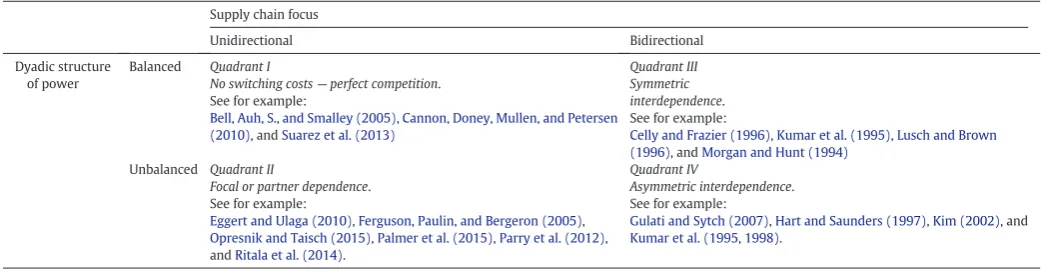
The reviewed literature on power in supply chains is illustrated in
Table 1in a representation of power structure and perspective. On the
Four quadrants of power are created. Quadrant I reflects competitive markets in which numerous buyers and suppliers operate. In those mar-kets there are no vertical dependencies because there are either no switching costs or they are very low. Quadrants II and IV represent those markets in which upstream or downstream organizations can exert some power over the other parties in the supply chain. The differ-ence between those quadrants resides in the unit of analysis. Whilst studies in Quadrant II analyse the power imbalances from one perspec-tive, either the dependent party or the one exercising the power, Quad-rant IV analyses imbalances from two perspectives, such that both parties may be dependent on each other, but this dependency is asym-metric. Studies in Quadrant IV examine actions and reactions and take a broader perspective than Quadrant II, creating greater understanding of the dynamics of power in supply chains. Finally, studies in Quadrant III similarly to Quadrant IV analyse supply chains in which buyer and seller are dependent on each other, but in the case of Quadrant III the parties are equally dependent.
2.2. Digital servitization disruption
Servitization refers to the process wherefirms set out to create greater value by increasing the services they offer (Vandermerwe & Rada, 1988). The focus of academic literature has been on product
firms from different industry sectors that have developed services to add value, revenue and profit, to their particular business operations (Baines & Lightfoot, 2013; Cusumano et al., 2015; Neely, 2008). At a theoretical level the addition of services in productfirms seems to be an important element in enhancing the value of a products' technical performance and securing a competitive position in a supply chain (Matthyssens & Vandenbempt, 2008; Vandermerwe & Rada, 1988). In addition, the process of servitization develops thefirm's innovative ca-pabilities, creating value at the consumer level by offering a balance of products and services (Visnjic & Van Looy, 2013). Nevertheless, recent empirical studies indicate that the addition of services is not a guarantee of increasedfirm performance (Benedetti et al., 2015; Kohtamäki et al., 2013; Kowalkowski, Windahl, Kindström, & Gebauer, 2015; Suarez et al., 2013). There are different factors such as product lifecycle and the threat of entry of new competitors that influence the capacity to capture value from service implementation (Cusumano et al., 2015). The addi-tion of services in productfirms often requires a period of organizational transformation and if thefirm is under stable market conditions the process of value capture can remain invariant (Lepak, Smith, & Taylor, 2007).
The process of value capture can change when disruptive shocks arise (Christensen, 1997) and digital technology disrupts the way prod-uctfirms compete and offer services (Lerch & Gotsch, 2015; Porter & Heppelmann, 2014, 2015; Vendrell-Herrero & Wilson, 2016). Digital technologies are changing employment relations and increasingfirm productivity, but may also bring higher unemployment (Brynjolfsson
& McAfee, 2011). Business models reflect consumer's requirement,
how value is delivered, consumer lock-in, processes of value capture and profit generation (Teece, 2010). Chesbrough and Rosenbloom
(2002)state that the implementation of new business models unlocks
latent value from existing technology, linking technical potential and re-alization of economic value. The digital transformation of business models is re-shaping consumer preferences and consumption as indus-tries are introducing digital technologies to enhance their competitive-ness in order to change customer relationships (Dellarocas, 2003), internal processes (BarNir, Gallaugher, & Auger, 2003) and value prop-ositions (Lusch, Vargo, & Tanniru, 2010).‘Digitization’is becoming “the new norm”(Hinssen, 2010).
Are digitization and servitization the same or at least similar con-structs? Whilst it is possible to move towards service without digitizing the offer, and it is possible to digitize an offer without offering it as a ser-vice, the interaction between digitization and servitization is considered very strong (Gago & Rubalcaba, 2007; Lerch & Gotsch, 2015).Kindström
and Kowalkowski (2014)find that digitization facilitates the
develop-ment of cost-efficient operations and is an enabler of service quality through better resource allocation and more accurate information sharing inside and outside the boundaries of thefirm. The provision of digital services has become a sub-stream of service business model cre-ation or servitizcre-ation (Baird & Raghu, 2015) and has enhanced the func-tioning of servitized supply chains (Holmström & Partanen, 2014). This sub-stream of research, described recently as‘Digital Servitization’ (Vendrell-Herrero & Wilson, 2016), is defined as the provision of IT-enabled (i.e. digital) services relying on digital components embedded in physical products (Holmström & Partanen, 2014; Schroeder & Kotlarsky, 2015).
Thefield of digital servitization is differentiated from mainstream servitization in three aspects. First, the marginal cost of digital services is near zero (Rifkin, 2014). Second, whilst services are usually comple-mentary to a product offering (Cusumano et al., 2015), digital services are often substitutes for traditional products (Greenstein, 2010). Finally, digital technologies, as with other disruptive technology, open new business opportunities that can be executed by new entrants (Christensen, 1997), especially hardware and software developers or retailers.
An incipient body of empirical research has explored digital servitization in specific contexts which include manufacturing (Opresnik & Taisch, 2015), software companies (Suarez et al., 2013), and the recorded music industry (Parry, Bustinza, & Vendrell-Herrero, 2012). These empirical papers can be linked to the theoretical frame-work offirm interdependencies seen inTable 1.Suarez et al. (2013) analyse service business models of software companies from a unidirec-tional perspective and assume that there are no switching costs be-tween software suppliers and their clients, so are located in Quadrant I
ofTable 1. Further to their discussion of servitization, bothParry et al.
[image:3.595.41.563.85.221.2](2012) andOpresnik and Taisch (2015) implicitly analyse power
Table 1
What are interdependences and the risks of asymmetric interdependences? Source: Author elaboration.
Supply chain focus
Unidirectional Bidirectional
Dyadic structure of power
Balanced Quadrant I
No switching costs—perfect competition. See for example:
Bell, Auh, S., and Smalley (2005),Cannon, Doney, Mullen, and Petersen (2010), andSuarez et al. (2013)
Quadrant III Symmetric interdependence. See for example:
Celly and Frazier (1996),Kumar et al. (1995),Lusch and Brown (1996), andMorgan and Hunt (1994)
Unbalanced Quadrant II
Focal or partner dependence. See for example:
Eggert and Ulaga (2010),Ferguson, Paulin, and Bergeron (2005), Opresnik and Taisch (2015),Palmer et al. (2015),Parry et al. (2012), andRitala et al. (2014).
Quadrant IV
Asymmetric interdependence. See for example:
imbalances experienced by the focal upstream company due to the in-troduction of digital technology into their business model (Quadrant II
ofTable 1). The work presented here builds on this past research and
identifies a gap in the literature as no empirical papers have been found which address digital servitization and supply chain power dy-namics corresponding to Quadrants III and IV ofTable 1.
2.3. Digital servitization andfirm interdependencies
Digital servitization can offer opportunities to downstream compa-nies to improve their position in the supply chain. Wise and
Baumgartner (1999)show that there are economic and environmental
rationales forfirms to go downstream and capture value from additional services. Further to this,Stabell and Fjeldstad (1998)find that down-streamfirms can achieve a dominant position in a supply chain through the improvement of communication with customers and other organizations.
Supplier linkages are essential determinants of supply chain perfor-mance and value generation (Lee, Kwon, & Severance, 2007). Link chan-nels are the point of interaction between clients and afirm's front office, and as the site of supplier relationships act as enablers of interactions where value is co-created, and actions are accessible to both parties (Bustinza et al., 2013). The study of link channels enables greater under-standing of consumer needs as they are an important element in creat-ing and capturcreat-ing value (Lepak et al., 2007; Yoo & Lee, 2011). Firms controlling access to consumers have bargaining power in supply chains and hence link channels are a focus of power and a source of disputes between upstream and downstreamfirms (Porter & Heppelman, 2014). A move downstream towards thefinal customer in a supply chain yields opportunities for organizations, enabling them to draw upon in-creased volumes of consumer data and use increasingly sophisticated methods to analyse such data (Neely, 2008; Bell, 2015). Such action po-tentially also empowers consumers in B2C relations (Bustinza et al., 2013) and downstream organizations in B2B relations (Wise & Baumgartner, 1999). Therefore, disruption caused by digital servitization might have substantial impact on the upstream– down-stream power structure. The process of downdown-stream empowerment generates asymmetric interdependencies in processes of digital servitization.
Proposition 1. Digital servitization increases the relative dependence of upstreamfirms on downstream companies.
Digital technology is an engine for service innovation (Carlborg, Kindström, & Kowalkowski, 2014; Gago & Rubalcaba, 2007), and there-fore it enables upstream organizations to move from gaining value through traditional product-centric business models to creating greater value from service offerings (Holmström & Partanen, 2014). The process of value creation and capture are often separate, but connected products allowfirms to rethink how value is created and captured, and how they could capture data and evolve the business models with traditional or new partners (Porter & Heppelmann, 2014; Parry, Brax, Maull, & Ng, 2016).
Digital service provision by upstreamfirms may enhance value cre-ation processes but they also need to develop specific strategies (Kumar, Scheer, & Steenkamp, 1998) to enhance their bargaining power or their gains may be appropriated by downstreamfirms (Coff, 1999; Lepak et al., 2007). Strategies must compensate for the potential impact and re-establish symmetric interdependencies, movingfirms from Quadrant IV to Quadrant III inTable 1. These bidirectional relationships have not been explored in the context of digital servitization.
According toStabell and Fjeldstad (1998), upstream companies can rebalance interdependencies by regaining control in the linkages and communication channels with customers. The identification, manage-ment and deploymanage-ment of unique resources has been identified as an es-sential factor to increasefirm competitive advantage (Sirmon & Hitt,
2003), networks (Keil, Maula, & Wilson, 2010), and market positioning (Costa, Cool, & Dierickx, 2013; Finne, Turunen, & Eloranta, 2015) and hence improve value capture mechanisms. Unique resources can take different forms such as patents, intellectual property rights or copy-rights, tacit knowledge, organization culture andflexibility, etc. Product
firms adding digital services to their offer must learn how to leverage their unique resources in order to rebalance their position of power in respect of downstreamfirms (Ulaga & Reinhart, 2011). We argue that the deployment of such unique resources provide opportunities for upstreamfirms to reshape the competitive landscape because they im-prove negotiation power and can give the provider access to the linkage with customers. Following this argumentation we contend that for productfirms offering digital services bargaining power enhancement is achieved through the control and deployment of unique resources.
Proposition 2.Unique resources allow upstream companies to reduce relative dependence on downstream companies.
3. The context of the study: the publishing industry
There are several reasons that justify the selection of the book publishing industry as the empirical context for this study. First, the publishing industry continues to face digital servitization disruption. Similar to other creative and entertainment industries, the book indus-try business model changed from selling content in only tangible phys-ical format, hardback and softback books, to offering content in both physical and digital forms (Baye et al., 2013). The eBook is the main dig-ital offer in the publishing industry (Gilbert, 2015). It has a digdig-ital com-ponent (i.e.files), which are embedded in physical hardware during use, and therefore it complies with definitions of digital servitization (Shroeder & Kotlarsky, 2015; Holmström & Partanen, 2014). According
toGreenstein (2010), a difficulty in assessing the value created by the
digital servitization of a product arises as the new offering may partly cannibalize the existing offering. In the case of the publishing industry the effect of cannibalization is straightforward to access given that the new offer creates little if any new demand and any additionalfinancial value realised is due to the consumer's increased valuation of the new offer over the old.
Second, the publishing industry has Business-to-Business (B2B) in-terdependencies between upstream (i.e. publishers) and downstream (i.e. retailers)firms. Industryfirms have a large proportion of their personnel in boundary spanning roles, upstream to contract for and supervise production of books, and downstream to achieve optimal dis-tribution, promote and market the products. The individuals in the boundary roles monitor the environment, providing information to thefirm, which helps develop strategy tofit the organizations position within an uncertain environment (Aldrich & Herker, 1977; Ferguson, Paulin, & Bergeron, 2005).
The market structure changed dramatically with digital servitization, producing power imbalances in the publishing industry (Gilbert, 2015). In the 1990s thefirst electronic retailers, e-retailers, en-tered the market selling only physical books via online stores. More than 30 e-retailers appeared in the US including Wordsworth, Powells and Amazon (Clay, Krishnan, & Wolff, 2001, p. 532). Following innovation infile formats and after 2007 when dedicated hardware was launched, eBook sales generated significant growth in sales volumes (Anand et al., 2009).
Third, and importantly, the dynamics of power imbalances can be di-rectly observed with the analysis of a single variable: the price. Recent studies have provided theoretical models in which price determination is the main factor of disagreement between publishers and retailers (Gaudin & White, 2014; Hua, Cheng, & Wuang, 2011; Li et al., 2015). At a theoretical level there are two main models employed in the publishing industry to set thefinal price for consumers—seeGilbert
producer receives the designated wholesale price for each unit of the product and the retailer sets the retail or market price, which deter-mines total industry revenues. In the second model, described as an agent model, the publisher sets the market price and the retailer sells the product as its agent, getting a portion of the market price.
The structure of retailing produces disagreement in pricing strategies between publishers and retailers due to the different economic interests of the actors. The six largest publishers in the US, accounting for 90% of the eBook market, have sought to enhance the market value of eBooks, and have been described as an oligopoly (Baye et al., 2013). Thosefirms have traditionally behaved as profit maximizers, and they have been ac-cused of colluding to increase prices (De los Santos & Wildenbeest, 2015; Reimers & Waldfogel, 2014). The model is under threat as digital servitization disruption has reduced the capacity offirms to set horizontal or vertical barriers and control markets (Bradley et al., 2015). Therefore the profitability of publishers (Myrthianos, Vendrell-Herrero, Bustinza, & Parry, 2014) and artists (Byrne, 2012) is decreasing, or at least stagnat-ing. Comparative annual data is difficult to gather butFig. 1provides reli-ablefigures for the evolution of publishers' revenues from 2006 to 2013 in UK and US. The data provided shows that publishers' revenues have remained constant during this period.
On the retail side, one single company, Amazon, currently dominates the market, holding significant market power and a monopsony posi-tion (Ritala et al., 2014). Amazon's estimated US market share is now 60% eBooks and 30% physical books.1The other 40% of the market of eBooks is divided amongst a range of companies including Apple, Barnes & Noble, Google, Asda and others. In 2013 we engaged in a part-nership with one of thefive global leading publishing companies as part of a project to understand how consumers value digital goods and the likely changes facing the supply network. The industry project partner conducted a survey of 8000 consumers, half of them residing in US and the other half in UK. The survey contained questions regarding eReader ownership and the online stores in which consumers have made a purchase. With this information analysis was undertaken of Amazon's leadership as a retailer in the publishing industry.Table 2 re-ports mean values for eReader device ownership and purchasing in on-line stores. In terms of eReaders Amazon has a slightly larger market share; 19.6% of US households and 27.6% of UK households own the Am-azon Kindle eReader device. AmAm-azon Kindle's main competitors are the iPad from Apple and android tablets. Their market share ranges be-tween 15% and 20%. The market power of Amazon is more evident through its online store. Results show that 54% of UK consumers and 36% of US consumers have purchased at least one item from Amazon's online store. The iBookstore of Apple is significantly behind with only 3–4% of consumers purchasing from it. The remaining e-retailers have significantly lower market shares.
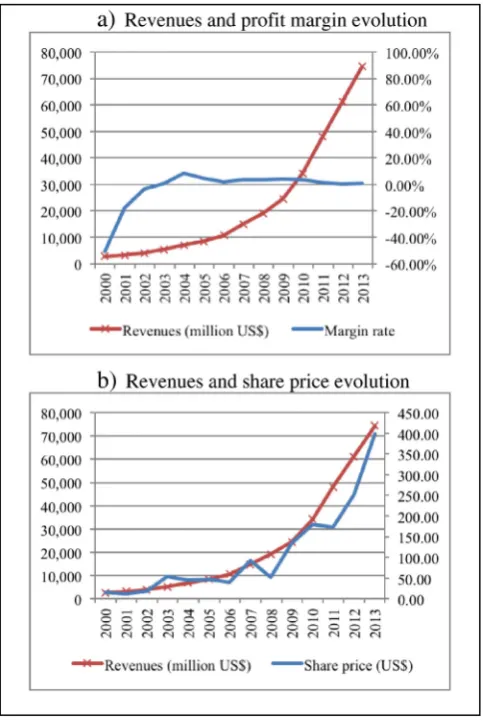
Amazon has employed an unusual pricing strategy which is to in-crease their installed base of consumers and revenues, but not necessar-ily their profit (Reimers & Waldfogel, 2014). To visualize this strategy,
Fig. 2provides detailed information about the evolution of revenues,
profit margin and share price of Amazon.com Inc. from 2000 to 2013. This information shows the results of the whole organization and was collected from Amazon's annual reports and Nasdaq.Fig. 2a shows that whilst revenues have grown exponentially, profit margin was neg-ative until 2003 and close to zero from then on. Additionally,Fig. 2b shows that the market perceives revenue as the key metric of worth since the price of Amazon's shares is strongly correlated with revenue, and practically uncorrelated to profit. Consistent with this evidence, in the present research Amazon is considered as a revenue-maximizing
firm at least for the period the data for the present study was collected and therefore has a different pricing strategy to publishers who are prof-it maximizers (Gilbert, 2015). According to standard economic
modelling with reasonable assumptions of downward sloping demand curves and positive costs (Besanko, Dranove, Shanley, & Schaefer,
2000), the optimal price of a profit maximizing company is larger than
the optimal price of a revenue maximizing company who pursue an in-crease of the quantity sold, lowering price and average profit margin (Williamson, 1966).
The evolution of the publishing industry provides further support for this fundamental point of price disagreement between publishers and Amazon—seeBaye et al. (2013)orGilbert (2015)for more detail. The launch of the iPad from Apple in January 2010 gave the publishers a new platform through which they could reach their consumers and a number of leading publishers signed a contract with Apple to sell their content in the iBookstore using the agent model. The agreement was different to previous wholesale model contracts signed with Amazon or other retailers. Apple was the agent and sold the eBooks at the market price decided by the publishers, obtaining 30% commission of the stipu-lated market price. With this agreement in place the publishers re-contracted with their other retailers resulting in an increase of the price for consumers. Amazon was pressurised to accept the new condi-tions and signed agent contracts with the publishers. However, Amazon was unhappy with this situation and took Apple and the other pub-lishers to the US anti-trust court. Amazon's argument focused on the re-duction in consumer surplus produced by the increase in price, which Amazon argued was a direct result of implicit collusion between the publishers and Apple. Amazon won the case in 2013, which produced
1
[image:5.595.311.560.52.216.2]Source Financial Times: http://www.ft.com/cms/s/0/ab87b634-e5ad-11e3-aeef-00144feabdc0.html#axzz34mua7vxpLast accessed June 16th, 2014.
Fig. 1.Publishers' revenue evolution.
Source: UK information only contains sales of books in physical form and is collected by Nielsen Bookscan, US information contains data for the aggregated sales (physical and digital) for 5 of the big six publishers. This information comes from the association of American Publishers.
Table 2
Market share of Amazon's kindle and Amazon's store.
Hardware (% ownership) US UK
Kindle 19.6% 27.6%
Kindle as the only hardware to read eBooks 8.9% 12.3%
iPad 15.9% 19.0%
iPad as the only hardware to read eBooks 8.0% 7.7%
Android tablet 17.4% 19.8%
Android tablet as the only hardware to read eBooks 8.5% 8.4%
Online store (% at least one purchase) US UK
Amazon.com 36.1% 54%
iBookstore 4.3% 3.4%
Google books 3% 2.7%
eBay 5.9% 15%
Barnes & Noble 7.8% –
Asda.com – 6.2%
Audible.com 2.9% 2.9%
AbeBooks.com 2.4% 4.2%
[image:5.595.309.562.574.747.2]a return to wholesale agreements in UK and US markets.De los Santos
and Wildenbeest (2015)conducted an event study to examine the
price shift in the book market when wholesale agreement was enforced in the US. They found that on average book prices were down by 18% when retailers recovered the capacity to decide a book's prices through wholesale agreements. This scenario evokes a situation where there are no joint profit considerations.Reimers and Waldfogel (2014)collected market information of hourly price changes of bestsellers in the years 2012 and 2013 and they estimate the price elasticity for eBooks sold by Amazon. Their evidence suggests that eBooks are priced below the static profit maximizing levels.
Finally, the publishing industry has another important characteristic that develops the theoretical underpinning of this work. Publishers offer two types of books: titles protected with exclusive copyrights, consid-ered non-imitable resources (Miller & Shamsie, 1996), and titles with-out those exclusive rights. In this regard the research is based on a quasi-natural experiment, distinguishing between two forms of novels: classic and modern. According toHeald (2014)the main difference be-tween these forms of novels is who owns the copyrights: new releases (e.g. Harry Potter) have exclusive copyrights and this provides the pub-lisher with power to deploy and enforce unique resources, rebalancing interdependencies with retailers; in contrast classic novels (e.g. Shakespeare's Romeo and Juliet) don't have exclusivity in their copy-rights and hence the power imbalance between retailers and publishers is towards retailers. Altogether, the elements discussed enable us to
consider the publishing industry as a suitable empirical context to test our theoretical propositions.
4. Methodology, data and results
4.1. General description of the method
The aim of the present research is to examine upstream and down-stream pricing strategies in the publishing industry, as prices reflect power imbalances in the publishing supply chain. After a process of dig-ital servitization the publishing industry has a new format, eBook, and a dominant retailer, Amazon, who seeks to maximize revenues, and con-sequently according to standard economic theory its optimal price needs to be below the profit maximizing price of the producer (Williamson, 1966). The analysis in this paper begins after the point a reader has chosen the specific book that they wish to read. At this point, the reader needs to make a decision on whether to purchase the book in either physical or electronic format. Whilst the content in both formats is exactly the same, readers might allocate different value to formats offered on the basis of reasons such as the cult of tan-gible ownership or the appreciation of the experience of visiting a book-store (Ng & Smith, 2012). The relative price of the electronic version in relation to the traditional physical version of the book is an important determinant for the choice between these two varieties. The method here acknowledges the existence of separate monopolies constructed around each title, whilst the price of the traditional and electronic ver-sion is one of the key determinants of the share of the two varieties of each book in a closed market.
In this empirical context thefirst theoretical proposition of the paper –digital servitization enhances downstreamfirms power–will be val-idated if eBook market price is below publisher's profit maximizing price point. In addition, the second theoretical proposition states that publishers can regain power by deploying unique resources, in this con-text exclusive copyright. The second theoretical proposition will be em-pirically validated if, in addition to the validation ofProposition 1, there is no significant difference between eBook market price and publisher's profit maximizing price point for new releases over which the publisher holds exclusive copyrights.
The test described requires four different steps;first, the identifi ca-tion of average market prices for each eBook category of interest (i.e. classic novels and new releases). For greater robustness the analysis is performed in two large and relevant markets; the UK and US. Second, the specification of a precise form of the demand function resulting from the elicitation of an accurate pattern of product choice per relative price interval, estimated using the payment card method via extensive consumer surveys. The evidence provided comes from a consumer sur-vey undertaken by a leading publisher with input from the researchers. The third step is to construct a profit function and to know the price point that maximises publisher's profits. Thefinal step consists of a comparison for each category and country of the difference between av-erage market price and publishers' profit maximizing price.
4.2. Stage 1: the identification of average market prices
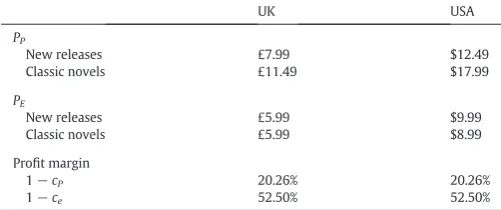
[image:6.595.39.281.52.414.2]An estimated price has been calculated using average prices per book category and country. Market price estimates are made using the average retail price of thirty books sold, selecting the bestsellers on www.amazon.com, in each category based upon prices in September 2013.Table 3reports the market price for the novel forms (New releases and Classic) and countries (UK, US) considered in the analysis. Whilst market prices for new releases and classic novels are practically the same for eBooks (PE), classic novels are significantly more expensive than new releases for physical books (PP). This evidence seems to indi-cate that the discount for digital versions is larger in those forms of novel without protected copyright.
Fig. 2.Summary of results of Amazon from 2000 to 2013. a. Revenues and profit margin evolution. b. Revenues and share price evolution.
4.3. Stage 2: the estimation of demand functions for eBooks
The construction of a demand function for eBooks requires a signifi -cant amount of information for a complex market like the publishing in-dustry. The research therefore includes a number of assumptions to simplify the problem; whilst the assumptions place significant limits on the research, the simplifications still give a realistic picture of the market. To test the rigour of the assumptions the work has been validat-ed by industry experts. Thefirst assumption refers to the fact that con-sumers do not purchase the same content in different formats (Greenstein, 2010). In particular an assumption is made that there are nconsumers who purchase a book, selecting the format in which to pur-chase: physical or digital. This decision will depend on the relative prices of formats. IfBPis the number of books sold in physical format andBEare the books sold in digital format, thenBp+BE=n. In addition, ifQp¼Bp
nis the market share of physical books, andQE¼BE
nis the market share of digital books thenQp+QE= 1, orQp=f(QE) = 1−QE.
The second assumption refers to the price of the physical format, which is assumed to be exogenously given. The rationale behind this as-sumption is twofold. First, paper books are a mature format and con-sumers expect certain prices to be applied and the publishers understand the variables which affect the demand function. Second, the physical format serves as anchor in the digital format buying deci-sion. This anchor effect is well-described in the experimental economics literature (Jones-Lee, 1989), which confirms the appropriateness of the payment card method as applied here (Camacho-Cuenca et al., 2004; Ryan & Watson, 2009).
The payment card method involves making an offer available to the consumer (an eBook in this case) at varied price points from below to above the anchor price of a comparable offer (in this case the same book in physical format). The stepwise variations (in eBook price) are presented sequentially until the consumer switches (or not) from one offering to the other. The switching point price difference is then used to determine the respondent's willingness to pay for the new offer. Points of maximum revenues for markets can be calculated. Consumers may positively value the offer, such as when the offer is val-ued at a point higher than the anchor. In this case the digital format of the book is given a higher value than the physical. In such a case, the in-direct utility function of a consumer purchasing one unit of the physical format is:
Up¼R−Pp: ð1Þ
Whereas the purchase of a unit of the digital format implies a utility:
UE¼RþWi−PE ð2Þ
whereRrepresents the consumer's reservation price,Ppthe price of the physical format,PEthe price of the eBook, andWiconsumeri's specific extra value (positive or negative) that the consumer gives to the digital format in contraposition to the physical format. A consumer
will prefer the eBook only ifUENUp, which implies that the following holds:
WiNPE−Pp: ð3Þ
Inequality (3) implies that a consumer buys the eBook and not the paper version only if his/her valuation for the digital format offsets the price difference across formats.
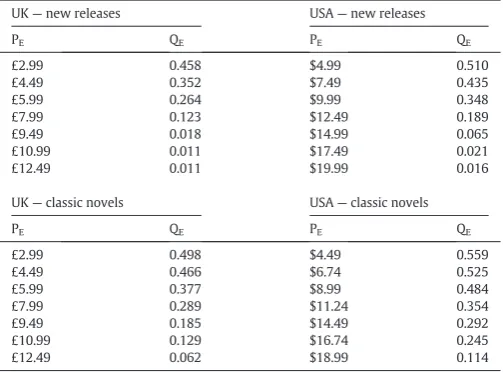
The implementation of the payment cardfirst requires the collection of market data. In October 2013 an extensive survey of 4000 consumers in the UK and 4000 consumers in the US was conducted in collaboration with a leading international publisher. The survey included the pay-ment card questions based on the data collected previously, allowing the estimation of the switching points.Table 4gives detailed informa-tion concerning the switching points. The results show that the majority of the proportion of the population still prefers to read novels in physi-cal form. The cheapest price proposed to the respondents was half of the market price. For example, in the US a classic novels market price is $17.99, whilst its digital version is $8.99. Using the payment card the eBook was offered to US consumers at a discounted price of $4.49, but even with this large discount 44.1% of the respondents preferred the paper version, despite the price being four times higher.
With the data collected with the payment card we can directly esti-mate the demand functions PE=g(QE) and total revenues (TR= g(QE)⋅QE)). The form of the functiong(⋅) requires further analysis. Anal-ysis provides 7 switching points (or observations) per eBook category and country, therefore the degrees of freedom condition the estimation ofg. For that reason estimates are made only for linear, second and third degree polynomials. The log likelihood test is performed after model es-timation and in most of the cases rejects the null hypothesis2that all polynomial forms considered have the same information, implying that third degree functions were the most informative and efficient to explain the demand form described by the switching points. The ex-planatory power of those models was high, ranging fromR2−0.93 to
R2= 0.98.
4.4. Stage 3: the estimation of profit functions for eBooks
The information collected and analysed to this point was informative and sufficient to estimate optimal revenue points; however, the pub-lisher is a profit maximizing organization and so it is necessary to iden-tify the profit maximizing price point. The identification of this price requires the collection of further information to estimate the margin contribution of digital (1−cE) and physical (1−cp) formats. Availability of marginal contribution information is poor as it contributes towards a publisher's competitive advantage. For the analysis the industry partner providedfigures for an average margin contribution for the sector; spec-ified at the bottom ofTable 3. The margin contribution to profits given for eBooks is ~50%, and for paper books is ~20%.3
2For example in modern novels in the US we reject the null hypothesis that linear and third degree (LR Chi2(2) = 5.93, ProbNChi = 0.0516) and second and third degree (LR Chi2
(1) = 5.43, ProbNChi2
= 0.0198) exhibit the same information at 5% level of signif-icance. In other cases (Classic novels in US) wefind the linear function is preferred. How-ever, for homogeneity reasons we will show only third degree functions in this article. The profit maximizing points using the linear demand functions are quite close to those found using third degree functions and are reported in this article. Linear demand functions are available upon request, though an expert reader will be able to construct them herself using the data available inTable 4.
3
[image:7.595.42.293.78.183.2]The true difference in the margin contribution between an eBook and a Physical book is subject to some discussion (for example seeHyatt, 2010). To address this limitation ad-ditional tests were carried out (available upon request), reducing the difference in margin from 30% to 20% and 10%. Profit maximization points do not change significantly when the margin contribution for physical books is 30%. Given the assumption of perfect substitut-ability between formats we see a significant increment of profit maximization prices when margin contribution of physical books is 40%. But even in this last case the difference in discount rates between classic novels and new releases is large and significant, which sup-ports the arguments made in this article.
Table 3
Average prices and costs of physical (p) and electronic (E) books.
UK USA
PP
New releases £7.99 $12.49
Classic novels £11.49 $17.99
PE
New releases £5.99 $9.99
Classic novels £5.99 $8.99
Profit margin
1−cP 20.26% 20.26%
A third assumption performed in this study is that the margin contri-bution is constant, and does not depend on the country or the type of novel. With all the data collected and three assumptions mentioned above, the profit function can be expressed in terms of the market share of eBooks
π−Ppð1−QEÞ 1−cpþg Qð Þ E QEð1−cEÞ ð4Þ
wherePp,cpandcEare held constant, andg(QE) is a third degree de-mand function with estimated parameters and switching points. De-mand and profit functions are drawn inFig. 3a to d. In thesefigures the profit maximizing point determines the market share of eBooks in the profit function (graph at the bottom of thefigure), and the market share of eBooks determines the price that maximises profits in the de-mand function (graph at the top of eachfigure).
4.5. Stage 4: The empirical validation of theoretical propositions
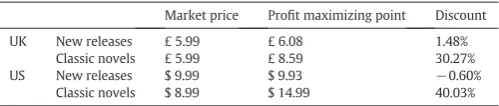
In the fourth andfinal stage we obtain the results that validate the theoretical propositions. As can be seen inTable 5the results support our two theoretical propositions. For classic novels, where copyright normally no-longer applies, there are significant discounts offered. In the UK the profit maximizing price for the eBook is £8.59 and the mar-ket price £5.99, suggesting that the e-retailer is responsible for a 30% discount in relation to the profit-maximizing point. Similarly, in the US the profit maximizing price for the eBook is $14.99 and the market price $8.99, suggesting that the e-retailer is responsible for implementing discounts of over 40%. The results show that in the pres-ence of digital servitization, retailers in the publishing industry enforce wholesale agreements, enabling them to set a market price significantly below the price desired by publishers. E-retailers wish to attract con-sumers to their websites and increase their sales volume; our results seem to suggest that e-retailers take advantage of the providers value offerings where there are no copyrights to increase their consumer base and revenues through price reductions. Our interpretation of this result is that the e-retailers action allows them to capture and maintain links with a large consumer group, increasing the dependence of the supplier on the e-retailer for access to the market. This empirically val-idates theoreticalProposition 1, since the provision of digital services (eBooks) seems to increase the dependence of upstreamfirms on downstream companies.
Our results also demonstrate that publishers have a mechanism to respond to the power of e-retailers. The inclusion of e-books with exclu-sive copyright allowed publishers to realise e-retailer market prices
closer to publisher profit maximizing prices. For new releases pub-lishers are assured a period of exclusive copyright, so we understand that new releases are a good proxy for the deployment of unique resource. Our results indicate that for new releases the estimated pub-lishers' profit maximizing price approximately equals the market price. This result is consistent in both UK and US markets and suggests that publishers have regained power in the supply chain when deploying unique resource. For new releases the enforcement of copy-rights diminishes the monopsony power of the retailer who cannot de-crease market prices. Therefore, we take the evidence provided as empirical validation of theoreticalProposition 2, since the deployment of unique resources would appear to allow upstream companies to re-duce relative dependence on downstream companies.
5. Discussion of the results
Publishers are dematerialising their offering by adding digital services (eBooks) to their existing product offer (books). This makes the publishing industry an appropriate context to analyse drivers of servitization such as digitization andfirm interdependencies. In addi-tion, large electronic retailers such as Amazon control the link channel to thefinal customer and have shifted the balance of power in the sup-ply chain (Ritala et al., 2014). The analysis of the specific context is gen-erating a body of managerial and economic literature to which we also contribute, as one of the main issues“involves the conflict between Amazon and publishers, and in particular their preference for different industry pricing models”(Gilbert, 2015, p. 165).
At the time of writing the articles published on pricing strategies of publishers and retailers are found to be complementary since they use different methodological approaches to reach a similar conclusion. In empirical terms,De los Santos and Wildenbeest (2015)perform an event study andfind that after a wholesale model empowering retailers was implemented in 2012 in the US market prices decreased on average by 18%.Reimers and Waldfogel (2014)use market data to translate hourly price changes into an estimation of price elasticity of demand for eBooks. Their result suggests that eBooks are priced below the static profit maximizing level. Our empirical approach uses consumer survey data and a payment card to elicit demand functions. The results show that in conditions where the publisher does not have unicity of an offer, eBooks are priced 30–40% below the profit maximizing level. Three studies with different methodological strategies (i.e. event study, demand elicitation/market data, demand elicitation/survey data) identify a similar result which strengthens the relevance of Proposition 1, which states that the addition of digital services in prod-uctfirms increases the relative dependence of upstreamfirms (i.e. profit maximizing publishers) on downstream companies (i.e. revenue maxi-mizing retailers).
To the best of our knowledge previous research has not identified a way publishers can influence retailer's price positioning of their offer-ings. So far publishers' efforts have been focused on implementing “windowing”,“disintermediation”or“agency pricing”strategies, but none of them appear to have an influence on the way retailers operate (Gilbert, 2015). However, we argue that there is a missing element in the toolkit of publishers, the deployment of immutable resource, se-cured in this case by the publisher holding copyright over work.
[image:8.595.34.286.77.263.2]In a recent studyHeald (2014)constructed a random sample of books for sale onAmazon.comand identified that there were more books for sale from the 1880s than the 1980s. Her result suggests that copyright status is negatively associated with books availability on Am-azon. Building on this evidence our second proposition states that unique resources (i.e. copyright) allow upstream companies to reduce their dependence on downstream companies. Our results fully support this evidence. When publishers do not have exclusive copyright over a digital title the market price offered by the e-retailer is 30–40% below the publisher's profit maximizing price. However, when publishers have exclusive copyrights over the digital title market price offered by Table 4
Switching points and eBook market share (QE) in the payment card.
UK—new releases USA—new releases
PE QE PE QE
£2.99 0.458 $4.99 0.510
£4.49 0.352 $7.49 0.435
£5.99 0.264 $9.99 0.348
£7.99 0.123 $12.49 0.189
£9.49 0.018 $14.99 0.065
£10.99 0.011 $17.49 0.021
£12.49 0.011 $19.99 0.016
UK—classic novels USA—classic novels
PE QE PE QE
£2.99 0.498 $4.49 0.559
£4.49 0.466 $6.74 0.525
£5.99 0.377 $8.99 0.484
£7.99 0.289 $11.24 0.354
£9.49 0.185 $14.49 0.292
£10.99 0.129 $16.74 0.245
Fig
.
3.
Demand
an
d
p
ro
fi
t
funct
ion
s
for
e
Book
ca
te
g
o
ries
and
countries
the e-retailer is practically the same as that which maximises profit. Our evidence seems to indicate that copyrighted books allow publishers to circumvent the otherwise dominant position of the e-retailers. This
finding supports other research which demonstrates how unique re-sources can improvefirm positioning and value capture processes in the supply chain (Costa et al., 2013; Finne et al., 2015; Keil et al., 2010; Sirmon & Hitt, 2003; Ulaga & Reinhart, 2011).
The provision of digital services requires the combination of cloud content (i.e. data, applications, eBooks), a physical product with embed-ded hardware and software and a link channel to deliver the service to the customer, usually a retailer (Porter & Heppelmann, 2014, p. 7). A strategic element of power in publishing supply chains is the control of the digital book reading devices, which is currently in the hands of re-tailers (i.e. Amazon's Kindle). A recent game-theoretical approach is consistent with this possibility. The work ofGaudin & White (2014)
finds that if the retailer did not exclusively own the reading device, the equilibrium price point of eBooks in the wholesale agreement would be greater than it is under agency agreements.
The analysis in this paper focuses primarily on the pricing strategies of publishers and retailers. The assumption that price determination is the main element of rivalry between publishers and retailers is central to the literature in this area (De los Santos & Wildenbeest, 2015; Gaudin & White, 2014; Gilbert, 2015; Hua et al., 2011; Li et al., 2015; Reimers & Waldfogel, 2014), however we acknowledge that there are other factors such as specific investments or high exit costs that might explain the power relationship between publishers and retailers. Our data does not contain information to examine those factors sufficiently to comment on their impact and recent literature is silent on these is-sues as well. Further research is required to examine the role of specific investments and exit costs that can influence power in the publishing industry supply chain.
6. Conclusion
6.1. Academic implications
The literature on servitization was initiated with the seminal article
ofVandermerwe and Rada (1988)and whilst their work discusses both
goods and servicefirms servitization research has focused mainly on the move to implement services undertaken by manufacturing companies. The theoretical concepts of servitization have been applied in the study of digital technologies in software (Suarez et al., 2013) and music industries (Parry et al., 2012) and this sub-stream of research is named digital servitization (Lerch & Gotsch, 2015; Schroeder & Kotlarsky, 2015; Vendrell-Herrero & Wilson, 2016). This article is novel as it is explicitly positioned to examine digital servitization and the interdependencies offirms in supply chains. The choice of the digital transition of the publishing industry is relevant because it simulta-neously involves the provision of digital services and the appearance of powerful electronic retailers (Gilbert, 2015), elements that have transformed the wayfirms in many industries compete (Porter & Heppelmann, 2014).
Our empirical analysis has three important insights that contribute towards the understanding of industry dynamics after digital servitization. First, our results confirm that digital servitization has transformed the structure of the supply chain, separating the infrastruc-ture operation and service provision from production (Stabell &
Fjeldstad, 1998) and impacting on the power offirms in vertical
rela-tionships (Cox, 1999; Scheer et al., 2014). Second, the methodological approach presented here is novel and offers an enhanced view of consumer surplus and worth value (Lepak et al., 2007) in digital servitization though the use of the payment card method (Ryan & Watson, 2009). Third, our evidence shows that provision of digital ser-vices produces a paradigm shift in consumer valuation (Anand et al., 2009; Rifkin, 2014).
In relation to supply chain structure, previous empirical research has analysed digital servitization from a unidirectional approach (e.g. Opresnik & Taisk, 2015; Parry et al., 2012), focusing on either a down-stream or updown-streamfirm perspective. This article provides a bidirection-al perspective, anbidirection-alysing the power dynamics of the interdependencies between upstream and downstream parties. The evidence in the pres-ent research supports two theoretical propositions which state that (1) digital servitization empowers downstreamfirms when they gain control of link channels to consumers (Bustinza et al., 2013; Wise & Baumgartner, 1999), but (2) upstream companies can regain power when they control key resources which are desirable to the consumer (Costa et al., 2013; Finne et al., 2015; Ulaga & Reinhart, 2011). As such, thefindings demonstrate that digital servitization produces asymmetric interdependencies that empower downstream companies when re-sources are not immutable. In the case where a provider holds immuta-ble resource upstream companies are aimmuta-ble to alter power interdependences in their favour. This is a significant contribution for the particular case of the publishing industry, as previous research was unable to identify an effective mechanism for publishers to rebal-ance the power in their dependent relationship with retailers (Gilbert, 2015).
The dynamics of power imbalance provides a further contribution to mainstream servitization and digital servitization literatures. These literatures are underpinned by the assumption that companies implementing servitization strategies go downstream, enhancing value creation at the cost of lowering value network dominance, which could harm their value capturing processes (Kowalkowski et al., 2015). This is one of the main reasons why servitization is considered a risky strategy and some companies have decided to de-servitize in order to survive (Benedetti et al., 2015). Nevertheless, our evidence sug-gests that having a dominant position in the supply chain and moving downstream through the supply chain are not necessarily related events. We argue that one important condition for productfirms to suc-cessfully implement service business models is to lock in their compet-itive advantage by assuring they have control over the difficult to imitate elements of their offerings. These results are consistent with the predictions of the theoretical model ofLee, Staelin, Yoo, and Du
(2013)whofind that differentiation is a crucial factor to determine
up-stream profitability.
6.2. Managerial implications
The provision of digital and smart products has transformed the way
firms compete and provide services (Porter & Heppelmann, 2014, 2015). Digital servitization has implications for the relational power a
firm holds in the supply chain as the transition to service often em-powers downstream companies (Bustinza et al., 2013; Wise & Baumgartner, 1999). In the case of the publishing industry Amazon il-lustrates this dominance having achieved 60% of the global market share in eBooks and exponential growth in both revenues and share price over the last decade. The past success of this company is linked to volume maximizing behaviour and seeking to reduce market prices (Baye et al., 2013; Gilbert, 2015). Digital servitization has produced a more complex situation for creative content producers upstream in the supply chain who have often experienced decreasing or stagnating revenues (Myrthianos et al., 2014).
[image:10.595.35.285.76.129.2]To counteract the loss of power and reduction in revenue produced by the entry of retailers controlling linking channels, productfirms have Table 5
Market price and publishers' profit maximizing point for eBooks.
Market price Profit maximizing point Discount
UK New releases £ 5.99 £ 6.08 1.48%
Classic novels £ 5.99 £ 8.59 30.27%
US New releases $ 9.99 $ 9.93 −0.60%
applied a number of different strategies including windowing (Gilbert, 2015), different contractual agreements (Baye et al., 2013), disinterme-diation (Porter & Heppelman, 2014), and deployment of unique re-sources (Costa et al., 2013). The analysis here is context specific and focuses on publishingfirms. Previous research in the book publishing industry has shown that agency contracts, windowing and disinterme-diation are not suitable strategies to maintain a sustainable position of power (Gilbert, 2015). In this work we show that holding immutable resource has an effect on the way publishers and retailers interact. Pub-lishers have power in their relationship with retailers over new releases where they hold copyright, creating an immutable resource, but not with regards older publications where no copyright exists. Consequent-ly, publishers need to focus on marketing unique resources for profit maximization and look at collaborative commodity strategies (i.e. vol-ume) with retailers for out of copyright titles. A willingness to develop volume strategies for older titles may facilitate the development of co-operative strategies with digital retailers. Cooperation could be used to gain access to consumer transaction data (Bell, 2015), which would allow providers to better estimate demand functions and comprehend the interests and purchasing patterns of consumers.
Future dominance in the supply chain is not guaranteed and Amazon, as well as other digital retailers, will need to adopt cooperative approaches in the future (Ritala et al., 2014), and to assure that their dominant role in the industry provides more benefits than costs for up-stream companies. The leading trade magazine Bookseller's editor Philip Jones notes“The worst thing that could happen [to book publishers] would be for Amazon to go away”,4but at the same time“The second worst thing would be for it to become more dominant”.
6.3. Limitations and future research avenues
This article contributes to industrial marketing with an empirical methodological grounding based in microeconomics. This article pro-vides a novel analysis of upstream–downstream bilateral relationships in servitization literature, which is also consistent with theoretical mi-croeconomic techniques such as game theoretic models. Whilst game theoretic modelling is beyond the scope of this paper we acknowledge relevant research (e.g.Yoo & Lee, 2011) and our investigation provides opportunities for alternative research approaches, for example with regards the differences in business goals. Future game theoretic models may show how a dominant and revenue-maximizingfirm affects the strategic decisions of other companies as well as the specific relevance of sources of competitive advantage such as the upstream–downstream knowledge asymmetries created by demand for new varieties.
Methodological assumptions in the construction of demand func-tions include perfect substitutability of physical and digital formats and their polynomial form. Such assumptions place limits upon the ve-racity of the work and future work could explore how demand functions differ using other assumptions and methods. In addition, demand func-tions estimated with survey data may suffer from hypothetical bias. Work should be undertaken to correct for this potential bias, eliciting demand functions in the laboratory (Camacho-Cuenca et al., 2004). Fi-nally, profit functions were difficult to estimate since confidentiality clauses impeded access to data of publishers' cost functions and their marginal contributions, particularly the differences between cost and profit for physical and eBooks. Future research, including more precise information on the cost functions of publishers and intermediaries, will enhance the understanding of pricing strategies for physical and digital offerings.
We acknowledge that we make a strong assumption with regards the underlying strategy of Amazon. Our assumption that Amazon's strategy is that of a revenue maximizer is based on the observed data for the period of study and supported by thefirm's market share price.
However,‘time makes fools of us all’and in future greater data availabil-ity may challenge our assumption. In addition, according toRitala et al.
(2014)andBell (2015)Amazon's core strategy is to create value though
capturing data from consumers and making informed decisions on how to distribute and store products. This does not rule out the possibility that Amazon behaves as a revenue maximizingfirm. Indeed, we con-tend that it is difficult to derive a convincing alternative conclusion
fromFig. 2, where it is shown that the company has not reported a profit
for fourteen years, whereas revenues have increased exponentially. Whilst the present research uses the publishing industry as the main context of analysis, we expect that the theoretical and managerial impli-cations of the present research can be instructive and provide guidance to others contexts. Future research should focus upon additional specific contexts. A recent example is the taxi industry where upstreamfirms represented by associations of licensed taxis have lost their dominant market position with the arrival of Uber in the downstream, who have developed an effective digital link channel to the consumer.
Another avenue of further inquiry is to identify patterns of power dynamics after digital disruption and assess whether alternative strate-gies for securing the competitive advantage of productfirms, such as new contractual agreements, windowing or disintermediation, are ef-fective in other contexts.
Acknowledgement
The authors would like to acknowledge the comments provided on early versions of this article by Professor Stan Siebert and Prof. Paul Edwards, comments received by attendees at ICBS 2014 and EUROMA 2015 conferences, and three anonymous referees. This research was supported by the European Commission under the Horizon 2020 Marie Skłodowska-Curie Actions project“MAKERS: Smart Manufactur-ing for EU Growth and Prosperity”with grant agreement number 691192, the Spanish Government under Grant ECO2014-58472-R, and the Junta de Andalusia under Grant P11-SEJ-7294.
References
Aldrich, H., & Herker, D. (1977).Boundary spanning roles and organization structure.
Academy of Management Review,2(2), 217–230.
Anand, B., Olson, P., & Tripsas, M. (2009).Ereading: Amazon's kindle (case study 9-709-406).Boston, MA: Harvard Business School.
Baines, T., & Lightfoot, H. (2013).Made to serve: How manufacturers can compete through servitization and product service systems.New York, NY: John Wiley & Sons. Baird, A., & Raghu, T. S. (2015).Associating consumer perceived value with business
models for digital services.European Journal of Information Systems,24(1), 4–22. BarNir, A., Gallaugher, J. M., & Auger, P. (2003).Business process digitization, strategy, and
the impact offirm age and size: The case of the magazine publishing industry.Journal of Business Venturing,18(6), 789–814.
Baye, M. R., De los Santos, B., & Wildenbeest, M. R. (2013).Searching for physical and dig-ital media: The evolution of platforms forfinding books.NBER working paper no. 19519.
Bell, P. C. (2015).Sustaining an analytics advantage.MIT Sloan Management Review,56(3), 21–24.
Bell, S., Auh, S., & Smalley, K. (2005).Customer relationship dynamics: Service quality and customer loyalty in the context of varying levels of customer expertise and switching costs.Journal of the Academy of Marketing Science,33(2), 169–183.
Benedettini, O., Neely, A., & Swink, M. (2015).Why do servitizedfirms fail? A risk-based explanation.International Journal of Operations and Production Management,35(6), 946–979.
Besanko, D., Dranove, D., Shanley, M., & Schaefer, S. (2000).Economics of strategy.New York, NY: John Wiley&Sons.
Bradley, J., Loucks, J., Macaulay, J., Noronha, A., & Wade, M. (2015). Digital vortex: How digital disruption is redefining industries.Global Center for Digital Business Transfor-mation: An IMD and Cisco initiative(June 2015. (Retrieved February 5, 2016, from https://pdfs.semanticscholar.org/5a43/4925db8bbbc997b6b3c6c8bbaddc23540b3b. pdf)).
Brynjolfsson, E., & McAfee, A. (2011).Race against the machine: How the digital revolu-tion is accelerating innovarevolu-tion, driving productivity, and irreversibly transforming employment and the economy.Research brief. Massachusetts, MA: MIT Sloan School of Management.
Bustinza, O. F., Parry, G., & Vendrell-Herrero, F. (2013).Supply and demand chain man-agement orientation: The effect of adding services to product offerings.Supply Chain Management,18(6), 618–629.
Byrne, D. (2012).How music works.San Francisco, CA: McSweeney's. 4