A Knowledge Review: Implications
for Future Research and Practical Application
Stefan Mikic, Gareth R.T. White (Corresponding author) & Azley Abd Razak Bristol Business School
The University of the West of England Coldharbour Lane, Bristol. BS 11QY, United Kingdom Tel: 117-3283-466 E-mail: [email protected]
Abstract
Knowledge has evolved from being an abstract concept that resides within the human mind to a manageable resource that is capable of contributing to organisational competitive advantage. Research in the field is largely divergent, both in methodological execution and in objective, resulting in potential for a widening of the gulf between scholastic endeavour and practical value. A ‘Knowledge Matrix’ based upon Tranfield and Starkey’s (1998) social and cognitive dimensional conceptualisation is used to depict the theory-practice gaps that exist in the knowledge management literature.
Keywords: Knowledge, Knowledge management, Research, Practical application
1. Introduction
It was not until recently that knowledge came to be viewed as a useful organisational resource (Alavi and Leidner, 2001), a knowledge economy is developing and knowledge management is gaining recognition amongst scholars and enterprises (Chen and Chen, 2006). Organisations are beginning to understand that competitiveness hinges on the effective management of intellectual resources (Davenport and Grover, 2001). It is becoming clear that the effective utilisation of knowledge will be a significant source of competitive advantage (Pfeffer and Sutton, 1999) and the integration of individuals’ knowledge into organisational strategy (Nonaka, 2007) will become a basic requirement for the future.
Some of the most influential works within this field, including Brown and Duguid (1991), Dyer and Nobeoka (2000), and Wenger (2000), are divergent due to their inability to agree upon a common meaning of the key terms. These influential works have encouraged current research (Chua and Pan, 2006; Hew and Hara, 2007) to expand rapidly and overlap into more diverse subject areas, thus broadening the boundaries of the communities of practice stream of research. There is now a tension around whether knowledge management should be centred at management, employees or management scholars, and ultimately, whether knowledge management should be allowed to slip into what March (2004) terms a ‘fragmentation trap’. Alvesson and Kärreman (2001) recognise that the field is in danger of becoming divided through focussing upon the management of people or information, rather than as a practice attuned towards facilitating knowledge creation.
1.1 Birth
The nature of knowledge has been conceptualised and debated for millennia but the emergence of knowledge as a factor to be considered in modern business is perhaps best signposted by the works of Polanyi (1966, 1983). It was as a result of a crossbreeding between the fields of organisational learning (Adler and Clark, 1991; Arrow, 1962) and quality management (Linderman, Schroeder, Zaheer, Liedtke and Choo, 2004, Sousa and Voss, 2002) that knowledge management came to be: Hedlund (1994) for example, examined quality circles and organisational learning to discover what prohibits knowledge dispersion within organisations.
The birth of knowledge management as a practicable business discipline may be connected chronologically with Nonaka’s (1994) (SECI) theory of knowledge transfer that has become the fundamental platform for much subsequent enquiry (Grant, 1996a; 1996b; Spender, 1996; Szulanski, 1996). These works have contributed to the development of the theoretical aspect of knowledge, often further connecting the field to pre-established research streams.
1.2 Renaissance
(1996). It was during this short time span that two new streams of research were developed within the knowledge management spectrum, changing its boundaries and expanding it into new areas.
The prominent authors of the 1990s period contributed significant epistemological evidence towards the importance of knowledge as a process and how the coordination of knowledge was necessary in order to achieve a strategic competitive advantage (Grant, 1996a). Davenport and Prusak (1998) highlight the development of knowledge markets, where individuals possess the power to barter with knowledge. The works of authors such as Conner and Prahalad (1996) and Grant (1996a, b) and Spender (1996) have also achieved significant progress in bridging the gap between a resource based view and knowledge based view of the firm.
The SECI model has faced numerous criticisms during this time, made upon practical and epistemological grounds (Gourlay, 2006; Griffin, Shaw and Stacey, 2001; McAdam and McCreedy, 1999). The model is observed to omit a satisfactory account of tacit knowledge and its transfer, it is based upon a far too subjective methodology, and is far too simplistic to be applied to organisations in practice. Knowledge management seems to have been evolving as a result of a continuous tension between research that is either radically subjective or radically objective (Burrell and Morgan, 1979), that is to say, the paradigms being produced are contradictory, or at least incommensurable, and hence cannot successfully collectively contribute toward furthering our understanding.
This continuous divergence of ideas means that there is a lack of regulation of knowledge management literature. The bottom line being that the radical paradigms created by authors such as Wenger (1998) have led to enhanced focus upon the Socialization element of SECI model. This, in combination with the works of Wenger (2000) and Dyer and Nobeoka (2001) created a new revival of knowledge management, in such a way that a new research stream gained prominence and attention.
1.3 Second Renaissance
The latest stream of research to surface from the sea of knowledge management literature is the work from the communities of practice sphere. Even though it is possible to argue that the true rudiments of this field may be traced back to Lave and Wenger (1991) it is not until much later that this field became generally acknowledged.
Anand, Gardner and Morris (2007) and Van de Ven and Johnson (2006) both focus on bridging the gap between theory and practice in an attempt to make the current communities of practice research more applicable across various environments: Anand et al (2007) specifically attempt to qualitatively determine how knowledge-based innovative structures may be embedded within various communities of practice existing in organisations. These qualitative and more practically based approaches might suggest that the latest research such as Hew’s and Hara’s (2007) or Kane’s and Alavi’s (2007) are jointly attempting to tip a fragile balance towards a form of research that has more practical value to business.
To illustrate this it is appropriate to pay particular attention to how the concept of communities of practice (CoP) has altered in its meaning over time. Brown and Duguid (1991) have contributed to the establishment of the concept of CoP by explaining it in terms of how knowledge flows most effectively when it moves through networks of people who have the same interests, even though they might not be in the same part of an organisation. On the other hand, Cox (2005) explains how Wenger (1998) embarks upon a definition of communities of practice that discusses social relations and meanings that coalesce about a work process when it is appropriated by participants. It is possible to see this definition broaden the sense of communities of practice to the concept of social relations and work processes.
In its most recent sense, the notion of communities of practice has deviated further. Cross, Laseter, Parker and Velasquez (2006) relate to this latest stream of research as one of ‘informal networks’. This highlights how the meaning of communities of practice has managed to diverge itself from its more specific definition concerning knowledge flows between people with similar interests to simply the supposition that it revolves around informal networks
2. The Knowledge Matrix
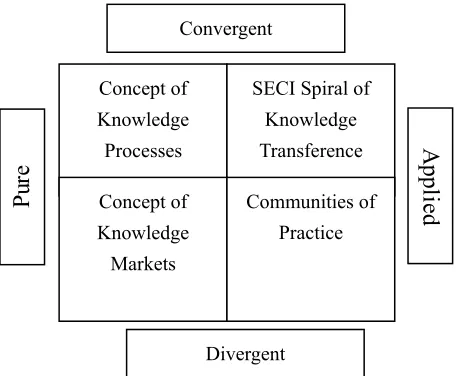
Based on Tranfield’s and Starkey’s (1998) social and cognitive dimensions, it is possible to create a matrix which analyses and exposes some of the fragile tensions that have emerged within knowledge management and proposes an explanation for the existence of major theory–practice gaps in the knowledge management literature (Figure 1).
An analysis of the matrix suggests that different knowledge management concepts are located at different stages of Tranfield’s (2002) modal scale of knowledge production. Whereas mode 1 is characterised by a concrete epistemological base and knowledge aimed at researchers; the ‘pure’ axis in the model, mode 2 is centred around finding short term solutions and theory application; the ‘applied’ axis within the matrix. The second mode also deals with managers as beneficiaries. Thus, the notion of knowledge markets can be linked to a first stage of evolution; mode 1. This is because it has only commenced its development on a theoretical level and much of the literature remains divergent due to its inability to agree upon a common definition.
mode 1 knowledge production as described by Wood (2001). It is convergent in terms of theory, however it appears that no significant attempts have been made in order to develop a concretely practical use for this concept to implement it in organisations. It currently bears no sense of purpose for practitioners; a requirement of mode 2 knowledge production. Nonaka’s (1994) SECI concept on the other hand has been developed through theory which has converged to a certain extent. It has then been referred to through a more practical basis by Szulanski (1996), Grant (1997) or most recently by Lin (2007), Jashapara (2007) and Williams (2007), and forms a central part of knowledge management.
It is as a result of its critiques and initial contributions that the SECI model has made such a large impact and it is this notion that is important; the ability to contribute and trigger progress. Thus, this may be described as an advanced stage of the evolution of a knowledge management concept as it appears to be sufficiently developed in order to merit implementation on a practical level. It could be described in terms of mode 1.5 (Huff, 2000).
Remarkably, the notion of communities of practice is at stage that is difficult to relate to a mode 1 or mode 2 type of knowledge production. It would appear that some of the latest research, for example, that of Kane and Alavi (2007) or Nicholls and Cargill (2008) is attempting to build on its practical application, whilst the epistemological debate that stems from this research stream rests rather fragmented. In other words, the matrix suggests that theories should be sufficiently developed if there is to be effective progress on a practical level, highlighting a vital link between realising theory into practice.
According to the matrix, it seems likely that points of convergence to some extent lead to the evolution of knowledge management concepts. This suggests why it is difficult to explain the communities of practice stream in terms of the modal spectrum of knowledge production; it faces a lack of convergence in terms of its central definitions. Thus, it could be argued that convergence is required to shift concepts between modes of knowledge production.
Additionally, the communities of practice stream can be linked to the likes of a rational means of expansion as discussed by Abrahamson and Fairchild (1999), and Abrahamson (1991). In this case, theories are not being replaced by each other but rather diluted and weakened through a process of evolution. To emphasise this further, this development may be compared to the ripple effect explained by Scarbrough and Swan (2001). These theories together can be used to explain why the communities of practice research stream is divergent in terms of theory, but still being applied on a practical level. The ripple effect especially, explains that theories do not follow a particular pattern of behaviour, but may emerge and progress in any direction; a critical flaw in the matrix that is addressed in the conclusion.
In order to complete a review of this complex web of literature and further investigate the practical argument constructed by the matrix, three influential articles are mapped onto the knowledge matrix (Wenger, 2000; Dyer and Nobeoka, 2000; Anand et al, 2007) in order to show how the key tensions manifest themselves in individual pieces of work and thus draw them into embarking upon research in certain directions over others.
Wenger (2000) has attempted to confer to the view that the success of organisations depends on their ability to design themselves as social learning systems. This particular work lacks empirical foundations, and is limited in its attempts to aid managers in the application of knowledge management practices as it does not provide any practical evidence. It is highly conceptual in nature and builds on very few previous works; (Lave and Wenger, 1991; Wenger, 1998; McDermott, 1999). Wenger (2000) has attempted to bridge the theory-practice gap from a conceptual perspective centred around what Hodgkinson, Herriot and Anderson (2001) refer to as ‘relevance’, Dyer and Nobeoka (2000) on the other hand are empirically grounded and are more practical, developing their research around the effective management of coordinating principles needed to improve the effectiveness of networks. However their objective analyses are centred at researchers and academic scholars rather than management. Therefore, two of the most influential pieces of research stand on either side of an incomplete theory-practice bridge. This can significantly affect the impact future research will have within the field but may also lead to a fragmentation trap (Knudsen, 2003).
Anand et al (2007) have undertaken research that builds upon these two earlier works, but there appears to be a misconception of what management research should be concerned with. This latest piece of research obtains a definition of communities of practice from the work of Brown and Duguid (1991) rather than from later works which are themselves divergent in terms of their definitions. The limitations brought about by the consistent trend of divergence seen in every aspect of knowledge management as well as through the knowledge matrix and through a combination of these three works, has significant implications for organisations attempting to implement aspects of the communities of practice research stream into organisations.
Firstly, a concept developed from divergent theories is flawed in terms of consistency and prominence (Pfeffer, 1997) and is less likely to be implemented throughout organisations successfully.
Thirdly, the emergence of a fragmentation trap (Knudsen, 2003) and inconsistency in research might begin to diminish practitioners’ confidence in the academic principles of knowledge management. This could in turn provoke a decline in research and authenticity of the research being developed.
Fourthly, it has been established that knowledge management is a transdisciplinary field. The inability to develop generalisable knowledge principles, as seen through Dyer and Nobeoka (2000) for example, means that research will not strengthen secondary disciplines that are related to knowledge management thus leading to further divergence.
Finally, to bridge the theory-practice gap research should aim to constantly shift towards mode two knowledge production since knowledge management is a field which ultimately aims to improve organisational effectiveness and competitive advantage.
3. Conclusions and recommendations
The knowledge matrix demonstrates the way in which the major knowledge management concepts are scattered amongst different stages of development. These stages vary in their ability to bridge theory and practice effectively. Since knowledge management is a field centred on organisations as primary beneficiaries, its theories must move towards mode 2 types of knowledge production. To be able to shift theories across modes, a certain amount of convergence is required. Specifically in terms of the communities of practice field, a generally accepted definition is required.
Nonetheless, divergence is as equally important if knowledge management develops through an evolutionary process. The specific works of Wenger (2000), Dyer and Nobeoka (2000) and Anand et al (2007) have expanded by highlighting that the communities of practice field is weak in both rigour and relevance. Hodgkinson et al. (2001) refer to this type of combination as ‘puerile science’. These tensions contribute to a consistent divergence of research and are ultimately developing a ‘fragmentation trap’ (Knudsen, 2003).
Future research could investigate the amount of inter-dependence between the various research streams identified in this review and whether a stream that is in an earlier stage of development in relation to another is actually affecting the progress of other inter-connected streams of research.
As generalisability is an issue, future research will need to focus on evaluating the effectiveness of knowledge transfer across different industries. More specifically, and as Alavi and Leidner (2001) suggest, there is still a lack of empirical work which assesses the impact of culture upon communities of practice. Research could investigate the effectiveness of knowledge transfer in communities of practice in different cultural settings or different industries altogether. This literature review has a crucial limitation. The matrix itself is grounded in the assumption that progress should occur through an evolutionary process as depicted by Popper (1972). It does not take into consideration that progress might be achieved through other means.
Knowledge management is at an early stage in its development. Much of the theory rests divergent and difficult to translate into practice due to epistemological arguments that stem from divergent literature. Many believe that this should be developed by scholars. However knowledge production is not only taking place in academic institutions as was once the case, organisations themselves are becoming recognised as vital sources of knowledge creation. This could complicate this subject further and broaden its boundaries. Knowledge management is passing through its own rites of passage.
References
Abrahamson, E. (1991). Managerial fads and fashion: The diffusion and rejection of innovations. Academy of Management Review, 16(3): 586-612.
Abrahamson, E., Fairchild, G. (1999). Management fashion: Lifecycles, triggers and collective learning processes. Administrative Science Quarterly, 44(4):708-740.
Adler, P. S., Clark, KB. (1991). Behind the learning curve: a sketch of the learning process. Management Science, 37(3): 267-281.
Alavi, M., Leidner, D. E. (2001). Review: Knowledge management and knowledge management systems: Conceptual foundations and research issues. MIS Quarterly, 25(1):107-136.
Alvesson, M., Kärreman, D. (2001). Odd couple: Making sense of the curious concept of knowledge management. Journal of Management Studies, 38(7): 995-1018.
Anand, N., Gardner, Heidi K., Morris, Tim. (2007). Knowledge-based innovation: Emergence and embedding of new practice areas in management consulting firms. Academy of Management Journal, 50(2): 406-428.
Burrell, G., Gareth, M. (1979). Sociological paradigms and organisational analysis. London: Heinemann.
Chen, M. Y., Chen, A. P. (2006). Knowledge management performance evaluation: a decade review from 1995 to 2004. Journal of Information Science, 32(1): 17-38.
Chua, A. L., Pan, L. S. (2006). Knowledge transfer and organisational learning in IS offshore sourcing. Omega - The International Journal of Management Science, 36(2): 267-281.
Conner, K. R., Prahalad, C. K. (1996). A resource-based theory of the firm: Knowledge versus opportunism. Organisational Science, 7(5): 477-501.
Cox, A. (2005). What are communities of practice? A comparative review of four seminal works. Journal of Information Science, 31(6): 527-540.
Cross, R., Laseter, T., Parker, A., Velasquez, G. (2006). Using social network analysis to improve communities of practice.California Management Review, 49(1): 32-60.
Davenport, T. H., Grover, V. (2001). General perspectives on knowledge management: Fostering a research agenda. Journal of Management Information Systems, 18(1): 5.
Davenport. T. H., and Prusak. L. (1998). Working Knowledge: How Organizations Manage What They Know. Boston: Harvard Business School Press.
Dyer, H. J., Nobeoka, K. (2000). Creating and managing a high-performance knowledge-sharing network: The Toyota case.Strategic Management Journal, 21(3): 345-367.
Gourlay, S. (2006). Conceptualizing knowledge creation: A critique of Nonaka’s theory*. Journal of Management Studies, 43(7): 1415-1436.
Grant, R. M. (1996a). Towards a knowledge-based theory of the firm. Strategic Management Journal, 17(Winter Special Issue): 109-122.
Grant, R. M. (1996b). Prospering in dynamically-competitive environments. Organisational capability as knowledge integration. Organization Science, 7(4): 375-387.
Grant, R. M. (1997). The knowledge based view of the firm: Implications for management practice. Long Range Planning, 30(3): 450-454.
Griffin, D., Shaw, P., Stacey, R. (1999). Knowing and acting in conditions of uncertainty: a complexity perspective. Systematic Practice and Action Research, 12(3): 295-309.
Hedlund, Gunnar. (1994). A Model of Knowledge Management and the N-Form Corporation. Strategic Management Journal, Vol. 15, Special Issue: Strategy: Search for New Paradigms, p. 73-90.
Hew, F. K., Hara, N. (2007). Knowledge sharing in online environments: A qualitative case study. Journal of the American Society for Information Science and Technology, 58(14): 2310-2324.
Hodgkinson, P. G., Herriot, P., Anderson, N. (2001). Re-aligning the stakeholders in management research. Lessons from industrial, work and organisational psychology. British Journal of Management, 12(1): 41-48.
Huff, A. S. (2000). Changes in organizational knowledge production. Academy of Management Review, 22(2): 288-293. Jashapara, A. (2007). Moving beyond tacit and explicit distinctions: a realist theory of organisational knowledge. Journal of Information Science, 33(6): 752-766.
Kane, G. C., Alavi, M. (2007). Information technology and organizational learning: An investigation of exploration and exploitation processes. Organization Science, 18(5): 796-812.
Knudsen, C. (2003). The essential tension in the social sciences: Between the ‘unification’ and ‘fragmentation’ trap. Cheltenham: Edward Elgar.
Lave, J., Wenger, E. (1991). Situated learning: Legitimate peripheral participation. Cambridge: Cambridge University Press.
Lin, H. F. (2007). A stage model of knowledge management: an empirical investigation of process and effectiveness. Journal of Information Science, 33(6): 643-659.
Linderman, K., Schroeder, R. G., Zaheer, S., Liedtke, C., Choo, Adrian S. (2004). Integrating quality management practices with knowledge creation processes. Journal of Operations Management, 22(6): 589-607.
March, G. J. (2004). Parochialism in the evolution of a research community: the case of organization studies. Management and Organization Review, 1(1): 5-22.
McDermott, R. (1999). Learning across teams: How to build communities of practice in team-based organizations. Knowledge Management Review, 8(1): 32-6.
Nicholls, M. G., Cargill, B. J. (2008). Determining best practice production in an aluminium smelter involving sub-processes based substantially on tacit knowledge: An application of communities of practice. Journal of the Operational Research Society, 59(1), 13.
Nonaka, I. (1994). A dynamic theory of organisational knowledge creation. Organization Science, 5(1): 14-37. Nonaka, I. (2007). The knowledge creating company. Harvard Business Review, July-August: 96-104.
Pfeffer, J. (1997). New directions for organization theory: Problems and prospects. New York: Oxford University Press.
Pfeffer, Jeffrey; Sutton, Robert I. (1999). Knowing ‘What’ to do is not enough: turning knowledge into action. California Management Review, 42(1), 83-108.
Polanyi, M, (1966). The Tacit Dimension. Routledge and Kegan Paul, London. Polanyi, Michael. (1983). The Tacit Dimension, Peter Smith, US.
Popper, K. R. (1972). Objective knowledge: An evolutionary approach. Oxford: Oxford University Press.
Scarbrough, H., Swan, J. (2001). Explaining the diffusion of knowledge management: The role of fashion. British Journal of Management, 12(1): 3-12.
Sousa, R., Voss, C. A. (2002). Quality management re-visited: a reflective review and agenda for future research. Journal of Operations Management, 20(1): 91-109.
Spender, J. C. (1996). Making knowledge the basis of a dynamic theory of the firm. Strategic Management Journal, 17(Winter Special Issue): 45-62.
Szulanski, G. (1996). Exploring internal stickiness: Impediments to the transfer of best practice within the firm. Strategic Management Journal, 17(Winter Special Issue): 27-4.
Tranfield, D. (2002). Formulating the nature of management research. European Management Journal, 20(4): 378-382. Tranfield, D., Starkey, K. (1998). The nature, social organisation and promotion of management research: Towards policy. British Journal of Management, 9(4): 341-353.
Van de Ven, H. A., Johnson, E. P. (2006). Knowledge for theory and practice. Academy of Management Review, 31(4): 802-821.
Wenger, E. (1998). Communities of Practice: Learning meaning and identity. Cambridge: Cambridge University Press. Wenger, E. (2000). Communities of practice and social learning systems. Organization, 7(2): 225-246.
Williams, C. (2007). Transfer in context: Replication and adaptation in knowledge transfer relationships. Strategic Management Journal, 28(9): 867-889.
[image:6.595.164.393.545.733.2]Wood, M. (2001). Mind the Gap? A processual reconsideration of organizational knowledge. Organization, 9(1): 151-171.
Figure 1. The Knowledge Matrix (based upon Tranfield and Starkey, 1998) Concept of
Knowledge Processes
SECI Spiral of Knowledge Transference Concept of
Knowledge Markets
Communities of Practice Convergent
Divergent